
Smith R., Minton R. Calculus
Подождите немного. Документ загружается.

P1: OSO/OVY P2: OSO/OVY QC: OSO/OVY T1: OSO
MHDQ256-Ch02 MHDQ256-Smith-v1.cls December 8, 2010 18:21
LT (Late Transcendental)
CONFIRMING PAGES
2-37 SECTION 2.5
..
The Chain Rule 143
= 2x(x
2
+ 1)
2
+ (x
2
+ 1)2(x
2
+ 1)2x
= 3(x
2
+ 1)
2
2x.
We leave it as a straightforward exercise to extend this result to
d
dx
[(x
2
+ 1)
4
] = 4(x
2
+ 1)
3
2x.
You should observe that, in each case, we have brought the exponent down, lowered
the power by one and then multiplied by 2x, the derivative of x
2
+ 1. Notice that we can
write (x
2
+ 1)
4
as the composite function f (g(x)) = (x
2
+ 1)
4
, where g(x) = x
2
+ 1 and
f (x) = x
4
. Finally, observe that the derivative of the composite function is
d
dx
[ f (g(x))] =
d
dx
[(x
2
+ 1)
4
] = 4(x
2
+ 1)
3
2x = f
(g(x))g
(x).
This is an example of the chain rule, which has the following general form.
THEOREM 5.1 (Chain Rule)
If g is differentiable at x and f is differentiable at g(x), then
d
dx
[ f (g(x))] = f
(g(x))g
(x).
PROOF
At this point, we can prove only the special case where g
(x) = 0. Let F(x) = f (g(x)).
Then,
d
dx
[ f (g(x))] = F
(x) = lim
h→0
F(x + h) − F(x)
h
= lim
h→0
f (g(x + h)) − f (g(x))
h
Since F(x) = f (g(x)).
= lim
h→0
f (g(x + h)) − f (g(x))
h
g(x + h) − g(x)
g(x + h) − g(x)
Multiply numerator
and denominator by
g(x +h) − g(x).
= lim
h→0
f (g(x + h)) − f (g(x))
g(x + h) − g(x)
lim
h→0
g(x + h) − g(x)
h
Regroup terms.
= lim
g(x+h)→g(x)
f (g(x + h)) − f (g(x))
g(x + h) − g(x)
lim
h→0
g(x + h) − g(x)
h
= f
(g(x))g
(x),
where the next to the last line is valid since as h → 0, g(x + h) → g(x), by the continuity
of g. (Recall thatsince g isdifferentiable,itisalso continuous.) You willbeaskedinexercise
40 to fill in some of the gaps in this argument. In particular, you should identify why we
need g
(x) = 0 in this proof.
It is often helpful to think of the chain rule in Leibniz notation. If y = f (u) and
u = g(x), then y = f (g(x)) and the chain rule says that
dy
dx
=
dy
du
du
dx
, (5.1)
where it looks like we are cancelling the du’s, even though these are not fractions.

P1: OSO/OVY P2: OSO/OVY QC: OSO/OVY T1: OSO
MHDQ256-Ch02 MHDQ256-Smith-v1.cls December 8, 2010 18:21
LT (Late Transcendental)
CONFIRMING PAGES
144 CHAPTER 2
..
Differentiation 2-38
REMARK 5.1
The chain rule should make
sense intuitively as follows.
We think of
dy
dx
as the
(instantaneous) rate of change
of y with respect to x,
dy
du
as the
(instantaneous) rate of change
of y with respect to u and
du
dx
as
the (instantaneous) rate of
change of u with respect to x.
So, if
dy
du
= 2 (i.e., y is
changing at twice the rate of u)
and
du
dx
= 5 (i.e., u is changing
at five times the rate of x), it
should make sense that y is
changing at 2 × 5 = 10 times
the rate of x. That is,
dy
dx
= 10,
which is precisely what
equation (5.1) says.
EXAMPLE 5.1 Using the Chain Rule
Differentiate y = (x
3
+ x −1)
5
.
Solution For u = x
3
+ x −1, note that y = u
5
. From (5.1), we have
dy
dx
=
dy
du
du
dx
=
d
du
(u
5
)
du
dx
Since y = u
5
.
= 5u
4
d
dx
(x
3
+ x −1)
= 5(x
3
+ x −1)
4
(3x
2
+ 1).
For the composition f (g(x)), f is often referred to as the outside function and g
is referred to as the inside function. The chain rule derivative f
(g(x))g
(x) can then be
viewed as the derivative of the outside function times the derivative of the inside function.
In example 5.1, the inside function is x
3
+ x −1 (the expression inside the parentheses)
and the outside function is u
5
.
EXAMPLE 5.2 Using the Chain Rule with a Square Root Function
Find
d
dt
(
√
100 + 8t).
Solution Let u = 100 +8t and note that
√
100 + 8t = u
1/2
. Then, from (5.1),
d
dt
(
√
100 + 8t) =
d
dt
(u
1/2
) =
1
2
u
−1/2
du
dt
=
1
2
√
100 + 8t
d
dt
(100 + 8t) =
4
√
100 + 8t
.
Notice that the derivative of the inside here is the derivative of the expression under the
square root sign.
Youare nowin aposition to calculate the derivativeof a verylargenumber of functions,
by using the chain rule in combination with other differentiation rules.
TODAY IN
MATHEMATICS
Fan Chung (1949– )
A Taiwanese mathematician with
a highly successful career in
American industry and academia.
She says, “As an undergraduate in
Taiwan, I was surrounded by
good friends and many women
mathematicians. . . . A large part of
education is learning from your
peers, not just the professors.”
Collaboration has been a hallmark
of her career. “Finding the right
problem is often the main part of
the work in establishing the
connection. Frequently a good
problem from someone else will
give you a push in the right
direction and the next thing you
know, you have another good
problem.”
EXAMPLE 5.3 Derivatives Involving the Chain Rule and Other Rules
Computethe derivativeof f (x) = x
3
√
4x + 1, g(x) =
8x
(x
3
+ 1)
2
andh(x) =
8
(x
3
+ 1)
2
.
Solution Notice the differences in these three functions. The first function f (x)is
a product of two functions, g(x) is a quotient of two functions and h(x) is a constant
divided by a function. This tells us to use the product rule for f (x), the quotient rule
for g(x) and simply the chain rule for h(x). For the first function, we have
f
(x) =
d
dx
x
3
√
4x + 1
= 3x
2
√
4x + 1 + x
3
d
dx
√
4x + 1 By the product rule.
= 3x
2
√
4x + 1 + x
3
1
2
(4x + 1)
−1/2
d
dx
(4x + 1)
derivative of the inside
By the chain rule.
= 3x
2
√
4x + 1 + 2x
3
(4x + 1)
−1/2
. Simplifying.
Next, we have
g
(x) =
d
dx
8x
(x
3
+ 1)
2
=
8(x
3
+ 1)
2
− 8x
d
dx
[(x
3
+ 1)
2
]
(x
3
+ 1)
4
By the quotient rule.

P1: OSO/OVY P2: OSO/OVY QC: OSO/OVY T1: OSO
MHDQ256-Ch02 MHDQ256-Smith-v1.cls December 8, 2010 18:21
LT (Late Transcendental)
CONFIRMING PAGES
2-39 SECTION 2.5
..
The Chain Rule 145
=
8(x
3
+ 1)
2
− 8x
2(x
3
+ 1)
d
dx
(x
3
+ 1)
derivative of the inside
(x
3
+ 1)
4
By the chain rule.
=
8(x
3
+ 1)
2
− 16x(x
3
+ 1)3x
2
(x
3
+ 1)
4
=
8(x
3
+ 1) −48x
3
(x
3
+ 1)
3
=
8 − 40x
3
(x
3
+ 1)
3
. Simplifying.
For h(x), notice that instead of using the quotient rule, it is simpler to rewrite the
function as h(x) = 8(x
3
+ 1)
−2
. Then
h
(x) =
d
dx
[8(x
3
+ 1)
−2
] =−16(x
3
+ 1)
−3
d
dx
(x
3
+ 1)
derivative of the inside
=−16(x
3
+ 1)
−3
(3x
2
)
=−48x
2
(x
3
+ 1)
−3
.
In example 5.4, we apply the chain rule to a composition of a function with a compo-
sition of functions.
EXAMPLE 5.4 A Derivative Involving Multiple Chain Rules
Find the derivative of f (x) =
√
x
2
+ 4 − 3x
2
3/2
.
Solution We have
f
(x) =
3
2
x
2
+ 4 −3x
2
1/2
d
dx
x
2
+ 4 −3x
2
By the chain rule.
=
3
2
x
2
+ 4 −3x
2
1/2
1
2
(x
2
+ 4)
−1/2
d
dx
(x
2
+ 4) −6x
By the chain rule.
=
3
2
x
2
+ 4 −3x
2
1/2
1
2
(x
2
+ 4)
−1/2
(2x) −6x
=
3
2
x
2
+ 4 −3x
2
1/2
x(x
2
+ 4)
−1/2
− 6x
. Simplifying.
EXERCISES 2.5
WRITING EXERCISES
1. If gear 1 rotates at 10 rpm and gear 2 rotates twice as fast as
gear 1, how fast does gear 2 rotate? The answer is obvious for
most people. Formulate this simple problem as a chain rule
calculation and conclude that the chain rule (in this context) is
obvious.
2. The biggest challenge in computing the derivatives
of
(x
2
+ 4)(x
3
− x + 1), (x
2
+ 4)
√
x
3
− x + 1 and
x
2
+ 4
√
x
3
− x + 1 is knowing which rule (product, chain
etc.) to use when. Discuss how you know which rule to use
when. (Hint: Think of the order in which you would perform
operations to compute the value of each function for a specific
choice of x.)
3. Onesimpleimplicationofthechainruleis:ifg(x) = f (x − a),
then g
(x) = f
(x − a). Explain this derivative graphically:
how does g(x) compare to f (x) graphically and why do the
slopes of the tangent lines relate as the formula indicates?
4. Another simple implication of the chain rule is: if
h(x) = f (2x), then h
(x) = 2 f
(2x). Explain this derivative
graphically: how does h(x) compare to f (x) graphically and
why do the slopes of the tangent lines relate as the formula
indicates?
In exercises 1–4, find the derivative with and without using the
chain rule.
1. f (x) = (x
3
− 1)
2
2. f (x) = (x
2
+ 2x + 1)
2
3. f (x) = (x
2
+ 1)
3
4. f (x) = (2x + 1)
4
............................................................
In exercises 5–16, differentiate each function.
5. (a) f (x) = (x
3
− x)
3
(b) f (x) =
√
x
2
+ 4
6. (a) f (x) = (x
3
+ x − 1)
3
(b) f (x) =
√
4x − 1/x
7. (a) f (t) = t
5
√
t
3
+ 2 (b) f (t) = (t
3
+ 2)
√
t
P1: OSO/OVY P2: OSO/OVY QC: OSO/OVY T1: OSO
MHDQ256-Ch02 MHDQ256-Smith-v1.cls December 8, 2010 18:21
LT (Late Transcendental)
CONFIRMING PAGES
146 CHAPTER 2
..
Differentiation 2-40
8. (a) f (t) = (t
4
+ 2)
√
t
2
+ 1 (b) f (t) =
√
t(t
4/3
+ 3)
9. (a) f (u) =
u
2
+ 1
u + 4
(b) f (w) =
w
3
(w
2
+ 4)
2
10. (a) f (v) =
v
2
− 1
v
2
+ 1
(b) f (x) =
x
2
+ 4
(x
3
)
2
11. (a) g(x) =
x
√
x
2
+ 1
(b) h(x) =
x
x
2
+ 1
12. (a) g(x) = x
2
√
x + 1 (b) h(x) =
(x
2
+ 1)(
√
x + 1)
3
13. (a) h(x) =
6
√
x
2
+ 4
(b) h(x) =
√
x
2
+ 4
6
14. (a) h(t) =
(t
3
+ 4)
5
8
(b) h(t) =
8
(t
3
+ 4)
5
15. (a) f (x) = (
√
x
3
+ 2 + 2x)
−2
(b) f (x) =
x
3
+ 2 + 2x
−2
16. (a) f (x) =
4x
2
+ (8 − x
2
)
2
(b) f (x) = (
√
4x
2
+ 8 − x
2
)
2
............................................................
In exercises 17–20, name the method (chain rule, product rule,
quotient rule) that you would use first to find the derivative of
the function. Then list any other rule(s) that you would use, in
order. Do not compute the derivative.
17. f (x) =
3
x
x
4
+ 2x
4
8
x + 2
18. f (x) =
3x
2
+ 2
x
3
+ 4/x
4
(x
3
− 4)
√
x
2
+ 2
19. f (t) =
t
2
+ 4/t
3
8t + 5
2t − 1
3
20. f (t) =
3t +
4
√
t
2
+ 1
t − 5
3
............................................................
In exercises 21 and 22, find an equation of the tangent line to
the graph of y f (x)atx a.
21. f (x) =
√
x
2
+ 16, a = 3
22. f (x) =
6
x
2
+ 4
, a =−2
............................................................
In exercises 23 and 24, use the position function to find the
velocity at time t 2. (Assume units of meters and seconds.)
23. s(t) =
√
t
2
+ 8 24. s(t) =
60t
√
t
2
+ 1
............................................................
In exercises 25 and 26, compute f
(x), f
(x) and f
(4)
(x), and
identify a pattern for the nth derivative f
(n)
(x).
25. f (x) =
√
2x + 1 26. f (x) =
2
x + 1
............................................................
In exercises 27 and 28, use the relevant information to compute
the derivative for h(x) f (g(x)).
27. h
(1), where f (1) = 3, g(1) = 2, f
(1) = 4, f
(2) = 3,
g
(1) =−2 and g
(3) = 5
28. h
(2), where f (2) = 1, g(2) = 3, f
(2) =−1, f
(3) =−3,
g
(1) = 2 and g
(2) = 4
............................................................
29. A function f is an even function if f (−x) = f (x) for all x
and is an odd function if f (−x) =−f (x) for all x. Prove that
the derivative of an even function is odd and the derivative of
an odd function is even.
30. If the graph of a differentiable function f is symmetric about
the line x = a, what can you say about the symmetry of the
graph of f
?
............................................................
In exercises 31–34, find the derivative, where f is an unspecified
differentiable function.
31. (a) f (x
2
) (b) [ f (x)]
2
32. (a) f (
√
x) (b)
√
f (x)
33. (a) f (1/x) (b) 1/ f (x)
34. (a) 1 + f (x
2
) (b) [1 + f (x)]
2
............................................................
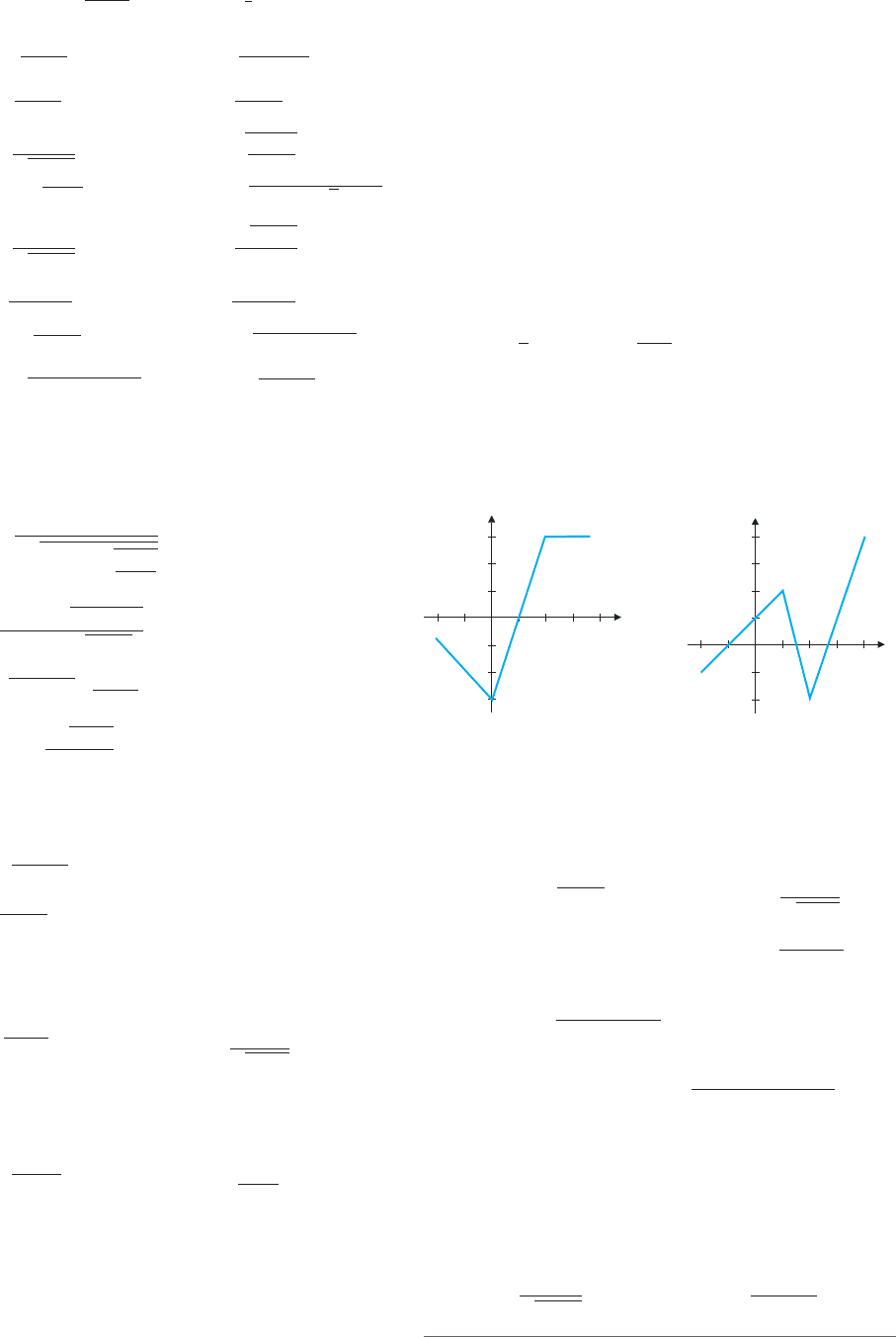
In exercises 35 and 36, use the graphs to find the derivative of
the composite function at the point, if it exists.
y
x
2134
2 1
3
2
1
1
2
3
y f (x)
y
x
2134
2 1
2
1
1
2
3
4
y
g(
x
)
35. f (g(x)) at (a) x = 0, (b) x = 1 and (c) x = 3
36. g( f (x)) at (a) x = 0, (b) x = 1 and (c) x = 3
............................................................
In exercises 37 and 38, find the second derivative of each
function.
37. (a) f (x) =
√
x
2
+ 4 (b) f (t) =
2
√
t
2
+ 4
38. (a) h(t) = (t
3
+ 3)
2
(b) g(s) =
3
(s
2
+ 1)
2
............................................................
39. (a) Determine all values of x such that
f (x) =
3
√
x
3
− 3x
2
+ 2x is not differentiable. Describe
the graphical property that prevents the derivative from
existing.
(b) Repeat part (a) for f (x) =
√
x
4
− 3x
3
+ 3x
2
− x.
40. Which steps in our outline of the proof of the chain rule are
not well documented? Where do we use the assumption that
g
(x) = 0?
............................................................
In exercises 41–44, find a function g such that g
(x) f (x).
41. f (x) = (x
2
+ 3)
2
(2x) 42. f (x) = x
2
(x
3
+ 4)
2/3
43. f (x) =
x
√
x
2
+ 1
44. f (x) =
x
(x
2
+ 1)
2
P1: OSO/OVY P2: OSO/OVY QC: OSO/OVY T1: OSO
MHDQ256-Ch02 MHDQ256-Smith-v1.cls December 8, 2010 18:21
LT (Late Transcendental)
CONFIRMING PAGES
2-41 SECTION 2.6
..
Derivatives of Trigonometric Functions 147
EXPLORATORY EXERCISES
1. Newton’s second law of motion is F = ma, where m is the
mass of the object that undergoes an acceleration a due to an
applied force F. This law is accurate at low speeds. At high
speeds, we use the corresponding formula from Einstein’s
theory of relativity, F = m
d
dt
v(t)
1 − v
2
(t)/c
2
, where v(t)
is the velocity function and c is the speed of light. Compute
d
dt
v(t)
1 − v
2
(t)/c
2
. What has to be “ignored” to simplify
this expression to the acceleration a = v
(t) in Newton’s
second law?
2. Supposethat f isa function such that f (1) = 0 and f
(x) =
1
x
for all x > 0.
(a) If g
1
(x) = f (x
n
) and g
2
(x) = nf(x) for x > 0 show that
g
1
(x) = g
2
(x). Since g
1
(1) = g
2
(1) = 0, can you conclude
that g
1
(x) = g
2
(x) for all x > 0?
(b) For positive, differentiable functions h
1
and h
2
, define
g
3
= f (h
1
h
2
)and g
4
= f (h
1
) + f (h
2
).Showthat g
3
= g
4
.
Can you conclude that g
3
= g
4
?
2.6 DERIVATIVES OF TRIGONOMETRIC FUNCTIONS
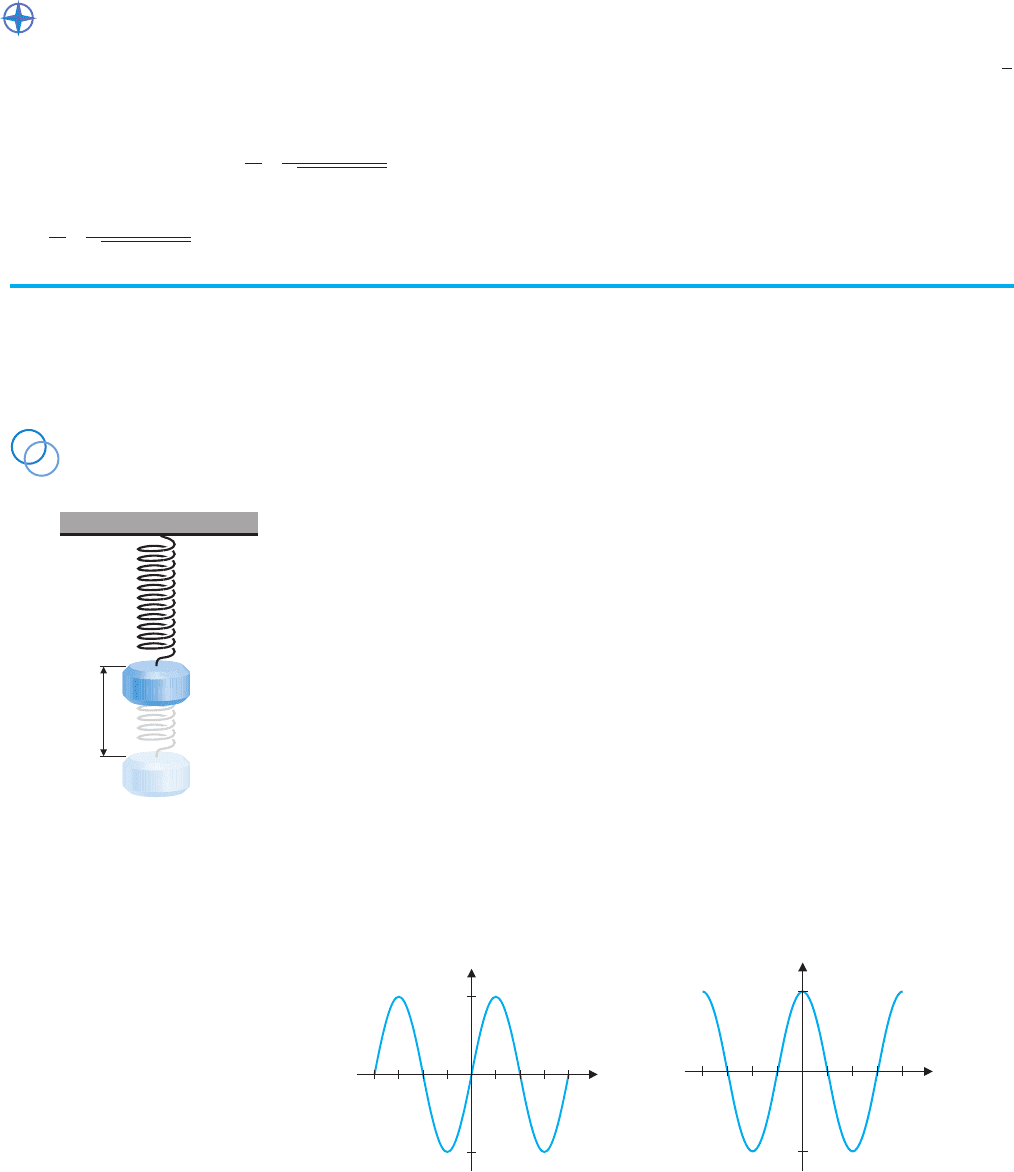
Imagine a weight hanging from a spring suspended from the ceiling. (See Figure 2.24.)
Once set in motion (e.g., by tapping down on it), the weight will bounce up and down in
ever-shortening strokes until it eventually is again at rest (equilibrium).
Displacement
u(t)
Equilibrium
position
FIGURE 2.24
Spring-mass system
If we pull the weight down, its vertical displacement from its equilibrium position is
negative. The weight then swings up to where the displacement is positive, swings down to
a negative displacement and so on. Two functions that exhibit this kind of behavior are the
sine and cosine functions. We calculate the derivatives of these and the other trigonometric
functions in this section.
We can learn a lot about the derivatives of sin x and cos x from their graphs.
From the graph of y = sin x in Figure 2.25, notice the horizontal tangents at
x =−3π/2, −π/2,π/2 and 3π/2. At these x-values, the derivative must equal 0. The tan-
gent lines havepositive slope for −2π<x < −3π/2, negativeslope for −3π/2 < x < −π/2
and so on. For each interval on which the derivative is positive (or negative), the graph ap-
pears to be steepest in the middle of the interval: for example, from x =−π/2, the graph
gets steeper until about x = 0 and then gets less steep until leveling out at x = π/2. A
sketch of the derivative graph should then look like the graph in Figure 2.26, which looks
like the graph of y = cos x. We show here that this conjecture is, in fact, correct.
y
x
1
w
q
q
w
1
y
x
1
1
2p 2ppp
FIGURE 2.25
y = sin x
FIGURE 2.26
The derivative of f (x) = sin x
Before we move to the calculation of the derivatives of the six trigonometric functions,
we first consider a few limits involvingtrigonometric functions. (We refer to these results as
lemmas—minor theorems that lead up to some more significant result.) You will see shortly
why we must consider these first.
P1: OSO/OVY P2: OSO/OVY QC: OSO/OVY T1: OSO
MHDQ256-Ch02 MHDQ256-Smith-v1.cls December 8, 2010 18:21
LT (Late Transcendental)
CONFIRMING PAGES
148 CHAPTER 2
..
Differentiation 2-42
LEMMA 6.1
lim
θ→0
sinθ = 0.
This result certainly seems reasonable, especially when we consider the graph of
y = sin x. In fact, we have been using this for some time now, having stated this (with-
out proof) as part of Theorem 3.4 in section 1.3. We now prove the result.
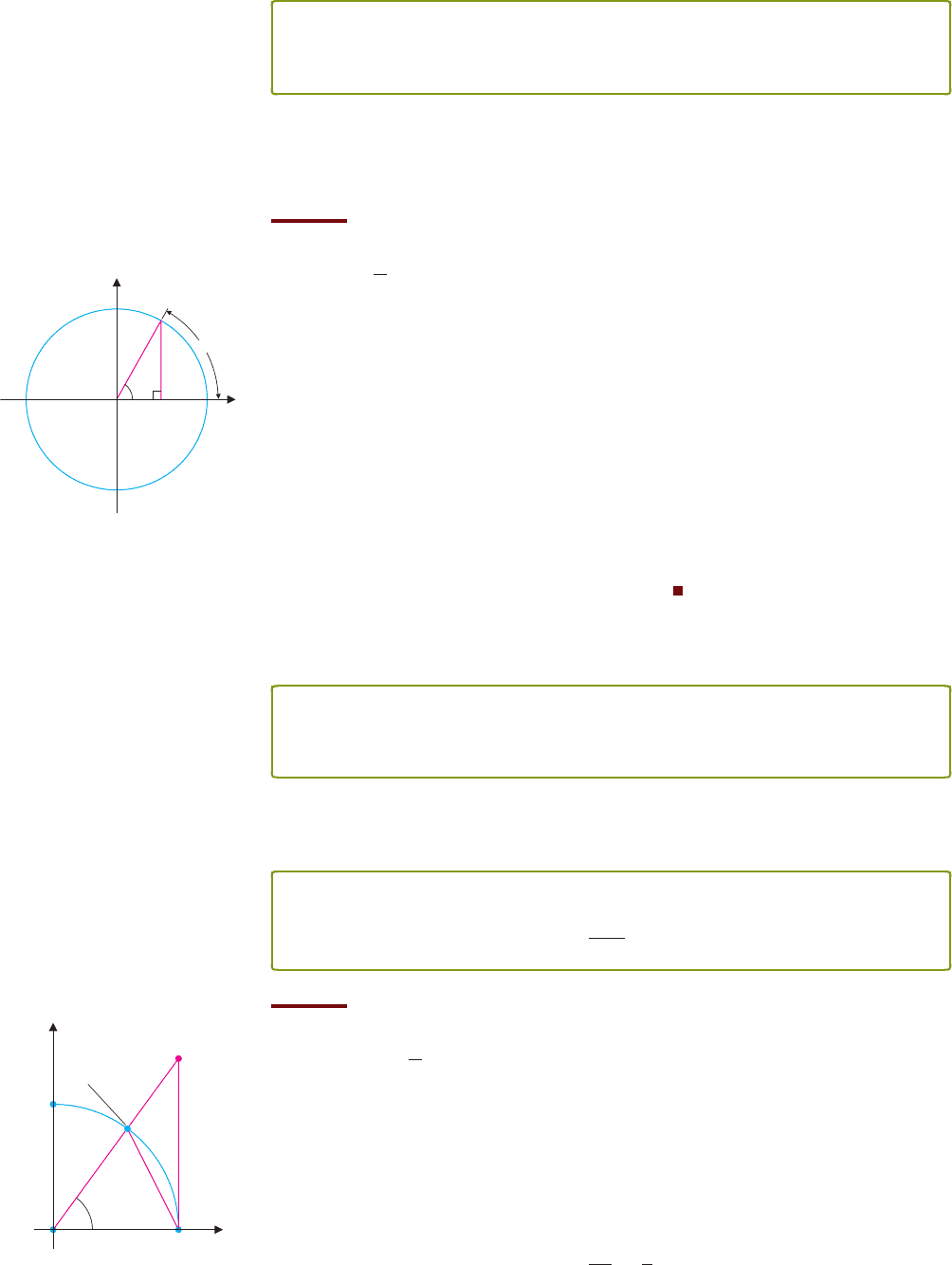
y
x
u
u
sin u
1
FIGURE 2.27
Definition of sinθ
PROOF
For 0 <θ<
π
2
, from Figure 2.27, observe that
0 ≤ sinθ ≤ θ. (6.1)
Since
lim
θ→0
+
0 = 0 = lim
θ→0
+
θ, (6.2)
it follows from the Squeeze Theorem (see section 1.3), and from (6.1) and (6.2) that
lim
θ→0
+
sinθ = 0.
We leave it as an exercise to show that
lim
θ→0
−
sinθ = 0.
Since both one-sided limits are the same, it follows that
lim
θ→0
sinθ = 0.
We leave it as an exercise to show that the following result follows from Lemma 6.1 and
the Pythagorean Theorem.
LEMMA 6.2
lim
θ→0
cosθ = 1.
The following result was conjectured to be true (based on a graph and some computa-
tions) when we first examined limits in section 1.2. We can now prove the result.
LEMMA 6.3
lim
θ→0
sinθ
θ
= 1.
y
x
(0, 1)
R(1, 0)
Q(1, tan u)
P(cos u, sin u)
u
O
FIGURE 2.28
PROOF
Assume 0 <θ<
π
2
.
Referring to Figure 2.28, observe that the area of the circular sector OPR is larger than
the area of the triangle OPR, but smaller than the area of the triangle OQR. That is,
0 < Area OPR < Area sector OPR < Area OQR. (6.3)
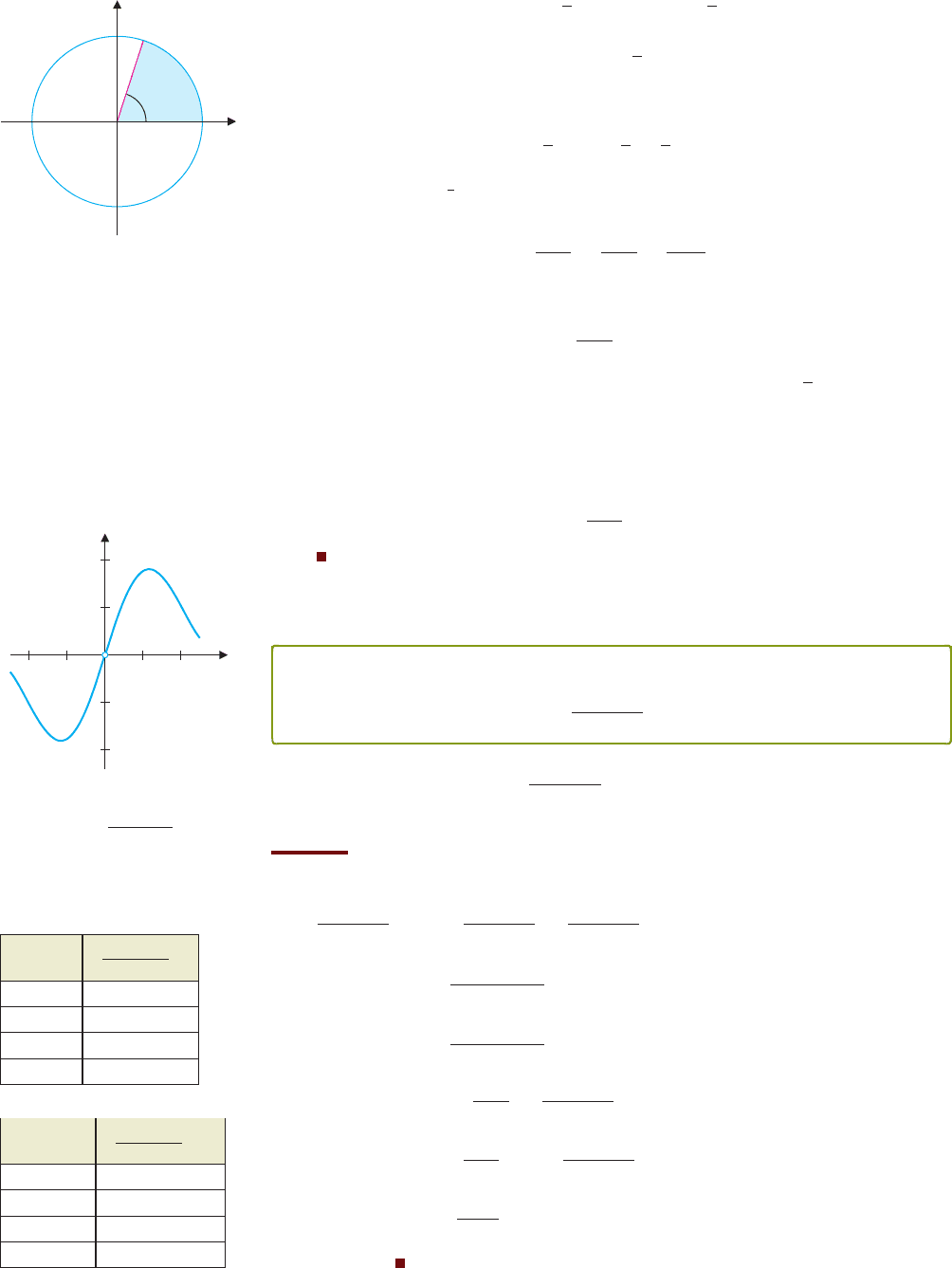
You can see from Figure 2.29 that
Area sector OPR = π(radius)
2
(fraction of circle included)
= π (1
2
)
θ
2π
=
θ
2
. (6.4)
P1: OSO/OVY P2: OSO/OVY QC: OSO/OVY T1: OSO
MHDQ256-Ch02 MHDQ256-Smith-v1.cls December 8, 2010 18:21
LT (Late Transcendental)
CONFIRMING PAGES
2-43 SECTION 2.6
..
Derivatives of Trigonometric Functions 149
Also,
Area OPR =
1
2
(base)(height) =
1
2
(1)sin θ (6.5)
and
Area OQR =
1
2
(1)tan θ. (6.6)
Thus, from (6.3), (6.4), (6.5) and (6.6), we have
0 <
1
2
sinθ<
θ
2
<
1
2
tanθ. (6.7)
If we divide (6.7) by
1
2
sinθ (note that this is positive, so that the inequalities are not
affected), we get
1 <
θ
sinθ
<
tanθ
sinθ
=
1
cosθ
.
Taking reciprocals (again, everything here is positive), we find
1 >
sinθ
θ
> cosθ. (6.8)
We leave it as an exercise to show that inequality (6.8) also holds if −
π
2
<θ<0. Finally,
note that
lim
θ→0
cosθ = 1 = lim
θ→0
1.
Thus, it follows from (6.8) and the Squeeze Theorem that
lim
θ→0
sinθ
θ
= 1
also.
Weneed oneadditional limit result before wetacklethe derivativesof the trigonometric
functions.
LEMMA 6.4
lim
θ→0
1 − cosθ
θ
= 0.
y
x
1
u
FIGURE 2.29
A circular sector
y
x
0.8
0.4
0.8
424 2
FIGURE 2.30
y =
1 − cos x
x
Referringto the graph of y =
1 − cos x
x
inFigure 2.30 and the tablesof function values
that follow, the result should seem reasonable.
x
1 − cos x
x
0.1 0.04996
0.01 0.00499996
0.001 0.0005
0.0001 0.00005
x
1 − cos x
x
−0.1 −0.04996
−0.01 −0.00499996
−0.001 −0.0005
−0.0001 −0.00005
PROOF
lim
θ→0
1 − cosθ
θ
= lim
θ→0
1 − cosθ
θ
1 + cosθ
1 + cosθ
Multiply numerator and denominator by 1 +cos θ .
= lim
θ→0
1 − cos
2
θ
θ(1 + cos θ )
Multiply out numerator and denominator.
= lim
θ→0
sin
2
θ
θ(1 + cos θ )
Since sin
2
θ +cos
2
θ = 1.
= lim
θ→0
sinθ
θ
sinθ
1 + cosθ
=
lim
θ→0
sinθ
θ
lim
θ→0
sinθ
1 + cosθ
Split up terms, since both limits exist.
= (1)
0
1 + 1
= 0,
as conjectured.

P1: OSO/OVY P2: OSO/OVY QC: OSO/OVY T1: OSO
MHDQ256-Ch02 MHDQ256-Smith-v1.cls December 8, 2010 18:21
LT (Late Transcendental)
CONFIRMING PAGES
150 CHAPTER 2
..
Differentiation 2-44
We are finally in a position to compute the derivatives of the sine and cosine functions.
THEOREM 6.1
d
dx
sin x = cos x.
PROOF
From the limit definition of derivative, for f (x) = sin x,wehave
d
dx
sin x = f
(x) = lim
h→0
sin(x + h) − sin(x)
h
= lim
h→0
sin x cosh + sinh cosx −sin x
h
Trig identity: sin(α + β) =
sinα cosβ +sinβ cos α.
= lim
h→0
sin x cosh − sinx
h
+ lim
h→0
sinh cos x
h
Grouping terms with sin x and terms
with sinh separately.
= (sin x) lim
h→0
cosh − 1
h
+ (cos x) lim
h→0
sinh
h
Factoring sinx from the first term
and cos x from the second term.
= (sin x)(0) + (cos x)(1) = cos x,
from Lemmas 6.3 and 6.4.
The proof of the following result is left as an exercise.
THEOREM 6.2
d
dx
cos x =−sin x.
The derivatives of the remaining four trigonometric functions follow from the quotient
rule.
THEOREM 6.3
d
dx
tan x = sec
2
x.
PROOF
By the quotient rule,
d
dx
tan x =
d
dx
sin x
cos x
=
d
dx
(sin x)
(cos x) − (sin x)
d
dx
(cos x)
(cos x)
2
=
cos x(cos x) − sin x(−sinx)
(cos x)
2
=
cos
2
x +sin
2
x
(cos x)
2
=
1
(cos x)
2
= sec
2
x.

P1: OSO/OVY P2: OSO/OVY QC: OSO/OVY T1: OSO
MHDQ256-Ch02 MHDQ256-Smith-v1.cls December 8, 2010 18:21
LT (Late Transcendental)
CONFIRMING PAGES
2-45 SECTION 2.6
..
Derivatives of Trigonometric Functions 151
The derivatives of the remaining trigonometric functions are left as exercises. The
derivatives of all six trigonometric functions are summarized below.
d
dx
sin x = cos x
d
dx
cos x =−sin x
d
dx
tan x = sec
2
x
d
dx
cot x =−csc
2
x
d
dx
sec x = sec x tan x
d
dx
csc x =−csc x cot x
Example 6.1 shows where the product rule is necessary.
EXAMPLE 6.1 A Derivative That Requires the Product Rule
Find the derivative of f (x) = x
5
cos x.
Solution From the product rule, we have
d
dx
(x
5
cos x) =
d
dx
(x
5
)
cos x + x
5
d
dx
(cos x)
= 5x
4
cos x − x
5
sin x.
EXAMPLE 6.2 Computing Some Routine Derivatives
Compute the derivatives of (a) f (x) = sin
2
x and (b) g(x) = 4tan x −5csc x.
Solution For (a), we first rewrite the function as f (x) = (sin x)
2
and use the chain
rule. We have
f
(x) = (2sin x)
d
dx
(sin x)
derivative of the inside
= 2sin x cos x.
For (b), we have
g
(x) = 4sec
2
x +5csc x cot x.
You must be very careful to distinguish between similar notations with very different
meanings, as we illustrate in example 6.3.
EXAMPLE 6.3 The Derivatives of Some Similar
Trigonometric Functions
Compute the derivative of (a) f (x) = cos x
3
, (b) g(x) = cos
3
x and (c) h(x) = cos3x.
Solution Note the differences in these three functions. Using the implied parentheses
we normally do not bother to include, we have f (x) = cos (x
3
), g(x) = (cos x)
3
and
h(x) = cos(3x). For (a), we have
f
(x) =
d
dx
cos(x
3
) =−sin(x
3
)
d
dx
(x
3
)
derivative of the inside
=−sin(x
3
)(3x
2
) =−3x
2
sin x
3
.
P1: OSO/OVY P2: OSO/OVY QC: OSO/OVY T1: OSO
MHDQ256-Ch02 MHDQ256-Smith-v1.cls December 8, 2010 18:21
LT (Late Transcendental)
CONFIRMING PAGES
152 CHAPTER 2
..
Differentiation 2-46
Next, for (b) we have
g
(x) =
d
dx
(cos x)
3
= 3(cos x)
2
d
dx
(cos x)
derivative of the inside
= 3(cos x)
2
(−sin x) =−3 sin x cos
2
x.
Finally, for (c) we have
h
(x) =
d
dx
(cos3x) =−sin(3x)
d
dx
(3x)
derivative of the inside
=−sin(3x)(3) =−3 sin3x.
By combining our trigonometric rules with the product, quotient and chain rules, we
can now differentiate many complicated functions.
EXAMPLE 6.4 A Derivative Involving the Chain Rule
and the Quotient Rule
Find the derivative of f (x) = sin
2x
x +1
.
Solution We have
f
(x) = cos
2x
x +1
d
dx
2x
x +1
derivative of the inside
By the chain rule.
= cos
2x
x +1
2(x + 1) − 2x(1)
(x + 1)
2
By the quotient rule.
= cos
2x
x +1
2
(x + 1)
2
.
EXAMPLE 6.5 Finding an Equation of a Tangent Line
Find an equation of the tangent line to
y = 3tan x − 2 csc x
at x =
π
3
.
Solution The derivative is
y
= 3sec
2
x −2(−csc x cot x) = 3sec
2
x +2csc x cot x.
At x =
π
3
,wehave
y
π
3
= 3(2)
2
+ 2
2
√
3
1
√
3
= 12 +
4
3
=
40
3
.
The tangent line with slope
40
3
and point of tangency
π
3
, 3
√
3 −
4
√
3
has equation
y =
40
3
x −
π
3
+ 3
√
3 −
4
√
3
.
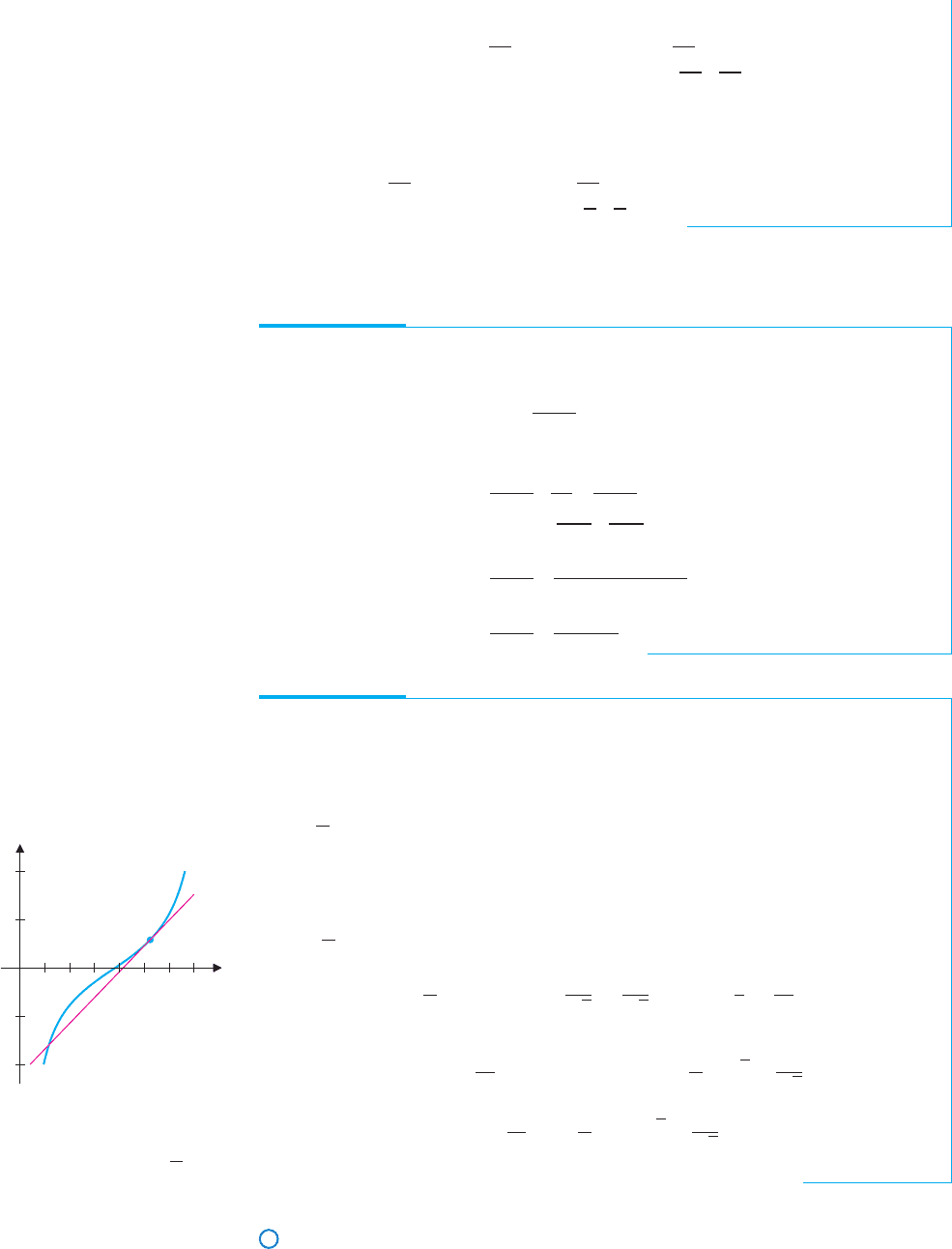
We show a graph of the function and the tangent line in Figure 2.31.
y
x
5
10
5
10
0.4 1.20.8
FIGURE 2.31
y = 3 tan x − 2 csc x and the
tangent line at x =
π
3
Applications
The trigonometric functions arise quite naturally in the solution of numerous physical
problems of interest. For instance, it can be shown that the vertical displacement of a mass