
Smith R., Minton R. Calculus
Подождите немного. Документ загружается.

P1: OSO/OVY P2: OSO/OVY QC: OSO/OVY T1: OSO
MHDQ256-Ch08 MHDQ256-Smith-v1.cls December 16, 2010 21:19
LT (Late Transcendental)
CONFIRMING PAGES
8-23 SECTION 8.3
..
Direction Fields and Euler’s Method 513
2
31
1
2
3
123
t
P
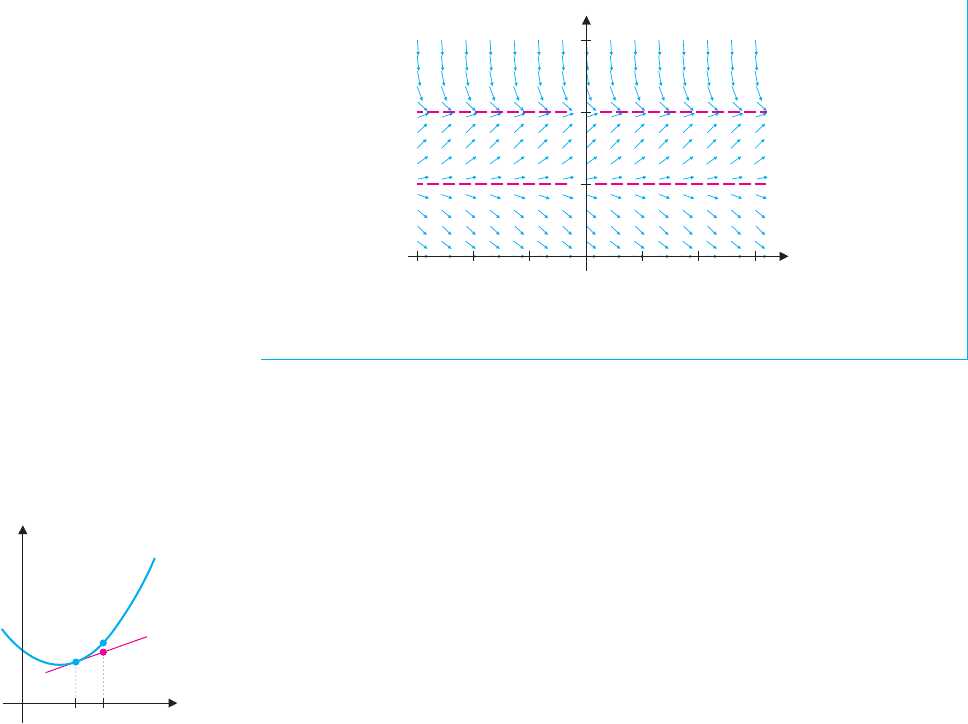
FIGURE 8.13
Direction field for P
(t) =−2[1 − P(t)][2 − P(t)]P(t)
In cases where you are interested in finding a specific solution, the numerous arrows
of a direction field can be distracting. Euler’s method, developed below, enables you to
approximate a single solution curve. The method is quite simple, based essentially on the
idea of a direction field. Although Euler’s method does not provide particularly accurate
approximations, related and more accurate methods will be explored in the exercises.
x
0
x
1
y
x
y y(x)
(x
1
, y(x
1
))
(x
1
, y
1
)
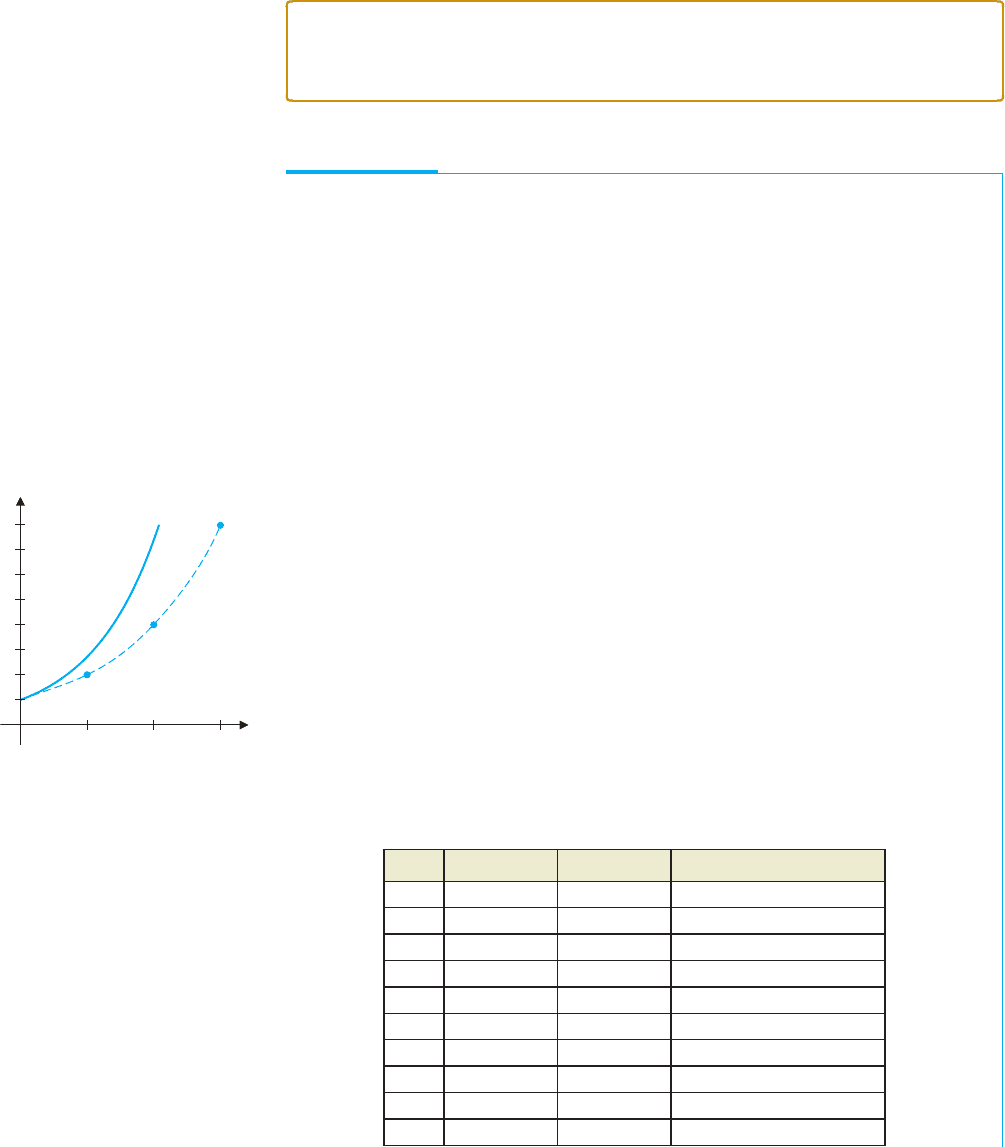
FIGURE 8.14
Tangent line approximation
Consider the IVP
y
= f (x, y), y(x
0
) = y
0
.
Once again, we must emphasize that, assuming there is a solution y = y(x), the differential
equation tells us that the slope of the tangent line to the solution curve at any point (x, y)is
given by f (x, y). Remember that the tangent line to a curve stays close to that curve near
the point of tangency. Notice that we already know one point on the graph of y = y(x),
namely, the initial point (x
0
, y
0
). Referring to Figure 8.14, if we would like to approximate
the value of the solution at x = x
1
[i.e., y(x
1
)] and if x
1
is not too far from x
0
, then
we could follow the tangent line at (x
0
, y
0
) to the point corresponding to x = x
1
and use
the y-value at that point (call it y
1
) as an approximation to y(x
1
). This is virtually the same
thinking we employed when we devised Newton’s method and differential (tangent line)
approximations in Chapter 3. The equation of the tangent line at x = x
0
is
y = y
0
+ y
(x
0
)(x − x
0
).
Thus, an approximation to the value of the solution at x = x
1
is the y-coordinate of the
point on the tangent line corresponding to x = x
1
, that is,
y(x
1
) ≈ y
1
= y
0
+ y
(x
0
)(x
1
− x
0
). (3.3)
YouhaveonlytoglanceatFigure8.14torealizethatthisapproximationisvalidonlywhen x
1
is close to x
0
. In solving an IVP, though, we are usually interested in finding the value of the
solution on an interval [a, b] of the x-axis. With Euler’s method, we settle for finding an ap-
proximatesolutionatasequenceofpointsintheinterval[a, b].First,wepartitiontheinterval
[a, b] into n equal-sized pieces (a regular partition; where did you see this notion before?):
a = x
0
< x
1
< x
2
< ···< x
n
= b,
where
x
i+1
− x
i
= h,
for all i = 0, 1,...,n − 1. We call h the step size. From the tangent line approximation
(3.3), we already have
y(x
1
) ≈ y
1
= y
0
+ y
(x
0
)(x
1
− x
0
)
= y
0
+ hf(x
0
, y
0
),
where we have replaced (x
1
− x
0
) by the step size, h, and used the differential equation to
write y
(x
0
) = f (x
0
, y
0
). To approximate the value of y(x
2
), we could use the tangent line
at the point (x
1
, y(x
1
)) to produce a tangent line approximation.
y(x
2
) ≈ y(x
1
) + y
(x
1
)(x
2
− x
1
)
= y(x
1
) + hf(x
1
, y(x
1
)),
P1: OSO/OVY P2: OSO/OVY QC: OSO/OVY T1: OSO
MHDQ256-Ch08 MHDQ256-Smith-v1.cls December 16, 2010 21:19
LT (Late Transcendental)
CONFIRMING PAGES
514 CHAPTER 8
..
First-Order Differential Equations 8-24
where we have used the differential equation to replace y
(x
1
)by f (x
1
, y(x
1
)) and used the
fact that x
2
− x
1
= h. This is not usable, though, since we do not know the value of y(x
1
).
However, we can approximate y(x
1
) by the approximation obtained in the previous step,
y
1
, to obtain
y(x
2
) ≈ y(x
1
) + hf(x
1
, y(x
1
))
≈ y
1
+ hf(x
1
, y
1
) = y
2
.
Continuing in this way, we obtain the sequence of approximate values
EULER’S METHOD
y(x
i+1
) ≈ y
i+1
= y
i
+ hf(x
i
, y
i
), for i = 0, 1, 2.... (3.4)
This tangent line method of approximation is called Euler’s method.
EXAMPLE 3.4 Using Euler’s Method
Use Euler’s method to approximate the solution of the IVP
y
= y, y(0) = 1.
Solution You can probably solve this equation by inspection, but if not, notice that
it’s separable and that the solution of the IVP is y = y(x) = e
x
. We will use this exact
solution to evaluate the performance of Euler’s method. From (3.4) with f (x, y) = y
and taking h = 1, we have
y(x
1
) ≈ y
1
= y
0
+ hf(x
0
, y
0
)
= y
0
+ hy
0
= 1 + 1(1) = 2.
Likewise, for further approximations, we have
y(x
2
) ≈ y
2
= y
1
+ hf(x
1
, y
1
)
= y
1
+ hy
1
= 2 + 1(2) = 4,
y(x
3
) ≈ y
3
= y
2
+ hf(x
2
, y
2
)
= y
2
+ hy
2
= 4 +1(4) = 8
and so on. In this way, we construct a sequence of approximate values of the solution
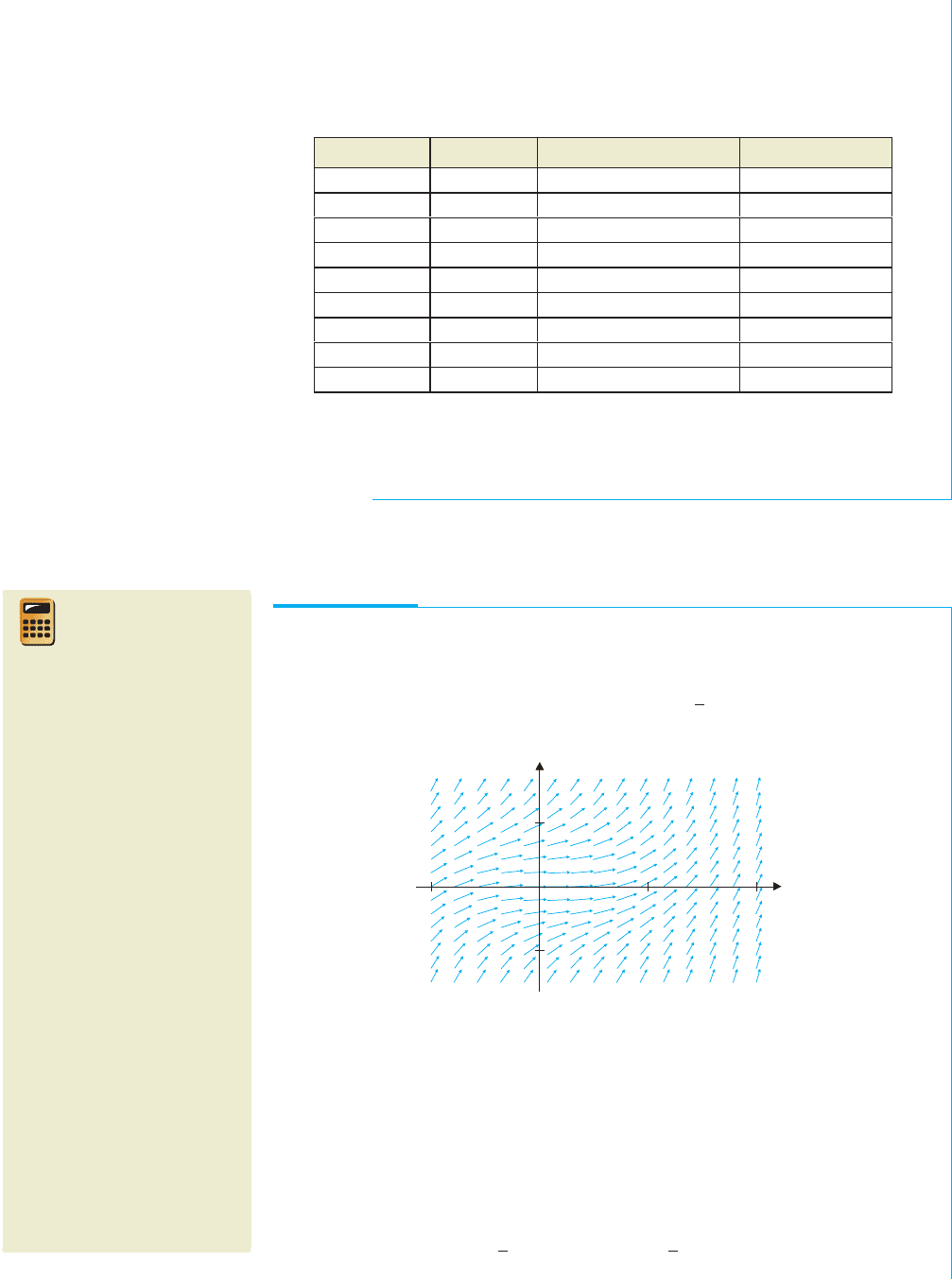
function. In Figure 8.15, we have plotted the exact solution (solid curve) against the
approximate solution obtained from Euler’s method (dashed curve). Notice how the
error grows as x gets farther and farther from the initial point. This is characteristic of
Euler’s method (and other similar methods). This growth in error becomes even more
apparent if we look at a table of values of the approximate and exact solutions together.
We display these in the table that follows, where we have used h = 0.1 (values are
displayed to seven digits).
y
x
1
2
3
4
5
6
7
8
123
FIGURE 8.15
Exact solution versus the
approximate solution (dashed line)
x Euler Exact Error Exact − Euler
0.1 1.1 1.1051709 0.0051709
0.2 1.21 1.2214028 0.0114028
0.3 1.331 1.3498588 0.0188588
0.4 1.4641 1.4918247 0.0277247
0.5 1.61051 1.6487213 0.0382113
0.6 1.771561 1.8221188 0.0505578
0.7 1.9487171 2.0137527 0.0650356
0.8 2.1435888 2.2255409 0.0819521
0.9 2.3579477 2.4596031 0.1016554
1.0 2.5937425 2.7182818 0.1245393
P1: OSO/OVY P2: OSO/OVY QC: OSO/OVY T1: OSO
MHDQ256-Ch08 MHDQ256-Smith-v1.cls December 16, 2010 21:19
LT (Late Transcendental)
CONFIRMING PAGES
8-25 SECTION 8.3
..
Direction Fields and Euler’s Method 515
As you might expect from our development of Euler’s method, the smaller we make h,
the more accurate the approximation at a given point tends to be. As well, the smaller
the value of h, the more steps it takes to reach a given value of x. In the following table,
we display the Euler’s method approximation, the error and the number of steps needed
to reach x = 1.0. Here, the exact value of the solution is y = e
1
≈ 2.718281828459.
h Euler Error Exact − Euler Number of Steps
1.0 2 0.7182818 1
0.5 2.25 0.4682818 2
0.25 2.4414063 0.2768756 4
0.125 2.5657845 0.1524973 8
0.0625 2.6379285 0.0803533 16
0.03125 2.6769901 0.0412917 32
0.015625 2.697345 0.0209369 64
0.0078125 2.707739 0.0105428 128
0.00390625 2.7129916 0.0052902 256
From the table, observe that each time the step size h is cut in half, the error is also cut
roughly in half. This increased accuracy though, comes at the cost of the additional
steps of Euler’s methods required to reach a given point (doubled each time h
is halved).
Thepointofhavinganumericalmethod,ofcourse,istofindmeaningfulapproximations
to the solution of problems that we do not know how to solve exactly. Example 3.5 is of
this type.
TODAY IN
MATHEMATICS
Kay McNulty (1921– )
An Irish mathematician who
became one of the first computer
software designers. In World
War II, before computers, she
approximated solutions of
projectile differential equations.
McNulty says, “We did have desk
calculators at that time,
mechanical and driven with
electric motors, that could do
simple arithmetic. You’d do a
multiplication and when the
answer appeared, you had to
write it down to reenter it into
the machine to do the next
calculation. We were preparing a
firing table for each gun, with
maybe 1800 simple trajectories.
To hand-compute just one of
these trajectories took 30 or 40
hours of sitting at a desk with
paper and a calculator. . . .
Actually, my title working for
the ballistics project was
‘computer’. . . . ENIAC made me,
one of the first ‘computers,’
obsolete.’’
EXAMPLE 3.5 Finding an Approximate Solution
Find an approximate solution of the IVP
y
= x
2
+ y
2
, y(−1) =−
1
2
.
112
1
1
x
y
FIGURE 8.16
Direction field for y
= x
2
+ y
2
Solution First let’s take a look at the direction field, so that we can see how solutions
to this differential equation should behave. (See Figure 8.16.) Using Euler’s method
with h = 0.1, we get
y(x
1
) ≈ y
1
= y
0
+ hf(x
0
, y
0
)
= y
0
+ h
x
2
0
+ y
2
0
=−
1
2
+ 0.1
(−1)
2
+
−
1
2
2
=−0.375
P1: OSO/OVY P2: OSO/OVY QC: OSO/OVY T1: OSO
MHDQ256-Ch08 MHDQ256-Smith-v1.cls December 16, 2010 21:19
LT (Late Transcendental)
CONFIRMING PAGES
516 CHAPTER 8
..
First-Order Differential Equations 8-26
and
y(x
2
) ≈ y
2
= y
1
+ hf(x
1
, y
1
)
= y
1
+ h
x
2
1
+ y
2
1
=−0.375 +0.1[(−0.9)
2
+ (−0.375)
2
] =−0.2799375
and so on. Continuing in this way, we generate the table of values that follows.
x Euler x Euler x Euler
−0.9 −0.375 0.1 −0.0575822 1.1 0.3369751
−0.8 −0.2799375 0.2 −0.0562506 1.2 0.4693303
−0.7 −0.208101 0.3 −0.0519342 1.3 0.6353574
−0.6 −0.1547704 0.4 −0.0426645 1.4 0.8447253
−0.5 −0.116375 0.5 −0.0264825 1.5 1.1120813
−0.4 −0.0900207 0.6 −0.0014123 1.6 1.4607538
−0.3 −0.0732103 0.7 0.0345879 1.7 1.9301340
−0.2 −0.0636743 0.8 0.0837075 1.8 2.5916757
−0.1 −0.0592689 0.9 0.1484082 1.9 3.587354
0.0 −0.0579176 1.0 0.2316107 2.0 5.235265
0.5 1.0 1.5 2.0
x
1.0
0.5
1.0
1.5
y
0.5
1.0
1.5
0.5 1.0 1.5 2.0
x
1.0
0.5
1.0
1.5
y
0.5
1.0
1.5
FIGURE 8.17a
Approximate solution of y
= x
2
+ y
2
,
passing through (−1, −
1
2
)
FIGURE 8.17b
Approximate solution superimposed
on the direction field
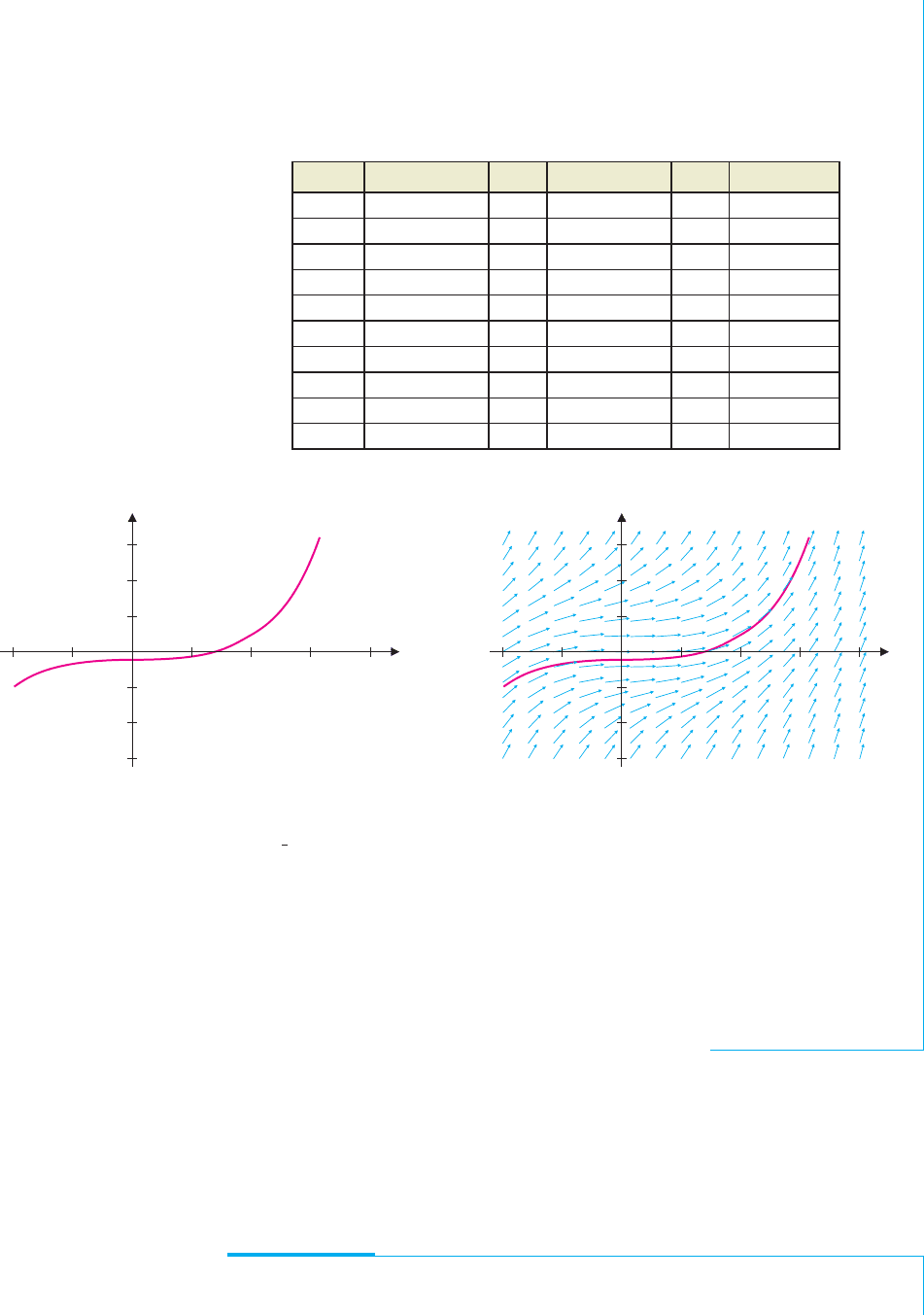
In Figure 8.17a, we display a smooth curve connecting the data points in the preceding
table. Take particular note of how well this corresponds with the direction field in
Figure 8.16. To make this correspondence more apparent, we show a graph of the
approximate solution superimposed on the direction field in Figure 8.17b. Since this
corresponds so well with the behavior you expect from the direction field, you should
expect that there are no gross errors in this approximate solution. (Certainly, there is
always some level of round-off and other numerical errors.)
We can expand on the concept of equilibrium solution, which we introduced briefly in
example 3.3. More generally, we say that the constant function y = c is an equilibrium
solution of the differential equation y
= f (t, y)if f (t, c) = 0 for all t. In simple terms,
this says that y = c isan equilibrium solution of the differentialequation y
= f (t, y) if the
substitution y = c reduces the equation to simply y
= 0. Observe that this, in turn, says
that y(t) = c is a (constant) solution of the differential equation. In example 3.6, notice that
finding equilibrium solutions requires only basic algebra.
EXAMPLE 3.6 Finding Equilibrium Solutions
Find all equilibrium solutions of (a) y
(t) = k[y(t) − 70] and (b) y
(t) = 2y(t)[4 − y(t)].
P1: OSO/OVY P2: OSO/OVY QC: OSO/OVY T1: OSO
MHDQ256-Ch08 MHDQ256-Smith-v1.cls December 16, 2010 21:19
LT (Late Transcendental)
CONFIRMING PAGES
8-27 SECTION 8.3
..
Direction Fields and Euler’s Method 517
0
2
2
4
4
40
80
120
x
y
FIGURE 8.18a
Direction field
0
2
2
4
4
40
80
120
x
y
FIGURE 8.18b
Solution curve starting above
y = 70
0
2
2
4
4
20
40
60
80
100
120
140
x
y
FIGURE 8.18c
Solution curve starting below
y = 70
6
4
2
2
2.520.5 1
y
x
1.5 3
FIGURE 8.19
Direction field for y
= 2y(4 − y)
Solution An equilibrium solution is a constant solution that reduces the equation to
y
(t) = 0. For part (a), this gives us
0 = y
(t) = k[y(t) − 70] or 0 = y(t) −70.
The only equilibrium solution is then y = 70. For part (b), we want
0 = 2y(t)[4 − y(t)] or 0 = y(t)[4 − y(t)].
So, in this case, there are two equilibrium solutions: y = 0 and y = 4.
There is some special significance to an equilibrium solution, which we describe from
a sketch of the direction field. Start with the differential equation y
(t) = k[y(t) − 70] for
some negative constant k. Notice that if y(t) > 70, then y
(t) = k[y(t) − 70] < 0 (since
k is negative). Of course, y
(t) < 0 means that the solution is decreasing. Similarly, when
y(t) < 70, wehave that y
(t) = k[y(t) − 70] > 0, sothatthesolutionis increasing. Observe
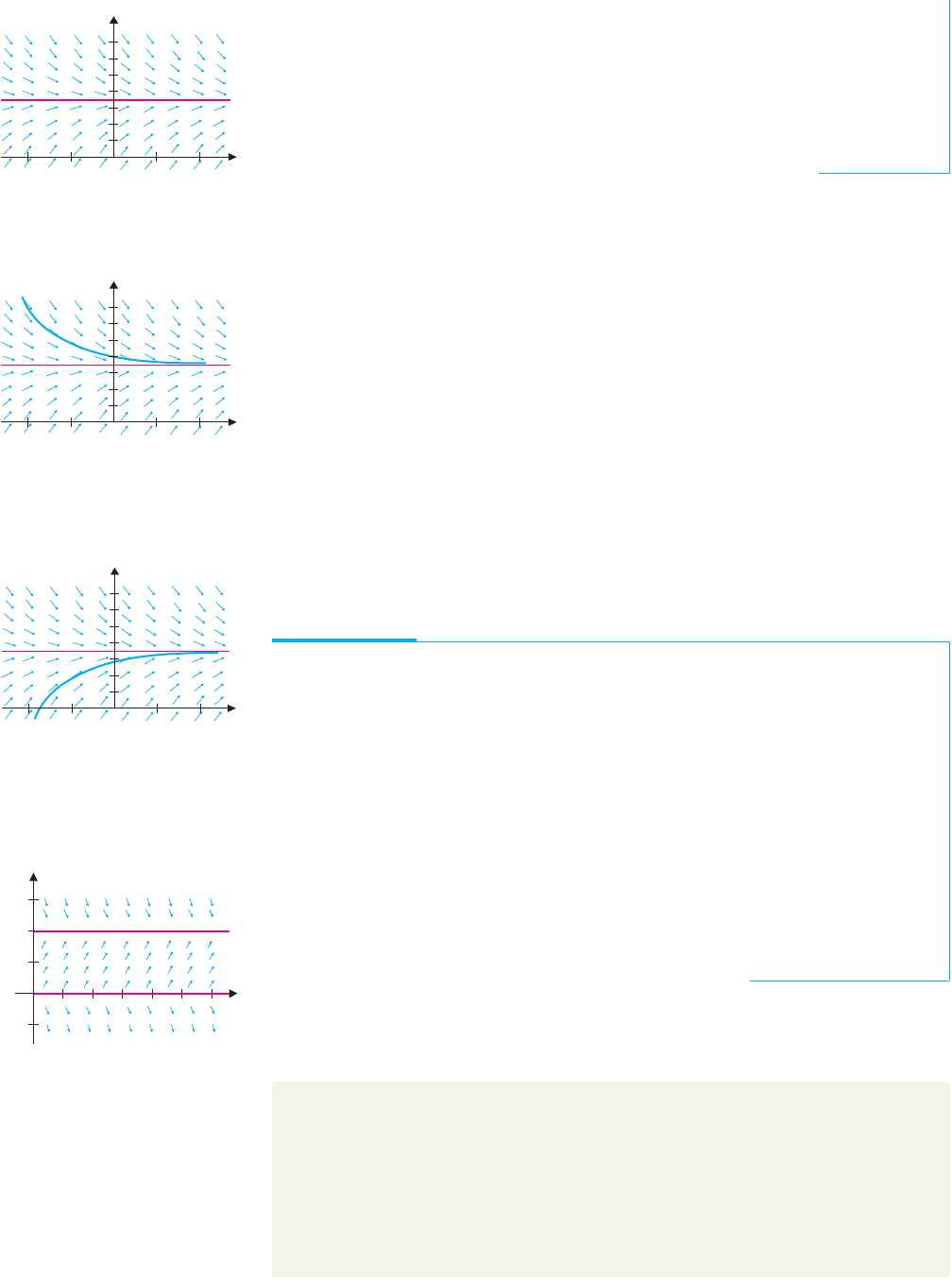
that the direction field sketched in Figure 8.18a suggests that y(t) → 70 as t →∞, since
all arrows point toward the line y = 70. More precisely, if a solution curve lies slightly
above the line y = 70, notice that the solution decreases, toward y = 70, as indicated in
Figure 8.18b. Similarly, if the solution curve lies slightly below y = 70, then the solution
increases toward y = 70, as shown in Figure 8.18c. You should observe that we obtained
this information without solving the differential equation.
We say that an equilibrium solution is stable if solutions close to the equilibrium
solutiontendtoapproach that solution as t →∞. Observethat thisisthebehaviorindicated
in Figures 8.18a to 8.18c, so that the solution y = 70 is a stable equilibrium. Alternatively,
an equilibrium solution is unstable if solutions close to the equilibrium solution tend to get
further away from that solution as t →∞.
In example 3.6, part (b), we found that y
(t) = 2y(t)[4 − y(t)] has the two equilibrium
solutions y = 0and y = 4.Wenowuseadirectionfieldtodeterminewhetherthesesolutions
are stable or unstable.
EXAMPLE 3.7 Determining the Stability of Equilibrium Solutions
Draw a direction field for y
(t) = 2y(t)[4 − y(t)] and determine the stability of all
equilibrium solutions.
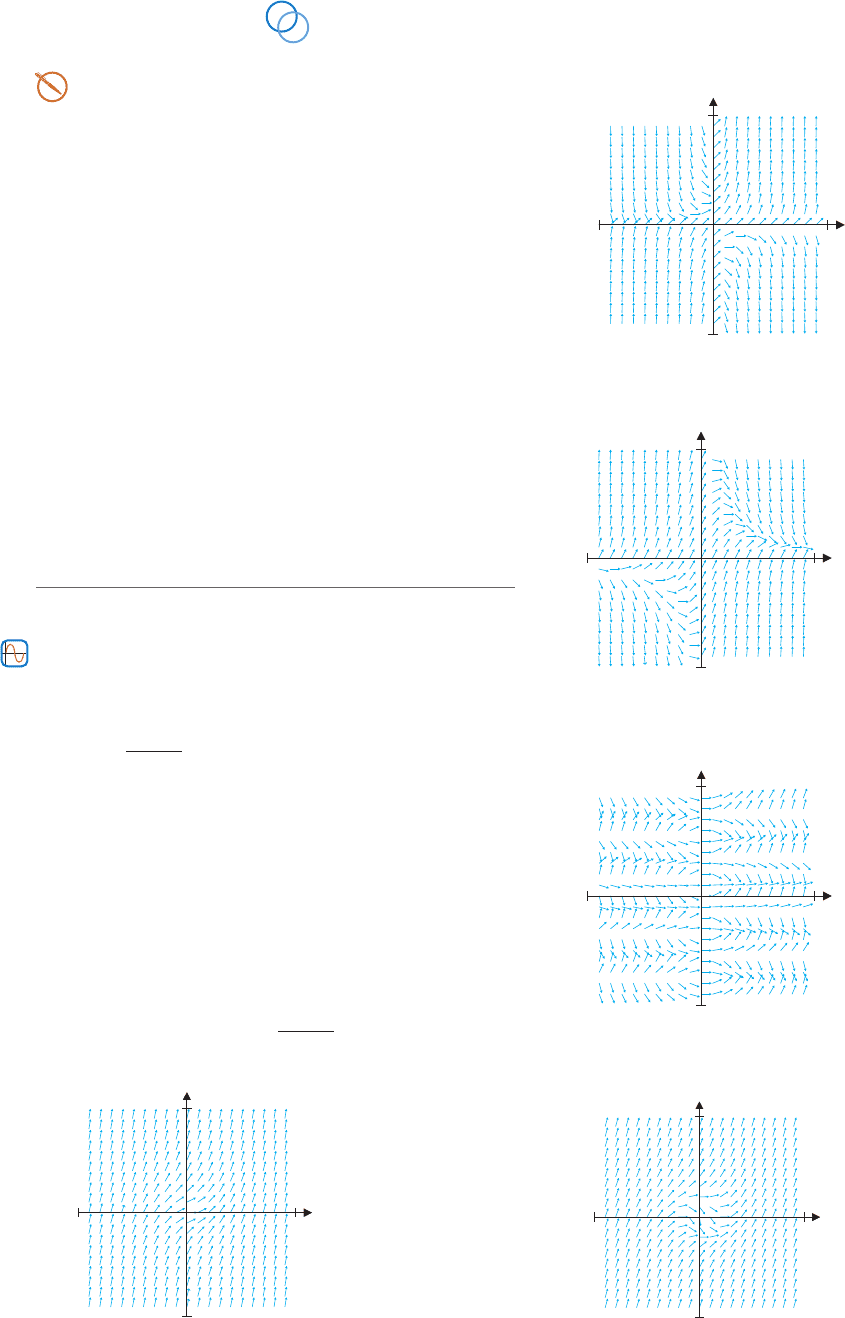
Solution We determined in example 3.6 that the equilibrium solutions are y = 0 and
y = 4. We superimpose the horizontal lines y = 0 and y = 4 on the direction field in
Figure 8.19.
Observe that the behavior is distinctly different in each of three regions in this
diagram: y > 4, 0 < y < 4 and y < 0. We analyze each separately. First, observe that if
y(t) > 4, then y
(t) = 2y(t)[4 − y(t)] < 0 (since 2y is positive, but 4 − y is negative).
Next, if 0 < y(t) < 4, then y
(t) = 2y(t)[4 − y(t)] > 0 (since 2y and 4 − y are both
positive in this case). Finally, if y(t) < 0, then y
(t) = 2y(t)[4 − y(t)] < 0. In
Figure 8.19, the arrows on either side of the line y = 4 all point toward y = 4. This
indicates that y = 4 is stable. By contrast, the arrows on either side of y = 0 point away
from y = 0, indicating that y = 0 is an unstable equilibrium.
Noticethatthedirectionfieldinexample3.7givesstrongevidencethatif y(0) > 0, then
thelimiting valueis lim
t→∞
y(t) = 4.[Thinkaboutwhy the condition y(0) > 0is needed here.]
BEYOND FORMULAS
Numerical approximations of solutions of differential equations are basic tools of the
trade for modern engineers and scientists. Euler’s method, presented in this section, is
one of the least accurate methods in use today, but its simplicity makes it useful in a
variety of applications. Since most differential equations cannot be solved exactly, we
need reliable numerical methods to obtain approximate values of the solution. What
other types of calculations have you seen that typically must be approximated?
P1: OSO/OVY P2: OSO/OVY QC: OSO/OVY T1: OSO
MHDQ256-Ch08 MHDQ256-Smith-v1.cls December 16, 2010 21:19
LT (Late Transcendental)
CONFIRMING PAGES
518 CHAPTER 8
..
First-Order Differential Equations 8-28
EXERCISES 8.3
WRITING EXERCISES
1. For Euler’s method, explain why using a smaller step size
should produce a better approximation.
2. Look back at the direction field in Figure 8.16 and the Euler’s
method solution in Figure 8.17a. Describe how the direction
field gives you a more accurate sense of the exact solution.
Given this, explain why Euler’s method is important. (Hint:
How would you get a table of approximate values of the solu-
tion from a direction field?)
3. In the situation of example 3.3, if you only needed to know
the stability of an equilibrium solution, explain why a qual-
itative method is preferred over trying to solve the differ-
ential equation. Discuss the extra information provided by a
solution.
4. Imagine superimposing solution curves over Figure 8.12a.Ex-
plain why the Euler’s method approximation takes you from
one solution curve to a nearby one. Use one of the exam-
ples in this section to describe how such a small error could
lead to very large errors in approximations for large values
of x.
In exercises 1–6, construct four of the direction field arrows by
hand and use your CAS or calculator to do the rest. Describe
the general pattern of solutions.
1. y
= x +4y
2. y
=
x
2
+ y
2
3. y
= 2y − y
2
4. y
= y
3
− 1
5. y
= 2xy − y
2
6. y
= y
3
− x
............................................................
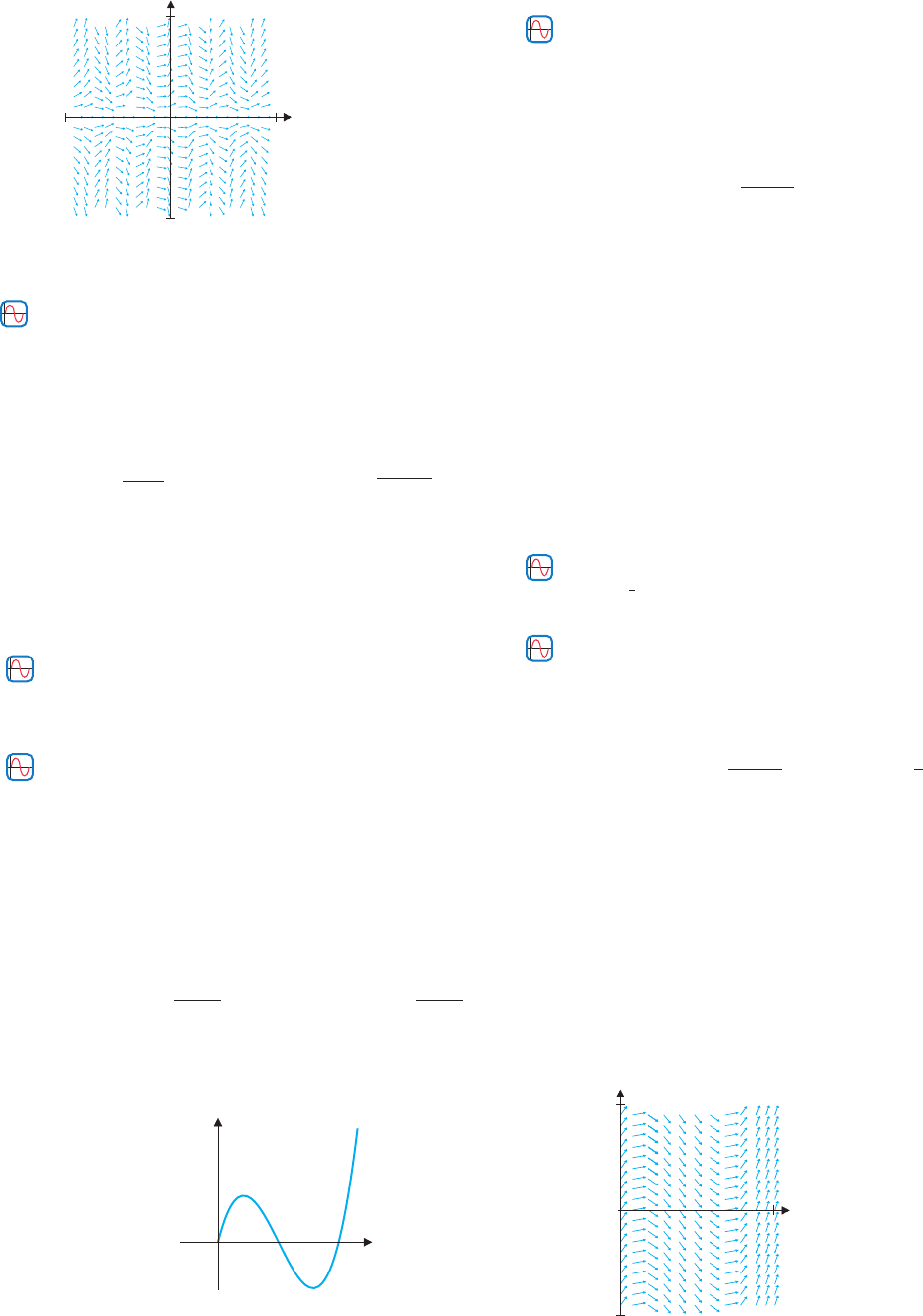
In exercises 7–12,match each differentialequation to the correct
direction field.
7. y
= 2 − xy 8. y
= 1 +2xy 9. y
= x cos3y
10. y
= y cos3x 11. y
=
x
2
+ y
2
12. y
= ln(x
2
+ y
2
)
5
5
5
5
y
x
FIELD A
5
5
5
5
y
x
FIELD B
5
5
5
5
y
x
FIELD C
5
5
5
5
y
x
FIELD D
5
5
5
5
y
x
FIELD E
P1: OSO/OVY P2: OSO/OVY QC: OSO/OVY T1: OSO
MHDQ256-Ch08 MHDQ256-Smith-v1.cls December 16, 2010 21:19
LT (Late Transcendental)
CONFIRMING PAGES
8-29 SECTION 8.3
..
Direction Fields and Euler’s Method 519
5
5
5
5
y
x
FIELD F
............................................................
In exercises 13–20, use Euler’s method with h 0.1 and
h 0.05 to approximate y(1) and y(2). Show the first two steps
by hand.
13. y
= 2xy, y(0) = 1 14. y
= x/y, y(0) = 2
15. y
= 4y − y
2
, y(0) = 1 16. y
= x/y
2
, y(0) = 2
17. y
= 1 − y + e
−x
, y(0) = 3 18. y
= sin y − x
2
, y(0) = 1
19. y
=
√
x + y, y(0) = 1 20. y
=
x
2
+ y
2
, y(0) = 4
............................................................
21. Find the exact solutions in exercises 13 and 14, and compare
y(1) and y(2) to the Euler’s method approximations.
22. Find the exact solutions in exercises 15 and 16, and compare
y(1) and y(2) to the Euler’s method approximations.
23. Sketch the direction fields for exercises 17 and 18, highlight
the curve corresponding to the giveninitial condition and com-
pare the Euler’s method approximations to the location of the
curve at x = 1 and x = 2.
24. Sketch the direction fields for exercises 19 and 20, highlight
the curve corresponding to the giveninitial condition and com-
pare the Euler’s method approximations to the location of the
curve at x = 1 and x = 2.
In exercises 25–30, find the equilibrium solutions and identify
each as stable, unstable or neither.
25. y
= 2y − y
2
26. y
= y
3
− 1
27. y
= y
2
− y
4
28. y
= e
−y
− 1
29. y
= (1 − y)
1 + y
2
30. y
=
1 − y
2
............................................................
31. Given the graph of g, sketch a direction field for y
= g.
y ⫽ g(x)
y
x
Figure for exercises 31 and 32
32. Given the graph of g, sketch a direction field for y
= g
.
33. Apply Euler’s method with h = 0.1 to the initial value prob-
lem y
= y
2
− 1, y(0) = 3 and estimate y(0.5). Repeat with
h = 0.05 and h = 0.01. In general, Euler’s method is more
accurate with smaller h-values. Conjecture how the exact so-
lution behaves in this example. (This is explored further in
exercises 34–36.)
34. Show that f (x) =
2 + e
2x
2 − e
2x
is a solution of the initial
valueproblem in exercise33. Compute f (0.1), f (0.2), f (0.3),
f (0.4) and f (0.5), and compare to the approximations in ex-
ercise 33.
35. Graph the solution of y
= y
2
− 1, y(0) = 3, given in exer-
cise 34. Find an equation of the vertical asymptote. Explain
why Euler’s method would be “unaware” of the existence of
this asymptote and would therefore provide very unreliable
approximations.
36. In exercises 33–35, suppose that x represents time (in hours)
and y represents the force (in newtons) exerted on an arm of
a robot. Explain what happens to the arm. Given this, explain
why the negative function values in exercise 34 are irrelevant
and, in some sense, the Euler’s method approximations in ex-
ercise 33 give useful information.
37. Apply Euler’s method with (a) h = 1 and (b) h = 0.1to
y
=
1
3
y(8 − y), y(0) = 1. Discuss the behavior of the approx-
imations and the actual solution as t increases.
38. This exercise develops a continuous Newton’s method. (See
Neuberger’s article in the May 2007 issue of American Math-
ematical Monthly.) Instead of following the tangent line to
the x-axis, the tangent line is followed an infinitesimally
small distance, producing a curve (x(t), y(t)) that satisfies
x
(t) =−f (x(t))/f
(x(t)). (a) For f (x) = x
2
− 2, x(0) = 1,
show that x(t) =
√
2 − e
−t
and lim
t→∞
x(t) =
√
2. (b) Show that
Euler’s method with h = 1 produces Newton’s method.
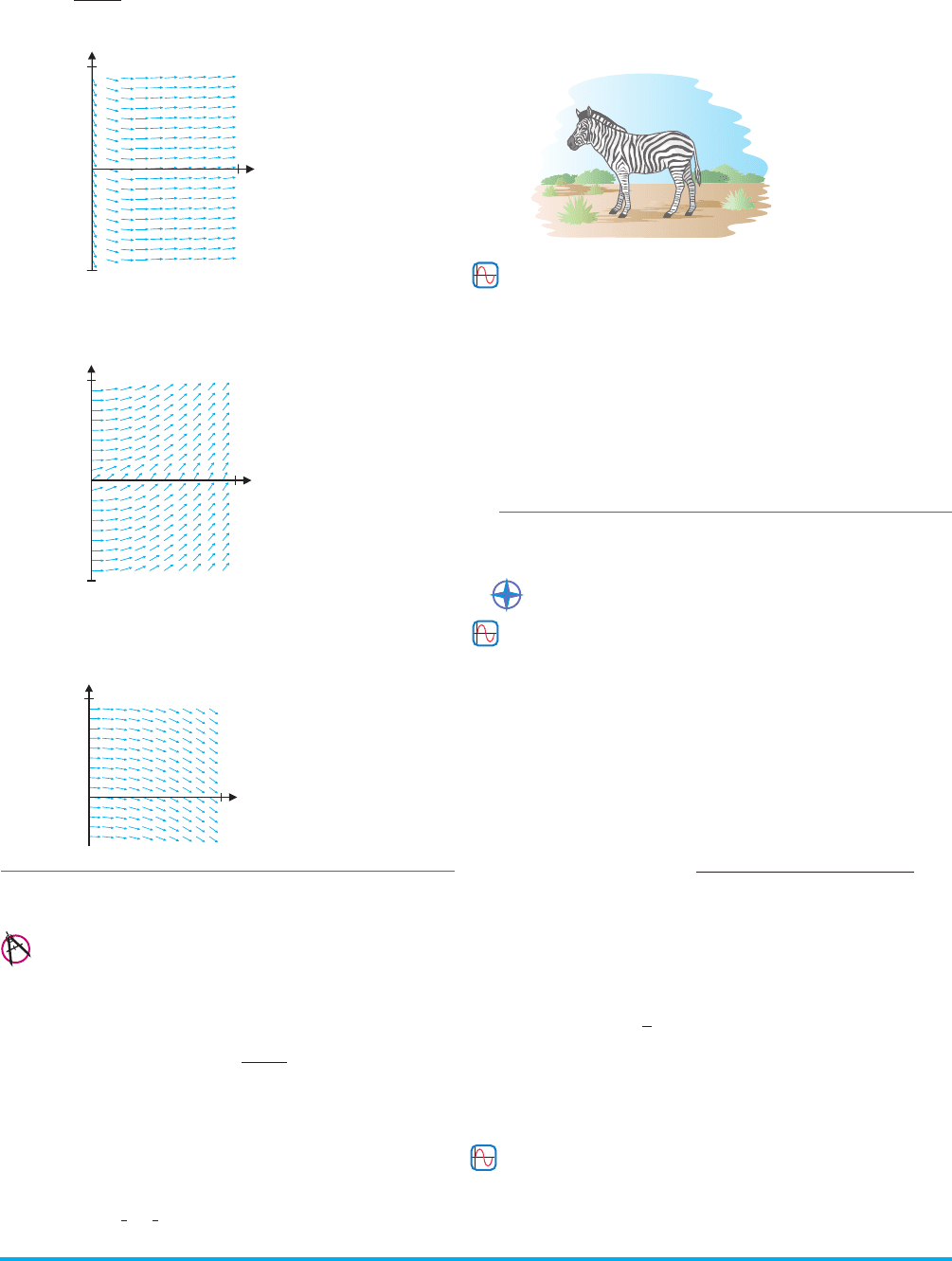
In exercises 39–42, use the direction field to sketch solution
curves and estimate the initial value y(0) such that the solu-
tion curve would pass through the given point P. In exercises
39 and 40, solve the equation and determine how accurate your
estimate is. In exercises 41 and 42, use a CAS if available to
determine how accurate your estimate is.
39. y
= x
2
− 4x + 2, P(3, 0)
5
3
⫺5
y
x
p
•
P1: OSO/OVY P2: OSO/OVY QC: OSO/OVY T1: OSO
MHDQ256-Ch08 MHDQ256-Smith-v1.cls December 16, 2010 21:19
LT (Late Transcendental)
CONFIRMING PAGES
520 CHAPTER 8
..
First-Order Differential Equations 8-30
40. y
=
x − 3
4x + 1
, P(8, 1)
⫺10
10
y
8
1
1
x
•
p
41. y
= 0.2x +e
−y
2
, P(5, −3)
⫺10
5
10
y
x
•p
42. y
=−0.1x − 0.1e
−y
2
/20
, P(10, 4)
10
10
y
x
•p
APPLICATIONS
43. Zebra stripes and patterns on butterfly wings are thought to be
the result of gene-activated chemical processes. Suppose g(t)
is the amount of a gene that is activated at time t. The dif-
ferential equation g
=−g +
3g
2
1 + g
2
has been used to model
the process. Show that there are three equilibrium solutions:
0 and two positive solutions a and b, with a < b. Show that
g
> 0ifa < g < b and g
< 0if0< g < a org > b.Explain
why lim
t→∞
g(t) could be 0 or b, depending on the initial amount
of activated gene. Suppose that a patch of zebra skin extends
from x = 0tox = 4π with an initial activated-gene distribu-
tion g(0) =
3
2
+
3
2
sin x at location x. If black corresponds to
an eventual activated-gene level of 0 and white corresponds
to an eventual activated-gene level of b, show what the zebra
stripes will look like.
44. Many species of trees are plagued by sudden infestations of
worms.Let x(t)bethepopulationofaspeciesofwormonapar-
ticular tree. Forsome species, a model for population change is
x
= 0.1x(1 − x/k) − x
2
/(1 + x
2
) for some positive constant
k.Ifk = 10, show that there is only one positive equilibrium
solution. If k = 50, show that there are three positive equilib-
rium solutions. Sketch the direction field for k = 50. Explain
why the middle equilibrium value is called a threshold.An
outbreak of worms corresponds to crossing the threshold for a
large value of k (k is determined by the resources available to
the worms).
EXPLORATORY EXERCISES
1. In this exercise, we use an alternative form of Euler’s
method to derive a method known as the Improved
Euler’s method. Start with the differential equation
y
(x) = f (x, y(x)) and integrate both sides from x = x
n
to
x = x
n+1
. Show that y(x
n+1
) = y(x
n
) +
x
n+1
x
n
f (x, y(x))dx.
Given y(x
n
), then, you can estimate y(x
n+1
) by estimat-
ing the integral
x
n+1
x
n
f (x, y(x))dx. One such estimate
is a Riemann sum using left-endpoint evaluation, given
by f (x
n
, y(x
n
))x. Show that with this estimate you get
Euler’s method. There are numerous ways of getting better
estimates of the integral. One is to use the Trapezoidal Rule,
x
n+1
x
n
f (x, y(x))dx ≈
f (x
n
, y(x
n
)) + f (x
n+1
, y(x
n+1
))
2
x.
The drawback with this estimate is that you know y(x
n
)
but you do not know y(x
n+1
). The way out is to use
Euler’s method; you can approximate y(x
n+1
)by
y(x
n+1
) ≈ y(x
n
) + hf(x
n
, y(x
n
)). Put all of this together to
get the Improved Euler’s method:
y
n+1
= y
n
+
h
2
[ f (x
n
, y
n
) + f (x
n
+ h, y
n
+ hf(x
n
, y
n
))].
Usethe ImprovedEuler’smethod for the IVP y
= y, y(0) = 1
with h = 0.1 to compute y
1
, y
2
and y
3
. Compare to the exact
values and the Euler’s method approximations given in exam-
ple 3.4.
2. As in exercise 1, derive a numerical approximation method
based on (a) the Midpoint rule and (b) Simpson’s rule.
Compare your results to those obtained in example 3.4 and
exercise 1.

P1: OSO/OVY P2: OSO/OVY QC: OSO/OVY T1: OSO
MHDQ256-Ch08 MHDQ256-Smith-v1.cls December 16, 2010 21:19
LT (Late Transcendental)
CONFIRMING PAGES
8-31 SECTION 8.4
..
Systems of First-Order Differential Equations 521
8.4 SYSTEMS OF FIRST-ORDER DIFFERENTIAL EQUATIONS
In this section, we consider systems of two or more first-order differential equations. Re-
call that the exponential growth described in example 1.1 and the logistic growth shown
in example 2.6 both model the population of a single organism in isolation. A more real-
istic model would account for interactions between two species, where such interactions
significantly impact both populations. For instance, the population of rabbits in a given
area is negatively affected by the presence of various predators (such as foxes), while the
population of predators will grow in response to an abundant supply of prey and decrease
when the prey are less plentiful. We begin with the analysis of such a predator-prey model,
where a species of predators depends on a species of prey for food.
Predator-Prey Systems
Supposethatthepopulationoftheprey(inhundredsofanimals)isgivenbyx(t).Thisspecies
thrives in its environment, except for interactions with a predator, with population y(t)
(in hundreds of animals). Without any predators, we assume that x(t) satisfies the logistic
equation x
(t) = bx(t) − c[x(t)]
2
, for positive constants b and c. The negative effect of the
predator should be proportional to the number of interactions between the species, which
we assume to be proportional to x(t)y(t), since the number of interactions increases as x(t)
or y(t) increases. This leads us to the model
x
(t) = bx(t) − c[x(t)]
2
− k
1
x(t)y(t),
for some positive constant k
1
. On the other hand, the population of predators depends on
interactions between the two species to survive. We assume that without any available prey,
thepopulation y(t)decays exponentially, while interactions betweenpredatorand preyhave
a positive influence on the population of predators. This gives us the model
y
(t) =−dy(t) + k
2
x(t)y(t),
for positive constants d and k
2
.
Putting these equations together, we have a system of first-order differential equations:
PREDATOR-PREY EQUATIONS
x
(t) = bx(t) − c[x(t)]
2
− k
1
x(t)y(t)
y
(t) =−dy(t) + k
2
x(t)y(t).
A solution of this system is a pair of functions, x(t) and y(t), which satisfy both of the equa-
tions.We refer tothissystemas coupled, since we mustsolvethe equationstogether,aseach
of x
(t) and y
(t) depends on both x(t) and y(t). Although solving such a system is beyond
the level of this course, we can learn something about the solutions using graphical meth-
ods. The analysis of this system proceeds similarly to examples 3.6 and 3.7. As before, it is
helpful to first find equilibrium solutions (solutions for which both x
(t) = 0 and y
(t) = 0).
EXAMPLE 4.1 Finding Equilibrium Solutions of a System of Equations
Find and interpret all equilibrium solutions of the predator-prey model
x
(t) = 0.2x(t) − 0.1[x(t)]
2
− 0.4x(t)y(t)
y
(t) =−0.1y(t) +0.1x(t)y(t),
where x and y represent the populations (in hundreds of animals) of a prey and a
predator, respectively.
Solution If (x, y) is an equilibrium solution, then the constant functions x(t) = x and
y(t) = y satisfy the system of equations with x
(t) = 0 and y
(t) = 0. Substituting into

P1: OSO/OVY P2: OSO/OVY QC: OSO/OVY T1: OSO
MHDQ256-Ch08 MHDQ256-Smith-v1.cls December 16, 2010 21:19
LT (Late Transcendental)
CONFIRMING PAGES
522 CHAPTER 8
..
First-Order Differential Equations 8-32
the equations, we have
0 = 0.2x − 0.1x
2
− 0.4xy
0 =−0.1y + 0.1xy
This is now a system of two (nonlinear) equations for the two unknowns x and y. There
is no general method for solving systems of nonlinear algebraic equations exactly. In
this case, you should solve the simpler equation carefully and then substitute solutions
back into the more complicated equation. Notice that both equations factor, to give
0 = 0.1x(2 − x −4y)
0 = 0.1y(−1 + x).
The second equation has solutions y = 0 and x = 1. We now substitute these solutions
one at a time into the first equation.
Taking y = 0, the first equation becomes 0 = 0.1x(2 − x), which has the solutions
x = 0 and x = 2. This says that (0, 0) and (2, 0) are equilibrium solutions of the system.
Note that the equilibrium point (0, 0) corresponds to the case where there are no predators
or prey, while (2, 0) corresponds to the case where there are prey but no predators.
Taking x = 1, the first equation becomes 0 = 0.2 − 0.1 − 0.4y, which has the
solution y =
0.1
0.4
= 0.25. A third equilibrium solution is then (1, 0.25), corresponding to
having both populations constant, with four times as many prey as predators.
Since we have now considered both solutions from the second equation, we have
found all equilibrium solutions of the system: (0, 0), (2, 0) and (1, 0.25).
Next,weanalyzethestabilityofeachequilibriumsolution.Wecaninferfromthiswhich
solution corresponds to the natural balance of the populations. More advanced techniques
for determining stability can be found in most differential equations texts. For simplicity,
we use a graphical technique involving a plot called the phase portrait to determine the
stability. For the system in example 4.1, we can eliminate the time variable, by observing
that by the chain rule,
dy
dx
=
y
(t)
x
(t)
=
−0.1y + 0.1xy
0.2x − 0.1x
2
− 0.4xy
.
Observe that this is simply a first-order differential equation for y as a function of x. In this
case, we refer to the xy-plane as the phase plane for the original system. A phase portrait
is a sketch of a number of solution curves of the differential equation in the xy-plane. We
illustrate this in example 4.2.
EXAMPLE 4.2 Using a Direction Field to Sketch a Phase Portrait
Sketch a direction field of
dy
dx
=
−0.1y + 0.1xy
0.2x − 0.1x
2
− 0.4xy
, and use the resulting phase
portrait to determine the stability of the three equilibrium points (0, 0), (2, 0) and
(1, 0.25).
Solution The direction field generated by our CAS (see Figure 8.20) is not especially
helpful, largely because it does not show sufficient detail near the equilibrium points.
To more clearly see the behavior of solutions near each equilibrium solution, we
zoom in on each equilibrium point in turn and plot a number of solution curves, as
shown in Figures 8.21a, 8.21b and 8.21c.
Since the arrows in Figure 8.21a point away from (0, 0), we refer to (0, 0) as an
unstable equilibrium. That is, solutions that start out close to (0, 0) move away from
that point as t →∞. Similarly, most of the arrows in Figure 8.21b point away from
(2, 0) and so, we conclude that (2, 0) is also unstable. Finally, in Figure 8.21c, the
arrows spiral in toward the point (1, 0.25), indicating that solutions that start out near
(1, 0.25) tend toward that point as t →∞, making this is a stable equilibrium. From
this, we conclude that the naturally balanced state is for the two species to coexist, with
4 times as many prey as predators.