
Smith R., Minton R. Calculus
Подождите немного. Документ загружается.

P1: OSO/OVY P2: OSO/OVY QC: OSO/OVY T1: OSO
MHDQ256-Ch08 MHDQ256-Smith-v1.cls December 16, 2010 21:19
LT (Late Transcendental)
CONFIRMING PAGES
8-13 SECTION 8.2
..
Separable Differential Equations 503
3
1
1
3
4
234
y
x
c = 7
c = 3
c = 1
c = 7
c = 3
c = 1
c = 0
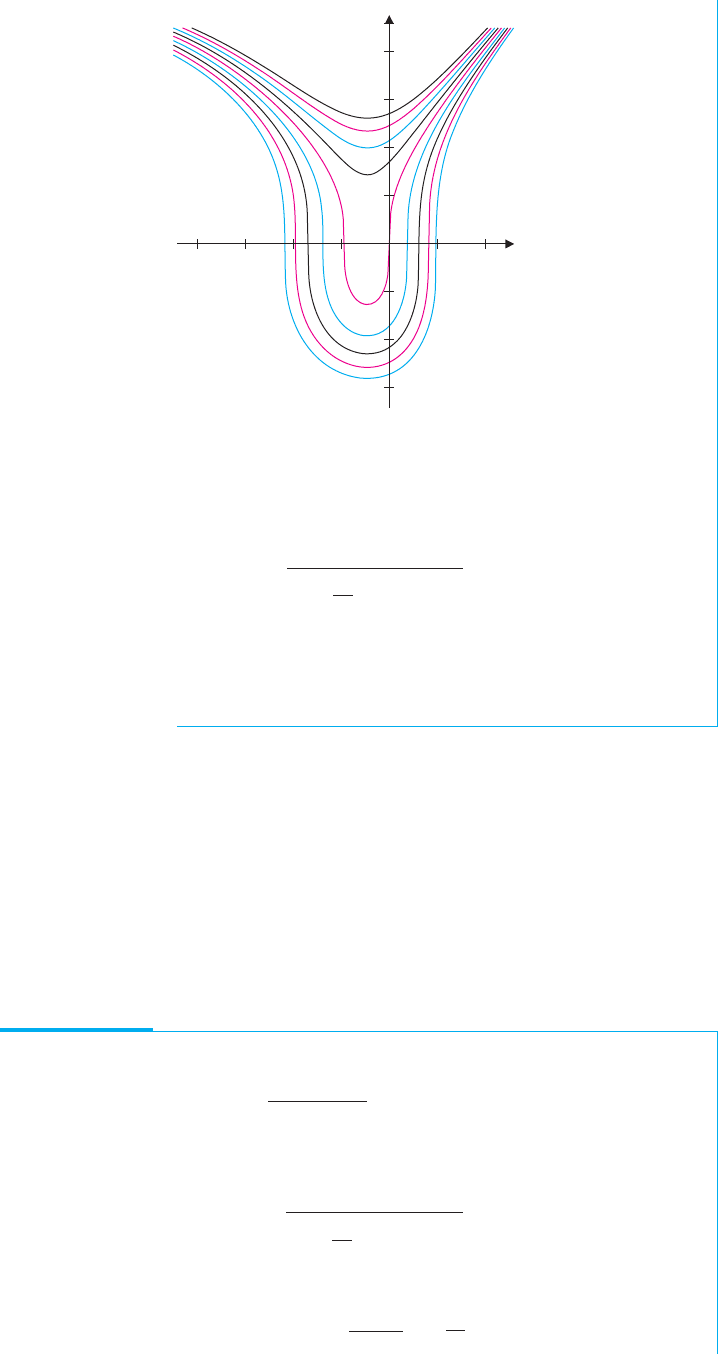
FIGURE 8.6
A family of solutions
Solving for y,weget
y =
3
x
3
+
21
2
x
2
+ 9x + 3c.
Notice that for each value of c, we get a different solution of the differential
equation. This is called a family of solutions (or the general solution)ofthe
differential equation. In Figure 8.6, we have plotted a number of the members of this
family of solutions.
In general, the solution of a first-order separable equation will include an arbitrary
constant(theconstant ofintegration).Toselectjustone ofthese solutioncurves,wespecifya
singlepointthroughwhich the solution curvemustpass,say (x
0
, y
0
).Thatis,we require that
y(x
0
) = y
0
.
This is called an initial condition (since this condition often specifies the initial state of
a physical system). A first-order differential equation together with an initial condition is
referred to as an initial value problem (IVP).
EXAMPLE 2.4 Solving an Initial Value Problem
Solve the IVP
y
=
x
2
+ 7x + 3
y
2
, y(0) = 3.
Solution In example 2.3, we found that the general solution of the differential
equation is
y =
3
x
3
+
21
2
x
2
+ 9x + 3c.
From the initial condition, we now have
3 = y(0) =
3
√
0 + 3c =
3
√
3c
P1: OSO/OVY P2: OSO/OVY QC: OSO/OVY T1: OSO
MHDQ256-Ch08 MHDQ256-Smith-v1.cls December 16, 2010 21:19
LT (Late Transcendental)
CONFIRMING PAGES
504 CHAPTER 8
..
First-Order Differential Equations 8-14
and hence, c = 9. The solution of the IVP is then
y =
3
x
3
+
21
2
x
2
+ 9x + 27.
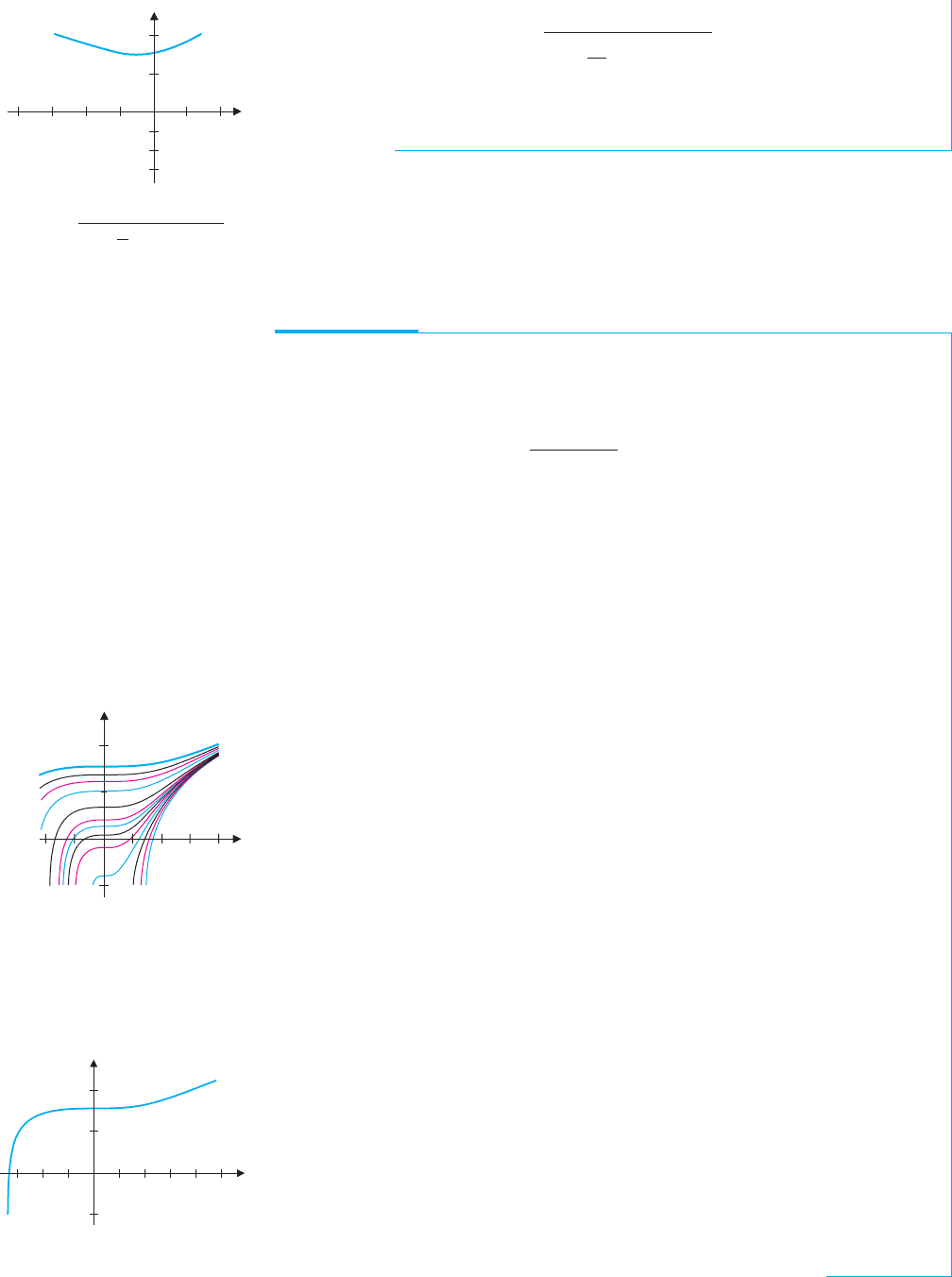
We show a graph of this solution in Figure 8.7. Notice that this graph would fit above
the curves shown in Figure 8.6. We’ll explore the effects of other initial conditions in
the exercises.
We are not always as fortunate as we were in example 2.4. There, we were able to
obtain an explicit representation of the solution (i.e., we found a formula for y in terms
of x). Most often, we must settle for an implicit representation of the solution, that is, an
equation relating x and y that cannot be solved for y in terms of x alone.
x
y
21 1 2
1
2
4
2
3
34
FIGURE 8.7
y =
3
x
3
+
21
2
x
2
+ 9x + 27
4322
x
c = 100
c = 80
c = 60
c = 40
c = 25
c = −12
c = −8
4
2
2
y
c = −4
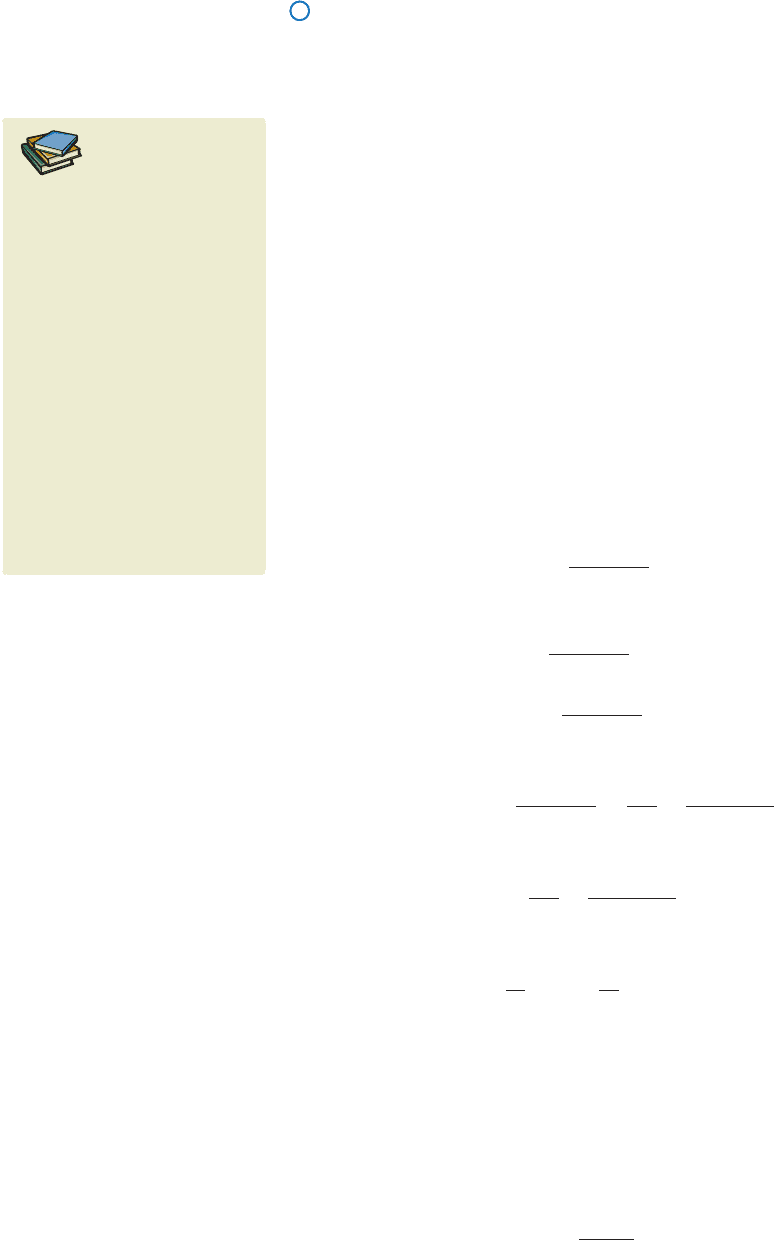
FIGURE 8.8a
A family of solutions
5
x
43212 1
4
2
2
y
FIGURE 8.8b
The solution of the IVP
EXAMPLE 2.5 An Initial Value Problem That Has Only
an Implicit Solution
Find the solution of the IVP
y
=
9x
2
− sin x
cos y + 5e
y
, y(0) = π.
Solution First, note that the differential equation is separable, since we can rewrite
it as
(cos y + 5e
y
)y
(x) = 9x
2
− sin x.
Integrating both sides of this equation with respect to x,wefind
(cos y + 5e
y
)y
(x)dx =
(9x
2
− sin x)dx
or
(cos y + 5e
y
)dy =
(9x
2
− sin x)dx.
Evaluating the integrals, we obtain
sin y + 5e
y
= 3x
3
+ cos x + c. (2.3)
Notice that there is no way to solve this equation explicitly for y in terms of x. However,
you can still picture the graphs of some members of this family of solutions by using the
implicit plot mode on your graphing utility. Several of these are plotted in Figure 8.8a.
Even though we have not solved for y explicitly in terms of x, we can still use the initial
condition. Substituting x = 0 and y = π into equation (2.3), we have
sinπ + 5e
π
= 0 + cos0 +c
or
5e
π
− 1 = c.
This leaves us with
sin y + 5e
y
= 3x
3
+ cos x + 5e
π
− 1
as an implicit representation of the solution of the IVP. Although we cannot solve for y
in terms of x alone, given any particular value for x, we can use Newton’s method (or
some other numerical method) to approximate the value of the corresponding y. This is
essentially what your CAS does (with many, many points) when you use it to plot a
graph in implicit mode. We plot the solution of the IVP in Figure 8.8b.
P1: OSO/OVY P2: OSO/OVY QC: OSO/OVY T1: OSO
MHDQ256-Ch08 MHDQ256-Smith-v1.cls December 16, 2010 21:19
LT (Late Transcendental)
CONFIRMING PAGES
8-15 SECTION 8.2
..
Separable Differential Equations 505
Logistic Growth
In section 8.1, we introduced the differential equation
y
= ky
as a model of bacterial population growth, valid for populations growing with unlimited
resources and with unlimited room for growth. Of course, all populations have factors
that eventually limit their growth. Thus, this particular model generally provides useful
information only for relatively short periods of time.
HISTORICAL
NOTES
Pierre Verhulst (1804–1849)
A Belgian mathematician who
proposed the logistic model for
population growth. Verhulst
was a professor of mathematics
in Brussels and did research
on number theory and social
statistics. His most important
contribution was the logistic
equation (also called the Verhulst
equation) giving the first realistic
model of a population with
limited resources. It is worth
noting that Verhulst’s estimate of
Belgium’s equilibrium population
closely matches the current
Belgian population.
Analternativemodelofpopulationgrowthassumesthatthereisamaximumsustainable
population, M (called the carrying capacity), determined by the available resources.
Further, as the population size approaches M (as available resources become more scarce),
thepopulationgrowthwillslow. To reflect this, we assume that the rate of population growth
is jointly proportional to the present population level and the difference between the current
level and the maximum, M. That is, if y(t) is the population at time t, we assume that
y
(t) = ky(M − y).
This differential equation is referred to as the logistic equation.
Two special solutions of this differential equation are apparent. The constant functions
y = 0 and y = M are both solutions of this differential equation. These are called
equilibrium solutions since, under the assumption of logistic growth, once a population
hits one of these levels, it remains there for all time. If y = 0 and y = M, we can solve the
differential equation, since it is separable, as
1
y(M − y)
y
(t) = k. (2.4)
Integrating both sides with respect to t, we obtain
1
y(M − y)
y
(t) dt =
kdt
or
1
y(M − y)
dy =
kdt. (2.5)
Using partial fractions, we can write
1
y(M − y)
=
1
My
+
1
M(M − y)
.
From (2.5) we now have
1
My
+
1
M(M − y)
dy =
kdt.
Carrying out the integrations gives us
1
M
ln|y|−
1
M
ln|M − y|=kt +c.
Multiplying both sides by M and using the fact that 0 < y < M,wehave
ln y − ln(M − y) = kMt + Mc.
Taking exponentials of both sides, we find
exp[ln y − ln(M − y)] = e
kMt+Mc
= e
kMt
e
Mc
.
Next, using rules of exponentials and logarithms and replacing the constant term e
Mc
by a
new constant A, we obtain
y
M − y
= Ae
kMt
.
To solve this for y, we first multiply both sides by (M − y) to obtain
y = Ae
kMt
(M − y)
= AMe
kMt
− Ae
kMt
y.
P1: OSO/OVY P2: OSO/OVY QC: OSO/OVY T1: OSO
MHDQ256-Ch08 MHDQ256-Smith-v1.cls December 16, 2010 21:19
LT (Late Transcendental)
CONFIRMING PAGES
506 CHAPTER 8
..
First-Order Differential Equations 8-16
Combining the two y terms, we find
y(1 + Ae
kMt
) = AMe
kMt
,
which gives us the explicit solution of the logistic equation,
y =
AMe
kMt
1 + Ae
kMt
. (2.6)
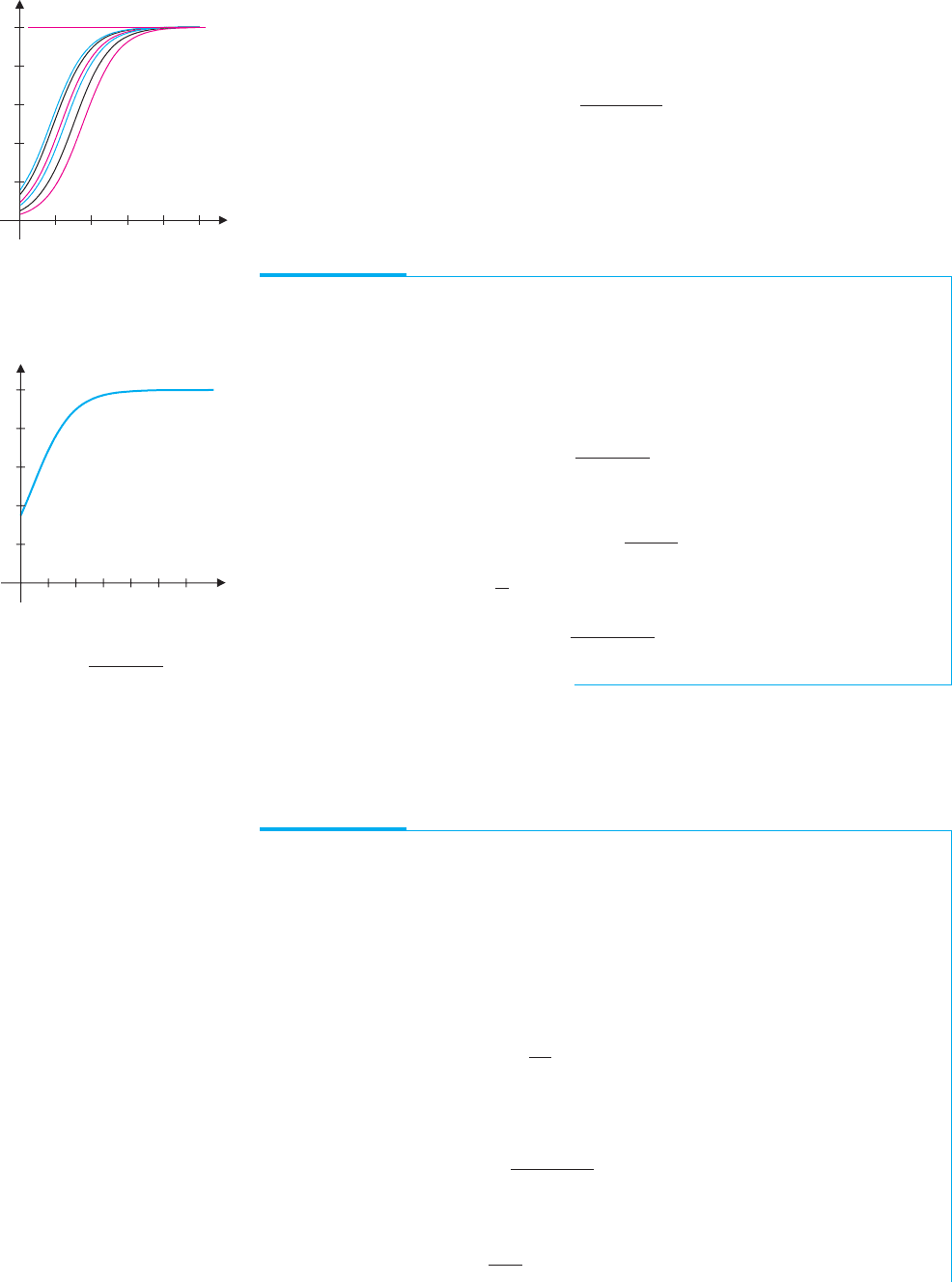
In Figure 8.9, we plot a number of these solution curves for various values of A (for the
case where M = 1000 and k = 0.001), along with the equilibrium solution y = 1000. You
can see from Figure 8.9 that logistic growth consists of nearly exponential growth initially,
followed by the graph becoming concave down and then asymptotically approaching the
maximum, M.
y
t
102468
200
400
600
800
1000
FIGURE 8.9
Several solution curves
1000
800
600
400
200
0.4 0.8 1.2
t
y
FIGURE 8.10
y =
35,000e
7t
65 + 35e
7t
EXAMPLE 2.6 Solving a Logistic Growth Problem
Given a maximum sustainable population of M = 1000 (this could be measured in
millions or tons, etc.) and growth rate k = 0.007, find an expression for the population
at any time t, given an initial population of y(0) = 350 and assuming logistic growth.
Solution From the solution (2.6) of the logistic equation, we have kM = 7 and
y =
1000Ae
7t
1 + Ae
7t
.
From the initial condition, we have
350 = y(0) =
1000A
1 + A
.
Solving for A, we obtain A =
35
65
, which gives us the solution of the IVP
y =
35,000e
7t
65 + 35e
7t
.
This solution is plotted in Figure 8.10.
We should note that, in practice, the values of M and k are not known and must be esti-
matedfromacarefulstudyoftheparticularpopulation.Weexploretheseissuesfurtherinthe
exercises.
In our final example, we consider growth in an investment plan.
EXAMPLE 2.7 Investment Strategies for Making a Million
Money is invested at 8% interest compounded continuously. If deposits are made
continuously at the rate of $2000 per year, find the size of the initial investment needed
to reach $1 million in 20 years.
Solution Here, interest is earned at the rate of 8% and additional deposits are
assumed to be made on a continuous basis. If the deposit rate is $d per year, the amount
A(t) in the account after t years satisfies the differential equation
dA
dt
= 0.08A + d.
This equation is separable and can be solved by dividing both sides by 0.08A + d and
integrating. We have
1
0.08A + d
dA =
1 dt,
so that
1
0.08
ln|0.08A +d|=t + c.

P1: OSO/OVY P2: OSO/OVY QC: OSO/OVY T1: OSO
MHDQ256-Ch08 MHDQ256-Smith-v1.cls December 16, 2010 21:19
LT (Late Transcendental)
CONFIRMING PAGES
8-17 SECTION 8.2
..
Separable Differential Equations 507
Using d = 2000, we have
12.5ln|0.08A +2000|=t + c.
Setting t = 0 and taking A(0) = x gives us the constant of integration:
12.5ln|0.08x + 2000|=c,
so that
12.5ln|0.08A +2000|=t + 12.5ln|0.08x + 2000|. (2.7)
To find the value of x such that A(20) = 1,000,000, we substitute t = 20 and
A = 1,000,000 into equation (2.7) to obtain
12.5ln|0.08(1,000,000) +2000|=20 +12.5ln|0.08x + 2000|
or 12.5ln|82,000|=20 + 12.5ln|0.08x + 2000|.
We can solve this for x, by subtracting 20 from both sides and then dividing by 12.5,
to obtain
12.5ln82,000 −20
12.5
= ln|0.08x +2000|.
Taking the exponential of both sides, we now have
e
(12.5ln82,000−20)/12.5
= 0.08x + 2000.
Solving this for x yields
x =
e
ln82,000−1.6
− 2000
0.08
≈ 181,943.93.
So, the initial investment needs to be $181,943.93 (slightly less than $200,000) in order
to be worth $1 million at the end of 20 years.
To be fair, the numbers in example 2.7 (like most investment numbers) must be in-
terpreted carefully. Of course, 20 years from now, $1 million likely won’t buy as much
as $1 million does today. For instance, the value of a million dollars adjusted for 8%
annual inflation would be $1,000,000e
−0.08(20)
≈ $201,896, which is not much larger than
the $181,943 initial investment required. However, if inflation is only 4%, then the value
of a million dollars (in current dollars) is $449,328. The lesson here is the obvious one: Be
sure to invest money at an interest rate that exceeds the rate of inflation.
EXERCISES 8.2
WRITING EXERCISES
1. Discuss the differences between solving algebraic equations
(e.g., x
2
− 1 = 0) and solving differential equations. Espe-
cially note what type of mathematical object you are solving
for.
2. A differential equation is not separable if it can’t be written
in the form g(y)y
= h(x). If you have an equation that you
can’t write in this form, how do you know whether it’s really
impossible or you justhaven’t figured it outyet? Discuss some
general forms (e.g., x + y and xy) that give you clues as to
whether the equation is likely to separate or not.
3. The solution curves in Figures 8.6, 8.8a and 8.9 do not ap-
pear to cross. In fact, they never intersect. If solution curves
crossed at the point (x
1
, y
1
), then there would be two solutions
satisfying the initial condition y(x
1
) = y
1
. Explain why this
does not happen. In terms of the logistic equation as a model
of population growth, explain why it is important to know that
this does not happen.
4. The logistic equation includes a term in the differential equa-
tion that slows population growth as the population increases.
Discusssomeofthereasonswhythisoccursinrealpopulations
(human, animal and plant).
In exercises 1–4, determine whether the differential equation is
separable.
1. (a) y
= (3x +1) cos y (b) y
= (3x + y) cos y
2. (a) y
= 2x(cos y − 1) (b) y
= 2x(y − x)
P1: OSO/OVY P2: OSO/OVY QC: OSO/OVY T1: OSO
MHDQ256-Ch08 MHDQ256-Smith-v1.cls December 16, 2010 21:19
LT (Late Transcendental)
CONFIRMING PAGES
508 CHAPTER 8
..
First-Order Differential Equations 8-18
3. (a) y
= x
2
y + y cos x (b) y
= x
2
y − x cos y
4. (a) y
= 2x cos y − xy
3
(b) y
= x
3
− 2x + 1
............................................................
In exercises 5–16, the differential equation is separable. Find
the general solution, in an explicit form if possible.
5. y
= (x
2
+ 1)y 6. y
= 2x(y − 1)
7. y
= 2x
2
y
2
8. y
= 2(y
2
+ 1)
9. y
=
6x
2
y(1 + x
3
)
10. y
=
3x
y + 1
11. y
=
2x
y
e
y−x
12. y
=
1 − y
2
x ln x
13. y
=
cos x
sin y
14. y
= x cos
2
y
15. y
=
xy
1 + x
2
16. y
=
2
xy + y
............................................................
In exercises 17–20, find the general solution in an explicit form
and sketch several members of the family of solutions.
17. y
=−xy 18. y
=
−x
y
19. y
=
1
y
20. y
= 1 + y
2
............................................................
In exercises 21–28, solve the IVP, explicitly if possible.
21. y
= 3(x +1)
2
y, y(0) = 1 22. y
=
x − 1
y
2
, y(0) = 2
23. y
=
4x
2
y
, y(0) = 2 24. y
=
x − 1
y
, y(0) =−2
25. y
=
4y
x + 3
, y(−2) = 1 26. y
=
3x
4y + 1
, y(1) = 4
27. y
=
4x
cos y
, y(0) = 0 28. y
=
tan y
x
, y(1) =
π
2
............................................................
In exercises 29–34, use equation (2.6) to help solve the IVP.
29. y
= 3y(2 − y), y(0) = 1 30. y
= y(3 − y), y(0) = 2
31. y
= 2y(5 − y), y(0) = 4 32. y
= y(2 − y), y(0) = 1
33. y
= y(1 − y), y(0) =
3
4
34. y
= y(3 − y), y(0) = 0
............................................................
35. The logistic equation is sometimes written in the form
y
(t) = ry(t)(1 − y(t)/M). Show that this is equivalent to
equation (2.4) with r/M = k. Biologists have measured the
values of the carrying capacity M and growth rate r for a
variety of fish. Just for the halibut, approximate values are
r = 0.71 year
−1
and M = 8 ×10
7
kg. (a) If the initial biomass
of halibut is y(0) = 2 × 10
7
kg, find an equation for the
biomass of halibut at any time. (b) Sketch a graph of the
biomass as a function of time. (c) Estimate how long it will
takefor the biomass to get within 10% of the carrying capacity.
36. (a) Find the solution of equation (2.4) if y(t) > M. (b) If the
halibut biomass (see exercise 35) explodes to 3 × 10
8
kg, how
long will it take for the population to drop back to within 10%
of the carrying capacity?
Exercises 37–40 relate to money investments.
37. (a) If continuous deposits are made into an account at the rate
of $2000 per year and interest is earned at 6% compounded
continuously, find the size of the initial investment needed
to reach $1 million in 20 years. Comparing your answer to
that of example 2.7, how much difference does interest rate
make? (b) If $10,000 is invested initially at 6% interest com-
poundedcontinuously,findthe(yearly)continuousdepositrate
needed to reach $1 million in 20 years. How much difference
does an initial deposit make?
38. A house mortgage is a loan that is to be paid over a fixed
period of time. Suppose $150,000 is borrowed at 8% interest.
If the monthly payment is $P, then explain why the equation
A
(t) = 0.08A(t) − 12P, A(0) = 150,000 is a model of the
amountowedaftert years.Fora30-yearmortgage,thepayment
P is set so that A(30) = 0. (a) Find P. Then, compute the
total amount paid and the amount of interest paid. (b) Rework
part (a) with a 7.5% loan. Does the half-percent decrease in
interest rate make a difference? (c) Rework part (a) with a
15-year mortgage. Compare the monthly payments and total
amount paid. (d) Reworkpart (a) with a loan of $125,000. How
much difference does it make to add an additional $25,000
down payment?
39. (a) A person contributes $10,000 per year to a retirement fund
continuously for 10 years until age 40 but makes no initial
payment and no further payments. At 8% interest, what is the
value of the fund at age 65? (b) A person contributes $20,000
per year to a retirement fund from age 40 to age 65 but makes
no initial payment. At 8% interest, what is the valueof the fund
at age 65? (c) Find the interest rate r at which the investors
have equal retirement funds.
40. Anendowmentisseededwith$1,000,000investedwithinterest
compounded continuously at 10%. Determine the amount that
can be withdrawn (continuously) annually so that the endow-
ment lasts 30 years.
............................................................
41. (a) In example 2.3, find and graph the solution passing
through (0, 0). (b) Notice that the initial value problem is
y
=
x
2
+ 7x + 3
y
2
with y(0) = 0. If you substitute y = 0 into
the differential equation, what is y
(0)? Describe what is hap-
pening graphically at x = 0. (c) Notice that y
(x) does not
exist at any x for which y(x) = 0. Given the solution of exam-
ple 2.4, this occurs if x
3
+
21
2
x
2
+ 9x + 3c = 0. Find the
values c
1
and c
2
such that this equation has three real solutions
if and only if c
1
< c < c
2
.
42. (a) Graph the solution of y
=
x
2
+ 7x + 3
y
2
with c = c
2
. (See
exercise 41.) (b) For c = c
2
in exercise 41, argue that the so-
lution to y
=
x
2
+ 7x + 3
y
2
with y(0) =
3
√
3c
2
has two points
with vertical tangent lines. (c) Estimate the locations of the
three points with vertical tangent lines in exercise 41.
P1: OSO/OVY P2: OSO/OVY QC: OSO/OVY T1: OSO
MHDQ256-Ch08 MHDQ256-Smith-v1.cls December 16, 2010 21:19
LT (Late Transcendental)
CONFIRMING PAGES
8-19 SECTION 8.2
..
Separable Differential Equations 509
Exercises 43–46 relate to reversible bimolecular chemical
reactions, where molecules A and B combine to form two
other molecules C and D and vice versa. If x(t) and y(t)are
the concentrations of C and D, respectively, and the initial con-
centrations of A, B, C and D are a, b, c and d, respectively, then
the reaction is modeled by
x
(t) k
1
(a c − x)(b c − x) − k
−1
x(d − c x)
for rate constants k
1
and k
−1
.
43. If k
1
= 1, k
−1
= 0.625, a + c = 0.4, b + c = 0.6, c = d and
x(0) = 0.2, find the concentration x(t). Graph x(t) and find
the eventual concentration level.
44. Repeat exercise 43 with (a) x(0) = 0.3 and (b) x(0) = 0.6.
Briefly explain what is physically impossible about the initial
condition in part (b).
45. For the bimolecular reaction with k
1
= 0.6, k
−1
= 0.4,
a + c = 0.5, b + c = 0.6 and c = d, write the differential
equation for the concentration of C. For x(0) = 0.2, solve for
the concentration at any time and graph the solution.
46. For the bimolecular reaction with k
1
= 1.0, k
−1
= 0.4,
a + c = 0.6, b + c = 0.4 and d − c = 0.1, write the differ-
ential equation for the concentration of C. For x(0) = 0.2,
solve for the concentration at any time and graph the solution.
............................................................
Exercises 47–50 relate to logistic growth with harvesting.
Suppose that a population in isolation satisfies the logistic
equation y
(t) ky(M − y). If the population is harvested (for
example, by fishing) at the rate R, then the population model
becomes y
(t) ky(M − y) − R.
47. Suppose that a species of fish has population in hundreds of
thousands that follows the logistic model with k = 0.025
and M = 8. (a) Determine the long-term effect on pop-
ulation if the initial population is 800,000 [y(0) = 8]
and fishing removes fish at the rate of 20,000 per year.
(b) Repeat if fish are removed at the rate of 60,000 per year.
48. For the fishing model P
(t) = 0.025P(t)[8 − P(t)] − R,
the population is constant if P
(t) = P
2
− 8P + 40R = 0.
The solutions are called equilibrium points. Compare the
equilibrium points for parts (a) and (b) of exercise 47.
49. Solve the population model
P
(t) = 0.05P(t)[8 − P(t)] − 0.6
= 0.4P(t)[1 − P(t)/8] − 0.6
with P(0) > 2 and determine the limiting amount lim
t→∞
P(t).
What happens if P(0) < 2?
50. The constant 0.4 in exercise 49 represents the natural growth
rate of the species. Comparing answers to exercises 47 and 49,
discuss how this constant affects the population size.
APPLICATIONS
51. The resale value r(t) of a machine decreases at a rate pro-
portional to the difference between the current price and
the scrap value S. Write a differential equation for r. If the
machine sells new for $14,000, is worth $8000 in 4 years and
has a scrap valueof $1000, find an equation for the resale value
at any time.
52. A granary is filled with 6000 kg of grain. The grain is shipped
out at a constant rate of 1000 kg per month. Storage costs
equal 2 cents per kg per month. Let S(t) be the total storage
charge for t months. Write a differential equation for S with
0 ≤ 1 ≤ 6. Solve the initial value problem for S(t). What is
the total storage bill for 6 months?
53. Forthe logistic equation y
(t) = ky(M − y), show that a graph
of
1
y
y
asafunctionofy producesalineargraph.Giventheslope
m and interceptb ofthisline,explainhowto computethemodel
parametersk andM. Usethe followingdata to estimate k and M
forafishpopulation.Predict the eventualpopulationofthefish.
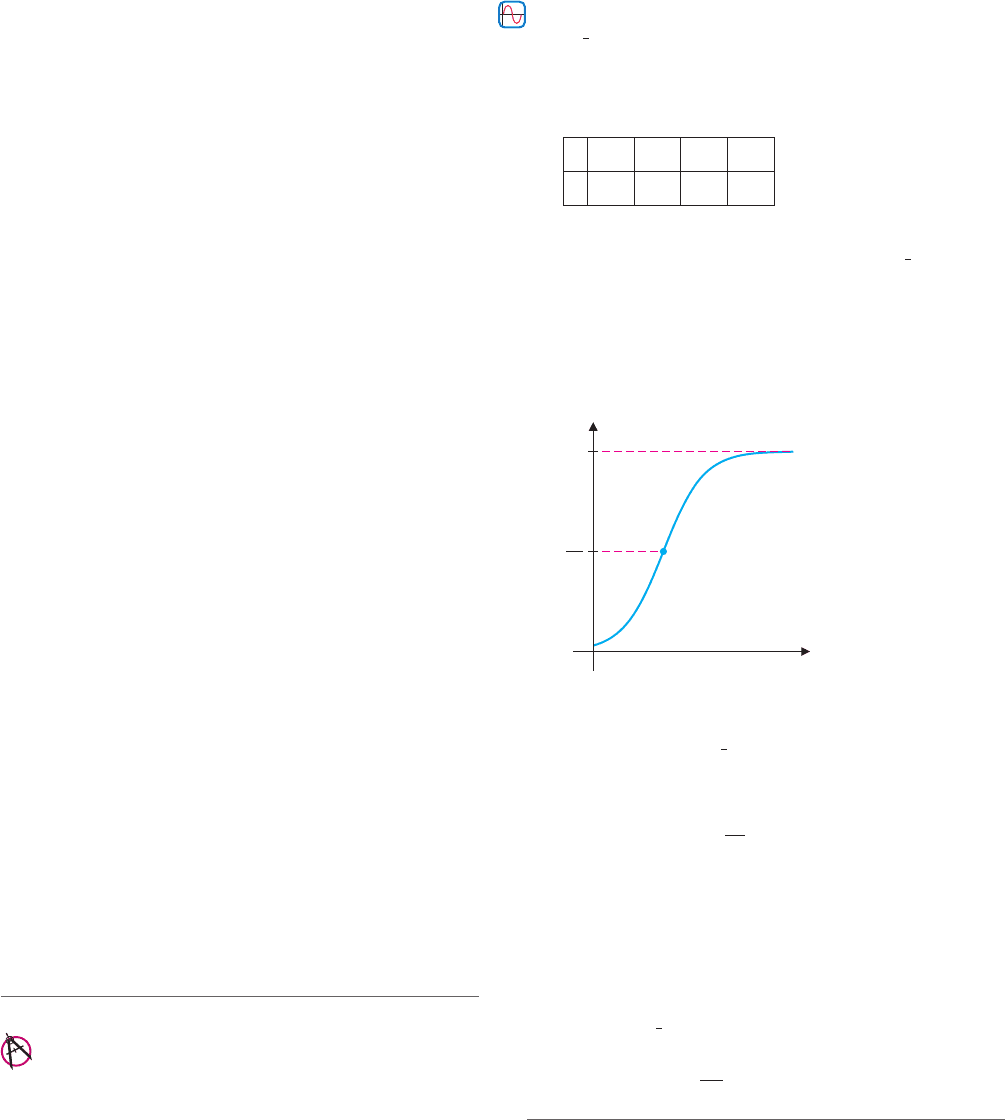
t 2 3 4 5
y 1197 1291 1380 1462
54. It is an interesting fact that the inflection point in the solution
of a logistic equation (see figure) occurs at y =
1
2
M. To verify
this, you do not want to compute two derivatives of equation
(2.6) and solve y
= 0. This would be quite ugly and would
give you the solution in terms of t, instead of y. Instead, a
more abstract approach works well. Start with the differential
equation y
= ky(M − y) and take derivatives of both sides.
y
x
M
2
M
Inflection point
(Hint: Use the product and chain rules on the right-hand side.)
You should find that y
= ky
(M − 2y). Then, y
= 0ifand
only if y
= 0ory =
1
2
M. Rule out y
= 0 by describing how
the solution behaves at the equilibrium values.
55. The downward velocity of a falling object is modeled by the
differential equation
dv
dt
= 9.8 −0.002v
2
.Ifv(0) = 0 m/s,
the velocity will increase to a terminal velocity. The terminal
velocity is an equilibrium solution where the upward air drag
exactly cancels the downward gravitational force. Find the
terminal velocity.
56. Suppose that f is a function such that f (x) ≥ 0 and f
(x) < 0
for x > 0. Show that the area of the triangle with sides
x = 0, y = 0 and the tangent line to y = f (x)atx = a > 0
is A(a) =−
1
2
{a
2
f
(a) −2af(a) + [ f (a)]
2
/ f
(a)}. To find a
curve such that this area is the same for any choice of a > 0,
solve the equation
dA
da
= 0.
P1: OSO/OVY P2: OSO/OVY QC: OSO/OVY T1: OSO
MHDQ256-Ch08 MHDQ256-Smith-v1.cls December 16, 2010 21:19
LT (Late Transcendental)
CONFIRMING PAGES
510 CHAPTER 8
..
First-Order Differential Equations 8-20
EXPLORATORY EXERCISES
1. An object traveling through the air is acted on by gravity
(acting vertically), air resistance (acting in the direction
opposite velocity) and other forces (such as a motor).
An equation for the horizontal motion of a jet plane is
v
= c − f (v)/m, where c is the thrust of the motor and
f (v) is the air resistance force. For some ranges of velocity,
the air resistance actually drops substantially for higher
velocities as the air around the object becomes turbulent.
For example, suppose that v
= 32,000 − f (v), where
f (v) =
0.8v
2
if 0 ≤ v ≤ 100
0.2v
2
if 100 <v
. To solve the initial value
problem v
= 32,000 − f (v),v(0) = 0, start with the ini-
tial value problem v
= 32,000 −0.8v
2
,v(0) = 0. Solve
this IVP and determine the time t such that v(t) = 100.
From this time forward, the equation becomes v
= 32,000 −
0.2v
2
. Solve the IVP v
= 32,000 −0.2v
2
,v(0) = 100. Put
this solution together with the previous solution to piece to-
gether a solution valid for all time.
2. Solve the initial value problems
dy
dt
= 2(1 − y)(2 − y)(3 − y)
with (a) y(0) = 0, (b) y(0) = 1.5, (c) y(0) = 2.5 and
(d) y(0) = 4. State as completely as possible how the limit
lim
t→∞
y(t) depends on y(0).
8.3 DIRECTION FIELDS AND EULER’S METHOD
In section 8.2, we saw how to solve some simple first-order differential equations, namely,
those that are separable. While there are numerous other special cases of differential equa-
tions whose solutions are known(you will encounter many of these in any beginning course
in differential equations), the vast majority cannot be solved exactly. For instance, the
equation
y
= x
2
+ y
2
+ 1
isnotseparable andcannot besolvedusingourcurrenttechniques.Nevertheless,some infor-
mation about the solution(s) can be determined. In particular, since y
= x
2
+ y
2
+ 1 > 0,
we can conclude that every solution is an increasing function. This type of information is
called qualitative, since it tells us about some quality of the solution without providing any
specific quantitative information.
In this section, we examine first-order differential equations in a more general setting.
We consider any first-order equation of the form
y
= f (x, y). (3.1)
Whilewe cannot solveallsuch equations, it turns out thattherearemanynumericalmethods
available for approximating the solution of such problems. In this section, we will study
one such method, called Euler’s method.
We begin by observing that any solution of equation (3.1) is a function y = y(x)
whose slope at any particular point (x, y) is given by f (x, y). To get an idea of what a
solution curve looks like, we draw a short line segment through each of a sequence of
points (x, y), with slope f (x, y), respectively. This collection of line segments is called the
direction field or slope field of the differential equation. Notice that if a particular solution
curve passes through a given point (x, y), then its slope at that point is f (x, y). Thus, the
direction field gives an indication of the behavior of the family of solutions of a differential
equation.
HISTORICAL
NOTES
Leonhard Euler (1707–1783)
A Swiss mathematician regarded
as the most prolific mathematician
of all time. Euler’s complete
works fill over 100 large volumes,
with much of his work being
completed in the last 17 years of
his life after losing his eyesight.
Euler made important and lasting
contributions in numerous
research fields, including calculus,
number theory, calculus of
variations, complex variables,
graph theory and differential
geometry. Mathematics author
George Simmons calls Euler, “the
Shakespeare of mathematics—
universal, richly detailed and
inexhaustible.’’Several excellent
books about Euler were published
around 2007, celebrating the
300th birthday of this giant of
mathematics.
EXAMPLE 3.1 Constructing a Direction Field
Construct the direction field for
y
=
1
2
y. (3.2)
P1: OSO/OVY P2: OSO/OVY QC: OSO/OVY T1: OSO
MHDQ256-Ch08 MHDQ256-Smith-v1.cls December 16, 2010 21:19
LT (Late Transcendental)
CONFIRMING PAGES
8-21 SECTION 8.3
..
Direction Fields and Euler’s Method 511
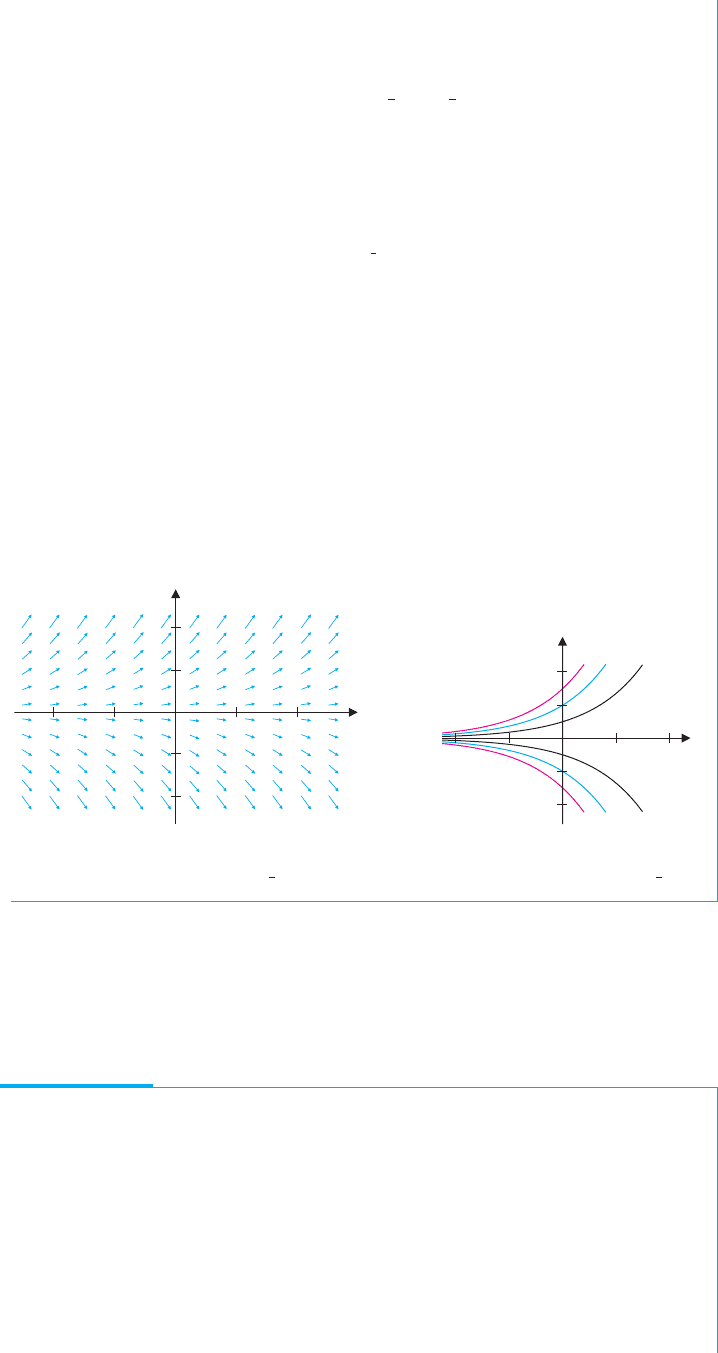
Solution All that needs to be done is to plot a number of points and then through each
point (x, y), draw a short line segment with slope f (x, y). For example, at the point
(0, 1), draw a short line segment with slope
y
(0) = f (0, 1) =
1
2
(1) =
1
2
.
Draw corresponding segments at 25 to 30 points. While this is a bit tedious to do by
hand, a good graphing utility can do this for you with minimal effort. See Figure 8.11a
for the direction field for equation (3.2). Notice that equation (3.2) is separable. We
leave it as an exercise to produce the general solution
y = Ae
1
2
x
.
We plot a number of the curves in this family of solutions in Figure 8.11b using the
same graphing window we used for Figure 8.11a. Notice that if you connected some of
the line segments in Figure 8.11a, you would obtain a close approximation to the
exponential curves depicted in Figure 8.11b. It is significant to note that the direction
field was constructed using only elementary algebra, without ever solving the
differential equation. That is, by constructing the direction field, we obtain a reasonably
good picture of how the solution curves behave. Such qualitative information about the
solution gives us a graphical idea of how solutions behave, but no details, such as the
value of a solution at a specific point. We’ll see later in this section that we can obtain
approximate values of the solution of an IVP numerically.
4
2
24
2
x
y
4
2
4
y
x
4
4
4
24
FIGURE 8.11a
Direction field for y
=
1
2
y
FIGURE 8.11b
Several solutions of y
=
1
2
y
As we have already seen, differential equations are used to model a wide variety of
phenomena in science and engineering. For instance, differential equations are used to find
flow lines or equipotential lines for electromagnetic fields. In such cases, it is very helpful
to visualize solutions graphically, so as to gain an intuitive understanding of the behavior
of such solutions and the physical phenomena they are describing.
EXAMPLE 3.2 Using a Direction Field to Visualize the Behavior
of Solutions
Construct the direction field for
y
= x + e
−y
.
Solution There’s really no trick to this; just draw a number of line segments with the
correct slope. Again, we let our CAS do this for us and obtained the direction field in
Figure 8.12a (on the following page). Unlike example 3.1, you do not know how to
solve this differential equation exactly. Even so, you should be able to clearly see from
the direction field how solutions behave. For example, solutions that start out in the
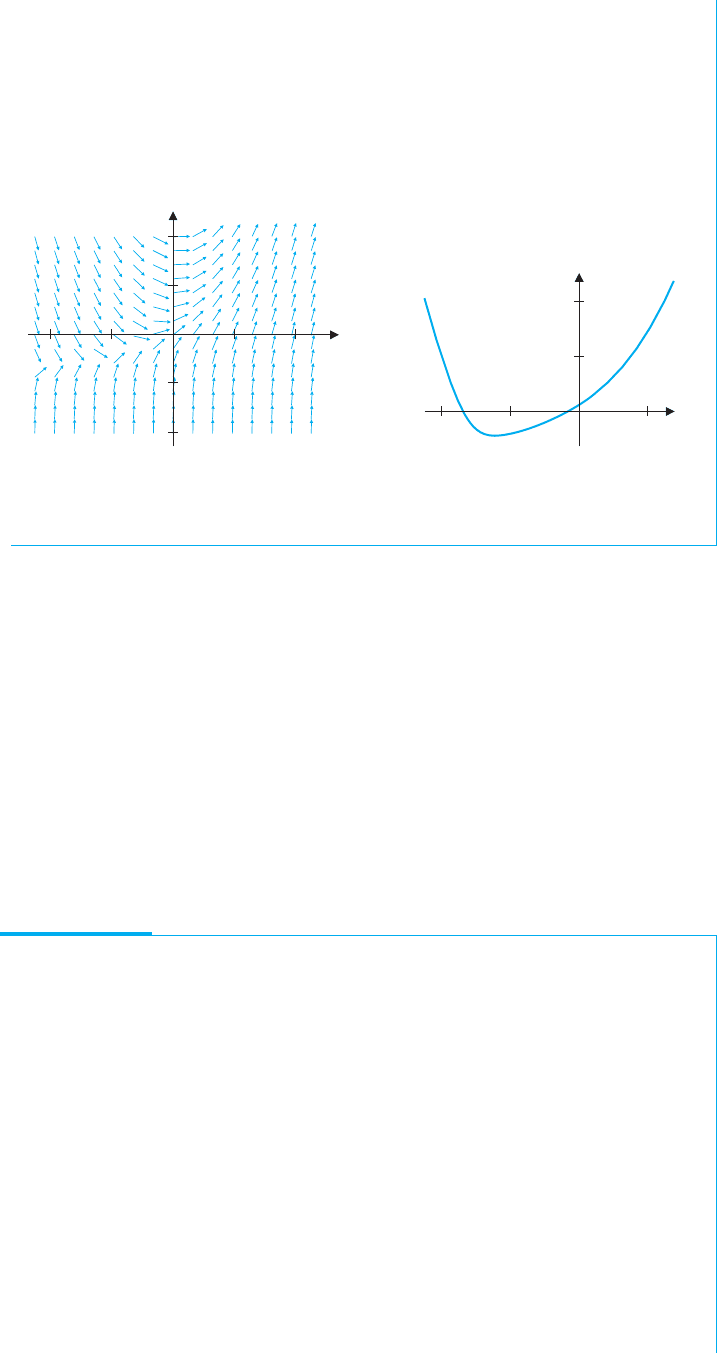
P1: OSO/OVY P2: OSO/OVY QC: OSO/OVY T1: OSO
MHDQ256-Ch08 MHDQ256-Smith-v1.cls December 16, 2010 21:19
LT (Late Transcendental)
CONFIRMING PAGES
512 CHAPTER 8
..
First-Order Differential Equations 8-22
second quadrant initially decrease very rapidly, may dip into the third quadrant and then
get pulled into the first quadrant and increase quite rapidly toward infinity. This is quite
a bit of information to have determined using little more than elementary algebra. In
Figure 8.12b, we have plotted the solution of the differential equation that also satisfies
the initial condition y(−4) = 2. We’ll see how to generate such an approximate solution
later in this section. Note how well this corresponds with what you get by connecting a
number of the line segments in Figure 8.12a.
4
2
2
4
x
y
4
24
2
x
y
2
2
2
4
4
FIGURE 8.12a
Direction field for y
= x +e
−y
FIGURE 8.12b
Solution of y
= x +e
−y
passing through (−4, 2)
You have already seen (in sections 8.1 and 8.2) how differential equation models
can provide important information about how populations change over time. A model of
population growth that includes a critical threshold is
P
(t) =−2[1 − P(t)][2 − P(t)]P(t),
where P(t) represents the size of a population at time t.
A simple context in which you might encounter a critical threshold is with the case
of a sudden infestation of pests. For instance, suppose that you have some method for
removing ants from your home. As long as the reproductive rate of the ants is lower than
your removal rate, the ant population will stay under control. However, as soon as your
removal rate becomes less than the ant reproductive rate (i.e., the removal rate crosses a
critical threshold), you won’t be able to keep up with the extra ants and you will suddenly
be faced with a big ant problem. We see this type of behavior in example 3.3.
EXAMPLE 3.3 Population Growth with a Critical Threshold
Draw the direction field for
P
(t) =−2[1 − P(t)][2 − P(t)]P(t)
and discuss the eventual size of the population.
Solution The direction field is particularly easy to sketch here since the right-hand
side depends on P, but not on t.IfP(t) = 0, then P
(t) = 0, also, so that the direction
field is horizontal. The same is true for P(t) = 1 and P(t) = 2. If 0 < P(t) < 1, then
P
(t) < 0 and the solution decreases. If 1 < P(t) < 2, then P
(t) > 0 and the solution
increases. Finally, if P(t) > 2, then P
(t) < 0 and the solution decreases. Putting all of
these pieces together, we get the direction field seen in Figure 8.13. The constant
solutions P(t) = 0, P(t) = 1 and P(t) = 2 are called equilibrium solutions. The
solution P(t) = 1 is called an unstable equilibrium, since populations that start near 1
don’t remain close to 1. Similarly, the solutions P(t) = 0 and P(t) = 2 are called stable
equilibria, since populations either rise to 2 or drop to 0 (extinction), depending on
which side of the critical threshold P(t) = 1 they are on. (Look again at Figure 8.13.)