
Smith R., Minton R. Calculus
Подождите немного. Документ загружается.

P1: OSO/OVY P2: OSO/OVY QC: OSO/OVY T1: OSO
MHDQ256-Ch08 MHDQ256-Smith-v1.cls December 16, 2010 21:19
LT (Late Transcendental)
CONFIRMING PAGES
8-33 SECTION 8.4
..
Systems of First-Order Differential Equations 523
0.25
0.1
0.2
0.3
0.4
0.5
0.6
0.7
0.8
0.9
1
0.5 0.75 1 1.25 1.5 1.75 2 2.25 2.50
y
x
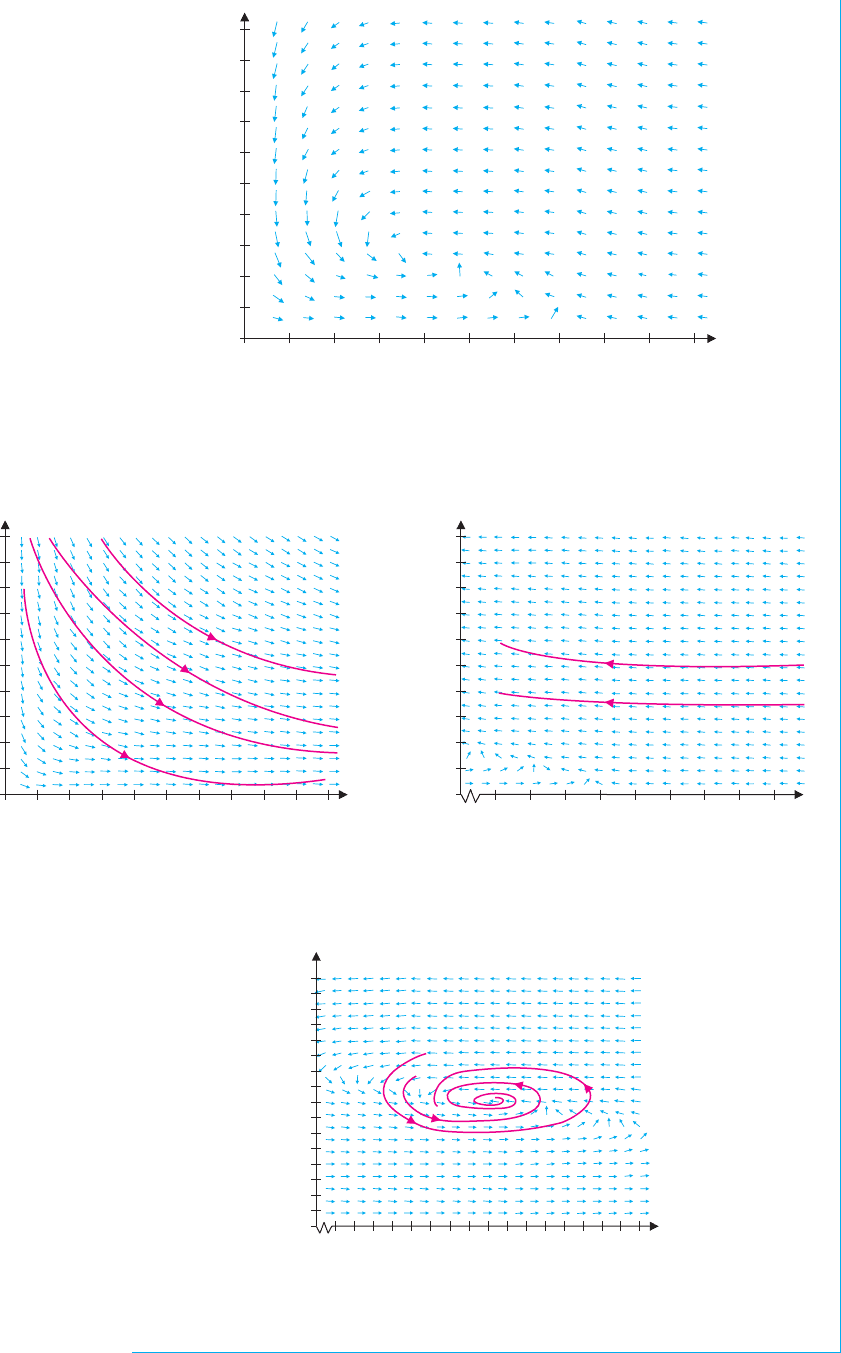
FIGURE 8.20
Direction field
x
y
0.1
0.09
0.08
0.07
0.06
0.05
0.04
0.03
0.02
0.01
0 0.0125 0.025 0.0375 0.05 0.0625 0.075 0.0875 0.1 0.1125 0.12
x
y
0.1
0.09
0.08
0.07
0.06
0.05
0.04
0.03
0.02
0.01
1.95 1.962 1.975 1.987 2 2.012 2.025 2.038 2.05
FIGURE 8.21a
Phase portrait near (0, 0)
FIGURE 8.21b
Phase portrait near (2, 0)
x
y
0.2425
0.245
0.2475
0.25
0.2525
0.255
0.2575
0.26
0.2625
0.265
0.2675
0.27
0.24
0.235
0.2375
0.2325
0.23
0.98
0.9825
0.985
0.9875
0.99
0.9925
0.995
0.9975
1.0
1.0025
1.005
1.0075
1.01
1.0125
1.015
1.0175
1.02
FIGURE 8.21c
Phase portrait near (1, 0.25)

P1: OSO/OVY P2: OSO/OVY QC: OSO/OVY T1: OSO
MHDQ256-Ch08 MHDQ256-Smith-v1.cls December 16, 2010 21:19
LT (Late Transcendental)
CONFIRMING PAGES
524 CHAPTER 8
..
First-Order Differential Equations 8-34
We next consider a two-species system where the species compete for the same
resources and/or space. General equations describing this case (where species X has
population x(t) and species Y has population y(t)) are
x
(t) = b
1
x(t) − c
1
[x(t)]
2
− k
1
x(t)y(t)
y
(t) = b
2
y(t) − c
2
[y(t)]
2
− k
2
x(t)y(t),
forpositiveconstants b
1
, b
2
, c
1
, c
2
, k
1
andk
2
.Noticehowthis differsfrom the predator-prey
case. As before, species X grows logistically in the absence of species Y. However, here,
species Y also grows logistically in the absence of species X. Further, the interaction terms
k
1
x(t)y(t) and k
2
x(t)y(t) are now negative for both species. So, in this case, both species
survive nicely on their own but are hurt by the presence of the other. As with predator-prey
systems, our focus here is on finding equilibrium solutions.
EXAMPLE 4.3 Finding Equilibrium Solutions of a System of Equations
Find and interpret all equilibrium solutions of the competing species model
x
(t) = 0.4x(t) − 0.1[x(t)]
2
− 0.4x(t)y(t)
y
(t) = 0.3y(t) −0.2[y(t)]
2
− 0.1x(t)y(t).
Solution If (x, y) is an equilibrium solution, then the constant functions x(t) = x and
y(t) = y satisfy the system of equations with x
(t) = 0 and y
(t) = 0. Substituting into
the equations, we have
0 = 0.4x − 0.1x
2
− 0.4xy
0 = 0.3y − 0.2y
2
− 0.1xy.
Notice that both equations factor, to give
0 = 0.1x(4 − x −4y)
0 = 0.1y(3 − 2y − x).
The equations are equally complicated, so we work with both equations simultaneously.
From the top equation, either x = 0orx +4y = 4. From the bottom equation,
either y = 0orx + 2y = 3. Summarizing, we have
x = 0orx + 4y = 4
and
y = 0orx +2y = 3.
Taking x = 0 from the top line and y = 0 from the bottom gives us the equilibrium
solution (0, 0). Taking x = 0 from the top and substituting into x + 2y = 3onthe
bottom, we get y =
3
2
so that (0,
3
2
) is a second equilibrium solution. Note that (0, 0)
corresponds to the case where neither species exists and (0,
3
2
) corresponds to the case
where species Y exists but species X does not.
Substituting y = 0 from the bottom line into x + 4y = 4, we get x = 4 so that
(4, 0) is an equilibrium solution, corresponding to the case where species X exists but
species Y does not. The fourth and last possibility has x + 4y = 4 and x + 2y = 3.
Subtracting the equations gives 2y = 1ory =
1
2
. With y =
1
2
, x + 2y = 3 gives us
x = 2. The final equilibrium solution is then (2,
1
2
). In this case, both species exist, with
4 times as many of species X.
Since we have now considered all combinations that make both equations true, we
have found all equilibrium solutions of the system: (0, 0), (0,
3
2
), (4, 0) and (2,
1
2
).
We explore predator-prey systems and models for competing species further in the
exercises.
Systems of first-order differential equations also arise when werewrite a single higher-
order differential equation as a system of first-order equations. There are several reasons for
doing this, notably so that the theory and numerical approximation schemes for first-order
equations (such as Euler’s method from section 8.3) can be applied.

P1: OSO/OVY P2: OSO/OVY QC: OSO/OVY T1: OSO
MHDQ256-Ch08 MHDQ256-Smith-v1.cls December 16, 2010 21:19
LT (Late Transcendental)
CONFIRMING PAGES
8-35 SECTION 8.4
..
Systems of First-Order Differential Equations 525
A falling object is acted on by two primary forces, gravity (pulling down) and air drag
(pushing in the direction opposite the motion). In section 5.5, we solved a number of prob-
lems by ignoring air drag and assuming that the force due to gravity (i.e., the weight) is
constant. While these assumptions lead to solvable equations, in many important applica-
tions, neither assumption is valid. Air drag is frequently described as proportional to the
squareofvelocity.Further,theweightofanobjectofconstantmassisnotconstant,butrather,
depends on its distance from the center of the Earth. In this case, if we take y as the height
of the object abovethe surface of the Earth, then the velocity is y
and the acceleration is y
.
Theair drag is then c(y
)
2
,for some positive constant c (thedrag coefficient) and the weight
is−
mgR
2
(R + y)
2
,whereR istheradiusoftheEarth.Newton’ssecondlaw F = ma thengivesus
−
mgR
2
(R + y)
2
+ c(y
)
2
= my
.
Since this equation involves y, y
and y
, we refer to this as a second-order differential
equation. In example 4.4, we see how to write this as a system of first-order equations.
EXAMPLE 4.4 Writing a Second-Order Equation as a System
of First-Order Equations
Write the equation y
= 0.1(y
)
2
−
1600
(40 + y)
2
as a system of first-order equations.
Then, find any equilibrium solutions and interpret the result.
Solution The idea is to define new functions u and v where u = y and v = y
.We
then have u
= y
= v and
v
= y
= 0.1(y
)
2
−
1600
(40 + y)
2
= 0.1v
2
−
1600
(40 + u)
2
.
Summarizing, we have the system of first-order equations
u
= v
v
= 0.1v
2
−
1600
(40 + u)
2
.
The equilibrium points are then solutions of
0 = v
0 = 0.1v
2
−
1600
(40 + u)
2
.
With v = 0, observe that the second equation has no solution, so that there are no
equilibrium points. For a falling object, the position (u) is not constant and so, there are
no equilibrium solutions.
Some graphing calculators will graph solutions of differential equations, but the equa-
tions must be written as a single first-order equation or a system of first-order equations.
With the technique shown in example 4.4, you can use such a calculator to graph solutions
of higher-order equations.
EXERCISES 8.4
WRITING EXERCISES
1. Explain why in the general predator-prey model, the interac-
tion term k
1
xy is subtracted in the prey equation and k
2
xy is
added in the predator equation.
2. In general, explain why you would expect the constants for the
interaction terms in the predator-preymodel to satisfy k
1
> k
2
.
3. In example 4.1, the second equilibrium equation is solved to
get x = 1 and y = 0. Explain why this does not mean that
(1, 0) is an equilibrium point.
4. If the populations in a predator-prey or other system approach
constant values, explain why the values must come from an
equilibrium point.
P1: OSO/OVY P2: OSO/OVY QC: OSO/OVY T1: OSO
MHDQ256-Ch08 MHDQ256-Smith-v1.cls December 16, 2010 21:19
LT (Late Transcendental)
CONFIRMING PAGES
526 CHAPTER 8
..
First-Order Differential Equations 8-36
In exercises 1–6, find and interpret all equilibrium points for
the predator-prey model.
1.
x
= 0.2x −0.2x
2
− 0.4xy
y
=−0.1y + 0.2xy
2.
x
= 0.4x −0.1x
2
− 0.2xy
y
=−0.2y + 0.1xy
3.
x
= 0.3x −0.1x
2
− 0.2xy
y
=−0.2y + 0.1xy
4.
x
= 0.1x −0.1x
2
− 0.4xy
y
=−0.1y + 0.2xy
5.
x
= 0.2x −0.1x
2
− 0.4xy
y
=−0.3y + 0.1xy
6.
x
= 0.2x −0.1x
2
− 0.4xy
y
=−0.2y + 0.1xy
............................................................
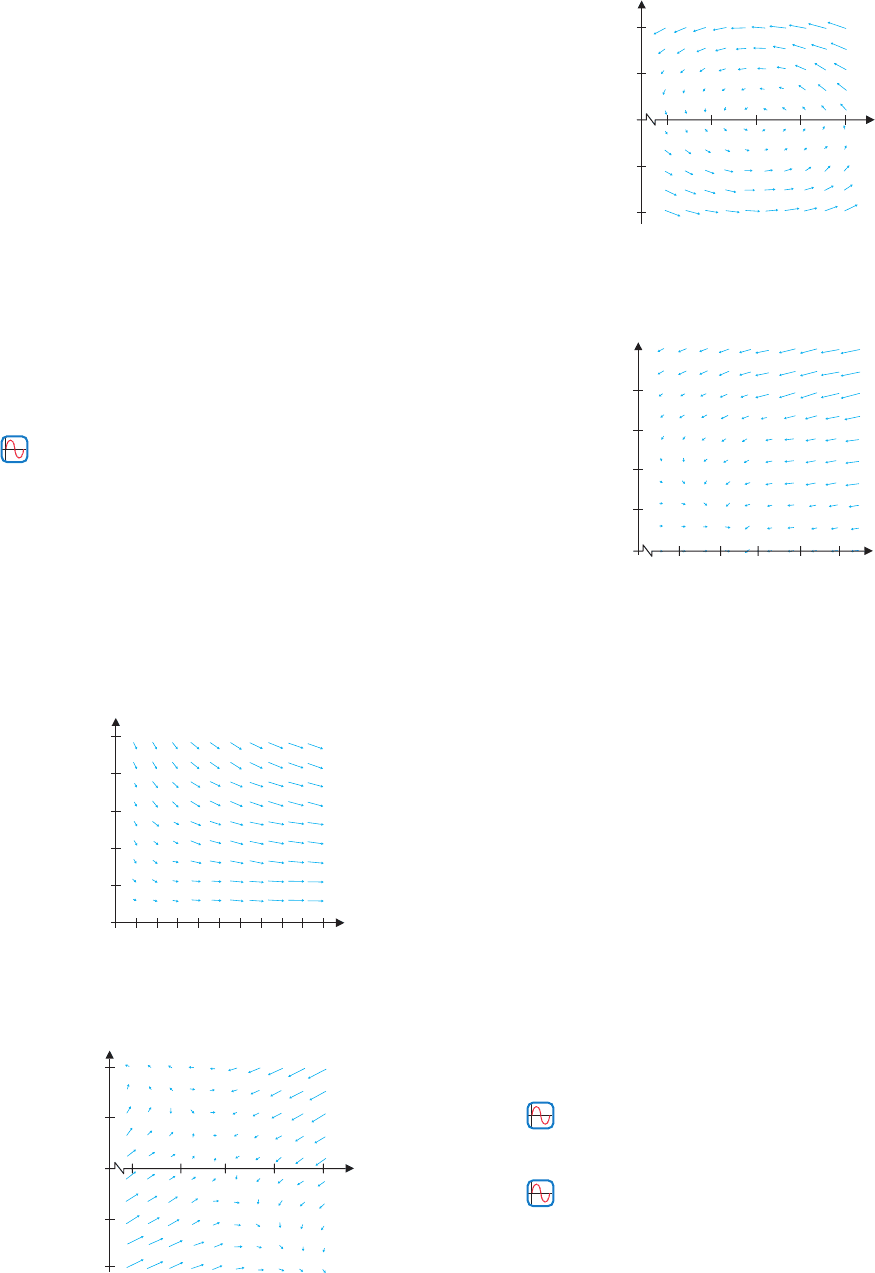
In exercises 7–10, use direction fields to determine the stability
of each equilibrium point found in the given exercise.
7. exercise 1 8. exercise 2 9. exercise 5 10. exercise 6
............................................................
In exercises 11–14, use the direction fields to determine the sta-
bility of each point.
11. The point (0, 0)
y
x
0.02 0.04 0.06 0.08 0.1
0.02
0.04
0.06
0.08
0.1
12. The point (0.5, 0.5)
x
y
0.48 0.49 0.50 0.51 0.52
0.51
0.52
0.49
0.50
0.48
13. The point (0.5, 0.5)
y
x
0.48 0.49 0.50 0.51 0.52
0.49
0.50
0.51
0.52
0.48
14. The point (1, 0)
y
x
0.02
0.04
0.96010.98 1.02 1.04
0.06
0.08
0.1
............................................................
In exercises 15–20, find and interpret all equilibrium points for
the competing species model. (Hint: There are four equilibrium
points in exercise 15.)
15.
x
= 0.3x − 0.2x
2
− 0.1xy
y
= 0.2y − 0.1y
2
− 0.1xy
16.
x
= 0.4x − 0.1x
2
− 0.2xy
y
= 0.5y − 0.4y
2
− 0.1xy
17.
x
= 0.3x − 0.2x
2
− 0.2xy
y
= 0.2y − 0.1y
2
− 0.2xy
18.
x
= 0.4x − 0.3x
2
− 0.1xy
y
= 0.3y − 0.2y
2
− 0.1xy
19.
x
= 0.2x − 0.2x
2
− 0.1xy
y
= 0.1y − 0.1y
2
− 0.2xy
20.
x
= 0.1x − 0.2x
2
− 0.1xy
y
= 0.3y − 0.2y
2
− 0.1xy
............................................................
Use the following in exercises 21 and 22. The competitive
exclusion principle in biology states that two species with the
same niche cannot coexist in the same ecology (as a stable
equilibrium).
21. Use direction fields to determine the stability of each equilib-
rium point in exercise 15. Do your results contradict or affirm
the competitive exclusion principle?
22. Use direction fields to determine the stability of each equilib-
rium point in exercise 16. Do your results contradict or affirm
the competitive exclusion principle?
............................................................

P1: OSO/OVY P2: OSO/OVY QC: OSO/OVY T1: OSO
MHDQ256-Ch08 MHDQ256-Smith-v1.cls December 16, 2010 21:19
LT (Late Transcendental)
CONFIRMING PAGES
8-37 SECTION 8.4
..
Systems of First-Order Differential Equations 527
23. Sketch solutions of the system of exercise 1 with the
initial conditions (a) x = 1, y = 1; (b) x = 0.2, y = 0.4; (c)
x = 1, y = 0.
24. Sketch solutions of the system of exercise 15 with the ini-
tial conditions (a) x = 0.5, y = 0.5; (b) x = 0.2, y = 0.4;
(c)x = 0, y = 0.5.
In exercises 25–28, write the second-order equation as a system
of first-order equations.
25. y
+ 2xy
+ 4y = 4x
2
26. y
− 3y
+ 3
√
xy = 4
27. y
− (cos x)y
+ xy
2
= 2x 28. xy
+ 3(y
)
2
= y + 2x
............................................................
29. To write a third-order equation as a system of equations, define
u
1
= y, u
2
= y
and u
3
= y
and compute derivatives as in ex-
ample 4.4. Write y
+ 2xy
− 4y
+ 2y = x
2
as a system of
first-order equations.
30. As in exercise 29, write y
− 2x
2
y
+ y
2
= 2 as a system of
first-order equations.
31. Write y
(4)
− 2y
+ xy
= 2 −e
x
as a system of first-order
equations.
32. Write y
(4)
− 2y
y
+ (cos x)y
2
= 0 as a system of first-order
equations.
33. Euler’s method applied to the system of equations
x
= f (x, y), x(0) = x
0
, y
= g(x, y), y(0) = y
0
is given by
x
n+1
= x
n
+ hf(x
n
, y
n
), y
n+1
= y
n
+ hg(x
n
, y
n
).
Use Euler’s method with h = 0.1 to estimate the solution at
t = 1 for exercise 3 with x(0) = y(0) = 0.2.
34. Use Euler’s method with h = 0.1 to estimate the solution at
t = 1 for exercise 15 with x(0) = y(0) = 0.2.
In exercises 35–38, find all equilibrium points.
35.
x
= (x
2
− 4)(y
2
− 9)
y
= x
2
− 2xy
36.
x
= (x − y)(1 − x − y)
y
= 2x − xy
37.
x
= (2 + x)(y − x)
y
= (4 − x)(x + y)
38.
x
=−x + y
y
= y + x
2
............................................................
39. Sketch the x–y phase portrait for
x
(t) = cos y
y
(t) = 2x
.
40. Sketch the x–y phase portrait for
x
(t) = cos y
y
(t) = sin 2x
.
APPLICATIONS
41. For the predator-prey model
x
= 0.4x −0.1x
2
− 0.2xy
y
=−0.5y + 0.1xy
show that the species cannot coexist. If the death rate 0.5 of
speciesYcouldbereduced,determinehowmuchitwouldhave
to decrease before the species can coexist.
42. In exercise 41, if the death rate of species Y stays constant but
the birthrate 0.4 of species X can be increased, determine how
much it would have to increase before the species can coexist.
Briefly explain why an increase in the birthrate of species X
could help species Y survive.
43. For the general predator-prey model
x
= bx −cx
2
− k
1
xy
y
=−dy + k
2
xy
show that the species can coexist if and only if bk
2
> cd.
44. In the predator-prey model of exercise 43, the prey could
be a pest insect that attacks a farmer’s crop and the preda-
tor, a natural predator (e.g., a bat) of the pest. Assume that
c = 0 and the coexistence equilibrium point is stable. The
effect of a pesticide would be to reduce the birthrate b of
the pest. It could also potentially increase the death rate d
of the predator. If this happens, state the effect on the co-
existence equilibrium point. Is this the desired effect of the
pesticide?
EXPLORATORY EXERCISES
1. Inthisexercise,weexpandthepredator-preymodelofexample
4.1 to a model of a small ecology with one predator and two
prey. To start, let x and y be the populations of the prey species
and z the predator population. Consider the model
x
(t) = b
1
x(t) − k
1
x(t)z(t)
y
(t) = b
2
y(t) − k
2
y(t)z(t)
z
(t) =−dz(t) +k
3
x(t)z(t) +k
4
y(t)z(t)
for positive constants b
1
, b
2
, d and k
1
,...,k
4
. Notice that in
the absence of the predator, each prey population grows ex-
ponentially. Assuming that the predator population is reason-
ably large and stable, explain why it might be an acceptable
simplification to leave out the x
2
and y
2
terms for logistic
growth. According to this model, are there significant inter-
actions between the x and y populations? Find all equilib-
rium points and determine the conditions under which all
three species could coexist. Repeat this with the logistic terms
restored.
x
(t) = b
1
x(t) − c
1
[x(t)]
2
− k
1
x(t)z(t)
y
(t) = b
2
y(t) − c
2
[y(t)]
2
− k
2
y(t)z(t)
z
(t) =−dz(t) +k
3
x(t)z(t) +k
4
y(t)z(t)
Does it make any difference which model is used?
2. For the general competing species model
x
(t) = b
1
x(t) − c
1
[x(t)]
2
− k
1
x(t)y(t)
y
(t) = b
2
y(t) − c
2
[y(t)]
2
− k
2
x(t)y(t)
showthat the species cannot coexist under either of the follow-
ing conditions:
(a)
b
1
k
1
>
b
2
c
2
and
b
1
c
1
>
b
2
k
2
or (b)
b
2
k
2
>
b
1
c
1
and
b
2
c
2
>
b
1
k
1
.

P1: OSO/OVY P2: OSO/OVY QC: OSO/OVY T1: OSO
MHDQ256-Ch08 MHDQ256-Smith-v1.cls December 16, 2010 21:19
LT (Late Transcendental)
CONFIRMING PAGES
528 CHAPTER 8
..
First-Order Differential Equations 8-38
Review Exercises
WRITING EXERCISES
The following list includes terms that are defined and theorems
that are stated in this chapter. For each term or theorem, (1) give
a precise definition or statement, (2) state in general terms what
it means and (3) describe the types of problems with which it is
associated.
Differential equation Doubling time Half-life
Newton’s Law of Equilibrium solution Stable
Cooling Logistic growth Euler’s method
Separable equation System of equations
Direction field Phase portrait
Predator-prey systems
TRUE OR FALSE
State whether each statement is true or false and briefly explain
why. If the statement is false, try to “fix it” by modifying the given
statement to a new statement that is true.
1. For exponential growth and decay, the rate of change is
constant.
2. For logistic growth, the rate of change is proportional to the
amount present.
3. Any separable equation can be solved for y as a function of x.
4. The direction field of a differential equation is tangent to the
solution.
5. The smaller h is, the more accurate Euler’s method is.
6. An equilibrium point of a system of two equations and un-
known functions x and y is any value of x such that x
= 0or
y
= 0.
7. A phase portrait shows several solutions on the same graph.
In exercises 1–6, solve the IVP.
1. y
= 2y, y(0) = 3 2. y
=−3y, y(0) = 2
3. y
=
2x
y
, y(0) = 2 4. y
=−3xy
2
, y(0) = 4
5. y
=
√
xy, y(1) = 4 6. y
= x + y
2
x, y(0) = 1
............................................................
7. A bacterial culture has an initial population 10
4
and doubles
every 2 hours. Find an equation for the population at any time
t and determine when the population reaches 10
6
.
8. An organism has population 100 at time t = 0 and population
140 at time t = 2. Find an equation for the population at any
time and determine the population at time t = 6.
9. The half-life of nicotine in the human bloodstream is 2 hours.
If there is initially 2 mg of nicotine present, find an equation
for the amount at any time t and determine when the nicotine
level reaches 0.1 mg.
10. If the half-life of a radioactive material is 3 hours, what per-
centage of the material will be left after 9 hours? 11 hours?
11. Ifyou invest $2000at 8% compounded continuously,howlong
will it take the investment to double?
12. If you invest $4000 at 6% compounded continuously, how
much will the investment be worth in 10 years?
13. A cup of coffee is served at 180
◦
F in a room with temperature
68
◦
F. After 1 minute, the temperature has dropped to 176
◦
F.
Find an equation for the temperature at any time and determine
when the temperature will reach 120
◦
F.
14. Acold drink is servedat 46
◦
Fin a room with temperature 70
◦
F.
After 4 minutes, the temperature has increased to 48
◦
F. Find an
equation for the temperature at any time and determine when
the temperature will reach 58
◦
F.
............................................................
In exercises 15–18, solve each separable equation, explicitly if
possible.
15. y
= 2x
3
y 16. y
=
y
√
1 − x
2
17. y
=
4
(y
2
+ y)(1 + x
2
)
18. y
= e
x+y
............................................................
In exercises 19–22, find all equilibrium solutions and determine
which are stable and which are unstable.
19. y
= 3y(2 − y) 20. y
= y(1 − y
2
)
21. y
=−y
1 + y
2
22. y
= y +
2y
1 − y
............................................................
In exercises 23–26, sketch the direction field.
23. y
=−x(4 − y) 24. y
= 4x − y
2
25. y
= 2xy − y
2
26. y
= 4x − y
............................................................
27. Suppose that the concentration x of a chemical in a
bimolecular reaction satisfies the differential equation
x
(t) = (0.3 − x)(0.4 − x) − 0.25x
2
. For (a) x(0) = 0.1 and
(b) x(0) = 0.4, find the concentration at any time. Graph the
solutions. Explain what is physically impossible about
problem (b).
28. For exercise 27, find equilibrium solutions and use a slope
diagram to determine the stability of each equilibrium.
29. In the second-order chemical reaction x
= r(a − x)(b − x),
suppose that A and B are the same (thus, a = b). Identify the
values of x that are possible. Draw the direction field and de-
termine the limiting amount lim
t→∞
x(t). Verify your answer by
solving for x. Interpret the physical significance of a in this
case.
30. In an autocatalytic reaction, a substance reacts with itself.
Explain why the concentration would satisfy the differential

P1: OSO/OVY P2: OSO/OVY QC: OSO/OVY T1: OSO
MHDQ256-Ch08 MHDQ256-Smith-v1.cls December 16, 2010 21:19
LT (Late Transcendental)
CONFIRMING PAGES
8-39 CHAPTER 8
..
Review Exercises 529
Review Exercises
equation x
= rx(1 − x).Identify thevaluesof x thatarepossi-
ble.Drawthedirection field and determine thelimiting amount
lim
t→∞
x(t). Verify your answer by solving for x.
31. Suppose that $100,000 is invested initially and continuous de-
posits are made at the rate of $20,000 per year. Interest is
compounded continuously at 10%. How much time will ittake
for the account to reach $1 million?
32. Rework exercise 31 withthe $20,000 paymentmade at theend
of each year instead of continuously.
............................................................
In exercises 33–36, identify the system of equations as a
predator-prey model or a competing species model. Find and
interpret all equilibrium points.
33.
x
= 0.1x −0.1x
2
− 0.2xy
y
=−0.1y + 0.1xy
34.
x
= 0.2x −0.1x
2
− 0.2xy
y
= 0.1y − 0.1y
2
− 0.1xy
35.
x
= 0.5x −0.1x
2
− 0.2xy
y
= 0.4y − 0.1y
2
− 0.2xy
36.
x
= 0.4x −0.1x
2
− 0.2xy
y
=−0.2y + 0.1xy
............................................................
37. Use direction fields to determine the stability of each equilib-
rium point in exercise 33.
38. Use direction fields to determine the stability of each equilib-
rium point in exercise 35.
39. Write the second-order equation y
− 4x
2
y
+ 2y = 4xy − 1
as a system of first-order equations.
40. If you have a CAS that can solve systems of equations, sketch
solutionsofthesystem of exercise33 withtheinitialconditions
(a) x = 0.4, y = 0.1; (b) x = 0.1, y = 0.4.
EXPLORATORY EXERCISES
1. In this exercise, we compare two models of the vertical veloc-
ity of a falling object. Forces acting on the object are gravity
and air drag. From experience, you know that the faster an
object moves, the more air drag there is. But, is the drag force
proportional to velocity v or the square of velocity v
2
? It turns
out that the answer depends on the shape and speed of the
object. The goal of this exercise is to explore how much dif-
ference it makes which model is used. Define the following
models for a falling object with v ≤ 0 (units of meters and
seconds):
Model 1:
dv
dt
=−9.8 + 0.7v
Model 2:
dv
dt
=−9.8 + 0.05v
2
.
Solve each equation with the initial condition v(0) = 0. Graph
the two solutions onthe same axes and discuss similarities and
differences. Show that in both cases the limiting velocity is
lim
t→∞
v(t) = 14 m/s. In each case, determine the time required
to reach 4 m/s and the time required to reach 13 m/s. Summa-
rizing, discuss howmuch differenceit makeswhich model you
use.
2. In this exercise, we compare the two drag models for objects
moving horizontally. Since gravity does not affect horizontal
motion, if v ≥ 0, the models are
Model 1:
dv
dt
=−c
1
v
Model 2:
dv
dt
=−c
2
v
2
,
for positiveconstants c
1
and c
2
. Explain why the negative signs
are needed. If v ≤ 0, how would the equations change? For a
pitched baseball, physicists find that the second model is more
accurate. The drag coefficient is approximately c
2
= 0.0025
if v is measured in ft/s. For comparison purposes, find the
value of c
1
such that c
1
v = c
2
v
2
for v = 132 ft/s (this is a
90-mph pitch). Then solve each equation with initial condi-
tion v(0) = 132. Find the time it takes the ball to reach home
plate 60 feet away. Find the velocity of the ball when itreaches
home plate. How much difference is there in the two models?
For a tennis serve, use the second model with c
2
= 0.003 to
estimate how much a 140-mph serve has slowed by the time it
reaches the service line 60 feet away. Both baseball and tennis
use radar guns to measure speeds. Based on your calculations,
does it make much of a difference at which point the speed of
a ball is measured?
This page intentionally left blank
P1: OSO/OVY P2: OSO/OVY QC: OSO/OVY T1: OSO
MHDQ256-Ch09 MHDQ256-Smith-v1.cls December 17, 2010 19:47
LT (Late Transcendental)
CONFIRMING PAGES
CHAPTER
9
Infinite Series
Everywhere we look today, we are surrounded by digital technologies.
Forinstance, music and video are now routinely delivered digitally, while
digital still and video cameras are now the standard. An essential ingre-
dient in this digital revolution has been the use of Fourier analysis, a
mathematical idea that is introduced in this chapter.
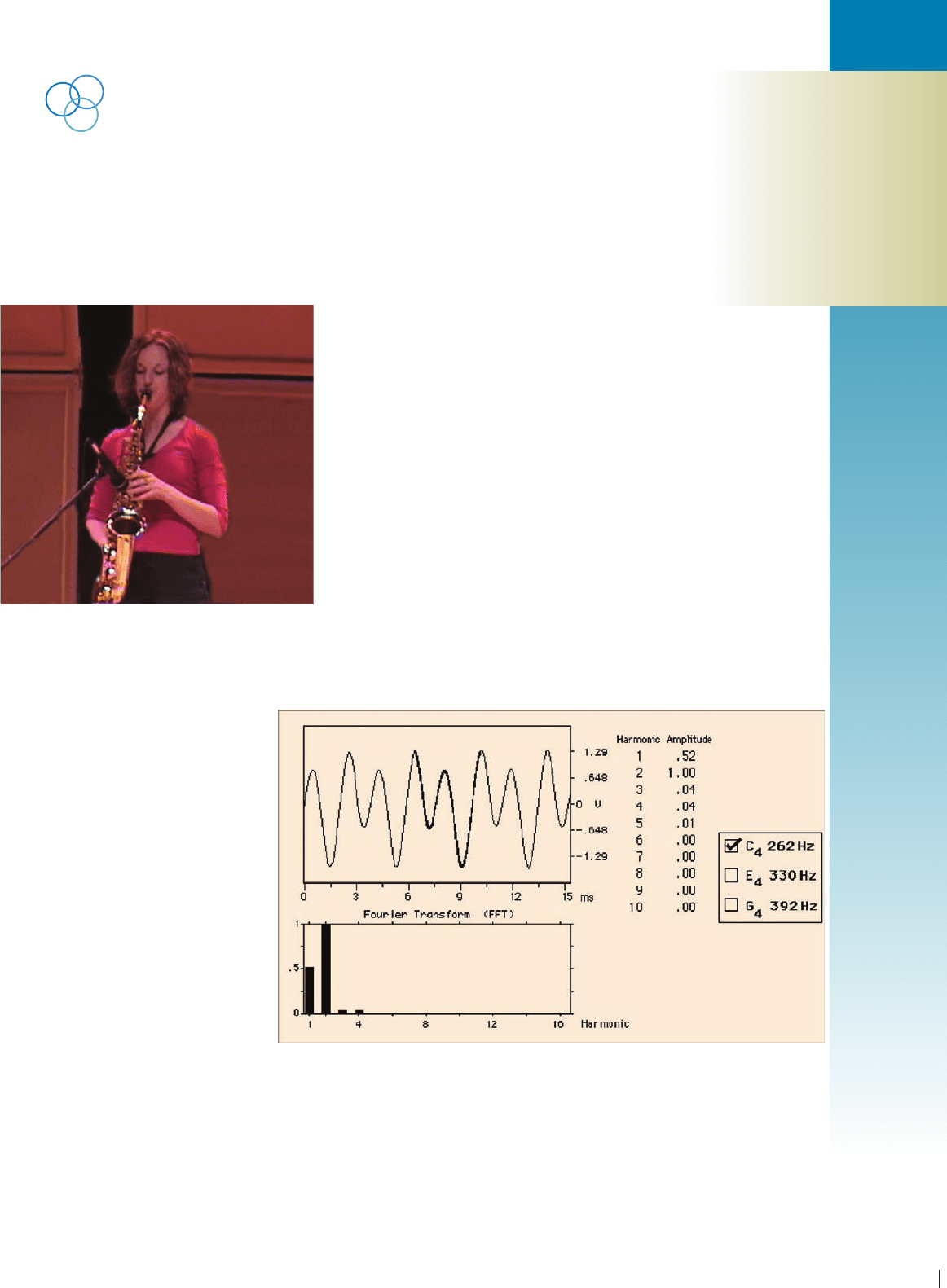
Thekeytothesedigitaltechnologiesistheabilitytotransformvarious
kinds of information into a digital format. For instance, the music made
by a saxophone might be initially represented as a series of notes on sheet
music,butthemusician bringsherownspecialinterpretation tothemusic.
Such an individual performance can then be recorded, to be copied and
replayedlater.Whilethisiseasilyaccomplishedwithconventionalanalog
technology,theadventofdigitaltechnologyhasallowedrecordingswitha
previouslyunknownfidelity. To do this, the music is broken down into its
component parts, which are individually recorded and then reassembled
ondemandtorecreatetheoriginalsound. So, the complexrhythms andintonations
generated by the saxophone reed and body are converted into a stream of digital
bits (zeros and ones), which are then turned back into music.
In this chapter, we learn how calculators can quickly approximate a quantity
like sin 1.234567, but we’ll also see how music synthesizers work. The mathe-
matics of these two modern marvels is surprisingly similar. Quite significantly, we
see how to express a wide range of functions in terms of much simpler functions,
opening up a new world of important applications.
531
P1: OSO/OVY P2: OSO/OVY QC: OSO/OVY T1: OSO
MHDQ256-Ch09 MHDQ256-Smith-v1.cls December 17, 2010 19:47
LT (Late Transcendental)
CONFIRMING PAGES
532 CHAPTER 9
..
Infinite Series 9-2
9.1 SEQUENCES OF REAL NUMBERS
The mathematical notion of sequence is not much differentfrom the common English usage
of the word. For instance, to describe the sequence of events that led up to a traffic accident,
you’d not only need to list the events, but you’d need to do so in the correct order.In
mathematics, the term sequence refers to an infinite collection of real numbers, written in
a specific order.
We have already seen sequences several times now. For instance, to find approximate
solutions to nonlinear equations such as tan x − x = 0, we began by first making an initial
guess, x
0
and then using Newton’s method to compute a sequence of successively improved
approximations, x
1
, x
2
,...,x
n
,....
DEFINITION OF SEQUENCE
A sequence is any function whose domain is the set of integers starting with some
integer n
0
(often 0 or 1). For instance, the function a(n) =
1
n
, for n = 1, 2, 3,...,
defines the sequence
1
1
,
1
2
,
1
3
,
1
4
,....
Here,
1
1
is called the first term,
1
2
is the second term and so on. We call a(n) =
1
n
the
general term, since it gives a (general) formula for computing all the terms of the
sequence. Further, we use subscript notation instead of function notation and write a
n
instead of a(n).
EXAMPLE 1.1 The Terms of a Sequence
Write out the first four terms of the sequence whose general term is given by a
n
=
n + 1
n
,
for n = 1, 2, 3,....
Solution We have the sequence
a
1
=
1 + 1
1
=
2
1
, a
2
=
2 + 1
2
=
3
2
, a
3
=
4
3
, a
4
=
5
4
,....
a
n
n
0.04
5 101520
0.08
0.12
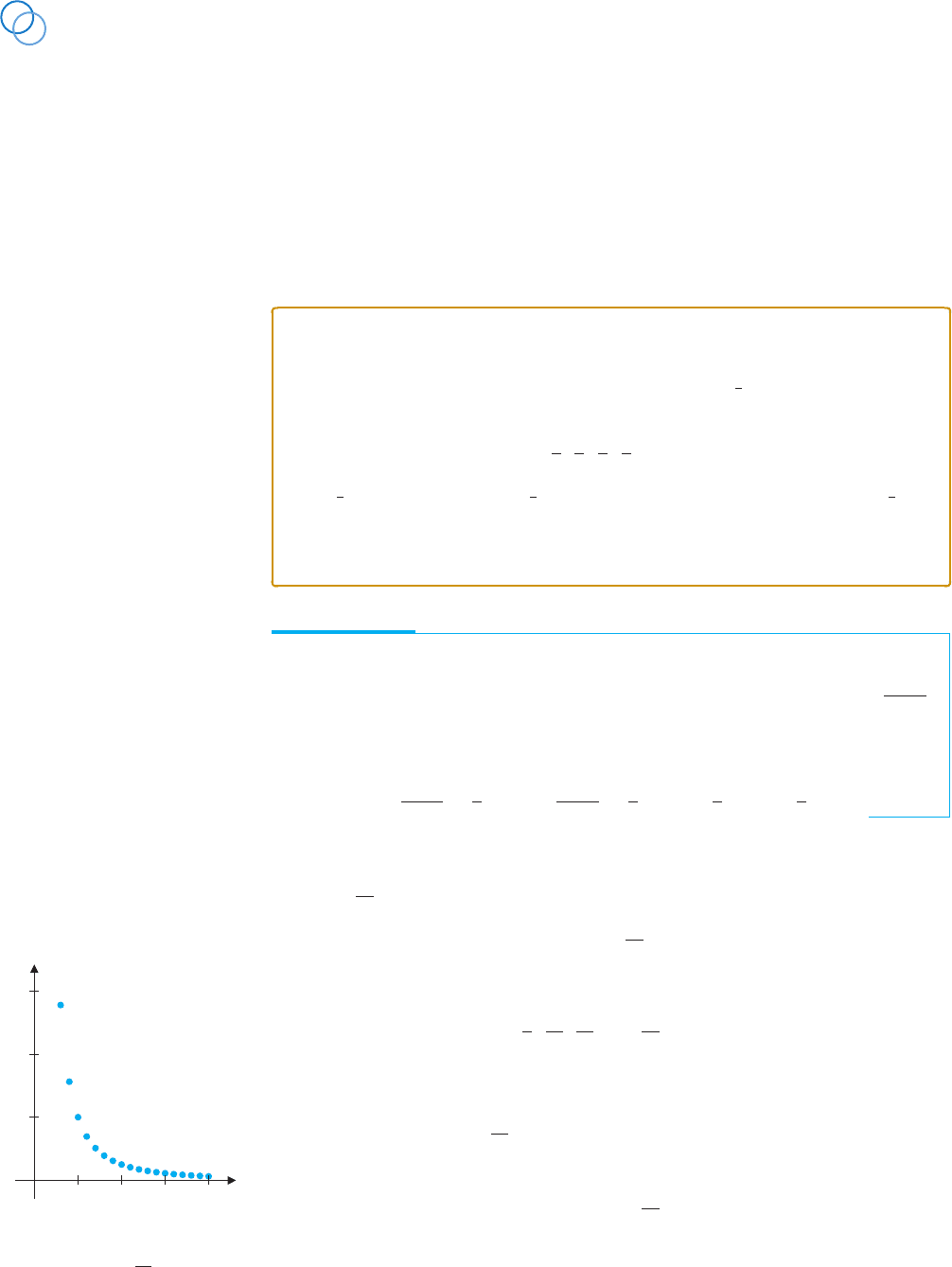
FIGURE 9.1
a
n
=
1
n
2
We often use set notation to denote a sequence. For instance, the sequence with general
term a
n
=
1
n
2
, for n = 1, 2, 3,..., is denoted by
{a
n
}
∞
n=1
=
1
n
2
∞
n=1
,
or equivalently, by listing the terms of the sequence:
1
1
,
1
2
2
,
1
3
2
,...,
1
n
2
,...
.
To graph this sequence, we plot a number of discrete points, since a sequence is a function
defined only on the integers. (See Figure 9.1.) Note that as n gets larger and larger, the
terms of the sequence, a
n
=
1
n
2
, get closer and closer to zero. In this case, we say that the
sequence converges to 0 and write
lim
n→∞
a
n
= lim
n→∞
1
n
2
= 0.
In general, we say that the sequence {a
n
}
∞
n=1
converges to L (i.e., lim
n→∞
a
n
= L)ifwe
can make a
n
as close to L as desired, simply by making n sufficiently large. Notice that this