
Smith R., Minton R. Calculus
Подождите немного. Документ загружается.

P1: OSO/OVY P2: OSO/OVY QC: OSO/OVY T1: OSO
MHDQ256-Ch09 MHDQ256-Smith-v1.cls December 17, 2010 19:47
LT (Late Transcendental)
CONFIRMING PAGES
9-3 SECTION 9.1
..
Sequences of Real Numbers 533
language parallels that used in the definition of the limit lim
x→∞
f (x) = L for a function of a
real variable x (given in section 1.6). The only difference is that n can take on only integer
values, while x can take on any real value (integer, rational or irrational).
When we say that we can make a
n
as close to L as desired (i.e., arbitrarily close), just
how close must we be able to make a
n
to L? Well, if you pick any (small) real number,
ε>0, you must be able to makea
n
within a distance ε of L, simply by making n sufficiently
large. That is, we need |a
n
− L| <ε.
We summarize this in Definition 1.1.
DEFINITION 1.1
The sequence {a
n
}
∞
n=n
0
converges to L if and only if given any number ε>0, there is
an integer N for which
|a
n
− L| <ε, for every n > N.
If there is no such number L, then we say that the sequence diverges.
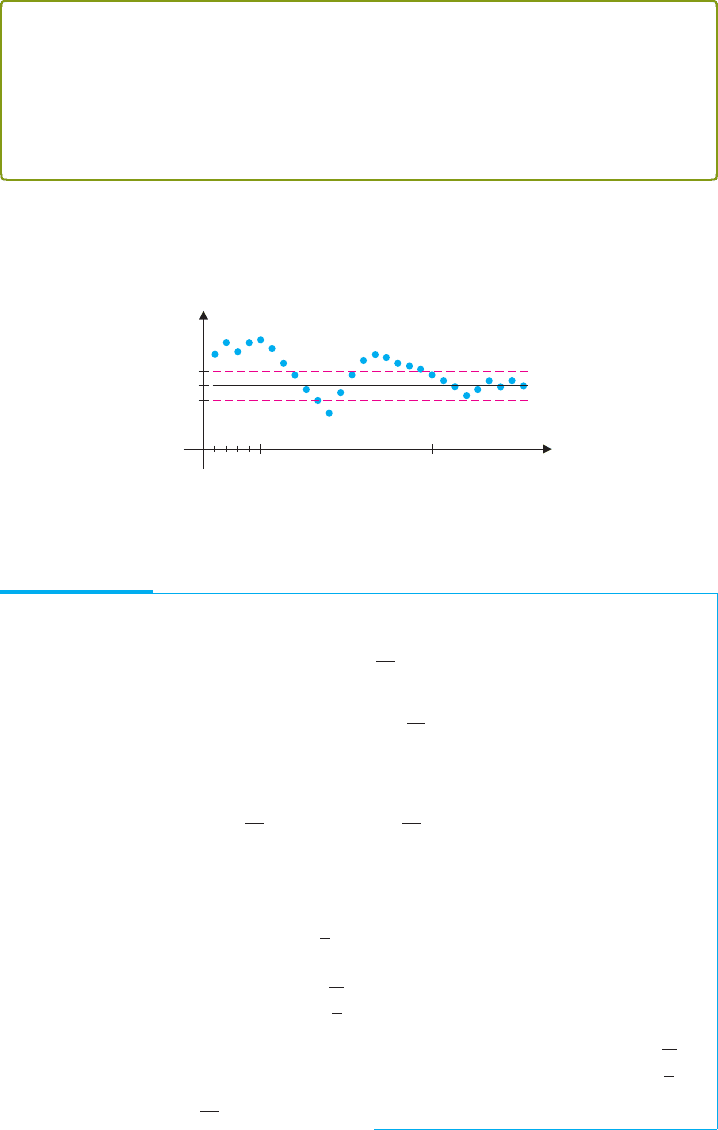
We illustrate Definition 1.1 in Figure 9.2. Notice that the definition says that the se-
quence {a
n
}
∞
n=1
converges to L if given any number ε>0, we can find an integer N so that
the terms of the sequence stay between L − ε and L + ε for all values of n > N.
y
n
12345 N
L
´
L
L
´
FIGURE 9.2
Convergence of a sequence
In example 1.2, we show how to use Definition 1.1 to prove that a sequence converges.
EXAMPLE 1.2 Proving That a Sequence Converges
Use Definition 1.1 to show that the sequence
1
n
2
∞
n=1
converges to 0.
Solution Here, we must show that we can make
1
n
2
as close to 0 as desired,
just by making n sufficiently large. So, given any ε>0, we must find N sufficiently
large so that for every n > N,
1
n
2
− 0
<ε or
1
n
2
<ε. (1.1)
Since n
2
and ε are positive, we can divide both sides of (1.1) by ε and multiply by n
2
,
to obtain
1
ε
< n
2
.
Taking square roots gives us
1
ε
< n.
Working backwards now, observe that if we choose N to be an integer with N ≥
1
ε
,
then n > N implies that
1
n
2
<ε, as desired.
P1: OSO/OVY P2: OSO/OVY QC: OSO/OVY T1: OSO
MHDQ256-Ch09 MHDQ256-Smith-v1.cls December 17, 2010 19:47
LT (Late Transcendental)
CONFIRMING PAGES
534 CHAPTER 9
..
Infinite Series 9-4
Most of the usual rules for computing limits of functions of a real variable also apply
to computing the limit of a sequence, as we see in Theorem 1.1.
THEOREM 1.1
Suppose that {a
n
}
∞
n=n
0
and {b
n
}
∞
n=n
0
both converge. Then
(i) lim
n→∞
(a
n
+ b
n
) = lim
n→∞
a
n
+ lim
n→∞
b
n
,
(ii) lim
n→∞
(a
n
− b
n
) = lim
n→∞
a
n
− lim
n→∞
b
n
,
(iii) lim
n→∞
(a
n
b
n
) =
lim
n→∞
a
n
lim
n→∞
b
n
and
(iv) lim
n→∞
a
n
b
n
=
lim
n→∞
a
n
lim
n→∞
b
n
(assuming lim
n→∞
b
n
= 0).
The proof of Theorem 1.1 is virtually identical to the proof of the corresponding
theorem about limits of a function of a real variable (see Theorem 3.1 in section 1.3 and
Appendix A) and is omitted.
To find the limit of a sequence, you should work largely the same as when computing
the limit of a function of a real variable, but keep in mind that sequences are defined only
for integer values of the variable.
a
n
n
5 10 15 20
1
2
3
4
5
6
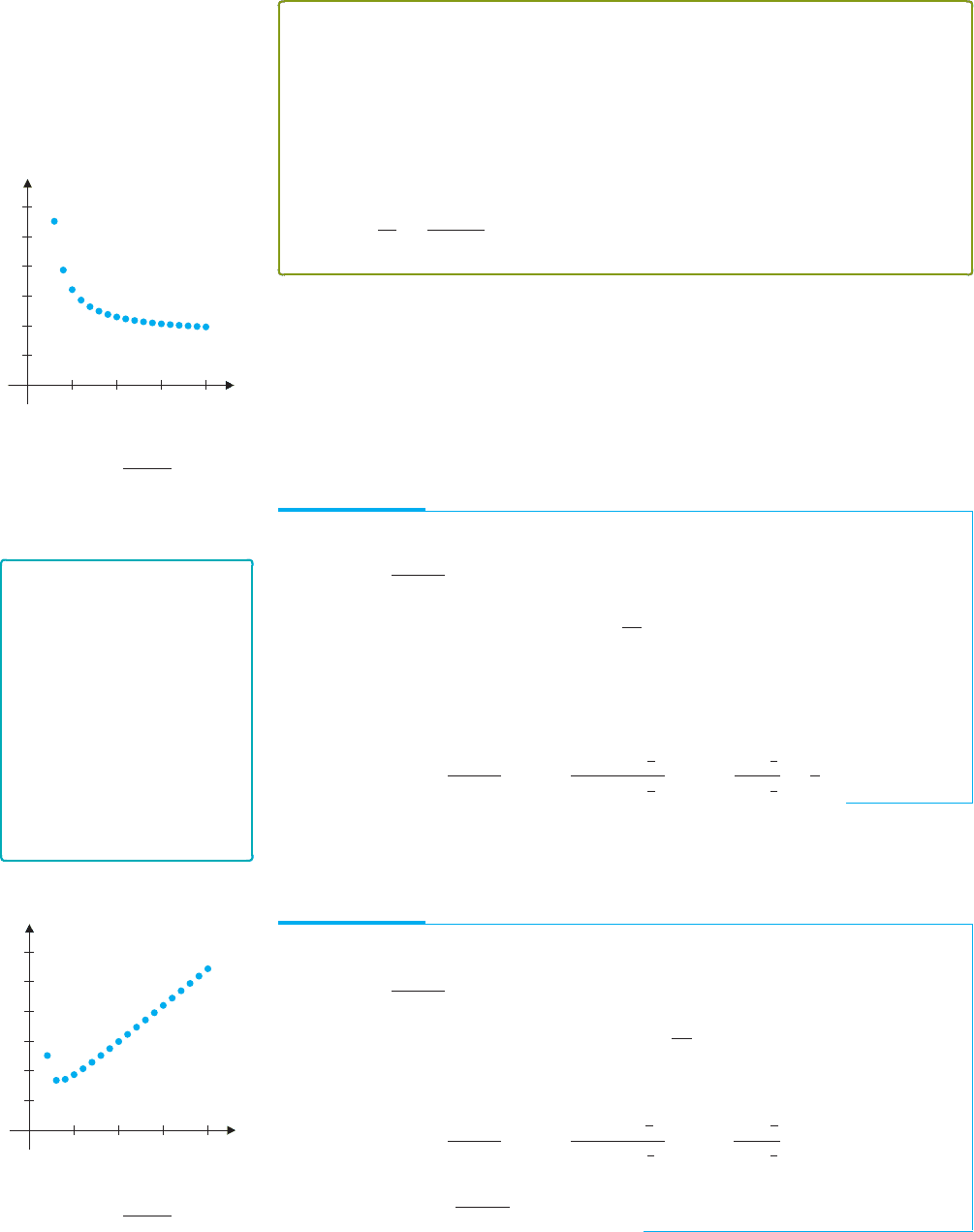
FIGURE 9.3
a
n
=
5n + 7
3n − 5
REMARK 1.1
If you (incorrectly) apply
l’Hˆopital’s Rule in example 1.3,
you get the right answer. (Go
ahead and try it; nobody’s
looking.) Unfortunately, you
will not always be so lucky. It’s
a lot like trying to cross a busy
highway: while there are times
when you can successfully cross
with your eyes closed, it’s not
generally recommended.
Theorem 1.2 describes how you
can safely use l’Hˆopital’s Rule.
EXAMPLE 1.3 Finding the Limit of a Sequence
Evaluate lim
n→∞
5n + 7
3n − 5
.
Solution This has the indeterminate form
∞
∞
. The graph in Figure 9.3 suggests that
the sequence tends to some limit around 2. Note that we cannot apply l’Hˆopital’s Rule
here, since the functions in the numerator and the denominator are defined only for
integer values of n and hence, are not differentiable. Instead, simply divide numerator
and denominator by the highest power of n in the denominator. We have
lim
n→∞
5n + 7
3n − 5
= lim
n→∞
(5n + 7)
1
n
(3n − 5)
1
n
= lim
n→∞
5 +
7
n
3 −
5
n
=
5
3
.
In example 1.4, we see a sequence that diverges by virtue of its terms tending to +∞.
a
n
n
5 10 15 20
2
4
6
8
10
12
FIGURE 9.4
a
n
=
n
2
+ 1
2n − 3
EXAMPLE 1.4 A Divergent Sequence
Evaluate lim
n→∞
n
2
+ 1
2n − 3
.
Solution Again, this has the indeterminate form
∞
∞
, but from the graph in Figure 9.4,
the sequence appears to be increasing without bound. Dividing top and bottom by n (the
highest power of n in the denominator), we have
lim
n→∞
n
2
+ 1
2n − 3
= lim
n→∞
(n
2
+ 1)
1
n
(2n − 3)
1
n
= lim
n→∞
n +
1
n
2 −
3
n
=∞
and so, the sequence
n
2
+ 1
2n − 3
∞
n=1
diverges.
P1: OSO/OVY P2: OSO/OVY QC: OSO/OVY T1: OSO
MHDQ256-Ch09 MHDQ256-Smith-v1.cls December 17, 2010 19:47
LT (Late Transcendental)
CONFIRMING PAGES
9-5 SECTION 9.1
..
Sequences of Real Numbers 535
In example 1.5, we see that a sequence doesn’t need to tend to ±∞in order to diverge.
EXAMPLE 1.5 A Divergent Sequence Whose Terms Do Not Tend to ∞
Determine the convergence or divergence of the sequence {(−1)
n
}
∞
n=1
.
Solution If we write out the terms of the sequence, we have
{−1, 1, −1, 1, −1, 1,...}.
That is, the terms of the sequence alternate back and forth between −1 and 1 and so,
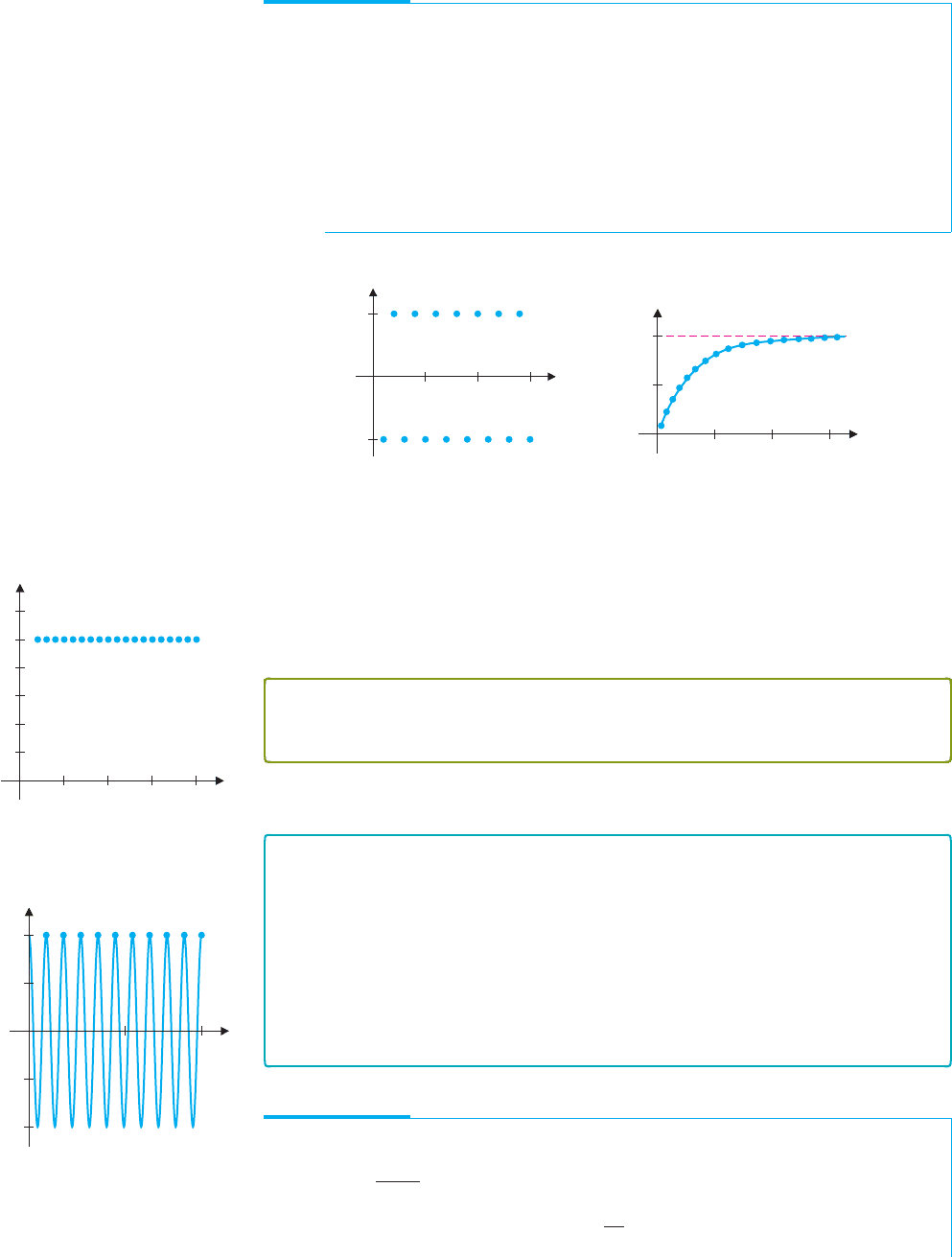
the sequence diverges. To see this graphically, we plot the first few terms of the
sequence in Figure 9.5. Notice that the points do not approach any limit (a horizontal
line).
10 155
1
1
a
n
n
5 1510
1
2
a
n
n
FIGURE 9.5
a
n
= (−1)
n
FIGURE 9.6
a
n
= f (n), where f (x) → 2,
as x →∞
You can use an advanced tool like l’Hˆopital’s Rule to find the limit of a sequence, but
you must be careful. Theorem 1.2 says that if f (x) → L as x →∞through all real values,
then f (n) must approach L, too, as n →∞through integer values. (See Figure 9.6 for a
graphical representation of this.)
5 10 15 20
0.2
0.4
0.6
0.8
1.0
1.2
a
n
n
FIGURE 9.7a
a
n
= cos(2πn)
10
0.5
1
0.5
1
x
y
FIGURE 9.7b
y = cos(2π x)
THEOREM 1.2
Suppose that lim
x→∞
f (x) = L. Then, lim
n→∞
f (n) = L, also.
REMARK 1.2
The converse of Theorem 1.2 is false. That is, if lim
n→∞
f (n) = L, it need not be true
that lim
x→∞
f (x) = L. This is clear from the following observation. Note that
lim
n→∞
cos(2πn) = 1,
since cos(2πn) = 1 for every integer n. (See Figure 9.7a.) However,
lim
x→∞
cos(2π x) does not exist,
since as x →∞, cos(2π x) oscillates between −1 and 1. (See Figure 9.7b.)
EXAMPLE 1.6 Applying L’H
ˆ
opital’s Rule to a Related Function
Evaluate lim
n→∞
n + 1
e
n
.
Solution This has the indeterminate form
∞
∞
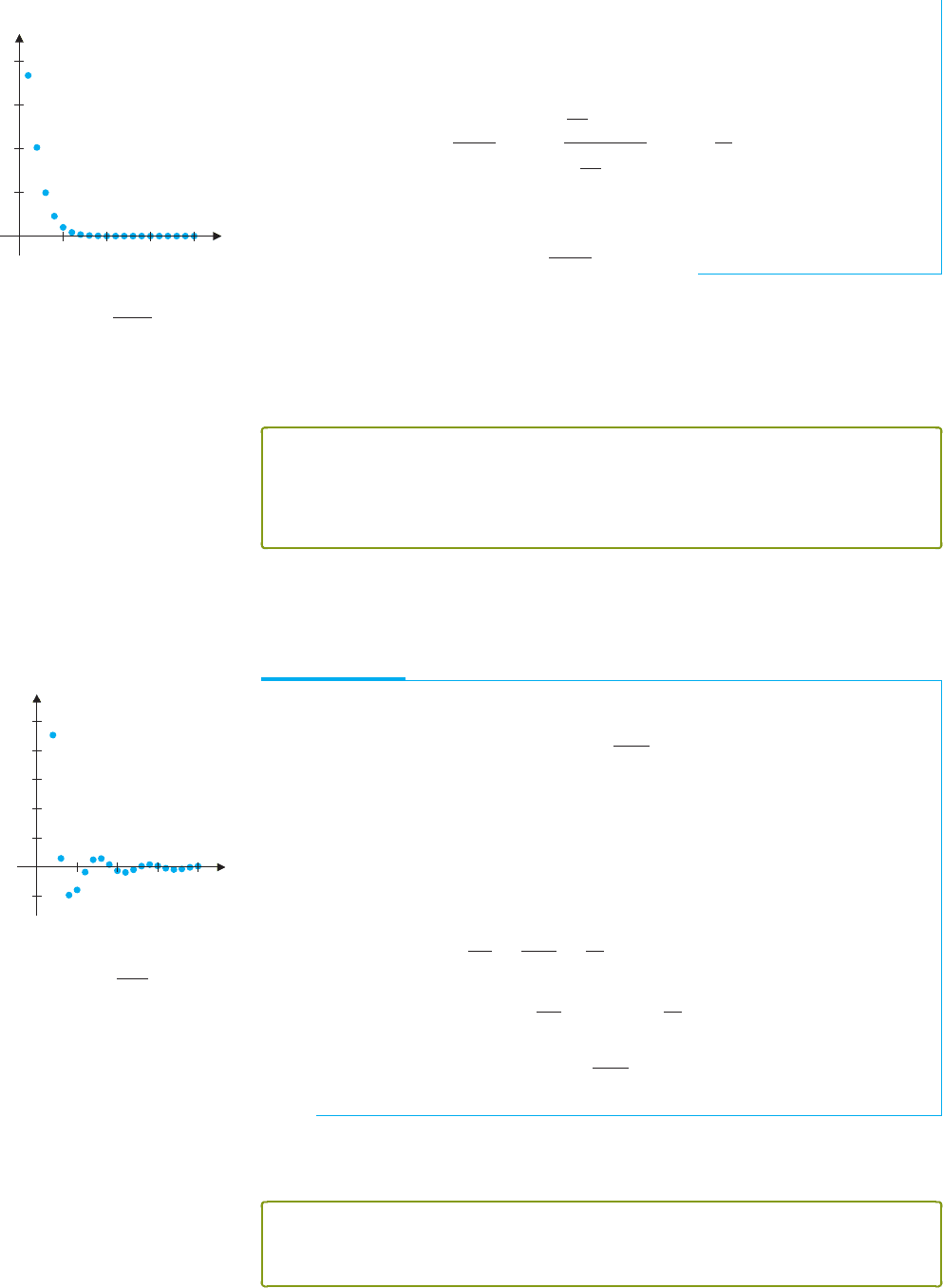
, but the graph in Figure 9.8 (on the
following page) suggests that the sequence converges to 0. However, there is no obvious
P1: OSO/OVY P2: OSO/OVY QC: OSO/OVY T1: OSO
MHDQ256-Ch09 MHDQ256-Smith-v1.cls December 17, 2010 19:47
LT (Late Transcendental)
CONFIRMING PAGES
536 CHAPTER 9
..
Infinite Series 9-6
way to resolve this, except by l’Hˆopital’s Rule (which does not apply to limits of
sequences). So, we instead consider the limit of the corresponding function of a real
variable to which we may apply l’Hˆopital’s Rule. (Be sure you check the hypotheses.)
We have
lim
x→∞
x +1
e
x
= lim
x→∞
d
dx
(x + 1)
d
dx
(e
x
)
= lim
x→∞
1
e
x
= 0.
5 101520
0.2
0.4
0.6
0.8
a
n
n
FIGURE 9.8
a
n
=
n + 1
e
n
From Theorem 1.2, we now have
lim
n→∞
n + 1
e
n
= 0, also.
For many sequences (including infinite series, which we study in the remainder of this
chapter), we don’t even have an explicit formula for the general term. In such cases, we
must test for convergence in some indirect way. Our first indirect tool corresponds to the
result (of the same name) for limits of functions of a real variable presented in section 1.3.
THEOREM 1.3 (Squeeze Theorem)
Suppose {a
n
}
∞
n=n
0
and {b
n
}
∞
n=n
0
are convergent sequences, both converging to the limit
L. If there is an integer n
1
≥ n
0
such that for all n ≥ n
1
, a
n
≤ c
n
≤ b
n
, then {c
n
}
∞
n=n
0
converges to L, too.
In example 1.7, we demonstrate how to apply the Squeeze Theorem to a sequence.
Observe that the trick here is to find two sequences, one on each side of the given sequence
(i.e., one larger and one smaller) that have the same limit.
10
5
15 20
0.05
0.25
0.20
0.15
0.10
0.05
a
n
n
FIGURE 9.9
a
n
=
sinn
n
2
EXAMPLE 1.7 Applying the Squeeze Theorem to a Sequence
Determine the convergence or divergence of
sinn
n
2
∞
n=1
.
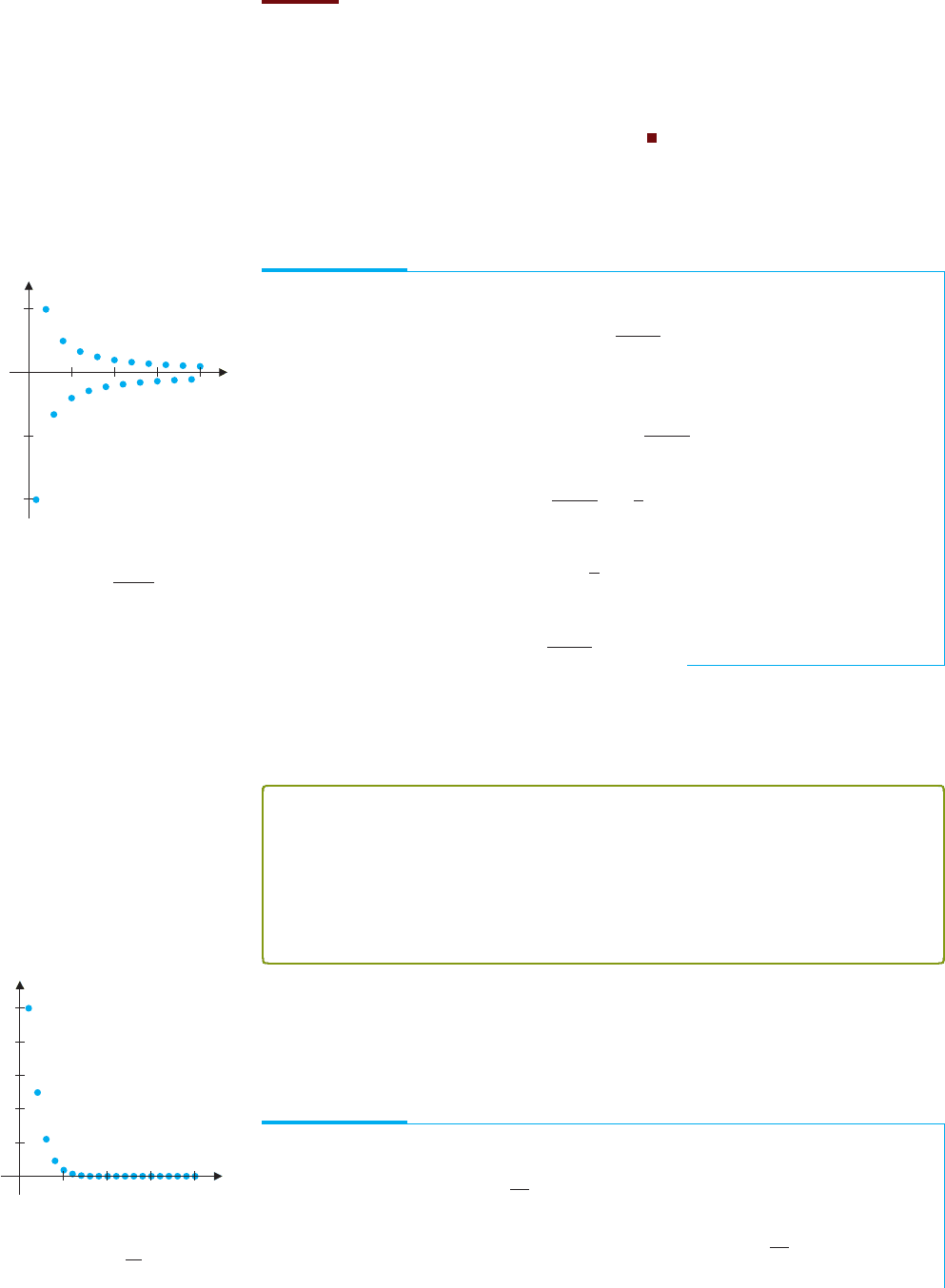
Solution From the graph in Figure 9.9, the sequence appears to converge to 0, despite
the oscillation. Further, note that you cannot compute this limit using the rules we have
established so far. (Try it!) However, since
−1 ≤ sinn ≤ 1, for all n,
dividing through by n
2
gives us
−1
n
2
≤
sinn
n
2
≤
1
n
2
, for all n ≥ 1.
Finally, since
lim
n→∞
−1
n
2
= 0 = lim
n→∞
1
n
2
,
the Squeeze Theorem gives us that
lim
n→∞
sinn
n
2
= 0,
also.
The following useful result follows immediately from Theorem 1.3.
COROLLARY 1.1
If lim
n→∞
|a
n
|=0, then lim
n→∞
a
n
= 0, also.
P1: OSO/OVY P2: OSO/OVY QC: OSO/OVY T1: OSO
MHDQ256-Ch09 MHDQ256-Smith-v1.cls December 17, 2010 19:47
LT (Late Transcendental)
CONFIRMING PAGES
9-7 SECTION 9.1
..
Sequences of Real Numbers 537
PROOF
Notice that for all n,
−|a
n
|≤a
n
≤|a
n
|.
Further, lim
n→∞
|a
n
|=0 and lim
n→∞
(−|a
n
|) =−lim
n→∞
|a
n
|=0.
So, from the Squeeze Theorem, lim
n→∞
a
n
= 0, too.
Corollary 1.1 is particularly useful for sequences with both positive and negative terms,
as in example 1.8.
105 15 20
1
0.5
0.5
a
n
n
FIGURE 9.10
a
n
=
(−1)
n
n
EXAMPLE 1.8 A Sequence with Terms of Alternating Signs
Determine the convergence or divergence of
(−1)
n
n
∞
n=1
.
Solution The graph of the sequence in Figure 9.10 suggests that although the
sequence oscillates, it still may be converging to 0. Since (−1)
n
oscillates back and
forth between −1 and 1, we cannot compute lim
n→∞
(−1)
n
n
directly. However, notice that
(−1)
n
n
=
1
n
and
lim
n→∞
1
n
= 0.
From Corollary 1.1, we get that lim
n→∞
(−1)
n
n
= 0, too.
We remind you of the following definition, which we use throughout the chapter.
DEFINITION 1.2
For any integer n ≥ 1, the factorial n! is defined as the product of the first n positive
integers,
n! = 1 · 2 · 3·····n.
We define 0! = 1.
Example 1.9 shows a sequence whose limit would be extremely difficultto find without
the Squeeze Theorem.
5 10 15 20
0.2
0.4
0.6
0.8
1.0
a
n
n
FIGURE 9.11
a
n
=
n!
n
n
EXAMPLE 1.9 A Proof of Convergence by the Squeeze Theorem
Investigate the convergence of
n!
n
n
∞
n=1
.
Solution First, notice that we have no means of computing lim
n→∞
n!
n
n
directly.
(Try this!) From the graph of the sequence in Figure 9.11, it appears that the sequence
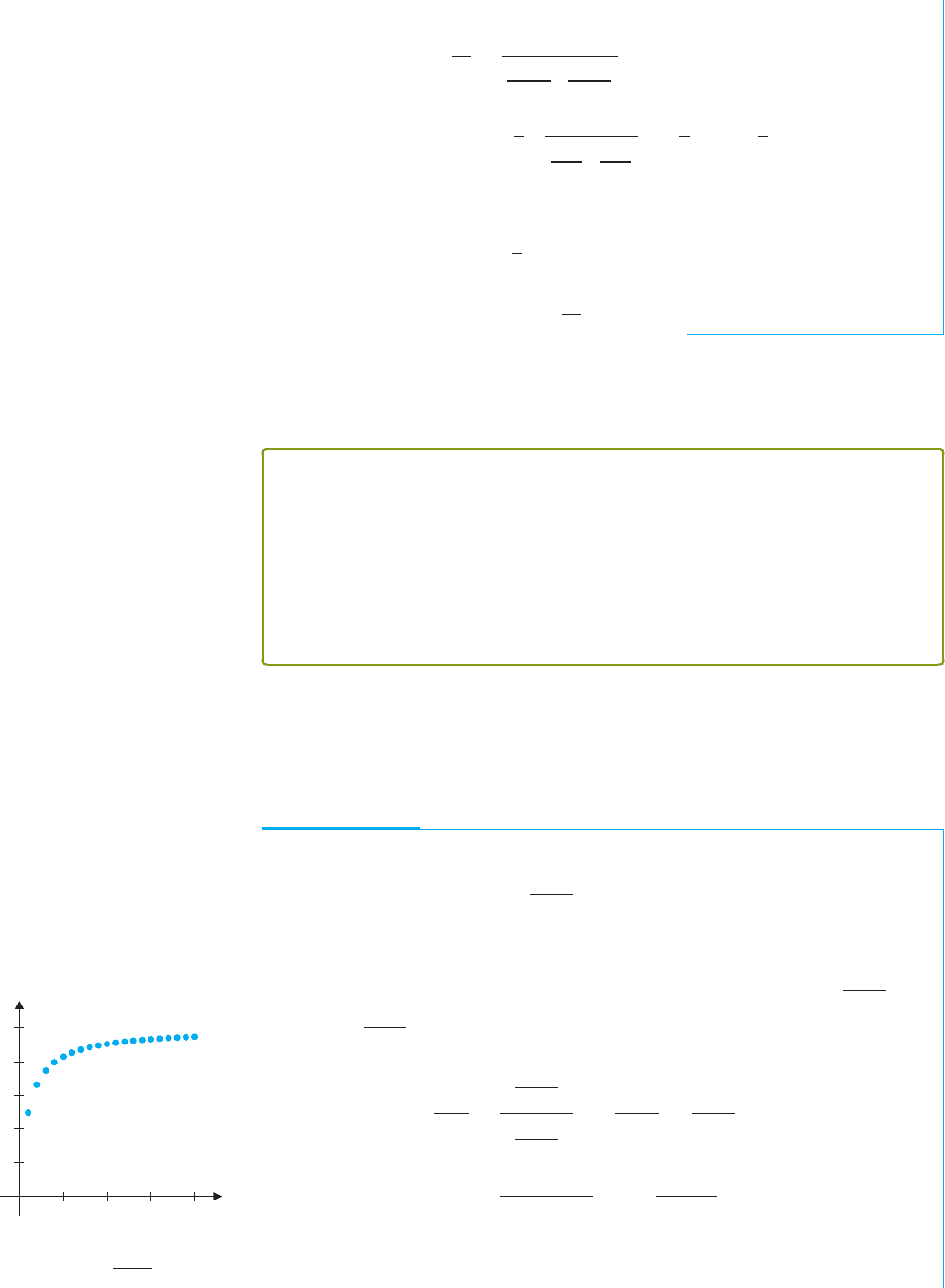
P1: OSO/OVY P2: OSO/OVY QC: OSO/OVY T1: OSO
MHDQ256-Ch09 MHDQ256-Smith-v1.cls December 17, 2010 19:47
LT (Late Transcendental)
CONFIRMING PAGES
538 CHAPTER 9
..
Infinite Series 9-8
is converging to 0. Notice that the general term of the sequence satisfies
0 <
n!
n
n
=
1 · 2 · 3·····n
n · n · n ·····n
n factors
=
1
n
2 · 3·····n
n · n ·····n
n − 1 factors
≤
1
n
(1) =
1
n
. (1.2)
From the Squeeze Theorem and (1.2), we have that since
lim
n→∞
1
n
= 0 and lim
n→∞
0 = 0,
then
lim
n→∞
n!
n
n
= 0, also.
Just as we did with functions of a real variable, we need to distinguish between
sequences that are increasing and decreasing. The definitions are straightforward.
DEFINITION 1.3
(i) The sequence {a
n
}
∞
n=1
is increasing if
a
1
≤ a
2
≤···≤a
n
≤ a
n+1
≤···.
(ii) The sequence {a
n
}
∞
n=1
is decreasing if
a
1
≥ a
2
≥···≥a
n
≥ a
n+1
≥···.
If a sequence is either increasing or decreasing, it is called monotonic.
There are several ways to show that a sequence is monotonic. Regardless of which
method you use, you will need to show that either a
n
≤ a
n+1
for all n (increasing) or
a
n+1
≤ a
n
for all n (decreasing). We illustrate two very useful methods in examples 1.10
and 1.11.
5 10 15 20
0.2
0.4
0.6
0.8
1.0
a
n
n
FIGURE 9.12
a
n
=
n
n + 1
EXAMPLE 1.10 An Increasing Sequence
Investigate whether the sequence
n
n + 1
∞
n=1
is increasing, decreasing or neither.
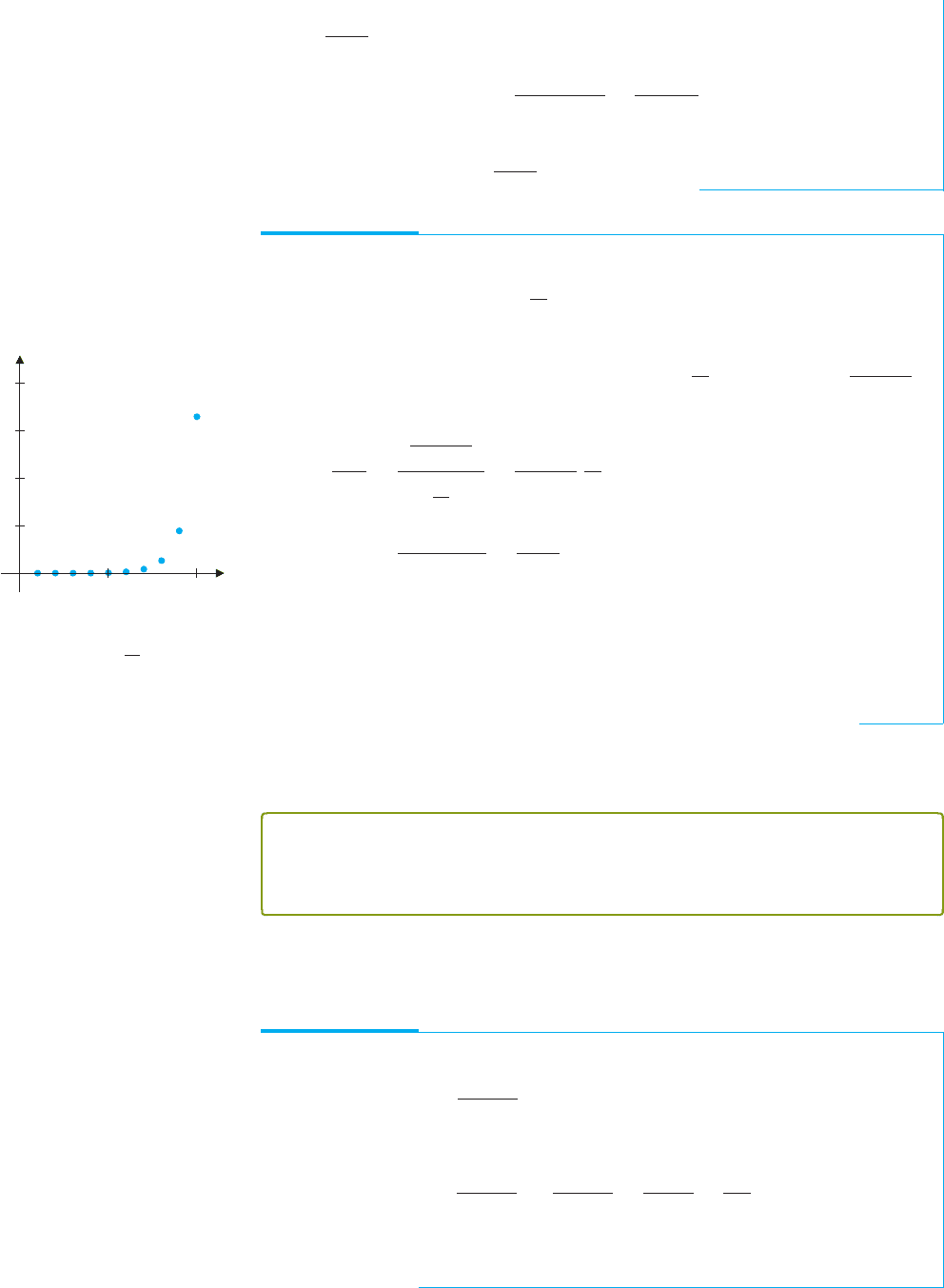
Solution From the graph in Figure 9.12, it appears that the sequence is increasing.
However, you should not be deceived by looking at the first few terms of a sequence.
More generally, we look at the ratio of two successive terms. Defining a
n
=
n
n + 1
,we
have a
n+1
=
n + 1
n + 2
and so,
a
n+1
a
n
=
n + 1
n + 2
n
n + 1
=
n + 1
n + 2
n + 1
n
=
n
2
+ 2n + 1
n
2
+ 2n
= 1 +
1
n
2
+ 2n
> 1. (1.3)
Multiplying both sides of (1.3) by a
n
> 0, we obtain
a
n+1
> a
n
,
P1: OSO/OVY P2: OSO/OVY QC: OSO/OVY T1: OSO
MHDQ256-Ch09 MHDQ256-Smith-v1.cls December 17, 2010 19:47
LT (Late Transcendental)
CONFIRMING PAGES
9-9 SECTION 9.1
..
Sequences of Real Numbers 539
for all n and so, the sequence is increasing. Alternatively, consider the function
f (x) =
x
x +1
(of the real variable x) corresponding to the sequence. Observe that
f
(x) =
(x + 1) − x
(x + 1)
2
=
1
(x + 1)
2
> 0,
which says that the function f (x) is increasing. From this, it follows that the
corresponding sequence a
n
=
n
n + 1
is also increasing.
105
50
100
150
200
a
n
n
FIGURE 9.13
a
n
=
n!
e
n
EXAMPLE 1.11 A Sequence That Is Increasing for n ≥ 2
Investigate whether the sequence
n!
e
n
∞
n=1
is increasing, decreasing or neither.
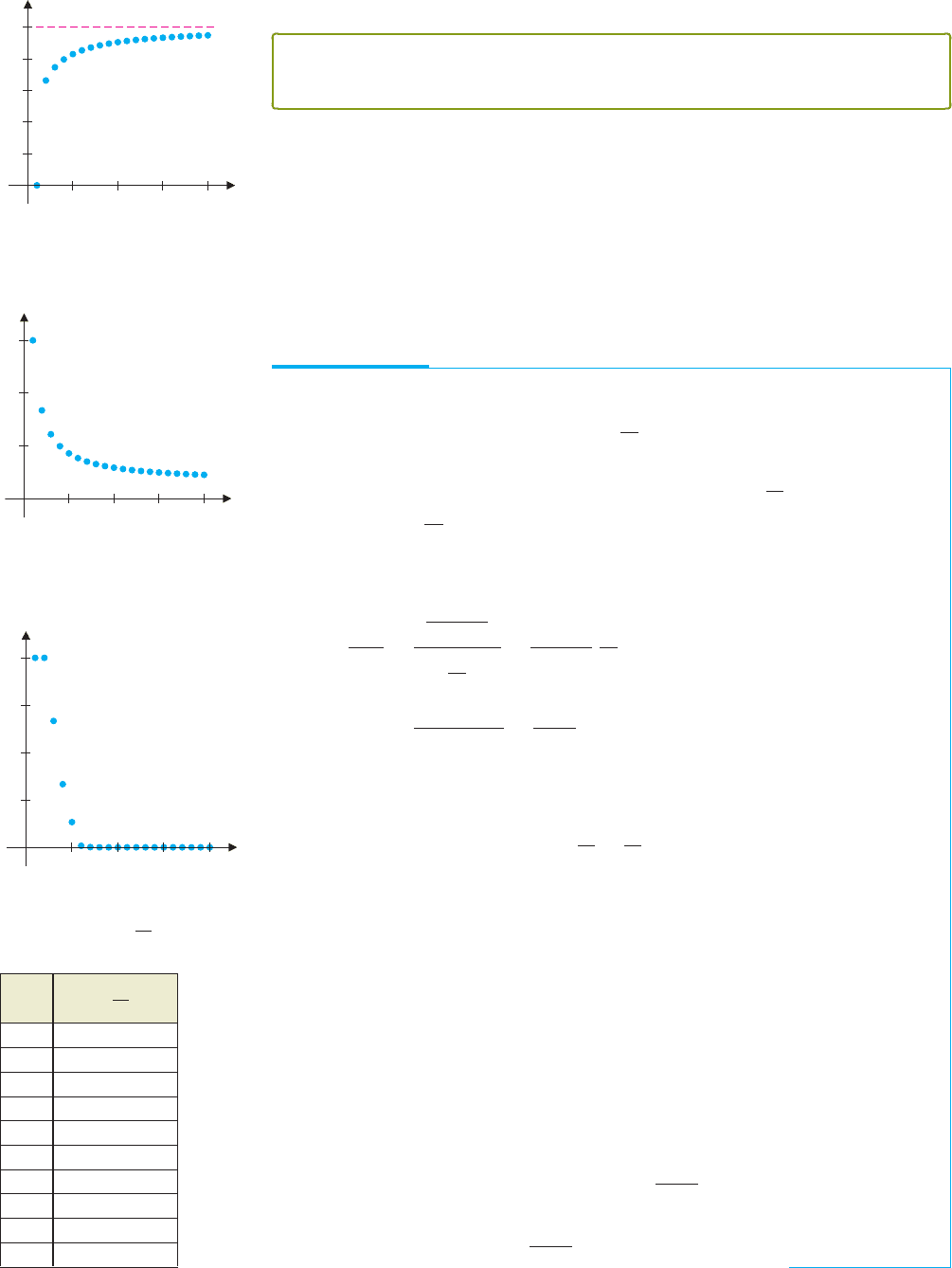
Solution From the graph of the sequence in Figure 9.13, it appears that the sequence
is increasing (and rather rapidly, at that). Here, for a
n
=
n!
e
n
,wehavea
n+1
=
(n + 1)!
e
n+1
,
so that
a
n+1
a
n
=
(n + 1)!
e
n+1
n!
e
n
=
(n + 1)!
e
n+1
e
n
n!
=
(n + 1)n!e
n
e(e
n
)n!
=
n + 1
e
> 1, for n ≥ 2.
Since (n + 1)! = (n + 1) · n! (1.4)
and e
n+1
= e · e
n
.
Multiplying both sides of (1.4) by a
n
> 0, we get
a
n+1
> a
n
, for n ≥ 2.
Notice that in this case, although the sequence is not increasing for all n, it is increasing
for n ≥ 2. Keep in mind that it doesn’t really matter what the first few terms do,
anyway. We are only concerned with the behavior of a sequence as n →∞.
We need to define one additional property of sequences.
DEFINITION 1.4
We say that the sequence {a
n
}
∞
n=n
0
is bounded if there is a number M > 0 (called a
bound) for which |a
n
|≤M, for all n.
It is important to realize that a given sequence may have any number of bounds (for
instance, if |a
n
|≤10 for all n, then |a
n
|≤20, for all n, too).
EXAMPLE 1.12 A Bounded Sequence
Show that the sequence
3 − 4n
2
n
2
+ 1
∞
n=1
is bounded.
Solution We use the fact that 4n
2
− 3 > 0, for all n ≥ 1, to get
|a
n
|=
3 − 4n
2
n
2
+ 1
=
4n
2
− 3
n
2
+ 1
<
4n
2
n
2
+ 1
<
4n
2
n
2
= 4.
So, this sequence is bounded by 4. (We might also say in this case that the sequence is
bounded between −4 and 4.) Further, note that we could also use any number greater
than 4 as a bound.
P1: OSO/OVY P2: OSO/OVY QC: OSO/OVY T1: OSO
MHDQ256-Ch09 MHDQ256-Smith-v1.cls December 17, 2010 19:47
LT (Late Transcendental)
CONFIRMING PAGES
540 CHAPTER 9
..
Infinite Series 9-10
Theorem 1.4 provides a powerful tool for the investigation of sequences.
THEOREM 1.4
Every bounded, monotonic sequence converges.
5 10 15 20
0.2
0.4
0.6
0.8
1.0
n
a
n
FIGURE 9.14a
A bounded and increasing
sequence
5 10 15 20
2
4
6
n
a
n
FIGURE 9.14b
A bounded and decreasing
sequence
A typical bounded and increasing sequence is illustrated in Figure 9.14a, while a
bounded and decreasing sequence is illustrated in Figure 9.14b. In both figures, notice that
a bounded and monotonic sequence can’t oscillate or increase/decrease without bound and
consequently, must converge. The proof of Theorem 1.4 is rather involved and we leave it
to the end of the section.
Theorem 1.4 says that if we can show that a sequence is bounded and monotonic, then
it must also be convergent, although we may have little idea of what its limit might be. Still,
once we establish that a sequence converges, we can approximate its limit by computing a
sufficient number of terms, as in example 1.13.
5 10 15 20
0.5
1.0
1.5
2.0
n
a
n
FIGURE 9.15
a
n
=
2
n
n!
EXAMPLE 1.13 A Bounded, Monotonic Sequence
Investigate the convergence of the sequence
2
n
n!
∞
n=1
.
Solution First, note that we do not know how to compute lim
n→∞
2
n
n!
. This has the
indeterminate form
∞
∞
, but we cannot use l’Hˆopital’s Rule here directly or indirectly.
(Why not?) The graph in Figure 9.15 suggests that the sequence converges to 0. To
confirm this suspicion, we first show that the sequence is monotonic. We have
a
n+1
a
n
=
2
n+1
(n + 1)!
2
n
n!
=
2
n+1
(n + 1)!
n!
2
n
=
2(2
n
)n!
(n + 1)n!2
n
=
2
n + 1
≤ 1, for n ≥ 1.
Since 2
n+1
= 2 · 2
n
and
(n + 1)! = (n + 1) · n!.
(1.5)
Multiplying both sides of (1.5) by a
n
> 0 gives us a
n+1
≤ a
n
for all n and so, the
sequence is decreasing. Next, since the sequence is decreasing, we have that
|a
n
|=
2
n
n!
≤
2
1
1!
= 2,
for n ≥ 1 (i.e., the sequence is bounded by 2). Since the sequence is both bounded and
monotonic, it must be convergent, by Theorem 1.4. We display a number of terms of the
sequence in the accompanying table, from which it appears that the sequence is
converging to approximately 0. We can make a slightly stronger statement, though.
Since we have established that the sequence is decreasing and convergent, we have
from our computations that
0 ≤ a
n
≤ a
20
≈ 4.31 × 10
−13
, for n ≥ 20.
Further, the limit L must also satisfy the inequality
0 ≤ L ≤ 4.31 × 10
−13
.
We can confirm that the limit is 0, as follows. From (1.5),
L = lim
n→∞
a
n+1
= lim
n→∞
2
n + 1
a
n
,
so that
L =
lim
n→∞
2
n + 1
lim
n→∞
a
n
= 0 · L = 0.
n a
n
2
n
n!
2 2
4 0.666667
6 0.088889
8 0.006349
10 0.000282
12 0.0000086
14 1.88 ×10
−7
16 3.13 ×10
−9
18 4.09 ×10
−11
20 4.31 ×10
−13
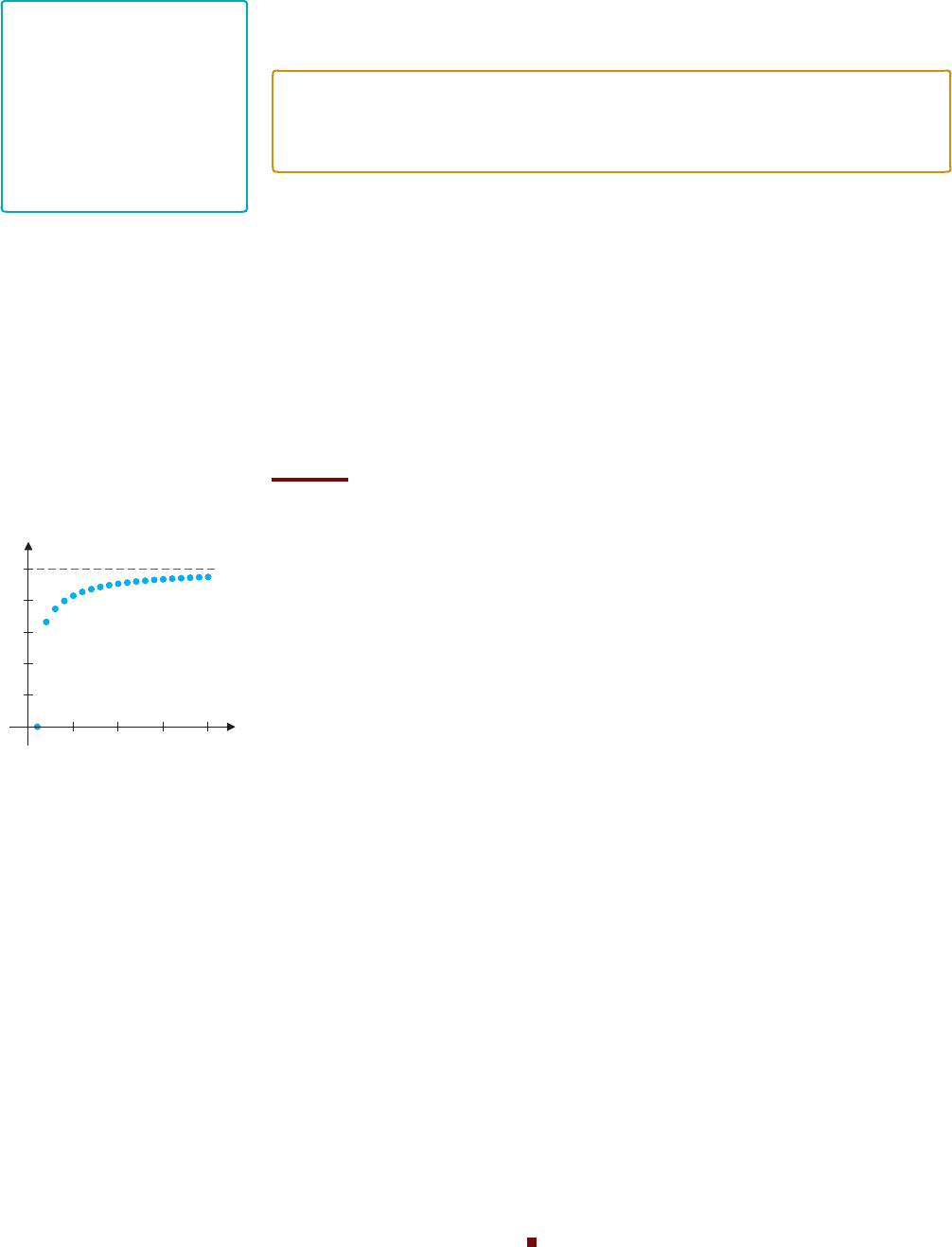
P1: OSO/OVY P2: OSO/OVY QC: OSO/OVY T1: OSO
MHDQ256-Ch09 MHDQ256-Smith-v1.cls December 17, 2010 19:47
LT (Late Transcendental)
CONFIRMING PAGES
9-11 SECTION 9.1
..
Sequences of Real Numbers 541
Proof of Theorem 1.4
Before we can prove Theorem 1.4, we need to state one of the properties of the real number
system.
REMARK 1.3
Do not underestimate the
importance of Theorem 1.4.
This indirect way of testing a
sequence for convergence takes
on additional significance when
we study infinite series (a
special type of sequence that is
the topic of the remainder of
this chapter).
THE COMPLETENESS AXIOM
If a nonempty set S of real numbers has a lower bound, then it has a greatest lower
bound. Equivalently, if it has an upper bound, it has a least upper bound.
This axiom says that if a nonempty set S has an upper bound, that is, a number M such
that
x ≤ M, for all x ∈ S,
then there is an upper bound L, for which
L ≤ M for all upper bounds, M,
with a corresponding statement holding for lower bounds.
The Completeness Axiom enables us to prove Theorem 1.4.
PROOF
(Increasing sequence) Suppose that {a
n
}
∞
n=n
0
is increasing and bounded. This is illustrated
in Figure 9.16, where you can see an increasing sequence bounded by 1. We have
a
1
≤ a
2
≤ a
3
≤···≤a
n
≤ a
n+1
≤···
and for some number M > 0, |a
n
|≤M for all n. This is the same as saying that
−M ≤ a
n
≤ M, for all n.
5 10 15 20
0.2
0.4
0.6
0.8
1.0
n
a
n
FIGURE 9.16
Bounded and increasing
Now, let S be the set containing all of the terms of the sequence, S ={a
1
, a
2
,...,a
n
,...}.
Notice that M is an upper bound for the set S. From the Completeness Axiom, S must have
a least upper bound, L. That is, L is the smallest number for which
a
n
≤ L, for all n. (1.6)
Notice that for any number ε>0, L − ε<L and so, L −ε is not an upper bound, since
L is the least upper bound. Since L −ε is not an upper bound for S, there is some element,
a
N
,ofS for which
L − ε<a
N
.
Since {a
n
} is increasing, we have that for n ≥ N, a
N
≤ a
n
. Finally, from (1.6) and the fact
that L is an upper bound for S and since ε>0, we have
L − ε<a
N
≤ a
n
≤ L < L +ε,
or more simply
L − ε<a
n
< L + ε,
for n ≥ N. This is equivalent to
|a
n
− L| <ε, for n ≥ N,
which says that {a
n
} converges to L. The proof for the case of a decreasing sequence is
similar and is left as an exercise.

P1: OSO/OVY P2: OSO/OVY QC: OSO/OVY T1: OSO
MHDQ256-Ch09 MHDQ256-Smith-v1.cls December 17, 2010 19:47
LT (Late Transcendental)
CONFIRMING PAGES
542 CHAPTER 9
..
Infinite Series 9-12
BEYOND FORMULAS
The essential logic behind sequences is the same as that behind much of the calculus.
When evaluating limits (including limits of sequences and those that define derivatives
andintegrals),wearefrequentlyabletocomputean exactanswerdirectly,asin example
1.3.However,somelimitsaremoredifficulttodetermineandcanbefoundonlybyusing
an indirect method, as in example 1.13. Such indirect methods prove to be extremely
important (and increasingly common) as we expand our study of sequences to those
defining infinite series in the rest of this chapter.
EXERCISES 9.1
WRITING EXERCISES
1. Compare and contrast lim
x→∞
sinπ x and lim
n→∞
sinπn. Indicate
the domains of the two functions and how they affect the
limits.
2. Explain why Theorem 1.2 should be true, taking into account
the respective domains and their effect on the limits.
3. In words, explain why a decreasing bounded sequence must
converge.
4. A sequence is said to diverge if it does not converge. The word
“diverge”is well chosen for sequences that divergeto ∞, butis
less descriptive of sequences such as {1, 2, 1, 2, 1, 2,...} and
{1, 2, 3, 1, 2, 3,...}. Briefly describe the limiting behavior of
these sequences and discuss other possible limiting behaviors
of divergent sequences.
In exercises 1–4, write out the terms a
1
, a
2
,...,a
6
of the given
sequence.
1. a
n
=
2n − 1
n
2
2. a
n
=
3
n + 4
3. a
n
=
4
n!
4. a
n
= (−1)
n
n
n + 1
............................................................
In exercises 5–8, (a) find the limit of each sequence, (b) use the
definition to show that the sequence converges and (c) plot the
sequence on a calculator or CAS.
5. a
n
=
1
n
3
6. a
n
=
2
√
n
7. a
n
=
n
n + 1
8. a
n
=
2n + 1
n
............................................................
9. Plot each sequence in exercises 5–8 and illustrate the
convergence.
10. Plot the sequence a
n
=
sin
nπ
2
+ cos
nπ
2
n
n + 1
and
describe the behavior of the sequence.
In exercises 11–24, determine whether the sequence converges
or diverges.
11. a
n
=
3n
2
+ 1
2n
2
− 1
12. a
n
=
5n
3
− 1
2n
3
+ 1
13. a
n
=
n
2
+ 1
n + 1
14. a
n
=
n
2
+ 1
n
3
+ 1
15. a
n
= (−1)
n
n + 2
3n − 1
16. a
n
= (−1)
n
n + 4
n + 1
17. a
n
= (−1)
n
n + 2
n
2
+ 4
18. a
n
= cosπn
19. a
n
= ne
−n
20. a
n
=
cosn
e
n
21. a
n
=
e
n
+ 2
e
2n
− 1
22. a
n
=
3
n
e
n
+ 1
23. a
n
=
n2
n
3
n
24. a
n
=
n!
2
n
............................................................
In exercises 25–30, evaluate each limit.
25. lim
n→∞
n sin
1
n
26. lim
n→∞
√
n
2
+ n − n
27. lim
n→∞
[
ln(2n + 1) −ln(n)
]
28. lim
n→∞
cos
nπ
2
2n − 1
n + 2
29. lim
n→∞
n
3
+ 1
e
n
30. lim
n→∞
ln(n)
√
n + 1
............................................................
In exercises 31–34, use the Squeeze Theorem and Corol-
lary 1.1 to prove that the sequence converges to 0 (given that
lim
n→∞
1
n
lim
n→∞
1
n
2
0).
31. a
n
=
cosn
n
2
32. a
n
=
cosnπ
n
2
33. a
n
= (−1)
n
e
−n
n
34. a
n
= (−1)
n
lnn
n
2
............................................................