
Smith R., Minton R. Calculus
Подождите немного. Документ загружается.

P1: OSO/OVY P2: OSO/OVY QC: OSO/OVY T1: OSO
MHDQ256-Ch09 MHDQ256-Smith-v1.cls December 17, 2010 19:47
LT (Late Transcendental)
CONFIRMING PAGES
9-13 SECTION 9.1
..
Sequences of Real Numbers 543
In exercises 35–38, determine whether the sequence is increas-
ing, decreasing or neither.
35. a
n
=
n + 3
n + 2
36. a
n
=
n − 1
n + 1
37. a
n
=
e
n
n
38. a
n
=
3
n
(n + 2)!
............................................................
In exercises 39–42, show that the sequence is bounded.
39. a
n
=
3n
2
− 2
n
2
+ 1
40. a
n
=
6n − 1
n + 3
41. a
n
=
sin(n
2
)
n + 1
42. a
n
= e
1/n
............................................................
Inexercises43–46,write a formulathatproducesthegiventerms
of the sequence.
43. a
1
=
1
8
, a
2
=
−1
4
, a
3
=
1
2
, a
4
=−1, a
5
= 2
44. a
1
= 1, a
2
=
1
3
, a
3
=
1
5
, a
4
=
1
7
, a
5
=
1
9
45. a
1
= 1, a
2
=
3
4
, a
3
=
5
9
, a
4
=
7
16
, a
5
=
9
25
46. a
1
=
1
4
, a
2
=
−2
9
, a
3
=
3
16
, a
4
=
−4
25
, a
5
=
5
36
............................................................
47. Prove Theorem 1.4 for a decreasing sequence.
48. Define the sequence a
n
with a
1
=
√
3 and a
n
=
√
3 + 2a
n−1
for n ≥ 2. Show that {a
n
} converges and estimate the limit of
the sequence.
49. (a) Numerically estimate the limits of the sequences
a
n
=
1 +
2
n
n
and b
n
=
1 −
2
n
n
. Compare the answers
to e
2
and e
−2
.
(b) Given that lim
n→∞
1 +
1
n
n
= e, showthat lim
n→∞
1 +
r
n
n
= e
r
for any constant r. (Hint: Make the substitution n = m/r.)
50. (a) Suppose that a
1
= 1 and a
n+1
=
1
2
a
n
+
4
a
n
. Show
numerically that the sequence converges to 2. To find this
limit analytically, let L = lim
n→∞
a
n+1
= lim
n→∞
a
n
and solve
the equation L =
1
2
L +
4
L
.
(b) Determine the limit of the sequence defined by a
1
= 1,
a
n+1
=
1
2
a
n
+
c
a
n
for c > 0 and a
n
> 0.
51. Define the sequence a
n
with a
1
=
√
2 and a
n
=
2 +
√
a
n−1
for n ≥ 2. Show that {a
n
} is increasing and bounded by 2.
Evaluate the limit of the sequence by estimating the appropri-
ate solution of x =
2 +
√
x.
52. (a) Find all values of p such that the sequence a
n
=
1
p
n
converges.
(b) Find all values of p such that the sequence a
n
=
1
n
p
converges.
53. Define a
n
=
1
n
2
+
2
n
2
+···+
n
n
2
. Evaluate the sum using a
formulafromsection4.2andshowthatthesequenceconverges.
By thinking of a
n
as a Riemann sum, identify the definite in-
tegral to which the sequence converges.
54. Define a
n
=
n
k=1
1
n + k
. By thinking of a
n
as a Riemann sum,
identify the definite integral to which the sequence converges.
55. Start with two circles C
1
and C
2
of radius r
1
and r
2
, re-
spectively, that are tangent to each other and each tangent
to the x-axis. Construct the circle C
3
that is tangent to
C
1
, C
2
and the x-axis. (See the accompanying figure.) (a) If
the centers of C
1
and C
2
are (c
1
, r
1
) and (c
2
, r
2
), respec-
tively, show that (c
2
−c
1
)
2
+(r
2
−r
1
)
2
=(r
1
+r
2
)
2
and then
|c
2
−c
1
|=2
√
r
1
r
2
. (b) Find similar relationships for circles
C
1
and C
3
and for circles C
2
and C
3
. (c) Show that the radius
r
3
of C
3
is given by
√
r
3
=
√
r
1
r
2
√
r
1
+
√
r
2
.
y
C
1
C
2
C
3
x
(d) Construct a sequence of circles where C
4
is tangent to
C
2
, C
3
and the x-axis; then C
5
is tangent to C
3
, C
4
and the x-
axis. If you start with unit circles r
1
= r
2
= 1, find a formula
fortheradiusr
n
intermsof F
n
,thenth term intheFibonaccise-
quence of exercises61 and 62. (Suggested by James Albrecht.)
56. (a) Let C be the circle of radius r inscribed in the parabola
y = x
2
. (See the figure.) Show that the y-coordinate c of
the center of the circle equals c =
1
4
+r
2
.
y
x
10
1.25
2.5
5
3.75
22 1
(b) Let C
1
be the circle of radius r
1
= 1 inscribed in y = x
2
.
Construct a sequence of circles C
2
, C
3
and so on, where
each circle C
n
rests on top of the prev
´
ious circle C
n−1
(that
is, C
n
is tangent to C
n−1
) and is inscribed in the parabola.
If r
n
is the radius of circle C
n
, find a (simple) formula for
r
n
. (Suggested by Gregory Minton.)
57. Archimedes showed that if S
n
is the length of an n-gon
inscribedina circle, then S
2n
=
2 −
4 − S
2
n
.IfS
6
= 1,find
S
48
and show that S
48
≈
π
24
.
58. Show that
n!
n
n
<
1
n
and prove that lim
n→∞
n!
n
n
= 0. Nevertheless,
show numerically that lim
n→∞
ln(n!)
ln(n
n
)
= 1. What graphical prop-
erty of ln x explains this?

P1: OSO/OVY P2: OSO/OVY QC: OSO/OVY T1: OSO
MHDQ256-Ch09 MHDQ256-Smith-v1.cls December 17, 2010 19:47
LT (Late Transcendental)
CONFIRMING PAGES
544 CHAPTER 9
..
Infinite Series 9-14
APPLICATIONS
59. A packing company works with 12
square boxes. Show
that for n = 1, 2, 3,..., a total of n
2
circular disks of diameter
12
n
fit into the bottom of a box. Let a
n
be the wasted area in
the bottom of a box with n
2
disks. Compute a
n
.
60. The pattern of a sequence can’t always be determinedfrom the
first few terms. Start with a circle, picktwo points on the circle
and connect them with a line segment. The circle is divided
into a
1
= 2 regions. Add a third point, connect all points and
show that there are now a
2
= 4 regions. Add a fourth point,
connect all points and show that there are a
3
= 8 regions. Is
the pattern clear? Show that a
4
= 16 and then compute a
5
for
a surprise!
61. A different population model was studied by Fibonacci, an
Italian mathematician of the thirteenth century. He imagined a
population of rabbits starting with a pair of newborns. For one
month, they grow and mature. The second month, they have
a pair of newborn baby rabbits. We count the number of pairs
of rabbits. Thus far, a
0
= 1, a
1
= 1 and a
2
= 2. The rules are:
adult rabbit pairs give birth to a pair of newborns every month,
newborns take one month to mature and no rabbits die. Show
that a
3
= 3, a
4
= 5 and in general a
n
= a
n−1
+ a
n−2
. This
sequence of numbers, known as the Fibonacci sequence,
occurs in an amazing number of applications.
62. In this exercise, we visualize the Fibonacci sequence (see
exercise 61). Start with two squares of side 1 placed next to
each other (see Figure A). Place a square on the long side of
the resulting rectangle (see Figure B); this square has side 2.
Continue placing squares on the long sides of the rectangles:
a square of side 3 is added in Figure C, then a square of side 5
is added to the bottom of Figure C, and so on.
FIGURE A FIGURE B FIGURE C
Argue that the sides of the squares are determined by the
Fibonacci sequence of exercise 61.
EXPLORATORY EXERCISES
1. (a) If a
1
= 3 and a
n+1
= a
n
+ sina
n
for n ≥ 2, show nu-
merically that {a
n
} converges to π. With the same relation
a
n+1
= a
n
+ sina
n
, try other starting values a
1
. (Hint: Try
a
1
=−3, a
1
=±6, a
1
=±9, a
1
=±12andothervalues.)and
state a general rule for the limit of the sequence as a func-
tion of the starting value. (b) If a
1
= 6 and a
n+1
= a
n
− sina
n
for n ≥ 2, numerically estimate the limit of {a
n
} in terms of
π. Then try other starting values and state a general rule for
the limit of the sequence as a function of the starting value.
(c) State a general rule for the limit of the sequence with
a
n+1
= a
n
+ cosa
n
as a function of the starting value a
1
.
2. Let a
1
= 0, a
2
= 1 and a
n
=
a
n−1
+ a
n−2
2
for n ≥ 3. Find a
general formula for |a
n
− a
n−1
| and prove that the sequence
converges. Show that a
n
=
2
3
+
1
3
(−
1
2
)
n−2
and find the limit
of the sequence. Generalize to a
1
= a, a
2
= b.
9.2 INFINITE SERIES
Recall that we write the decimal expansion of
1
3
as the repeating decimal
1
3
= 0.3333333
¯
3,
where we understand that the 3’s in this expansion go on forever. Alternatively, we can
think of this as
1
3
= 0.3 +0.03 +0.003 +0.0003 +0.00003 +···
= 3(0.1) +3(0.1)
2
+ 3(0.1)
3
+ 3(0.1)
4
+···+3(0.1)
k
+···. (2.1)
For convenience, we write (2.1) using summation notation as
1
3
=
∞
k=1
3(0.1)
k
. (2.2)
Since we can’t add together infinitely many terms, we need to carefully define the infinite
sum indicated in (2.2). Equation (2.2) means that as you add together more and more terms,
the sum gets closer and closer to
1
3
.
In general, for any sequence {a
k
}
∞
k=1
, suppose we start adding the terms together. We
define the partial sums S
1
, S
2
,...,S
n
,...by
S
1
= a
1
,
S
2
= a
1
+ a
2
= S
1
+ a
2
,

P1: OSO/OVY P2: OSO/OVY QC: OSO/OVY T1: OSO
MHDQ256-Ch09 MHDQ256-Smith-v1.cls December 17, 2010 19:47
LT (Late Transcendental)
CONFIRMING PAGES
9-15 SECTION 9.2
..
Infinite Series 545
S
3
= a
1
+ a
2
S
2
+a
3
= S
2
+ a
3
,
S
4
= a
1
+ a
2
+ a
3
S
3
+a
4
= S
3
+ a
4
,
.
.
.
S
n
= a
1
+ a
2
+···+a
n−1
S
n−1
+a
n
= S
n−1
+ a
n
(2.3)
and so on. Note that each partial sum S
n
is the sum of two numbers: the nth term, a
n
, and
the previous partial sum, S
n−1
, as indicated in (2.3).
For instance, for the sequence
1
2
k
∞
k=1
, consider the partial sums
S
1
=
1
2
, S
2
=
1
2
+
1
2
2
=
3
4
,
S
3
=
3
4
+
1
2
3
=
7
8
, S
4
=
7
8
+
1
2
4
=
15
16
and so on. Look at these carefully and you might notice that S
2
=
3
4
= 1 −
1
2
2
,
S
3
=
7
8
= 1 −
1
2
3
, S
4
=
15
16
= 1 −
1
2
4
and so on, so that S
n
= 1 −
1
2
n
, for each
n = 1, 2,.... Observe that the sequence {S
n
}
∞
n=1
of partial sums converges, since
lim
n→∞
S
n
= lim
n→∞
1 −
1
2
n
= 1.
This says that as we add together more and more terms of the sequence
1
2
k
∞
k=1
, the partial
sums are drawing closer and closer to 1. In view of this, we write
∞
k=1
1
2
k
= 1. (2.4)
It’s very important to understand what’s going on here. This new mathematical object,
∞
k=1
1
2
k
, is called a series (or infinite series). It is not a sum in the usual sense of the word,
but rather, the limit of the sequence of partial sums. Equation (2.4) says that as we add
together more and more terms, the sums are approaching the limit of 1.
In general, for any sequence, {a
k
}
∞
k=1
, we can write down the series
a
1
+ a
2
+···+a
k
+···=
∞
k=1
a
k
.
DEFINITION 2.1
If the sequence of partial sums S
n
=
n
k=1
a
k
converges (to some number S), then we
say that the series
∞
k=1
a
k
converges (to S) and write
∞
k=1
a
k
= lim
n→∞
n
k=1
a
k
= lim
n→∞
S
n
= S. (2.5)
In this case, we call S the sum of the series. Alternatively, if the sequence of partial
sums {S
n
}
∞
n=1
diverges (i.e., lim
n→∞
S
n
does not exist), then we say that the series
diverges.
P1: OSO/OVY P2: OSO/OVY QC: OSO/OVY T1: OSO
MHDQ256-Ch09 MHDQ256-Smith-v1.cls December 17, 2010 19:47
LT (Late Transcendental)
CONFIRMING PAGES
546 CHAPTER 9
..
Infinite Series 9-16
EXAMPLE 2.1 A Convergent Series
Determine whether the series
∞
k=1
1
2
k
converges or diverges.
Solution From our work on the introductory example, observe that
∞
k=1
1
2
k
= lim
n→∞
n
k=1
a
k
= lim
n→∞
1 −
1
2
n
= 1.
In this case, we say that the series converges to 1.
In example 2.2, we examine a simple divergent series.
EXAMPLE 2.2 A Divergent Series
Investigate the convergence or divergence of the series
∞
k=1
k
2
.
Solution Here, the nth partial sum is
S
n
=
n
k=1
k
2
= 1
2
+ 2
2
+···+n
2
and lim
n→∞
S
n
= lim
n→∞
(1
2
+ 2
2
+···+n
2
) =∞.
Since the sequence of partial sums diverges, the series diverges also.
Determining the convergence or divergence of a series is only rarely as simple as it was
in examples 2.1 and 2.2.
EXAMPLE 2.3 A Series with a Simple Expression for the Partial Sums
Investigate the convergence or divergence of the series
∞
k=1
1
k(k + 1)
.
Solution In Figure 9.17, we have plotted the first 20 partial sums. In the
accompanying table, we list a number of partial sums of the series.
From both the graph and the table, it appears that the partial sums are approaching
1, as n →∞. However, we must urge caution. It is extremely difficult to look at a graph
or a table of any partial sums and decide whether a given series converges or diverges.
In the present case, we can find a simple expression for the partial sums. The partial
fractions decomposition of the general term of the series is
1
k(k + 1)
=
1
k
−
1
k + 1
. (2.6)
Now, consider the nth partial sum. From (2.6), we have
S
n
=
n
k=1
1
k(k + 1)
=
n
k=1
1
k
−
1
k + 1
=
1
1
−
1
2
+
1
2
−
1
3
+
1
3
−
1
4
+···+
1
n − 1
−
1
n
+
1
n
−
1
n + 1
.
5 10 15 20
0.2
0.4
0.6
0.8
1.0
n
S
n
FIGURE 9.17
S
n
=
n
k=1
1
k(k +1)
n S
n
n
k1
1
k(k 1)
10 0.90909091
100 0.99009901
1000 0.999001
10,000 0.99990001
100,000 0.99999
1 × 10
6
0.999999
1 × 10
7
0.9999999
P1: OSO/OVY P2: OSO/OVY QC: OSO/OVY T1: OSO
MHDQ256-Ch09 MHDQ256-Smith-v1.cls December 17, 2010 19:47
LT (Late Transcendental)
CONFIRMING PAGES
9-17 SECTION 9.2
..
Infinite Series 547
Notice how nearly every term in the partial sum is canceled by another term in the
sum (the next term). For this reason, such a sum is referred to as a telescoping sum
(or collapsing sum). We now have
S
n
= 1 −
1
n + 1
and so,
lim
n→∞
S
n
= lim
n→∞
1 −
1
n + 1
= 1.
This says that the series converges to 1, as suggested by the graph and the table.
It is relatively rare that we can find the sum of a convergent series exactly. Usually, we
musttest a series for convergenceusingsomeindirectmethodandthenapproximate the sum
by calculating some partial sums. The series we considered in example 2.1,
∞
k=1
1
2
k
,isan
example of a geometric series, whose sum is known exactly. We have the following result.
THEOREM 2.1
For a = 0, the geometric series
∞
k=0
ar
k
converges to
a
1 − r
if |r| < 1 and diverges if
|r|≥1. (Here, r is referred to as the ratio.)
NOTES
A geometric series is any series
that can be written in the form
∞
k=0
ar
k
for nonzero constants a
and r. In this case, each term in
the series equals the constant r
times the previous term.
PROOF
The proof relies on a clever observation. Since the first term of the series corresponds to
k = 0, the nth partial sum (the sum of the first n terms) is
S
n
= a + ar
1
+ ar
2
+···+ar
n−1
. (2.7)
Multiplying (2.7) by r,weget
rS
n
= ar
1
+ ar
2
+ ar
3
+···+ar
n
. (2.8)
Subtracting (2.8) from (2.7), we get
(1 − r)S
n
= (a + ar
1
+ ar
2
+···+ar
n−1
) − (ar
1
+ ar
2
+ ar
3
+···+ar
n
)
= a − ar
n
= a(1 −r
n
).
Dividing both sides by (1 – r) gives us
S
n
=
a(1 −r
n
)
1 − r
.
If |r| < 1, notice that r
n
→ 0asn →∞and so,
lim
n→∞
S
n
= lim
n→∞
a(1 −r
n
)
1 − r
=
a
1 − r
.
We leave it as an exercise to show that if |r|≥1, lim
n→∞
S
n
does not exist.
EXAMPLE 2.4 A Convergent Geometric Series
Investigate the convergence or divergence of the series
∞
k=2
5
1
3
k
.
P1: OSO/OVY P2: OSO/OVY QC: OSO/OVY T1: OSO
MHDQ256-Ch09 MHDQ256-Smith-v1.cls December 17, 2010 19:47
LT (Late Transcendental)
CONFIRMING PAGES
548 CHAPTER 9
..
Infinite Series 9-18
Solution The first 20 partial sums are plotted in Figure 9.18. It appears from the
graph that the sequence of partial sums is converging to some number around 0.8.
Further evidence is found in the following table of partial sums.
5 10 15 20
0.2
0.4
0.6
0.8
1.0
n
S
n
FIGURE 9.18
S
n
=
n+1
k=2
5
1
3
k
n S
n
n1
k2
5
1
3
k
6 0.83219021
8 0.83320632
10 0.83331922
12 0.83333177
14 0.83333316
16 0.83333331
18 0.83333333
20 0.83333333
While the table suggests that the series converges to approximately 0.83333333, we
must urge caution. Some sequences and series converge (or diverge) far too slowly to
observe graphically or numerically. You must always confirm your suspicions with
careful mathematical analysis. In the present case, note that the series is geometric, as
follows:
∞
k=2
5
1
3
k
= 5
1
3
2
+ 5
1
3
3
+ 5
1
3
4
+···+5
1
3
n
+···
= 5
1
3
2
1 +
1
3
+
1
3
2
+···
=
∞
k=0
5
1
3
2
1
3
k
.
You can now see that this is a geometric series with ratio r =
1
3
and a = 5
1
3
2
.
Further, since
|r|=
1
3
< 1,
we have from Theorem 2.1 that the series converges to
a
1 − r
=
5
1
3
2
1 −
1
3
=
5
9
2
3
=
5
6
= 0.8333333
¯
3,
which is consistent with the graph and the table of partial sums.
EXAMPLE 2.5 A Divergent Geometric Series
Investigate the convergence or divergence of the series
∞
k=0
6
−
7
2
k
.
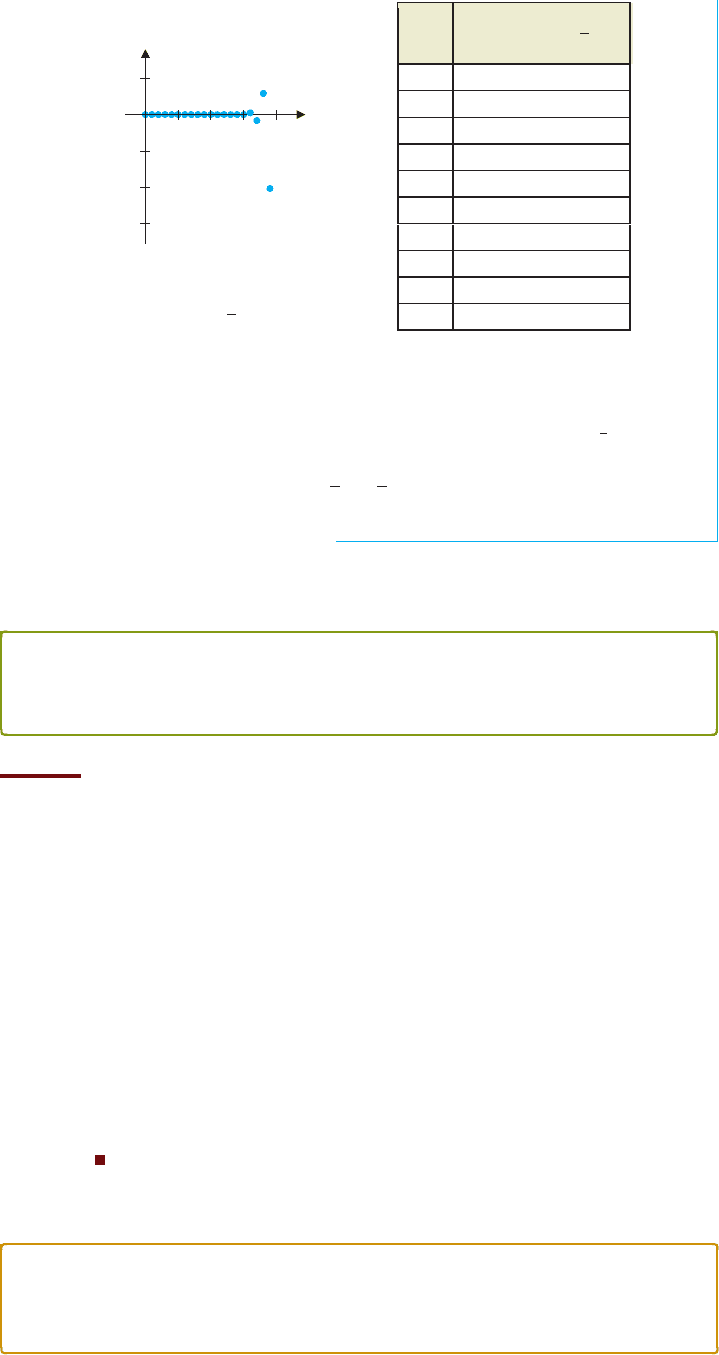
Solution A graph showing the first 20 partial sums (see Figure 9.19) is not
particularly helpful, until you look at the vertical scale. The following table showing a
number of partial sums is more revealing.
P1: OSO/OVY P2: OSO/OVY QC: OSO/OVY T1: OSO
MHDQ256-Ch09 MHDQ256-Smith-v1.cls December 17, 2010 19:47
LT (Late Transcendental)
CONFIRMING PAGES
9-19 SECTION 9.2
..
Infinite Series 549
1.0 10
11
1.5 10
11
0.5 10
11
0.5 10
11
S
n
n
2015105
FIGURE 9.19
S
n
=
n−1
k=0
6
−
7
2
k
n S
n
n−1
k0
6
−
7
2
k
11 1.29 × 10
6
12 −4.5 ×10
6
13 1.6 × 10
7
14 −5.5 ×10
7
15 1.9 × 10
8
16 −6.8 ×10
8
17 2.4 × 10
9
18 −8.3 ×10
9
19 2.9 × 10
10
20 −1 × 10
11
Note that while the partial sums are oscillating back and forth between positive and
negative values, they are growing larger and larger in absolute value. We can confirm
our suspicions by observing that this is a geometric series with ratio r =−
7
2
. Since
|r|=
−
7
2
=
7
2
≥ 1,
the series is divergent, as we suspected.
The following simple observation provides us with a very useful test.
THEOREM 2.2
If
∞
k=1
a
k
converges, then lim
k→∞
a
k
= 0.
PROOF
Suppose that
∞
k=1
a
k
converges to some number L. This means that the sequence of partial
sums defined by S
n
=
n
k=1
a
k
also converges to L. Notice that
S
n
=
n
k=1
a
k
=
n−1
k=1
a
k
+ a
n
= S
n−1
+ a
n
.
Subtracting S
n−1
from both sides, we have
a
n
= S
n
− S
n−1
.
This gives us
lim
n→∞
a
n
= lim
n→∞
(S
n
− S
n−1
) = lim
n→∞
S
n
− lim
n→∞
S
n−1
= L − L = 0,
as desired.
The following very useful test follows directly from Theorem 2.2.
kth-Term Test for Divergence
If lim
k→∞
a
k
= 0, then the series
∞
k=1
a
k
diverges.
P1: OSO/OVY P2: OSO/OVY QC: OSO/OVY T1: OSO
MHDQ256-Ch09 MHDQ256-Smith-v1.cls December 17, 2010 19:47
LT (Late Transcendental)
CONFIRMING PAGES
550 CHAPTER 9
..
Infinite Series 9-20
The kth-term test is so simple, you should use it to test every series you run into. It says
that if the terms don’t tend to zero, the series is divergent and there’s nothing more to do.
However, as we’ll soon see, if the terms do tend to zero, theseries may or may not converge
and additional testing is needed.
EXAMPLE 2.6 A Series Whose Terms Do Not Tend to Zero
Investigate the convergence or divergence of the series
∞
k=1
k
k + 1
.
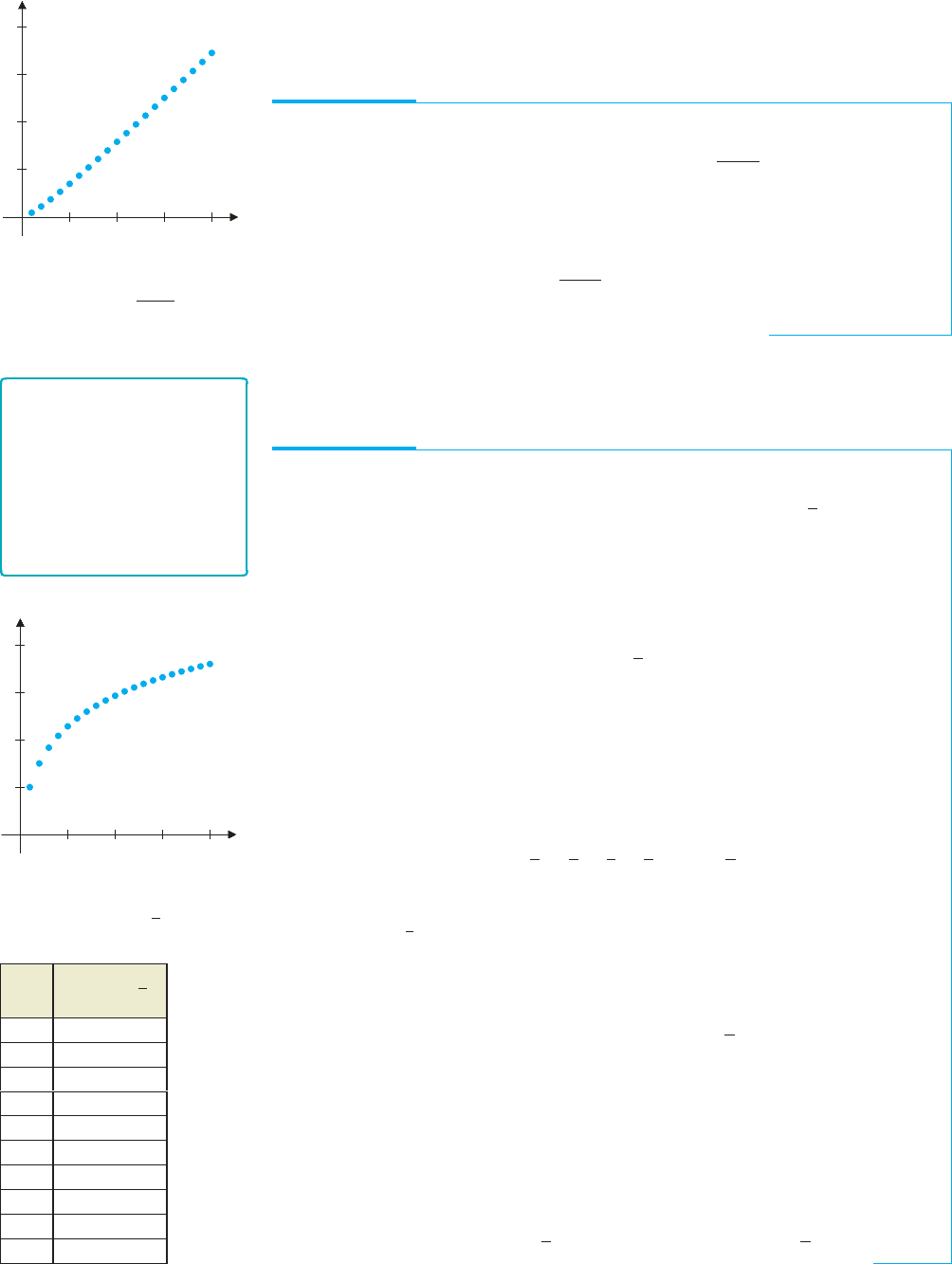
Solution A graph showing the first 20 partial sums is shown in Figure 9.20. The
partial sums appear to be increasing without bound as n increases. Further,
lim
k→∞
k
k + 1
= 1 = 0.
So, by the kth-term test for divergence, the series must diverge.
Example 2.7 shows an important series whose terms tend to 0 as k →∞, but that diverges,
nonetheless.
105 15 20
5
10
15
20
S
n
n
FIGURE 9.20
S
n
=
n
k=1
k
k + 1
REMARK 2.1
The converse of Theorem 2.2
is false. That is, having
lim
k→∞
a
k
= 0 does not guarantee
that the series
∞
k=1
a
k
converges.
Be very clear about this point.
This is a very common
misconception.
EXAMPLE 2.7 The Harmonic Series
Investigate the convergence or divergence of the harmonic series:
∞
k=1
1
k
.
5 10 15 20
2
3
4
1
S
n
n
FIGURE 9.21
S
n
=
n
k=1
1
k
n S
n
n
k1
1
k
11 3.01988
12 3.10321
13 3.18013
14 3.25156
15 3.31823
16 3.38073
17 3.43955
18 3.49511
19 3.54774
20 3.59774
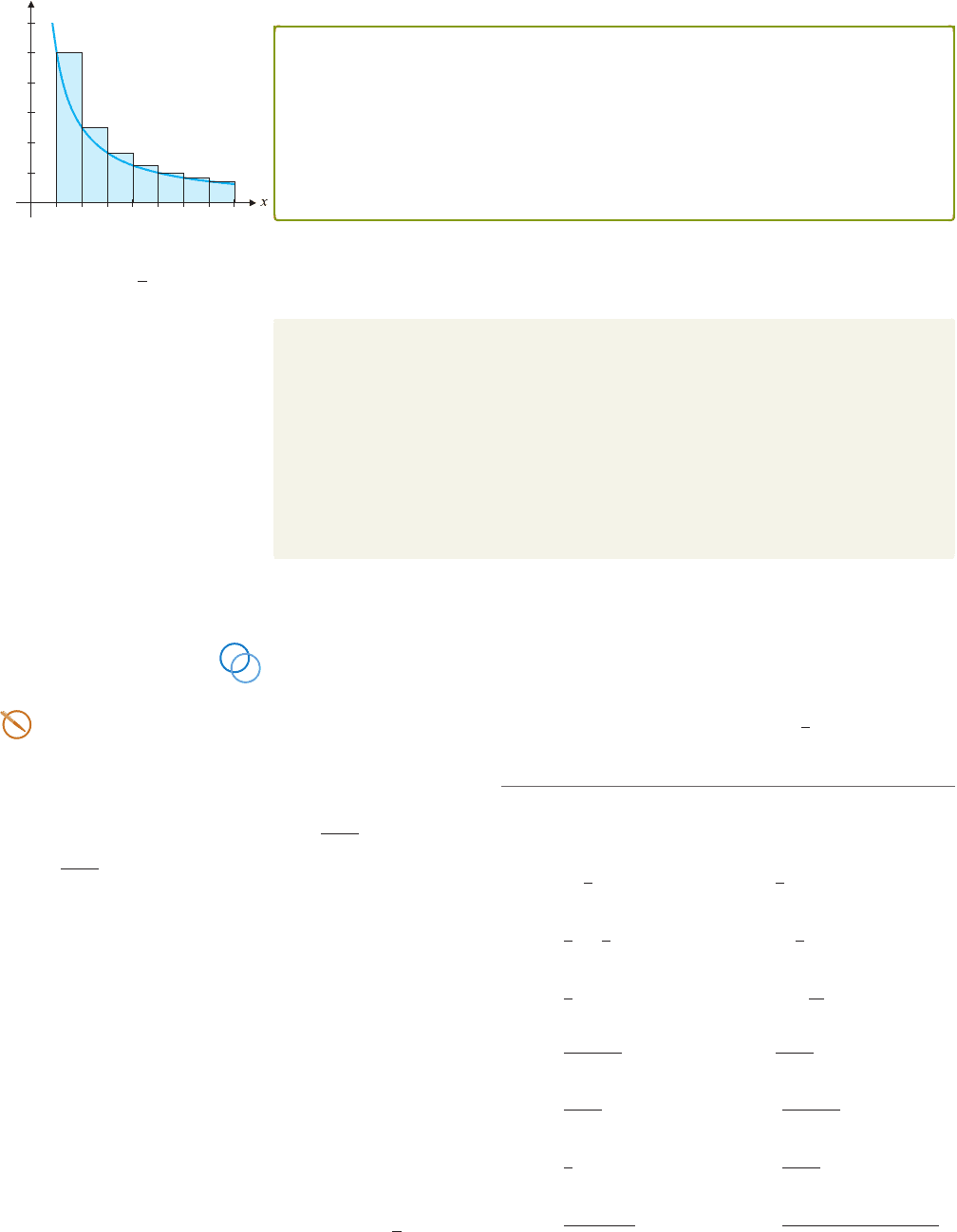
Solution In Figure 9.21, we see the first 20 partial sums of the series. In the table, we
display several partial sums. The table and the graph suggest that the series might
converge to a number around 3.6. As always with sequences and series, we need to
confirm this suspicion. First, note that
lim
k→∞
a
k
= lim
k→∞
1
k
= 0.
Be careful: once again, this does not say that the series converges. If the limit had been
nonzero, we would have concluded that the series diverges. In the present case, where
the limit is 0, we can conclude only that the series may converge, but we will need to
investigate further.
The following clever proof provides a preview of things to come. Consider the nth
partial sum
S
n
=
n
k=1
1
k
=
1
1
+
1
2
+
1
3
+···+
1
n
.
Note that S
n
corresponds to the sum of the areas of the n rectangles superimposed on
the graph of y =
1
x
, as shown in Figure 9.22 for the case where n = 7.
Since each of the indicated rectangles lies partly above the curve, we have
S
n
= Sum of areas of n rectangles
≥ Area under the curve =
n+1
1
1
x
dx
= ln |x|
n+1
1
= ln(n + 1).
(2.9)
However, the sequence {ln(n +1)}
∞
n=1
diverges, since
lim
n→∞
ln(n + 1) =∞.
Since S
n
≥ ln(n + 1), for all n [from (2.9)], we must also have that lim
n→∞
S
n
=∞, from
which it follows that the series,
∞
k=1
1
k
diverges, too, even though lim
k→∞
1
k
= 0.
P1: OSO/OVY P2: OSO/OVY QC: OSO/OVY T1: OSO
MHDQ256-Ch09 MHDQ256-Smith-v1.cls December 17, 2010 19:47
LT (Late Transcendental)
CONFIRMING PAGES
9-21 SECTION 9.2
..
Infinite Series 551
We conclude this section with several unsurprising results.
THEOREM 2.3
(i) If
∞
k=1
a
k
converges to A and
∞
k=1
b
k
converges to B, then the series
∞
k=1
(a
k
± b
k
)
converges to A ± B and
∞
k=1
(ca
k
) converges to cA, for any constant c.
(ii) If
∞
k=1
a
k
converges and
∞
k=1
b
k
diverges, then
∞
k=1
(a
k
± b
k
) diverges.
The proof of the theorem is left as an exercise.
1 2 3 4 5 6 7 8
0.2
0.4
0.6
0.8
1.0
1.2
y
FIGURE 9.22
y =
1
x
BEYOND FORMULAS
The harmonic series illustrates one of the most counterintuitive facts in calculus. A
full understanding of this particular infinite series will help you recognize many of
the subtle issues that arise in later mathematics courses. The general result may be
stated this way: in the case where lim
k→∞
a
k
= 0, the series
∞
k=1
a
k
might diverge or might
converge, depending on how fast the sequence a
k
approacheszero. Keepthinking about
why the harmonic series diverges and you will develop a deeper understanding of how
infinite series in particular and calculus in general work.
EXERCISES 9.2
WRITING EXERCISES
1. Suppose that your friend is confused about the difference
between the convergence of a sequence and the convergence
of a series. Carefully explain the difference between conver-
gence or divergence of the sequencea
k
=
k
k + 1
and the series
∞
k=1
k
k + 1
.
2. Explain in words why the kth-term test for divergence is
valid. Explain why it is not true that if lim
k→∞
a
k
= 0 then
∞
k=1
a
k
necessarily converges. In your explanation, include an impor-
tant example that proves that this is not true and comment
on the fact that the convergence of a
k
to 0 can be slow or
fast.
3. In Theorems 2.2 and 2.3, the series start at k = 1, as in
∞
k=1
a
k
.
Explain why the conclusions of the theorems hold if the series
start at k = 2, k = 3 or at any positive integer.
4. We emphasized in the text that numerical and graphical ev-
idence for the convergence of a series can be misleading.
Suppose your calculator carries 14 digits in its calculations.
Explain why for large enough values of n, the term
1
n
will be
too small to change the partial sum
n
k=1
1
k
. Thus, the calculator
would incorrectly indicate that the harmonic series converges.
In exercises 1–24, determine whether the series converges or
diverges. For convergent series, find the sum of the series.
1.
∞
k=0
3
1
5
k
2.
∞
k=0
1
3
(5)
k
3.
∞
k=0
1
2
−
1
3
k
4.
∞
k=0
4
1
2
k
5.
∞
k=0
1
2
(3)
k
6.
∞
k=3
(−1)
k
3
2
k
7.
∞
k=1
4
k(k +2)
8.
∞
k=1
4k
k + 2
9.
∞
k=1
3k
k + 4
10.
∞
k=1
9
k(k +3)
11.
∞
k=1
2
k
12.
∞
k=0
4
k + 1
13.
∞
k=1
2k + 1
k
2
(k + 1)
2
14.
∞
k=1
4
k(k +1)(k + 3)(k +4)

P1: OSO/OVY P2: OSO/OVY QC: OSO/OVY T1: OSO
MHDQ256-Ch09 MHDQ256-Smith-v1.cls December 17, 2010 19:47
LT (Late Transcendental)
CONFIRMING PAGES
552 CHAPTER 9
..
Infinite Series 9-22
15.
∞
k=2
2e
−k
16.
∞
k=1
k
√
3
17.
∞
k=0
1
2
k
−
1
k + 1
18.
∞
k=0
1
2
k
−
1
3
k
19.
∞
k=2
2
3
k
+
1
2
k
20.
∞
k=2
1
k
−
1
4
k
21.
∞
k=0
(−1)
k+1
3k
k + 1
22.
∞
k=0
(−1)
k
k
3
k
2
+ 1
23.
∞
k=1
sin
k
5
24.
∞
k=1
tan
−1
k
............................................................
In exercises 25–28, determine all values of c such that the series
converges.
25.
∞
k=0
3(2c +1)
k
26.
∞
k=0
2
(c −3)
k
27.
∞
k=0
c
k + 1
28.
∞
k=0
2
ck +1
............................................................
In exercises 29–32, use graphical and numerical evidence to
conjecture the convergence or divergence of the series.
29.
∞
k=1
1
k
2
30.
∞
k=1
1
√
k
31.
∞
k=1
3
k!
32.
∞
k=1
2
k
k!
............................................................
33. (a) Prove that if
∞
k=1
a
k
converges, then
∞
k=m
a
k
converges for any
positive integer m. In particular, if
∞
k=1
a
k
converges to L, what
does
∞
k=m
a
k
converge to? (b) Prove that if
∞
k=1
a
k
diverges, then
∞
k=m
a
k
diverges for any positive integer m.
34. Explainwhythepartialfractionstechniqueofexample2.3does
not work for
∞
k=1
1
k(k +1/2)
.
35. Prove Theorem 2.3 (i). 36. Prove Theorem 2.3 (ii).
37. Let S
n
=
n
k=1
1
k
.Showthat S
1
= 1and S
2
=
3
2
.Since
1
3
>
1
4
,we
have
1
3
+
1
4
>
1
4
+
1
4
=
1
2
. Therefore, S
4
>
3
2
+
1
2
= 2. Simi-
larly,
1
5
+
1
6
+
1
7
+
1
8
>
1
8
+
1
8
+
1
8
+
1
8
=
1
2
,soS
8
>
5
2
.Show
that S
16
> 3 and S
32
>
7
2
. For which n can you guarantee that
S
n
> 4? S
n
> 5? For any positive integer m, determine n such
that S
n
> m. Conclude that the harmonic series diverges.
38. Compute several partial sums S
n
of the series
1 + 1 − 1 + 1 − 1 + 1 − 1 +···. Prove that the series
diverges.Find theCesaro sum of thisseries: lim
n→∞
1
n
n
k=1
S
k
.
39. (a) Write 0.9999
¯
9 = 0.9 +0.09 +0.009 +··· and sum the
geometric series to prove that 0.9999
¯
9 = 1. (b) Prove that
0.19999
¯
9 = 0.2.
40. (a) Write 0.1818
18 as a geometric series and then write the
sum of the geometric series as a fraction. (b) Write 2.134
134
as a fraction.
41. Give an example where
∞
k=1
a
k
and
∞
k=1
b
k
both diverge but
∞
k=1
(a
k
+ b
k
) converges.
42. If
∞
k=0
a
k
converges and
∞
k=0
b
k
diverges,isit necessarily truethat
∞
k=0
(a
k
+ b
k
) diverges?
43. Prove that the sum of a convergent geometric series
1 +r +r
2
+···must be greater than
1
2
.
44. Prove that if the series
∞
k=0
a
k
converges, then the series
∞
k=0
1
a
k
diverges.
45. Show that the partial sum S
n
= 1 +
1
2
+
1
3
+···+
1
n
does not
equal an integer for any prime n < 100. Is the statement true
for all integers n > 1?
46. The Cantor set is one of the most famous sets in mathemat-
ics. To construct the Cantor set, start with the interval [0, 1].
Then remove the middle third,
1
3
,
2
3
. This leaves the set
0,
1
3
∪
2
3
, 1
. For each of the two subintervals, remove the
middle third; in this case, remove the intervals
1
9
,
2
9
and
7
9
,
8
9
. Continue in this way, removing the middle thirds of
each remaining interval. The Cantor set is all points in [0, 1]
that are not removed. Argue that 0,1,
1
3
and
2
3
are in the Cantor
set, and identify four more points in the set. It can be shown
that there are an infinite number of points in the Cantor set. On
the other hand, the total length of the subintervals removed is
1
3
+ 2
1
9
+···. Find the third term in this series, identify the
series as a convergent geometric series and find the sum of the
series. Given that you started with an interval of length 1, how
much “length” does the Cantor set have?
47. For 0 < x < 1, show that 1 + x + x
2
+···+x
n
<
1
1−x
. Does
this inequality hold for −1 < x < 0?
48. For any positive integer n, show that 2 > 1 +
1
2
+···+
1
2
n
,
3
2
> 1 +
1
3
+···+
1
3
n
and
5
4
> 1 +
1
5
+···+
1
5
n
. Use these
facts to show that 2 ·
3
2
·
5
4
· ··· ·
p
p−1
> 1 +
1
2
+
1
3
+···+
1
n
where p is the largest prime that is less than n. Conclude that
there are an infinite number of primes.
APPLICATIONS
49. Suppose you have n boards of length L. Place the first board
with length
L
2n
hanging over the edge of the table. Place the
next board with length
L
2(n−1)
hanging over the edge of the first
board. The next board should hang
L
2(n−2)
over the edge of the
second board. Continue on until the last board hangs
L
2
over
the edge of the (n − 1)st board. Theoretically, this stack will
balance (in practice, don’t use quite as much overhang). With
n = 8, compute the total overhang of the stack. Determine the