
Smith R., Minton R. Calculus
Подождите немного. Документ загружается.

P1: OSO/OVY P2: OSO/OVY QC: OSO/OVY T1: OSO
MHDQ256-Ch09 MHDQ256-Smith-v1.cls December 17, 2010 19:47
LT (Late Transcendental)
CONFIRMING PAGES
9-23 SECTION 9.2
..
Infinite Series 553
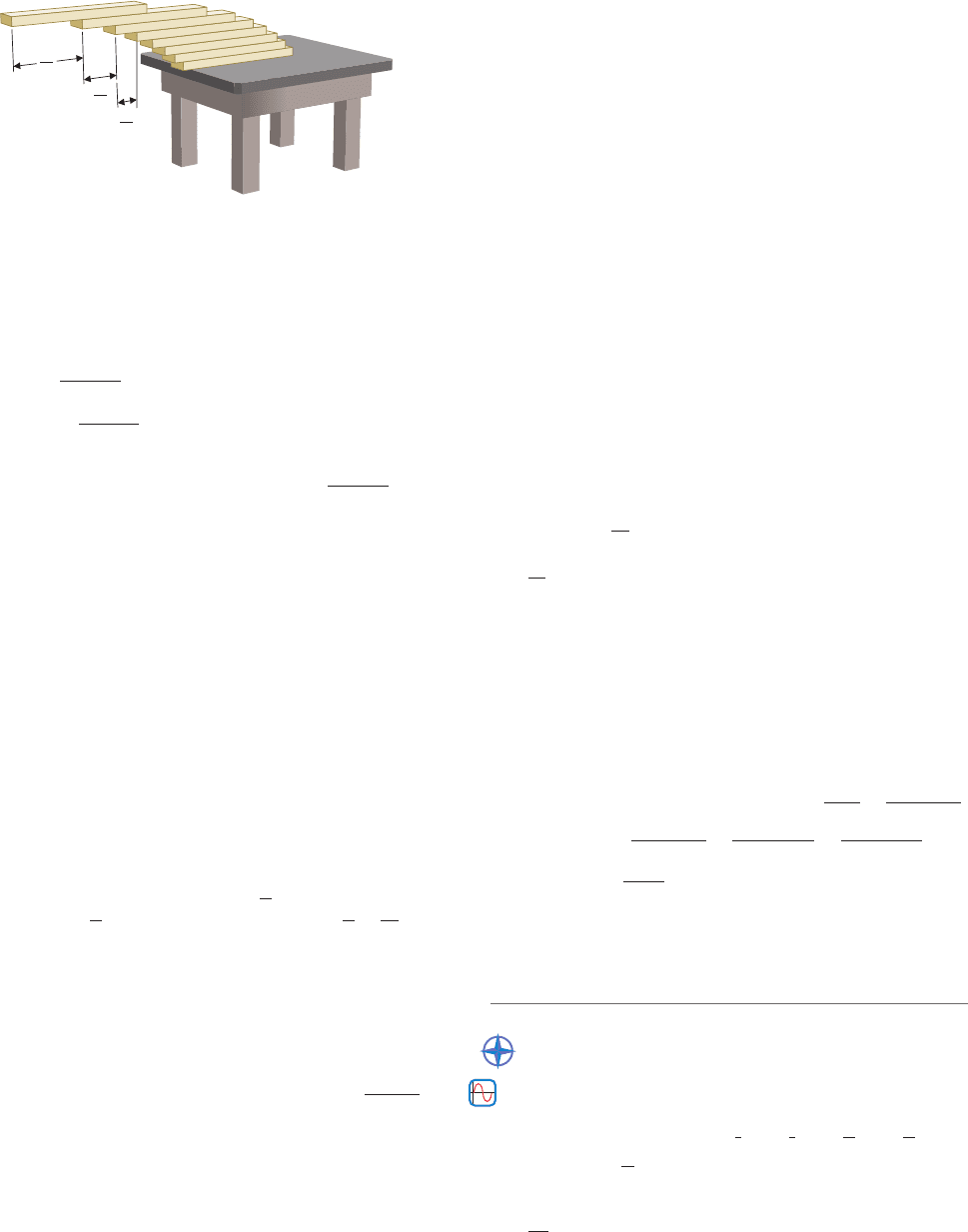
number of boards n such that the total overhang is greater than
L. This means that the last board is entirely beyond the edge of
the table. What is the limit of the total overhang as n →∞?
L
2
L
4
. . .
L
6
50. Have you ever felt that the line you’re standing in moves more
slowly than the other lines? In An Introduction to Probabil-
ity Theory and Its Applications, William Feller proved just
how bad your luck is. Let N be the number of people who
get in line until someone waits longer than you do (you’re
the first, so N ≥ 2). The probability that N = k is given by
p(k) =
1
k(k −1)
. Prove that the total probability equals 1;
that is,
∞
k=2
1
k(k −1)
= 1. From probability theory, the average
(mean) number of people who must getin line before someone
has waited longer than you is given by
∞
k=2
k
1
k(k −1)
. Prove
that this diverges to ∞. Talk about bad luck!
51. To win a deuce tennis game, one player or the other must
win the next two points. If each player wins one point, the
deuce starts over. If you win each point with probability
p, the probability that you win the next two points is p
2
.
The probability that you win one of the next two points is
2p(1 − p). The probability that you win a deuce game is then
p
2
+2p(1− p)p
2
+[2p(1− p)]
2
p
2
+[2p(1− p)]
3
p
2
+···.
Explain what each term represents, explain why the geometric
series converges and find the sum of the series. If p = 0.6,
you’re a better player than your opponent. Show that you are
more likely to win a deuce game than you are a single point.
The slightly strange scoring rules in tennis make it more likely
that the better player wins.
52. On an analog clock, at 1:00, the minute hand points to 12 and
the hour hand points to 1. When the minute hand reaches 1,
the hour hand hasprogressed to 1 +
1
12
. When the minutehand
reaches 1 +
1
12
, the hour hand has moved to 1 +
1
12
+
1
12
2
. Find
the sum of a geometric series to determine the time at which
the minute hand and hour hand are in the same location.
53. A dosage d of a drug is given at times t = 0, 1, 2,....
The drug decays exponentially with rate r in the blood-
stream. The amount in the bloodstream after n + 1 doses is
d + de
−r
+ de
−2r
+···+de
−nr
. Show that the eventual level
of the drug (after an “infinite” number of doses) is
d
1 − e
−r
.If
r = 0.1, find the dosage needed to maintain a drug level of 2.
54. Two bicyclists are 40 miles apart, riding toward each other at
20 mph (each). A fly starts at one bicyclist and flies toward the
other bicyclist at 60 mph. When it reaches the bike, it turns
around and flies back to the first bike. It continues flying back
and forth until the bikes meet. Determine the distance flown on
each leg of the fly’s journey and find the sum of the geometric
series to get the total distance flown. Verify that this is theright
answer by solving the problem the easy way.
55. Suppose $100,000 of counterfeit money is introduced into the
economy. Each time the money is used, 25% of the remaining
money is identified as counterfeit and removed from circula-
tion.Determine the total amount of counterfeit moneysuccess-
fully used in transactions. Thisis an example of the multiplier
effect in economics. Suppose that a new marking scheme on
dollar bills helps raise the detection rate to 40%. Determine the
reductioninthetotalamountofcounterfeitmoneysuccessfully
spent.
56. In this exercise, we will find the present value of a plot of
farmland. Assume that a crop of value $c will be planted in
years 1, 2, 3 and so on, and the yearly inflation rate is r. The
present value is given by
P = ce
−r
+ ce
−2r
+ ce
−3r
+···.
Find the sum of the geometric series to compute the present
value.
57. Suppose you repeat a game at which you have a probability
p of winning each time you play. The probability that your
first win comes in your nth game is p(1 − p)
n−1
. Compute
∞
n=1
p(1 − p)
n−1
and state in terms of probability why the
result makes sense.
58. In general, the total time it takes for a ball to complete its
bounces is
2v
g
∞
k=0
r
k
and the total distance the ball moves is
v
2
g
∞
k=0
r
2k
, where r is the coefficient of restitution of the ball.
Assuming 0 < r < 1, find the sums of these geometric series.
59. (a)Hereisa magic trick (fromArtBenjamin).Pickanypositive
integer less than 1000. Divide it by 7, then divide the answer
by 11, then divide the answer by 13. Look at the first six digits
after the decimal of the answer and call out any five of them
in any order and the magician will tell what the other digit is.
The “secret” knowledge used by the magician is that the sum
of the six digits will equal 27. Try this! (b) Let x be a pos-
itive integer less than 1000, and let c =
x
1000
+
999 − x
1,000,000
.
Showthatc +
c
1,000,000
+
c
1,000,000
2
+
c
1,000,000
3
+···
converges to
x + 1
1001
. (c) Explain why part (b) implies that the
decimal expansion of the fraction in part (a) will repeat ev-
ery six digits, with the first three digits being one less than
the original number and the remaining three digits being the
9’s-complement of the first three digits.
EXPLORATORY EXERCISES
1. Infinite products are also of great interest to mathemati-
cians. Numerically explore the convergence or divergence
of the infinite product
1−
1
4
1−
1
9
1−
1
25
1−
1
49
···=
p = prime
1−
1
p
2
. Note that the productis taken over the prime
numbers, not all integers. Compare your results to the number
6
π
2
.
P1: OSO/OVY P2: OSO/OVY QC: OSO/OVY T1: OSO
MHDQ256-Ch09 MHDQ256-Smith-v1.cls December 17, 2010 19:47
LT (Late Transcendental)
CONFIRMING PAGES
554 CHAPTER 9
..
Infinite Series 9-24
2. Inexample2.7,weshowedthat1 +
1
2
+
1
3
+···+
1
n
> ln(n +
1). Superimpose the graph of f (x) =
1
x−1
onto Figure 9.22 and
showthat
1
2
+
1
3
+···+
1
n
< ln(n).Concludethatln(n + 1) <
1 +
1
2
+
1
3
+···+
1
n
< 1 +ln(n).Euler’sconstant isdefined
by
γ = lim
n→∞
1 +
1
2
+
1
3
+···+
1
n
− ln(n)
.
Look up the value of γ . (Hint: Use your CAS.) Use
γ to estimate
n
i=1
1
i
for n = 10,000 and n = 100,000.
Investigate whether the sequence a
n
=
2n
k=n
1
k
converges or
diverges.
3. Define a
1
= 1, a
2
= 1 −
1
2
−
1
3
and
a
n
= a
n−1
+ (−1)
n−1
2
n
−1
k=2
n−1
1
k
forn ≥ 2. Illustrate numerically
thatthesequencediverges,alternatingbetween twovalueswith
lim
n→∞
|a
n
− a
n−1
|=ln2. Explore the sequence with b
1
= 1
and b
n
= b
n−1
+ (−1)
n−1
3
n
−1
k=3
n−1
1
k
. (Chris Davis and David
Taylor have extended these results from base 2 and base
3 to any base b > 1.)
9.3 THE INTEGRAL TEST AND COMPARISON TESTS
We need to test most series for convergence in some indirect way that does not result
in finding the sum of the series. In this section, we will develop several such tests for
convergence of series. The first of these is a generalization of the method we used in section
9.2 to show that the harmonic series is divergent.
For a given series
∞
k=1
a
k
, suppose that there is a function f for which
f (k) = a
k
, for k = 1, 2,...,
wheref iscontinuousand decreasing and f (x) ≥ 0for all x ≥ 1.We consider the nth partial
sum
S
n
=
n
k=1
a
k
= a
1
+ a
2
+···+a
n
.
y
14
n
32
x
(2, a
2
)
(3, a
3
)
(n, a
n
)
y f(x)
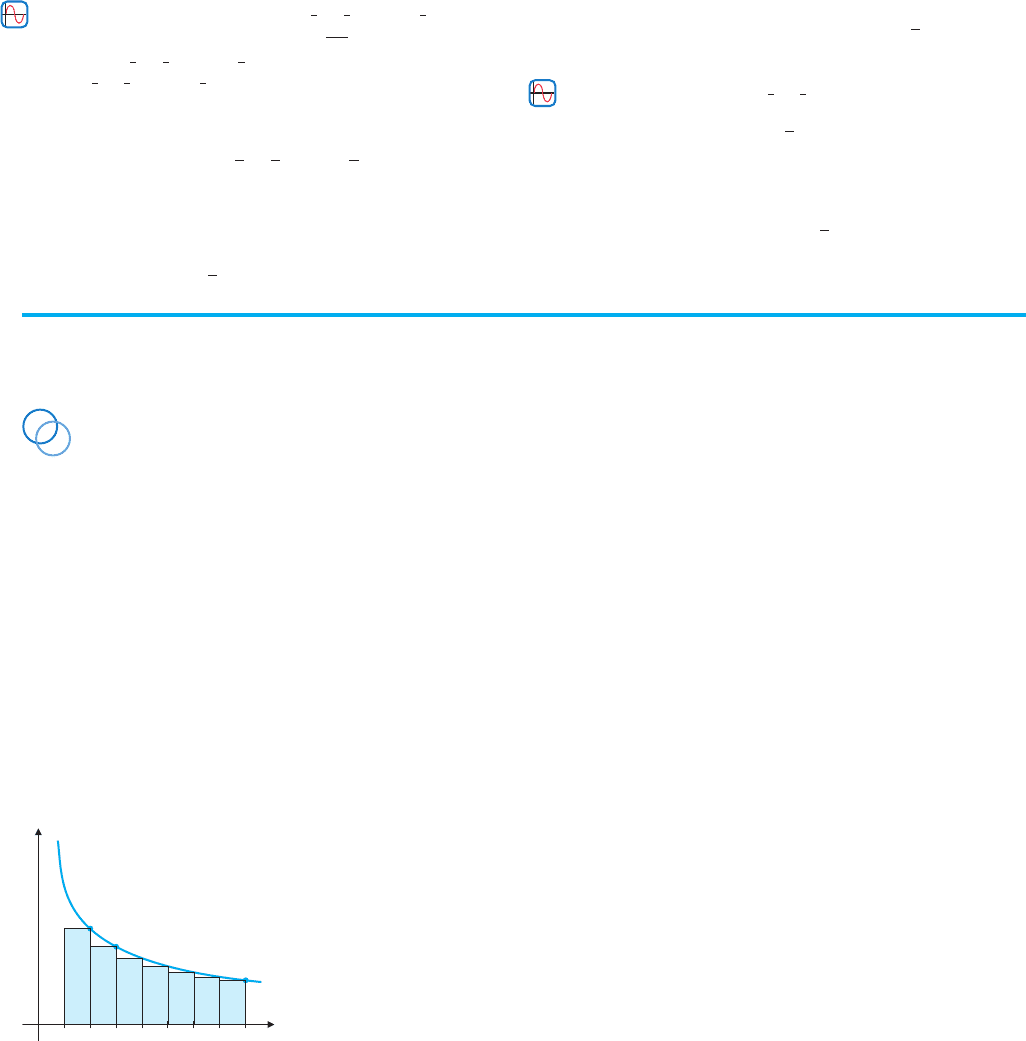
FIGURE 9.23a
(n − 1) rectangles, lying
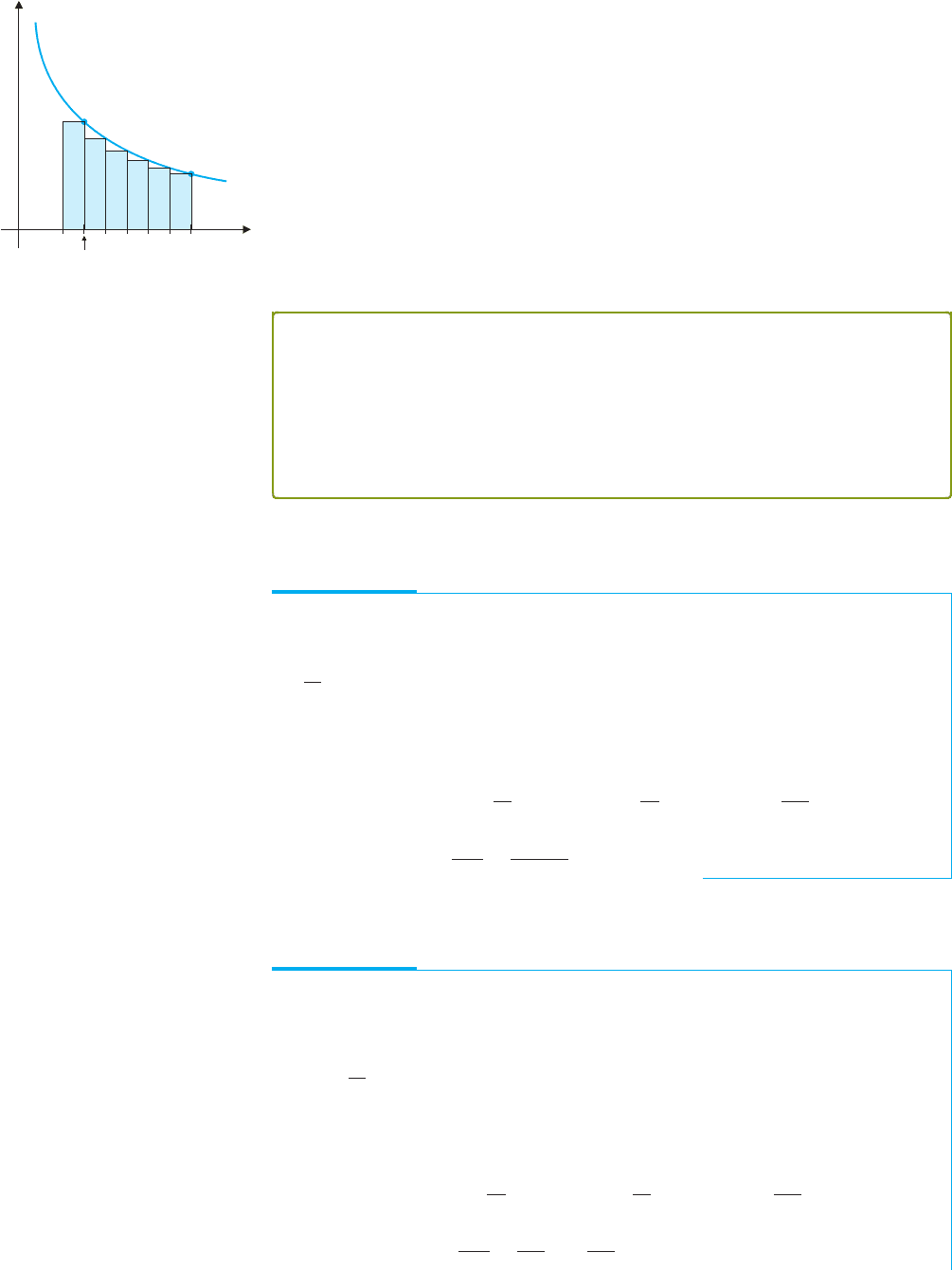
beneath the curve
In Figure 9.23a, we show (n − 1) rectangles constructed on the interval [1, n], each of
width 1 and with height equal to the value of the function at the right-hand endpoint of
the subinterval on which it is constructed. Notice that since each rectangle lies completely
beneath the curve, the sum of the areas of the (n − 1) rectangles shown is less than the area
under the curve from x = 1tox = n. That is,
0 ≤ Sum of areas of(n − 1)rectangles ≤ Area under the curve =
n
1
f (x) dx. (3.1)
Note that the area of the first rectangle is length × width = (1)(a
2
), the area of the second
rectangle is (1)(a
3
) and so on. We get that the sum of the areas of the (n − 1) rectangles
shown is
a
2
+ a
3
+ a
4
+···+a
n
= S
n
− a
1
.
Together with (3.1), this gives us
0 ≤ Sum of areas of (n − 1) rectangles
= S
n
− a
1
≤ Area under the curve =
n
1
f (x) dx. (3.2)
Now, suppose that the improper integral
!
∞
1
f (x) dx converges. Then, from (3.2), we
have
0 ≤ S
n
− a
1
≤
n
1
f (x) dx ≤
∞
1
f (x) dx.
P1: OSO/OVY P2: OSO/OVY QC: OSO/OVY T1: OSO
MHDQ256-Ch09 MHDQ256-Smith-v1.cls December 17, 2010 19:47
LT (Late Transcendental)
CONFIRMING PAGES
9-25 SECTION 9.3
..
The Integral Test and Comparison Tests 555
Adding a
1
to all the terms gives us
a
1
≤ S
n
≤ a
1
+
∞
1
f (x) dx,
so that the sequence of partial sums {S
n
}
∞
n=1
is bounded. Since {S
n
}
∞
n=1
is also monotonic
(why is that?), {S
n
}
∞
n=1
is convergent by Theorem 1.4 and so, the series
∞
k=1
a
k
is also
convergent.
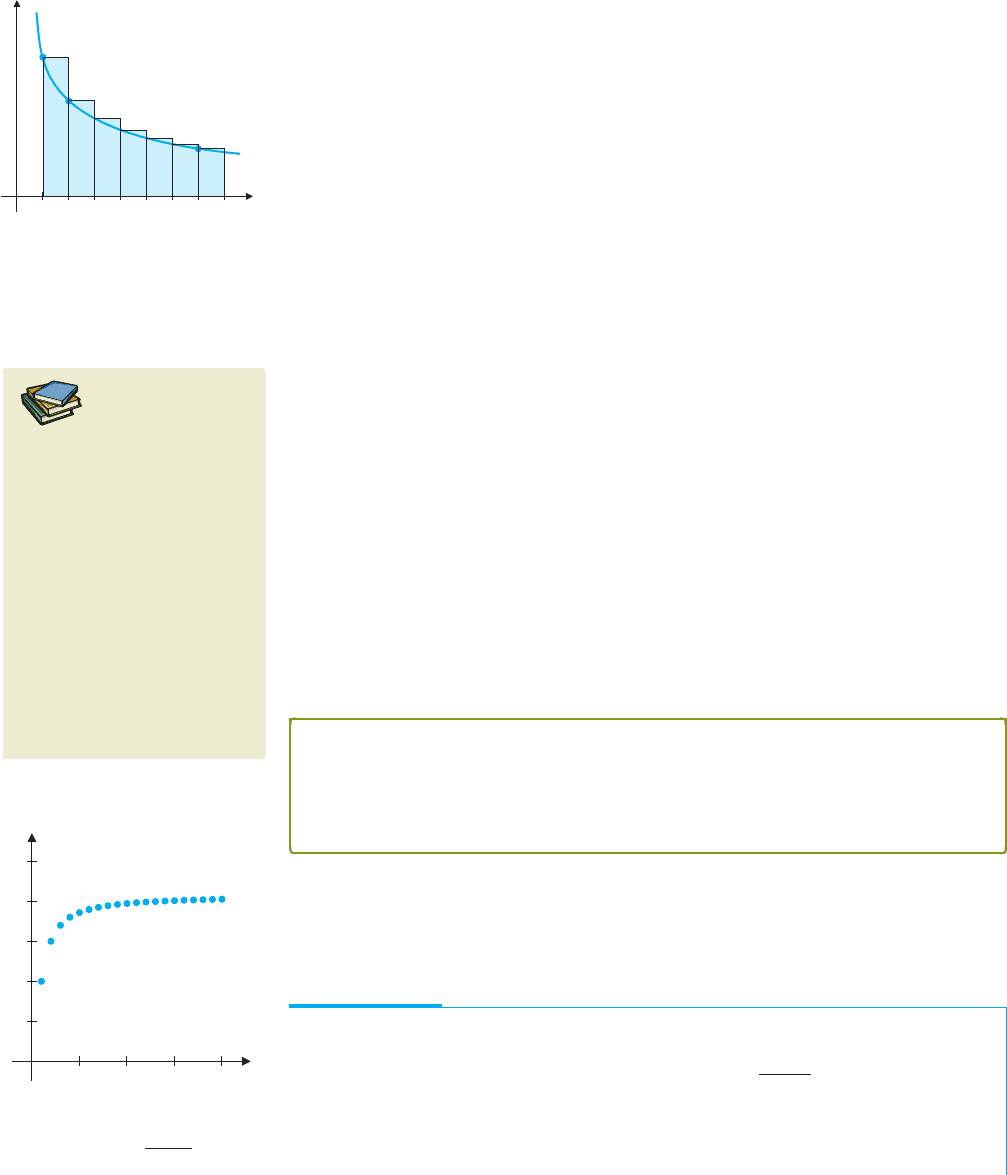
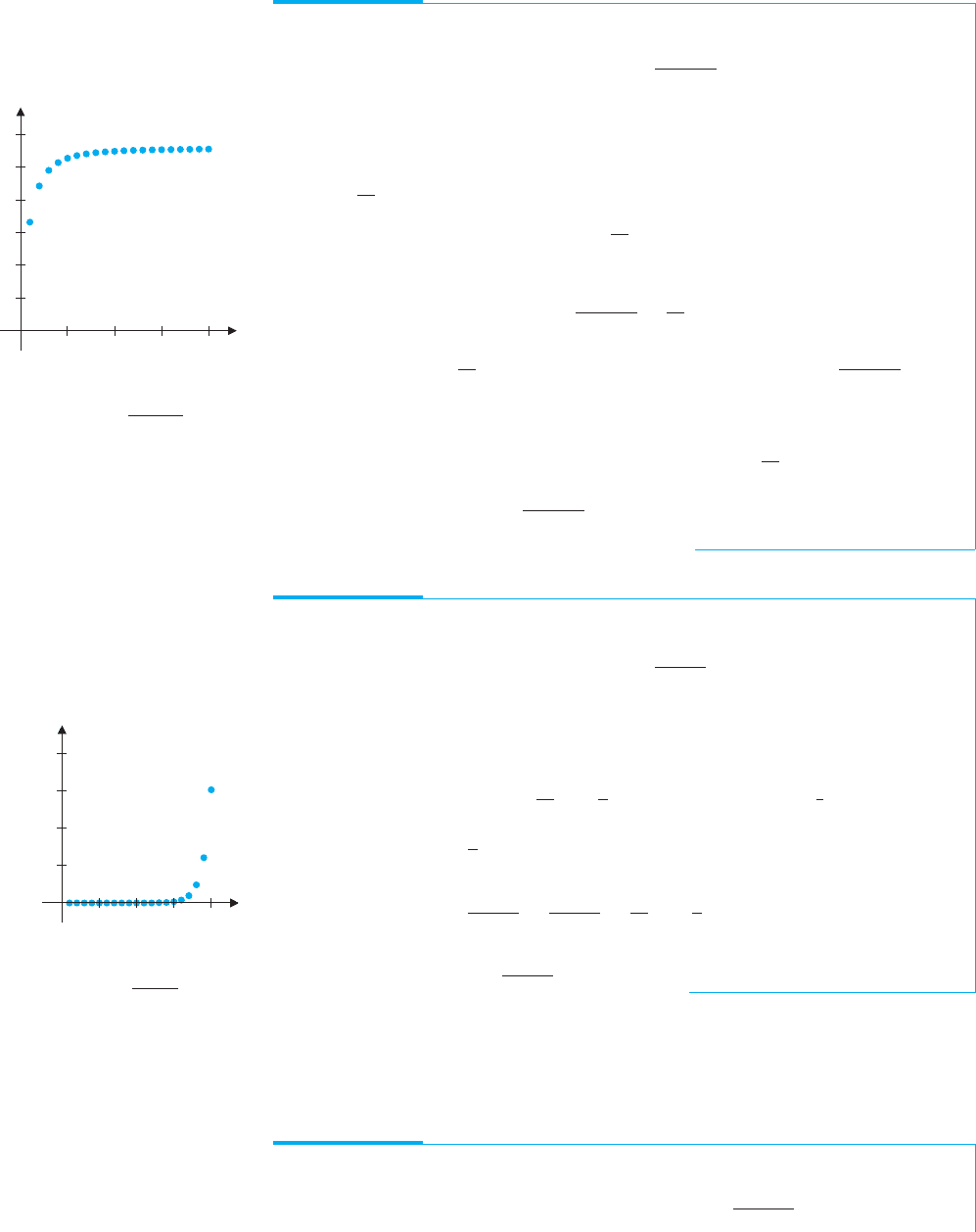
In Figure 9.23b, we show (n − 1) rectangles constructed on the interval [1, n], each
of width 1, but with height equal to the value of the function at the left-hand endpoint of
the subinterval on which it is constructed. In this case, the sum of the areas of the (n − 1)
rectangles shown is greater than the area under the curve. That is,
0 ≤ Area under the curve =
n
1
f (x) dx
≤ Sum of areas of (n − 1) rectangles. (3.3)
y
14 n32
x
y f(x)
(1, a
1
)
(2, a
2
)
(n 1, a
n1
)
FIGURE 9.23b
(n − 1) rectangles, partially
above the curve
Further, note that the area of the first rectangle is length ×width = (1)(a
1
), the area of
the second rectangle is (1)(a
2
) and so on. We get that the sum of the areas of the (n − 1)
rectangles indicated in Figure 9.23b is
a
1
+ a
2
+···+a
n−1
= S
n−1
.
Together with (3.3), this gives us
0 ≤ Area under the curve =
n
1
f (x) dx
≤ Sum of areas of (n − 1) rectangles = S
n−1
. (3.4)
Now, suppose that the improper integral
!
∞
1
f (x) dx diverges. Since f (x) ≥ 0, this says
that lim
n→∞
!
n
1
f (x) dx =∞. From (3.4), we have that
n
1
f (x) dx ≤ S
n−1
.
This says that
lim
n→∞
S
n−1
=∞,
also. So, the sequence of partial sums {S
n
}
∞
n=1
divergesand hence, the series
∞
k=1
a
k
diverges,
too.
HISTORICAL
NOTES
Colin Maclaurin (1698–1746)
Scottish mathematician who
discovered the Integral Test.
Maclaurin was one of the founders
of the Royal Society of Edinburgh
and was a pioneer in the
mathematics of actuarial studies.
The Integral Test was introduced
in a highly influential book that
also included a new treatment of
an important method for finding
series of functions. Maclaurin
series, as we now call them, are
developed in section 9.7.
We summarize the results of this analysis in Theorem 3.1.
THEOREM 3.1 (Integral Test)
If f (k) = a
k
for all k = 1, 2,..., f is continuous and decreasing, and f (x) ≥ 0 for
x ≥ 1, then
!
∞
1
f (x) dx and
∞
k=1
a
k
either both converge or both diverge.
Note that while the Integral Test might say that a given series and improper integral
both converge, it does not say that they will converge to the same value. In fact, this is
generally not the case, as we see in example 3.1.
5 10 15 20
0.5
1.0
1.5
2.0
2.5
S
n
n
FIGURE 9.24
S
n
=
n−1
k=0
1
k
2
+ 1
EXAMPLE 3.1 Using the Integral Test
Investigate the convergence or divergence of the series
∞
k=0
1
k
2
+ 1
.
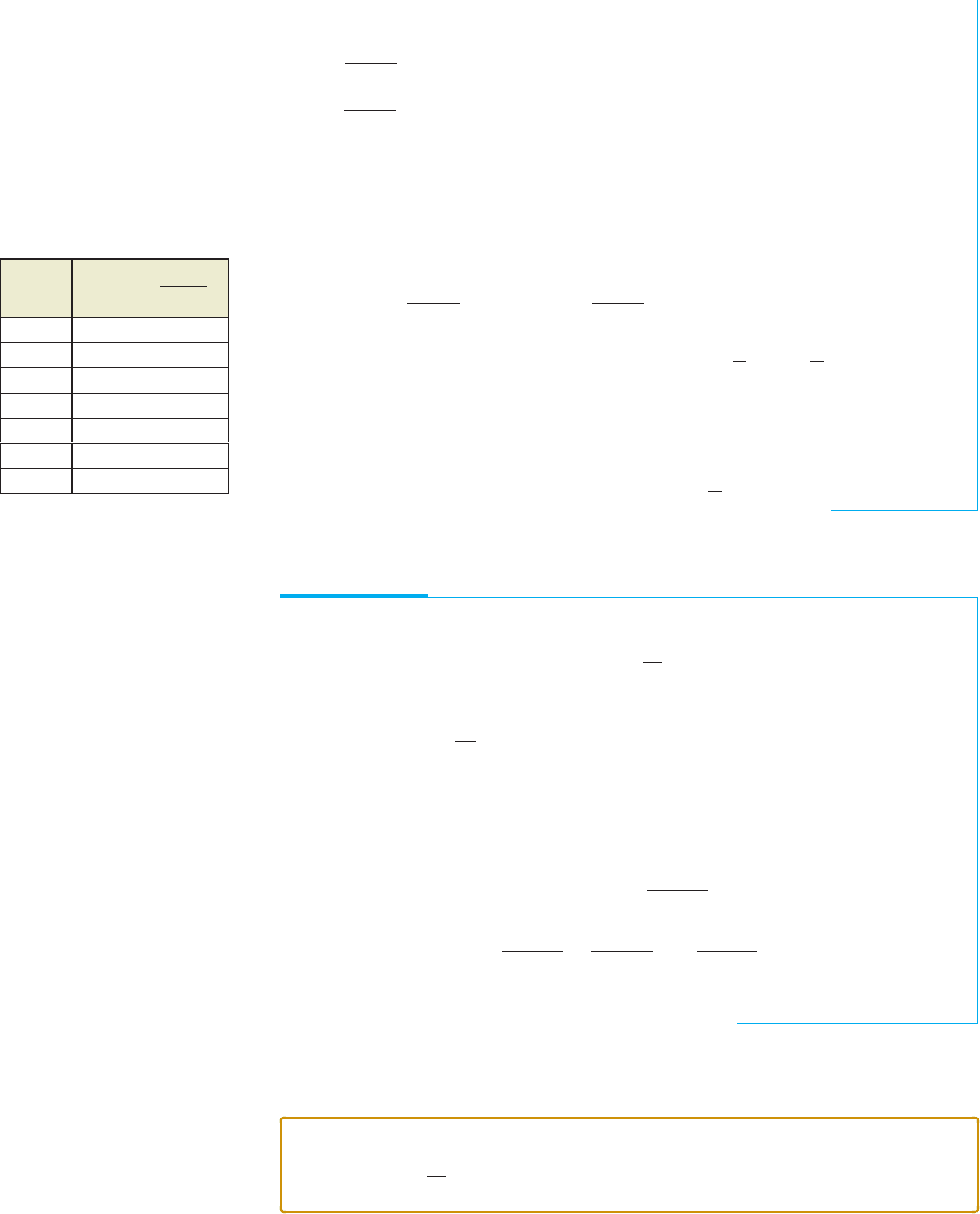
Solution The graph of the first 20 partial sums shown in Figure 9.24 suggests that the
series converges to some value around 2. In the accompanying table, we show some
selected partial sums. Based on this, it is difficult to say whether the series is converging
P1: OSO/OVY P2: OSO/OVY QC: OSO/OVY T1: OSO
MHDQ256-Ch09 MHDQ256-Smith-v1.cls December 17, 2010 19:47
LT (Late Transcendental)
CONFIRMING PAGES
556 CHAPTER 9
..
Infinite Series 9-26
very slowly to a limit around 2.076 or whether the series is instead diverging very
slowly. To determine which is the case, we must test the series further. Define
f (x) =
1
x
2
+ 1
. Note that f is continuous and positive everywhere and
f (k) =
1
k
2
+ 1
= a
k
, for all k ≥ 1. Further,
f
(x) = (−1)(x
2
+ 1)
−2
(2x) < 0,
for x ∈ (0, ∞), so that f is decreasing. This says that the Integral Test applies to this
series. So, we consider the improper integral
∞
0
1
x
2
+ 1
dx = lim
R→∞
R
0
1
x
2
+ 1
dx = lim
R→∞
tan
−1
x
R
0
= lim
R→∞
(tan
−1
R − tan
−1
0) =
π
2
− 0 =
π
2
.
The Integral Test says that since the improper integral converges, the series must
converge, also. Now that we have established that the series is convergent, our earlier
calculations give us the estimated sum 2.076. Notice that this is not the same as the
value of the corresponding improper integral, which is
π
2
≈ 1.5708.
n S
n
n−1
k0
1
k
2
1
10 1.97189
50 2.05648
100 2.06662
200 2.07166
500 2.07467
1000 2.07567
2000 2.07617
In example 3.2, we discuss an important type of series.
EXAMPLE 3.2 The p-Series
Determine for which values of p the series
∞
k=1
1
k
p
(a p-series) converges.
Solution First, notice that for p = 1, this is the harmonic series, which diverges. For
p > 1, define f (x) =
1
x
p
= x
−p
. Notice that for x ≥ 1, f is continuous and positive.
Further,
f
(x) =−px
−p−1
< 0,
so that f is decreasing. This says that the Integral Test applies. We now consider
∞
1
x
−p
dx = lim
R→∞
R
1
x
−p
dx = lim
R→∞
x
−p+1
−p + 1
R
1
= lim
R→∞
R
−p+1
−p + 1
−
1
−p + 1
=
−1
−p + 1
.
Since p > 1 implies
that −p + 1 < 0.
In this case, the improper integral converges and so too, must the series. We leave it as
an exercise to show that the series diverges when p < 1.
We summarize the result of example 3.2 as follows.
p-SERIES
The p-series
∞
k=1
1
k
p
converges if p > 1 and diverges if p ≤ 1.
Notice that in each of examples 3.1 and 3.2, we were able to use the Integral Test to
establish the convergence of a series. While you can use the partial sums of a convergent
series to estimate its sum, it remains to be seen how precise a given estimate is. First, if
P1: OSO/OVY P2: OSO/OVY QC: OSO/OVY T1: OSO
MHDQ256-Ch09 MHDQ256-Smith-v1.cls December 17, 2010 19:47
LT (Late Transcendental)
CONFIRMING PAGES
9-27 SECTION 9.3
..
The Integral Test and Comparison Tests 557
we estimate the sum s of the series
∞
k=1
a
k
by the nth partial sum S
n
=
n
k=1
a
k
, we define the
remainder R
n
to be
R
n
= s − S
n
=
∞
k=1
a
k
−
n
k=1
a
k
=
∞
k=n+1
a
k
.
Notice that this says that the remainder R
n
is the error in approximating s by S
n
. For any
seriesshownto be convergentby the Integral Test, we canestimatethe size of the remainder,
as follows. From Figure 9.25, observe that R
n
corresponds to the sum of the areas of the
indicated rectangles. Further, under the conditions of the Integral Test, this is less than the
area under the curve y = f (x) on the interval [n, ∞). (Recall that this area is finite, since
!
∞
1
f (x) dx converges.) This gives us the following result.
y
n
n 1
x
(n 1, a
n1
)
y f(x)
FIGURE 9.25
Estimate of the remainder
THEOREM 3.2 (Error Estimate for the Integral Test)
Suppose that f (k) = a
k
for all k = 1, 2,...,where f is continuous and decreasing,
and f (x) ≥ 0 for all x ≥ 1. Further, suppose that
!
∞
1
f (x) dx converges. Then, the
remainder R
n
satisfies
0 ≤ R
n
=
∞
k=n+1
a
k
≤
∞
n
f (x) dx.
Whenever the Integral Test applies, we can use Theorem 3.2 to estimate the error in
using a partial sum to approximate the sum of a series.
EXAMPLE 3.3 Estimating the Error in a Partial Sum
Estimate the error in using the partial sum S
100
to approximate the sum of the series
∞
k=1
1
k
3
.
Solution First, recall that in example 3.2, we used the Integral Test to show that this
series (a p-series, with p = 3) is convergent. From Theorem 3.2, the remainder satisfies
0 ≤ R
100
≤
∞
100
1
x
3
dx = lim
R→∞
R
100
1
x
3
dx = lim
R→∞
−
1
2x
2
R
100
= lim
R→∞
−1
2R
2
+
1
2(100)
2
= 5 × 10
−5
.
Amoreinterestingandfarmorepracticalquestionrelatedtoexample3.3istodetermine
the number of terms of the series necessary to obtain a given accuracy.
EXAMPLE 3.4 Finding the Number of Terms Needed
for a Given Accuracy
Determine the number of terms needed to obtain an approximation to the sum of the
series
∞
k=1
1
k
3
correct to within 10
−5
.
Solution Again, we already used the Integral Test to show that the series in question
converges. Then, by Theorem 3.2, we have that the remainder satisfies
0 ≤ R
n
≤
∞
n
1
x
3
dx = lim
R→∞
R
n
1
x
3
dx = lim
R→∞
−
1
2x
2
R
n
= lim
R→∞
−1
2R
2
+
1
2n
2
=
1
2n
2
.

P1: OSO/OVY P2: OSO/OVY QC: OSO/OVY T1: OSO
MHDQ256-Ch09 MHDQ256-Smith-v1.cls December 17, 2010 19:47
LT (Late Transcendental)
CONFIRMING PAGES
558 CHAPTER 9
..
Infinite Series 9-28
So, to ensure that the remainder is less than 10
−5
, we require that
0 ≤ R
n
≤
1
2n
2
≤ 10
−5
.
Solving this last inequality for n yields
n
2
≥
10
5
2
or n ≥
10
5
2
= 100
√
5 ≈ 223.6.
So, taking n ≥ 224 will guarantee the required accuracy and consequently, we have
∞
k=1
1
k
3
≈
224
k=1
1
k
3
≈ 1.202047, which is correct to within 10
−5
, as desired.
Comparison Tests
We next present two results that allow us to compare a given series with one that is already
knownto be convergentor divergent, much as we did with improper integrals in section 7.7.
THEOREM 3.3 (Comparison Test)
Suppose that 0 ≤ a
k
≤ b
k
, for all k.
(i) If
∞
k=1
b
k
converges, then
∞
k=1
a
k
converges, too.
(ii) If
∞
k=1
a
k
diverges, then
∞
k=1
b
k
diverges, too.
Intuitively, this theorem should make abundant sense: if the “larger” series converges,
then the “smaller” one must also converge. Likewise, if the “smaller” series diverges, then
the “larger” one must diverge, too.
PROOF
Given that 0 ≤ a
k
≤ b
k
for all k, observe that the nth partial sums of the two series satisfy
0 ≤ S
n
= a
1
+ a
2
+···+a
n
≤ b
1
+ b
2
+···+b
n
.
(i) If
∞
k=1
b
k
converges (say to B), this says that
0 ≤ S
n
= a
1
+ a
2
+···+a
n
≤ b
1
+ b
2
+···+b
n
≤
∞
k=1
b
k
= B, (3.5)
for all n ≥ 1. From (3.5), the sequence {S
n
}
∞
n=1
of partial sums of
∞
k=1
a
k
is bounded.
Notice that {S
n
}
∞
n=1
is also increasing. (Why?) Since every bounded, monotonic sequence
is convergent (see Theorem 1.4), we get that
∞
k=1
a
k
is convergent, too.
(ii) If
∞
k=1
a
k
is divergent, we have (since all of the terms of the series are nonnegative) that
lim
n→∞
(b
1
+ b
2
+···+b
n
) ≥ lim
n→∞
(a
1
+ a
2
+···+a
n
) =∞.
Thus,
∞
k=1
b
k
must be divergent, also.
P1: OSO/OVY P2: OSO/OVY QC: OSO/OVY T1: OSO
MHDQ256-Ch09 MHDQ256-Smith-v1.cls December 17, 2010 19:47
LT (Late Transcendental)
CONFIRMING PAGES
9-29 SECTION 9.3
..
The Integral Test and Comparison Tests 559
You can use the Comparison Test to test the convergence of series that look similar
to series that you already know are convergent or divergent (notably, geometric series or
p-series).
EXAMPLE 3.5 Using the Comparison Test for a Convergent Series
Investigate the convergence or divergence of
∞
k=1
1
k
3
+ 5k
.
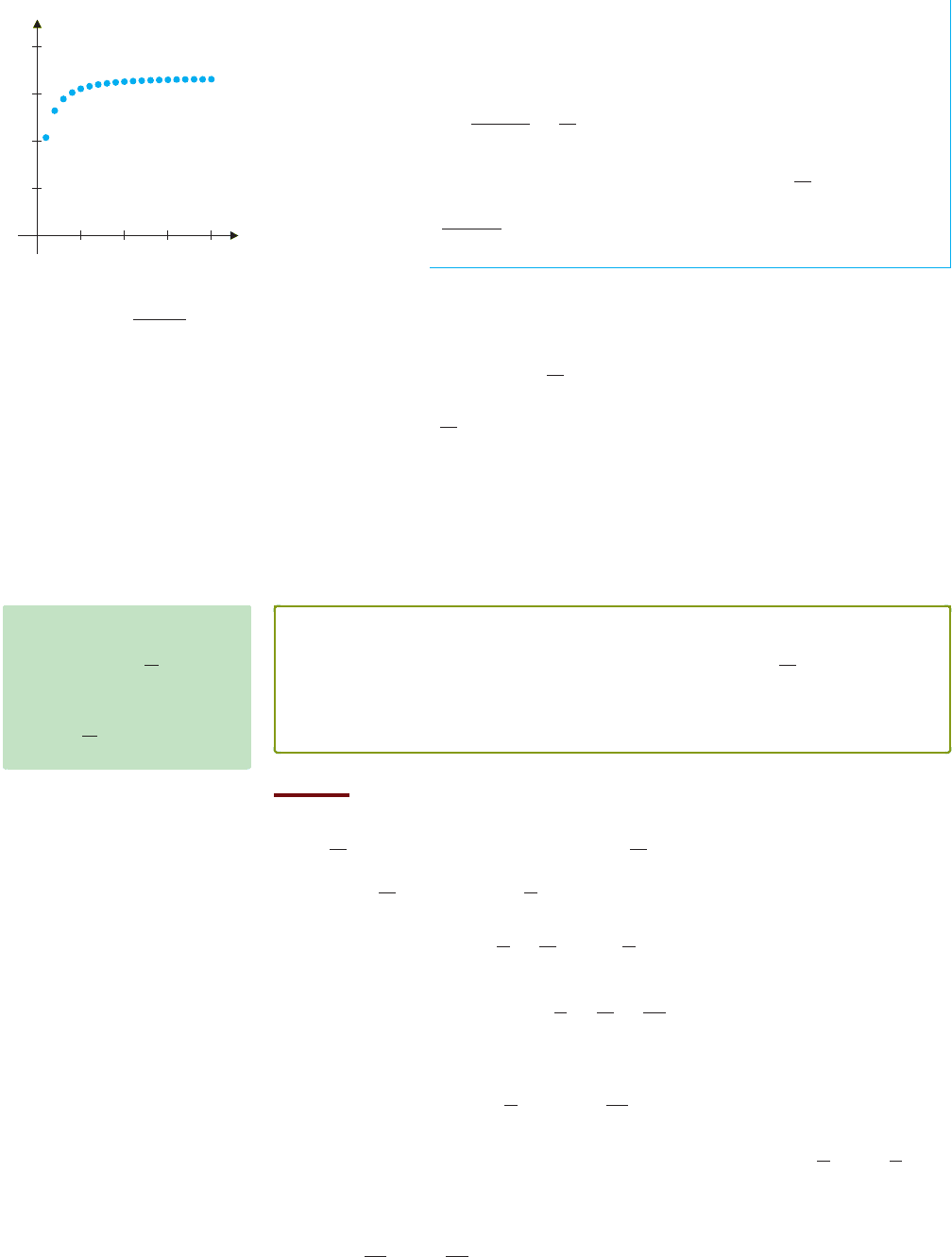
Solution The graph of the first 20 partial sums shown in Figure 9.26 suggests that
the series converges to some value near 0.3. To confirm such a conjecture, we must
carefully test the series. Note that for large values of k, the general term of the series
looks like
1
k
3
, since when k is large, k
3
is much larger than 5k. This observation is
significant, since we already know that
∞
k=1
1
k
3
is a convergent p-series (p = 3 > 1).
Further, observe that
0 ≤
1
k
3
+ 5k
≤
1
k
3
,
for all k ≥ 1. Since
∞
k=1
1
k
3
converges, the Comparison Test says that
∞
k=1
1
k
3
+ 5k
converges, too. As with the Integral Test, although the Comparison Test tells us that
both series converge, the two series need not converge to the same sum. A quick
calculation of a few partial sums should convince you that
∞
k=1
1
k
3
converges to
approximately 1.202, while
∞
k=1
1
k
3
+ 5k
converges to approximately 0.2798. (Note that
this is consistent with what we saw in Figure 9.26.)
5 10 15 20
0.1
0.2
0.3
S
n
n
FIGURE 9.26
S
n
=
n
k=1
1
k
3
+ 5k
5 10 15 20
S
n
0.5 10
8
1.0 10
8
1.5 10
8
2.0 10
8
n
FIGURE 9.27
S
n
=
n
k=1
5
k
+ 1
2
k
− 1
EXAMPLE 3.6 Using the Comparison Test for a Divergent Series
Investigate the convergence or divergence of
∞
k=1
5
k
+ 1
2
k
− 1
.
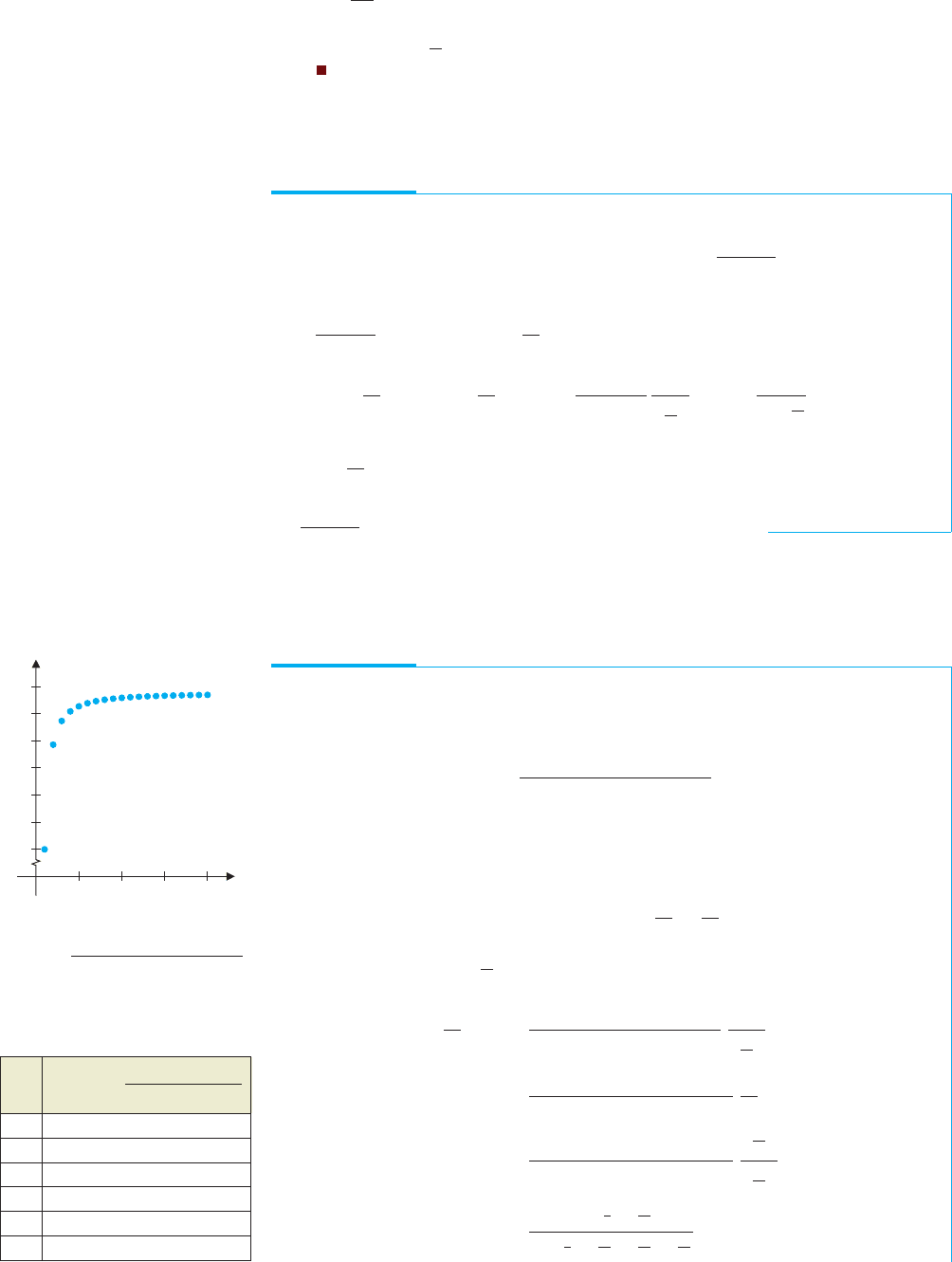
Solution From the graph of the first 20 partial sums seen in Figure 9.27, it appears
that the partial sums are growing very rapidly. On this basis, we would conjecture that
the series diverges. Of course, to verify this, we need further testing. Notice that for k
large, the general term looks like
5
k
2
k
=
5
2
k
and we know that
∞
k=1
5
2
k
is a divergent
geometric series
|r|=
5
2
> 1
. Further,
5
k
+ 1
2
k
− 1
≥
5
k
2
k
− 1
≥
5
k
2
k
=
5
2
k
≥ 0.
By the Comparison Test,
∞
k=1
5
k
+ 1
2
k
− 1
diverges, too.
There are plenty of series whose general term looks like the general term of a familiar
series, but for which it is unclear how to getthe inequality required for the Comparison Test
to go in the right direction.
EXAMPLE 3.7 A Comparison That Does Not Work
Investigate the convergence or divergence of the series
∞
k=3
1
k
3
− 5k
.
P1: OSO/OVY P2: OSO/OVY QC: OSO/OVY T1: OSO
MHDQ256-Ch09 MHDQ256-Smith-v1.cls December 17, 2010 19:47
LT (Late Transcendental)
CONFIRMING PAGES
560 CHAPTER 9
..
Infinite Series 9-30
Solution Note that this is nearly identical to example 3.5, except that there is a “−”
sign in the denominator instead of a “+” sign. The graph of the first 20 partial sums seen
in Figure 9.28 looks somewhat similar to the graph in Figure 9.26, except that the series
appears to be converging to about 0.12. In this case, however, we have the inequality
1
k
3
− 5k
≥
1
k
3
≥ 0, for all k ≥ 3.
Unfortunately, this inequality goes the wrong way: we know that
∞
k=3
1
k
3
is a convergent
p-series, but since
∞
k=3
1
k
3
− 5k
is “larger” than this convergent series, the Comparison
Test says nothing.
5 10 15 20
0.04
0.08
0.12
0.16
S
n
n
FIGURE 9.28
S
n
=
n+2
k=3
1
k
3
− 5k
Think about what happened in example 3.7 this way: while you might observe that
k
2
≥
1
k
3
≥ 0, for all k ≥ 1
andyou knowthat
∞
k=1
1
k
3
isconvergent,theComparison Test saysnothingabout the“larger”
series
∞
k=1
k
2
. In fact, we know that this last series is divergent (by the kth-term test for
divergence, since lim
k→∞
k
2
=∞= 0). To resolve this difficulty for the present problem, we
will need to either make a different comparison or use the Limit Comparison Test, which
follows.
NOTES
When we say lim
k→∞
a
k
b
k
= L > 0,
we mean that the limit exists and
is positive. In particular, we mean
that lim
k→∞
a
k
b
k
=∞.
THEOREM 3.4 (Limit Comparison Test)
Suppose that a
k
, b
k
> 0 and that for some (finite) value, L, lim
k→∞
a
k
b
k
= L > 0. Then,
either
∞
k=1
a
k
and
∞
k=1
b
k
both converge or they both diverge.
PROOF
If lim
k→∞
a
k
b
k
= L > 0, this says that we can make
a
k
b
k
as close to L as desired. So, in particular,
we can make
a
k
b
k
within distance
L
2
of L. That is, for some number N > 0,
L −
L
2
<
a
k
b
k
< L +
L
2
, for all k > N
or
L
2
<
a
k
b
k
<
3L
2
. (3.6)
Multiplying inequality (3.6) through by b
k
(since b
k
> 0), we get
0 <
L
2
b
k
< a
k
<
3L
2
b
k
, for k ≥ N.
Note that this says that if
∞
k=1
a
k
converges, then the “smaller” series
∞
k=1
L
2
b
k
=
L
2
∞
k=1
b
k
must also converge, by the Comparison Test. Likewise, if
∞
k=1
a
k
diverges, the “larger”
series
∞
k=1
3L
2
b
k
=
3L
2
∞
k=1
b
k
must also diverge. In the same way, if
∞
k=1
b
k
converges,
P1: OSO/OVY P2: OSO/OVY QC: OSO/OVY T1: OSO
MHDQ256-Ch09 MHDQ256-Smith-v1.cls December 17, 2010 19:47
LT (Late Transcendental)
CONFIRMING PAGES
9-31 SECTION 9.3
..
The Integral Test and Comparison Tests 561
then
∞
k=1
3L
2
b
k
converges and so, too, must the “smaller” series
∞
k=1
a
k
. Finally, if
∞
k=1
b
k
diverges, then
∞
k=1
L
2
b
k
diverges and hence, the “larger” series
∞
k=1
a
k
must diverge,
also.
We can now use the Limit Comparison Test to test the series from example 3.7 whose
convergence we have so far been unable to confirm.
EXAMPLE 3.8 Using the Limit Comparison Test
Investigate the convergence or divergence of the series
∞
k=3
1
k
3
− 5k
.
Solution Recall that we had already observed in example 3.7 that the general term
a
k
=
1
k
3
− 5k
“looks like” b
k
=
1
k
3
, for k large. We then consider the limit
lim
k→∞
a
k
b
k
= lim
k→∞
a
k
1
b
k
= lim
k→∞
1
(k
3
− 5k)
1
1
k
3
= lim
k→∞
1
1 −
5
k
2
= 1 > 0.
Since
∞
k=1
1
k
3
is a convergent p-series (p = 3 > 1), the Limit Comparison Test says that
∞
k=3
1
k
3
− 5k
is also convergent, as we had originally suspected.
The Limit Comparison Test can be used to resolve convergence questions for a great
many series. The first step in using this (like the Comparison Test) is to find another series
(whose convergence or divergence is known) that “looks like” the series in question.
EXAMPLE 3.9 Using the Limit Comparison Test
Investigate the convergence or divergence of the series
∞
k=1
k
2
− 2k + 7
k
5
+ 5k
4
− 3k
3
+ 2k − 1
.
5 10 15 20
1.52
1.54
1.56
1.58
1.60
1.62
1.50
S
n
n
FIGURE 9.29
S
n
=
n
k=1
k
2
− 2k + 7
k
5
+ 5k
4
− 3k
3
+ 2k − 1
n S
n
n
k1
k
2
−2k7
k
5
5k
4
−3k
3
2k−1
5 1.60522
10 1.61145
20 1.61365
50 1.61444
75 1.61453
100 1.61457
Solution The graph of the first 20 partial sums in Figure 9.29 suggests that the series
converges to a limit of about 1.61. The accompanying table of partial sums supports this
conjecture.
Notice that for k large, the general term looks like
k
2
k
5
=
1
k
3
(since the terms with the
largest exponents tend to dominate the expression, for large values of k). From the Limit
Comparison Test, for b
k
=
1
k
3
,wehave
lim
k→∞
a
k
b
k
= lim
k→∞
k
2
− 2k + 7
k
5
+ 5k
4
− 3k
3
+ 2k − 1
1
1
k
3
= lim
k→∞
(k
2
− 2k + 7)
(k
5
+ 5k
4
− 3k
3
+ 2k − 1)
k
3
1
= lim
k→∞
(k
5
− 2k
4
+ 7k
3
)
(k
5
+ 5k
4
− 3k
3
+ 2k − 1)
1
k
5
1
k
5
= lim
k→∞
1 −
2
k
+
7
k
2
1 +
5
k
−
3
k
2
+
2
k
4
−
1
k
5
= 1 > 0.

P1: OSO/OVY P2: OSO/OVY QC: OSO/OVY T1: OSO
MHDQ256-Ch09 MHDQ256-Smith-v1.cls December 17, 2010 19:47
LT (Late Transcendental)
CONFIRMING PAGES
562 CHAPTER 9
..
Infinite Series 9-32
Since
∞
k=1
1
k
3
is a convergent p-series (p = 3 > 1), the Limit Comparison Test says that
∞
k=1
k
2
− 2k + 7
k
5
+ 5k
4
− 3k
3
+ 2k − 1
converges, also. Finally, now that we have established
that the series is, in fact, convergent, we can use our table of computed partial sums to
approximate the sum of the series as 1.61457.
BEYOND FORMULAS
Keeping track of the many convergence tests arising in the study of infinite series can
be somewhat challenging. We need all of these convergence tests because there is not
a single test that works for all series (although more than one test may be used for a
given series). Keep in mind that each test works only for specific types of series. As a
result, you must be able to distinguish one type of infinite series (such as a geometric
series) from another (such as a p-series), in order to determine the right test to use.
EXERCISES 9.3
WRITING EXERCISES
1. Notice that the Comparison Test doesn’t always give us infor-
mation about convergence or divergence. If a
k
≤ b
k
for each k
and
∞
k=1
b
k
diverges, explain why you can’t tell whether or not
∞
k=1
a
k
diverges.
2. Explain why the Limit Comparison Test works. In particular,
if lim
k→∞
a
k
b
k
= 1, explain how a
k
and b
k
compare and conclude
that
∞
k=1
a
k
and
∞
k=1
b
k
either both converge or both diverge.
3. In the Limit Comparison Test, if lim
k→∞
a
k
b
k
= 0 and
∞
k=1
a
k
converges, explain why you can’t tell whether or not
∞
k=1
b
k
converges.
4. A p-series converges if p > 1 and diverges if p < 1.
What happens for p = 1? If your friend knows that
the harmonic series diverges, explain an easy way to
remember the rest of the conclusion of the p-series
test.
In exercises 1–20, determine convergence or divergence of the
series.
1. (a)
∞
k=1
4
3
√
k
(b)
∞
k=1
k
−9/10
2. (a)
∞
k=4
k
−11/10
(b)
∞
k=6
4
√
k
3. (a)
∞
k=3
k + 1
k
2
+ 2k + 3
(b)
∞
k=0
√
k
k
2
+ 1
4. (a)
∞
k=8
4
2 + 4k
(b)
∞
k=6
4
(2 + 4k)
2
5. (a)
∞
k=2
2
k lnk
(b)
∞
k=2
3
k(ln k)
2
6. (a)
∞
k=1
2k
k
3
+ 1
(b)
∞
k=2
k
2
+ 1
k
3
+ 3k + 2
7. (a)
∞
k=3
e
1/k
k
2
(b)
∞
k=4
1 + 1/ k
k
2
8. (a)
∞
k=1
e
−
√
k
√
k
(b)
∞
k=1
ke
−k
2
4 + e
−k
9. (a)
∞
k=1
2k
2
k
5/2
+ 2
(b)
∞
k=0
2
k
2
+ 4
10. (a)
∞
k=0
4
k
3
+ 1
(b)
∞
k=0
k
2
+ 1
k
5
+ 1
11. (a)
∞
k=1
tan
−1
k
1 + k
2
(b)
∞
k=1
sin
−1
(1/k)
k
2
12. (a)
∞
k=1
1
cos
2
k
(b)
∞
k=1
e
1/k
+ 1
k
3
13. (a)
∞
k=2
lnk
k
(b)
∞
k=1
2 + cos k
k
14. (a)
∞
k=4
k
4
+ 2k − 1
k
5
+ 3k
2
+ 1
(b)
∞
k=6
k
3
+ 2k + 3
k
4
+ 2k
2
+ 4
15. (a)
∞
k=3
k + 1
k
2
+ 2
(b)
∞
k=2
√
k + 1
k
2
+ 2
16. (a)
∞
k=8
k + 1
k
3
+ 2
(b)
∞
k=5
√
k + 1
√
k
3
+ 2