
Smith R., Minton R. Calculus
Подождите немного. Документ загружается.


P1: OSO/OVY P2: OSO/OVY QC: OSO/OVY T1: OSO
MHDQ256-Ch09 MHDQ256-Smith-v1.cls December 24, 2010 19:31
LT (Late Transcendental)
CONFIRMING PAGES
9-33 SECTION 9.3
..
The Integral Test and Comparison Tests 563
17. (a)
∞
k=1
1
k
√
k + k
√
k + 1
(b)
∞
k=1
2k + 1
k
√
k + k
2
√
k + 1
18. (a)
∞
k=4
ke
−k
(b)
∞
k=5
k
3
e
k
19. (a)
∞
k=2
1
lnk
(b)
∞
k=3
1
ln(lnk)
(c)
∞
k=3
1
ln(k lnk)
(d)
∞
k=2
1
ln(k!)
20. (a)
∞
k=1
tan
−1
k (b)
∞
k=1
tan
−1
k
k
(c)
∞
k=1
tan
−1
k
k
2
(d)
∞
k=2
sec
−1
k
k
2
1 − 1/ k
2
............................................................
In exercises 21–24, determine all values of p for which the series
converges.
21.
∞
k=2
1
k(ln k)
p
22.
∞
k=0
1
(a + bk)
p
, a > 0, b > 0
23.
∞
k=2
lnk
k
p
24.
∞
k=1
k
p−1
e
kp
............................................................
In exercises 25–30, estimate the error in using the indicated
partial sum S
n
to approximate the sum of the series.
25. S
100
,
∞
k=1
1
k
4
26. S
100
,
∞
k=1
4
k
2
27. S
50
,
∞
k=1
6
k
8
28. S
80
,
∞
k=1
2
k
2
+ 1
29. S
40
,
∞
k=1
ke
−k
2
30. S
200
,
∞
k=1
tan
−1
k
1 + k
2
............................................................
In exercises 31–34, determine the number of terms needed to
obtain an approximation accurate to within 10
−6
.
31.
∞
k=1
3
k
4
32.
∞
k=1
2
k
2
33.
∞
k=1
ke
−k
2
34.
∞
k=1
4
k
5
............................................................
In exercises 35 and 36, answer with “converges” or “diverges”
or “can’t tell.” Assume that a
k
> 0 and b
k
> 0.
35. Assume that
∞
k=1
a
k
converges and fill in the blanks.
(a) If b
k
≥ a
k
for k ≥ 10, then
∞
k=1
b
k
———
.
(b) If lim
k→∞
b
k
a
k
= 0, then
∞
k=1
b
k
———
.
(c) If b
k
≤ a
k
for k ≥ 6, then
∞
k=1
b
k
———
.
(d) If lim
k→∞
b
k
a
k
=∞, then
∞
k=1
b
k
———
.
36. Assume that
∞
k=1
a
k
diverges and fill in the blanks.
(a) If b
k
≥ a
k
for k ≥ 10, then
∞
k=1
b
k
———
.
(b) If lim
k→∞
b
k
a
k
= 0, then
∞
k=1
b
k
———
.
(c) If b
k
≤ a
k
for k ≥ 6, then
∞
k=1
b
k
———
.
(d) If lim
k→∞
b
k
a
k
=∞, then
∞
k=1
b
k
———
.
............................................................
37. Prove the following extensions of the Limit Comparison Test:
(a) if lim
k→∞
a
k
b
k
= 0 and
∞
k=1
b
k
converges, then
∞
k=1
a
k
converges.
(b) if lim
k→∞
a
k
b
k
=∞and
∞
k=1
b
k
diverges, then
∞
k=1
a
k
diverges.
38. If a
k
> 0 and
∞
k=1
a
k
converges, prove that
∞
k=1
a
2
k
converges.
39. Prove that if
∞
k=1
a
2
k
and
∞
k=1
b
2
k
converge, then
∞
k=1
|a
k
b
k
|
converges.
40. Prove that fora
k
> 0,
∞
k=1
a
k
converges if andonlyif
∞
k=1
a
k
1 +a
k
converges.
Hint: If x < 1, then x <
2x
1 + x
.
41. Prove that the every-other-term harmonic series 1 +
1
3
+
1
5
+
1
7
+···diverges. (Hint: Write the series as
∞
k=0
1
2k + 1
and use
the Limit Comparison Test.)
42. Would the every-third-term harmonic series 1 +
1
4
+
1
7
+
1
10
+···diverge? How about the every-fourth-term harmonic
series 1 +
1
5
+
1
9
+
1
13
+···? Make as general a statement as
possible about such series.
43. Show that
∞
k=2
1
(lnk)
lnk
and
∞
k=2
1
(lnk)
k
both converge.
44. Show that
∞
k=2
1
(lnk)
n
diverges for any integer n > 0. Compare
this result to exercise 43.
45. Use your CAS to evaluate
∞
k=1
1
k
p
for p = 2, 4, 6, 8 and 10. Can
your CAS evaluate the sum for odd values of p?
46. The Riemann-zeta function is defined by ζ (x) =
∞
k=1
1
k
x
for x > 1. Explain why the restriction x > 1 is neces-
sary. Leonhard Euler, considered to be one of the greatest
mathematicians ever, proved the remarkable result that
ζ (x) =
p=prime
1
1 −
1
p
x
.
47. (a) Explain why the Trapezoidal Rule approximation of
n
0
x
n
dx
will be larger than the integral, for any integer n > 1.
(b) Show that the Trapezoidal Rule approximation, with h = 1
equals 1
n
+ 2
n
+···+(n − 1)
n
+
1
2
n
n
.
(c) Conclude that
1
n
+ 2
n
+···+n
n
n
n
>
3n + 1
2n + 2
.
P1: OSO/OVY P2: OSO/OVY QC: OSO/OVY T1: OSO
MHDQ256-Ch09 MHDQ256-Smith-v1.cls December 17, 2010 19:47
LT (Late Transcendental)
CONFIRMING PAGES
564 CHAPTER 9
..
Infinite Series 9-34
48. Numerically investigate the p-series
∞
k=1
1
k
0.9
and
∞
k=1
1
k
1.1
and
for other values of p close to 1. Can you distinguish convergent
from divergent series numerically?
APPLICATIONS
49. Suppose that you toss a fair coin until you get heads. How
many times would you expect to toss the coin? To answer this,
notice that the probability of getting heads on the first toss is
1
2
, getting tails then heads is
1
2
2
, getting two tails then heads
is
1
2
3
and so on. The mean number of tosses is
∞
k=1
k
1
2
k
.
Use the Integral Test to prove that this series converges and
estimate the sum numerically.
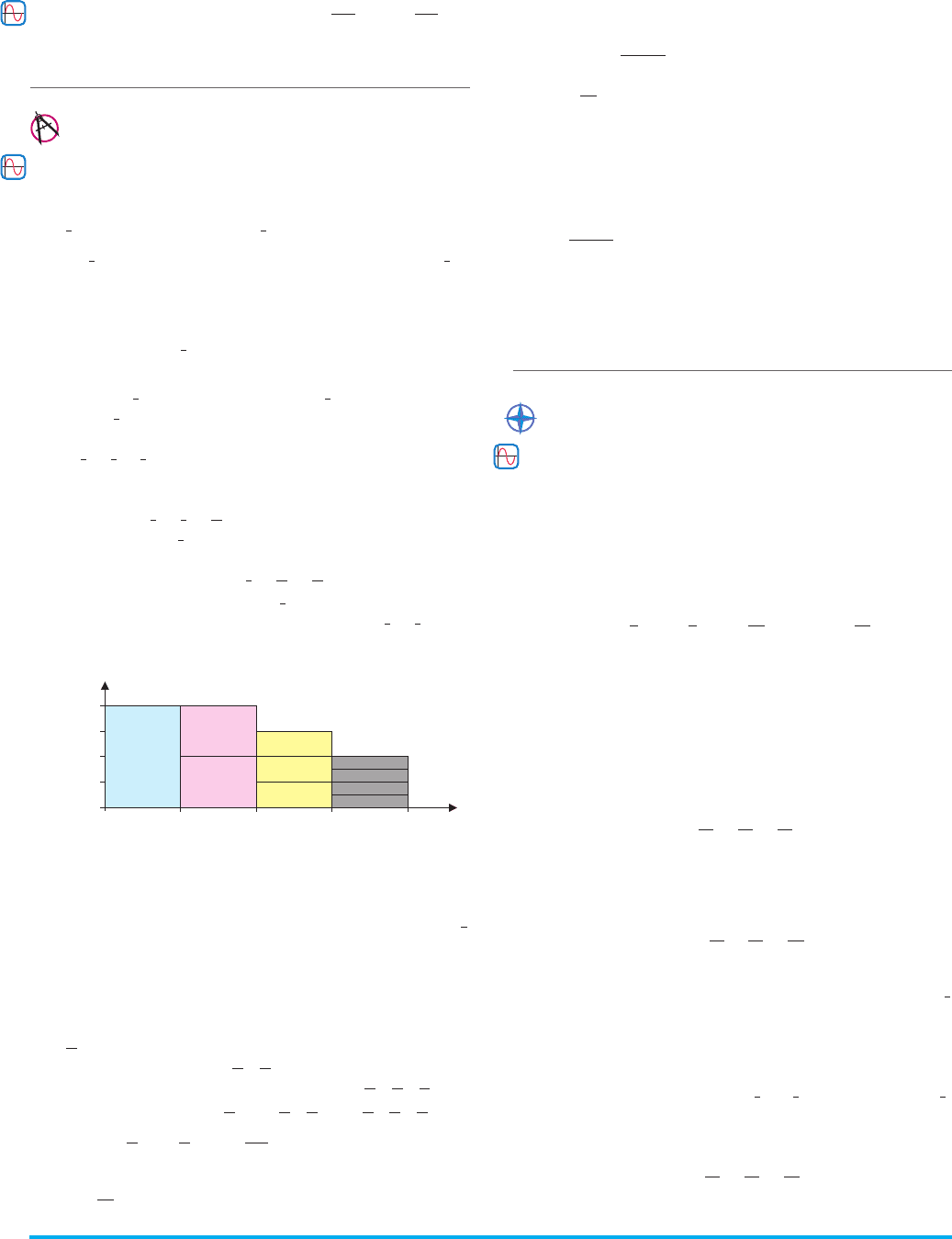
50. The series
∞
k=1
k
1
2
k
can be visualized as the area shown in
the figure. In columns of width one, we see one rectangle
of height
1
2
, two rectangles of height
1
4
, three rectangles of
height
1
8
and so on. Start the sum by taking one rectangle
from each column. The combined area of the first rectangles
is
1
2
+
1
4
+
1
8
+···. Show that this is a convergent series with
sum 1. Next, take the second rectangle from each column that
has at least two rectangles. The combined area of the second
rectangles is
1
4
+
1
8
+
1
16
+···. Show that this is a convergent
series with sum
1
2
. Next, take the third rectangle from each
column that has at least three rectangles. The combined area
from the third rectangles is
1
8
+
1
16
+
1
32
+···. Show that this
is a convergent series with sum
1
4
. Continue this process and
show that the total area of all rectangles is 1 +
1
2
+
1
4
+···.
Find the sum of this convergent series.
0
0.125
0.25
0.5
1 2 3 4
x
y
0.375
51. Thecoupon collectors’ problem is facedbycollectors of trad-
ing cards. If there are n differentcards that make a complete set
and you randomly obtain oneat a time,how many cards would
youexpecttoobtainbeforehavingacompleteset?(Byrandom,
we mean that each different card has the same probability of
1
n
ofbeingthenextcardobtained.) Inexercises51–53,wefindthe
answer for n = 10. The first step is simple; to collect one card
youneedtoobtainonecard.Now,giventhat you haveone card,
how many cards do you need to obtain to get a second (differ-
ent)card?If you’relucky,thenextcardisit(thishasprobability
9
10
).Butyour next card might bea duplicate, thenyou get anew
card (this has probability
1
10
·
9
10
). Or you might get two dupli-
cates and then a newcard (this has probability
1
10
·
1
10
·
9
10
); and
so on. The mean is 1 ·
9
10
+ 2 ·
1
10
·
9
10
+ 3 ·
1
10
·
1
10
·
9
10
+···
or
∞
k=1
k
1
10
k−1
9
10
=
∞
k=1
9k
10
k
. Using the same trick as in
exercise 50, show that this is a convergent series with
sum
10
9
.
52. In the situation of exercise 51, if you have two different cards
out of ten, the average number of cards to get a third distinct
card is
∞
k=1
8k2
k−1
10
k
; show that this is a convergent series with
sum
10
8
.
53. (a) Extend the results of exercises51 and 52 to find the average
number of cards you need to obtain to complete the set of
ten different cards.
(b) Compute the ratio of cards obtained to cards in the set. That
is, for a set of 10 cards, on the average you need to obtain
times 10 cards to complete the set.
54. (a) Generalize exercise 53 in the case of n cards in the set
(n > 2).
(b) Use the divergence of the harmonic series to state the un-
fortunate fact about the ratio of cards obtained to cards in
the set as n increases.
EXPLORATORY EXERCISES
1. In this exercise, you explore the convergence of the infinite
product P = 2
1/4
3
1/9
4
1/16
···. This can be written in the form
P =
∞
k=2
k
1/k
2
. For the partial product P
n
=
n
k=2
k
1/k
2
, use the
natural logarithm to write
P
n
= e
ln P
n
= e
ln[2
1/4
3
1/9
4
1/16
···n
1/n
2
]
= e
S
n
, where
S
n
= ln[2
1/4
3
1/9
4
1/16
···n
1/n
2
]
=
1
4
ln2 +
1
9
ln3 +
1
16
ln4 +···+
1
n
2
lnn.
By comparing to an appropriate integral and showing that the
integral converges, show that {S
n
} converges. Show that {P
n
}
converges to a number between 2.33 and 2.39. Use a CAS or
calculator to compute P
n
for large n and see how accurate the
computation is.
2. Define a function f (x) in the following way for 0 ≤ x ≤ 1.
Write out the binary expansion of x. That is,
x =
a
1
2
+
a
2
4
+
a
3
8
+···
where each a
i
is either 0 or 1. Prove that this infinite series
converges. Then f (x) is the corresponding ternary expansion,
given by
f (x) =
a
1
3
+
a
2
9
+
a
3
27
+···
Prove that this series converges. There is a subtle issue here
of whether the function is well defined or not. Show that
1
2
can be written with a
1
= 1 and a
k
= 0 for k ≥ 2 and also with
a
1
= 0 and a
k
= 1 for k ≥ 2. Show that you get different val-
ues of f (x) with different representations. In such cases, we
choose the representation with as few 1’s as possible. Show
that f (2x) = 3 f (x) and f
x +
1
2
=
1
3
+ f (x)for0 ≤ x ≤
1
2
.
Use these facts to compute
!
1
0
f (x) dx. Generalize the result
for any base n conversion
f (x) =
a
1
n
+
a
2
n
2
+
a
3
n
3
+···,
where n is an integer greater than 1.
P1: OSO/OVY P2: OSO/OVY QC: OSO/OVY T1: OSO
MHDQ256-Ch09 MHDQ256-Smith-v1.cls December 17, 2010 19:47
LT (Late Transcendental)
CONFIRMING PAGES
9-35 SECTION 9.4
..
Alternating Series 565
9.4 ALTERNATING SERIES
So far, we have focused our attention on positive-term series, that is, series for which all
the terms are positive. In this section, we examine alternating series, that is, series whose
terms alternate back and forth from positive to negative.
An alternating series is any series of the form
∞
k=1
(−1)
k+1
a
k
= a
1
− a
2
+ a
3
− a
4
+ a
5
− a
6
+···,
where a
k
> 0, for all k.
EXAMPLE 4.1 The Alternating Harmonic Series
Investigate the convergence or divergence of the alternating harmonic series
∞
k=1
(−1)
k+1
k
= 1 −
1
2
+
1
3
−
1
4
+
1
5
−
1
6
+···.
5 10 15 20
0.2
0.4
0.6
0.8
1.0
n
S
n
FIGURE 9.30
S
n
=
n
k=1
(−1)
k+1
k
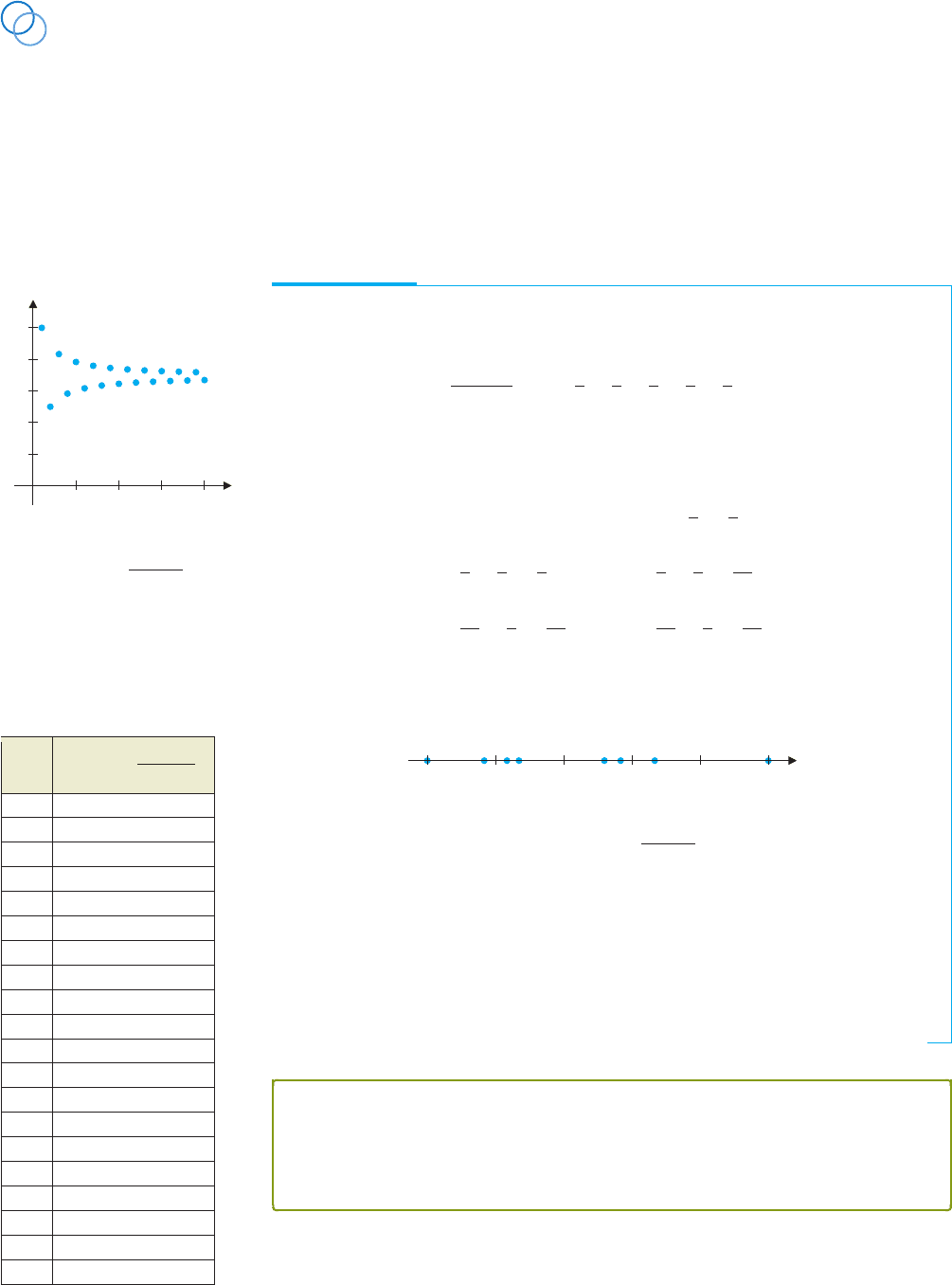
Solution The graph of the first 20 partial sums seen in Figure 9.30 suggests that the
series might converge to about 0.7. We now calculate the first few partial sums by hand.
Note that
S
1
= 1, S
2
= 1 −
1
2
=
1
2
,
S
3
=
1
2
+
1
3
=
5
6
, S
4
=
5
6
−
1
4
=
7
12
,
S
5
=
7
12
+
1
5
=
47
60
, S
6
=
47
60
−
1
6
=
37
60
,
and so on. We have plotted the first 8 partial sums on the number line shown in
Figure 9.31.
0.5 0.6 0.7 0.8 0.9 1
S
2
S
4
S
6
S
8
S
7
S
5
S
3
S
1
FIGURE 9.31
Partial sums of
∞
k=1
(−1)
k+1
k
Notice that the partial sums are bouncing back and forth, but seem to be zeroing in on
some value. This should not be surprising, since each new term that is added or
subtracted is less than the term added or subtracted to get the previous partial sum. You
should notice this same zeroing-in process in the accompanying table displaying the
first 20 partial sums of the series. Based on the behavior of the partial sums, it is
reasonable to conjecture that the series converges to some value between 0.66877 and
0.71877. We can resolve the question of convergence definitively with Theorem 4.1.
n S
n
n
k1
(−1)
k1
k
1 1
2 0.5
3 0.83333
4 0.58333
5 0.78333
6 0.61667
7 0.75952
8 0.63452
9 0.74563
10 0.64563
11 0.73654
12 0.65321
13 0.73013
14 0.65871
15 0.72537
16 0.66287
17 0.7217
18 0.66614
19 0.71877
20 0.66877
THEOREM 4.1 (Alternating Series Test)
Suppose that lim
k→∞
a
k
= 0 and 0 < a
k+1
≤ a
k
for all k ≥ 1. Then, the alternating
series
∞
k=1
(−1)
k+1
a
k
converges.
Before considering the proof of Theorem 4.1, make sure that you have a clear idea what
it is saying. In the case of an alternating series satisfying the hypotheses of the theorem,
P1: OSO/OVY P2: OSO/OVY QC: OSO/OVY T1: OSO
MHDQ256-Ch09 MHDQ256-Smith-v1.cls December 17, 2010 19:47
LT (Late Transcendental)
CONFIRMING PAGES
566 CHAPTER 9
..
Infinite Series 9-36
we start with 0 and add a
1
> 0 to get the first partial sum S
1
. To get the next partial sum,
S
2
, we subtract a
2
from S
1
, where a
2
≤ a
1
. This says that S
2
will be between 0 and S
1
.We
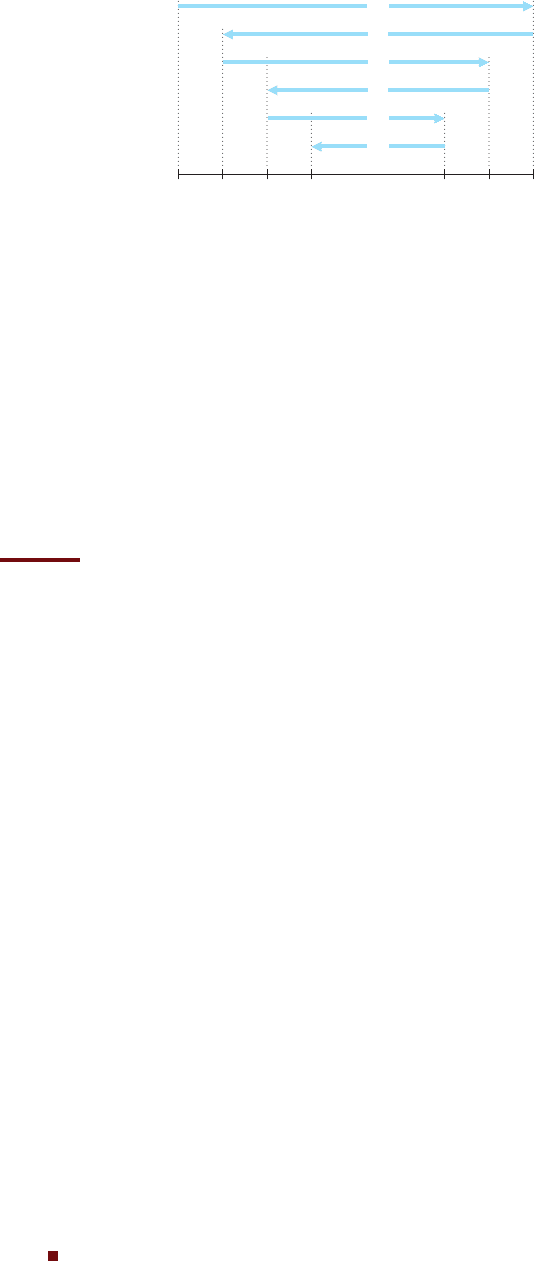
illustrate this situation in Figure 9.32.
a
1
a
2
a
3
a
4
a
5
a
6
0 S
2
S
4
S
6
S
5
S
3
S
1
FIGURE 9.32
Convergence of the partial sums of an alternating series
Continuing in this fashion, we add a
3
to S
2
to get S
3
. Since a
3
≤ a
2
, we must have that
S
2
≤ S
3
≤ S
1
. Referring to Figure 9.32, notice that
S
2
≤ S
4
≤ S
6
≤···≤S
5
≤ S
3
≤ S
1
.
Inparticular,thissaysthatall oftheodd-indexedpartialsums(i.e., S
2n+1
,forn = 0, 1, 2,...)
are larger than all of the even-indexed partial sums (i.e., S
2n
, for n = 1, 2,...). As the
partial sums oscillate back and forth, they should be drawing closer and closer to some
limit S, somewhere between all of the even-indexed partial sums and the odd-indexed
partial sums,
S
2
≤ S
4
≤ S
6
≤···≤S ≤···≤S
5
≤ S
3
≤ S
1
. (4.1)
PROOF
Notice from Figure 9.32 that the even- and odd-indexed partial sums seem to behave
somewhat differently. First, we consider the even-indexed partial sums. We have
S
2
= a
1
− a
2
≥ 0
and S
4
= S
2
+ (a
3
− a
4
) ≥ S
2
,
since (a
3
− a
4
) ≥ 0. Likewise, for any n, we can write
S
2n
= S
2n−2
+ (a
2n−1
− a
2n
) ≥ S
2n−2
,
since (a
2n−1
− a
2n
) ≥ 0. This says that the sequence of even-indexed partial sums {S
2n
}
∞
n=1
is increasing (as we saw in Figure 9.32). Further, observe that
0 ≤ S
2n
= a
1
+ (−a
2
+ a
3
) + (−a
4
+ a
5
) +···+(−a
2n−2
+ a
2n−1
) − a
2n
≤ a
1
,
for all n, since every term in parentheses is negative. Thus, {S
2n
}
∞
n=1
is both bounded (by a
1
)
andmonotonic (increasing). By Theorem 1.4, {S
2n
}
∞
n=1
mustbe convergentto some number,
say L.
Turning to the sequence of odd-indexed partial sums, notice that we have
S
2n+1
= S
2n
+ a
2n+1
.
From this, we have
lim
n→∞
S
2n+1
= lim
n→∞
(S
2n
+ a
2n+1
) = lim
n→∞
S
2n
+ lim
n→∞
a
2n+1
= L + 0 = L,
since lim
n→∞
a
n
= 0. Since both the sequence of odd-indexed partial sums {S
2n+1
}
∞
n=0
and the
sequence of even-indexed partial sums {S
2n
}
∞
n=1
converge to the same limit, L, we have that
lim
n→∞
S
n
= L,
also.
P1: OSO/OVY P2: OSO/OVY QC: OSO/OVY T1: OSO
MHDQ256-Ch09 MHDQ256-Smith-v1.cls December 17, 2010 19:47
LT (Late Transcendental)
CONFIRMING PAGES
9-37 SECTION 9.4
..
Alternating Series 567
EXAMPLE 4.2 Using the Alternating Series Test
Reconsider the convergence of the alternating harmonic series
∞
k=1
(−1)
k+1
k
.
Solution Notice that
lim
k→∞
a
k
= lim
k→∞
1
k
= 0.
Further,
0 < a
k+1
=
1
k + 1
≤
1
k
= a
k
, for all k ≥ 1.
By the Alternating Series Test, the series converges. (The calculations from example 4.1
give an approximate sum. An exact sum is found in exercise 45.)
The Alternating Series Test is straightforward, but you will sometimes need to work a
bit to verify the hypotheses.
EXAMPLE 4.3 Using the Alternating Series Test
Investigate the convergence or divergence of the alternating series
∞
k=1
(−1)
k
(k + 3)
k(k + 1)
.
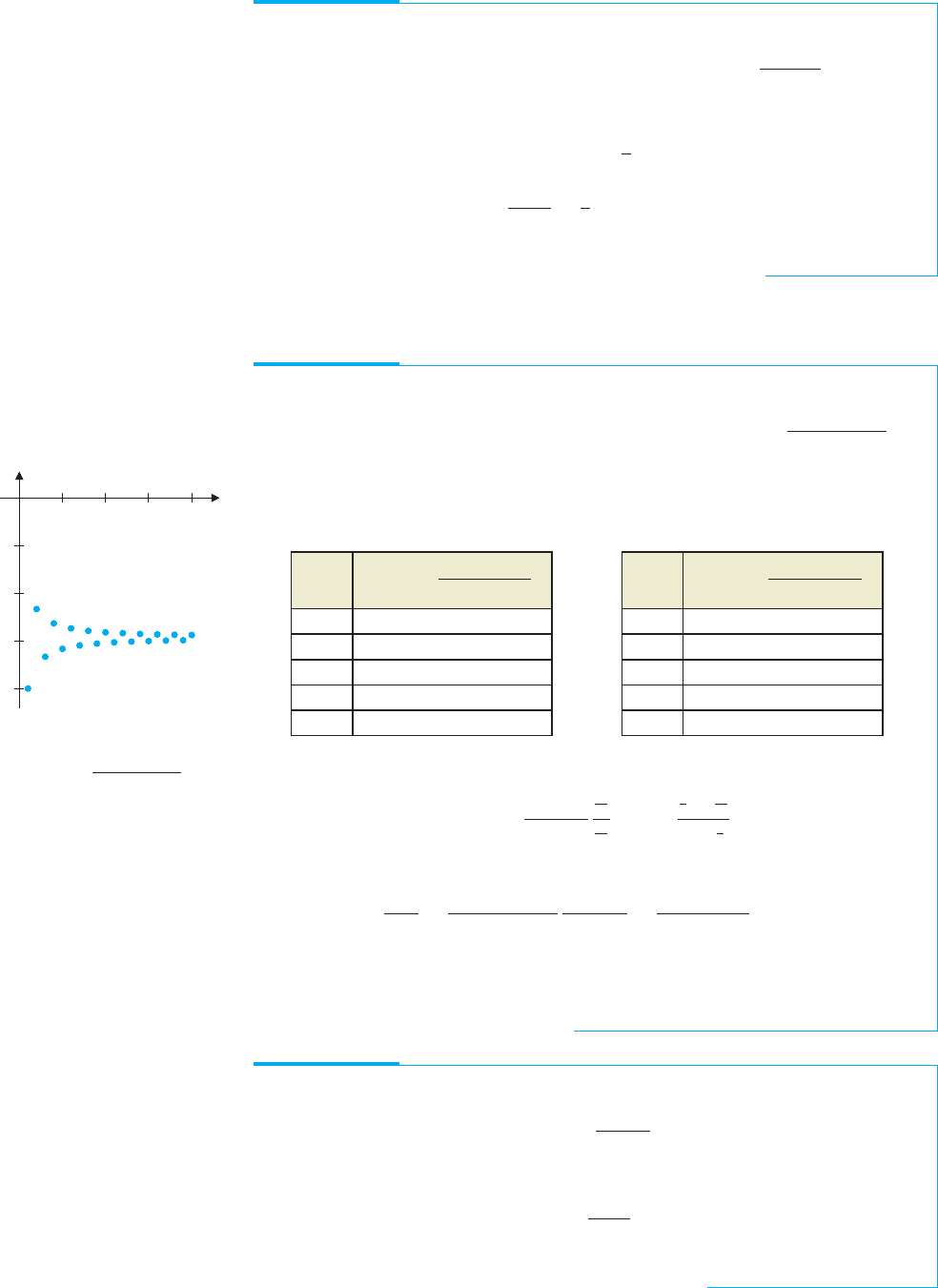
Solution The graph of the first 20 partial sums seen in Figure 9.33 suggests that the
series converges to some value around −1.5. The following table showing some select
partial sums suggests the same conclusion.
n S
n
n
k1
(−1)
k
(k 3)
k(k 1)
50 −1.45545
100 −1.46066
200 −1.46322
300 −1.46406
400 −1.46448
n S
n
n
k1
(−1)
k
(k 3)
k(k 1)
51 −1.47581
101 −1.47076
201 −1.46824
301 −1.46741
401 −1.46699
5 10 15 20
0.5
1.0
1.5
2.0
S
n
n
FIGURE 9.33
S
n
=
n
k=1
(−1)
k
(k + 3)
k(k +1)
We can verify that the series converges by first checking that
lim
k→∞
a
k
= lim
k→∞
(k + 3)
k(k + 1)
1
k
2
1
k
2
= lim
k→∞
1
k
+
3
k
2
1 +
1
k
= 0.
Next, consider the ratio of two consecutive terms:
a
k+1
a
k
=
(k + 4)
(k + 1)(k + 2)
k(k + 1)
(k + 3)
=
k
2
+ 4k
k
2
+ 5k + 6
< 1,
for all k ≥ 1. From this, it follows that a
k+1
< a
k
, for all k ≥ 1 and so, by the
Alternating Series Test, the series converges. Finally, from the preceding table, we can
see that the series converges to a sum between −1.46448 and −1.46699. (How can you
be sure that the sum is in this interval?)
EXAMPLE 4.4 A Divergent Alternating Series
Determine whether the alternating series
∞
k=3
(−1)
k
k
k + 2
converges or diverges.
Solution First, notice that
lim
k→∞
a
k
= lim
k→∞
k
k + 2
= 1 = 0.
So, this alternating seriesis divergent,since by the kth-term test for divergence, the terms
must tend to zero in order for the series to be convergent.

P1: OSO/OVY P2: OSO/OVY QC: OSO/OVY T1: OSO
MHDQ256-Ch09 MHDQ256-Smith-v1.cls December 17, 2010 19:47
LT (Late Transcendental)
CONFIRMING PAGES
568 CHAPTER 9
..
Infinite Series 9-38
Estimating the Sum of an Alternating Series
So far, we have found approximate sums of convergent series by calculating a number of
partial sums of the series. As was the case for positive-term series to which the Integral Test
applies, we can say something very precise for alternating series. First, note that the error
in approximating the sum S by the nth partial sum S
n
is S − S
n
.
Look back at Figure 9.32 and observethat all of the even-indexed partial sums S
n
of the
convergent alternating series
∞
k=1
(−1)
k+1
a
k
lie belowthe sum S, while all of the odd-indexed
partial sums lie above S. That is [as in (4.1)],
S
2
≤ S
4
≤ S
6
≤···≤S ≤···≤S
5
≤ S
3
≤ S
1
.
This says that for n even,
S
n
≤ S ≤ S
n+1
.
Subtracting S
n
from all terms, we get
0 ≤ S − S
n
≤ S
n+1
− S
n
= a
n+1
.
Since a
n+1
> 0, we have
−a
n+1
< 0 ≤ S − S
n
≤ a
n+1
,
or
|S − S
n
|≤a
n+1
, for n even. (4.2)
Similarly, for n odd, we have that
S
n+1
≤ S ≤ S
n
.
Again subtracting S
n
,weget
−a
n+1
= S
n+1
− S
n
≤ S − S
n
≤ 0 < a
n+1
or
|S − S
n
|≤a
n+1
, for n odd. (4.3)
Since (4.2) and (4.3) (called error bounds) are the same, we have the same error bound
whether n is even or odd. This establishes the following result.
THEOREM 4.2
Suppose that lim
k→∞
a
k
= 0 and 0 < a
k+1
≤ a
k
for all k ≥ 1. Then, the alternating
series
∞
k=1
(−1)
k+1
a
k
converges to some number S and the error in approximating S by
the nth partial sum S
n
satisfies
|S − S
n
|≤a
n+1
. (4.4)
Theorem 4.2 says that the absolute value of the error in approximating S by S
n
does
not exceed a
n+1
(the absolute value of the first neglected term).
EXAMPLE 4.5 Estimating the Sum of an Alternating Series
Approximate the sum of the alternating series
∞
k=1
(−1)
k+1
k
4
by the 40th partial sum and
estimate the error in this approximation.

P1: OSO/OVY P2: OSO/OVY QC: OSO/OVY T1: OSO
MHDQ256-Ch09 MHDQ256-Smith-v1.cls December 17, 2010 19:47
LT (Late Transcendental)
CONFIRMING PAGES
9-39 SECTION 9.4
..
Alternating Series 569
Solution We leave it as an exercise to show that this series is convergent. We then
approximate the sum by
S ≈ S
40
≈ 0.9470326439.
From our error estimate (4.4), we have
|S − S
40
|≤a
41
=
1
41
4
≈ 3.54 × 10
−7
.
This says that our approximation S ≈ 0.9470326439 is off by no more than
±3.54 × 10
−7
.
A much more interesting question than the one asked in example 4.5 is the following.
For a given convergent alternating series, how many terms must we take, in order to obtain
an approximation with a given accuracy? We illustrate this in example 4.6.
EXAMPLE 4.6 Finding the Number of Terms Needed
for a Given Accuracy
For the convergent alternating series
∞
k=1
(−1)
k+1
k
4
, how many terms are needed to
guarantee that S
n
is within 1 × 10
−10
of the actual sum S?
Solution In this case, we want to find the number of terms n for which
|S − S
n
|≤1 × 10
−10
.
From (4.4), we have that |S − S
n
|≤a
n+1
=
1
(n + 1)
4
.
So, we look for n such that
1
(n + 1)
4
≤ 1 × 10
−10
.
Solving for n, we get 10
10
≤ (n + 1)
4
,
so that
4
√
10
10
≤ n + 1
or n ≥
4
√
10
10
− 1 ≈ 315.2.
So, if we take n ≥ 316, we will guarantee an error of no more than 1 ×10
−10
. Using
the suggested number of terms, we get the approximate sum
S ≈ S
316
≈ 0.947032829447,
which we now know to be correct to within 1 ×10
−10
.
BEYOND FORMULAS
When you think about infinite series, you must understand the interplay between se-
quences and series. Our tests for convergence involve sequences and are completely
separate from the question of finding the sum of the series. It is important to keep
reminding yourself that the sum of a convergent series is the limit of the sequence
of partial sums. Often, the best we can do is to approximate the sum of a series by
adding together a number of terms. In this case, it becomes important to determine the
accuracy of the approximation. For alternating series, this is found by examining the
firstneglectedterm. When finding anapproximation with a specified accuracy, you first
use the error bound in Theorem 4.2 to find how many terms you need to add. You then
get an approximation with the desired accuracy by adding together that many terms.

P1: OSO/OVY P2: OSO/OVY QC: OSO/OVY T1: OSO
MHDQ256-Ch09 MHDQ256-Smith-v1.cls December 17, 2010 19:47
LT (Late Transcendental)
CONFIRMING PAGES
570 CHAPTER 9
..
Infinite Series 9-40
EXERCISES 9.4
WRITING EXERCISES
1. If a
k
≥ 0 and lim
k→∞
a
k
= 0, explain in terms of partial sums why
∞
k=1
(−1)
k+1
a
k
is more likely to converge than
∞
k=1
a
k
.
2. Explain why in Theorem 4.2 we need the assumption that
a
k+1
≤ a
k
. That is, what would go wrong with the proof if
a
k+1
> a
k
?
3. The Alternating Series Test was stated for the series
∞
k=1
(−1)
k+1
a
k
. Explain the difference between
∞
k=1
(−1)
k
a
k
and
∞
k=1
(−1)
k+1
a
k
and explain why we could have stated the theo-
rem for
∞
k=1
(−1)
k
a
k
.
4. A common mistake is to think that if lim
k→∞
a
k
= 0, then
∞
k=1
a
k
converges. Explain why this is not true for positive-term se-
ries. This is also not true for alternating series unless you add
one more hypothesis. State the extra hypothesis. (Exercise 43
shows why it is needed.)
In exercises 1–24, determine whether the series is convergent or
divergent.
1.
∞
k=1
(−1)
k+1
3
k
2.
∞
k=1
(−1)
k
2
k
2
3.
∞
k=1
(−1)
k
4
√
k
4.
∞
k=1
(−1)
k+1
k
2
k + 1
5.
∞
k=2
(−1)
k
k
k
2
+ 2
6.
∞
k=7
(−1)
k
2k − 1
k
3
7.
∞
k=5
(−1)
k+1
k
2
k
8.
∞
k=4
(−1)
k+1
3
k
k
9.
∞
k=1
(−1)
k
4
k
k
2
10.
∞
k=1
(−1)
k
k + 2
4
k
11.
∞
k=1
3
2 + k
12.
∞
k=2
3
2
k
13.
∞
k=3
(−1)
k
3
√
k + 1
14.
∞
k=4
(−1)
k
k + 1
k
3
15.
∞
k=1
(−1)
k+1
2
k!
16.
∞
k=3
(−1)
k+1
k!
3
k
17.
∞
k=1
4k
k
2
+ 2k + 2
18.
∞
k=3
4k
2
k
4
+ 2k + 2
19.
∞
k=5
(−1)
k+1
2e
−k
20.
∞
k=6
(−1)
k+1
3e
1/k
21.
∞
k=2
(−1)
k
lnk 22.
∞
k=2
(−1)
k
1
lnk
23.
∞
k=0
(−1)
k+1
1
2
k
24.
∞
k=0
(−1)
k+1
2
k
............................................................
In exercises 25–32, estimate the sum of each convergent series
to within 0.01.
25.
∞
k=1
(−1)
k+1
4
k
3
26.
∞
k=1
(−1)
k+1
2
k
3
27.
∞
k=3
(−1)
k
k
2
k
28.
∞
k=4
(−1)
k
k
2
10
k
29.
∞
k=0
(−1)
k
3
k!
30.
∞
k=0
(−1)
k+1
2
k!
31.
∞
k=2
(−1)
k+1
4
k
4
32.
∞
k=3
(−1)
k+1
3
k
5
............................................................
In exercises 33–36, determine how many terms are needed to
estimate the sum of the series to within 0.0001.
33.
∞
k=1
(−1)
k+1
2
k
34.
∞
k=0
(−1)
k
2
k
k!
35.
∞
k=0
(−1)
k
10
k
k!
36.
∞
k=1
(−1)
k+1
k!
k
k
............................................................
In exercises 37–40, explain why Theorem 4.1 does not directly
apply. Conjecture the convergence or divergence of the series.
37.
∞
k=1
(−1)
k
e
−k
sink 38.
∞
k=2
(−1)
k
|sin(kπ/2)|
k
39.
∞
k=3
(−1)
k
1 + (−1)
k
√
k
40.
∞
k=4
(−1)
2k
sink
k
2
............................................................
41. In the text, we showed you one way to verify that a sequence
is decreasing. As an alternative, explain why if a
k
= f (k) and
f
(k) < 0, then the sequence a
k
is decreasing. Use this method
to prove that a
k
=
k
k
2
+ 2
is decreasing.
42. Verifythattheseries
∞
k=0
(−1)
k
1
2k + 1
=1 −
1
3
+
1
5
−
1
7
+···
converges. It can be shown that the sum of this series is
π
4
.
Given this result,we could use this series to obtain an approxi-
mation of π. How many terms would be necessary to get eight
digits of π correct?
43. In this exercise, you will discover why the Alternating Series
Test requires that a
k+1
≤ a
k
.Ifa
k
=
1/k if k is odd
1/k
2
if k is even
,
argue that
∞
k=1
(−1)
k+1
a
k
diverges to ∞. Thus, an alternating
series can diverge even if lim
k→∞
a
k
= 0.

P1: OSO/OVY P2: OSO/OVY QC: OSO/OVY T1: OSO
MHDQ256-Ch09 MHDQ256-Smith-v1.cls December 17, 2010 19:47
LT (Late Transcendental)
CONFIRMING PAGES
9-41 SECTION 9.5
..
Absolute Convergence and the Ratio Test 571
44. (a) Find a counterexample to show that the following state-
ment is false (not always true). If
∞
k=1
a
k
and
∞
k=1
b
k
converge,
then
∞
k=1
a
k
b
k
converges. (b)Find assumptionsthat can be made
(for example, a
k
> 0) that make the statement in part (a) true.
45. For the alternating harmonic series, show that
S
2n
=
2n
k=1
1
k
−
n
k=1
1
k
=
n
k=1
1
n + k
=
1
n
n
k=1
1
1 + k/n
. Identify
this as a Riemann sum and show that the alternating harmonic
series converges to ln 2.
46. Find all values of p such that the series
∞
k=1
(−1)
k
1
k
p
converges.
Compare your result to the p-series of section 9.3.
APPLICATIONS
47. Aperson starts walkingfromhome (at x = 0)toward a friend’s
house (at x = 1). Three-fourths of the way there, he changes
his mind and starts walking back home. Three-fourths of the
way home, he changes his mind again and starts walking back
to his friend’s house. If he continues this pattern of indecision,
always turning around at the three-fourths mark, what will be
theeventualoutcome?Asimilarproblemappearedinanational
magazine and created a minor controversy due to the ambigu-
ous wording of the problem. It is clear that the first turnaround
is at x =
3
4
and the second turnaround is at
3
4
−
3
4
3
4
=
3
16
.
But is the third turnaround three-fourths of the way to x = 1
or x =
3
4
? The magazine writer assumed the latter. Show that
with this assumption, the person’s location forms a geometric
series. Find the sum of the series and state where the person
ends up.
48. If the problem of exercise 47 is interpreted differently, a
more interesting answer results. As before, let x
1
=
3
4
and
x
2
=
3
16
. If the next turnaround is three-fourths of the way
from x
2
to 1, then x
3
=
3
16
+
3
4
1 −
3
16
=
3
4
+
1
4
x
2
=
51
64
.
Three-fourths of the way back to x = 0 would put us at
x
4
= x
3
−
3
4
x
3
=
1
4
x
3
=
51
256
. Show that if n is even, then
x
n+1
=
3
4
+
1
4
x
n
and x
n+2
=
1
4
x
n+1
. Show that the person ends
up walking back and forth between two specific locations.
EXPLORATORY EXERCISES
1. In this exercise, you will determine whether or not the
improper integral
!
1
0
sin(1/x)dx converges. Argue that
!
1
1/π
sin(1/x)dx,
!
1/π
1/(2π)
sin(1/x)dx,
!
1/(2π)
(1/3π)
sin(1/x)dx,...
exist and that (if it exists),
1
0
sin(1/x)dx =
1
1/π
sin(1/x) dx +
1/π
1/(2π)
sin(1/x) dx
+
1/(2π)
1/(3π)
sin(1/x) dx +···.
Verify that the series is an alternating series and show that the
hypotheses of the Alternating Series Test are met. Thus, the
series and the improper integral both converge.
2. Consider the series
∞
k=1
(−1)
k+1
x
k
k
, where x is a constant. Show
that the series converges for x = 1/2; x =−1/2; any x such
that −1 < x ≤ 1. Show that the series diverges if x =−1,
x < −1orx > 1. We see in exercise 5 of section 8.7 that
when the series converges, it converges to ln(1 + x). Verify
this numerically for x = 1/2 and x =−1/2.
9.5 ABSOLUTE CONVERGENCE AND THE RATIO TEST
Outside of the Alternating Series Test presented in section 9.4, our other tests for conver-
gence of series (i.e., the Integral Test and the two comparison tests) apply only to series all
of whose terms are positive. So, what do we do if we’re faced with a series that has both
positive and negative terms, but that is not an alternating series? For instance, the series
∞
k=1
sink
k
3
= sin1 +
1
8
sin2 +
1
27
sin3 +
1
64
sin4 +···
has both positive and negative terms, but the terms do not alternate signs. (Calculate the
first five or six terms of the series to see this for yourself.) For any such series
∞
k=1
a
k
,we
check whether the series of absolute values
∞
k=1
|a
k
| is convergent. When this happens, we
say that the original series
∞
k=1
a
k
is absolutely convergent (or converges absolutely). Note
that to test the convergence of the series of absolute values
∞
k=1
|a
k
| (all of whose terms are
positive), we have all of our earlier tests for positive-term series available to us.
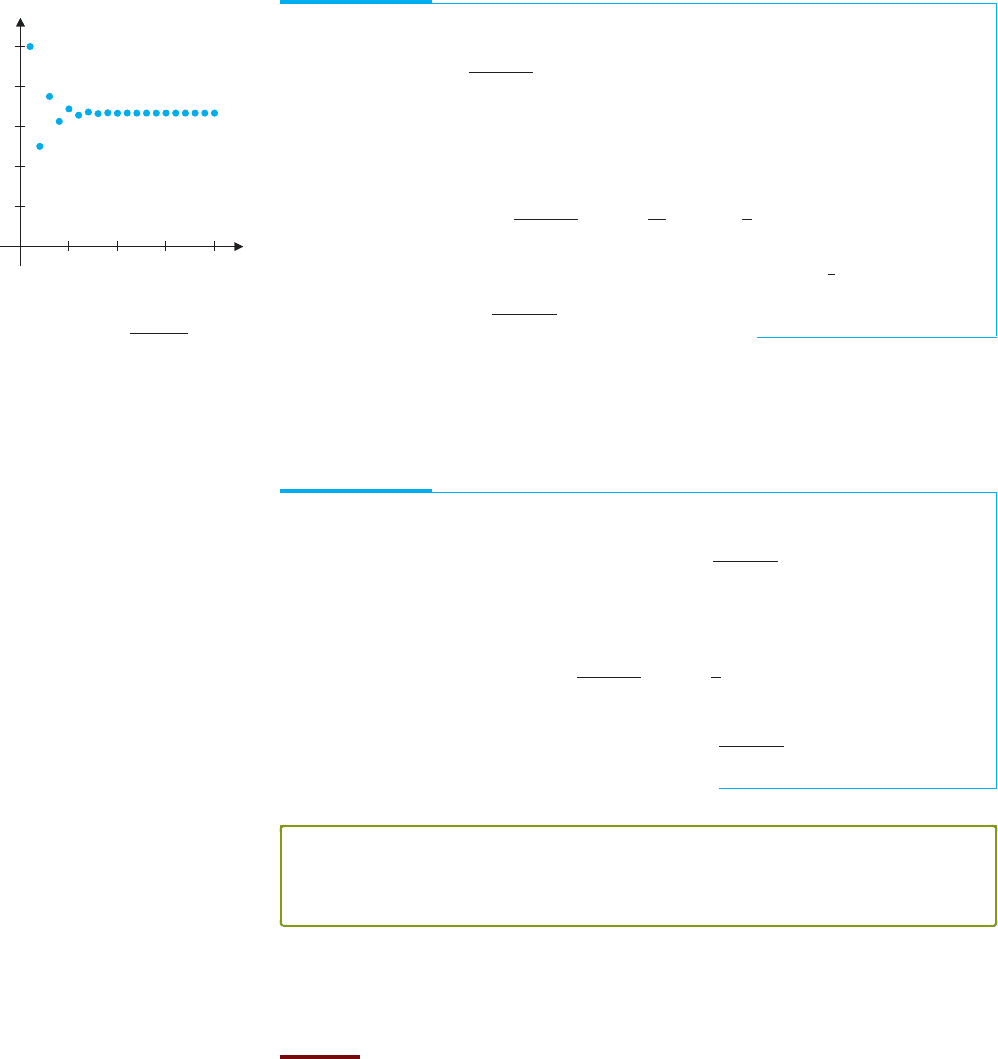
P1: OSO/OVY P2: OSO/OVY QC: OSO/OVY T1: OSO
MHDQ256-Ch09 MHDQ256-Smith-v1.cls December 17, 2010 19:47
LT (Late Transcendental)
CONFIRMING PAGES
572 CHAPTER 9
..
Infinite Series 9-42
EXAMPLE 5.1 Testing for Absolute Convergence
Determine whether
∞
k=1
(−1)
k+1
2
k
is absolutely convergent.
Solution It is easy to show that this alternating series converges to approximately
0.35. (See Figure 9.34.) To determine absolute convergence, we need to check whether
or not the series of absolute values is convergent. We have
∞
k=1
(−1)
k+1
2
k
=
∞
k=1
1
2
k
=
∞
k=1
1
2
k
,
which you should recognize as a convergent geometric series (|r|=
1
2
< 1). This says
that the original series
∞
k=1
(−1)
k+1
2
k
converges absolutely.
5 10 15 20
0.1
0.2
0.3
0.4
0.5
S
n
n
FIGURE 9.34
S
n
=
n
k=1
(−1)
k+1
2
k
We’ll prove shortly that every absolutely convergent series is also convergent. How-
ever, the reverse is not true; there are many series that are convergent, but not absolutely
convergent. These are called conditionally convergent series. Can you think of an example
of such a series? If so, it’s probably the example that follows.
EXAMPLE 5.2 A Conditionally Convergent Series
Determine whether the alternating harmonic series
∞
k=1
(−1)
k+1
k
is absolutely convergent.
Solution In example 4.2, we showed that this series is convergent. To test this for
absolute convergence, we consider the series of absolute values,
∞
k=1
(−1)
k+1
k
=
∞
k=1
1
k
(theharmonicseries),whichdiverges.Thissaysthat
∞
k=1
(−1)
k+1
k
convergesconditionally
(i.e., it converges, but does not converge absolutely).
THEOREM 5.1
If
∞
k=1
|a
k
| converges, then
∞
k=1
a
k
converges.
Thisresult says thatifaseries convergesabsolutely, thenitmustalso converge.Because
of this, when we test series, we first test for absolute convergence. If a series converges
absolutely, then we need not test any further to establish convergence.
PROOF
Notice that for any real number, x, we can say that −|x|≤x ≤|x|. So, for any k,wehave
−|a
k
|≤a
k
≤|a
k
|.
Adding |a
k
| to all the terms, we get
0 ≤ a
k
+|a
k
|≤2|a
k
|. (5.1)
Since
∞
k=1
|a
k
| is convergent, we have that
∞
k=1
2|a
k
|=2
∞
k=1
|a
k
| is convergent. Define
b
k
= a
k
+|a
k
|. From (5.1),
0 ≤ b
k
≤ 2|a
k
|