
Smith R., Minton R. Calculus
Подождите немного. Документ загружается.

P1: OSO/OVY P2: OSO/OVY QC: OSO/OVY T1: OSO
MHDQ256-Ch09 MHDQ256-Smith-v1.cls December 17, 2010 19:47
LT (Late Transcendental)
CONFIRMING PAGES
9-43 SECTION 9.5
..
Absolute Convergence and the Ratio Test 573
and so, by the Comparison Test,
∞
k=1
b
k
is convergent. Observe that we may write
∞
k=1
a
k
=
∞
k=1
(a
k
+|a
k
|−|a
k
|) =
∞
k=1
(a
k
+|a
k
|)
b
k
−
∞
k=1
|a
k
|
=
∞
k=1
b
k
−
∞
k=1
|a
k
|.
Since the two series on the right-hand side are convergent, it follows that
∞
k=1
a
k
must also
be convergent.
EXAMPLE 5.3 Testing for Absolute Convergence
Determine whether
∞
k=1
sink
k
3
is convergent or divergent.
Solution Notice that while this is not a positive-term series, neither is it an
alternating series. Because of this, our only choice is to test the series for absolute
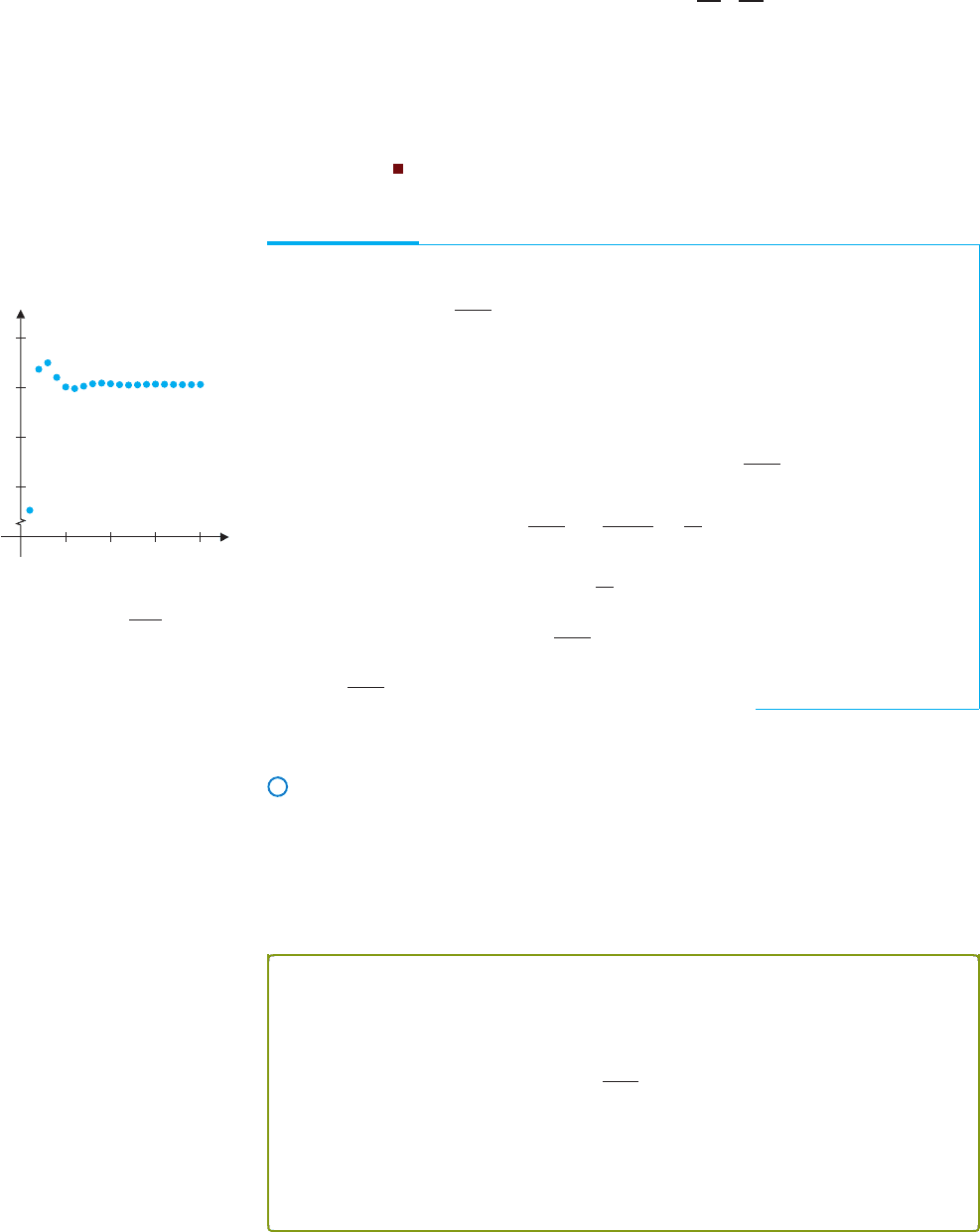
convergence. From the graph of the first 20 partial sums seen in Figure 9.35, it appears
that the series is converging to some value around 0.94. To test for absolute
convergence, we consider the series of absolute values,
∞
k=1
sink
k
3
. Notice that
sink
k
3
=
|sin k|
k
3
≤
1
k
3
, (5.2)
since |sink|≤1, for all k. Of course,
∞
k=1
1
k
3
is a convergent p-series (p = 3 > 1). By
the Comparison Test and (5.2),
∞
k=1
sink
k
3
converges, too. Consequently, the original
series
∞
k=1
sink
k
3
converges absolutely and hence, converges.
5 10 15 20
0.86
0.90
0.94
0.98
S
n
n
FIGURE 9.35
S
n
=
n
k=1
sink
k
3
The Ratio Test
We next introduce a very powerful tool for testing a series for absolute convergence. This
test can be applied to a wide range of series, including the extremely important case of
power series, which we discuss in section 9.6. As you’ll see, this test is remarkably easy to
use.
THEOREM 5.2 (Ratio Test)
Given
∞
k=1
a
k
, with a
k
= 0 for all k, suppose that
lim
k→∞
a
k+1
a
k
= L.
Then,
(i) if L < 1, the series converges absolutely,
(ii) if L > 1 (or L =∞), the series diverges and
(iii) if L = 1, there is no conclusion.

P1: OSO/OVY P2: OSO/OVY QC: OSO/OVY T1: OSO
MHDQ256-Ch09 MHDQ256-Smith-v1.cls December 17, 2010 19:47
LT (Late Transcendental)
CONFIRMING PAGES
574 CHAPTER 9
..
Infinite Series 9-44
PROOF
(i) For L < 1, pick any number r with L < r < 1. Then, we have
lim
k→∞
a
k+1
a
k
= L < r.
For this to occur, there must be some number N > 0, such that for k ≥ N,
a
k+1
a
k
< r. (5.3)
Multiplying both sides of (5.3) by |a
k
| gives us
|a
k+1
| < r|a
k
|.
In particular, taking k = N gives us
|a
N+1
| < r|a
N
|
and taking k = N + 1 gives us
|a
N+2
| < r|a
N+1
| < r
2
|a
N
|.
Likewise,
|a
N+3
| < r|a
N+2
| < r
3
|a
N
|
and so on. We have
|a
N+k
| < r
k
|a
N
|, for k = 1, 2, 3,... .
Notice that
∞
k=1
|a
N
|r
k
=|a
N
|
∞
k=1
r
k
is a convergent geometric series, since 0 < r < 1. By
the Comparison Test, it follows that
∞
k=1
|a
N+k
|=
∞
n=N+1
|a
n
| converges, too. This says that
∞
n=N+1
a
n
converges absolutely. Finally, since
∞
n=1
a
n
=
N
n=1
a
n
+
∞
n=N+1
a
n
,
we also get that
∞
n=1
a
n
converges absolutely.
(ii) For L > 1, we have
lim
k→∞
a
k+1
a
k
= L > 1.
This says that there must be some number N > 0, such that for k ≥ N,
a
k+1
a
k
> 1. (5.4)
Multiplying both sides of (5.4) by |a
k
|,weget
|a
k+1
| > |a
k
| > 0, for all k ≥ N.
Notice that if this is the case, then
lim
k→∞
a
k
= 0.
By the kth-term test for divergence, we now have that
∞
k=1
a
k
diverges.
P1: OSO/OVY P2: OSO/OVY QC: OSO/OVY T1: OSO
MHDQ256-Ch09 MHDQ256-Smith-v1.cls December 17, 2010 19:47
LT (Late Transcendental)
CONFIRMING PAGES
9-45 SECTION 9.5
..
Absolute Convergence and the Ratio Test 575
EXAMPLE 5.4 Using the Ratio Test
Test
∞
k=1
(−1)
k
k
2
k
for convergence.
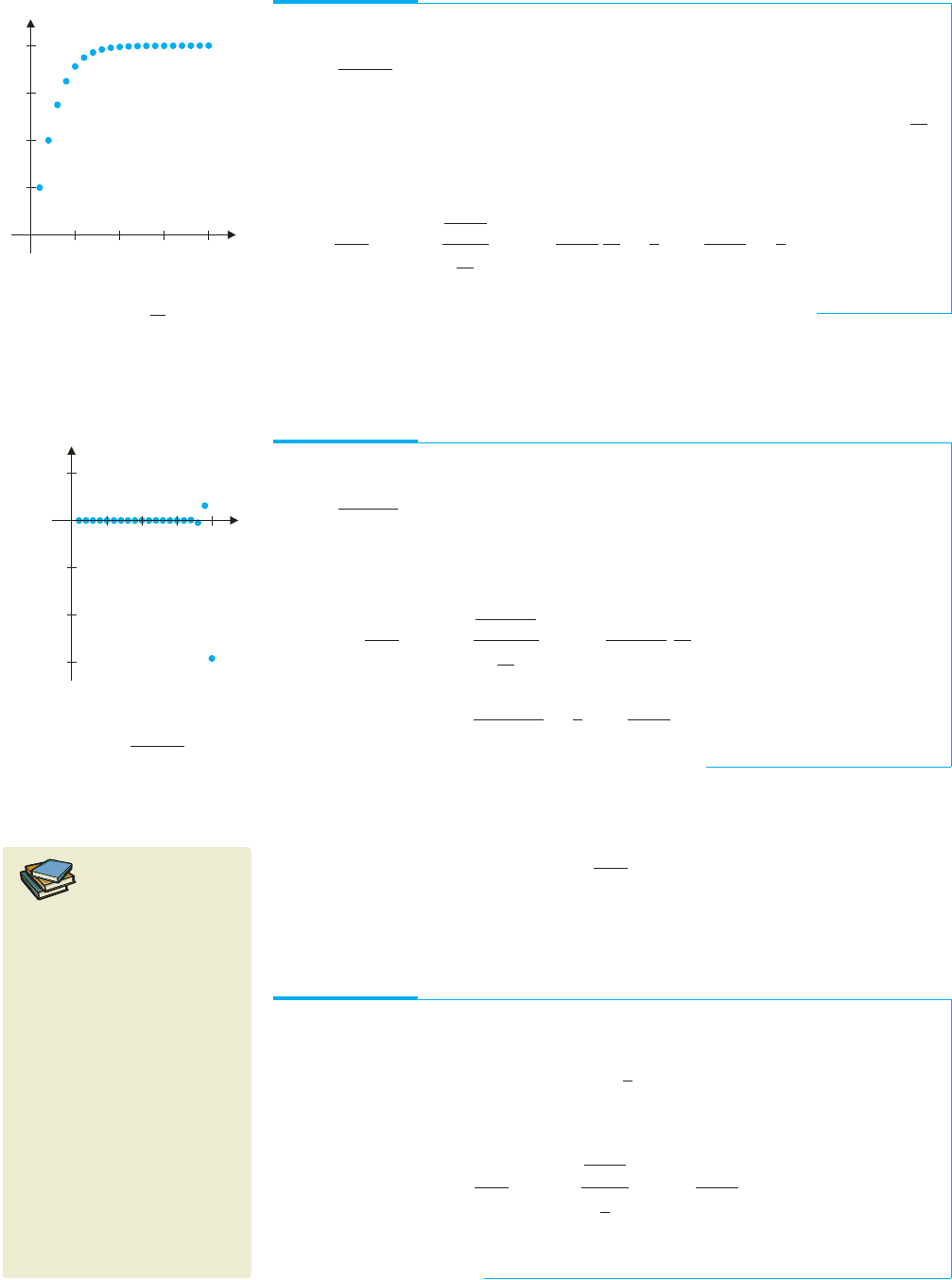
Solution The graph of the first 20 partial sums of the series of absolute values,
∞
k=1
k
2
k
,
seen in Figure 9.36, suggests that the series of absolute values convergesto about 2. From
the Ratio Test, we have
lim
k→∞
a
k+1
a
k
= lim
k→∞
k + 1
2
k+1
k
2
k
= lim
k→∞
k + 1
2
k+1
2
k
k
=
1
2
lim
k→∞
k + 1
k
=
1
2
< 1
Since
2
k+1
= 2
k
· 2
1
.
and so, the series converges absolutely, as expected from Figure 9.36.
5 10 15 20
1.0
1.5
2.0
0.5
S
n
n
FIGURE 9.36
S
n
=
n
k=1
k
2
k
The Ratio Test is particularly useful when the general term of a series contains an
exponential term, as in example 5.4, or a factorial, as in example 5.5.
EXAMPLE 5.5 Using the Ratio Test
Test
∞
k=0
(−1)
k
k!
e
k
for convergence.
Solution Thegraph of thefirst 20 partial sums of the series seen in Figure9.37 suggests
that the series diverges. We can confirm this suspicion with the Ratio Test. We have
lim
k→∞
a
k+1
a
k
= lim
k→∞
(k + 1)!
e
k+1
k!
e
k
= lim
k→∞
(k + 1)!
e
k+1
e
k
k!
= lim
k→∞
(k + 1)k!
ek!
=
1
e
lim
k→∞
k + 1
1
=∞.
Since (k + 1)! = (k + 1) ·k!
and e
k+1
= e
k
· e
1
.
By the Ratio Test, the series diverges, as we suspected.
5 10 15 20
4 10
8
6 10
8
2 10
8
2 10
8
S
n
n
FIGURE 9.37
S
n
=
n−1
k=0
(−1)
k
k!
e
k
Recall that in the statement of the Ratio Test, we said that if
lim
k→∞
a
k+1
a
k
= 1,
then the Ratio Test yields no conclusion. By this, we mean that in such cases, the series
may or may not converge and further testing is required.
HISTORICAL
NOTES
Srinivasa Ramanujan
(1887–1920) Indian
mathematician whose incredible
discoveries about infinite series
still amaze mathematicians.
Largely self-taught, Ramanujan
filled notebooks with conjectures
about series, continued fractions
and the Riemann-zeta function.
Ramanujan rarely gave a proof or
even justification of his results.
Nevertheless, the famous English
mathematician G. H. Hardy said,
“They must be true because, if
they weren’t true, no one would
have had the imagination to invent
them.” (See exercise 61.)
EXAMPLE 5.6 A Divergent Series for Which the Ratio Test
Is Inconclusive
Use the Ratio Test for the harmonic series
∞
k=1
1
k
.
Solution We have
lim
k→∞
a
k+1
a
k
= lim
k→∞
1
k + 1
1
k
= lim
k→∞
k
k + 1
= 1.
In this case, the Ratio Test yields no conclusion, although we already know that the
harmonic series diverges.

P1: OSO/OVY P2: OSO/OVY QC: OSO/OVY T1: OSO
MHDQ256-Ch09 MHDQ256-Smith-v1.cls December 17, 2010 19:47
LT (Late Transcendental)
CONFIRMING PAGES
576 CHAPTER 9
..
Infinite Series 9-46
EXAMPLE 5.7 A Convergent Series for Which the Ratio Test
Is Inconclusive
Use the Ratio Test to test the series
∞
k=0
1
k
2
.
Solution Here, we have
lim
k→∞
a
k+1
a
k
= lim
k→∞
1
(k + 1)
2
k
2
1
= lim
k→∞
k
2
k
2
+ 2k + 1
= 1.
So again, the Ratio Test yields no conclusion, although we already know that this is a
convergent p-series (p = 2 > 1).
Carefully examine examples 5.6 and 5.7 and you should recognize that the Ratio Test
will be inconclusive for any p-series.
The Root Test
We now present one final test for convergence of series.
TODAY IN
MATHEMATICS
Alain Connes (1947– )
A French mathematician who
earned a Fields Medal in 1983 for
his spectacular results in the
classification of operator algebras.
As a student, Connes developed a
very personal understanding of
mathematics. He has explained,
“I first began to work in a very
small place in the mathematical
geography . . . . I had my own
system, which was very strange
because when the problems the
teacher was asking fell into my
system, then of course I would
have an instant answer, but when
they didn’t—and many problems,
of course, didn’t fall into my
system—then I would be like an
idiot and I wouldn’t care.” As
Connes’ personal mathematical
system expanded, he found more
and more “instant answers” to
important problems.
THEOREM 5.3 (Root Test)
Given
∞
k=1
a
k
, suppose that lim
k→∞
k
√
|a
k
|=L. Then,
(i) if L < 1, the series converges absolutely,
(ii) if L > 1 (or L =∞), the series diverges and
(iii) if L = 1, there is no conclusion.
Notice how similar the conclusion is to the conclusion of the Ratio Test. The proof is
also similar to that of the Ratio Test and we leave this as an exercise.
EXAMPLE 5.8 Using the Root Test
UsetheRootTesttodeterminetheconvergenceordivergenceoftheseries
∞
k=1
2k + 4
5k − 1
k
.
Solution In this case, we consider
lim
k→∞
k
|a
k
|= lim
k→∞
k
"
2k + 4
5k − 1
k
= lim
k→∞
2k + 4
5k − 1
=
2
5
< 1.
By the Root Test, the series is absolutely convergent.
Summary of Convergence Tests
By this point in your study of series, it may seem as if we have thrown at you a dizzying
array of different series and tests for convergence or divergence. Just how are you to keep
all of these straight? The best suggestion we have is that you work through many problems.
We provide a good assortment in the exercise set that follows this section. Some of these
require the methods of this section, while others are drawn from the preceding sections (just
to keep you thinking about the big picture). For the sake of convenience, we summarize our
convergence tests in the table that follows.

P1: OSO/OVY P2: OSO/OVY QC: OSO/OVY T1: OSO
MHDQ256-Ch09 MHDQ256-Smith-v1.cls December 17, 2010 19:47
LT (Late Transcendental)
CONFIRMING PAGES
9-47 SECTION 9.5
..
Absolute Convergence and the Ratio Test 577
Test When to Use Conclusions Section
Geometric Series
∞
k=0
ar
k
Converges to
a
1 −r
if |r| <1;
9.2
diverges if |r|≥1.
kth-Term Test All series If lim
k→∞
a
k
= 0, the series diverges. 9.2
Integral Test
∞
k=1
a
k
where f (k) = a
k
,
∞
k=1
a
k
and
∞
1
f (x)dx 9.3
f is continuous and decreasing and f (x) ≥ 0 both converge or both diverge.
p-series
∞
k=1
1
k
p
Converges for p > 1; diverges for p ≤ 1. 9.3
Comparison Test
∞
k=1
a
k
and
∞
k=1
b
k
, where 0 ≤ a
k
≤ b
k
If
∞
k=1
b
k
converges, then
∞
k=1
a
k
converges. 9.3
If
∞
k=1
a
k
diverges, then
∞
k=1
b
k
diverges.
Limit Comparison Test
∞
k=1
a
k
and
∞
k=1
b
k
, where
∞
k=1
a
k
and
∞
k=1
b
k
9.3
a
k
, b
k
> 0 and lim
k→∞
a
k
b
k
= L > 0 both converge or both diverge.
Alternating Series Test
∞
k=1
(−1)
k+1
a
k
where a
k
> 0 for all k If lim
k→∞
a
k
= 0 and a
k+1
≤ a
k
for all k, 9.4
then the series converges.
Absolute Convergence Series with some positive and some
negative terms (including alternating series)
If
∞
k=1
|a
k
| converges, then 9.5
∞
k=1
a
k
converges absolutely.
Ratio Test Any series (especially those involving
exponentials and/or factorials)
For lim
k→∞
a
k+1
a
k
= L,
9.5
if L < 1,
∞
k=1
a
k
converges absolutely
if L > 1,
∞
k=1
a
k
diverges,
if L = 1, no conclusion.
Root Test Any series (especially those involving
exponentials)
For lim
k→∞
k
|a
k
|=L, 9.5
if L < 1,
∞
k=1
a
k
converges absolutely
if L > 1,
∞
k=1
a
k
diverges,
if L = 1, no conclusion.
EXERCISES 9.5
WRITING EXERCISES
1. Suppose that a
k
≥ 0, lim
k→∞
a
k
= 0, lim
k→∞
b
k
= 0 and {b
k
} con-
tains both positive and negative terms. Explain why
∞
k=1
b
k
is
more likely to converge than
∞
k=1
a
k
. In light of this, explain
why Theorem 5.1 is true.
2. In the Ratio Test, if lim
k→∞
a
k+1
a
k
> 1, which is (eventually) big-
ger,|a
k+1
|or|a
k
|?Explainwhythisimpliesthattheseries
∞
k=1
a
k
diverges.
3. In the Ratio Test, if lim
k→∞
a
k+1
a
k
= L < 1, which is bigger,
|a
k+1
| or |a
k
|? This inequality could also hold if L = 1.
Compare the relative sizes of |a
k+1
| and |a
k
| if L = 0.8 versus
L = 1. Explain why L = 0.8 would be more likely to corre-
spond to a convergent series than L = 1.
4. In many series of interest, the terms of the series involve
powers of k (e.g., k
2
), exponentials (e.g., 2
k
) or factorials (e.g.,
k!). For which type(s) of terms is the Ratio Test likely to pro-
duce a result (i.e., a limit different from 1)? Briefly explain.

P1: OSO/OVY P2: OSO/OVY QC: OSO/OVY T1: OSO
MHDQ256-Ch09 MHDQ256-Smith-v1.cls December 17, 2010 19:47
LT (Late Transcendental)
CONFIRMING PAGES
578 CHAPTER 9
..
Infinite Series 9-48
In exercises 1–40, determine whether the series is absolutely
convergent, conditionally convergent or divergent.
1.
∞
k=0
(−1)
k
3
k!
2.
∞
k=0
(−1)
k
6
k!
3.
∞
k=0
(−1)
k
2
k
4.
∞
k=0
(−1)
k
2
3
k
5.
∞
k=1
(−1)
k+1
k
k
2
+ 1
6.
∞
k=1
(−1)
k+1
k
2
+ 1
k
7.
∞
k=3
(−1)
k
3
k
k!
8.
∞
k=4
(−1)
k
10
k
k!
9.
∞
k=2
(−1)
k+1
k
2k + 1
10.
∞
k=3
(−1)
k+1
4
2k + 1
11.
∞
k=6
(−1)
k
k2
k
3
k
12.
∞
k=1
(−1)
k
k
2
3
k
2
k
13.
∞
k=1
4k
5k + 1
k
14.
∞
k=5
1 − 3k
4k
k
15.
∞
k=1
−2
k
16.
∞
k=1
4
k
17.
∞
k=0
(−1)
k+1
√
k
k + 1
18.
∞
k=2
(−1)
k+1
k
k
3
+ 1
19.
∞
k=7
k
2
e
k
20.
∞
k=1
k
3
e
−k
21.
∞
k=2
e
3k
k
3k
22.
∞
k=4
e
k
k
2
k
23.
∞
k=1
sink
k
2
24.
∞
k=1
cosk
k
3
25.
∞
k=1
coskπ
k
26.
∞
k=1
tan
−1
k
k
27.
∞
k=2
(−1)
k
lnk
28.
∞
k=2
(−1)
k
k lnk
29.
∞
k=1
(−1)
k
k
√
k
30.
∞
k=1
(−1)
k+1
√
k
31.
∞
k=3
3
k
k
32.
∞
k=8
2k
3
k
33.
∞
k=6
(−1)
k+1
k!
4
k
34.
∞
k=4
(−1)
k+1
k
2
4
k
k!
35.
∞
k=1
(−1)
k+1
k
10
(2k)!
36.
∞
k=0
(−1)
k
4
k
(2k + 1)!
37.
∞
k=0
(−2)
k
(k + 1)
5
k
38.
∞
k=1
(−3)
k
k
2
4
k
39.
∞
k=1
cos(kπ/5)
k!
40.
∞
k=1
(1 + 1/ k)
k
2
............................................................
In exercises 41–60, name the method by identifying a test that
will determine whether the series converges or diverges.
41.
∞
k=1
e
k
k!
42.
∞
k=2
e
k
(2 + 1/ k)
k
43.
∞
k=2
(−1)
k
1 + 1/ k
k
44.
∞
k=0
k
2
+ 5
√
k
5
+ 2
45.
∞
k=3
k
−4/5
46.
∞
k=1
(−4/5)
k
47.
∞
k=0
k
2
+ 1
4
k
48.
∞
k=1
(−1)
k
e
k
k!
49.
∞
k=1
k
2
e
−k
3
50.
∞
k=1
k
3
e
−k
2
51.
∞
k=0
(−1)
k
4 + k
3 + 2k
k
52.
∞
k=0
(−1)
k
4 + k
3 + 2k
53.
∞
k=1
lnk
2
k
3
54.
∞
k=2
k
2
√
k
3
+ 1
55.
∞
k=2
cosk
k
2
56.
∞
k=1
coskπ
k
57.
∞
k=2
2
k
√
lnk + 1
58.
∞
k=3
(−1)
k
ln(2 + 1/ k)
59.
∞
k=1
3
k
(k!)
2
60.
∞
k=2
3
k
k
............................................................
61. (a) In the 1910s, the Indian mathematician Srinivasa
Ramanujan discovered the formula
1
π
=
√
8
9801
∞
k=0
(4k)!(1103 +26,390k)
(k!)
4
396
4k
.
Approximate the series with only the k = 0 term and show
that you get 6 digits of π correct. Approximate the series
using the k = 0 and k = 1 terms and show that you get 14
digits of π correct. In general, each termof this remarkable
series increases the accuracy by 8 digits.
(b) Prove that Ramanujan’s series in part (a) converges.
62. To show that
∞
k=1
k!
k
k
converges, use the Ratio Test and the fact
that
lim
k→∞
k + 1
k
k
= lim
k→∞
1 +
1
k
k
= e.
63. (a) Find all values of p such that
∞
k=1
p
k
k
converges.
(b) Find all values of p such that
∞
k=1
p
k
k
2
converges.
64. Determine whether
∞
k=1
k!
1 · 3 · 5···(2k − 1)
converges or
diverges.
P1: OSO/OVY P2: OSO/OVY QC: OSO/OVY T1: OSO
MHDQ256-Ch09 MHDQ256-Smith-v1.cls December 17, 2010 19:47
LT (Late Transcendental)
CONFIRMING PAGES
9-49 SECTION 9.6
..
Power Series 579
EXPLORATORY EXERCISES
1. Onereasonthatitisimportanttodistinguishabsolutefromcon-
ditional convergence of a series is the rearrangement of series,
to be explored in this exercise. Show that the series
∞
k=0
(−1)
k
2
k
is absolutely convergent and find its sum S. Find the sum S
+
of the positive terms of the series. Find the sum S
−
of the neg-
ative terms of the series. Verify that S = S
+
+ S
−
. However,
you cannot separate the positive and negative terms for condi-
tionally convergent series. For example, show that
∞
k=0
(−1)
k
k + 1
converges (conditionally) but that the series of positive terms
and the series of negative terms both diverge. Thus, the order
of terms matters for conditionally convergent series. Amaz-
ingly, for conditionally convergent series, you can reorder the
terms so that the partial sums converge to any real number. To
illustrate this, suppose we want to reorder the series
∞
k=0
(−1)
k
k + 1
so that the partial sums converge to
π
2
. Start by pulling out
positive terms
1 +
1
3
+
1
5
+···
such that the partial sum is
within 0.1 of
π
2
. Next, take the first negative term
−
1
2
and
positive terms such that the partial sum is within 0.05 of
π
2
.
Then take the next negative term
−
1
4
and positive terms such
that the partial sum is within 0.01 of
π
2
. Argue that you could
continue in this fashion to reorder the terms so that the partial
sums converge to
π
2
. (Especially explain why you will never
“run out of” positive terms.) Then explain why you cannot do
the same with the absolutely convergent series
∞
k=0
(−1)
k
2
k
.
2. In this exercise, you show that the Root Test is more
general than the Ratio Test. To be precise, show that if
lim
n→∞
a
n+1
a
n
= r = 1 then lim
n→∞
|a
n
|
1/n
= r by considering
lim
n→∞
ln
a
n+1
a
n
and lim
n→∞
ln|a
n
|
1/n
= lim
n→∞
1
n
n
k=1
ln
a
k+1
a
k
.Inter-
pretthisresultintermsofhowlikelytheRatioTest or Root Test
is to give a definite conclusion. Show that the result is not “if
and only if” by finding a sequence for which lim
n→∞
|a
n
|
1/n
< 1
but lim
n→∞
a
n+1
a
n
does not exist. In spite of this, give one reason
why the Ratio Test might be preferable to the Root Test.
9.6 POWER SERIES
We now expand our discussion of series to the case where the terms of the series are
functions of the variable x. Pay close attention, as the primary reason for studying series is
that we can use them to represent functions. This opens up numerous possibilities for us,
from approximating the values of transcendental functions to calculating derivatives and
integralsof such functions, to studying differentialequations. As well, defining functions as
convergent series produces an explosion of new functions available to us, including many
important functions, such as the Bessel functions. We take the first few steps in this section.
321
1
1
2
3
y f(x)
y P
1
(x)
y P
2
(x)
y P
3
(x)
y
x
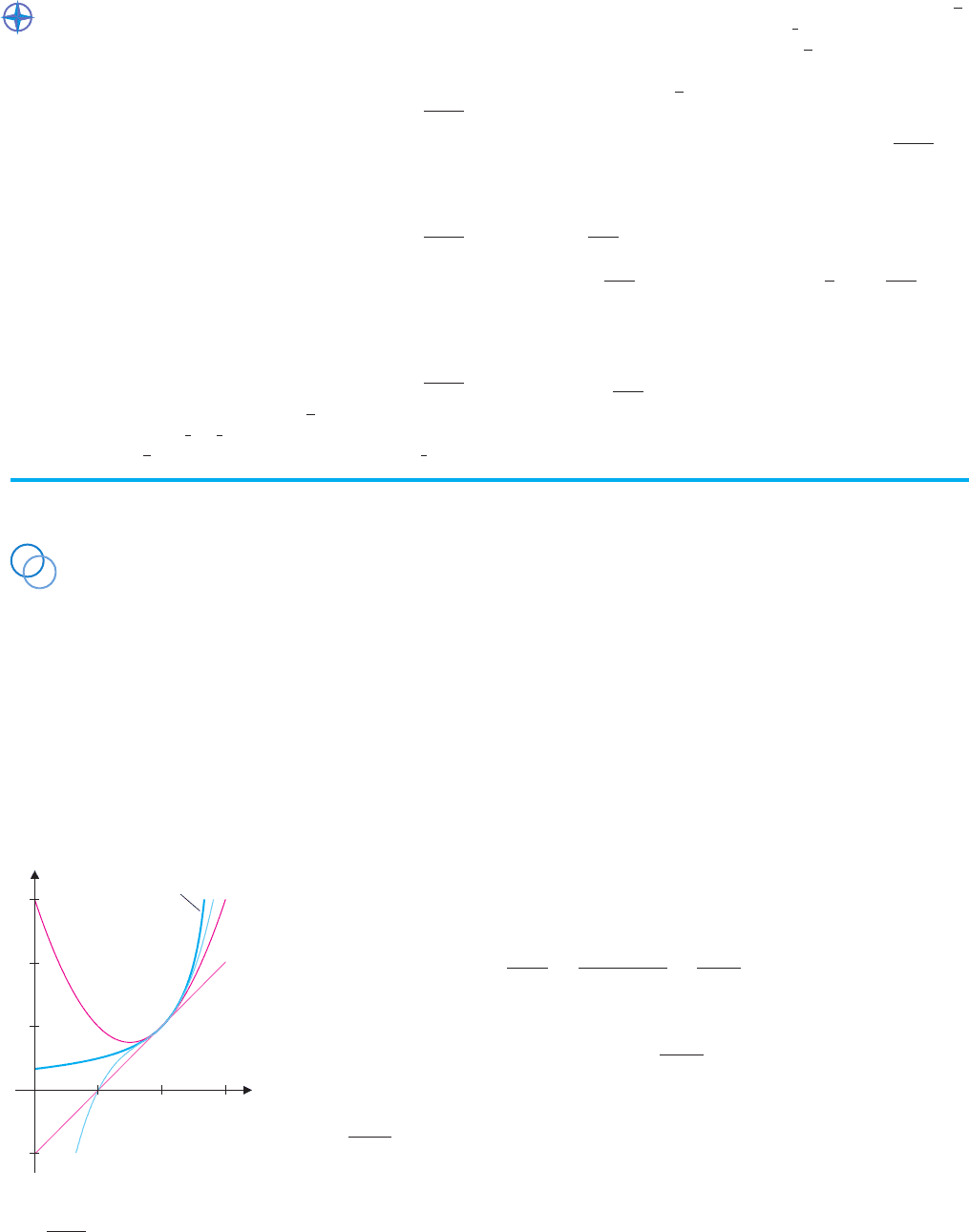
FIGURE 9.38
y =
1
3 − x
and the first three partial
sums of
∞
k=0
(x − 2)
k
As a start, consider the series
∞
k=0
(x − 2)
k
= 1 + (x − 2) + (x − 2)
2
+ (x − 2)
3
+···.
Notice that for each fixed x, this is a geometric series with r = (x −2), which will converge
whenever |r|=|x − 2| < 1 and diverge whenever |r|=|x − 2|≥1. Further, for each x
with |x − 2| < 1 (i.e., 1 < x < 3), the series converges to
a
1 − r
=
1
1 − (x − 2)
=
1
3 − x
.
That is, for each x in the interval (1, 3), we have
∞
k=0
(x − 2)
k
=
1
3 − x
.
For all other values of x, the series diverges. In Figure 9.38, we show a graph of
f (x) =
1
3 − x
, along with the first three partial sums P
n
of this series, where
P
n
(x) =
n
k=0
(x − 2)
k
= 1 + (x − 2) + (x − 2)
2
+···+(x − 2)
n
,
on the interval [0, 3]. Notice that as n gets larger, P
n
(x) appears to get closer to f (x), for
any given x in the interval (1, 3). Further, as n gets larger, P
n
(x) tends to stay close to f (x)
for a larger range of x-values.

P1: OSO/OVY P2: OSO/OVY QC: OSO/OVY T1: OSO
MHDQ256-Ch09 MHDQ256-Smith-v1.cls December 17, 2010 19:47
LT (Late Transcendental)
CONFIRMING PAGES
580 CHAPTER 9
..
Infinite Series 9-50
Here,we noticedthata seriesisequivalentto(i.e., it convergesto) a known functionona
certaininterval.Alternatively,imaginewhatbenefitsyou wouldderiveif foragivenfunction
(one that you don’t know much about) you could find an equivalent series representation.
This is precisely what we do in section 9.7. For instance, we will show that for all x,
e
x
=
∞
k=0
x
k
k!
= 1 + x +
x
2
2!
+
x
3
3!
+
x
4
4!
+···. (6.1)
As one immediate use of (6.1), suppose that you wanted to calculate e
1.234567
. Using (6.1),
for any given x, we can compute an approximation to e
x
, simply by summing the first few
terms of the equivalent power series. This is easy to do, since the partial sums of the series
are simply polynomials.
In general, any series of the form
POWER SERIES
∞
k=0
b
k
(x − c)
k
= b
0
+ b
1
(x − c) +b
2
(x − c)
2
+ b
3
(x − c)
3
+···
is called a power series in powers of (x −c). We refer to the constants b
k
, k = 0, 1, 2,...,
as the coefficients of the series. The first question is: for what values of x does the series
converge? Saying this another way, the power series
∞
k=0
b
k
(x − c)
k
defines a function of
x and its domain is the set of all x for which the series converges. The primary tool for
investigating the convergence or divergence of a power series is the Ratio Test.
EXAMPLE 6.1 Determining Where a Power Series Converges
Determine the values of x for which the power series
∞
k=0
k
3
k+1
x
k
converges.
Solution Using the Ratio Test, we have
lim
k→∞
a
k+1
a
k
= lim
k→∞
(k + 1)x
k+1
3
k+2
3
k+1
kx
k
= lim
k→∞
(k + 1)|x|
3k
=
|x|
3
lim
k→∞
k + 1
k
Since x
k+1
= x
k
· x
1
and 3
k+2
= 3
k+1
· 3
1
.
=
|x|
3
< 1,
for |x| < 3or−3 < x < 3. So, the series converges absolutely for −3 < x < 3 and
diverges for |x| > 3 (i.e., for x > 3orx < −3). Since the Ratio Test gives no
conclusion for the endpoints x =±3, we must test these separately.
For x = 3, we have the series
∞
k=0
k
3
k+1
x
k
=
∞
k=0
k
3
k+1
3
k
=
∞
k=0
k
3
.
Since
lim
k→∞
k
3
=∞= 0,
the series diverges by the kth-term test for divergence. The series diverges when
x =−3, for the same reason. Thus, the power series converges for all x in the interval
(−3, 3) and diverges for all x outside this interval.
Observe that in example 6.1, as well as in our introductory example, the series have
the form
∞
k=0
b
k
(x − c)
k
and there is an interval of the form (c −r, c +r) on which the
series converges and outside of which the series diverges. (In the case of example 6.1,
notice that c = 0.) This interval on which a power series converges is called the interval of

P1: OSO/OVY P2: OSO/OVY QC: OSO/OVY T1: OSO
MHDQ256-Ch09 MHDQ256-Smith-v1.cls December 17, 2010 19:47
LT (Late Transcendental)
CONFIRMING PAGES
9-51 SECTION 9.6
..
Power Series 581
convergence. The constant r is called the radius of convergence (i.e., r is half the length
of the interval of convergence). As we see in the following result, there is such an interval
for every power series.
NOTES
In part (iii) of Theorem 6.1, the
series may converge at neither,
one or both of the endpoints
x = c − r and x = c +r.
Because the interval of
convergence is centered at x = c,
we refer to c as the center of the
power series.
THEOREM 6.1
Given any power series,
∞
k=0
b
k
(x − c)
k
, there are exactly three possibilities:
(i) The series converges absolutely for all x ∈ (−∞, ∞) and the radius of
convergence is r =∞;
(ii) The series converges only for x = c (and diverges for all other values of x)
and the radius of convergence is r = 0; or
(iii) The series converges absolutely for x ∈ (c −r, c +r) and diverges for
x < c −r and for x > c +r, for some number r with 0 < r < ∞.
The proof of the theorem can be found in Appendix A.
EXAMPLE 6.2 Finding the Interval and Radius of Convergence
Determine the interval and radius of convergence for the power series
∞
k=0
10
k
k!
(x − 1)
k
.
Solution From the Ratio Test, we have
lim
k→∞
a
k+1
a
k
= lim
k→∞
10
k+1
(x − 1)
k+1
(k + 1)!
k!
10
k
(x − 1)
k
= 10|x − 1| lim
k→∞
k!
(k + 1)k!
Since (x − 1)
k+1
= (x − 1)
k
(x −1)
1
and (k + 1)! = (k + 1)k!.
= 10|x − 1| lim
k→∞
1
k + 1
= 0 < 1,
for all x. This says that the series converges absolutely for all x. Thus, the interval of
convergence for this series is (−∞, ∞) and the radius of convergence is r =∞.
The interval of convergencefor a powerseries can be a closed interval, an open interval
or a half-open interval, as in example 6.3.
EXAMPLE 6.3 A Half-Open Interval of Convergence
Determine the interval and radius of convergence for the power series
∞
k=1
x
k
k4
k
.
Solution From the Ratio Test, we have
lim
k→∞
a
k+1
a
k
= lim
k→∞
x
k+1
(k + 1)4
k+1
k4
k
x
k
=
|x|
4
lim
k→∞
k
k + 1
=
|x|
4
< 1.
So, we are guaranteed absolute convergence for |x| < 4 and divergence for |x| > 4. It
remains only to test the endpoints of the interval: x =±4. For x = 4, we have
∞
k=1
x
k
k4
k
=
∞
k=1
4
k
k4
k
=
∞
k=1
1
k
,

P1: OSO/OVY P2: OSO/OVY QC: OSO/OVY T1: OSO
MHDQ256-Ch09 MHDQ256-Smith-v1.cls December 17, 2010 19:47
LT (Late Transcendental)
CONFIRMING PAGES
582 CHAPTER 9
..
Infinite Series 9-52
which you will recognize as the harmonic series, which diverges. For x =−4, we have
∞
k=1
x
k
k4
k
=
∞
k=1
(−4)
k
k4
k
=
∞
k=1
(−1)
k
k
,
which is the alternating harmonic series, which we know converges conditionally. (See
example 5.2.) So, in this case, the interval of convergence is the half-open interval
[−4, 4) and the radius of convergence is r = 4.
NOTES
In example 6.3, the series for the
endpoints of the interval of
convergence are closely related.
One is a positive term series of the
form
∞
k=1
a
k
, while the other is the
corresponding alternating series
∞
k=1
(−1)
k
a
k
. This is a common
occurence.
Notice that (as stated in Theorem 6.1) every power series
∞
k=0
a
k
(x − c)
k
converges at
least for x = c since for x = c, we have the trivial case
∞
k=0
a
k
(x − c)
k
=
∞
k=0
a
k
(c −c)
k
= a
0
+
∞
k=1
a
k
0
k
= a
0
+ 0 = a
0
.
EXAMPLE 6.4 A Power Series That Converges at Only One Point
Determine the radius of convergence for the power series
∞
k=0
k!(x − 5)
k
.
Solution From the Ratio Test, we have
lim
k→∞
a
k+1
a
k
= lim
k→∞
(k + 1)!(x − 5)
k+1
k!(x − 5)
k
= lim
k→∞
(k + 1)k!|x −5|
k!
= lim
k→∞
[(k + 1)|x − 5|]
=
0, if x = 5
∞, if x = 5
.
Thus, this power series converges only for x = 5 and so, its radius of convergence is
r = 0.
Suppose that the power series
∞
k=0
b
k
(x − c)
k
has radius of convergencer > 0. Then the
series converges absolutely for all x in the interval (c −r, c +r) and so, defines a function
f on the interval (c −r, c +r),
f (x) =
∞
k=0
b
k
(x − c)
k
= b
0
+ b
1
(x − c) +b
2
(x − c)
2
+ b
3
(x − c)
3
+···.
It turns out that such a function is continuous and differentiable, although the proof is
beyond the level of this course. In fact, we differentiate exactly the way you might expect,
f
(x) =
d
dx
[b
0
+ b
1
(x − c) +b
2
(x − c)
2
+ b
3
(x − c)
3
+···]
= b
1
+ 2b
2
(x − c) +3b
3
(x − c)
2
+···=
∞
k=1
b
k
k(x − c)
k−1
,
Differentiating a power series
where the radius of convergence of the resulting series is also r. Since we find the deriva-
tive by differentiating each term in the series, we call this term-by-term differentiation.
Likewise, we can integrate a convergent power series term-by-term,