
Smith R., Minton R. Calculus
Подождите немного. Документ загружается.


P1: OSO/OVY P2: OSO/OVY QC: OSO/OVY T1: OSO
MHDQ256-Ch09 MHDQ256-Smith-v1.cls December 17, 2010 19:47
LT (Late Transcendental)
CONFIRMING PAGES
9-53 SECTION 9.6
..
Power Series 583
Integrating a power series
f (x) dx =
∞
k=0
b
k
(x − c)
k
dx =
∞
k=0
b
k
(x − c)
k
dx
=
∞
k=0
b
k
(x − c)
k+1
k + 1
+ K,
where the radius of convergence of the resulting series is again r and where K is a constant
of integration. The proof of these two results can be found in a text on advanced calculus.
It’s important to recognize that these two results are not obvious. They are not simply an
application of the rule that a derivative or integral of a sum is the sum of the derivatives or
integrals, respectively, since a series is not a sum, but rather, a limit of a sum. Further, these
results are true for power series, but are not true for series in general.
EXAMPLE 6.5 A Convergent Series Whose Series
of Derivatives Diverges
Find the interval of convergence of the series
∞
k=1
sin(k
3
x)
k
2
and show that the series of
derivatives does not converge for any x.
Solution Notice that
sin(k
3
x)
k
2
≤
1
k
2
, for all x,
since |sin(k
3
x)|≤1. Since
∞
k=1
1
k
2
is a convergent p-series (p = 2 > 1), it follows from
the Comparison Test that
∞
k=0
sin(k
3
x)
k
2
converges absolutely, for all x. On the other hand,
the series of derivatives (found by differentiating the series term-by-term) is
∞
k=1
d
dx
sin(k
3
x)
k
2
=
∞
k=1
k
3
cos(k
3
x)
k
2
=
∞
k=1
[k cos(k
3
x)],
which diverges for all x,bythekth-term test for divergence, since the terms do not tend
to zero as k →∞, for any x.
Keep in mind that
∞
k=1
sin(k
3
x)
k
2
is not a power series. (Why not?) The result of example
6.5 (a convergent series whose series of derivatives diverges) cannot occur with any power
series with radius of convergence r > 0.
In example 6.6, we find that once we have a convergent power series representation for
a given function, we can use this to obtain power series representations for any number of
otherfunctions,bysubstitution or by differentiatingand integratingthe series term-by-term.
EXAMPLE 6.6 Differentiating and Integrating a Power Series
Use the powerseries
∞
k=0
(−1)
k
x
k
to find powerseries representations of
1
(1 + x)
2
,
1
1 + x
2
and tan
−1
x.

P1: OSO/OVY P2: OSO/OVY QC: OSO/OVY T1: OSO
MHDQ256-Ch09 MHDQ256-Smith-v1.cls December 17, 2010 19:47
LT (Late Transcendental)
CONFIRMING PAGES
584 CHAPTER 9
..
Infinite Series 9-54
Solution Notice that
∞
k=0
(−1)
k
x
k
=
∞
k=0
(−x)
k
is a geometric series with ratio r =−x.
This series converges, then, whenever |r|=|−x|=|x| < 1, to
a
1 − r
=
1
1 − (−x)
=
1
1 + x
.
That is, for −1 < x < 1,
1
1 + x
=
∞
k=0
(−1)
k
x
k
. (6.2)
Differentiating both sides of (6.2), we get
−1
(1 + x)
2
=
∞
k=0
(−1)
k
kx
k−1
, for −1 < x < 1.
Multiplying both sides by −1 gives us a new power series representation:
1
(1 + x)
2
=
∞
k=0
(−1)
k+1
kx
k−1
,
valid for −1 < x < 1. Notice that we can also obtain a new power series from (6.2) by
substitution. For instance, if we replace x with x
2
,weget
1
1 + x
2
=
∞
k=0
(−1)
k
(x
2
)
k
=
∞
k=0
(−1)
k
x
2k
, (6.3)
valid for −1 < x
2
< 1 (which is equivalent to having x
2
< 1or−1 < x < 1).
Integrating both sides of (6.3) gives us
1
1 + x
2
dx =
∞
k=0
(−1)
k
x
2k
dx =
∞
k=0
(−1)
k
x
2k+1
2k + 1
+ c. (6.4)
You should recognize the integral on the left-hand side of (6.4) as tan
−1
x. That is,
tan
−1
x =
∞
k=0
(−1)
k
x
2k+1
2k + 1
+ c, for −1 < x < 1. (6.5)
Taking x = 0 gives us
tan
−1
0 =
∞
k=0
(−1)
k
0
2k+1
2k + 1
+ c = c,
so that c = tan
−1
0 = 0. Equation (6.5) now gives us a power series representation for
tan
−1
x, namely:
tan
−1
x =
∞
k=0
(−1)
k
x
2k+1
2k + 1
= x −
1
3
x
3
+
1
5
x
5
−
1
7
x
7
+···, for −1 < x < 1.
In this case, the series also converges at the endpoint x = 1.
Notice that working as in example 6.6, we can produce power series representations
of any number of functions. In section 9.7, we present a systematic method for producing
power series representations for a wide range of functions.
BEYOND FORMULAS
You should think of a power series as a different form for writing functions. Just as
x
e
x
can be rewritten as xe
−x
, many functions can be rewritten as power series. In general,
having another alternative for writing afunction gives you one more option to consider
when trying to solve a problem. Further, power series representations are often easier
to work with than other representations and have the advantage of having derivatives
and integrals that are easy to compute.
P1: OSO/OVY P2: OSO/OVY QC: OSO/OVY T1: OSO
MHDQ256-Ch09 MHDQ256-Smith-v1.cls December 17, 2010 19:47
LT (Late Transcendental)
CONFIRMING PAGES
9-55 SECTION 9.6
..
Power Series 585
EXERCISES 9.6
WRITING EXERCISES
1. Power series have the form
∞
k=0
a
k
(x − c)
k
. Explain why the
farther x is from c, the larger the terms of the series are and the
less likely the series is to converge. Describe how this general
trend relates to the radius of convergence.
2. Applying the Ratio Test to
∞
k=0
a
k
(x − c)
k
requires you to eval-
uate lim
k→∞
a
k+1
a
k
(x − c)
.Asx = c increases or decreases,
|x − c|increases.Iftheserieshasafiniteradiusofconvergence
r > 0, what is the value of the limit when |x − c|=r? Ex-
plain how the limit changes when |x − c| < r and |x − c| > r
and how this determines the convergence or divergence of the
series.
3. As shown in example 6.2,
∞
k=0
10
k
k!
(x − 1)
k
converges for all x.
If x = 1001,thevalueof(x −1)
k
= 1000
k
getsverylargevery
fast, as k increases. Explain why, for theseries to converge, the
value of k! must get large faster than 1000
k
. To illustrate how
fast the factorial grows, compute 50!, 100! and 200! (if your
calculator can).
4. In a power series representation of
√
x + 1 about c = 0,
explain why the radius of convergence cannot be greater than
1. (Think about the domain of
√
x + 1.)
In exercises 1–16, determine the radius and interval of
convergence.
1.
∞
k=0
2
k
k!
(x − 2)
k
2.
∞
k=0
3
k
k!
x
k
3.
∞
k=0
k
4
k
x
k
4.
∞
k=0
k
2
k
x
k
5.
∞
k=1
(−1)
k
k3
k
(x − 1)
k
6.
∞
k=1
(−1)
k+1
k4
k
(x + 2)
k
7.
∞
k=0
k!(x + 1)
k
8.
∞
k=1
1
k
(x − 1)
2k+1
9.
∞
k=2
(k + 3)
2
(2x − 3)
k
10.
∞
k=4
1
k
2
(3x + 2)
k
11.
∞
k=1
4
k
√
k
(2x + 1)
k
12.
∞
k=1
(−1)
k
√
k
(3x − 1)
k
13.
∞
k=1
k
2
2
k
(x + 2)
k
14.
∞
k=0
k
2
k!
(x + 1)
k
15.
∞
k=3
k!
(2k)!
x
k
16.
∞
k=2
(k!)
2
(2k)!
x
2k+1
............................................................
In exercises 17 and 18, graph partial sums P
6
(x), P
9
(x) and
P
12
(x). Discuss the behavior of the partial sums both inside and
outside the radius of convergence.
17. exercise 3 18. exercise 5
............................................................
In exercises 19–24, determine the interval of convergence and
the function to which the given power series converges.
19.
∞
k=0
(x + 2)
k
20.
∞
k=0
(x − 3)
k
21.
∞
k=0
(2x − 1)
k
22.
∞
k=0
(3x + 1)
k
23.
∞
k=0
(−1)
k
x
2
k
24.
∞
k=0
3
x
4
k
............................................................
In exercises 25–32, find a power series representation of f (x)
about c 0 (refer to example 6.6). Also, determine the radius
and interval of convergence, and graph f (x) together with the
partial sums
3
k0
a
k
x
k
and
6
k0
a
k
x
k
.
25. f (x) =
2
1 − x
26. f (x) =
3
x − 1
27. f (x) =
3
1 + x
2
28. f (x) =
2
1 − x
2
29. f (x) =
2x
1 − x
3
30. f (x) =
3x
1 + x
2
31. f (x) =
2
4 + x
32. f (x) =
3
6 − x
............................................................
In exercises 33–38, find a power series representation and
radius of convergence by integrating or differentiating one of
the series from exercises 25–32.
33. f (x) = 3tan
−1
x 34. f (x) = 2ln(1 − x)
35. f (x) =
2x
(1 − x
2
)
2
36. f (x) =
3
(x − 1)
2
37. f (x) = ln(1 + x
2
) 38. f (x) = ln(4 + x)
............................................................
In exercises 39–42, find the interval of convergence of the (non-
power) series and the corresponding series of derivatives.
39.
∞
k=1
cos(k
3
x)
k
2
40.
∞
k=1
cos(x/k)
k
41.
∞
k=0
e
kx
42.
∞
k=0
e
−2kx
............................................................

P1: OSO/OVY P2: OSO/OVY QC: OSO/OVY T1: OSO
MHDQ256-Ch09 MHDQ256-Smith-v1.cls December 17, 2010 19:47
LT (Late Transcendental)
CONFIRMING PAGES
586 CHAPTER 9
..
Infinite Series 9-56
43. For any constants a and b > 0, determine the interval and
radius of convergence of
∞
k=0
(x − a)
k
b
k
.
44. Prove that if
∞
k=0
a
k
x
k
has radius of convergence r, with
0 < r < ∞, then
∞
k=0
a
k
x
2k
has radius of convergence
√
r.
45. If
∞
k=0
a
k
x
k
has radius of convergence r, with 0 < r < ∞,
determine the radius of convergence of
∞
k=0
a
k
(x − c)
k
for any
constant c.
46. If
∞
k=0
a
k
x
k
hasradiusof convergencer,with 0 < r < ∞,deter-
mine the radius of convergence of
∞
k=0
a
k
x
b
k
for any constant
b = 0.
47. Show that f (x) =
x + 1
(1 − x)
2
=
2x
1−x
+ 1
1 − x
has the power se-
ries representation f (x) = 1 +3x + 5x
2
+ 7x
3
+ 9x
4
+···.
Find the radius of convergence. Set x =
1
1000
and discuss the
interesting decimal representation of
1,001,000
998,001
.
48. Show that the long division algorithm produces
1
1 − x
= 1 + x + x
2
+ x
3
+···. Explain why this equation
is not valid for all x.
49. Define f (x) =
x
0
2t
1 − t
3
dt. Find a power series for f and
determine its radius of convergence. Graph f .
50. Define f (x) =
x
0
2
1 + t
4
dt. Find a power series for f and
determine its radius of convergence. Graph f .
51. Evaluate
1
0
1 + x
2
1 + x
4
dx by (a) integrating a power series and
(b) rewriting the integrand as
1
1 + (1 −
√
2x)
2
+
1
1 + (1 +
√
2x)
2
.
52. Even great mathematicians can make mistakes. Leon-
hard Euler started with the equation
x
x − 1
+
x
1 − x
= 0,
rewrote it as
1
1 − 1/x
+
x
1 − x
= 0, found power
series representations for each function and concluded that
···+
1
x
2
+
1
x
+ 1 + x + x
2
+···=0. Substitute x = 1to
show that the conclusion is false, then find the mistake in
Euler’s derivation.
53. For 0 < p < 1, evaluate
∞
k=2
k(k −1)p
k−2
and
∞
k=3
k(k −1)(k − 2)p
k−3
. Generalize to
∞
k=n
k
n
p
k−n
for
positive integers n.
54. For each series f (x), compare the intervals of convergence
of f (x) and
!
f (x) dx, where the antiderivative is taken
term-by-term. (a) f (x) =
∞
k=0
(−1)
k
x
k
; (b) f (x) =
∞
k=0
√
kx
k
;
(c) f (x) =
∞
k=0
1
k
x
k
. Based on the examples in this exercise,
does integration make it more or less likely that the series will
converge at the endpoints?
APPLICATIONS
55. A discrete random variable that assumes value k with proba-
bility p
k
for k = 1, 2, ···, has expected value
∞
k=1
kp
k
.Agen-
erating function for the random variable is F(x) =
∞
k=1
p
x
x
k
.
Show that F
(1) equals the expected value.
56. An electric dipole consists of a charge q at x = 1 and a
charge −q at x =−1. The electric field at any x > 1isgiven
by E(x) =
kq
(x − 1)
2
−
kq
(x + 1)
2
, for some constant k. Find a
power series representation for E(x).
EXPLORATORY EXERCISES
1. Note that the radius of convergence in each of exercises 25–29
is 1. Given that the functions in exercises 25, 26, 28 and 29
are undefined at x = 1, explain why the radius of convergence
can’t be larger than 1. The restricted radius in exercise 27 can
be understood using complex numbers. Show that 1 + x
2
= 0
for x =±i, where i =
√
−1. In general, a complex number
a + bi is associated with the point (a, b). Find the “distance”
between the complex numbers 0 and i by finding the
distancebetweentheassociated points (0, 0)and(0,1).Discuss
how this compares to the radius of convergence. Then use the
ideas in this exercise to quickly conjecture the radius of
convergence of power series with center c = 0 for the func-
tions f (x) =
4
1 + 4x
, f (x) =
2
4 + x
and f (x) =
2
4 + x
2
.
2. Let { f
k
(x)} be a sequence of functions defined on a set E.
The Weierstrass M-test states that if there exist constants
M
k
such that | f
k
(x)|≤M
k
for each x and
∞
k=1
M
k
converges,
then
∞
k=1
f
k
(x) converges (uniformly) for each x in E. Prove
that
∞
k=1
1
k
2
+ x
2
and
∞
k=1
x
2
e
−kx
converge (uniformly) for all
x. “Uniformly” in this exercise refers to the rate at which the
infinite series converges to its sum. A precise definition can be
found in an advanced calculus book. We explore the main idea
ofthedefinitionin this exercise.Explain whyyouwouldexpect
theconvergenceoftheseries
∞
k=1
1
k
2
+x
2
tobeslowestatx = 0.
Now, numerically explore the following question. Defining
f (x) =
∞
k=1
1
k
2
+ x
2
and S
n
(x) =
n
k=1
1
k
2
+ x
2
, is there an inte-
ger N such that if n > N then | f (x) − S
n
(x)| < 0.01 for all x?

P1: OSO/OVY P2: OSO/OVY QC: OSO/OVY T1: OSO
MHDQ256-Ch09 MHDQ256-Smith-v1.cls December 17, 2010 19:47
LT (Late Transcendental)
CONFIRMING PAGES
9-57 SECTION 9.7
..
Taylor Series 587
9.7 TAYLOR SERIES
Representation of Functions as Power Series
In this section, we develop a compelling reason for considering series. They are not merely
a mathematical curiosity, but rather, are an essential means for exploring and computing
with transcendental functions (e.g., sin x, cos x, ln x, e
x
, etc.).
Supposethat the powerseries
∞
k=0
b
k
(x − c)
k
hasradius of convergencer > 0. As we’ve
observed, this means that the series converges absolutely to some function f on the interval
(c −r, c +r). We have
f (x) =
∞
k=0
b
k
(x − c)
k
= b
0
+ b
1
(x − c) +b
2
(x − c)
2
+ b
3
(x − c)
3
+ b
4
(x − c)
4
+···,
for each x ∈ (c −r, c +r). Differentiating term-by-term, we get that
f
(x) =
∞
k=0
b
k
k(x − c)
k−1
= b
1
+ 2b
2
(x − c) +3b
3
(x − c)
2
+ 4b
4
(x − c)
3
+···,
again, for each x ∈ (c −r, c +r). Likewise, we get
f
(x) =
∞
k=0
b
k
k(k − 1)(x − c)
k−2
= 2b
2
+ 3 ·2b
3
(x − c) +4 ·3b
4
(x − c)
2
+···
and
f
(x) =
∞
k=0
b
k
k(k − 1)(k − 2)(x − c)
k−3
= 3 · 2b
3
+ 4 ·3 ·2b
4
(x − c) +···
and so on (all valid for c −r < x < c +r). Notice that if we substitute x = c in each of
the above derivatives, all the terms of the series drop out, except one. We get
f (c) = b
0
,
f
(c) = b
1
,
f
(c) = 2b
2
,
f
(c) = 3! b
3
and so on. Observe that in general, we have
f
(k)
(c) = k!b
k
. (7.1)
Solving (7.1) for b
k
,wehave
b
k
=
f
(k)
(c)
k!
, for k = 0, 1, 2,....
To summarize, we found that if
∞
k=0
b
k
(x − c)
k
is a convergent power series with radius of
convergence r > 0, then the series converges to some function f that we can write as
f (x) =
∞
k=0
b
k
(x − c)
k
=
∞
k=0
f
(k)
(c)
k!
(x − c)
k
, for x ∈ (c −r, c +r).
Now, think about this problem from another angle. Instead of starting with a series,
supposethatyoustartwithaninfinitelydifferentiablefunction, f (i.e., f canbedifferentiated
infinitely often). Then, we can construct the series
Taylor Series Expansion
of f (x) about x = c
∞
k=0
f
(k)
(c)
k!
(x − c)
k
,
called a Taylor series expansion for f. (See the historical note on Brook Taylor in section
6.2.) There are two important questions we need to answer.
r
Does a series constructed in this way converge and, if so, what is its radius of
convergence?
r
If the series converges, it converges to a function. Does it converge to f?
P1: OSO/OVY P2: OSO/OVY QC: OSO/OVY T1: OSO
MHDQ256-Ch09 MHDQ256-Smith-v1.cls December 17, 2010 19:47
LT (Late Transcendental)
CONFIRMING PAGES
588 CHAPTER 9
..
Infinite Series 9-58
We can answer the first of these questions on a case-by-case basis, usually by applying
the Ratio Test. The second question will require further insight.
EXAMPLE 7.1 Constructing a Taylor Series Expansion
Construct the Taylor series expansion for f (x) = e
x
, about x = 0 (i.e., take c = 0).
Solution Here, we have the extremely simple case where
f
(x) = e
x
, f
(x) = e
x
and so on, f
(k)
(x) = e
x
, for k = 0, 1, 2,....
This gives us the Taylor series
∞
k=0
f
(k)
(0)
k!
(x − 0)
k
=
∞
k=0
e
0
k!
x
k
=
∞
k=0
1
k!
x
k
.
From the Ratio Test, we have
lim
k→∞
a
k+1
a
k
= lim
k→∞
|x|
k+1
(k + 1)!
k!
|x|
k
=|x| lim
k→∞
k!
(k + 1)k!
=|x| lim
k→∞
1
k + 1
=|x|(0) = 0 < 1, for all x.
So, the Taylor series
∞
k=0
1
k!
x
k
converges absolutely for all real numbers x. At this point,
though, we do not know the function to which the series converges. (Could it be e
x
?)
REMARK 7.1
The special case of a Taylor
series expansion about x = 0
is often called a Maclaurin
series. (See the historical note
about Colin Maclaurin in
section 9.3.) That is, the series
∞
k=0
f
(k)
(0)
k!
x
k
is the Maclaurin
series expansion for f.
Before we present any further examples of Taylor series, let’s see if we can determine
the function to which a given Taylor series converges. First, notice that the partial sums of
a Taylor series (like those for any power series) are simply polynomials. We define
Taylor polynomial
P
n
(x) =
n
k=0
f
(k)
(c)
k!
(x − c)
k
= f (c) + f
(c)(x − c) +
f
(c)
2!
(x − c)
2
+···+
f
(n)
(c)
n!
(x − c)
n
.
Observe that P
n
(x) is a polynomial of degree n,as
f
(k)
(c)
k!
is a constant for each k. We refer
to P
n
as the Taylor polynomial of degree n for f expanded about x = c.
x
2 42
2
2
4
6
8
y e
x
y P
1
(x)
y
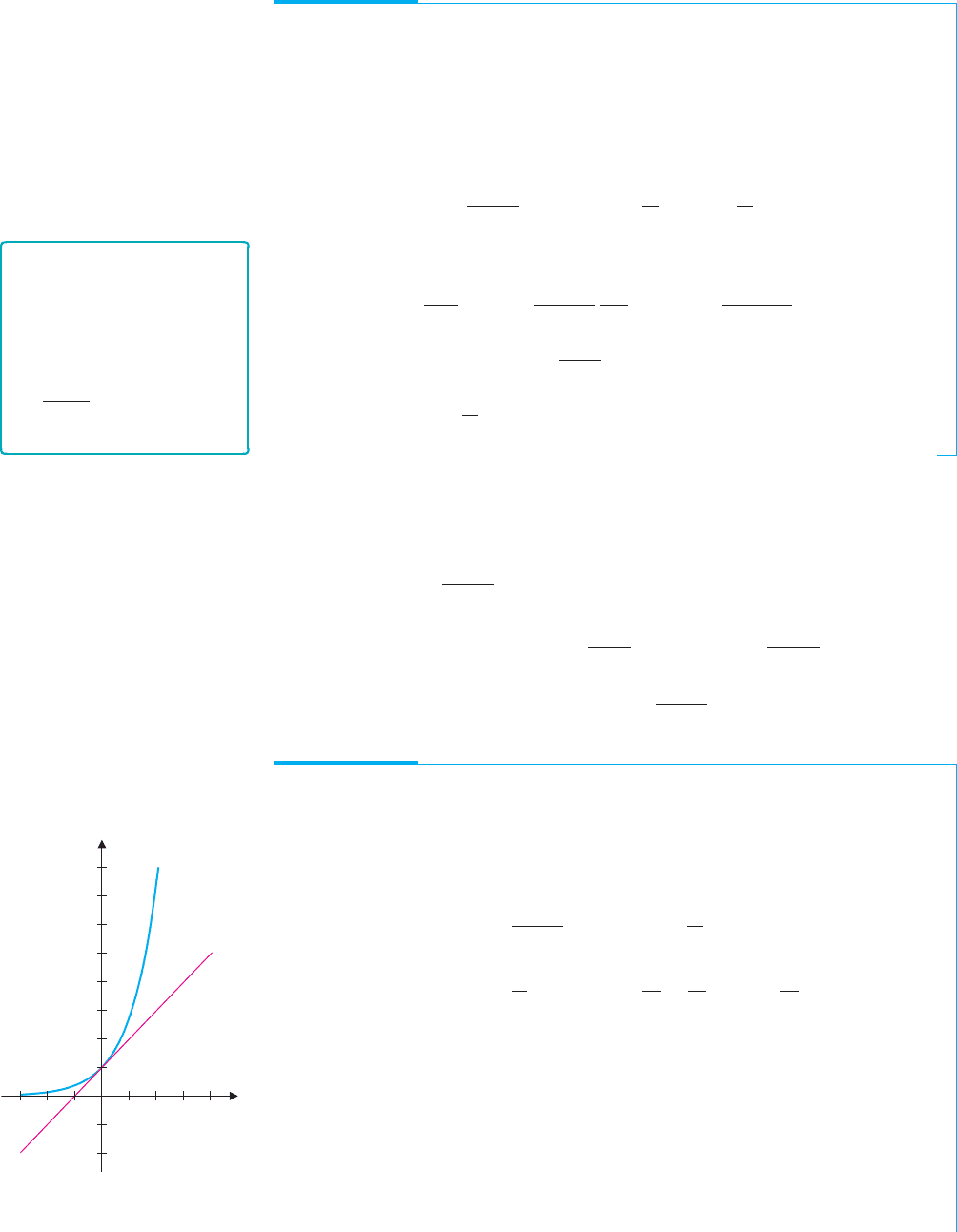
FIGURE 9.39a
y = e
x
and y = P
1
(x)
EXAMPLE 7.2 Constructing and Graphing Taylor Polynomials
For f (x) = e
x
, find the Taylor polynomial of degree n expanded about x = 0.
Solution As in example 7.1, we have that f
(k)
(x) = e
x
, for all k. So, we have that the
nth-degree Taylor polynomial is
P
n
(x) =
n
k=0
f
(k)
(0)
k!
(x − 0)
k
=
n
k=0
e
0
k!
x
k
=
n
k=0
1
k!
x
k
= 1 + x +
x
2
2!
+
x
3
3!
+···+
x
n
n!
.
Since we established in example 7.1 that the Taylor series for f (x) = e
x
about x = 0
converges for all x, this says that the sequence of partial sums (i.e., the sequence of
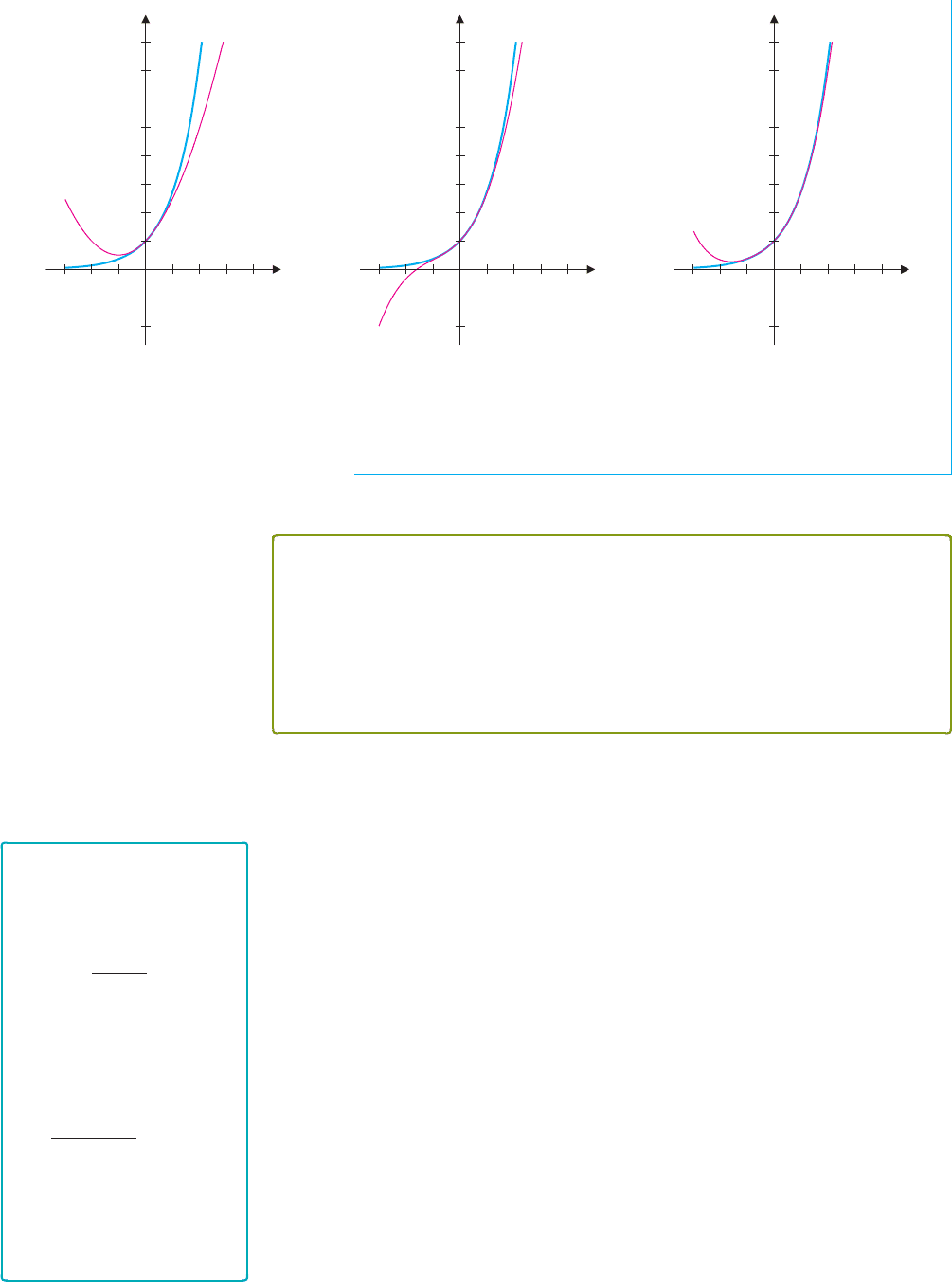
Taylor polynomials) converges for all x. In an effort to determine the function to which
the Taylor polynomials are converging, we have plotted P
1
(x), P
2
(x), P
3
(x) and P
4
(x),
together with the graph of f (x) = e
x
in Figures 9.39a–d, respectively.
Notice that as n gets larger, the graphs of P
n
(x) appear (at least on the interval
displayed) to be approaching the graph of f (x) = e
x
. Since we know that the Taylor
series converges and the graphical evidence suggests that the partial sums of the series
are approaching f (x) = e
x
, it is reasonable to conjecture that the series converges to e
x
.
P1: OSO/OVY P2: OSO/OVY QC: OSO/OVY T1: OSO
MHDQ256-Ch09 MHDQ256-Smith-v1.cls December 17, 2010 19:47
LT (Late Transcendental)
CONFIRMING PAGES
9-59 SECTION 9.7
..
Taylor Series 589
x
2 42
2
2
4
6
8
y e
x
y P
2
(x)
y
x
2 42
2
2
4
6
8
y e
x
y P
3
(x)
y
x
2 42
2
2
4
6
8
y e
x
y P
4
(x)
y
FIGURE 9.39b
y = e
x
and y = P
2
(x)
FIGURE 9.39c
y = e
x
and y = P
3
(x)
FIGURE 9.39d
y = e
x
and y = P
4
(x)
This is, in fact, exactly what is happening, as we can prove using Theorems 7.1
and 7.2.
THEOREM 7.1 (Taylor’s Theorem)
Suppose that f has (n + 1) derivatives on the interval (c −r, c +r), for some r > 0.
Then, for x ∈ (c −r, c +r), f (x) ≈ P
n
(x) and the error in using P
n
(x)to
approximate f (x)is
R
n
(x) = f (x) − P
n
(x) =
f
(n+1)
(z)
(n + 1)!
(x − c)
n+1
, (7.2)
for some number z between x and c.
REMARK 7.2
Observe that for n = 0, Taylor’s
Theorem simplifies to a very
familiar result. We have
R
0
(x) = f (x) − P
0
(x)
=
f
(z)
(0 + 1)!
(x − c)
0+1
.
Since P
0
(x) = f (c), we have
simply
f (x) − f (c) = f
(z)(x − c).
Dividing by (x − c), gives us
f (x) − f (c)
x − c
= f
(z),
which is the conclusion of the
Mean Value Theorem. In this
way, observe that Taylor’s
Theorem is a generalization of
the Mean Value Theorem.
The error term R
n
(x) in (7.2) is often called the remainder term. Note that this term
looks very much like the first neglected term of the Taylor series, except that f
(n+1)
is
evaluated at some (unknown) number z between x and c, instead of at c. This remainder
term serves two purposes: it enables us to obtain an estimate of the error in using a Taylor
polynomial to approximate a given function and, as we’ll see in Theorem 7.2, it gives us
the means to prove that a Taylor series for a given function f converges to f.
The proof of Taylor’s Theorem is somewhat technical and so we leave it for the end of
the section.
Note: If we could show that
lim
n→∞
R
n
(x) = 0, for all x in (c −r, c +r),
then we would have that
0 = lim
n→∞
R
n
(x) = lim
n→∞
[ f (x) − P
n
(x)] = f (x) − lim
n→∞
P
n
(x)
or
lim
n→∞
P
n
(x) = f (x), for all x ∈ (c −r, c +r).
That is, the sequence of partial sums of the Taylor series (i.e., the sequence of Taylor
polynomials) converges to f (x)for each x ∈ (c −r, c +r).We summarize this in Theorem
7.2.

P1: OSO/OVY P2: OSO/OVY QC: OSO/OVY T1: OSO
MHDQ256-Ch09 MHDQ256-Smith-v1.cls December 17, 2010 19:47
LT (Late Transcendental)
CONFIRMING PAGES
590 CHAPTER 9
..
Infinite Series 9-60
THEOREM 7.2
Suppose that f has derivatives of all orders in the interval (c − r, c +r), for some
r > 0 and lim
n→∞
R
n
(x) = 0, for all x in (c −r, c +r). Then, the Taylor series for f
expanded about x = c converges to f (x), that is,
f (x) =
∞
k=0
f
(k)
(c)
k!
(x − c)
k
,
for all x in (c −r, c +r).
We now return to the Taylor series expansion of f (x) = e
x
about x = 0, constructed
in example 7.1 and investigated further in example 7.2 and prove that it converges to e
x
,as
we had suspected.
EXAMPLE 7.3 Proving That a Taylor Series Converges
to the Desired Function
Show that the Taylor series for f (x) = e
x
expanded about x = 0 converges to e
x
.
Solution We already found the indicated Taylor series,
∞
k=0
1
k!
x
k
in example 7.1.
Here, we have f
(k)
(x) = e
x
, for all k = 0, 1, 2,....This gives us the remainder term
R
n
(x) =
f
(n+1)
(z)
(n + 1)!
(x − 0)
n+1
=
e
z
(n + 1)!
x
n+1
, (7.3)
where z is somewhere between x and 0 (and depends also on the value of n). We first
find a bound on the size of e
z
. Notice that if x > 0, then 0 < z < x and so,
e
z
< e
x
.
If x ≤ 0, then x ≤ z ≤ 0, so that
e
z
≤ e
0
= 1.
We define M to be the larger of these two bounds on e
z
. That is, we let
M = max{e
x
, 1}.
Then, for any x and any n,wehave
e
z
≤ M.
Together with (7.3), this gives us the error estimate
|R
n
(x)|=
e
z
(n + 1)!
|x|
n+1
≤ M
|x|
n+1
(n + 1)!
. (7.4)
To prove that the Taylor series converges to e
x
, we want to use (7.4) to show that
lim
n→∞
R
n
(x) = 0, for all x. However, for any given x, we cannot compute lim
n→∞
|x|
n+1
(n + 1)!
directly. Instead, we use the following indirect approach. We test the series
∞
n=0
|x|
n+1
(n + 1)!
using the Ratio Test. We have
lim
n→∞
a
n+1
a
n
= lim
n→∞
|x|
n+2
(n + 2)!
(n + 1)!
|x|
n+1
=|x| lim
n→∞
1
n + 2
= 0 < 1,
for all x. This says that the series
∞
n=0
|x|
n+1
(n + 1)!
converges absolutely for all x.Bythe
kth-term test for divergence, it then follows that the general term must tend to 0 as

P1: OSO/OVY P2: OSO/OVY QC: OSO/OVY T1: OSO
MHDQ256-Ch09 MHDQ256-Smith-v1.cls December 17, 2010 19:47
LT (Late Transcendental)
CONFIRMING PAGES
9-61 SECTION 9.7
..
Taylor Series 591
n →∞, for all x. That is,
lim
n→∞
|x|
n+1
(n + 1)!
= 0
and so, from (7.4), lim
n→∞
R
n
(x) = 0, for all x. From Theorem 7.2, we now conclude that
the Taylor series converges to e
x
for all x. That is,
e
x
=
∞
k=0
1
k!
x
k
= 1 + x +
x
2
2!
+
x
3
3!
+
x
4
4!
+···. (7.5)
When constructing a Taylor series expansion, first accurately calculate enough deriva-
tives for you to recognize the general form of the nth derivative. Then, show that
R
n
(x) → 0, as n →∞, for all x, to ensure that the series converges to the function you are
expanding.
One of the reasons for calculating Taylor series is that we can use their partial sums to
compute approximate values of a function.
EXAMPLE 7.4 Using a Taylor Series to Obtain an Approximation of
e
Use the Taylor series for e
x
in (7.5) to obtain an approximation to the number e.
Solution We have
e = e
1
=
∞
k=0
1
k!
1
k
=
∞
k=0
1
k!
.
We list some partial sums of this series in the accompanying table. From this we get the
very accurate approximation
e ≈ 2.718281828.
M
M
k0
1
k!
5 2.716666667
10 2.718281801
15 2.718281828
20 2.718281828
EXAMPLE 7.5 A Taylor Series Expansion of sin x
Find the Taylor series for f (x) = sin x, expanded about x =
π
2
and prove that the series
converges to sin x for all x.
Solution In this case, the Taylor series is
∞
k=0
f
(k)
π
2
k!
x −
π
2
k
.
First, we compute some derivatives and their value at x =
π
2
.Wehave
f (x) = sin xf
π
2
= 1,
f
(x) = cos xf
π
2
= 0,
f
(x) =−sin xf
π
2
=−1,
f
(x) =−cos xf
π
2
= 0,
f
(4)
(x) = sin xf
(4)
π
2
= 1
and so on. Recognizing that every other term is zero and every other term is ±1, we see
that the Taylor series is
∞
k=0
f
(k)
π
2
k!
x −
π
2
k
= 1 −
1
2
x −
π
2
2
+
1
4!
x −
π
2
4
−
1
6!
x −
π
2
6
+···
=
∞
k=0
(−1)
k
(2k)!
x −
π
2
2k
.
P1: OSO/OVY P2: OSO/OVY QC: OSO/OVY T1: OSO
MHDQ256-Ch09 MHDQ256-Smith-v1.cls December 27, 2010 19:21
LT (Late Transcendental)
CONFIRMING PAGES
592 CHAPTER 9
..
Infinite Series 9-62
To test this series for convergence, we consider the remainder term
|R
n
(x)|=
f
(n+1)
(z)
(n + 1)!
x −
π
2
n+1
, (7.6)
for some z between x and
π
2
. From our derivative calculation, note that
f
(n+1)
(z) =
±cos z, if n is even
±sin z, if n is odd
.
From this, it follows that
| f
(n+1)
(z)|≤1,
for every n. (Notice that this is true whether n is even or odd.) From (7.6), we now have
|R
n
(x)|=
f
(n+1)
(z)
(n + 1)!
x −
π
2
n+1
≤
1
(n + 1)!
x −
π
2
n+1
→ 0,
as n →∞, for every x, as in example 7.3. This says that
sin x =
∞
k=0
(−1)
k
(2k)!
x −
π
2
2k
= 1 −
1
2
x −
π
2
2
+
1
4!
x −
π
2
4
−···,
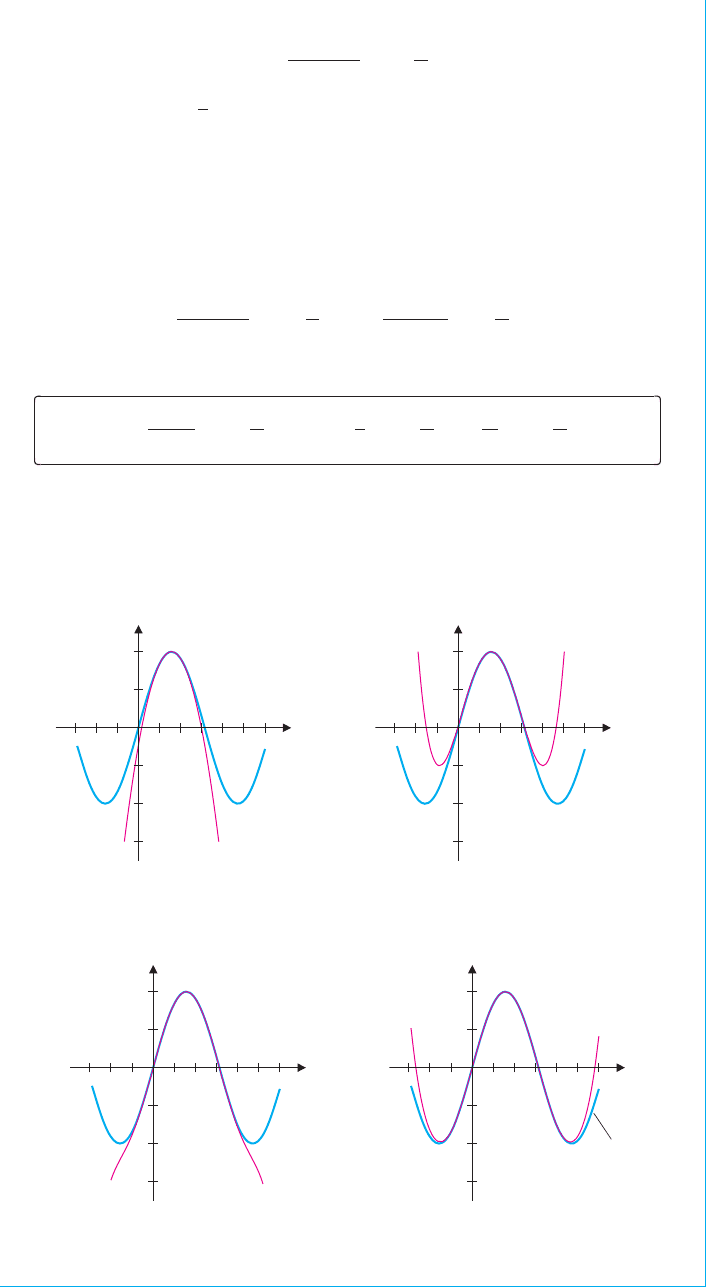
for all x. In Figures 9.40a–d, we show graphs of f (x) = sin x together with the Taylor
polynomials P
2
(x), P
4
(x), P
6
(x) and P
8
(x) (the first few partial sums of the series).
Notice that the higher the degree of the Taylor polynomial is, the larger the interval is
over which the polynomial provides a close approximation to f (x) = sin x.
y
x
2 4 6⫺2
⫺1
1
y ⫽ sin x
y ⫽ P
2
(x)
y
x
2 4 6⫺2
⫺1
1
y ⫽ sin x
y ⫽ P
4
(x)
FIGURE 9.40a
y = sin x and y = P
2
(x)
FIGURE 9.40b
y = sin x and y = P
4
(x)
y
x
2 4 6⫺2
⫺1
1
y
⫽ sin x
y ⫽ P
6
(x)
y
x
2 4 6⫺2
⫺1
1
y ⫽ sin x
y ⫽ P
8
(x)
FIGURE 9.40c
y = sin x and y = P
6
(x)
FIGURE 9.40d
y = sin x and y = P
8
(x)
In example 7.6, we illustrate how to use Taylor’s Theorem to estimate the error in using
a Taylor polynomial to approximate the value of a function.