
Smith R., Minton R. Calculus
Подождите немного. Документ загружается.

P1: OSO/OVY P2: OSO/OVY QC: OSO/OVY T1: OSO
MHDQ256-Ch09 MHDQ256-Smith-v1.cls December 27, 2010 19:21
LT (Late Transcendental)
CONFIRMING PAGES
9-63 SECTION 9.7
..
Taylor Series 593
EXAMPLE 7.6 Estimating the Error in a Taylor
Polynomial Approximation
Expand f (x) = ln x in a Taylor series about a convenient point and use a Taylor
polynomial of degree 4 to approximate the value of ln(1.1). Then, estimate the error in
this approximation.
2 31
2
⫺2
⫺4
y ⫽ ln x
y ⫽ P
4
(x)
y
x
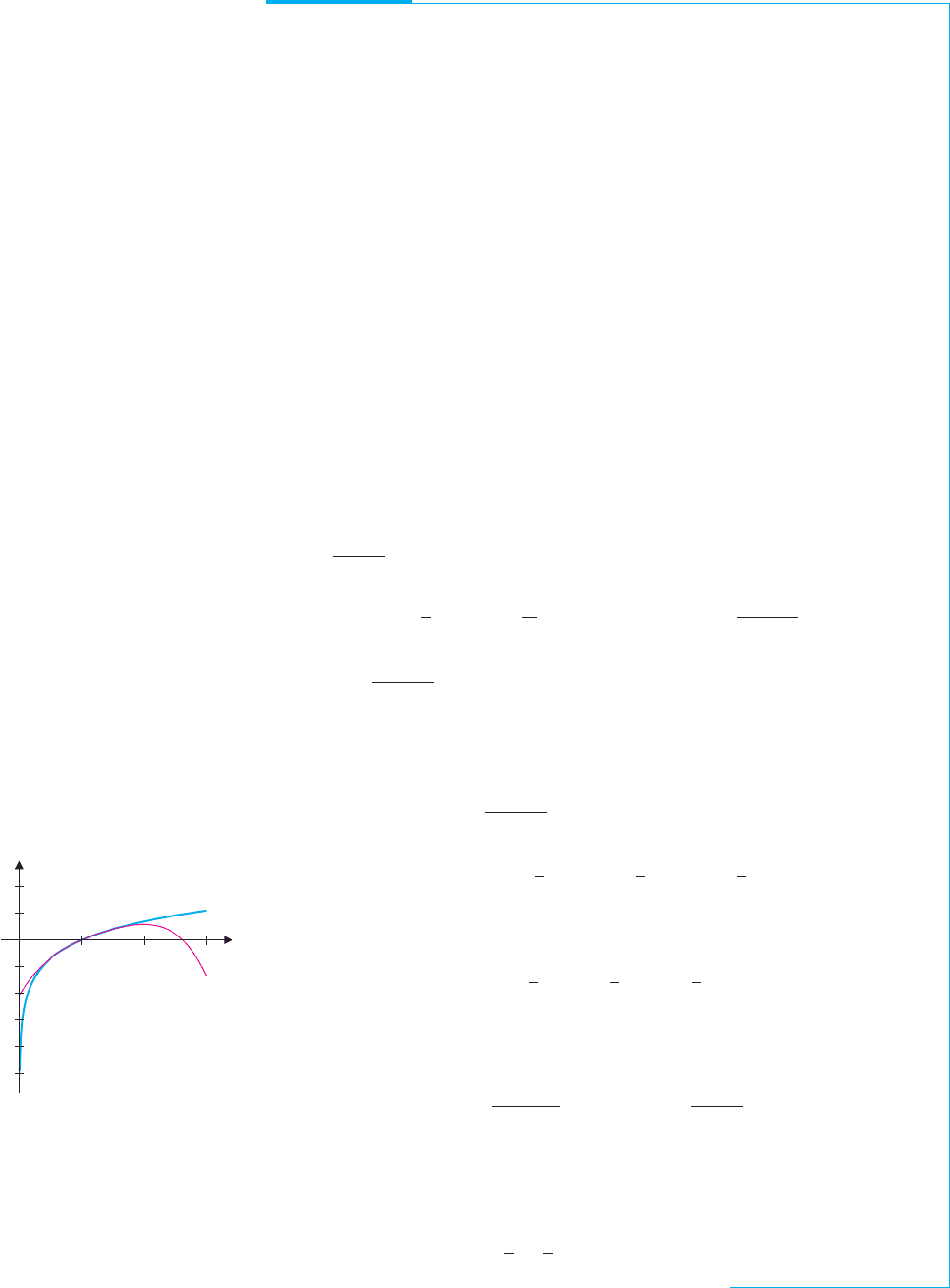
FIGURE 9.41
y = ln x and y = P
4
(x)
Solution First, note that since ln1 is known exactly and 1 is close to 1.1 (why would
this matter?), we expand f (x) = ln x in a Taylor series about x = 1. We compute an
adequate number of derivatives so that the pattern becomes clear. We have
f (x) = ln xf(1) = 0
f
(x) = x
−1
f
(1) = 1
f
(x) =−x
−2
f
(1) =−1
f
(x) = 2x
−3
f
(1) = 2
f
(4)
(x) =−3·2x
−4
f
(4)
(1) =−3!
f
(5)
(x) = 4! x
−5
f
(5)
(1) = 4!
.
.
.
.
.
.
f
(k)
(x) = (−1)
k+1
(k − 1)! x
−k
f
(k)
(1) = (−1)
k+1
(k − 1)!
We get the Taylor series
∞
k=0
f
(k)
(1)
k!
(x − 1)
k
= (x − 1) −
1
2
(x − 1)
2
+
2
3!
(x − 1)
3
+···+(−1)
k+1
(k − 1)!
k!
(x − 1)
k
+···
=
∞
k=1
(−1)
k+1
k
(x − 1)
k
.
We leave it as an exercise to show that the series converges to f (x) = ln x, for
0 < x < 2. The Taylor polynomial P
4
(x) is then
P
4
(x) =
4
k=1
(−1)
k+1
k
(x − 1)
k
= (x − 1) −
1
2
(x − 1)
2
+
1
3
(x − 1)
3
−
1
4
(x − 1)
4
.
We show a graph of y = ln x and y = P
4
(x) in Figure 9.41. Taking x = 1.1 gives us the
approximation
ln(1.1) ≈ P
4
(1.1) = 0.1 −
1
2
(0.1)
2
+
1
3
(0.1)
3
−
1
4
(0.1)
4
≈ 0.095308333.
We can use the remainder term to estimate the error in this approximation. We have
|Error|=|ln(1.1) − P
4
(1.1)|=|R
4
(1.1)|
=
f
(4+1)
(z)
(4 + 1)!
(1.1 − 1)
4+1
=
4!|z|
−5
5!
(0.1)
5
,
where z is between 1 and 1.1. This gives us the following bound on the error:
|Error|=
(0.1)
5
5z
5
<
(0.1)
5
5(1
5
)
= 0.000002,
since 1 < z < 1.1 implies that
1
z
<
1
1
= 1. This says that the approximation
ln(1.1) ≈ 0.095308333 is off by no more than ±0.000002.
P1: OSO/OVY P2: OSO/OVY QC: OSO/OVY T1: OSO
MHDQ256-Ch09 MHDQ256-Smith-v1.cls December 17, 2010 19:47
LT (Late Transcendental)
CONFIRMING PAGES
594 CHAPTER 9
..
Infinite Series 9-64
A better question related to example 7.6 is to determine how many terms of the Taylor
series are needed in order to guarantee a given accuracy. We use the remainder term to
accomplish this in example 7.7.
EXAMPLE 7.7 Finding the Number of Terms Needed
for a Given Accuracy
Find the number of terms in the Taylor series for f (x) = ln x expanded about x = 1
that will guarantee an accuracy of at least 1 × 10
−10
in the approximation of (a) ln(1.1)
and (b) ln(1.5).
y
x
1 2 3
2
4
2
y ln x
y P
9
(x)
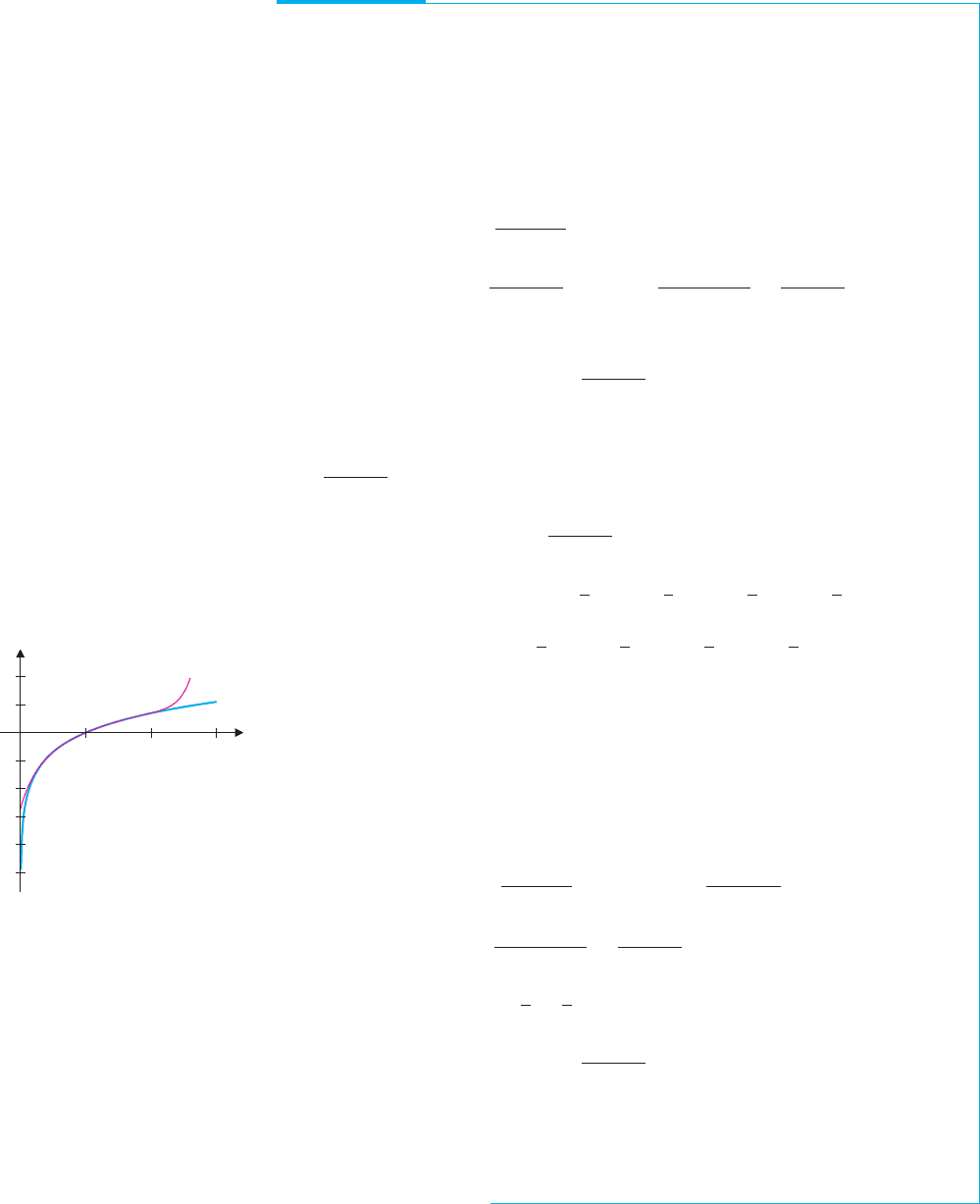
FIGURE 9.42
y = ln x and y = P
9
(x)
Solution (a) From our calculations in example 7.6 and (7.2), we have that for some
number z between 1 and 1.1,
|R
n
(1.1)|=
f
(n+1)
(z)
(n + 1)!
(1.1 − 1)
n+1
=
n!|z|
−n−1
(n + 1)!
(0.1)
n+1
=
(0.1)
n+1
(n + 1)z
n+1
<
(0.1)
n+1
n + 1
.
Further, since we want the error to be less than 1 × 10
−10
, we require that
|R
n
(1.1)| <
(0.1)
n+1
n + 1
< 1 × 10
−10
.
You can solve this inequality for n by trial and error, to find that n = 9 will guarantee
the required accuracy. Notice that larger values of n will also guarantee this accuracy,
since
(0.1)
n+1
n + 1
is a decreasing function of n. We then have the approximation
ln(1.1) ≈ P
9
(1.1) =
9
k=0
(−1)
k+1
k
(1.1 − 1)
k
= (0.1) −
1
2
(0.1)
2
+
1
3
(0.1)
3
−
1
4
(0.1)
4
+
1
5
(0.1)
5
−
1
6
(0.1)
6
+
1
7
(0.1)
7
−
1
8
(0.1)
8
+
1
9
(0.1)
9
≈ 0.095310179813,
which from our error estimate we know is correct to within ±1 × 10
−10
.Weshowa
graph of y = ln x and y = P
9
(x) in Figure 9.42. In comparing Figure 9.42 with
Figure 9.41, observe that while P
9
(x) provides an improved approximation to P
4
(x)
over the interval of convergence (0, 2), it does not provide a better approximation
outside of this interval.
(b) Similarly, notice that for some number z between 1 and 1.5,
|R
n
(1.5)|=
f
(n+1)
(z)
(n + 1)!
(1.5 − 1)
n+1
=
n!|z|
−n−1
(n + 1)!
(0.5)
n+1
=
(0.5)
n+1
(n + 1)z
n+1
<
(0.5)
n+1
n + 1
,
since 1 < z < 1.5 implies that
1
z
<
1
1
= 1. So, here we require that
|R
n
(1.5)| <
(0.5)
n+1
n + 1
< 1 × 10
−10
.
Solving this by trial and error shows that n = 28 will guarantee the required accuracy.
Observe that this says that to obtain the same accuracy, many more terms are needed to
approximate f (1.5) than for f (1.1). This further illustrates the general principle that the
farther away x is from the point about which we expand, the slower the convergence of
the Taylor series will be.

P1: OSO/OVY P2: OSO/OVY QC: OSO/OVY T1: OSO
MHDQ256-Ch09 MHDQ256-Smith-v1.cls December 17, 2010 19:47
LT (Late Transcendental)
CONFIRMING PAGES
9-65 SECTION 9.7
..
Taylor Series 595
Foryourconvenience,wehavecompileda listofcommonTaylorseriesinthe following
table.
Interval of
Taylor Series Convergence Where to Find
e
x
=
∞
k=0
1
k!
x
k
= 1 + x +
1
2
x
2
+
1
3!
x
3
+
1
4!
x
4
+··· (−∞, ∞) examples 7.1 and 7.3
sin x =
∞
k=0
(−1)
k
(2k + 1)!
x
2k+1
= x −
1
3!
x
3
+
1
5!
x
5
−
1
7!
x
7
+··· (−∞, ∞) exercise 2
cos x =
∞
k=0
(−1)
k
(2k)!
x
2k
= 1 −
1
2
x
2
+
1
4!
x
4
−
1
6!
x
6
+··· (−∞, ∞) exercise 1
sin x =
∞
k=0
(−1)
k
(2k)!
x −
π
2
2k
= 1 −
1
2
x −
π
2
2
+
1
4!
x −
π
2
4
−··· (−∞, ∞) example 7.5
ln x =
∞
k=1
(−1)
k+1
k
(x − 1)
k
= (x − 1) −
1
2
(x − 1)
2
+
1
3
(x − 1)
3
−··· (0, 2] examples 7.6, 7.7
tan
−1
x =
∞
k=0
(−1)
k
2k + 1
x
2k+1
= x −
1
3
x
3
+
1
5
x
5
−
1
7
x
7
+··· (−1, 1) example 6.6
Notice that once you have found a Taylor series expansion for a given function, you
can find any number of other Taylor series simply by making a substitution.
EXAMPLE 7.8 Finding New Taylor Series from Old Ones
Find Taylor series in powers of x for e
2x
, e
x
2
and e
−2x
.
Solution Rather than compute the Taylor series for these functions from scratch, recall
that we had established in example 7.3 that
e
t
=
∞
k=0
1
k!
t
k
= 1 + t +
1
2!
t
2
+
1
3!
t
3
+
1
4!
t
4
+···, (7.7)
for all t ∈ (−∞, ∞). Taking t = 2x in (7.7), we get the new Taylor series:
e
2x
=
∞
k=0
1
k!
(2x)
k
=
∞
k=0
2
k
k!
x
k
= 1 + 2x +
2
2
2!
x
2
+
2
3
3!
x
3
+···.
Similarly, setting t = x
2
in (7.7), we get the Taylor series
e
x
2
=
∞
k=0
1
k!
(x
2
)
k
=
∞
k=0
1
k!
x
2k
= 1 + x
2
+
1
2!
x
4
+
1
3!
x
6
+···.
Finally, taking t =−2x in (7.7), we get
e
−2x
=
∞
k=0
1
k!
(−2x)
k
=
∞
k=0
(−1)
k
k!
2
k
x
k
= 1 − 2x +
2
2
2!
x
2
−
2
3
3!
x
3
+···.
Notice that all of these last three series converge for all x ∈ (−∞, ∞). (Why is that?)
Proof of Taylor’s Theorem
Recall that we had observed that the Mean Value Theorem is a special case of Taylor’s
Theorem. As it turns out, the proof of Taylor’s Theorem parallels that of the Mean Value
Theorem, as both make use of Rolle’s Theorem. As with the proof of the Mean Value

P1: OSO/OVY P2: OSO/OVY QC: OSO/OVY T1: OSO
MHDQ256-Ch09 MHDQ256-Smith-v1.cls December 17, 2010 19:47
LT (Late Transcendental)
CONFIRMING PAGES
596 CHAPTER 9
..
Infinite Series 9-66
Theorem, for a fixed x ∈ (c −r, c +r), we define the function
g(t) = f (x) − f (t) − f
(t)(x − t) −
1
2!
f
(t)(x − t)
2
−
1
3!
f
(t)(x − t)
3
−···−
1
n!
f
(n)
(t)(x − t)
n
− R
n
(x)
(x − t)
n+1
(x − c)
n+1
,
where R
n
(x) is the remainder term, R
n
(x) = f (x) − P
n
(x). If we take t = x, notice that
g(x) = f (x) − f (x) −0 −0 −···−0 = 0
and if we take t = c,weget
g(c) = f (x) − f (c) − f
(c)(x − c) −
1
2!
f
(c)(x − c)
2
−
1
3!
f
(c)(x − c)
3
−···−
1
n!
f
(n)
(c)(x − c)
n
− R
n
(x)
(x − c)
n+1
(x − c)
n+1
= f (x) − P
n
(x) − R
n
(x) = R
n
(x) − R
n
(x) = 0.
By Rolle’s Theorem, there must be some number z between x and c for which g
(z) = 0.
Differentiating our expression for g(t) (with respect to t), we get (beware of all the product
rules!)
g
(t) = 0 − f
(t) − f
(t)(−1) − f
(t)(x − t) −
1
2
f
(t)(2)(x − t)(−1)
−
1
2
f
(t)(x − t)
2
−···−
1
n!
f
(n)
(t)(n)(x − t)
n−1
(−1)
−
1
n!
f
(n+1)
(t)(x − t)
n
− R
n
(x)
(n + 1)(x − t)
n
(−1)
(x − c)
n+1
=−
1
n!
f
(n+1)
(t)(x − t)
n
+ R
n
(x)
(n + 1)(x − t)
n
(x − c)
n+1
,
after most of the terms cancel. So, taking t = z, we have that
0 = g
(z) =−
1
n!
f
(n+1)
(z)(x − z)
n
+ R
n
(x)
(n + 1)(x − z)
n
(x − c)
n+1
.
Solving this for the term containing R
n
(x), we get
R
n
(x)
(n + 1)(x − z)
n
(x − c)
n+1
=
1
n!
f
(n+1)
(z)(x − z)
n
and finally,
R
n
(x) =
1
n!
f
(n+1)
(z)(x − z)
n
(x − c)
n+1
(n + 1)(x − z)
n
=
f
(n+1)
(z)
(n + 1)!
(x − c)
n+1
,
as we had claimed.
BEYOND FORMULAS
You should think of this section as giving a general procedure for finding power series
representations, where section 9.6 solves that problem only for special cases. Further,
if a function is the sum of a convergent power series, then we can approximate the
functionwith apartialsum ofthatseries. Taylor’sTheoremprovidesuswithan estimate
of the error in a given approximation and tells us that (in general) the approximation is
improved by taking more terms.

P1: OSO/OVY P2: OSO/OVY QC: OSO/OVY T1: OSO
MHDQ256-Ch09 MHDQ256-Smith-v1.cls December 17, 2010 19:47
LT (Late Transcendental)
CONFIRMING PAGES
9-67 SECTION 9.7
..
Taylor Series 597
EXERCISES 9.7
WRITING EXERCISES
1. DescribehowtheTaylor polynomial of degreen = 1 compares
to the linear approximation. (See section 3.1.) Give an analo-
gous interpretation of the Taylor polynomial of degree n = 2.
How do various graphical properties (position, slope, concav-
ity) of the Taylor polynomial compare with those of the func-
tion f (x)atx = c?
2. Briefly discuss how a computer might use Taylor polynomi-
als to compute sin(1.2). In particular, how would the computer
know how many terms to compute? How would the number of
terms necessary to compute sin(1.2) compare to the number
needed to compute sin(100)?Describe a trick that would make
it much easier for the computer to compute sin(100). (Hint:
The sine function is periodic.)
3. Taylor polynomials are built up from a knowledge of
f (c), f
(c), f
(c) and so on. Explain in graphical terms why
information at one point (e.g., position, slope, concavity, etc.)
can be used to construct the graph of the function on the entire
interval of convergence.
4. If f (c) is the position of an object at time t = c, then f
(c)
is the object’s velocity and f
(c) is the object’s acceleration
at time c. Explain in physical terms how knowledge of these
values at one time [plus f
(c), etc.] can be used to predict the
position of the object on the interval of convergence.
5. Our table of common Taylor serieslists two different series for
sin x. Explain how the same function could have two differ-
ent Taylor series representations. For a given problem (e.g.,
approximate sin 2), explain how you would choose which
Taylor series to use.
6. Explain why the Taylor series with center c = 0of
f (x) = x
2
− 1 is simply x
2
− 1.
In exercises 1–8, find the Maclaurin series (i.e., Taylor series
about c 0) and its interval of convergence.
1. f (x) = cosx 2. f (x) = sinx
3. f (x) = e
2x
4. f (x) = cos2x
5. f (x) = ln(1 + x) 6. f (x) = e
−x
7. f (x) = 1/(1 + x)
2
8. f (x) = 1/(1 − x)
............................................................
In exercises 9–14, find the Taylor series about the indicated
center and determine the interval of convergence.
9. f (x) = e
x−1
, c = 1 10. f (x) = cosx, c =−π/2
11. f (x) = lnx, c = e 12. f (x) = e
x
, c = 2
13. f (x) =
1
x
, c = 1 14. f (x) =
1
x + 5
, c = 0
............................................................
In exercises 15–20, graph f (x) and the Taylor polynomials for
the indicated center c and degree n.
15. f (x) =
√
x, c = 1, n = 3; n = 6
16. f (x) =
1
1 + x
, c = 0, n = 4; n = 8
17. f (x) = e
x
, c = 2, n = 3; n = 6
18. f (x) = cos x, c = π/2, n = 4; n = 8
19. f (x) = sin
−1
x, c = 0, n = 3; n = 5
20. f (x) =
2
x − 5
, c = 6, n = 4; n = 8
............................................................
In exercises21–24, prove that the Taylor series converges to f (x)
by showing that R
n
(x) → 0asn → ∞.
21. sin x =
∞
k=0
(−1)
k
x
2k+1
(2k + 1)!
22. cos x =
∞
k=0
(−1)
k
x
2k
(2k)!
23. ln x =
∞
k=1
(−1)
k+1
(x − 1)
k
k
, 1 ≤ x ≤ 2
24. e
−x
=
∞
k=0
(−1)
k
x
k
k!
............................................................
In exercises 25–28, (a) use a Taylor polynomial of degree 4 to
approximate the given number, (b) estimate the error in the
approximation and (c) estimate the number of terms needed in
a Taylor polynomial to guarantee an accuracy of 10
−10
.
25. ln(1.05) 26. ln(0.9)
27.
√
1.1 28.
√
1.2
............................................................
In exercises 29–34, use a known Taylor series to find the Taylor
series about c 0 for the given function and find its radius of
convergence.
29. f (x) = e
−3x
30. f (x) =
e
x
− 1
x
31. f (x) = xe
−x
2
32. f (x) = sinx
2
33. f (x) = x sin2x 34. f (x) = cos x
3
............................................................
In exercises 35–38, use a Taylor series to verify the given
formula.
35.
∞
k=0
2
k
k!
= e
2
36.
∞
k=0
(−1)
k
π
2k+1
(2k + 1)!
= 0
37.
∞
k=0
(−1)
k
2k + 1
=
π
4
38.
∞
k=1
(−1)
k+1
k
= ln2
............................................................

P1: OSO/OVY P2: OSO/OVY QC: OSO/OVY T1: OSO
MHDQ256-Ch09 MHDQ256-Smith-v1.cls December 17, 2010 19:47
LT (Late Transcendental)
CONFIRMING PAGES
598 CHAPTER 9
..
Infinite Series 9-68
In exercises 39–42, name the method by stating the
best method (geometric series, substitution, differentiation/
antidifferentiation, Taylor series) for finding a power series rep-
resentation of the function.
39. (a) f (x) = (1 − x)
−2
(b) f (x) =
2
x + x
2
40. (a) f (x) = cos(x
3
) (b) f (x) = cos
3
x
41. (a) f (x) = tanh
−1
x (b) f (x) = tan
−1
x
42. (a) f (x) =
1
e
2x
(b) f (x) = e
2/(x+1)
............................................................
43. You may have wondered why it is necessary to show that
lim
n→∞
R
n
(x) = 0 to conclude that a Taylor series converges
to f (x). Consider f (x) =
e
−1/x
2
, if x = 0
0, if x = 0
. Show that
f
(0) = f
(0) = 0. (Hint: Use the fact that lim
h→0
e
−1/h
2
h
n
= 0
for any positive integer n.) It turns out that f
(n)
(0) = 0 for
all n. Thus, the Taylor series of f (x) about c = 0 equals 0, a
convergent “series” that does not converge to f (x).
44. In many applications, the error function
erf(x) =
2
√
π
x
0
e
−u
2
du is important. Compute and graph
the fourth-order Taylor polynomial for erf(x) about c = 0.
Exercises 45–48 involve the binomial expansion.
45. Show that the Maclaurin series for (1 + x)
r
is
1 +
∞
k=1
r(r − 1)···(r − k + 1)
k!
x
k
, for any constant r.
46. Simplify the series in exercise 45 for r = 2; r = 3; r is a pos-
itive integer.
47. Use the result of exercise 45 to write out the Maclaurin series
for f (x) =
√
1 + x.
48. Use the result of exercise 45 to write out the Maclaurin series
for f (x) = (1 + x)
3/2
.
............................................................
49. Find the Taylor series of f (x) =|x| with center c = 1. Argue
that the radius of convergence is ∞. However, show that the
Taylor series of f (x) does not converge to f (x) for all x.
50. Find the Maclaurin series of f (x) =
√
a
2
+ x
2
−
√
a
2
− x
2
for some nonzero constant a.
51. Prove that if f and g are functions such that f
(x)
and g
(x) exist for all x and lim
x→a
f (x) − g(x)
(x − a)
2
= 0, then
f (a) = g(a), f
(a) = g
(a) and f
(a) = g
(a). What does
this imply about the Taylor series for f (x) and g(x)?
52. Generalize exercise 51 by proving that if f and g are functions
such that for some positive integer n, f
(n)
(x) and g
(n)
(x) exist
for all x and lim
x→a
f (x) − g(x)
(x − a)
n
= 0, then f
(k)
(a) = g
(k)
(a) for
0 ≤ k ≤ n.
53. Find the first five terms in the Taylor series about c = 0 for
f (x) = e
x
sin x and compare to the product of the Taylor
polynomials about c = 0ofe
x
and sin x.
54. Find the first five terms in the Taylor series about c = 0
for f (x) = tan x and compare to the quotient of the Taylor
polynomials about c = 0ofsinx and cos x.
55. Find the first four nonzero terms in the Maclaurin series of
f (x) =
sin x
x
, x = 0
1, x = 0
and compare to the Maclaurin series
for sin x.
56. Find the Taylor series of f (x) = x ln x about c = 1. Compare
to the Taylor series for ln x about c = 1.
57. FindtheMaclaurinseries of f (x) = cosh x and f (x) = sinh x.
Compare to the Maclaurin series of cos x and sin x.
58. Use the Maclaurin series for tan x and the result of exercise 57
to conjecture the Maclaurin series for tanh x.
............................................................
59. We have seen that sin 1 = 1 −
1
3!
+
1
5!
+···. Determine how
many terms are needed to approximate sin 1 to within 10
−5
.
Show that sin1 =
!
1
0
cos xdx. Determine how many points
are needed for Simpson’s Rule to approximate this integral to
within 10
−5
. Compare the efficiency of Maclaurin series and
Simpson’s Rule for this problem.
60. As in exercise 59, compare the efficiency of Maclaurin series
and Simpson’s Rule in estimating e to within 10
−5
.
EXPLORATORY EXERCISES
1. Almostall of our series results apply to series of complex num-
bers. Defining i =
√
−1, show that i
2
=−1, i
3
=−i, i
4
= 1
and so on. Replacing x with ix in the Maclaurin series for
e
x
, separate terms containing i from those that don’t contain i
(after the simplifications indicated above) and derive Euler’s
formula: e
ix
= cos x + i sin x. Show that cos(ix) = cosh x
and sin(ix) = i sinh x. That is, the trig functions and their
hyperbolic counterparts are closely related as functions of
complex variables.
2. The method used in examples 7.3, 7.5, 7.6 and 7.7 does not
require us to actually find R
n
(x), but to approximate it with
a worst-case bound. Often this approximation is fairly close
to R
n
(x), but this is not always true. As an extreme example
of this, show that the bound on R
n
(x) for f (x) = ln x about
c = 1(seeexercise23)increaseswithoutboundfor0 < x <
1
2
.
Explainwhythis doesnotnecessarilymeanthattheactual error
increaseswithoutbound.Infact, R
n
(x) → 0 for 0 < x <
1
2
but
wemustshowthisusingsomeother method. Use integrationof
an appropriate power series to show that
∞
k=1
(−1)
k+1
(x − 1)
k
k
converges to ln x for 0 < x <
1
2
.
3. Verify numerically that if a
1
is close to π, the sequence
a
n+1
= a
n
+ sina
n
converges to π. (In other words, if a
n
is
an approximation of π , then a
n
+ sina
n
is a better approxima-
tion.)Toprovethis, find theTaylorseriesfor sin x aboutc = π.
Use this to show that if π<a
n
< 2π, then π<a
n+1
< a
n
.
Similarly, show that if 0 < a
n
<π, then a
n
< a
n+1
<π.

P1: OSO/OVY P2: OSO/OVY QC: OSO/OVY T1: OSO
MHDQ256-Ch09 MHDQ256-Smith-v1.cls December 17, 2010 19:47
LT (Late Transcendental)
CONFIRMING PAGES
9-69 SECTION 9.8
..
Applications of Taylor Series 599
9.8 APPLICATIONS OF TAYLOR SERIES
In this section, we expand on our earlier presentation of Taylor series, by giving a few
examples of how these are used to approximate the values of transcendental functions,
evaluate limits and integrals and define important new functions. These represent but a
small sampling of the important applications of Taylor series.
First, consider how calculators and computers might calculate values of transcendental
functions, such as sin(1.234567). We illustrate this in example 8.1.
EXAMPLE 8.1 Using Taylor Polynomials to Approximate
a Sine Value
Use a Taylor series to approximate sin(1.234567) accurate to within 10
−11
.
Solution In section 9.7, we left it as an exercise to show that the Taylor series
expansion for f (x) = sin x about x = 0is
sin x =
∞
k=0
(−1)
k
(2k + 1)!
x
2k+1
= x −
1
3!
x
3
+
1
5!
x
5
−
1
7!
x
7
+···,
where the interval of convergence is (−∞, ∞). Taking x = 1.234567, we have
sin1.234567 =
∞
k=0
(−1)
k
(2k + 1)!
(1.234567)
2k+1
,
which is an alternating series. We can use a partial sum of this series to approximate the
desired value, but how many terms will we need for the desired accuracy? Recall that
for alternating series, the error in a partial sum is bounded by the absolute value of the
first neglected term. (Note that you could also use the remainder term from Taylor’s
Theorem to bound the error.) To ensure that the error is less than 10
−11
, we must find an
integer k such that
1.234567
2k+1
(2k + 1)!
< 10
−11
. By trial and error, we find that
1.234567
17
17!
≈ 1.010836 × 10
−13
< 10
−11
,
so that k = 8 will do. This says that the first neglected term corresponds to k = 8 and
so, we compute the partial sum
sin1.234567 ≈
7
k=0
(−1)
k
(2k + 1)!
(1.234567)
2k+1
= 1.234567−
1.234567
3
3!
+
1.234567
5
5!
−
1.234567
7
7!
+···−
1.234567
15
15!
≈ 0.94400543137.
Check your calculator or computer to verify that this matches your calculator’s estimate.
In example 8.1, while we produced an approximation with the desired accuracy, we
did not do this in the most efficient fashion, as we simply grabbed the most handy Taylor
series expansion of f (x) = sin x. We illustrate a more efficient choice in example 8.2.
EXAMPLE 8.2 Choosing a More Appropriate Taylor Series Expansion
Repeat example 8.1, but this time, make a more appropriate choice of the Taylor series.
Solution Recall that Taylor series converge much faster close to the point about
which you expand, than they do far away. Given this and the fact that we know the exact
value of sinx at only a few points, you should quickly recognize that a series expanded

P1: OSO/OVY P2: OSO/OVY QC: OSO/OVY T1: OSO
MHDQ256-Ch09 MHDQ256-Smith-v1.cls December 17, 2010 19:47
LT (Late Transcendental)
CONFIRMING PAGES
600 CHAPTER 9
..
Infinite Series 9-70
about x =
π
2
≈ 1.57 is a better choice for computing sin1.234567 than one expanded
about x = 0. (Another reasonable choice is the Taylor series expansion about x =
π
3
.)
In example 7.5, recall that we had found that
sin x =
∞
k=0
(−1)
k
(2k)!
x −
π
2
2k
= 1 −
1
2
x −
π
2
2
+
1
4!
x −
π
2
4
−···,
where the interval of convergence is (−∞, ∞). Taking x = 1.234567 gives us
sin1.234567 =
∞
k=0
(−1)
k
(2k)!
1.234567 −
π
2
2k
= 1 −
1
2
1.234567 −
π
2
2
+
1
4!
1.234567 −
π
2
4
−···,
which is again an alternating series. Using the remainder term from Taylor’s Theorem
to bound the error, we have that
|R
n
(1.234567)|=
f
(2n+2)
(z)
(2n + 2)!
1.234567 −
π
2
2n+2
≤
1.234567 −
π
2
2n+2
(2n + 2)!
.
(Note that we get the same error bound if we use the error bound for an alternating
series.) By trial and error, you can find that
1.234567 −
π
2
2n+2
(2n + 2)!
< 10
−11
for n = 4, so that an approximation with the required degree of accuracy is
sin1.234567 ≈
4
k=0
(−1)
k
(2k)!
1.234567 −
π
2
2k
= 1 −
1
2
1.234567 −
π
2
2
+
1
4!
1.234567 −
π
2
4
−
1
6!
1.234567 −
π
2
6
+
1
8!
1.234567 −
π
2
8
≈ 0.94400543137.
Compare this result to example 8.1, where we needed many more terms of the Taylor
series to obtain the same degree of accuracy.
We can also use Taylor series to quickly conjecture the value of difficult limits. Be
careful, though: the theory of when these conjectures are guaranteed to be correct is
beyond the level of this text. However, we can certainly obtain helpful hints about certain
limits.
EXAMPLE 8.3 Using Taylor Polynomials to Conjecture
the Value of a Limit
Use Taylor series to conjecture lim
x→0
sin x
3
− x
3
x
9
.
Solution Again recall that the Maclaurin series for sin x is
sin x =
∞
k=0
(−1)
k
(2k + 1)!
x
2k+1
= x −
1
3!
x
3
+
1
5!
x
5
−
1
7!
x
7
+···,
where the interval of convergence is (−∞, ∞). Substituting x
3
for x gives us
sin x
3
=
∞
k=0
(−1)
k
(2k + 1)!
(x
3
)
2k+1
= x
3
−
x
9
3!
+
x
15
5!
−···

P1: OSO/OVY P2: OSO/OVY QC: OSO/OVY T1: OSO
MHDQ256-Ch09 MHDQ256-Smith-v1.cls December 17, 2010 19:47
LT (Late Transcendental)
CONFIRMING PAGES
9-71 SECTION 9.8
..
Applications of Taylor Series 601
This gives us
sin x
3
− x
3
x
9
=
x
3
−
x
9
3!
+
x
15
5!
−···
− x
3
x
9
=−
1
3!
+
x
6
5!
+···
and so, computing the limit as x → 0 of the above polynomial, we conjecture that
lim
x→0
sin x
3
− x
3
x
9
=−
1
3!
=−
1
6
.
You can verify that this limit is correct using l’Hˆopital’s Rule (three times, simplifying
each time).
Since Taylor polynomials are used to approximate functions on a given interval and
since polynomials are easy to integrate, we can use a Taylor polynomial to obtain an
approximation of a definite integral. It turns out that such an approximation is often better
than that obtained from the numerical methods developed in section 4.7. We illustrate this
in example 8.4.
EXAMPLE 8.4 Using Taylor Series to Approximate a Definite Integral
Use a Taylor polynomial with n = 8 to approximate
!
1
−1
cos(x
2
)dx.
Solution Since we do not know an antiderivative of cos(x
2
), we must rely on a
numerical approximation of the integral. Since we are integrating on the interval
(−1, 1), a Maclaurin series expansion (i.e., a Taylor series expansion about x = 0) is a
good choice. We have
cos x =
∞
k=0
(−1)
k
(2k)!
x
2k
= 1 −
1
2
x
2
+
1
4!
x
4
−
1
6!
x
6
+···,
which converges on all of (−∞, ∞). Replacing x by x
2
gives us
cos(x
2
) =
∞
k=0
(−1)
k
(2k)!
x
4k
= 1 −
1
2
x
4
+
1
4!
x
8
−
1
6!
x
12
+···,
so that
cos(x
2
) ≈ 1 −
1
2
x
4
+
1
4!
x
8
.
This leads us to the approximation
1
−1
cos(x
2
)dx ≈
1
−1
1 −
1
2
x
4
+
1
4!
x
8
dx
=
x −
x
5
10
+
x
9
216
x=1
x=−1
=
977
540
≈ 1.809259.
Our CAS gives us
!
1
−1
cos(x
2
)dx ≈ 1.809048, so our approximation appears to be very
accurate.
You might reasonably argue that we don’t need Taylor series to obtain approximations
like those in example 8.4, as you could always use other, simpler numerical methods like
Simpson’s Rule to do the job. That’s often true, but just try to use Simpson’s Rule on the
integral in example 8.5.

P1: OSO/OVY P2: OSO/OVY QC: OSO/OVY T1: OSO
MHDQ256-Ch09 MHDQ256-Smith-v1.cls December 17, 2010 19:47
LT (Late Transcendental)
CONFIRMING PAGES
602 CHAPTER 9
..
Infinite Series 9-72
EXAMPLE 8.5 Using Taylor Series to Approximate
the Value of an Integral
Use a Taylor polynomial with n = 5 to approximate
1
−1
sin x
x
dx.
Solution Note that you do not know an antiderivative of
sin x
x
. Further, while the
integrand is discontinuous at x = 0, this does not need to be treated as an improper
integral, since lim
x→0
sin x
x
= 1. (That is, the integrand can be extended to a continuous
function g, with g(0) = 1.) From the first few terms of the Maclaurin series for
f (x) = sin x, we have the Taylor polynomial approximation
sin x ≈ x −
x
3
3!
+
x
5
5!
,
so that
sin x
x
≈ 1 −
x
2
3!
+
x
4
5!
.
Consequently,
1
−1
sin x
x
dx ≈
1
−1
1 −
x
2
6
+
x
4
120
dx
=
x −
x
3
18
+
x
5
600
x=1
x=−1
=
1 −
1
18
+
1
600
−
−1 +
1
18
−
1
600
=
1703
900
≈ 1.89222.
Our CAS gives us
1
−1
sin x
x
dx ≈ 1.89216, so our approximation is quite good. On the
other hand, if you try to apply Simpson’s Rule or Trapezoidal Rule, the algorithm will
not work, as they will attempt to evaluate
sin x
x
at x = 0.
While you have now calculated Taylor series expansions of many familiar functions,
manyotherfunctionsareactuallydefined byapowerseries.Theseincludemanyfunctionsin
theveryimportantclassofspecial functions thatfrequentlyariseinphysicsandengineering
applications. One important family of special functions are the Bessel functions, which
arise in the study of fluid mechanics, acoustics, wave propagation and other areas of applied
mathematics. The Bessel function of order p is defined by the power series
J
p
(x) =
∞
k=0
(−1)
k
x
2k+p
2
2k+p
k!(k + p)!
, (8.1)
for nonnegative integers p. Bessel functions arise in the solution of the differential equa-
tion x
2
y
+ xy
+ (x
2
− p
2
)y = 0. In examples 8.6 and 8.7, we explore several interesting
properties of Bessel functions.
EXAMPLE 8.6 The Radius of Convergence of a Bessel Function
Find the radius of convergence for the series defining the Bessel function J
0
(x).