
Smith R., Minton R. Calculus
Подождите немного. Документ загружается.


P1: OSO/OVY P2: OSO/OVY QC: OSO/OVY T1: OSO
MHDQ256-Ch09 MHDQ256-Smith-v1.cls December 17, 2010 19:47
LT (Late Transcendental)
CONFIRMING PAGES
9-73 SECTION 9.8
..
Applications of Taylor Series 603
Solution From equation (8.1) with p = 0, we have J
0
(x) =
∞
k=0
(−1)
k
x
2k
2
2k
(k!)
2
. The Ratio
Test gives us
lim
k→∞
a
k+1
a
k
= lim
k→∞
x
2k+2
2
2k+2
[(k + 1)!]
2
2
2k
(k!)
2
x
2k
= lim
k→∞
x
2
4(k + 1)
2
= 0 < 1,
for all x. The series then converges absolutely for all x and so, the radius of convergence
is ∞.
In example 8.7, we explore an interesting relationship between the zeros of two Bessel
functions.
EXAMPLE 8.7 The Zeros of Bessel Functions
Verify graphically that on the interval [0, 10], the zeros of J
0
(x) and J
1
(x) alternate.
Solution Unless you have a CAS with these Bessel functions available as built-in
functions, you will need to graph partial sums of the defining series:
J
0
(x) ≈
n
k=0
(−1)
k
x
2k
2
2k
(k!)
2
and J
1
(x) ≈
n
k=0
(−1)
k
x
2k+1
2
2k+1
k!(k + 1)!
.
Before graphing these, you must first determine how large n should be in order to
produce a reasonable graph. Notice that for each fixed x > 0, both of the defining series
are alternating series. Consequently, the error in using a partial sum to approximate the
function is bounded by the first neglected term. That is,
J
0
(x) −
n
k=0
(−1)
k
x
2k
2
2k
(k!)
2
≤
x
2n+2
2
2n+2
[(n + 1)!]
2
and
J
1
(x) −
n
k=0
(−1)
k
x
2k+1
2
2k+1
k!(k + 1)!
≤
x
2n+3
2
2n+3
(n + 1)!(n + 2)!
,
with the maximum error in each occurring at x = 10. Notice that for n = 12, we have
that
J
0
(x) −
12
k=0
(−1)
k
x
2k
2
2k
(k!)
2
≤
x
2(12)+2
2
2(12)+2
[(12 + 1)!]
2
≤
10
26
2
26
(13!)
2
< 0.04
and
J
1
(x) −
12
k=0
(−1)
k
x
2k+1
2
2k+1
k!(k + 1)!
≤
x
2(12)+3
2
2(12)+3
(12 + 1)!(12 + 2)!
≤
10
27
2
27
(13!)(14!)
< 0.04.
So, in either case, using a partial sum with n = 12 results in an approximation that is
within 0.04 of the correct value for each x in the interval [0, 10]. This is plenty of
accuracy for our present purposes. Figure 9.43 shows graphs of partial sums with
n = 12 for J
0
(x) and J
1
(x).
y
x
2 4 6 8 10
0.5
0.5
1
y J
0
(x)
y J
1
(x)
FIGURE 9.43
y = J
0
(x) and y = J
1
(x)
Notice that J
1
(0) = 0 and in the figure, you can clearly see that J
0
(x) = 0 at about
x = 2.4, J
1
(x) = 0 at about x = 3.9, J
0
(x) = 0 at about x = 5.6, J
1
(x) = 0 at about
x = 7.0 and J
0
(x) = 0 at about x = 8.8. From this, it is now apparent that the zeros of
J
0
(x) and J
1
(x) do indeed alternate on the interval [0, 10].
It turns out that the result of example 8.7 generalizes to anyintervalof positivenumbers
and any two Bessel functions of consecutive order. That is, between consecutive zeros of
J
p
(x) is a zero of J
p+1
(x) and between consecutive zeros of J
p+1
(x) is a zero of J
p
(x). We
explore this further in the exercises.

P1: OSO/OVY P2: OSO/OVY QC: OSO/OVY T1: OSO
MHDQ256-Ch09 MHDQ256-Smith-v1.cls December 17, 2010 19:47
LT (Late Transcendental)
CONFIRMING PAGES
604 CHAPTER 9
..
Infinite Series 9-74
The Binomial Series
You are already familiar with the Binomial Theorem, which states that for any positive
integer n,
(a + b)
n
= a
n
+ na
n−1
b +
n (n −1)
2
a
n−2
b
2
+···+nab
n−1
+ b
n
.
We often write this as
(a + b)
n
=
n
k=0
n
k
a
n−k
b
k
,
where we use the shorthand notation
n
k
to denote the binomial coefficient, defined by
n
0
= 1,
n
1
= n,
n
2
=
n(n −1)
2
and
n
k
=
n(n −1) ···(n −k + 1)
k!
, for k ≥ 3.
For the case where a = 1 and b = x, the Binomial Theorem simplifies to
(1 + x)
n
=
n
k=0
n
k
x
k
.
Newton discovered that this result could be extended to include values of n other than
positive integers. What resulted is a special type of power series known as the binomial
series, which has important applications in statistics and physics. We begin by deriving the
Maclaurin series for f (x) = (1 + x)
n
, for some constant n = 0. Computing derivatives and
evaluating these at x = 0, we have
f (x) = (1 + x)
n
f (0) = 1
f
(x) = n(1 + x)
n−1
f
(0) = n
f
(x) = n(n − 1)(1 + x)
n−2
f
(0) = n(n − 1)
.
.
.
.
.
.
f
(k)
(x) = n(n − 1) ···(n − k + 1)(1 + x)
n−k
f
(k)
(0) = n(n − 1)···(n − k + 1).
We call the resulting Maclaurin series the binomial series, given by
∞
k=0
f
(k)
(0)
k!
x
k
= 1 +nx + n(n − 1)
x
2
2!
+···+n(n − 1) ···(n − k + 1)
x
k
k!
+···
=
∞
k=0
n
k
x
k
.
From the Ratio Test, we have
lim
k→∞
a
k+1
a
k
= lim
k→∞
n(n −1) ···(n −k + 1)(n − k)x
k+1
(k + 1)!
k!
n(n −1) ···(n −k + 1)x
k
=|x| lim
k→∞
|n − k|
k + 1
=|x|,
so that the binomial series converges absolutely for |x| < 1 and diverges for |x| > 1. By
showing that the remainder term R
k
(x) tends to zero as k →∞, we can confirm that the
binomial series converges to (1 + x)
n
for |x| < 1. We state this formally in Theorem 8.1.
THEOREM 8.1 (Binomial Series)
For any real number r, (1 + x)
r
=
∞
k=0
r
k
x
k
, for −1 < x < 1.

P1: OSO/OVY P2: OSO/OVY QC: OSO/OVY T1: OSO
MHDQ256-Ch09 MHDQ256-Smith-v1.cls December 17, 2010 19:47
LT (Late Transcendental)
CONFIRMING PAGES
9-75 SECTION 9.8
..
Applications of Taylor Series 605
As seen in the exercises, for some values of the exponent r, the binomial series also
converges at one or both of the endpoints x =±1.
EXAMPLE 8.8 Using the Binomial Series
Using the binomial series, find a Maclaurin series for f (x) =
√
1 + x and use it to
approximate
√
17 accurate to within 0.000001.
Solution From the binomial series with r =
1
2
,wehave
√
1 + x = (1 + x)
1/2
=
∞
k=0
1/2
k
x
k
= 1 +
1
2
x +
1
2
−
1
2
2
x
2
+
1
2
−
1
2
−
3
2
3!
x
3
+···
= 1 +
1
2
x −
1
8
x
2
+
1
16
x
3
−
5
128
x
4
+···,
for −1 < x < 1. To use this to approximate
√
17, we first rewrite it in a form involving
√
1 + x, for −1 < x < 1. Observe that we can do this by writing
√
17 =
16 ·
17
16
= 4
17
16
= 4
1 +
1
16
.
Since x =
1
16
is in the interval of convergence, −1 < x < 1, the binomial series gives us
√
17 = 4
1 +
1
16
= 4
1 +
1
2
1
16
−
1
8
1
16
2
+
1
16
1
16
3
−
5
128
1
16
4
+···
.
Since this is an alternating series, the error in using the first n terms to approximate the
sum is bounded by the first neglected term. So, if we use only the first three terms of the
series, the error is bounded by
1
16
1
16
3
≈ 0.000015 > 0.000001. However, if we use
the first four terms of the series to approximate the sum, the error is bounded by
5
128
1
16
4
≈ 0.0000006 < 0.000001, as desired. So, we can achieve the desired
accuracy by summing the first four terms of the series:
√
17 ≈ 4
1 +
1
2
1
16
−
1
8
1
16
2
+
1
16
1
16
3
≈ 4.1231079,
where this approximation is accurate to within the desired accuracy.
EXERCISES 9.8
WRITING EXERCISES
1. In example 8.2, we showed that an expansion about x =
π
2
is
more accurate for approximating sin 1.234567 than an expan-
sion about x = 0 with the same number of terms. Explain why
an expansion about x = 1.2 would be even more efficient, but
is not practical.
2. Assuming that you don’t need to rederive the Maclaurin series
for cos x, compare the amount of work done in example 8.4 to
the work needed to compute a Simpson’s Rule approximation
with n = 16.
3. In equation (8.1), we defined the Bessel functions as
series. This may seem like a convoluted way of defining a
function, but compare the levels of difficulty doing the
following with a Bessel function versus sin x: computing
f (0), computing f (1.2), evaluating f (2x), computing f
(x),
computing
!
f (x) dx and computing
!
1
0
f (x) dx.
4. Discuss how you might estimate the error in the approximation
of example 8.4.
In exercises 1–6, use an appropriate Taylor series to approxi-
mate the given value, accurate to within 10
−11
.
1. sin1.61 2. sin6.32 3. cos0.34
4. cos3.04 5. e
−0.2
6. e
0.4
............................................................
In exercises 7–12, use a known Taylor series to conjecture the
value of the limit.
7. lim
x→0
cos x
2
− 1
x
4
8. lim
x→0
sin x
2
− x
2
x
6

P1: OSO/OVY P2: OSO/OVY QC: OSO/OVY T1: OSO
MHDQ256-Ch09 MHDQ256-Smith-v1.cls December 17, 2010 19:47
LT (Late Transcendental)
CONFIRMING PAGES
606 CHAPTER 9
..
Infinite Series 9-76
9. lim
x→1
ln x − (x − 1)
(x − 1)
2
10. lim
x→0
tan
−1
x − x
x
3
11. lim
x→0
e
x
− 1
x
12. lim
x→0
e
−2x
− 1
x
............................................................
In exercises 13–18, use a known Taylor polynomial with n
nonzero terms to estimate the value of the integral.
13.
1
−1
sin x
x
dx, n = 3 14.
√
π
−
√
π
cos x
2
dx, n = 4
15.
1
−1
e
−x
2
dx, n = 5 16.
1
0
tan
−1
xdx, n = 5
17.
2
1
ln xdx, n = 5 18.
1
0
e
√
x
dx, n = 4
............................................................
19. Find the radius of convergence of J
1
(x).
20. Find the radius of convergence of J
2
(x).
21. Find the number of terms needed to approximate J
2
(x) within
0.04 for x in the interval [0, 10].
22. Show graphically that the zerosof J
1
(x) and J
2
(x) alternate on
the interval (0, 10].
............................................................
In exercises 23–26, use the Binomial Theorem to find the first
five terms of the Maclaurin series.
23. f (x) =
1
√
1 − x
24. f (x) =
3
√
1 + 2x
25. f (x) =
6
3
√
1 + 3x
26. f (x) = (1 + x
2
)
4/5
............................................................
In exercises 27 and 28, use the Binomial Theorem to approxi-
mate the value to within 10
−6
.
27. (a)
√
26 (b)
√
24 28. (a)
2
3
√
9
(b)
4
√
17
............................................................
29. Applythe Binomial Theoremto (x + 4)
3
and(1 −2x)
4
.Deter-
mine the number of nonzero terms in the binomial expansion
for any positive integer n.
30. If n and k are positive integers with n > k, show that
n
k
=
n!
k!(n − k)!
.
31. Use exercise 23 to find the Maclaurin series for
1
√
1 − x
2
and
use it to find the Maclaurin series for sin
−1
x.
32. Use the Binomial Theorem to find the Maclaurin series for
(1 + 2x)
4/3
and compare this series to that of exercise 24.
APPLICATIONS
33. Einstein’s theory of relativity states that the mass of an ob-
ject traveling at velocity v is m(v) = m
0
/
1 − v
2
/c
2
, where
m
0
is the rest mass of the object and c is the speed of light.
(a) Show that m ≈ m
0
+
m
0
2c
2
v
2
. (b) Use this approxima-
tion to estimate how large v would need to be to increase the
mass by 10%. (c) Find the fourth-degree Taylor polynomial
expanded about v = 0. Use it to repeat part (b).
34. Show that
mt
√
m
2
c
2
+ t
2
≈
1
c
t for small t.
35. The weight (force due to gravity) of an object of mass m
and altitude x miles above the surface of the earth is w(x) =
mgR
2
(R + x)
2
, where R is the radius of the earth and g is the accel-
eration due to gravity. (a) Show that w(x) ≈ mg(1 −2x/R).
(b) Estimate howlarge x would need to be to reduce the weight
by 10%. (c) Find the second-degree Taylor polynomial ex-
panded about x = 0 for w(x). Use it to repeat part (b).
36. (a)Basedonyouranswerstoexercise35,isweightsignificantly
different at a high-altitude location (e.g., 7500 ft) compared to
sea level? (b) The radius of the earth is up to 300 miles larger
at the equator than it is at the poles. Whichwould have a larger
effect on weight, altitude or latitude?
In exercises 37–40, use the Maclaurin series expansion
tanh x x −
1
3
x
3
2
15
x
5
−···.
37. Thetangentialcomponent ofthespaceshuttle’svelocityduring
reentry is approximately v(t) = v
c
tanh
g
v
c
t + tanh
−1
v
0
v
c
,
where v
0
is the velocity at time 0 and v
c
is the terminal veloc-
ity(seeLongandWeiss,The American Mathematical Monthly,
February1999).Iftanh
−1
v
0
v
c
=
1
2
,showthatv(t) ≈ gt +
1
2
v
c
.
Is this estimate of v(t) too large or too small?
38. Showthatinexercise37,v(t) → v
c
ast →∞.Usetheapprox-
imationinexercise37to estimate the timeneededtoreach90%
of the terminal velocity.
39. The downward velocity of a sky diver of mass m is v(t) =
40mg tanh
g
40m
t
. Show that v(t) ≈ gt −
g
2
120m
t
3
.
40. The velocity of a water wave of length L in water of depth h
satisfiesthe equation v
2
=
gL
2π
tanh
2πh
L
.Showthat v ≈
√
gh.
............................................................
41. The energy density of electromagnetic radiation at wave-
length λ from a black body at temperature T (degrees
Kelvin) is given by Planck’s law of black body radiation:
f (λ) =
8πhc
λ
5
(e
hc/λkT
− 1)
, where h is Planck’s constant, c is
the speed of light and k is Boltzmann’s constant. To find the
wavelength of peak emission, maximize f (λ) by minimizing
g(λ) = λ
5
(e
hc/λkT
− 1). Use a Taylor polynomial for e
x
with
n = 7 toexpand the expressionin parentheses and find the crit-
ical number of the resulting function. (Hint: Use
hc
k
≈ 0.014.)
Compare this to Wien’s law: λ
max
=
0.002898
T
. Wien’s law is
accurate for small λ. Discuss the flaw in our use of Maclaurin
series.
42. Use a Taylor polynomial for e
x
to expand the denominator in
Planck’s lawof exercise41andshowthat f (λ) ≈
8πkT
λ
4
.State
whether this approximation is better for small or large wave-
lengthsλ. This is knownin physics as the Rayleigh-Jeans law.
P1: OSO/OVY P2: OSO/OVY QC: OSO/OVY T1: OSO
MHDQ256-Ch09 MHDQ256-Smith-v1.cls December 17, 2010 19:47
LT (Late Transcendental)
CONFIRMING PAGES
9-77 SECTION 9.9
..
Fourier Series 607
43. The power of a reflecting telescope is proportional to
the surface area S of the parabolic reflector, where
S =
8π
3
c
2
d
2
16c
2
+ 1
3/2
− 1
. Here, d is the diameter
of the parabolic reflector, which has depth k with c =
d
2
4k
.
Expand the term
d
2
16c
2
+ 1
3/2
and show that if
d
2
16c
2
is
small, then S ≈
πd
2
4
.
44. A disk of radius a has a charge of constant density σ . Point
P lies at a distance r directly above the disk. The electrical
potential at point P is given by V = 2πσ(
√
r
2
+ a
2
−r).
Show that for large r, V ≈
πa
2
σ
r
.
EXPLORATORY EXERCISES
1. TheBesselfunctions and Legendre polynomials are examples
of the so-called special functions. For nonnegative integers n,
the Legendre polynomials are defined by
P
n
(x) = 2
−n
[n/2]
k=0
(−1)
k
(2n − 2k)!
(n − k)!k!(n − 2k)!
x
n−2k
.
Here, [n/2] is the greatest integer less than or equal to
n/2 (for example, [1/2] = 0 and [2/2] = 1). Show that
P
0
(x) = 1, P
1
(x) = x and P
2
(x) =
3
2
x
2
−
1
2
. Show that for
these three functions,
1
−1
P
m
(x)P
n
(x)dx = 0, for m = n.
This fact, which is true for all Legendre polynomials, is called
the orthogonality condition. Orthogonal functions are com-
monly used to provide simple representations of complicated
functions.
2. Supposethatp isanapproximationofπ with|p −π | < 0.001.
Explain why p has two digits of accuracy and has a decimal
expansion that starts p = 3.14 .... Use Taylor’s Theorem to
show that p +sin p has six digits of accuracy. In general, if p
has n digits of accuracy, show that p + sin p has 3n digits of
accuracy. Compare this to the accuracy of p − tan p.
9.9 FOURIER SERIES
Many phenomena we encounter in the world around us are periodic in nature. That is,
they repeat themselves over and over again. For instance, light, sound, radio waves and x-
rays are all periodic. For such phenomena, Taylorpolynomial approximations have inherent
shortcomings.Recallthatasx getsfartherawayfromc (thepointaboutwhichyouexpanded),
the difference between the function and a given Taylor polynomial grows. Such behavior is
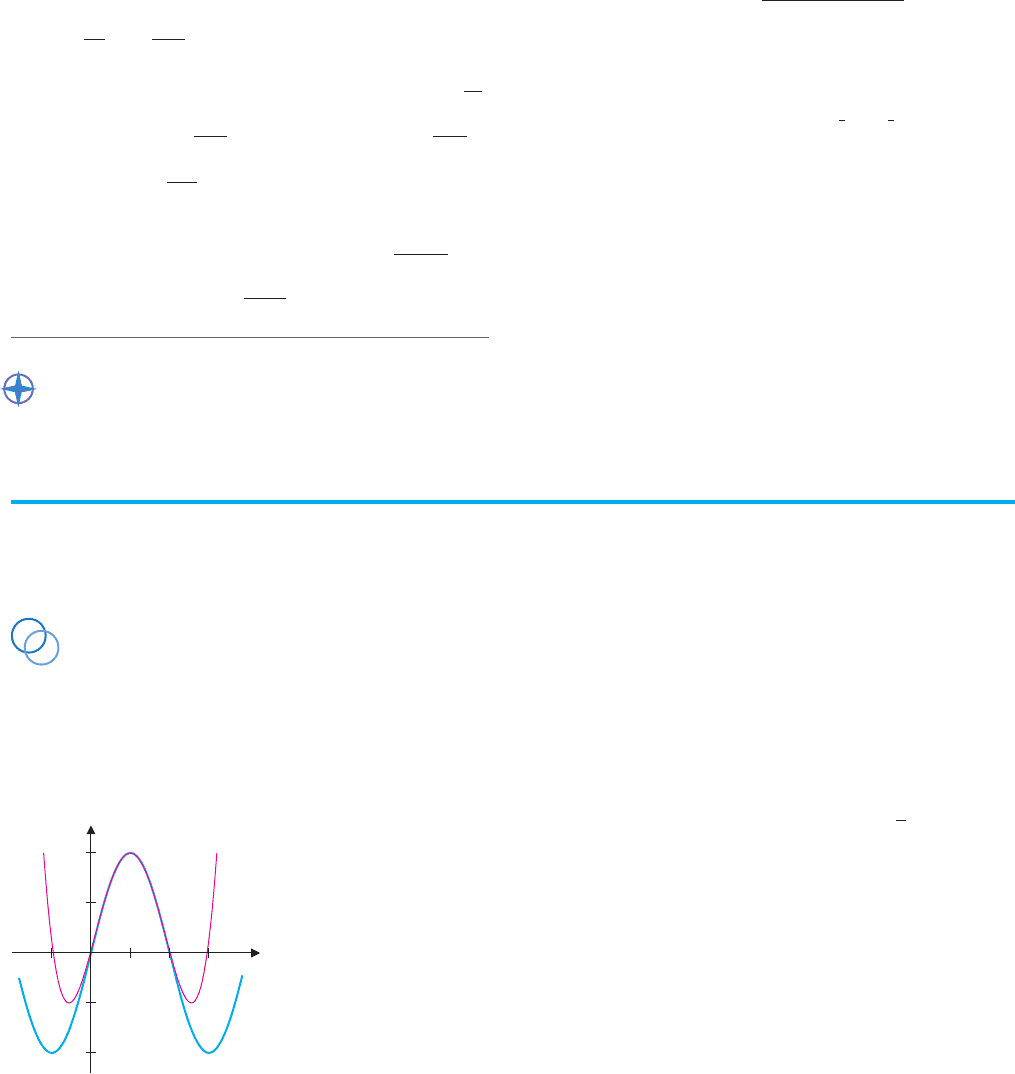
illustrated in Figure 9.44 for the case of f (x) = sin x expanded about x =
π
2
.
Because Taylor polynomials provide an accurate approximation only in the vicinity
of c, we say that they are accurate locally. In many situations, notably in communications,
we need to find an approximation to a given periodic function that is valid globally (i.e.,
for all x). For this reason, we construct a different type of series expansion for periodic
functions, one where each of the terms in the expansion is periodic.
1
1
qq w
p
y sin x
y P
4
(x)
y
x
FIGURE 9.44
y = sin x and y = P
4
(x)
Recall that we say that a function f is periodic of period T > 0if f (x + T ) = f (x),
for all x in the domain of f. The most familiar periodic functions are sin x and cos x, which
are both periodic of period 2π. Further, sin(2x), cos(2x), sin(3x), cos(3x) and so on are all
periodic of period 2π. In fact,
sin(kx) and cos(kx), for k = 1, 2, 3,...
are all periodic of period 2π , as follows. For any integer k, let f (x) = sin(kx). We then
have
f (x +2π) = sin[k(x +2π)] = sin(kx +2kπ) = sin(kx) = f (x).
Likewise, you can show that cos(kx) has period 2π.
So, if you wanted to expand a periodic function of period 2π in a series, you might
consider a series each of whose terms has period 2π, for instance,

P1: OSO/OVY P2: OSO/OVY QC: OSO/OVY T1: OSO
MHDQ256-Ch09 MHDQ256-Smith-v1.cls December 17, 2010 19:47
LT (Late Transcendental)
CONFIRMING PAGES
608 CHAPTER 9
..
Infinite Series 9-78
FOURIER SERIES
a
0
2
+
∞
k=1
[a
k
cos(kx) + b
k
sin(kx)],
called a Fourier series. Notice that if the series converges, it will converge to a periodic
function of period 2π, since every term in the series has period 2π. The coefficients of
the series, a
0
, a
1
, a
2
,...and b
1
, b
2
,...,are called the Fourier coefficients. You may have
noticed the unusual way in which we wrote the leading term of the series
a
0
2
. We did this
in order to simplify the formulas for computing these coefficients, as we’ll see later.
HISTORICAL
NOTES
Jean Baptiste Joseph Fourier
(1768 –1830) French
mathematician who invented
Fourier series. Fourier was
heavily involved in French politics,
becoming a member of the
Revolutionary Committee, serving
as scientific advisor to Napoleon
and establishing educational
facilities in Egypt. Fourier held
numerous offices, including
secretary of the Cairo Institute
and Prefect of Grenoble. Fourier
introduced his trigonometric
series as an essential technique
for developing his highly original
and revolutionary theory of heat.
There are a number of important questions we must address.
r
What functions can be expanded in a Fourier series?
r
How do we compute the Fourier coefficients?
r
Does the Fourier series converge? If so, to what function does the series converge?
We begin our investigation much as we did with power series. Suppose that a given
Fourier series converges on the interval [−π, π]. It then represents a function f on that
interval,
f (x) =
a
0
2
+
∞
k=1
[a
k
cos(kx) + b
k
sin(kx)], (9.1)
where f must be periodic outside of [−π, π]. Although some of the details of the proof
are beyond the level of this course, we want to give you some idea of how the Fourier
coefficients are computed. If we integrate both sides of equation (9.1) with respect to x on
the interval [−π,π], we get
π
−π
f (x) dx =
π
−π
a
0
2
dx +
π
−π
∞
k=1
[a
k
cos(kx) + b
k
sin(kx)]dx
=
π
−π
a
0
2
dx +
∞
k=1
a
k
π
−π
cos(kx)dx +b
k
π
−π
sin(kx)dx
, (9.2)
assuming we can interchange the order of integration and summation. [In general, the order
may not be interchanged (this is beyond the level of this course), but for many Fourier
series, doing so is permissible.] Observe that for every k = 1, 2, 3,...,we have
π
−π
cos(kx)dx =
1
k
sin(kx)
π
−π
=
1
k
[sin(kπ ) −sin(−kπ )] = 0
and
π
−π
sin(kx)dx =−
1
k
cos(kx)
π
−π
=−
1
k
[cos(kπ ) −cos(−kπ )] = 0.
This reduces equation (9.2) to simply
π
−π
f (x) dx =
π
−π
a
0
2
dx = a
0
π.
Solving this for a
0
,wehave
a
0
=
1
π
π
−π
f (x) dx. (9.3)

P1: OSO/OVY P2: OSO/OVY QC: OSO/OVY T1: OSO
MHDQ256-Ch09 MHDQ256-Smith-v1.cls December 17, 2010 19:47
LT (Late Transcendental)
CONFIRMING PAGES
9-79 SECTION 9.9
..
Fourier Series 609
Similarly, if we multiply both sides of equation (9.1) by cos(nx) (where n is an integer,
n ≥ 1) and then integrate with respect to x on the interval [−π, π], we get
π
−π
f (x) cos(nx)dx
=
π
−π
a
0
2
cos(nx) dx
+
π
−π
∞
k=1
[a
k
cos(kx)cos(nx) + b
k
sin(kx)cos(nx)]dx
=
a
0
2
π
−π
cos(nx) dx
+
∞
k=1
a
k
π
−π
cos(kx)cos(nx)dx +b
k
π
−π
sin(kx)cos(nx)dx
, (9.4)
againassuming we can interchange the orderof integrationandsummation. Next,recallthat
π
−π
cos(nx) dx = 0, for all n = 1, 2,....
It’s a straightforward, yet lengthy exercise to show that
π
−π
sin(kx)cos(nx)dx = 0, for all n = 1, 2,... and for all k = 1, 2,...
and that
π
−π
cos(kx)cos(nx)dx =
0, if n = k
π, if n = k
.
Notice that this says that every term in the series in equation (9.4) except one (the term
corresponding to k = n) is zero and equation (9.4) reduces to simply
π
−π
f (x) cos(nx) dx = a
n
π.
This gives us (after substituting k for n)
Fourier coefficients
a
k
=
1
π
π
−π
f (x) cos(kx) dx, for k = 1, 2, 3,.... (9.5)
Similarly, multiplying both sides of equation (9.1) by sin(nx) and integrating from −π to
π leads us to
b
k
=
1
π
π
−π
f (x) sin(kx) dx, for k = 1, 2, 3,.... (9.6)
Equations(9.3),(9.5) and (9.6) are called the Euler-Fourier formulas. Notice that equation
(9.3) is the same as (9.5) with k = 0. (This was the reason we chose the leading term of the
series to be
a
0
2
, instead of simply a
0
.)
To summarize what we’ve done so far, we have observed that if a Fourier series
converges on the interval [−π, π], then it converges to a function f where the Fourier
coefficients satisfy the Euler-Fourier formulas (9.3), (9.5) and (9.6).
Certainly, given many functions f, we can compute the coefficients in (9.3), (9.5) and
(9.6) and write down a Fourier series. But, will the series converge and if it does, to what
function will it converge? We’ll answer these questions shortly. For the moment, we simply
compute a Fourier series to see what we can observe.
P1: OSO/OVY P2: OSO/OVY QC: OSO/OVY T1: OSO
MHDQ256-Ch09 MHDQ256-Smith-v1.cls December 17, 2010 19:47
LT (Late Transcendental)
CONFIRMING PAGES
610 CHAPTER 9
..
Infinite Series 9-80
EXAMPLE 9.1 Finding a Fourier Series Expansion
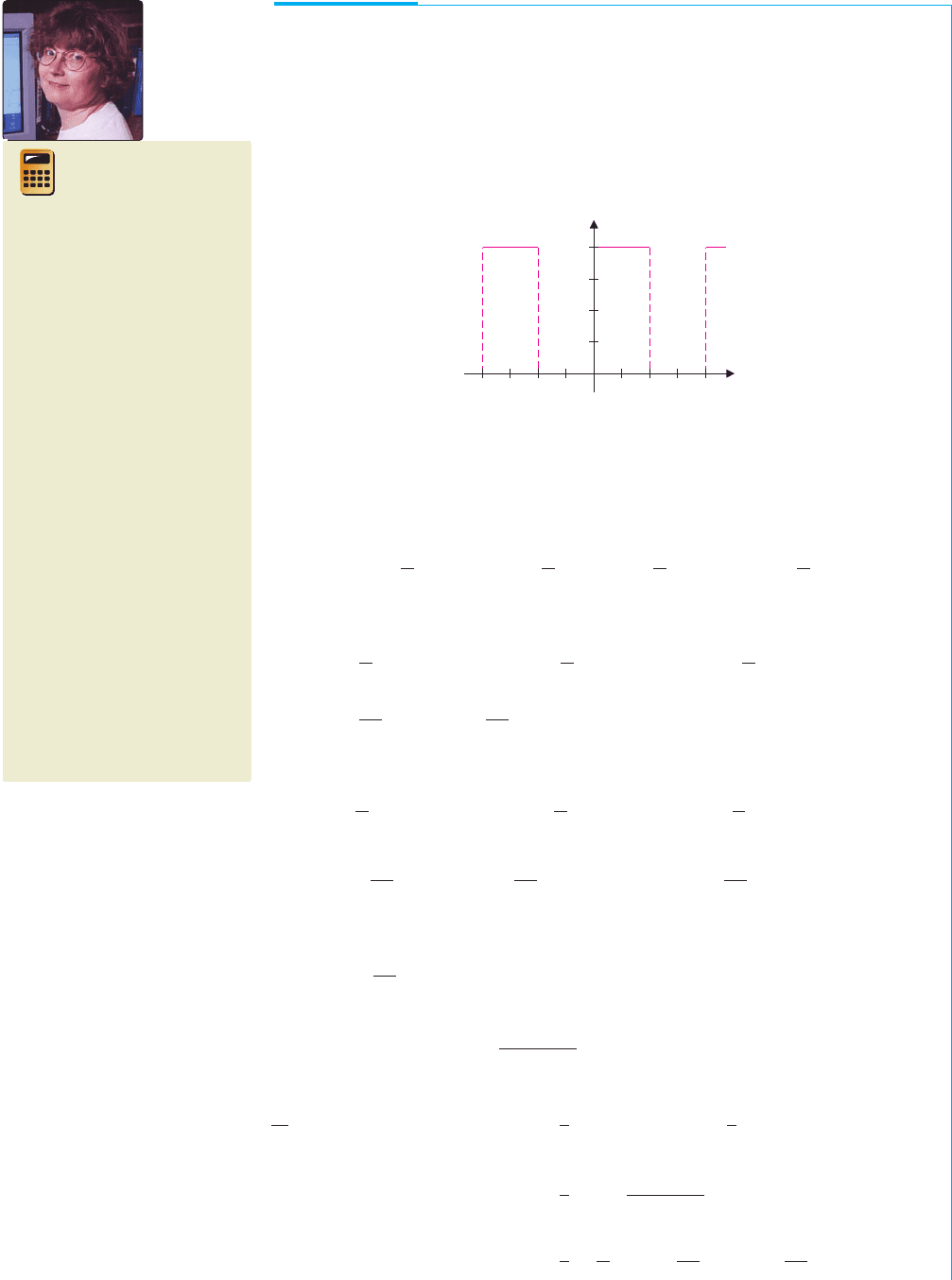
Find the Fourier series corresponding to the square-wave function
f (x) =
0, if −π<x ≤ 0
1, if 0 < x ≤ π
,
where f is assumed to be periodic outside of the interval [−π, π]. (See the graph in
Figure 9.45.)
TODAY IN
MATHEMATICS
Ingrid Daubechies (1954– )
A Belgian physicist and
mathematician who pioneered
the use of wavelets, which extend
the ideas of Fourier series. In a
talk on the relationship between
algorithms and analysis, she
explained that her wavelet
research was of a type
“stimulated by the requirements
of engineering design rather than
natural science problems, but
equally interesting and possibly
far-reaching.” To meet the needs
of an efficient image compression
algorithm, she created the
first continuous wavelet
corresponding to a fast algorithm.
The Daubechies wavelets are
now the most commonly used
wavelets in applications and were
instrumental in the explosion of
wavelet applications in areas as
diverse as FBI fingerprinting,
magnetic resonance imaging
(MRI) and digital storage formats
such as JPEG-2000.
y
x
1
0.5
2p2p pp
FIGURE 9.45
Square-wave function
Solution Even though a
0
satisfies the same formula as a
k
for k ≥ 1, we must always
compute a
0
separately from the rest of the a
k
’s. From equation (9.3), we get
a
0
=
1
π
π
−π
f (x) dx =
1
π
0
−π
0dx +
1
π
π
0
1dx = 0 +
π
π
= 1.
From (9.5), we also have that for k ≥ 1,
a
k
=
1
π
π
−π
f (x) cos(kx) dx =
1
π
0
−π
(0)cos(kx) dx +
1
π
π
0
(1)cos(kx) dx
=
1
πk
sin(kx)
π
0
=
1
πk
[sin(kπ ) −sin(0)] = 0.
Finally, from (9.6), we have
b
k
=
1
π
π
−π
f (x) sin(kx) dx =
1
π
0
−π
(0)sin(kx) dx +
1
π
π
0
(1)sin(kx) dx
=−
1
πk
cos(kx)
π
0
=−
1
πk
[cos(kπ ) −cos(0)] =−
1
πk
[(−1)
k
− 1]
=
⎧
⎨
⎩
0, if k is even
2
πk
, if k is odd
.
Notice that we can write the even- and odd-indexed coefficients separately as b
2k
= 0,
for k = 1, 2,...and b
2k−1
=
2
(2k − 1)π
, for k = 1, 2,....We then have the Fourier
series
a
0
2
+
∞
k=1
[a
k
cos(kx) + b
k
sin(kx)] =
1
2
+
∞
k=1
b
k
sin(kx) =
1
2
+
∞
k=1
b
2k−1
sin[(2k −1)x]
=
1
2
+
∞
k=1
2
(2k − 1)π
sin[(2k − 1)x]
=
1
2
+
2
π
sin x +
2
3π
sin(3x) +
2
5π
sin(5x) +···.
P1: OSO/OVY P2: OSO/OVY QC: OSO/OVY T1: OSO
MHDQ256-Ch09 MHDQ256-Smith-v1.cls December 17, 2010 19:47
LT (Late Transcendental)
CONFIRMING PAGES
9-81 SECTION 9.9
..
Fourier Series 611
Unfortunately, none of our existing convergence tests apply to this series. Instead, we
consider the graphs of the first few partial sums of the series defined by
F
n
(x) =
1
2
+
n
k=1
2
(2k − 1)π
sin[(2k − 1)x].
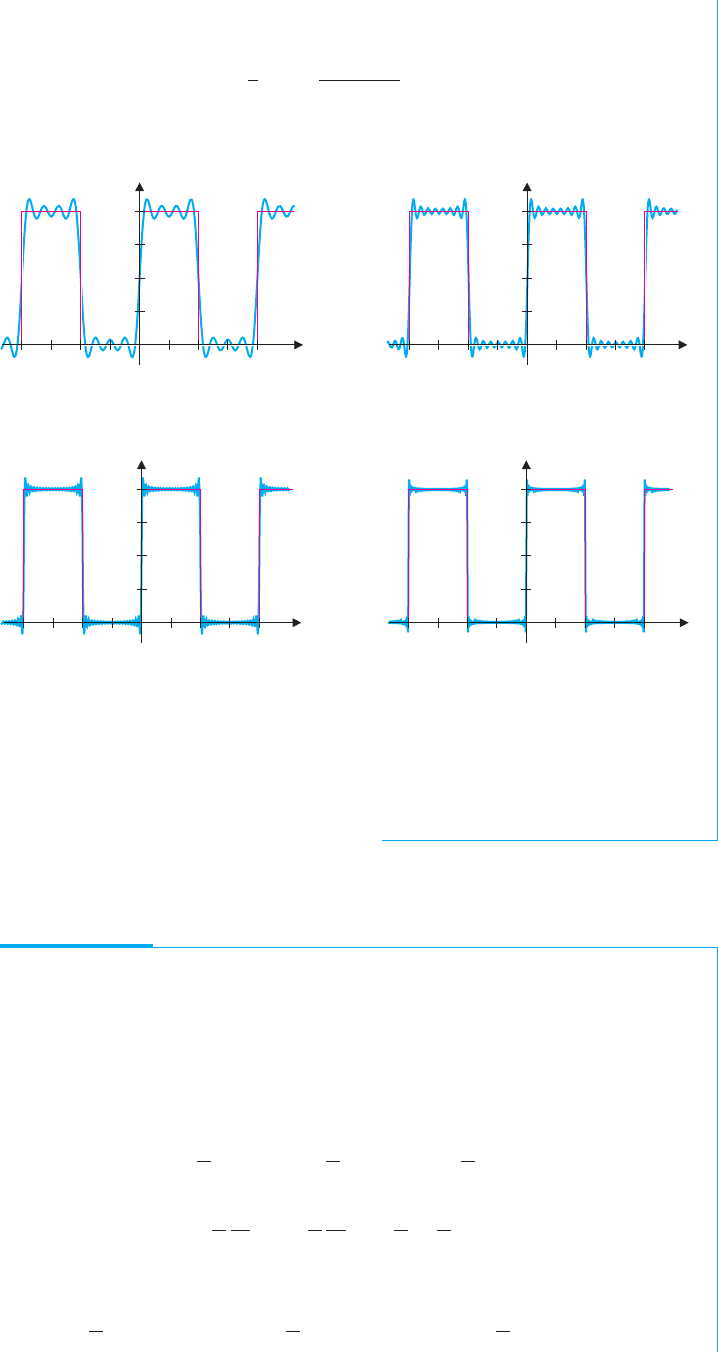
In Figures 9.46a–d, we graph a number of these partial sums.
y
x
1
0.5
pp 2p2p
y
x
1
0.5
pp 2p2p
FIGURE 9.46a
y = F
4
(x) and y = f (x)
FIGURE 9.46b
y = F
8
(x) and y = f (x)
y
x
1
0.5
pp 2p2p
y
x
1
0.5
pp 2p2p
FIGURE 9.46c
y = F
20
(x) and y = f (x)
FIGURE 9.46d
y = F
50
(x) and y = f (x)
Notice that as n gets larger and larger, the graph of F
n
(x) appears to be approaching the
graph of the square-wave function f (x) shown in red and seen in Figure 9.45. Based on
this, we might conjecture that the Fourier series converges to the function f (x). As it
turns out, this is not quite correct. We’ll soon see that the series converges to f (x)
everywhere, except at points of discontinuity.
Next, we give an example of constructing a Fourier series for another common
waveform.
EXAMPLE 9.2 A Fourier Series Expansion
for the Triangular-Wave Function
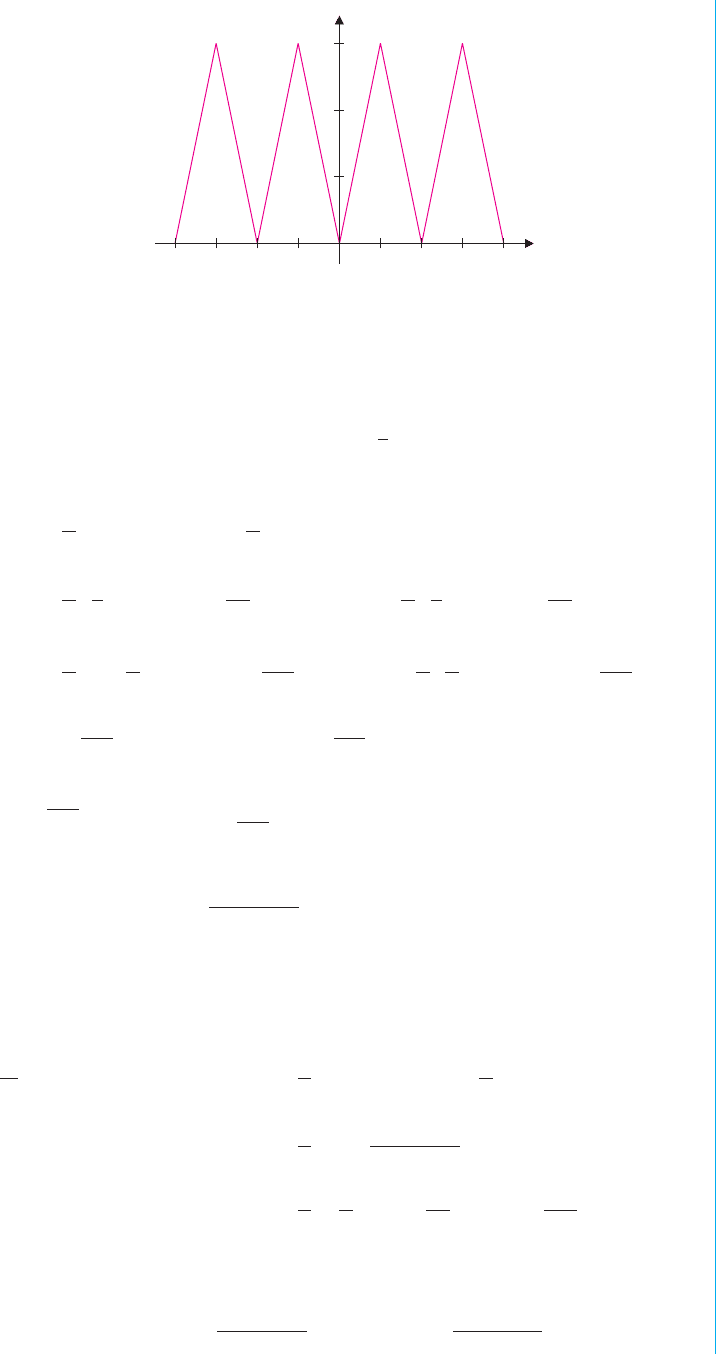
Find the Fourier series expansion of f (x) =|x|, for −π ≤ x ≤ π, where f is assumed
to be periodic, of period 2π, outside of the interval [−π, π].
Solution In this case, f is the triangular-wave function graphed in Figure 9.47
(on the following page). From the Euler-Fourier formulas, we have
a
0
=
1
π
π
−π
|x|dx =
1
π
0
−π
−xdx+
1
π
π
0
xdx
=−
1
π
x
2
2
0
−π
+
1
π
x
2
2
π
0
=
π
2
+
π
2
= π.
Similarly, for each k ≥ 1, we get
a
k
=
1
π
π
−π
|x|cos(kx)dx =
1
π
0
−π
(−x)cos(kx) dx +
1
π
π
0
x cos(kx) dx.
P1: OSO/OVY P2: OSO/OVY QC: OSO/OVY T1: OSO
MHDQ256-Ch09 MHDQ256-Smith-v1.cls December 17, 2010 19:47
LT (Late Transcendental)
CONFIRMING PAGES
612 CHAPTER 9
..
Infinite Series 9-82
y
3
2
p 2pp2p3p4p 3p 4p
x
FIGURE 9.47
Triangular-wave function
Both integrals require the same integration by parts. We let
u = xdv = cos(kx) dx
du = dx v =
1
k
sin(kx)
so that
a
k
=−
1
π
0
−π
x cos(kx)dx +
1
π
π
0
x cos(kx)dx
=−
1
π
x
k
sin(kx)
0
−π
+
1
πk
0
−π
sin(kx)dx +
1
π
x
k
sin(kx)
π
0
−
1
πk
π
0
sin(kx)dx
=−
1
π
0 +
π
k
sin(−πk)
−
1
πk
2
cos(kx)
0
−π
+
1
π
π
k
sin(πk) −0
+
1
πk
2
cos(kx)
π
0
= 0 −
1
πk
2
[cos0 −cos(−kπ)] + 0 +
1
πk
2
[cos(kπ ) −cos0]
Since sinπk = 0
and sin(−πk) = 0.
=
2
πk
2
[cos(kπ ) −1] =
⎧
⎨
⎩
0, if k is even
−4
πk
2
, if k is odd
.
Since cos(kπ) = 1 when k is even, and
cos(kπ) =−1 when k is odd.
Writing the even- and odd-indexed coefficients separately, we have a
2k
= 0, for
k = 1, 2,...and a
2k−1
=
−4
π(2k − 1)
2
, for k = 1, 2,....We leave it as an exercise to
show that
b
k
= 0, for all k.
This gives us the Fourier series
a
0
2
+
∞
k=1
[a
k
cos(kx) + b
k
sin(kx)] =
π
2
+
∞
k=1
a
k
cos(kx) =
π
2
+
∞
k=1
a
2k−1
cos[(2k −1)x]
=
π
2
−
∞
k=1
4
π(2k − 1)
2
cos[(2k − 1)x]
=
π
2
−
4
π
cos x −
4
9π
cos(3x) −
4
25π
cos(5x) −···.
You can show that this series converges absolutely for all x, by using the Comparison
Test, since
|a
k
|=
4
π(2k − 1)
2
cos(2k − 1)x
≤
4
π(2k − 1)
2