
Takadoum J. Materials and Surface Engineering in Tribology
Подождите немного. Документ загружается.

Table of Contents
ix
2.7.1.5. Greases.................................. 94
2.7.1.6. Anti-friction materials......................... 94
2.8. Wear-corrosion: tribocorrosion and erosion-corrosion........... 98
2.8.1. Tribocorrosion................................ 99
2.8.2. Erosion-corrosion..............................106
Chapter 3. Materials for Tribology .......................... 109
3.1. Introduction..................................... 109
3.2. Bulk materials................................... 110
3.2.1. Metallic materials ..............................110
3.2.1.1. Iron-based alloys............................110
3.2.1.2. Superalloys...............................112
3.2.1.3. Copper-based alloys.......................... 113
3.2.2. Polymers ...................................113
3.2.2.1. High-density polyethylene......................115
3.2.2.2. Fluorinated polymers.........................115
3.2.2.3. Polyacetal (polyoxymethylene: POM) and polyamide......116
3.2.2.4. Polyimide................................116
3.2.2.5. Polyetheretherketone (PEEK).................... 116
3.2.2.6. Friction and wear of polymers....................117
3.2.2.7. Surface treatment of polymers....................118
3.2.3. Composites..................................120
3.2.3.1. Friction materials............................121
3.2.4. Ceramics ...................................121
3.2.4.1. Friction and wear of ceramics....................126
3.2.5. Cermets....................................131
3.2.5.1. Tungsten-carbide (WC)-based cermets............... 132
3.2.5.2. Other carbide-based cermets.....................133
3.3. Surface treatments and coatings......................... 133
3.3.1. Conversion techniques ...........................134
3.3.1.1. Anodic oxidation............................ 134
3.3.1.2. Ion implantation............................137
3.3.1.3. Ion beam mixing............................142
3.3.1.4. Thermochemical treatment...................... 143
3.3.1.5. Transformation hardening ......................143
3.3.1.6. Mechanical treatment.........................144
3.3.2. Deposition techniques............................ 146
3.3.2.1. Thermal projection techniques....................147
3.3.2.2. Liquid-phase deposition techniques.................148
3.3.2.3. Vapor-phase deposition techniques ................. 154
3.4. Hard anti-wear and decorative coatings....................166
Materials and Surface Engineering in Tribology
x
3.4.1. Hard anti-wear coatings...........................166
3.4.1.1. Transition metal nitrides .......................166
3.4.1.2. Carbon-based films ..........................171
3.4.1.3. The role of the substrate........................173
3.4.2. Decorative coatings.............................174
3.5. Characterization of coatings : hardness, adherence and internal
stresses..........................................178
3.5.1. Hardness....................................178
3.5.1.1. The indentation size effect......................179
3.5.1.2. Hardness tests for coated materials.................180
3.5.2. Coating adhesion............................... 190
3.5.2.1. Methods for adherence testing....................192
3.5.3. Residual stresses in coatings........................201
3.5.3.1. Origin of internal stresses.......................201
3.5.3.2. Determining residual stresses upon X-ray diffraction......202
3.5.3.3. Determining internal stresses by radius of curvature
measurements (Stoney’s method) .......................202
Bibliography ........................................205
Index .............................................223
Foreword
Tribology is an old science, yet one that remains under active development.
Friction between solids was first measured as early as the Renaissance by Leonardo
da Vinci who discovered (and recorded in his notebooks) some extraordinary results.
Leonardo’s laws were subsequently rediscovered by the Frenchman Amontons in
the 18th
century. However, another 150 years elapsed before they were completely
understood thanks to the efforts of the English school led by David Tabor in
Cambridge.
Since the early 20th century, we have learnt to reduce friction wear in engines by
combining oils with an increasing range of smart additives such as surfactants and
polymers. We now have a fair understanding of the adhesion and friction of a tyre
on the road, even in wet conditions. We are also able to manufacture rather efficient
brakes, albeit by unsophisticated techniques at times (such as with the braking of a
high-speed TGV on its tracks using a sand discharge in front of the wheels).
However, new questions are emerging; for example, we poorly understand such
phenomena as the onset of earthquakes. To probe surfaces in the laboratory, we have
access to highly innovative instrumentation such as the force microscope. We also
have powerful simulation tools. Ultimately, from the practical point of view, a
whole range of new materials is now available allowing us to reduce friction while
at the same time minimizing wear.
It is essential that this know-how be made available to students and practicing
engineers alike. In this regard, I find the present book particularly well suited to the
needs of both graduate students and professional workers in the field. I therefore
wish it every success!
P.-G. De Gennes
This page intentionally left blank
Preface
Derived from the Greek word tribos, meaning friction, the word tribology was
first used in 1966 in Great Britain to describe the scientific and technical domains
focused on the study of friction, wear and lubrication.
Tribology addresses such questions as: what is the best way to reduce wear and
control friction? What materials should be used? What lubricant should be chosen to
protect a motor or manufacture a particular component? What surface treatment
should be applied to improve the wear resistance and reliability of a mechanical
system?
Despite their apparent simplicity, the problems of tribology are in fact very
complex. They involve the bulk properties of materials as well as their microscopic
surface characteristics and their interaction with the surrounding environment.
By providing solutions in fields as diverse as car manufacturing and medical
prosthesis, tribology can have a significant economic and ecological impact. For
instance, if we can reduce friction in a motor, we reduce energy consumption and
limit pollution. If we can reduce the wear in a cutting tool, we both increase
productivity and improve the quality of manufactured products. If we can limit ball
bearing and gearbox wear, then we can increase the life-span and improve the
reliability of many different mechanical systems. If we can reduce friction in an
artificial hip, then we can avoid production of wear-particles that can induce
inflammation and cause serious complications such as osteolysis or even loosening
of the joint itself.
Because tribological phenomena are by nature complex, solving them requires a
multidisciplinary approach combining techniques derived from mechanics, solid-
state physics and surface chemistry. This sometimes makes it seem like a poorly
defined subject, and raises a number of challenges for effective teaching. The
Materials and Surface Engineering in Tribology
xiv
purpose of this book is therefore to make tribology comprehensively accessible, by
illustrating its principles and its applications through a variety of case studies taken
from the scientific as well as the industrial domains. In both its content and
structure, Materials and Surface Engineering in Tribology is designed to provide a
clear, synthetic overview of the field, and therefore serve as a reference book
suitable for students, researchers and engineers alike.
Materials and Surface Engineering in Tribology is divided into three chapters:
Chapter 1 introduces the notion of a surface in tribology where a solid surface is
described from the topographical, structural, mechanical and energetic points of
view. It also describes the principal techniques used to characterize and analyze
surfaces.
Chapter 2 discusses what may be called tribology proper by introducing and
describing the concepts of adhesion, friction, wear and lubrication.
Chapter 3 focuses on the materials used in tribology. We introduce the major
classes of materials used, either in their bulk states or as coatings, including both
hard-facing protective layers and other coatings used for decorative purposes.
Acknowledgements
I wish to express my thanks to (in alphabetical order) Patrice Berçot, Lamine
Boubakar, Bernard Cretin, Patrick Delobelle, John Dudley, Joseph Gavoille, Jan
Lintymer, Hamid Makich, Nicolas Martin, Christine Millot, Jean-François Pierson,
Claude Roques-Carmes and Hassan Zahouani for their contributions as proofreaders,
for helping with the preparation of figures or for providing resource materials.
Finally, I wish to thank the authors and publishers who granted me permission to
reproduce some figures from existing publications.
– Authors: Y. Berthier (Elsevier) [BERT 88, BERT 92], H. Pastor (SIRPE)
[PAST 87], S. Mischler (MRS) [BIE 00], F. Palmino (FEMTO-ST Dpt
LPMO) (Figure 1.14), A.C. Van Popta and J.M. Brett (SPIE) [VANP 04].
– Publishers: EDP Sciences [ADD 06], Elsevier [ABD 06, BUL 06, BUL 90,
BUR 87a, BUR 87b, CHI 96, GAV 02a, GAY 01, GROS 01, JON 84, LIM 87,
LIN 03, LIN 04, NEV 99, PIL 06, PIV 94, QUI 02, TAK 87, VOE 96], CNRS
Editions/Eyrolles [GEO 00], Société Française du Vide (SFV) [TER 96], Springer
[TAK 94b], the American Chemical Society [MART 95] and Wiley [BRU 03].
Chapter 1
Surfaces
1.1. Introduction
The surface of a solid delimits its volume and defines the region where
interactions with its environment occur.
When considering the structure of a crystalline material, the surface corresponds
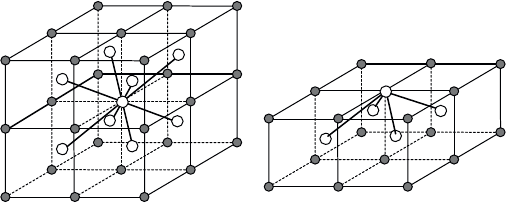
to a discontinuity in the periodic arrangement of atoms. The number of nearest
neighbors (8 for a body-centered cubic lattice, 12 for a hexagonal close-packed or
face-centered cubic lattice) is reduced for surface atoms, so that their vibrational
states, inter-atomic separations and associated electronic states are very different
from those of atoms within the solid’s interior [BOI 87] (see Figure 1.1).
a) b)
Figure 1.1. Centered cubic lattice showing the number of nearest neighbors
for an atom: a) within a solid; b) on its surface
2 Materials and Surface Engineering in Tribology
This difference between surface atoms and volume (or bulk) atoms allows us to
introduce the notions of an ideal surface and a realistic surface. An ideal surface is
defined only in terms of the topmost atomic layers spanning a dimension of only
several nanometers, whereas a realistic surface describes a region that extends
further below the outer surface, down to depths of several microns to several tens of
microns. The mechanical, physicochemical and structural properties of this region
differ noticeably from those of the material’s volume as well as those of the ideal
surface [PERR 87].
Because surface atoms possess a lower number of nearest neighbors, they are
involved in a smaller number of bonds and thus experience an asymmetric force
field. Indeed, these atoms interact only with other surface atoms and atoms situated
within the solid’s interior. This results in a certain number of dangling bonds,
directed towards the exterior of the solid, which allow the solid to interact with its
environment through the establishment of bonds aiming to re-establish the surface
atoms’ equilibrium.
The number of dangling bonds and the nature of their interactions with atoms or
molecules in the environment depend on the surface atom coordination and therefore
its crystallographic orientation. Each crystallographic plane (each grain in a
polycrystalline material) will therefore possess a specific reactivity and
physicochemical and mechanical properties different from those of other planes.
Passivation and gas adsorption kinetics, speed of corrosion, hardness, Young’s
modulus, surface energy and electron work function are all amongst the properties
that depend on the surface in this way [BERA 83, OUD 73].
1.2. The surface state
A surface can be characterized by its mechanical, physicochemical, topographic
or structural properties. The combination of these characteristics defines what we
refer to as the surface state.
1.2.1. Structural state of a surface
During shaping or machining processes, the contact between a surface and a
machining tool considerably modifies the crystalline structure of the superficial
surface layers through mechanical and thermal stresses.
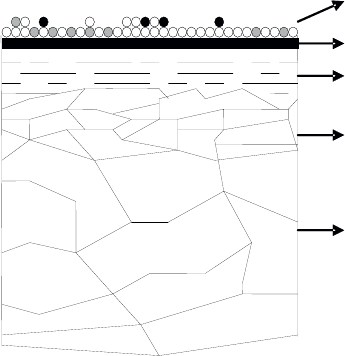
Figure 1.2 shows the cross-section of a surface presenting different zones or
layers:
(i) The first zone is a contamination zone consisting of a layer of adsorbed gases
such as water vapor, hydrocarbons and other atmospheric pollutants. This surface
layer extends to a depth of a few nanometers.
Surfaces 3
(ii) The second zone is made up of products arising from the interaction with the
environment and generally consists of oxides whose composition depends both on
the base metal and the environment.
(iii) The third zone corresponds to a material structure that has been significantly
“work-hardened” and where the crystalline matrix is essentially destroyed. This
layer, often referred to as the Beilby layer, extends to a depth of about one micron.
(iv) The fourth zone is one which has been mechanically deformed from the
accumulation of residual stresses. Its thickness ranges from several microns to
several tens of microns.
(v) The fifth zone corresponds to the unmodified structure of the original
material.
Figure 1.2. Visual representation of the different layers making up the surface of a material
1.2.2. Topographic state of a surface
It is important to distinguish the topographic state of the surface on the atomic
scale from its geometric state on the micrometer scale.
Modified crystalline
bulk microstructure (IV)
Work-hardened layer (III)
Oxide layer (II)
Contamination layer (I)
(adsorbed gases)
Crystalline bulk
microstructure (V)
4 Materials and Surface Engineering in Tribology
1.2.2.1. Atomic-scale topographic state [DES 87]
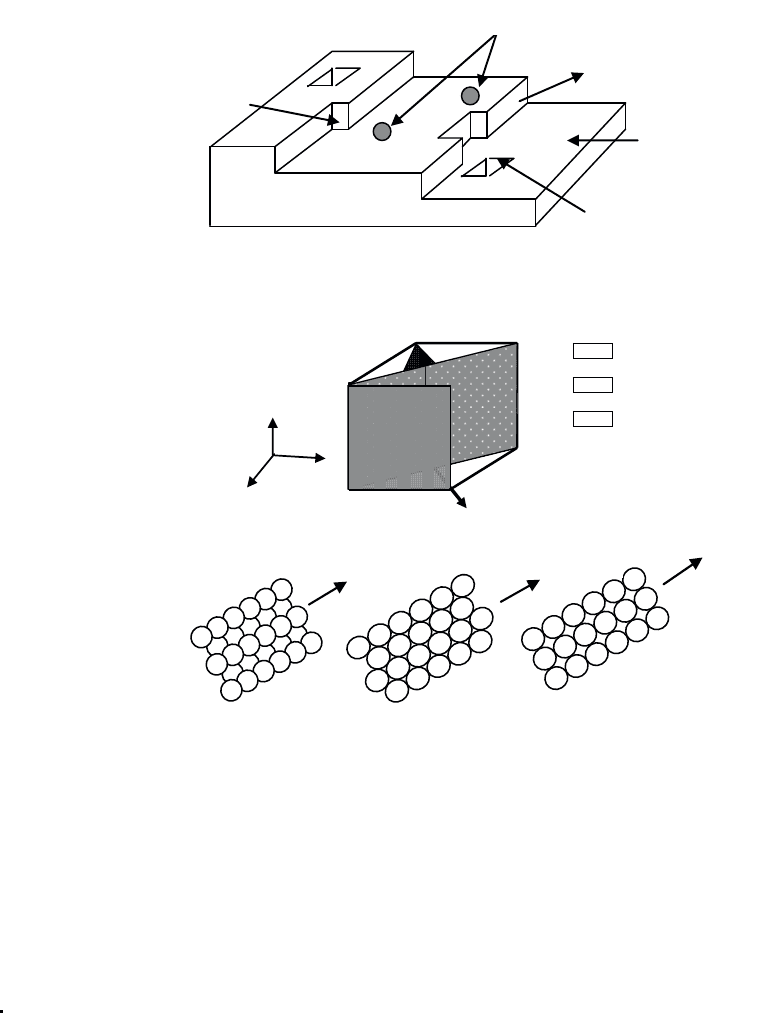
On the atomic scale, the surface appears as a series of steps/ledges and atomic
planes containing numerous point defects. This description of the surface is known
as the Terrace Ledge Kink (TLK) model illustrated in Figure 1.3. Moreover,
depending on their orientation, the crystallographic planes can appear more or less
smooth and therefore present varying degrees of roughness (see Figure 1.4).
Atomes adsorbés
Lacune
Cran
Marche
Terrasse
Adsorbed atoms
Kink
Monoatomic ledge
Terrace
A vacancy
Figure 1.3. Visual representation of atomic-scale defects on the surface of a solid
Z
Y
X
Plan (111)
Plan (100)
Plan (110)
Direction [110]
(111) plane
(110) plane
(100) plane
(
110
)
direction
_ _
Plan (110)
Plan (111)
Plan (100)
[011]
[110] [110]
(111) plane
(110) plane
(100) plane
Figure 1.4. a) Visual representation of several crystallographic planes of a face-centered
cubic lattice); b) the roughness of these planes differs
a)
b)