
Takadoum J. Materials and Surface Engineering in Tribology
Подождите немного. Документ загружается.

Surfaces 35
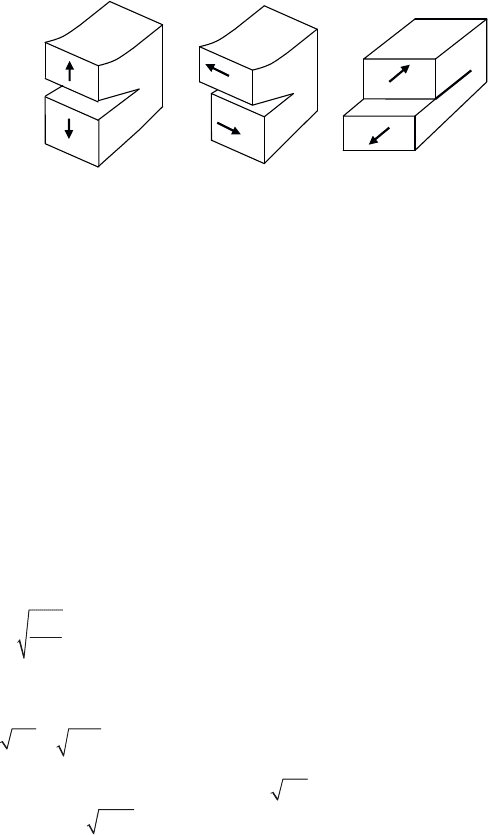
Type I Type II Type III
Figures 1.28. The different types of fractures
With brittle materials such as glass, minerals or ceramics, the energy of fracture
propagation corresponds to the work needed to break the bonds ensuring the
cohesion of the solid along a plane. The corresponding energy (W) is then equal to
double the surface energy (see equation [1.14]):
2W
J
[1.43]
If the energy released during the propagation of the fracture (due to the release of
elastic energy) is greater than or equal to that of the creation of a new crack surface
(due to the opening of the crack), then the fracture is able to propagate.
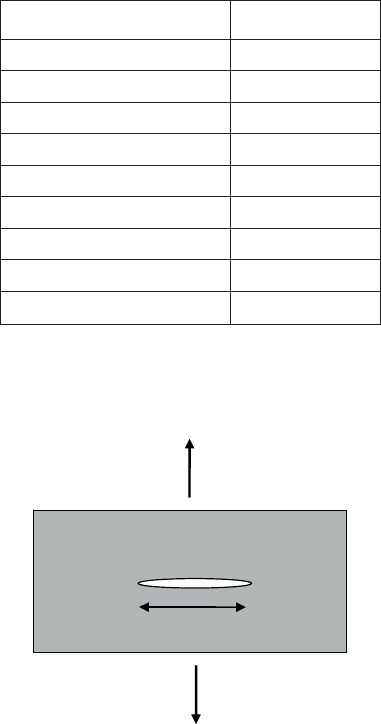
In the case of a material of Young’s modulus E with a fracture of length 2a (see
Figure 1.29) subject to stress ı, the condition for fracture propagation is:
2
E
a
J
V
S
t
[1.44]
This can also be written:
2aE
J
VS
t
[1.45]
The first term in this inequality
K
a
VS
is the stress intensity factor and the
second term
2Kc E
J
defines the fracture toughness, i.e. the amount of stress
required to propagate a pre-existing crack. Table 1.6 lists some values for fracture
toughness.
36 Materials and Surface Engineering in Tribology
Materials Kc (MPa m
–1/2
)
Aluminum oxide 5
Silicon carbide 3
Copper 200
Iron 160
Nickel 100
Aluminum 250
Polypropylene 3
High-density polyethylene 1
Low-density polyethylene 2.5
Table 1.6. Some values for fracture toughness
2a
ı
ı
Figure 1.29. Crack of length 2a within a material subject to stress ı
A pre-existing crack will propagate, leading to material failure, when K reaches
the critical value Kc. Kc is generally determined from impact tests on a single-edge
notch bend specimen. However, it can also be determined using Vickers indentation
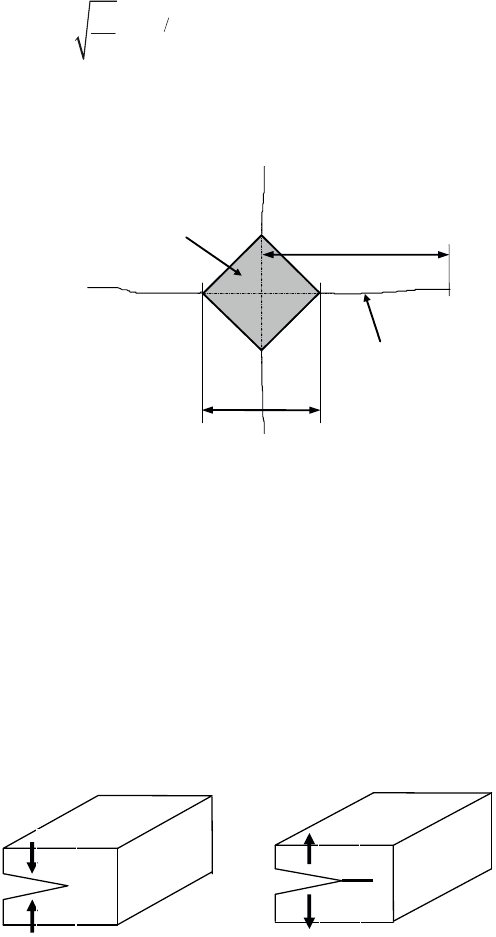
tests. Figure 1.30 shows the shape of an impression obtained on a brittle material.
The diagonal of the residual impression (D) allows the calculation of the material’s
hardness, while the length of the radial fracture (C) allows the calculation of fracture
toughness Kc using the following expression [ANS 81]:
Surfaces 37
32
0.016
E
Kc FC
H
[1.46]
where F is the applied load and E and H are the Young’s modulus and the Vickers
hardness for the material, respectively.
Figure 1.30. Vickers indentation of a brittle material
1.2.4.5. Residual stresses
Machining processes and different surface production processes induce, on the
superficial layers of materials, strains which generate internal “residual stresses”.
They can generally be classified into two classes: tension or compression stresses.
The first class is generally hazardous because they facilitate fracture propagation and
can cause breakup of materials and structures; conversely, the second class is
beneficial and indeed is often introduced deliberately through surface treatments
such as shot peening (see section 3.3.1.6) in order to harden the surface of a material
and improve its resistance to wear (see Figure 1.31).
ı
ı
ı
ı
a) b)
Figure 1.31. Effects of residual stresses (ı) on fractures: a) compression stress prevents
crack propagation; b) strain stress facilitates crack propagation
D
C
Fissure radiale
Empreinte
Indentation imprint
Radial crack
38 Materials and Surface Engineering in Tribology
Several experimental techniques allow the measurement of residual stress in
materials. A first class of so-called “destructive” techniques is based on the cutting-
away of some stressed material and the measuring of the resulting deformation in
the adjacent material as this is due to the relaxation of the residual stresses. A second
class of so-called “non-destructive” techniques is based on the analysis of the
modifications of the physical and crystallographic properties of the material induced
by residual stresses. Non-destructive techniques include the ultrasound method for
example, which uses the influence of residual stress on the variation of the
propagation speed of ultrasound waves; the so-called “Barkhausen” technique, based
on the interaction between elastic strain and magnetization (displacement of Bloch
walls) in ferromagnetic materials; and the method of X-ray diffraction which we will
now discuss in more detail.
1.2.4.5.1. Determination of residual stress by X-ray diffraction [MAC 86, MAE 88,
SPR 80]
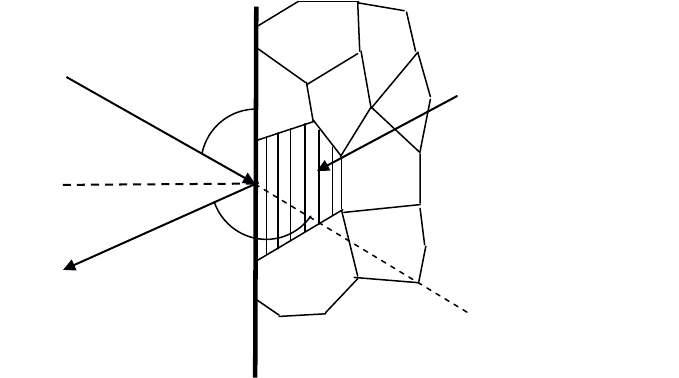
Crystalline networks are well-known to diffract X-rays when a family of
crystallographic planes of interplanar spacing d
hkl
(simply denoted d)
satisfies the
Bragg condition (see Figure 1.32):
2sind
TO
[1.47]
Figure 1.32. Principle of crystallographic X-ray diffraction
Famille de plans (hkl)
espacés de la distance d
hkl
2ș
Faisceau incident
Faisceau diffracté
ș
X-ray incident beam
Intereticular distance d
hkl
of the plane (hkl)
Diffracted beam
Surfaces 39
Differentiating this relation gives:
tan
d
d
T
T
''
[1.48]
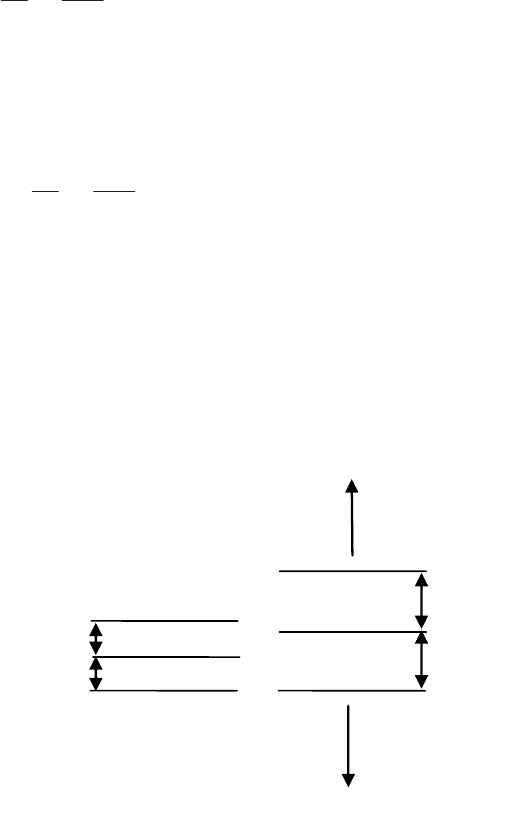
If the material is subjected to stress that induces lattice deformation by an
amount ǻd as shown in Figure 1.33, the relative strain may then be related to the
variation in the diffraction angle ș by the equation:
tan
d
d
T
H
T
''
[1.49]
We can therefore write:
22tan
THT
'
[1.50]
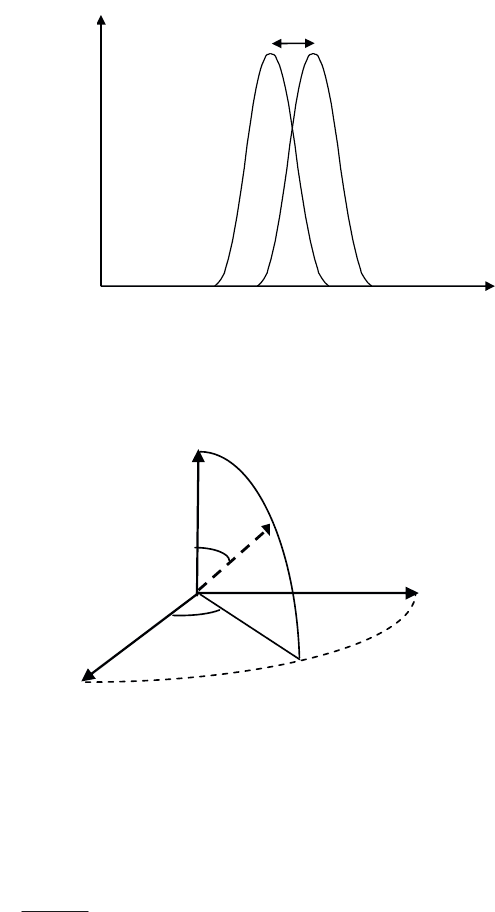
Equations [1.49] and [1.50] show that a variation of d will invariably induce a
variation of İ and, consequently, an angular displacement ǻ2ș of the diffraction
peak, as shown in Figure 1.34.
ı
ı
d
0
a)
d
0
+ ǻd
b)
Figure 1.33. Impact of tractive stress on lattice deformation:
a) unstrained crystalline network (interplanar spacing d
0
);
b) strained crystalline network (interplanar spacing d
0
+ ǻd)
40 Materials and Surface Engineering in Tribology
Figure 1.34. Displacement of the diffraction peak
The strain İ can be defined by its three components İ
1
, İ
2
, İ
3
(see Figure 1.35)
and will be denoted İ
ijȥ
.
İ
1
İ
2
İ
3
ij
ȥ
İ
ijȥ
Figure 1.35. Determination of strain İ
ijȥ
If d
0
is the interplanar spacing of the unstrained crystal and d
ȥ
is the interplanar
spacing after deformation, we can write:
0
0
dd
d
\
M\
H
[1.51]
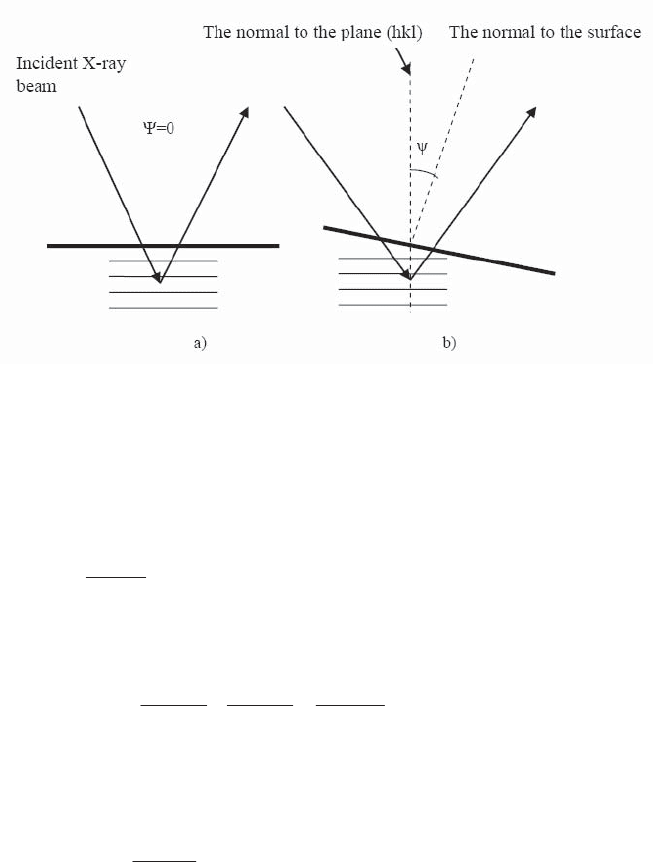
where ȥ is the angle between the normal to the sample surface and the normal to the
crystallographic planes that diffract the X-rays (see Figure 1.36).
ǻ2ș
Intensité
2 ș
Intensity
Surfaces 41
Figure 1.36. X-ray diffraction by planes (hkl): a) ȥ = 0; b) ȥ
z
0
When these two planes are parallel we have ȥ = 0, and if d
ŏ
is then the
interplanar spacing of the strained group of planes (hkl), the strain is given by:
0
0
dd
d
H
A
A
[1.52]
Equations [1.51] and [1.52] then yield:
0
0
00 0
dd dd
dd
dd d
\\
M\
HH
A
A
A
[1.53]
If the strain is small, we can write d
0
= d
ŏ
with negligible error. We can then
obtain:
dd
d
\
M\
HH
A
A
A
[1.54]
If we now use Hooke’s law, which allows us to express the strain in terms of the
stress, by assuming planar stresses (which is justified given the limited depth
analyzed by X-ray diffraction) the strain İ
ijȥ
can be written:
42 Materials and Surface Engineering in Tribology
2
12
1
sin
vv
EE
M\ M
HV\VV
[1.55]
where ı
1
, ı
2
and ı
ij
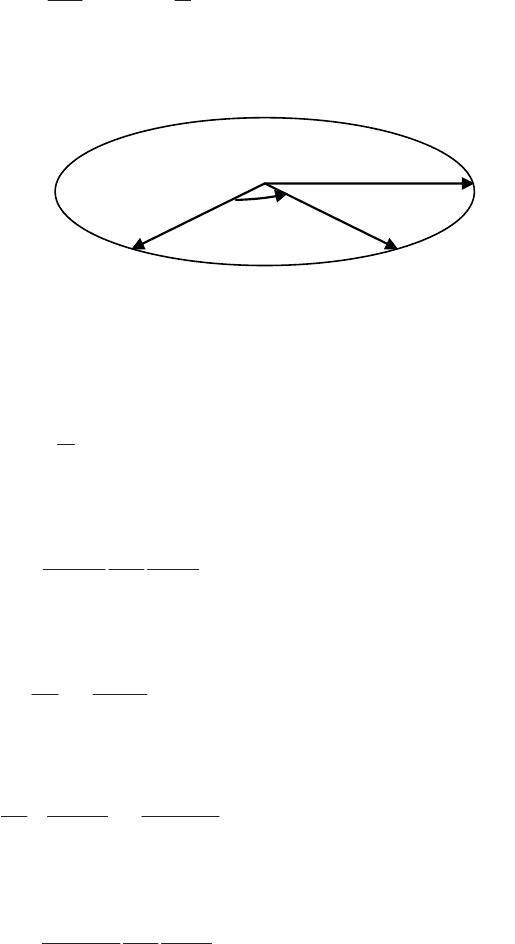
are defined in Figure 1.37.
ij
ı
1
ı
2
ı
ij
Figure 1.37. Definition of ı
ij
; stress ı
3
is null (state of plane stress)
If ȥ = 0, we can use equation [1.55] and the definition of İ
ŏ
to write:
12
v
E
HVV
A
[1.56]
If we combine equations [1.54], [1.55] and [1.56], we obtain:
2
1
1sin
dd
E
dv
\
M
V
\
A
A
[1.57]
Equation [1.49] then allows us to write:
2
2tan
d
d
T
H
T
''
[1.58]
It is therefore possible to obtain:
22
2tan
dd
d
dd
\\
TT
T
AA
AA
'
[1.59]
Equation [1.57] then becomes:
2
22
1
2tan 1 sin
E
v
\
M
TT
V
T\
A
A
[1.60]

Surfaces 43
We can write equation [1.60] in the form:
2
1
2 2 2 2 tan sin
E
\M
Q
TT T V T \
AA
'
[1.61]
Equation [1.61] is known as the “sin
2
ȥ method”. It gives the variation of '2ș as
a function of sin
2
ȥ in terms of a straight line that passes through the origin with a
slope that allows us to calculate the surface strain ı
ij
. Experimentally, to obtain ı
ij
,
ǻ2ș will have to be measured for two different angles ȥ. However, experience
shows that a minimum of five different values of ȥ is required to obtain sufficient
precision.
The limits of the X-ray diffraction method in determining internal stresses arise
directly from the hypotheses necessary to obtain the sin
2
ȥ method. The material
must be homogenous, continuous and isotropic, and the stresses must be elastic so
that the use of Hooke’s law is justified. The stresses and strains must also be
homogenous throughout the surface analyzed and the stress state needs to be biaxial,
implying that the normal stress ı
3
is zero [SPR 80].
When one or more of these requirements are not satisfied, significant deviations
are observed in relation to equation [1.61]. This is particularly true in the case of
strong anisotropy (as is the case with highly-textured materials) or for large grain
polycrystalline materials.
1.2.5. Chemical composition of a surface
The chemical composition of a surface can be characterized using a number of
different analysis techniques with the same underlying principle. Specifically, an
electronic, optical or ionic probe (the primary particle beam) is directed at the
surface under study and induces the emission of secondary or backscattered particles
(photons, electrons or ions). The characterization of these secondary particles (ion
mass, electron velocity, photon wavelength) allows the identification of the emitting
atom and the composition of the surface analyzed (see Figure 1.38). In addition to
these techniques, optically-based vibrational spectroscopy can allow the material
composition to be determined through analysis of molecular vibrations (infrared and
Raman spectroscopy).
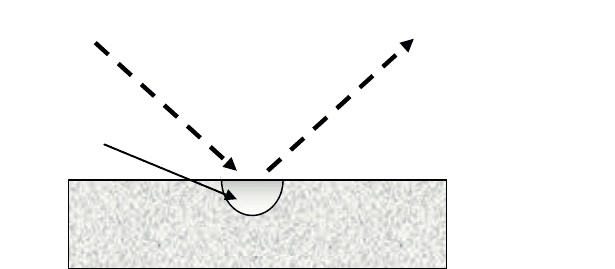
44 Materials and Surface Engineering in Tribology
Figure 1.38. Principle of spectroscopic surface analysis. Primary and secondary particles
are electrons, photons or ions. The characterization of secondary particles (through their
wavelength, speed, mass, etc.) enables us to define the nature of the emitting atom and
determine the sample’s composition
There has been extensive research in surface analysis techniques [AGI 90,
DAV 88, EBE 89]; here we provide a brief description of the most widely used
techniques in the field of material science.
1.2.5.1. Energy dispersive X-ray analysis
–
Primary particle: electron.
–
Secondary particle: photon.
–
Acronym: EDX.
–
Characteristics of the technique:
-
elemental analysis of materials to a depth of a few microns,
- possibility of generating X-ray images showing the distribution of elements,
- detection sensitivity in the range of 0.1–1 wt%, depending on the atomic
number, and
- not well-suited for light element analysis (Z < 11).
P
OSSIBLE APPLICATIONS Analysis of precipitation and segregation in metallurgical
materials and the characterization of thick thermal oxide films and hard anti-wear
and anti-corrosion coatings.
Zone d’interaction
Faisceau de particules primaires
Particules secondaires
(vers l’analyseur)
Matériau analysé
Beam of primary particles Secondary particles
(toward the analyzer)
Interaction zone
Material analyzed