
Takadoum J. Materials and Surface Engineering in Tribology
Подождите немного. Документ загружается.


Tribology 55
The load is distributed on a circular contact area of radius a:
3
a
4
FR
E
§
·
¨
¸
©
¹
1
3
·
¸
¹
[2.11]
where E is defined by:
22
12
12
111
EE E
QQ
[2.12]
where E
1
and E
2
are Young’s moduli and Q
1
and Q
2
correspond to Poisson’s
coefficients for the sphere and plane, respectively.
The pressure distribution on the contact area can be written:
2
0
1
r
PP
a
§·
¨¸
©¹
[2.13]
where r can take x-values ranging from a to –a (see Figure 2.5).
This expression shows that the contact pressure is zero at the edges and maximum at
the center. The maximum pressure P
0
(also called the Hertz pressure) is given by:
0
2
3
2
F
P
a
S
[2.14]
and it is 1.5 times greater than mean contact pressure P
m
:
2
m
F
P
a
S
[2.15]
Depending on the value of P
m
relative to the yield stress Y, the deformation will
be elastic, elastoplastic or plastic:
– for 0 P
m
< 1.1Y , we have truly elastic deformation;
– P
m
= 1.1Y corresponds to the threshold for initial plastification; and
– P
m
= 3Y corresponds to complete plastification.
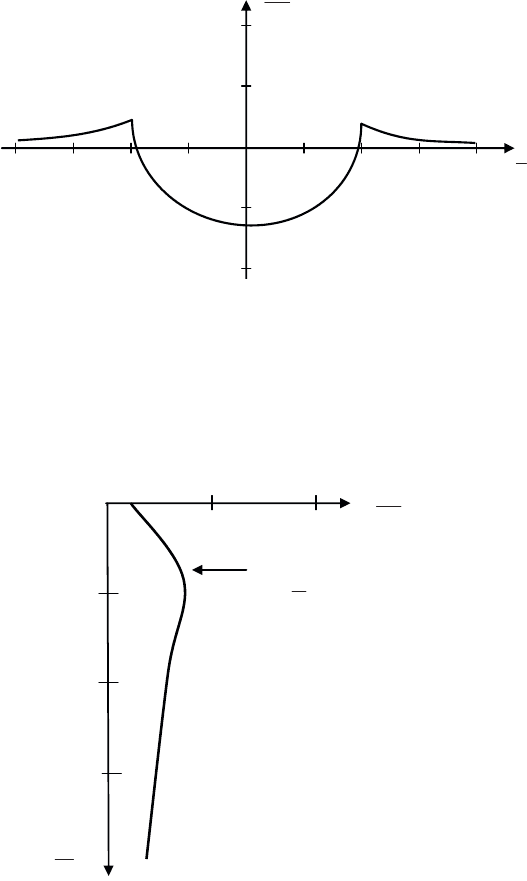
Figure 2.6 shows the surface distribution of stress ı
xx
(in the contact plane). The
stress is compressive within the contact region and tractive at its edges.
56 Materials and Surface Engineering in Tribology
Figure 2.6. Surface stress in a sphere-plane contact
Under the surface, along the z axis, the shear stress is maximal; IJ
max
= 0.31 P
0
at
the point z = 0.48a, as shown in Figure 2.7. It is at this point that the initial yielding
occurs.
1,5
0
p
W
Maximum de la contrainte de
cisaillement (IJ
max
) à
z
0, 48
a
0
0,5
0,5
1
1
a
z
1
0
0.5
0.5
1.5
1
Maximum shear stress (IJ
max
)
at
Z
0.48
a
Figure 2.7. Below-surface shear stress in the case of a sphere-plane contact
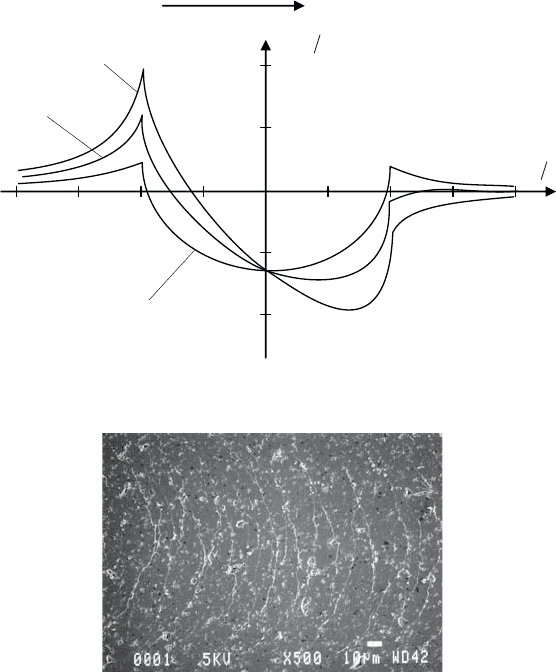
When a sphere slides on a plane, the distribution of stresses is significantly
modified. Figure 2.8 shows the new profile of the stress ı
xx
which loses its symmetry
-2 -1 1 2
0,5
1
-0,5
-1
x
a
xx
0
p
V
Tribology 57
and becomes a compressive stress at the front edge of the contact and a tensile stress at
the trailing edge of the contact. It is also clear that its amplitude grows sharply as a
function of the coefficient of friction μ and that it can lead, in the case of brittle
materials, to the development of characteristic, crescent-shaped cracks (see Figure
2.9).
-2.0 -1.0 1.0 2.0
0.5
1.0
-0.5
-1.0
xa
xx 0
pV
21
P!P
1
P!P
0P
Sliding direction of the sphere
Figure 2.8. Sliding of a sphere on a plane: alteration of surface stresses relative to friction
coefficient μ (static case i.e. μ = 0 and evolution after displacement with μ
2
>μ
1
>μ)
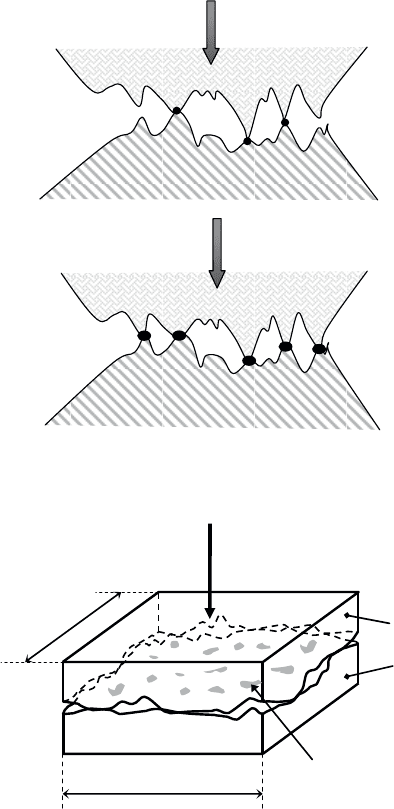
Figure 2.9. Crescent-shaped cracks on a SiC surface
after friction with a SiC sphere moved from right to left
2.3.2. The contact area
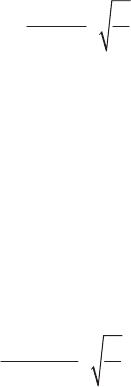
In the case of two plane rough surfaces placed in contact and subject to a normal
load F, contact occurs at points at the tips of the asperities, as shown in Figure 2.10a. If
the normal load is increased and replaced by a new force F' > F, new points of contact
58 Materials and Surface Engineering in Tribology
appear and the true contact area increases (see Figure 2.10b). This can be written A
r
=
Ȉ A
r(i)
(where A
r(i)
is the contact area between two asperities) and is very small with
respect to the apparent surface contact area (A
a
= XY), as shown in Figure 2.11. The
A
a
/A
r
ratio depends on the distribution of asperities, on the normal load and on the
yield stresses of the materials.
F
F’ > F
a)
b)
Figures 2.10. Two rough surfaces in contact under a) a load F and under b) F’ > F. When the
load increases, the number of asperities in contact also increases
F
X
Y
A
B
A
r(i)
Figure 2.11. Contact areas between two solids A and B: the apparent contact area (A
a
= XY)
and the true contact area (A
r
= Ȉ A
r(i)
)
Tribology 59
The apparent contact area is usually between 100 and 10,000 times greater than
the true contact area [BRI 92]. Note that during friction, this contact area changes,
both in terms of its total extent as well as its chemical and structural composition.
2.3.3. Plastification of asperities
For the case of a Gaussian distribution of asperities, the contact pressure is
expressed using [GRE 66]:
2
0.3
(1 )
E
P
V
QE
ªº
«»
¬¼
[2.16]
where ȕ is the mean radius of curvature of the (assumed spherical) asperities and ı
the standard deviation of their height distribution.
A plasticity index ȥ has been introduced in order to determine the limit between
elastic and plastic deformation of the asperities in contact. In the case of a Gaussian
distribution of asperities, this index is expressed as the product of two factors: the
first defines the mechanical properties of the materials whereas the second accounts
for the surfaces’ topographies
The plasticity index ȥ is written:
2
(1 )
E
H
V
\
QE
ªº
«»
¬¼
[2.17]
where E, H and Q represent the Young’s modulus, hardness and Poisson’s
coefficient for the softest material, respectively.
The nature of the deformation of the asperities depends on the value of Ȍ as
follows:
–
ȥ
1: plastic contact;
– 1 >
ȥ
0.6: elasto-plastic contact; and
–
ȥ
< 0.6: elastic contact.
2.3.4. Adhesive contact
The contact area, as calculated above based on Hertz’s theory (equation [2.11]),
does not take into account the forces of molecular attraction (mainly Van der Waals
60 Materials and Surface Engineering in Tribology
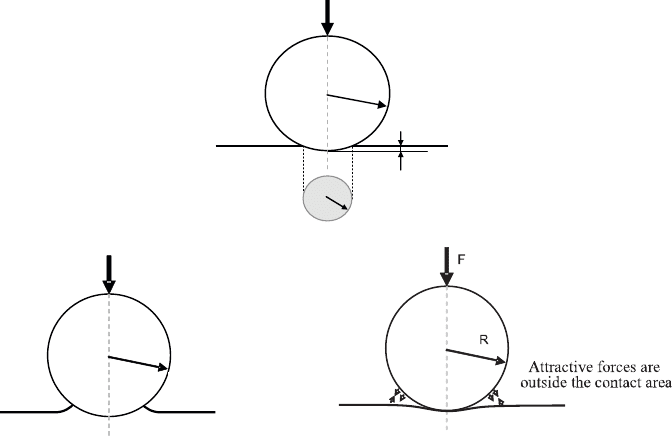
forces) which can noticeably modify its dimensions. Two models can be used to
calculate the new contact area (see Figure 2.12).
The first is the Johnson, Kendall and Roberts or JKR model [JOH 71]. It is based
on an energetic criterion and supposes the forces of attraction to be confined within
the contact area i.e. are zero outside it (Figure 2.12b).
The second is the Derjaguin, Muller and Toporov or DMT model [DER 75]. It
takes into account the attractive forces outside the contact area but supposes an
unmodified sphere-plane contact profile (Hertz-type contact) (Figure 2.12c).
R
a
F
G
a)
R
F
Attractive forces are within
the contact area
b) c)
Figure 2.12. a) Sphere-plane contact showing the penetration
G
̓̓of the sphere into the plane;
̓b) sphere-plane contact showing attractive forces confined to the contact area (JKR model);
c) Hertz contact with attractive forces outside of the contact area (DMT model)
Table 2.1 summarizes the main characteristics of the three types of sphere-plane
contacts: Hertz, JKR and DMT. Here, F
ad
refers to the adhesive force required to
break the contact, a is the radius of the contact area under load F (a
0
under zero
load), į is the total deformation (see Figure 2.12a), R is the sphere radius, F is the
normal applied load, W is the adhesive force between the sphere and the plane and
K is given by the relation:
Tribology 61
22
12
12
11
13
4KEE
QQ
§·
¨¸
©¹
[2.18]
Hertz
Contact
JKR Model DMT Model
F
ad
0
3
2
WR
S
2 WR
S
A
1
3
R
F
K
§·
¨¸
©¹
1
3
2
36(3)
R
FRW RWF RW
K
SS S
§·
¨¸
©¹
>@
1
3
2
R
FRW
K
S
§·
¨¸
©¹
a
0
0
1
2
3
6 WR
K
S
§·
¨¸
©¹
1
2
3
2 WR
K
S
§·
¨¸
©¹
G
2
a
R
2
26
3
aWa
R
K
S
2
a
R
Table 2.1. Some characteristic values for the sphere-plane contact
The JKR model is mainly valid for the case of high surface energy materials with
large contact areas (soft materials or large radius spheres, typically of a few mm),
whereas the DMT model is mostly valid in the case of hard materials of small radius
spheres and low surface energy.
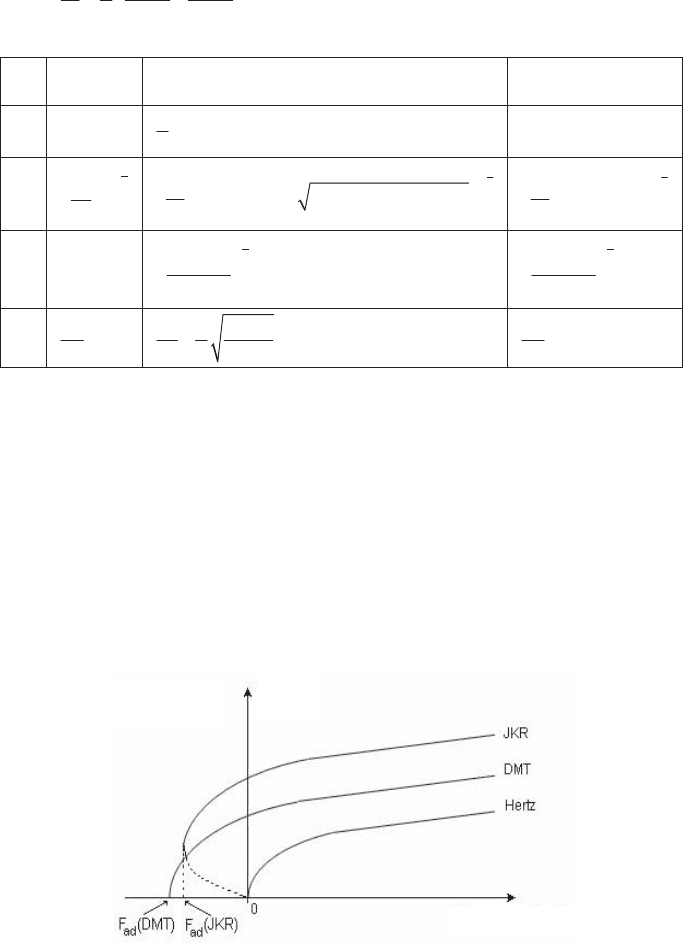
Figure 2.13 shows the evolution of the contact area between a sharp tip and a
plane surface as a function of the normal applied load. When this load is zero, the
contact area also becomes zero in the absence of surface forces (Hertz contact).
When surface forces are acting (JKR or DMT) we note that, even when the applied
load is zero or negative, the contact area always has a non-zero value.
Figure 2.13. Variation of the contact area as a function of the applied load: a
comparison of the three models Hertz, DMT and JKR
Applied load
Contact area
62 Materials and Surface Engineering in Tribology
Several authors have reported that the adhesive force due solely to surface forces
can be sufficient to induce plastification of the indented surface. Values ranging
from a few micronewtons to several tens of micronewtons have been recorded in a
vacuum between metallic surfaces [CHO 80, PAS 84, POL 77].
If Ȗ corresponds to the surface energy and we have two identical materials 1 and
2 (see section 1.2.3), we can write:
Ȗ
1
= Ȗ
2
= Ȗ and Ȗ
12
= 0 [2.19]
which allows us to write:
W = Ȗ
1
+ Ȗ
2
– Ȗ
12
= 2Ȗ [2.20]
Using equation [2.20] and the expressions for F
ad
(see Table 2.1), we therefore
have:
–
for the JKR model:
F
ad
= 3 ʌ Ȗ R [2.21]
–
and for the DMT model:
F
ad
= 4 ʌ Ȗ R [2.22]
It is therefore possible to determine the surface energy of the material by
carrying out experimental measurements of F
ad
(see section 2.5.2). However, this is
only possible if the separation force, which is negative here, is applied sufficiently
slowly to the contact in order to ensure reversible behavior. When the speed of
separation increases, visco-elastic losses can occur in the material (as has been
observed with rubber for example), which result in Ȗ values as high as 100 to 1,000
times those predicted by the laws of thermodynamics [PAS 84].
Finally, we note that the adhesive contact also depends on temperature and
duration of the contact between the materials [MAU 78, MAU 84].
2.4. Friction
2.4.1. The coefficient of friction
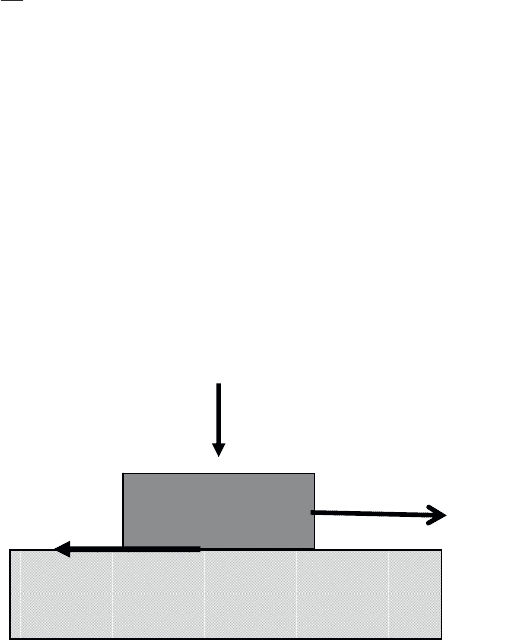
Consider a solid parallelepiped on a horizontal plane subject to a normal load F
n
.
We now progressively apply a force F parallel to the plane in order to set it into
motion and increase its speed (v) from 0 to V (see Figure 2.14). This displacement
will result in a friction force F
t
in the plane, in the opposite direction to the sliding
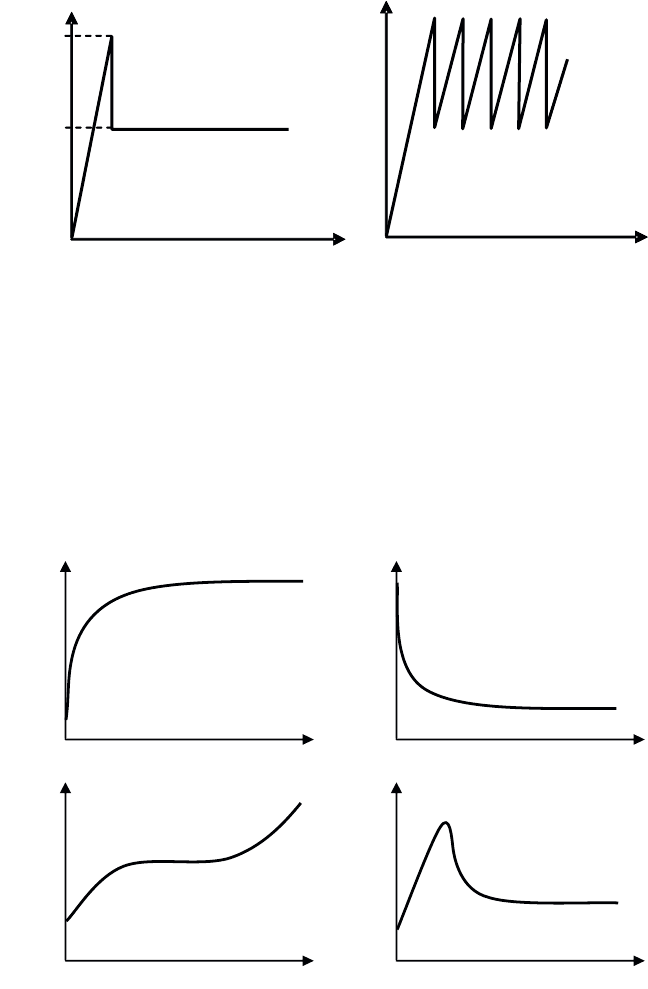
motion and opposing it. Figure 2.15a shows the temporal evolution of this force.
Tribology 63
Knowing F
n
and having determined F
t
experimentally, we can then calculate the
coefficient of friction μ which is defined by:
t
n
F
F
P
[2.23]
We note that the coefficient of static friction (
s
with F
t
= F
t(s)
) is distinct from
the coefficient of dynamic friction (
d
, with F
t
= F
t(d)
) as illustrated in Figure 2.15a:
–
F
t(s)
is the maximum force to be applied to set the solid into motion; and
–
F
t(d)
is the force applied to maintain this motion.
We often observe the evolution of the frictional force shown in Figure 2.15b.
This corresponds to the stick-slip phenomenon which results from a series of
adhesions and breakings of the contact at the contact points between opposing
surfaces (see Figure 2.11).
Figure 2.14. Definition of the tangential force F
t.
Interfacial friction is the origin of a solid’s resistance to sliding
F
n
Sens du
déplacement
F
t
Direction of sliding
64 Materials and Surface Engineering in Tribology
a) b)
Figure 2.15. Evolution of the friction force through time:
a) sliding without stick-slip; b) stick-slip sliding
Depending on the nature of the materials and the experimental conditions,
several different types of behavior can be observed as illustrated in Figure 2.16.
They result from chemical, topographical or structural modifications of the surfaces
in sliding contact and can include oxidation, allotropic phase transformation,
amorphization, crystallization, diffusion, melting, polishing or removal of material.
Figure 2.16. Examples of evolution of the friction force as a function of time
Time
Time
Friction coefficient
Friction coefficient
F
t
(
s
)
F
t
(
d
)
Temps Temps
Force de frottement
Temps
Force de frottement
Temps
Force de frottement
Force de frottement
Friction coefficient
Friction coefficient
Friction coefficient
Friction coefficient
Time Time
Time Time