
Takadoum J. Materials and Surface Engineering in Tribology
Подождите немного. Документ загружается.

Surfaces 25
Material
HV (or Shore D)
hardness
Aluminum oxide 2000
Silicon carbide 2700
Copper 108
Iron 145
Nickel 210
Aluminum 101
Polypropylene (70)
High-density
polyethylene
(66)
Low-density
polyethylene
(51)
Table 1.3. Some mean hardness values (they can vary according to the purity and
microstructure of materials); the Vickers scale is used for metals and ceramics hardness and
the Shore D hardness scale is used for polymers (in brackets)
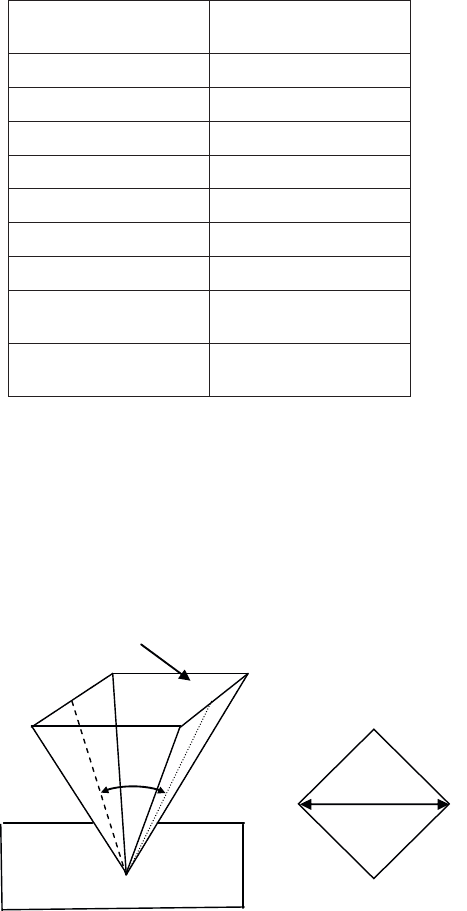
1.2.4.1.1. Vickers hardness
The indenter used is a diamond square-based pyramid with an angle of 136°
between opposite faces as shown in Figure 1.21.
Matériau testé
136 °
Empreinte
D
Vickers indenter
Indentation imprint
Tested material
a) b)
Figure 1.21. Vickers hardness test: a) square-based pyramidal Vickers indenter;
b) residual square indentation of diagonal D
26 Materials and Surface Engineering in Tribology
Vickers hardness is given by the formula:
2
1.854
F
HV
D
[1.30]
where F is the applied load (kg) and D is the diagonal of the residual indentation
(mm).
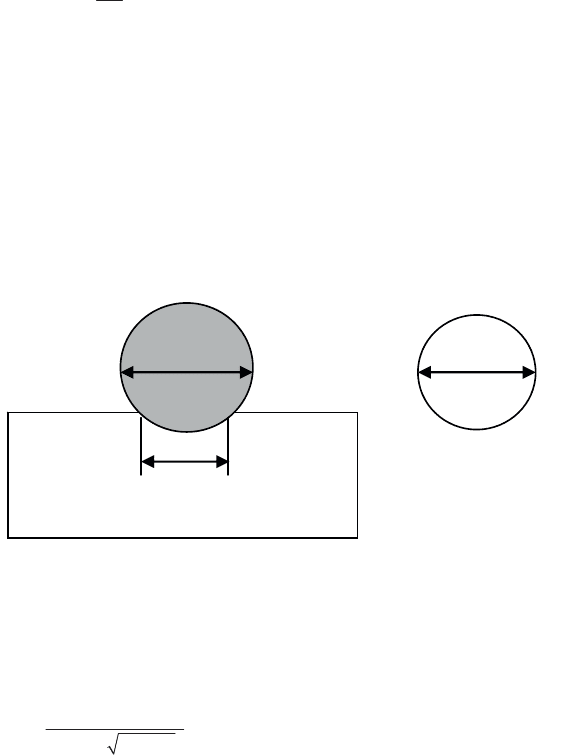
1.2.4.1.2. Brinell hardness
Brinell hardness is determined with tungsten carbide spherical indenters of 10, 5,
2.5 or 1 mm in diameter (see Figure 1.22).
a) b)
Figure 1.22. Brinell hardness test: a) Brinell indenter; b) residual impression
Brinell hardness can be expressed as follows:
HB =
22
0.204F
DD D d
S
[1.31]
where F is in newtons and both the diameter of the spherical indenter (D) and the
diameter of the residual impression (d) are in millimeters.
1.2.4.1.3. Rockwell hardness
When performing a Rockwell hardness test, it is the depth of the residual
indentation impression h, rather than its diameter, which is measured.
M
até
ri
au
testé
D
d
Indenteur Brinell
(sphère)
d
Empreinte
Tested material
Indentation imprint
Brinell indenter

Surfaces 27
We first apply a (minor) preliminary load of 98 N that forces the indenter into
the surface to a depth of l. This degree of penetration is not taken into account in the
hardness measurement, but is taken as the origin or zero penetration reference point.
We then apply a (major) normalized load to the surface for a few seconds
leading to a total penetration t. The major load is then reduced to the minor load and
the depth of the residual impression h is measured and given in millimeters.
With the Rockwell B test, we use a steel spherical indenter of diameter 1.58 mm
and a normal load of 980 N. With the Rockwell C test, the load is 1470 N and we
use a conical diamond indenter with radius of curvature of 0.2 mm and apex angle of
120°.
Both the Rockwell B and Rockwell C hardnesses can be written:
130
0.002
h
HRB
and
100
0.002
h
HRC
[1.32]
where h is measured in mm. The constant 0.002 has units in millimeters; therefore
the Rockwell hardness is a dimensionless number. It simply gives the ratio between
the depth of penetration of the indenter and the value of 0.002 mm, relative to an
arbitrary constant (130 for HRB hardness and 100 for HRC hardness).
1.2.4.1.4. Shore hardness
The Shore hardness test is specifically suited to polymers such as rubber,
thermoplastics or elastomers. The test is conducted with an apparatus called a
durometer and employs a calibrated spring that generates a known force on the
indenter. The apparatus records the penetration depth of the indenter and shows the
corresponding Shore hardness value on a scale graduated from 0 to 100 with these
values corresponding to maximum penetration and zero penetration (maximum
hardness), respectively.
There are two types of indenters:
1) a truncated cone with an apex angle of 35° (Shore A); and
2) a sharp cone with an apex angle of 30° (Shore D).
1.2.4.2. Young’s modulus
For an isotropic material, Young’s modulus is the constant of proportionality
between the stress applied to a rod and its elastic deformation. It is generally
obtained from uniaxial tensile tests but, as we will see later, it can also be
determined from indentation tests.
28 Materials and Surface Engineering in Tribology
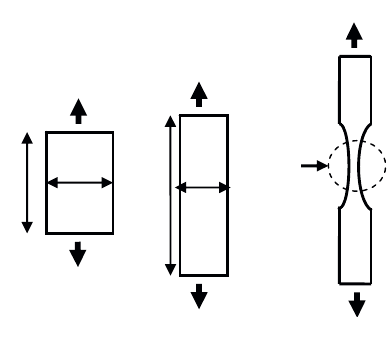
Consider a cylindrical rod of cross-sectional area S
0
and length L
0
to which we
apply a force F (see Figure 1.23). The stress ı = F/S
0
will vary as a function of the
strain İ = ǻL/L
0
following the classic curve shown in Figure 1.24. The stress ı =
F/S
0
and strain İ = ǻL/L
0
are both normalized relative to the initial dimensions (S
0
and L
0
) of the rod. The true stress true strain curve is obtained by considering the
true stress ı = F/S and the true strain İ = ǻL/L, where S and L represent the real
dimensions of the rod at any instant during the test. The true stress true strain curve
deviates from the classic stress–strain curve for increasing strain.
a) b) c)
Figure 1.23. Tensile test: a) at the onset of the test on a cylindrical rod;
b) homogenous strain; c) onset of necking
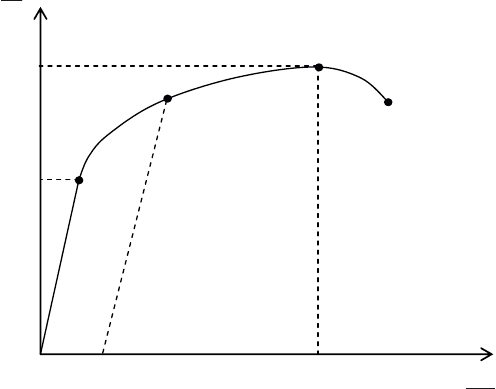
Figure 1.24 can be divided into three regions. Initially (region OP in the figure),
stress and strain are linearly proportional and their relationship can be expressed
using Hooke’s law:
E
VH
[1.33]
where E is the Young’s modulus.
F
F
L
0
F
F
L
F
Zone de
striction
F
S
0
S
N
ecking
zone
Surfaces 29
R
S
A
Re
A’
P
O
Rm
0
F
S
V
0
L
L'
H
Figure 1.24. Stress-strain curve
This linear region is characterized by its reversible nature. If the applied stress is
removed, the rod will return to its original dimensions. This is what is known as
purely elastic strain. However, when the applied stress reaches a certain threshold
value (Re) referred to as the yield strength, deformation of the material becomes
irreversible (point P). If the applied stress is removed at the point A, the material
will not return to its original dimensions but will show evidence of residual strain
(OA’).
The region PS of the curve corresponds to irreversible or plastic deformation
and, in this region, deformation is uniform along the rod.
The point S corresponds to the onset of necking, the localized narrowing of the
rod cross-section. Plastic deformation is then no longer homogenous and the local
narrowing of the cross-section (usually in the center of the rod) is accompanied by
an increase in the stress, which passes through a maximum before decreasing to its
rupture point (R). The value of stress at point S is known as the ultimate tensile
strength of the material (Rm). Table 1.4 summarizes the values for E, Re and Rm for
some common materials.

30 Materials and Surface Engineering in Tribology
Material E (GPa) Re (Mpa) Rm (MPa)
Diamond 1,000 50,000 –
Silicon carbide 420 10,000 –
Aluminum oxide 350 5,000 –
Silicon nitride 260 8,000 –
Nickel 220 70 400
Iron 190 50 200
Copper 124 60 400
Silicon 107 – –
Silica glass 94 7,200 –
Gold 82 40 220
Silver 76 55 300
Lead & alloys 14 11–55 14–70
Polystyrene 3-3.4 34–70 40–70
Polycarbonate 2.6 – –
Polypropylene 0.9 19-36 33-36
Very high density
polyethylene
0.7 20-30 37
Table 1.4. Some values for Young’s modulus (E),
yield strength (Re) and ultimate tensile strength (Rm)
1.2.4.3. Nano-indentation
This technique enables the simultaneous characterization of both the hardness
and Young’s modulus of the superficial layers of materials for depths ranging from a
few nanometers to several microns.
Unlike classic hardness tests which rely on a fixed load, nano-indentation uses a
dynamic load (P) which increases linearly with time and which enables the
monitoring of the indenter penetration (h) during the phases of loading and
unloading.
Surfaces 31
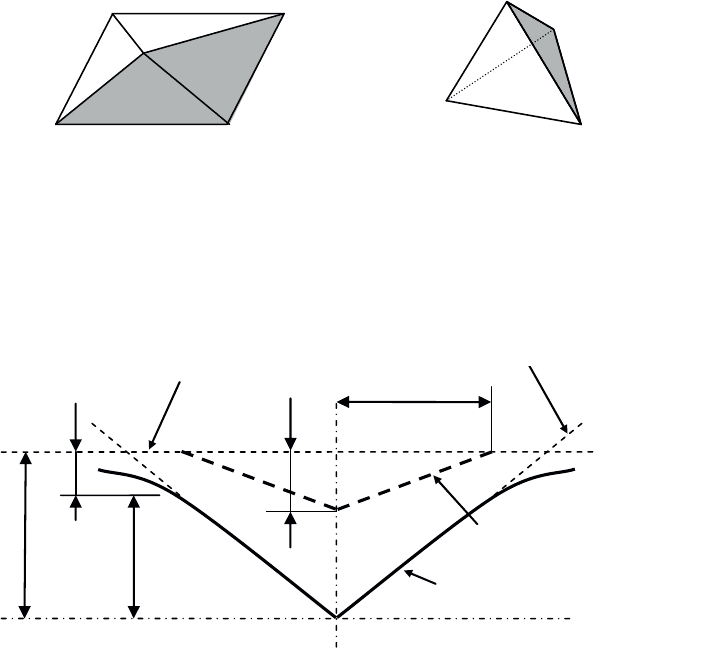
Nano-indentation tests use a square-based pyramidal Vickers-type indenter as
shown in Figure 1.25a or, more commonly, a Berkovich-type indenter (triangular
pyramid) as shown in Figure 1.25b.
a) b)
Figure 1.25. Indenters used in nano-indentation tests:
a) Vickers indenter; b) Berkovich indenter
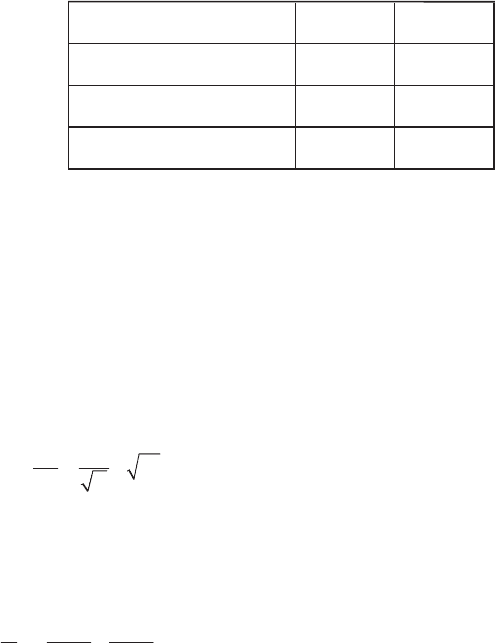
Figure 1.26 shows the impression left by the indenter under load and in the
absence of a load.
Figure 1.26. Schematic representation of the cross-section of an indentation
under load and after unloading
Here h
max
indicates the indenter displacement at maximum applied load (P
max
).
Experimental tests [OLI 92] carried out on a variety of materials (such as aluminum
oxide, glass, sapphire and tungsten) have shown that the load (P) and the
displacement (h) can be related by:
h
c
h
s
a
h
max
Surface initiale
Surface sous charge
Indenteur
h
f
Surface après décharge
Surface under load
Surface after load removal
Indenter
Initial surface
32 Materials and Surface Engineering in Tribology
m
f
PAhh
[1.34]
In this expression, h
f
gives the residual indentation depth (in the absence of a
load). A and m are constants determined from the fitting of the experimental results
obtained for the materials mentioned above. Their values lie within the range
0.0215–0.265 for A and 1.25–1.51 for m.
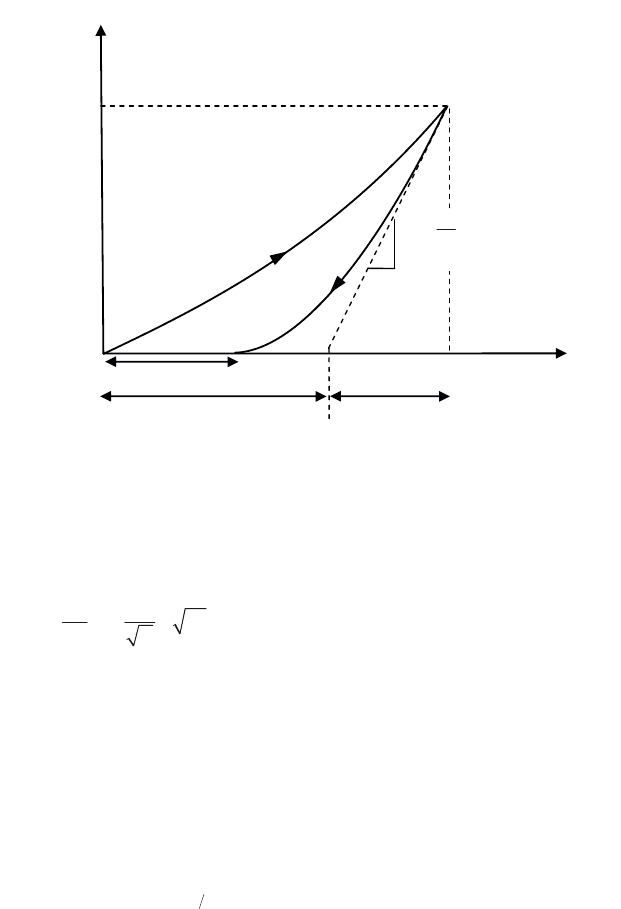
Table 1.5 gives the values of m for various indenter shapes. For Berkovitch
indenters, the value is 1.5.
Indenter shape m
D
Flat cylindrical indenter 1 1
Paraboloide of revolution 1.5 0.75
Conical indenter 2 0.72
Table 1.5. Theoretical values for m and
D
see equation [1.41])
for three types of axially-symetric indenters [OLI 92]
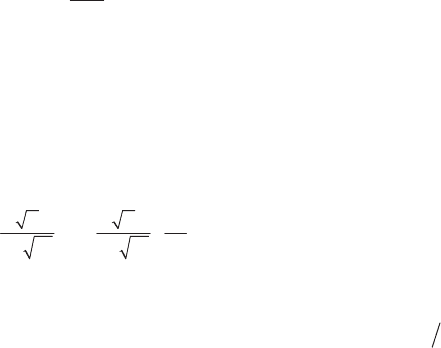
During the withdrawal of the indenter, it remains in contact with the surface for a
period corresponding to its elastic recovery. This is shown in the linear section of
the unload curve of Figure 1.27.
The slope of this line, given by the derivative dP/dh at point (P
max
, h
max
),
represents the elastic stiffness of the surface and can be expressed as:
2
c
dP
SEA
dh
S
[1.35]
where P (N) indicates the load, h (m) the depth of penetration, A
c
(m
2
) the contact
area and E (Pa) the reduced Young’s modulus, expressed as:
22
12
12
11
1
EE E
QQ
§·
¨¸
©¹
[1.36]
where E
1
and E
2
give the Young’s modulus and Q
1
, Q
2
the Poisson coefficients of the
indenter and the material’s surface, respectively.
Surfaces 33
Figure 1.27 shows an example of a load/unload curve. The analysis of this curve
is based on the model proposed in [OLI 92, OLI 04].
Figure 1.27. Indentation curve
In the case of a Berkovitch indenter (the most commonly used in nano-
indentation tests), a correction factor (ȕ = 1.05) is introduced in order to take into
account its asymmetric profile:
2
c
dP
SEA
dh
E
S
[1.37]
For this indenter (assuming perfect geometry), the contact area A
c
is given by:
2
24.5
cc
Ah
[1.38]
In reality, the tip of the indenter always exhibits some geometrical imperfection
which we include through an additional correction term:
8
21(21)
1
24.5
i
ccic
i
AhCh
¦
[1.39]
Charge (P)
Enfoncement (h)
h
c
h
f
h
s
P
max
h
max
dP
S
dh
(raideur de contact)
Load (P)
(Stiffness)
Displacement (h)
34 Materials and Surface Engineering in Tribology
The coefficients C
i
are constants which can be determined using a procedure
described in [OLI 92].
Based on Figures 1.26 and 1.27, we can write:
maxcs
hh h
[1.40]
where h
s
represents the elastic penetration which can be easily calculated using the
expression:
max
maxs
P
hh
S
D
[1.41]
where Į = 0.75 is a geometrical factor for a Berkovich indenter (see Table 1.5).
The determination of S from the unloading curve allows h
s
to be calculated
from
equation [1.41] and thus allows the determination of h
c
(h
c
= h
max
– h
s
). A
c
can then
be easily calculated and the reduced elasticity modulus E can be obtained (see
equation [1.37]):
22
cc
dP
ES
dh
AA
SS
EE
u u
[1.42]
Given the reduced modulus and the mechanical properties of the indenter (E
1
and
Ȟ
1
), it is then easy to determine the value of the ratio
2
22
(1 ) E
Q
from equation
[1.36].
If the precise value of ȣ
2
is not known, we generally take a value 0.30 for metals
and 0.20 for glass and ceramics to calculate the Young’s modulus E
2
of the material.
1.2.4.4. Fracture toughness
Figure 1.28 shows the different types of fractures which can occur within a
brittle material. Brittleness (the opposite of ductility) refers to the ease with which
fractures can propagate within a material. Brittleness is quantified through a
parameter known as toughness (denoted Kc), which describes the resistance of the
material to fracture propagation.