
Takadoum J. Materials and Surface Engineering in Tribology
Подождите немного. Документ загружается.

Surfaces 45
1.2.5.2. X-ray photoelectron spectroscopy
–
Primary particle: photon.
–
Secondary particle:electron.
–
Acronym: ESCA, XPS.
–
Characteristics of the technique:
- elemental analysis of materials,
- information about the environment of the atoms identified and the nature of
chemical bonds, and
- analysis of a surface of a few mm
2
to a depth of 0.1–2 nm.
P
OSSIBLE APPLICATIONS Analysis of oxide films and corrosion layers in order to
determine the nature of chemical bonds of the main elements as well as that of
impurities; analysis of passivation layers; characterization of the state of chemical
bonds within polymers; and analysis of the core level and valence band.
1.2.5.3. Auger electron spectroscopy
–
Primary particle: electron.
–
Secondary particle: electron.
–
Acronym: AES.
–
Characteristics of the technique:
- elemental analysis of the top few-atom layers of solids. The depth of analysis
is 2 to 3 monolayers (of the order of a nanometer),
- local analysis (primary electron beam diameter less than 10 nm); the use of
an ion beam allows in-depth analysis alternating between analysis and ionic erosion
(down to several microns). This is also made possible by photoelectron spectroscopy
(XPS).
P
OSSIBLE APPLICATIONS Analysis of adsorbed layers. Analysis of thermal or
anodic oxide films. Characterization of thin deposits and analysis of segregated
layers on surfaces or within grain boundaries.
1.2.5.4. Glow discharge optical emission spectroscopy
–
Primary particle: ion.
–
Secondary particle: photon.
46 Materials and Surface Engineering in Tribology
– Acronym: GDOS.
–
Characteristics of the technique:
- simultaneous elemental analysis of dozens of elements. Analysis of all
elements, including hydrogen, possible with high sensitivity (10 ppm),
- sputtering analysis, a destructive technique which allows in-depth sample
analysis,
- analysis over large areas (of the order of cm
2
).
P
OSSIBLE APPLICATIONS Study of diffusion gradients. Analysis of thin films or
composition gradients. Identification of molecules adsorbed on a surface and
characterization of coatings. Analysis of iron and steel materials.
1.2.5.5. Rutherford backscattering spectroscopy
–
Primary particle: ion.
–
Secondary particle: ion.
–
Acronym: RBS.
–
Characteristics of the technique:
- the analysis of the energy of backscattered helium ions after elastic collision
with the sample’s surface atoms allows the determination of their mass,
- several elements can be simultaneously analyzed over a depth of a few
microns.
P
OSSIBLE APPLICATIONS Analysis of thin films. Determination of concentration
profiles. Suitable for all types of material.
1.2.5.6. Secondary ion mass spectroscopy
–
Primary particle: ion.
–
Secondary particle: ion.
–
Acronym: SIMS.
–
Characteristics of the technique:
- elemental and isotopic analysis of all elements in the periodic table,
- determination of concentration profiles of chemical elements to a depth of
several microns using ionic sputtering,
Surfaces 47
- detection of trace elements (ppm),
- can be used to obtain ionic images showing elemental distribution.
P
OSSIBLE APPLICATIONS Analysis of concentration profiles of bulk materials or
thin layers. For example, in the semi-conductors industry (analysis of silicon,
gallium arsenide or other semi-conductors; the aim is to control the dopant
concentration profiles, but also to localize and quantify impurities). Also used to
analyze metallurgical products heterogenity.
1.2.5.7. Infrared spectrometry
–
Primary particle: photon.
–
Secondary particle: photon.
–
Acronym: IR spectrometry
–
Characteristics of the technique:
- a method principally used for the analysis of organic materials,
- allows the determination of functional groups present in a material and the
nature of the different bonds in which the carbon atoms are involved,
- an essentially qualitative technique,
- allows the analysis of gaseous, liquid and solid samples, even in very small
quantities.
P
OSSIBLE APPLICATIONS Analysis of plastics and lubricants such as oils or greases.
Analysis of polymer-based coatings and thin films such as paints, varnishes or
electrodeposited polymers.
This page intentionally left blank
Chapter 2
Tribology
2.1. Introduction
The word tribology is derived from the Greek word tribos, meaning friction. It
was first used in the UK in 1966 to describe the scientific and technical domains
studying friction, wear and lubrication.
Tribology is now a wide-ranging, multi-disciplinary field of study and research
aimed at:
reducing material wear and increasing the lifetime and reliability of
mechanical and mechatronic systems; and
controlling (or optimizing) friction (note that in some cases, e.g. vehicle
brakes, we aim for maximum friction, whereas in others, e.g. skiing and surfing, the
aim is to minimize its effects).
This dual objective requires an approach that combines contact mechanics with
the physico-chemistry of surfaces and interfaces.
We will discuss these two aspects of tribology in this chapter, and present results
that illustrate the coupling and interaction between mechanics and physico-
chemistry in problems of friction and wear. However, before we enter into a detailed
treatment of these effects, we first review a few basic notions of plasticity.
50 Materials and Surface Engineering in Tribology
2.2. Elements of solid mechanics
2.2.1. The stress vector
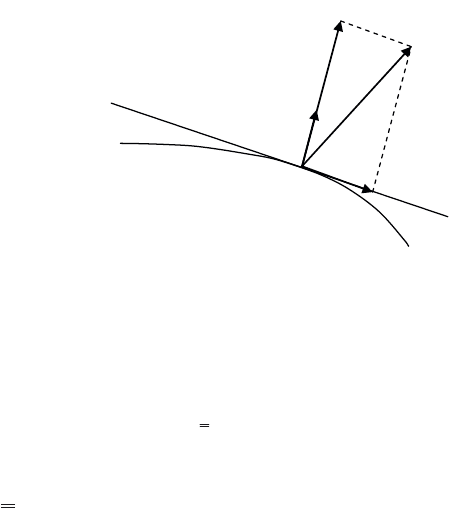
When a surface dS with normal
n
&
(see Figure 2.1) is subject to a force
Fd
&
at the
point P, the stress vector
T
&
at P is defined by the relation:
dF TdS
&&
[2.1]
The stress vector
T
&
is the force per unit area, written as
T
&
(P,
n
&
), corresponding
to the stress vector at P acting on the face of normal
n
&
.
T
&
can be decomposed into
two parts:
T
VW
&
&&
[2.2]
where
V
&
is the normal stress and
W
&
the shear stress.
P
dS
V
&
T
&
n
&
W
&
Figure 2.1. The stress vector
2.2.2. The stress tensor
To establish the state of stresses at a point P, it is sufficient to know the
components of the stress tensor
V
at this point.
x
xxyxz
yx yy yz
z
xzyzz
VVV
VVVV
VVV
§·
¨¸
¨¸
¨¸
©¹
[2.3]
Tribology 51
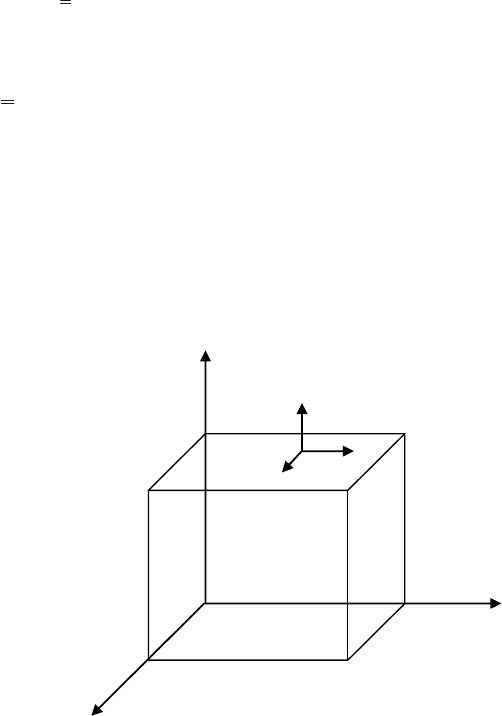
If we consider a parallelepiped of sides dx, dy, dz in equilibrium as shown in
Figure 2.2, each component ı
ij
represents the stress parallel to the direction i applied
to the face with normal j. ı
xx,
ı
yy
and ı
zz
are tension stresses, whereas the six other
components of the tensor are shear stresses. They are often written as IJ instead of ı,
noted as IJ
xy
, IJ
yx
, IJ
xz
, IJ
zx
, IJ
yz
, IJ
zy
.
Because the body is isotropic and in equilibrium, we can write:
ı
ij
= ı
ji
The tensor
V
therefore reduces to six components, and can be diagonalized in the
following form:
00
00
00
I
II
I
II
V
VV
V
§·
¨¸
¨¸
¨¸
©¹
[2.4]
where ı
I
, ı
II
and ı
III
are the principal stresses expressed in this new orthonormal
frame and the new axes are referred to the principal directions.
In the principal frame, the stress tensor therefore reduces to three components ı
I
,
ı
II
and ı
III
.
x
y
z
zz
V
yz
V
xz
V
O
Figure 2.2. Components of the stress tensor

52 Materials and Surface Engineering in Tribology
A given state of stress described in the principal frame by the tensor
V
can
therefore be decomposed into two terms
00 00 0 0
00000 0
00 00 0 0
ImIm
II m II m
I
II m III m
VVVV
VV VV
VV VV
§·§·§ ·
¨¸¨¸¨ ¸
¨¸¨¸¨ ¸
¨¸¨¸¨ ¸
©¹©¹© ¹
The first term is referred to as the spherical part of the tensor
V
and it
corresponds to a hydrostatic pressure. The second term represents the deviatoric
stress and corresponds to the shear component of tensor
V
.
2.2.3. Yield criteria
Yield criteria are expressed as a series of equations defining particular conditions
on the components ı
ij
of the stress tensor. They are noted in the form:
()0
ij
f
V
[2.6]
where f is a known function. When this condition is satisfied, yield will occur.
Equation [2.6] can be expressed as a function of the principal stresses in terms of
a new function f':
'( , , ) 0
IIIIII
f
VV V
[2.7]
2.2.3.1. The Tresca criterion
The Tresca criterion is a maximum shear stress criterion based on the notion that
yielding occurs when the maximum shear stress attains a threshold value.
Taking ı
I
ı
II
ı
III
, we can write this criterion:
max
22
IIII
Y
k
VV
W
t
[2.8]
When IJ
max
is greater than or equal to the yield shear stress for a state of pure
stress k, yielding occurs. Y gives the yield stress obtained from a tensile (or
compression) test.
[2.5]
Tribology 53
2.2.3.2. The von Mises criterion
This criterion is based on the notion that plastic deformation occurs when the
stored distortion strain energy attains a critical value.
Using Y and k defined above, the von Mises criterion is expressed in the
principal frame by:
2
()
I
II
VV
+
2
()
II III
VV
+
222
()26
III I
Yk
VV
[2.9]
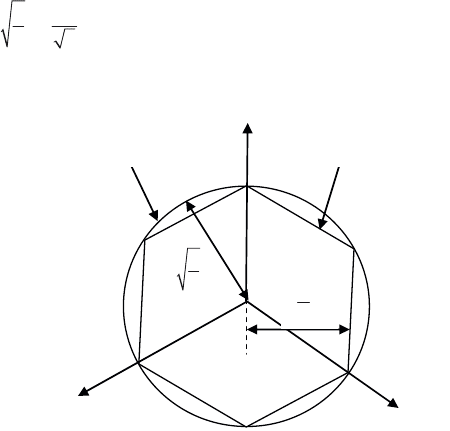
The two criteria have been superimposed in Figure 2.3, and we can note that the
maximum separation (E) between the two is equal to:
2
3
2
Y
EY
, [2.10]
a maximum difference of around 15%.
Figure 2.3. Representation of the Tresca and von Mises criteria in the principal frame
2.3. Elements of contact mechanics [JOH 85, WIL 94]
2.3.1. Hertz contact theory
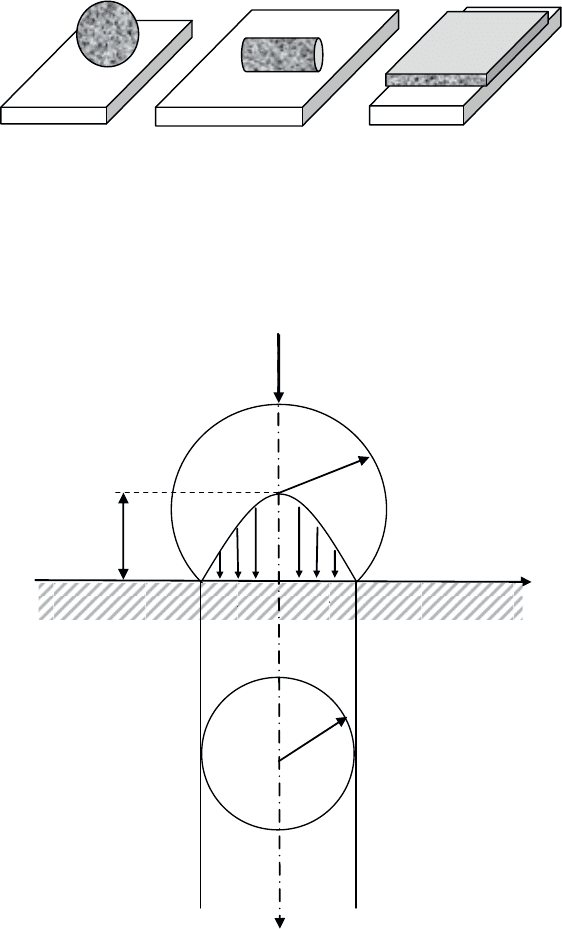
Figure 2.4 shows three different contact geometry configurations. In the case of
elastic contact, Hertz’s theory allows us to describe the stress distribution on and
below the surface.
ı
I
Hexagone de Tresca
ı
II
ı
III
Cercle
de von Mises
2
Y
2
3
Y
Von Mises
circle
Tresca hexagon
54 Materials and Surface Engineering in Tribology
a) b) c)
Figure 2.4. Different types of contacts:
a) point; b) linear; c) surface
We take a simple case of point contact, illustrated by a sphere of radius R
pushing on a plane surface under the action of a force F (see Figure 2.5).
z
x
F
R
P
0
P(x)
a
Figure 2.5. Sphere-plane contact