
Takadoum J. Materials and Surface Engineering in Tribology
Подождите немного. Документ загружается.

Materials for Tribology 175
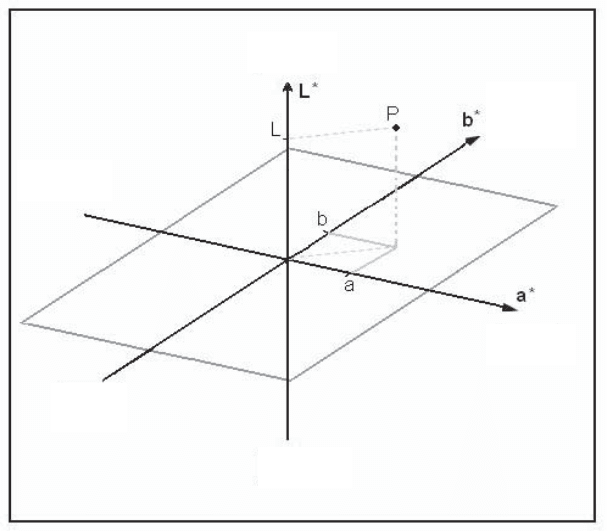
to 100 for a white object and varies continuously between these extremes. L* is
represented as a vertical axis, whereas the horizontal plane comprises the two axes
a* and b*. The coordinate a* indicates position between red and green (positive
values of a* indicate red while negative values of a* indicate green), whereas the
coordinate b* indicates position between yellow and blue (positive values of b*
indicate yellow while negative values of b* indicate blue) (see Figure 3.49).
Figure 3.49. Representation of a point P at coordinates L, a, and b in the color space L*a*b*
We limit ourselves here to coatings produced using PVD (generally applied
using reactive cathodic sputtering) as this technique is the most widely used in
industry within the decorative sector.
The substrates that can be used with this deposition technique are those that can
withstand temperatures of the order 200°C without degassing.
White
Yellow
Blue
Black
Red
Green
176 Materials and Surface Engineering in Tribology
Among the coating materials that are used, titanium dioxide (TiO
2
) has the
advantage of generating so-called interferential films where the color varies as a
function of the film thickness. For example, it is possible to obtain white films for
coating thicknesses less than a few nanometers, yellow films when the thickness
exceeds 40 nm, red films for thicknesses around 50 nm, and blue and green films for
thicknesses between 50 and 100 nm [MANA 04].
The fact that the films are based on optical interference, however, has limited the
widespread use of TiO
2
coatings on an industrial scale. In fact, only flat surfaces can
be coated satisfactorily using this technique and, for complex surface geometries,
different parts of the substrate are not coated with the same thickness, leading to
differences in colors. Moreover, titanium dioxide films are brittle and their hardness
is limited; the combined interferential nature of the coating and its low abrasion
resistance therefore limits the use of this material in decorative applications.
In contrast to TiO
2
, titanium nitride (TiN) is a hard, non-interferential coating
which presents good resistance to abrasion and appears golden yellow. Its
remarkable mechanical properties and its attractive color mean that it is one of the
materials most widely used for decorative purposes.
However, the radiance and golden yellow color of TiN are not rigorously
identical to those of gold and, in spite of systematic work carried out on the
production of TiN films under varying experimental conditions, it has not been
possible to achieve a genuine golden yellow color [MANA 04].
There is no possible combination of the three parameters a*, b* and L* for the
different layers generated that corresponds totally to the reference parameters of the
gold standards (according to the normalized NIHS colors or Normes de l'Industrie
Horlogère Suisse). Indeed, even when two parameters coincide with the
characteristics of one of the gold standards, the third is very far from the expected
value. It is for this reason that in industrial applications such as watch-making,
jewellery and accessories, the 1 μm thick film of TiN is coated with a additional
layer of “gold flash” one-tenth of a micron thick.
This solution, widely used in industry, does however present a major drawback.
In particular, the thin layer of gold (a soft material) erodes relatively quickly and
reveals the slightly darker titanium nitride layer, which causes the surface to look
tarnished [CONSTANTI 06]. To solve this problem, most research in the field has
been aimed at developing hard, genuinely gold-like films. Among some of the
solutions envisaged are mixed TiN/ZrN films, TiZrN films or multilayered TiN/ZrN
coatings.
Materials for Tribology 177
These multilayered TiN/ZrN coatings appear to open up interesting
opportunities. Indeed, alternate nanometer-scale films of TiN/ZrN deposited using
reactive cathodic sputtering have managed to reproduce the gold standards 1N14,
2N18 and 3N18 by combining TiN (golden-yellow but too reddish) and ZrN
(golden-yellow, but too greenish). Optimizing the experimental process has yielded
the same color values as the 1N and 2N gold standards for the a* and b* values.
However, the third value L* requires further improvement [CONSTANTI 06,
MANA 04].
Between the hard, non-interferential golden-yellow titanium nitride and the
softer, interferential titanium dioxide, the class of titanium oxinitrides Ti
x
N
y
O
z
presents intermediate properties that yield hard, non-interferential coatings
presenting desirable colors for decorative applications. Indeed, depending on the
oxygen/nitrogen ratio, titanium oxinitrides can take on a wide range of colors
[MARTIN 02, VAZ 04].
Ti
x
N
y
O
z
films have recently been generated using the reactive sputtering
technique with pulsed gases [CHAP 05, MARTIN 02]. Many ternary compounds
ranging from TiN to TiO
2
were thus obtained and characterized, showing that the
shift from nitride to oxide is paralleled by a gradual decrease in hardness, the
Young’s modulus and conductivity.
Regarding the colors obtained, the films are interferential within the composition
range (between 30 and 100% oxygen); however, when oxygen content is between 0
and 30%, they are non-interferential and present much higher values for hardness
than TiO
2
.
Increasing the oxygen content has yielded a varied palette of colors. It has been
possible to continuously vary the color from golden yellow for TiN to metallic
bronze, and then blue, purple, and dark and light green for compounds higher in
oxygen content.
Red is a rare and highly sought-after color in decorative applications. It is
therefore significant that recent research has reported that the Fe-O-N system has
made it possible to obtain compounds presenting the same reddish color as hematite
(Į-Fe
2
O
3
). Iron-oxinitride films were then generated using magnetron sputtering by
simultaneously injecting oxygen and nitrogen into the experimental reactor
[PET 06].
Carbonitrides are yet another class of coatings which must be mentioned as they
offer interesting solutions for decorative applications. Indeed, these materials are
characterized by high mechanical properties and highly sought-after colors. The
principal examples are titanium carbonitride (bronze, gray), titanium/aluminum

178 Materials and Surface Engineering in Tribology
carbonitride (black, gray and aubergine), chromium carbonitride (gray) and zirconia
carbonitride (brass yellow) [CAT 05].
3.5. Characterization of coatings: hardness, adherence and internal stresses
3.5.1. Hardness
We define three degrees of hardness principally differentiated by the depth of
indentation (d) as summarized in Table 3.6. The load required to reach these depths
will vary according to the material being tested. With nano-hardness, the required
load ranges from a few micronewtons to several hundreds of millinewtons. With
micro-hardness, the required load ranges from a few tens of millinewtons to a few
newtons. Finally, with macro-hardness the required load ranges from a few newtons
to several tens of newtons.
Table 3.6. The three types of hardness
As a consequence, the choice of hardness test will be tailored to the type of
material under study as well as to the application envisaged. Nano-hardness will
therefore be preferred to characterize thin layers (less than a micron) while micro-
hardness will be used to analyze the effects of surface treatments such as shot
peening or thermochemical treatments (carburizing, nitridation, etc.). Macro-
hardness will typically be used to measure the hardness of steels following
treatments such as quenching or tempering.
In section 1.2.4.1, we described the basic principles of the hardness test and the
different methods used to measure the hardness of materials. In the case of coated
materials, carrying out hardness tests presents two major difficulties. Specifically,
measurements carried out under very light loads can be affected by a size effect due
to the close proximity of the surface (see section 3.5.1.1), while measurements
performed under very heavy loads can be affected by the proximity of the substrate
(see section 3.5.1.2).
Nano-hardness Micro-hardness Macro-hardness
Indentation depth
(μm)
0.001–1 1–50 50–1000
Materials for Tribology 179
3.5.1.1. The indentation size effect
Hardness is a mechanical property of the material and its value (determined
experimentally) should therefore not depend on the measurement test conditions.
However, we note that measured hardness values are systematically higher when the
load (and penetration depth) is lower. Many reasons have been suggested to account
for this indentation size effect (ISE): work hardening; the presence of a superficial
oxide layer; the influence of impurities segregating on the surface after annealing of
the material; the presence of a free surface acting as an obstacle to dislocation
movements; or even elastic return. Indeed, although elastic return is often negligible
in macro- and micro-hardness, it becomes significant when the impressions obtained
present indentation depths ranging from a few tens to a few hundreds of nanometers
[BUL 01a]. Another theory based on the concept of geometrically necessary
dislocations (GND) to accommodate the deformation gradient in the plastified zone
has also been suggested [NIX 98].
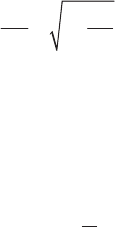
Two expressions are generally used to characterize the influence of the ISE on
the hardness:
– Model 1 [NIX 98]
0
*
1
H
d
H
d
[3.38]
where H is the measured hardness, H
0
is the measured hardness for an indentation
depth large enough so that ISE is not present, d is the indentation depth and d* is a
characteristic length that depends on the shape of the indenter determined from the
fitting of the experimental points by the model.
– Model 2 [BUL 01a]
0
k
HH
d
[3.39]
where H is the measured hardness, H
0
is the measured hardness for an indentation
depth large enough so that ISE is not present, d is the indentation depth and k is a
constant determined from the fitting of the experimental points by the model as
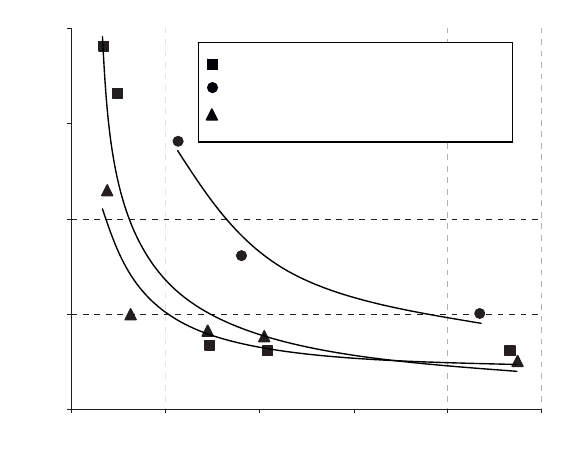
shown in Figure 3.50. It clearly shows the validity of the model and illustrates the
significant influence of elastic return on the ISE. Indeed, nano-indentation tests
carried out using a blunt-tip indenter clearly yielded greater elastic return than those
performed with a sharp-tip indenter.
180 Materials and Surface Engineering in Tribology
20
25
30
35
40
0 200 400 600 800 1000
Plastic depth (nm)
Micro-hardness (GPa)
Blunt nano-hardness (GPa)
Micro-hardness (GPa)
Sharp nano-hardness (GPa)
Figure 3.50. Hardness variation with plastic depth for PVD TiN,
comparing experimental data (symbols) with model fits (solid lines).The
indentation size effect behavior is clearly visible and depends on
indenter geometry and data analysis method [BUL 01a]
3.5.1.2.
Hardness tests for coated materials
The experimental determination of the mechanical and tribological properties of
coatings is often a delicate procedure due to the proximity of the substrate which can
significantly affect measurement results.
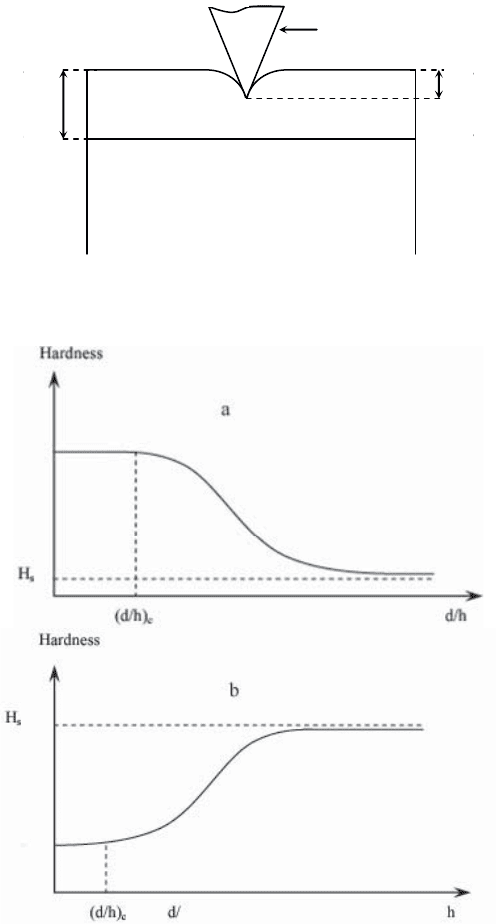
In the case of hardness tests, if h and d represent the thickness of the coating and
the depth of penetration of the indenter into the surface (see Figure 3.51), then as the
ratio d/h increases beyond a critical value (d/h)
c
the measurements will be affected
by the proximity to the substrate. The hardness measured will therefore be
overestimated or underestimated depending on whether the hardness of the substrate
is higher or lower than that of the coating (see Figure 3.52).
Materials for Tribology 181
Substrate
Film
h
d
Indenter
Figure 3.51. Indentation of a coated material
Figure 3.52. Hardness variation with the d/h ratio (see Figure 3.51). H
s
is the hardness of the
substrate: a) the coating is harder than the substrate; b) the coating is softer than the
substrate. The indentation size effect has been neglected
182 Materials and Surface Engineering in Tribology
Many models have been designed to analyze hardness tests performed on coated
materials, as described in the following.
3.5.1.2.1. Buckle’s model [BUC 65]
Using experimental data, Buckle was the first to suggest a model allowing the
influence of the substrate to be taken into account. He divided the volume under
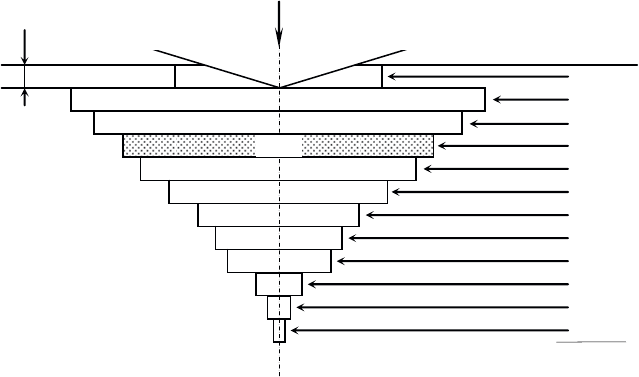
stress into twelve layers of equal thickness d parallel to the surface and attributed to
each layer a relative weight P
i
and hardness H
i
(see Figure 3.53). The contribution of
a given layer i to the total hardness measured will be given by the product H
i
P
i
. The
layer thickness is related to the indentation depth by the relation h = nd, where n is
an integer corresponding to the order (i) of the last layer d which still forms part of
the coating, with the zone i= n+1 then belonging to the substrate.
9
18.5
16.5
14
12
10
7.5
5.5
3.5
2
1
0.5
100
Pi
F
d
H
i
P
i
Figure 3.53. Buckle’s model of indentation. The volume under stress is divided into twelve
layers of equal thickness d parallel to the surface [BUC 65]
If the hardness of the substrate is given by H
s
and if H
f
is the hardness of the
film, Buckle’s model allows the hardness of the coated material (noted H
c
and
hereafter referred to as composite) to be expressed:

Materials for Tribology 183
12
11
()
12
1
n
fis i
ii
iin
cd
i
i
i
H
PH P
HP
H
P
P
¦¦
¦
¦
¦
[3.40]
This equation gives the hardness of the composite for an indentation depth d.
If we write:
1
12
1
n
i
i
i
i
P
a
P
¦
¦
and
12
1
12
1
i
in
i
i
P
b
P
¦
¦
[3.41]
then equation [3.40] may be written:
()cd f s
H
aH bH with a + b = 1 [3.42]
If n is known, equations [3.41] can be used to calculate the values of the
coefficients a and b for different values of d or d/h. Figure 3.54 shows the variation
of a as a function of the d/h ratio. It is interesting to note that if the d/h ratio is lower
than 0.1, the measurement is only weakly influenced by the proximity of the
substrate. This observation forms the basis of the so-called one-tenth rule of thumb
that states that hardness measurements of a coated material can be deemed reliable
and unaffected by the substrate provided the depth of penetration of the indenter
does not exceed one-tenth of the coating thickness. This rule, established
experimentally based on Vickers hardness tests, is generally valid for this type of
hardness but only in the case of hard coatings deposited onto soft substrates. When
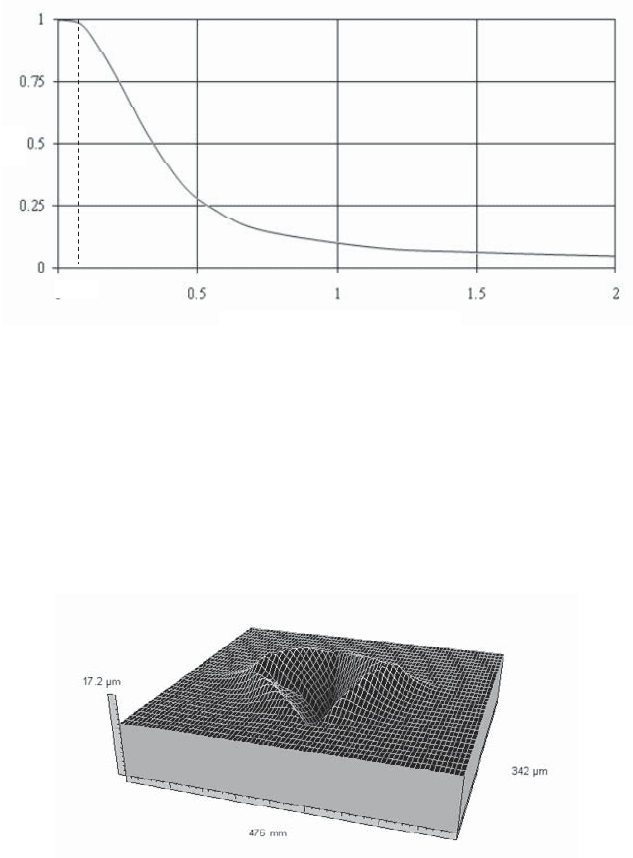
the coating is softer than the substrate, a significant pill-up forms around the
indentation due to the plastification of the soft film (see Figure 3.55) and this
considerably affects the predictions of the model. Indeed, this pill-up partially
withstands the applied load as reported in [CHA 88] and confirmed in [IOS 96].
184 Materials and Surface Engineering in Tribology
0.1
d/h
a
Figure 3.54. Variation of a (see equation [3.41]) with d/h ratio (see Figure 3.51)
Generally speaking, publications report values for the (d/h)
c
ratio ranging
between 0.07 and 1 [BEE 05, CHE 95, IOS 05, KOR 98]. Table 3.7 presents some
results obtained with different coatings. These results confirm that the one-tenth rule
is generally true in those cases when the coating is harder than the substrate.
However, significant variations are noted in the reverse situation when the substrate
is harder than the coating.
Figure 3.55. Indentation of a nickel film (hardness = 250 HV) deposited onto
a harder steel substrate of hardness 700 HV; a pill-up forms around the indentation