
Takadoum J. Materials and Surface Engineering in Tribology
Подождите немного. Документ загружается.

Materials for Tribology 165
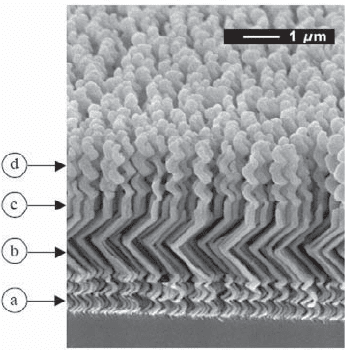
Figure 3.41 shows an example of a multilayered coating produced using several
different materials and comprising several kinds of microstructures [VANP 04].
Figure 3.41. Composite multilayered film showing the possibilities of the GLAD
technique [VANP 04]. Layer a: TiO
2
right-handed helix, 450 nm step, 3 turns;
layer b: SiO
2
zig-zag 1650 nm thick; layer c: SiO
2
vertical posts 600 nm thick;
layer d: SiO
2
left-handed helix 580 nm step, 3 turns
These GLAD-generated films represent a new class of materials suited to
multiple applications. Indeed, due to the possibility to engineer the surface of a
material through the deposition of structured films (zigzags, helixes, columns, etc.)
of controlled porosity, GLAD opens up opportunities for very diverse applications
such as humidity or gas sensors. Indeed, it has been shown that sensors based on
such topographically structured materials exhibit improved performance,
particularly with regard to their shorter response times compared to conventional
sensors. Other applications in the field of photonics, energy storage, display
technology and magnetic data storage have also demonstrated the wide applicability
of this technique [SATOM 00].
As a consequence of their specific structural properties, these materials are
expected to become increasingly important for tribological applications. An
unfortunate result of their very recent emergence, however, is that only a limited
number of publications have explored this domain. We highlight here three
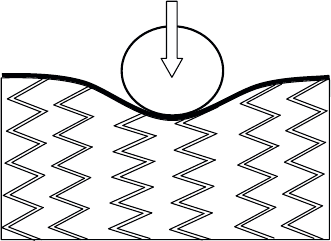
significant studies. In the first study [SET 99], the authors used nano-indentation to
study the mechanical behavior of helicoidal SiO films, and showed that the films
exhibit a genuine spring effect when deformed (Figure 3.42). Two years later, the
same group published additional results concerning the mechanical characterization
166 Materials and Surface Engineering in Tribology
of films generated using the GLAD technique [SET 01]. More recently, another
group [LIN 06] modeled the behavior of zigzag-structured chromium layers under
nano-indentation. The calculated hardness, toughness and Young’s modulus were
found to be in good agreement with experimental measurements.
Figure 3.42. Elastic deformation or “spring effect” of helix or zigzag-shaped films subjected
to nano-indentation (based on experimental results [SET 99])
Apart from the spring effect illustrated in Figure 3.42, the potential of these
materials to yield controlled roughness and porosity means that materials perfectly
adapted to lubricated friction can be produced. Moreover, oblique columnar
structures should enable the development of surfaces presenting anisotropic friction
characteristics. Indeed, Figure 3.37 clearly shows that if a sphere is placed under
friction against an oblique columnar film, the friction will vary according to the
sliding direction of the sphere relative to the angle of the columns.
3.4. Hard anti-wear and decorative coatings
Vapor deposited hard coatings are mainly used as anti-wear materials, but they
can also be used in decorative applications when they combine low abrasive wear
and attractive colors.
3.4.1. Hard anti-wear coatings
3.4.1.1. Transition metal nitrides
Simple or mixed nitrides such as TiN, AlN, TiAlN, CrN or ZrN have been
extensively studied, and some are used more specifically as anti-wear
coatings/materials. They are deposited using the PVD or PACVD techniques in the
form of a layer with thickness ranging from one to five microns.
Materials for Tribology 167
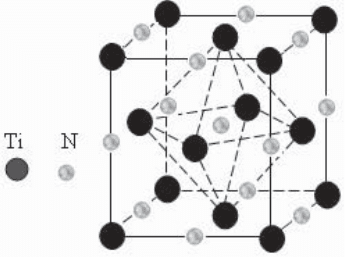
Titanium nitride (TiN) is the most commonly used of these materials. From the
crystallographic point of view, it is characterized by a face-centred cubic lattice as
shown in Figure 3.43. TiN hardness can range from 1400 HV to 4000 HV depending
on the deposition technique and conditions [TAK 97a].
Figure 3.43. The face-centered cubic lattice of titanium nitride
Titanium nitride readily oxidizes at 500°C yielding TiO
2
, and this significantly
impairs its mechanical properties. This material decomposition, under conditions of
extreme stress, restricts its use. To overcome this, titanium is therefore often used in
conjunction with aluminum in the form of a ternary solid solution TiAlN. Due to the
formation of the protective oxides Al
2
O
3
and TiAlO, this mixed nitride has much
better mechanical and tribological properties [RAU 00] and significantly increased
resistance to oxidation than TiN [CHU 97, JOS 95].
TiN, TiCN and TiAlN are widely used as coatings for cutting, stamping and
metal embossing tools. Because it is chemically more stable, TiAlN allows cutting
to be carried out even without lubrication and at greater speeds than with TiN and
TiCN.
The addition of silicon also results in significant improvements in the mechanical
and thermal properties of TiN. The compound TiSiN produced through PECVD is a
nanocomposite material made of TiN nanoparticles in an amorphous matrix of SiNx.
It is characterized by good hardness (50–70 GPa), excellent resistance to oxidation
and, even with relatively low levels of silicon (5%), it remains stable up to
temperatures of the order of 800°C [DIS 99, LI 92, VEP 95, VEP 00].
168 Materials and Surface Engineering in Tribology
The addition of silicon also has beneficial effects on the tribological properties
and ability of other nitrides – such as zirconium nitride – to withstand high
temperatures [PIL 06]. In addition, silicon results in the formation of a
nanocomposite material made of nanocrystals less than 10 nm in size.
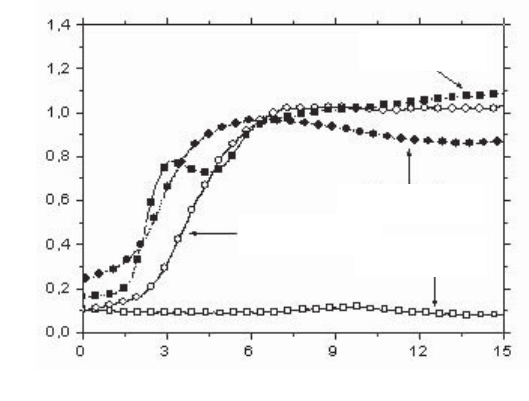
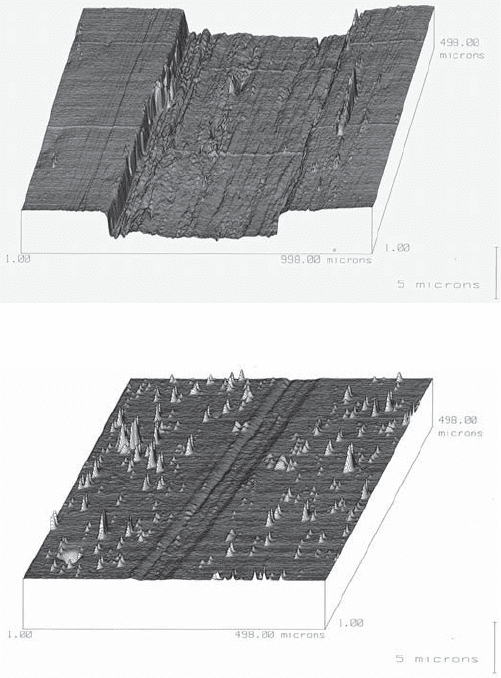
The characterization of the tribological properties of ZrSiN as a function of the
quantity of added silicon has shown that the friction coefficient (see Figure 3.44)
and rate of coating wear drop sharply when the silicon content reaches 7.6% (see
Figure 3.45a and 3.45b) [PIL 06]. This can be partly accounted for by the
amorphization of the material, partly by the oxidation of silicon under friction and by
the generation of a mixed film made of hydrated silicon oxide and hydroxide, which
protects the surface and behaves as a lubricant [BERTR 00, LIUC 01, SATOT 94].
Figure 3.44. Variation in the friction coefficient as a function of time for a PVD film of ZrSiN
(using a ball-on-disc tribometer). The sphere is a 5 mm diameter alumina ball,
the load is 25 N and the sliding speed is 5 mm s
–1
[PIL 06]
Friction coefficien
t
Time (min)
0% Si
4.9% Si
7.6% Si
3.3% Si
Materials for Tribology 169
a)
b)
Figure 3.45. Wear path at the end of the friction test described in Figure 3.44 for:
a) ZrSiN containing 3.3% silicon (similar results were obtained for a silicon content
of 0 and 4.9%); b) ZrSiN containing 7.6% silicon [PIL 06]
Chromium nitride is characterized by greater thermal stability [NAV 93] and
better resistance to wear [HUA 94, SATOT 94, YAO 97] and corrosion [BERTR 00,
LIUC 01] than titanium nitride. As a result, it offers an attractive alternative to TiN
for the coating of tools and wear parts.
For example, stamping tools made of X160CrMoV12 steel were coated with
CrN or TiN for an industrial application aimed at the production of copper contacts
for electrical components. These were then subsequently tested and compared to
170 Materials and Surface Engineering in Tribology
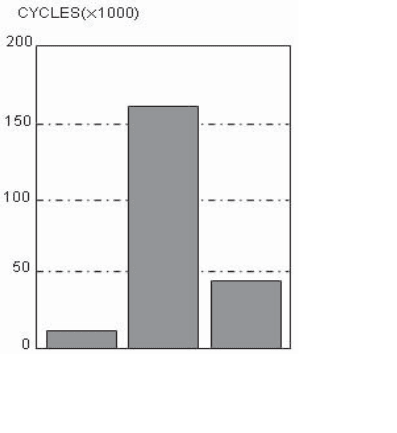
their untreated equivalents. The stamping was carried out under lubricated
conditions at a speed of 350 stamps per minute. The comparative lifespan of treated
and untreated tools is presented in Figure 3.46.
Figure 3.46. Comparative lifespan of X160CrMoV12 steel stamping tools
when untreated, coated with CrN or coated with TiN [TER 96]
The lifespan of CrN-coated stamping tools is 14 times greater than that of their
untreated equivalents and 3.5 times greater than those coated with TiN. Moreover,
copper has been shown to adhere significantly to TiN coatings and to induce a
significant transfer of metallic material unto the ceramic. However, in the case of
CrN coatings, the transfer of material and the friction coefficient proved extremely
low (0.25 for CrN but 0.35 for TiN) [TER 96].
When deposited using reactive sputtering, CrN can exhibit a wide range of
mechanical and microstructural characteristics, depending on specific deposition
conditions [HAE 02]. In particular, the bias voltage of the sample plays a very
important part. For example, the hardness of a chromium nitride film measured at
700 HV for an unbiased sample was increased to 2100 HV with a –150 V applied
bias. When measured using wear tests, the coating lifespan was found to increase by
a factor of ten using a substrate biased to –225, –300 or –900 V when compared to
deposition on an unbiased substrate.
Steel CrN TiN
(untreated)
Materials for Tribology 171
In the same study [HAE 02], the authors have clearly shown that the total gas
pressure and the N
2
/Ar pressure ratio plays an equally important part in determining
both the microstructure characteristics (grain size, roughness and porosity) and the
mechanical and tribological properties of the films. In particular, they demonstrated
that film microstructures characterized by high roughness and extensive, deep
porosities presented excellent behavior under lubricated friction because the
porosities acted as lubricant reservoirs.
3.4.1.2. Carbon-based films
Carbon-based films are an important class of materials for tribology. They are
usually generated using the PVD or PECVD techniques.
Diamond-like Carbon or (DLC) generated using PECVD combines high values
for hardness (2000–10 000 HV) with a low friction coefficient (0.1–0.2) and great
chemical stability [BUL 95, GRI 93, LEH 96, LIUY 96].
DLC is made from a mixture of graphite (sp
2
hybridization state) and diamond (sp
3
hybridization state). Its properties can vary considerably as a function of the
graphite/diamond ratio and the proportion of hydrogen it contains. Its mechanical
properties can be rapidly degraded when the temperature exceeds 400°C [TAK 03].
In this case, there is a sharp drop in the coating hardness due to the dehydrogenation
of the material and the transformation of the carbon atoms from the sp
3
to the sp
2
form.
The tribological behavior of DLC is also very sensitive to humidity, but
published results in the field are often contradictory [AKI 04, BUL 95, GRI 93,
LEH 96, LIUY 96, TAK 03]. Some publications suggest that higher rates of
humidity trigger a reduction in the friction coefficient and an improvement in wear
resistance, but many others argue that the opposite occurs.
These contradictory results are partly due to differences in the composition and
microstructure of the different films analyzed. Indeed, there is an important volume
of hydrogen contained in the films, the graphite/diamond ratio and the degree of
purity and density of the films. These data are not always provided in sufficient
detail in the published material.
DLC makes an excellent anti-wear coating, and is particularly well-suited for
cutting tools used in the machining of copper-aluminum alloys. However, because
of a strong reaction between the carbon and iron, it cannot be used for the machining
of steels.
172 Materials and Surface Engineering in Tribology
DLC is also often used to coat the moulds required for plastic or aluminum
injection molding. Moreover, as it is bio-compatible, it is also the preferred material
coating for the surfaces subject to friction in hip and knee prostheses.
Another material, carbon nitride (or CN
x
), is also worth mentioning for its
superior mechanical and tribological properties. Indeed, these properties are similar
to – if not better than – those of DLC, but CN
x
can also withstand high temperatures
without degradation [TAK 03].
Carbon nitride films have been the subject of much experimental research as a
result of theoretical calculations that showed that the hardness of the crystalline
compound C
3
N
4
was equivalent to, if not greater than, that of diamond [LIUA 89,
LIUA 90]. However, the synthesis of this material remains the subject of some
controversy because its method of production is not yet fully understood or
reproducible. However, it has been possible to generate and characterize numerous
CN
x
compounds that do not have the stoichiometry of the C
3
N
4
compound. It has
also been shown that carbon nitride films deposited by sputtering and containing
10% nitrogen had better wear resistance and a lower friction coefficient than pure
carbon films generated under the same conditions [KHU 96].
Another study has shown that the hardness of films generated using the
sputtering technique could increase from a value of 9 GPa with pure carbon coatings
to 25 GPa for carbon nitride films with an 18% nitrogen concentration [CUT 96].
However, many published results argue that high rates of nitrogen tend to reduce
material hardness due to the increase of sp and sp
2
carbon at the expense of sp
3
carbon [DEGR 98].
An increase in the friction coefficient and an improvement in resistance to wear
have also been observed with an increase in the quantity of nitrogen [KUS 98].
Another noteworthy carbon-based coating is the WC/C compound produced
through PVD with hardness ranging from 1500 to 2000 HV. By alternating hard
tungsten carbide with lubricating carbon layers, it is possible to obtain a high-
performance multilayered material well-adapted to the coating of tools used in the
machining and embossing of aluminum and metallic sheets with high Young’s
modulus [POD 04, WANS 99]. This coating can be applied directly onto the tools or
deposited as a final coating after prior treatment of the substrate with an initial film
of TiN, which enhances the adhesion of the WC/C coating to the substrate and also
acts as a diffusion barrier. Other nitride films such as CrN can also be deposited in
this way.
Materials for Tribology 173
3.4.1.3. The role of the substrate
Hard coatings should always be applied onto hard substrates to guarantee
maximum efficiency.
A useful guideline is that a hard coating of 1500 HV should never be applied
onto a substrate with hardness lower than 700 HV. Indeed, softer substrates
subjected to friction will undergo plastic deformation and thus be strained to the
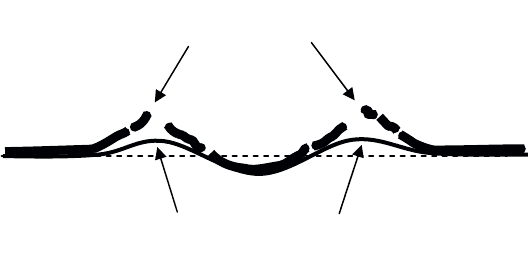
extent that the hard but brittle coating will crack and peel off from the substrate (see
Figure 3.47).
This has been clearly shown in a comparative study of three distinct layers of
TiN (2100 HV), TiCN (2600 HV) and DLC (3800 HV) deposited onto two
substrates of different hardness: 35CrMo4 steel of hardness 250 HV and
X85WMoCrV06.05.04.02 steel of hardness 880 HV [TAK 97b].
Figure 3.47. Behavior of a ceramic layer deposited onto a steel substrate subject to friction.
When the substrate is soft, it deforms plastically and causes the coating to peel off.
The minimum hardness required for the substrate is about 700 HV
In order to optimize the properties of hard coatings, multilayered deposits of
graded hardness such as Ti/TiN/TCN/DLC, Ti/TiN/WC/C or TiN/TiCN/CN
[MOR 04] have provided excellent results under friction.
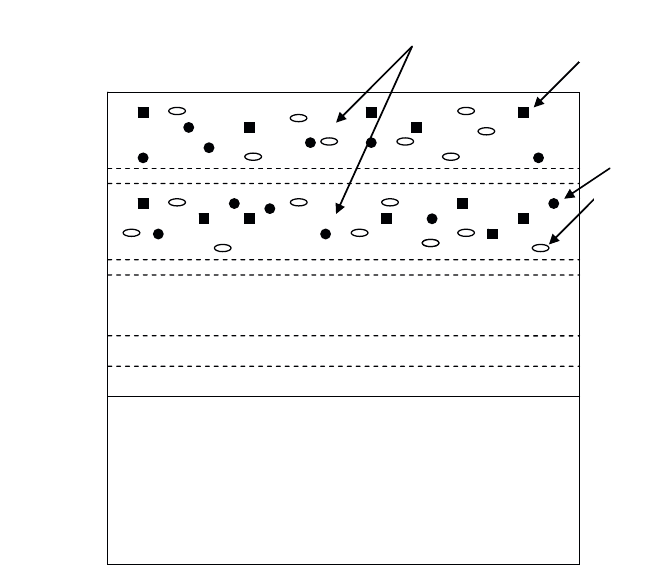
More complex systems with composite films also exhibit high performance. This
is, for example, the case with the multilayered coating Ti/TiN/TiCN/TiC/(Ti-
DLC)/TiC/(Ti-DLC) in which the titanium film improves the adhesion of the
coating to the steel substrate, while the intermediate layers support the load and act
as diffusion barriers or crack breakers. The outer DLC layer in this case is designed
Scaling of the
coating
Plastic deformation
174 Materials and Surface Engineering in Tribology
to lubricate the contact by reducing the friction coefficient [VOE 96] (see Figure
3.48).
Ti-DLC
Ti-DLC
TiC
TiCN
TiN
TiC
Ti
Gra
p
hite
Steel substrate
Ti
TiC
DLC
(
a: CH
)
Matrix
Figure 3.48. Example of a multilayered coating [VOE 96]
3.4.2. Decorative coatings
The oxide, nitride, oxinitride, oxicarbide or carbonitride coatings of certain
elements such as Ti, Zr, Cr or Al allow layers of different colors to be produced and
are therefore particularly well-suited for decorative purposes. The manufacturing of
spectacle frames, jewellery, watches and cutlery provide numerous examples of such
applications.
Film and coating color is described using the CIE system introduced by the
International Lighting Committee (Comité International de l’Eclairage). With this
system, color is expressed using three parameters or coordinates L*, a* and b*.
The coordinate L*, which expresses luminosity, ranges from 0 for a black object