
Takadoum J. Materials and Surface Engineering in Tribology
Подождите немного. Документ загружается.


Materials for Tribology 185
Reference
publication
Substrate Coating Relative
hardness
(H
coating
/H
substrate
)
Critical
depth
(d/h)
c
TiC 20 0.10 [HUM 83] Stainless
Steel
TiN 15 0.14
[TAZ 78] Glass Cu, Ag,
Au
<0.10* 1
[BAN 85] Silicon Al <0.10* 0.20–0.40
Quenched
steel (4135
(SAE))
Cu 0.30 0.22
Tempered
steel (4135
(SAE))
Cu 0.50 0.29
Quenched
steel (4135
(SAE))
NiB 1.30 0.15
[LEB 85]
Steel (1018
(SAE))
NiB 6.40 0.09
Stainless
steel M304
CrN 10 0.10
[KOR 98]
Tool steel
ASP23
TiN 4.33 0.10
[BEE 05] Silicon Cu 0.17 0.30
Aluminum Al
2
O
3
36 0.10–0.15
Silicon Al
2
O
3
0.75 0.40–0.50
[CHE 95]
Sapphire Al
2
O
3
0.36 0.70–0.90
Copper Ni 2.08 0.12
Iron Ni 1.40 0.16
Steel C48 Ni 0.56 0.33
[DUR 91]
Quenched
steel C48
Ni 0.25 0.47
Table 3.7. Values for the critical ratio (d/h)
c
for some
coating/substrate pairs (*estimated values)
3.5.1.2.2. The Jonsson and Hogmark model [JON 84]
This model is expressed in terms of the ratios of the surface areas of Vickers
indentations made on the film and substrate, and gives the composite hardness as:
f
s
cfs
A
A
H
VHVHV
A
A
[3.43]
where A = A
f
+ A
s
, the sum of the areas onto which HV
f
and HV
s
hardnesses are
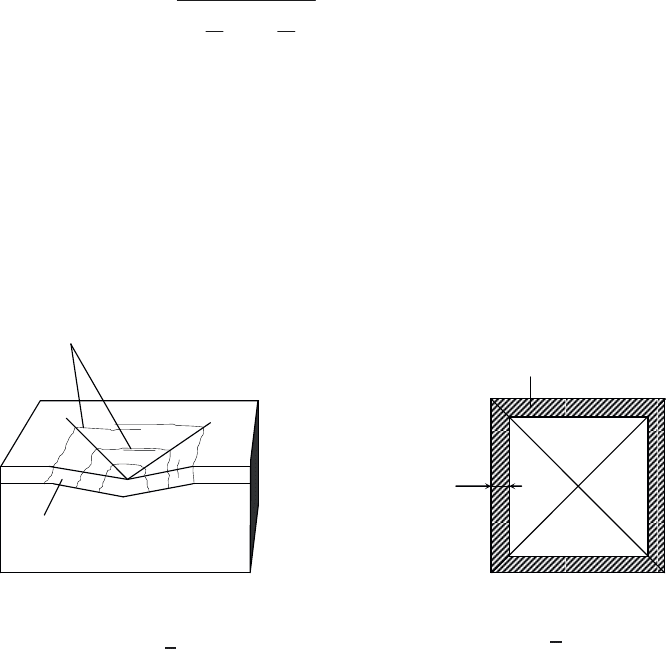
applied, respectively (see Figure 3.56).
186 Materials and Surface Engineering in Tribology
The hardness of the coating can be expressed as:
2
2
2
cs
fs
HV HV
HV HV
hh
CC
DD
§·
¨¸
©¹
[3.44]
where D is the diagonal of the indentation, h is the thickness of the coating and C is
a geometric constant that takes the value 0.5 if the coating undergoes plastic
deformation and 1 if the coating deformation is of the brittle type.
This model generally yields reliable results when the depth of indentation is
significant (d/h > 1) and the deformation is of the brittle type. However, for less
significant depths of indentation, greater variations are noted between experimental
values and the predictions of the model [KOR 98].
Cracks
Film
Substrate
x
A
f
A
s
b
a
Figure 3.56. The Jonsson and Hogmark model. Indentation of a film showing
(a) a brittle-type deformation and (b) the definition of areas A
s
and A
f
[JON 84].
A more realistic approach to describe the hardness of a coated material involves
considering the volume resulting from the deformation rather than the surface area
subjected to this deformation. This is the approach used in the following models.

Materials for Tribology 187
3.5.1.2.3. The Burnett and Rickerby model [BUL 01a ,BUR 87a]
This model is an improvement on the Sargent model [SAR 79] which suggests
that the composite hardness can be expressed using the following equation:
f
s
cs f
V
V
H
HH
VV
[3.45]
where V (V
s
+ V
f
) is the total volume that undergoes plastic deformation between
the indenter and a hemisphere with a diameter equal to the indentation diagonal. V
f
and V
s
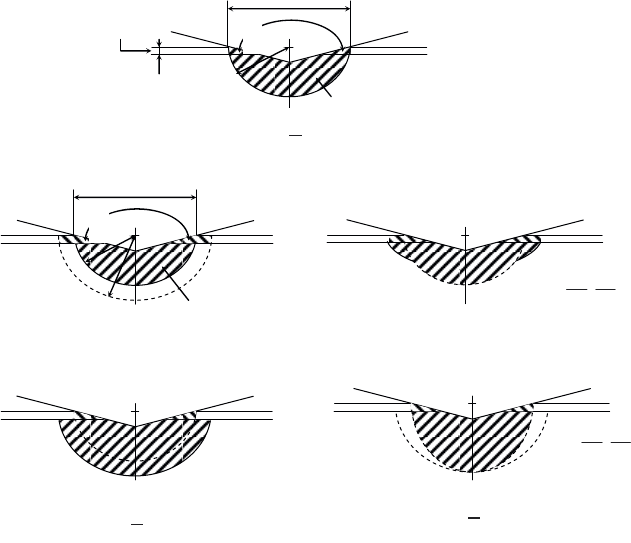
are the part of V contained in the film and the substrate respectively (see
Figure 3.57a). H
c
, H
s
and H
f
are the hardness values for the composite, the substrate
and the film.
When a Vickers indenter is used, the volume V can easily be calculated from the
expression suggested by Lawn
et al. [LAW 80]:
1
2
1
3
cotan
2
DE
R
H
[
§·
¨¸
©¹
[3.46]
where R is the radius of the plastically deformed zone, ȟ is the half angle at the
summit of the indenter between two opposite vertices (74° for a Vickers indenter), D
is the diagonal of the indentation and E and H are the Young’s modulus and the
hardness of the material being tested, respectively.
When the film thickness is known, calculating V allows the volumes V
s
and V
f
to be determined. If the substrate hardness is also known, the experimental
determination of H
c
can then yield the coating hardness H
f
using equation [3.45].
188 Materials and Surface Engineering in Tribology
V = V
s
+ V
f
D (diagonal)
V
s
h
Film
V
f
R
a
D (diagonal)
V
s
V
f
R
2
R
1
V = V
s
+ V
f
s
f
fs
E
E
HH
²
s
f
fs
E
E
HH
¢
b
c
Figure 3.57. Schematic representation of deformations induced by indentation; a) the
volumes considered in the case of the Sargeant model; expected modifications to plastic zone
morphology when b) there is no adhesion between film and substrate; and c) when adhesion
is strong. E
f
and E
s
are the Young’s moduli for the film and substrate. H
f
and H
s
are the film
and substrate hardness [BUL 01b, BUR 87b]
Burnett and Rickerby have improved this model by modifying the definition of
the volumes V
f
and V
s
(see Figures 3.57b and 3.57c) to take into account the
variation between the shape of the true deformation relative to the geometrically-
ideal spherical shape. Considering two hemispheres of radii R
1
and R
2
on either side
of the film-substrate interface, the authors have introduced an interfacial parameter Ȥ
to take into account the interaction between the coating and the substrate.
The following expressions have been proposed:

Materials for Tribology 189
– Case 1: H
s
< H
f
3
f
s
cf s
V
V
H
HH
VV
F
[3.47]
where
3
fs
VV V
F
;
– Case 2: H
f
< H
s
3
f
s
cs f
V
V
H
HH
VV
F
[3.48]
where
3
fs
VVV
F
.
Based on experimental tests carried out on different coatings, the authors have
proposed the following expression for Ȥ:
n
fs
sf
EH
EH
F
§·
¨¸
¨¸
©¹
[3.49]
where E
f
and E
s
are the Young’s modulus for the film and the substrate, and n has a
value between 1/2 and 1/3.
Other models based on a law of mixtures, including fractional volumes for the
coating and the substrate, have also been suggested. Two such models are presented
below.
3.5.1.2.4. The Chicot and Lesage model [CHI 95]
This model is based on the superposition of two hypothetical systems
representing the volumes resulting from plastic deformation in the film and in the
substrate respectively. This model yields the following expression for the
composite hardness:

190 Materials and Surface Engineering in Tribology
3
1
3
1
3
22
22
1
3
3
tan 2 tan
2
()
cs
ff
ss
fs fs
fs
HH
HH
HH
hh
DE E D E E
HH
[[
½
ªº
ªº
§· §·
§· §·
°°
§·
«»
«»
¨¸ ¨¸
®¾
¨¸ ¨¸
¨¸
¨¸ ¨¸
«»
«»
©¹
©¹ ©¹
°°
©¹ ©¹
¬¼
¬¼
¯¿
u
[3.50]
where ȟ, D, h, H
f
, E
f
, H
s
and E
s
are as previously defined.
When the diagonal of the impression D is greater than the coating thickness h,
equation [3.50] is reduced to:
1
1
2
2
1
3
3
tan ( )
2
f
s
cs fs
fs
H
H
h
H
HHH
DE E
[
½
ªº
§·
§·
°°
«»
¨¸
®¾
¨¸
¨¸
«»
©¹
°°
©¹
¬¼
¯¿
[3.51]
3.5.1.2.5. The Korsunsky
et al. model [KOR 98]
This model is based on the analysis of the energy required to generate an
indentation and yields the equation:
2
1
fs
cs
H
H
HH
d
k
h
§·
¨¸
©¹
[3.52]
where k is a constant that depends on the film thickness. The other terms have been
defined above.
A number of other models have also been suggested, including e.g. the Puchi-
Cabrera model [PUC 02], the Bhattacharya and Nix model [BHA 88] or the
Lebouvier, Gilormini and Felder model [LEB 85]. Comparative studies of these
models are to be found in [IOS 05] and [BEE 05].
3.5.2. Coating adhesion
Independently of its mechanical properties, a coating must adhere perfectly to its
substrate in order to act as a genuine protective layer against wear. This is why the
deposition of protective film coatings is always preceded by some mechanical
Materials for Tribology 191
and/or chemical treatment designed to cleanse the surface and activate it in order to
optimize the adherence of the film to the substrate. It is also common to deposit an
intermediate film (or binding layer) between the substrate and the final coating. A
nickel film is therefore systematically deposited onto copper-based substrates before
the application of a gold coating, a silicon film is applied onto steels before they are
coated with DLC and a pure titanium film is applied before the deposition of TiN
film onto steel substrates.
The very definition of adhesion remains complex and the fundamental
mechanisms are varied; they can include mechanical binding, electrostatic forces,
diffusion, wetting or chemical bonding [COG 00, DAR 03, ROC 91].
For the case of the combination of two solids A and B having surface energies Ȗ
A
and Ȗ
B
, the thermodynamic adhesion work or the Dupré adhesion energy is given by
the fundamental adhesion relation (see equation [1.13] in section 1.2.3). Adhesion
therefore appears as a true material property which needs to be considered in the
same way as any other physical constant.
Adherence, also referred to as “practical adhesion”, is given by the force or the
energy necessary to break the bonds between the coating and the substrate.
Coating detachment never occurs suddenly and completely, but rather arises as a
result of the propagation of a crack which gradually breaks the interfacial bonds,
liberating elastic energy and allowing the dissipation of irreversible work at the head
of the crack [MAU 84]. The crack can propagate when the adhesion energy W is
less than the strain energy release rate G (i.e.: W < G). Physically, the quantity G–W
represents the driving energy responsible for the crack propagation. W and G can be
related by the expression [MAU 78]:
(,)GW WFVT [3.53]
If the mechanical properties of the materials are known, G can easily be
calculated from geometrical considerations such as the size of the pre-existing crack,
contact geometry or type of stress.
Equation [3.53] shows that the strain energy release rate depends on two terms:
the adhesion energy and a function F(V,T) of the temperature (T) and speed of
propagation of the crack (V) which accounts for the viscoelastic losses within the
material. F(V,T) is a viscoelastic material property for a given mode of propagation.
Adherence will therefore be more significant when the adhesion energy and the
viscoelastic losses are high. These losses are particularly significant for polymers
and this allows us to “understand why the separation of two glued objects requires
such an enormous amount of energy which is at least 10000 times greater than that
corresponding to the forces of attraction between molecules” [BAR http].
192 Materials and Surface Engineering in Tribology
3.5.2.1.
Methods for adherence testing
A distinction is usually made between two main classes of techniques: non-
destructive and destructive. With non-destructive techniques, an optical or acoustic
probe is used to scan the coated material to detect defects or inhomogenities (such as
cracks, blemishes, porosity or bubbles) at the film–substrate interface. The most
widely used of these methods are acoustic and ultrasound techniques which exploit
the fact that material faults or discontinuities modify the propagation speed of
acoustic waves or cause wave reflection. Holographic interferometry and infrared
thermography are two additional techniques of this type [BAR http].
Destructive techniques can be divided into two categories. In the case of sealed
joints or for coatings made of ductile or weakly adhesive materials (such as paints,
varnish or polymers), the techniques used can include cross-cutting, cleaving,
peeling, blister tests, or three or four point flexion tests. When adherence is high,
such as with metallic or ceramic coatings, indentation or scratch techniques are
generally used. A selection of these techniques is now presented in more detail
[BEN 04, COG 00, DAR 03].
3.5.2.1.1. The peeling test
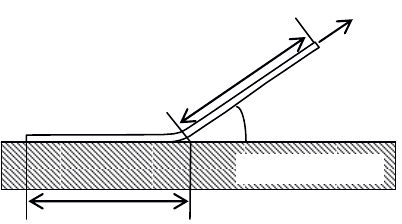
This test consists of applying a force F at an angle ș to a band of width b
deposited onto a substrate, as shown in Figure 3.58. This force is gradually increased
with time until the onset of the peeling of the film (maximum force = peeling force
F
p
). The process is then continued at a constant speed until peeling is complete. At
the end of the test, it is necessary to check the state of both the band that has peeled
off and that of the substrate, in order to ascertain that no lengthening or plastic
deformation has occurred, and that all the energy expended during the peeling of the
band has been used to break the bonds at the interface between the band and the
substrate.
F
lj
l
c
Substrate
Figure 3.58. Schematic representation of the peeling test principle
Materials for Tribology 193
In the case of an inextensible film of width b subjected to a peeling force F, the
strain energy release rate can be written:
(1 cos )
p
F
G
b
T
§·
¨¸
©¹
[3.54]
Peeling tests only yield reliable results in the case of low adherence. In fact,
when adherence energy is high, the experimental results can be strongly affected by
a significant extension of the band or by large dissipation of energy through plastic
or viscoleastic deformation.
When the system tested does not behave strictly elastically, the peeling force will
depend on the geometric and mechanical properties of the band and substrate
[COG 00].
3.5.2.1.2.
The blister test
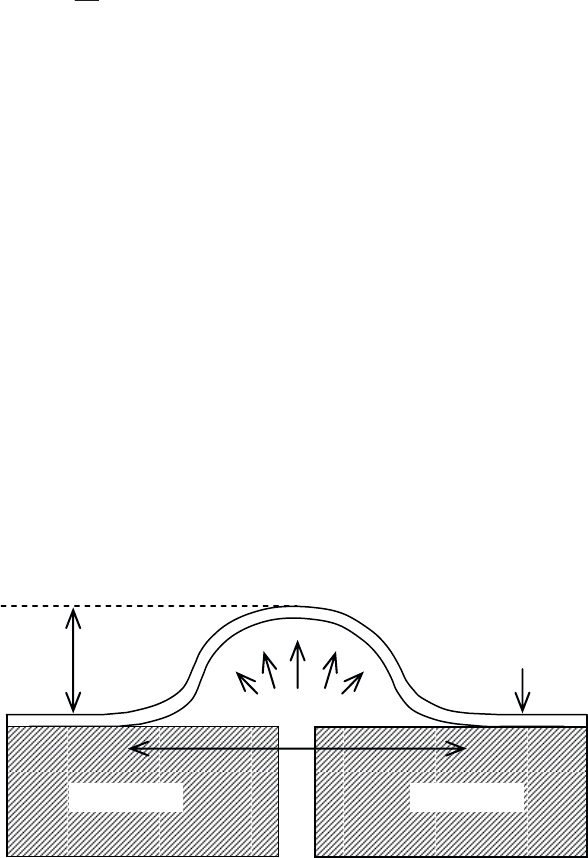
The test consists of creating an opening in the substrate through the selective
removal of material without altering the initial thickness of the coating. A pressure P
is then applied to the film using a fluid (generally a gas), causing the film to deform,
as shown in Figure 3.59. It gradually expands and blisters to a critical value į
c
corresponding to a pressure P
c
before starting to peel off from the substrate. The
strain energy release rate is given by the expression:
cc
GCP
G
[3.55]
with values for C generally ranging from 0.5 to 0.65 [BEN 04, COG 00]. P
c
is
expressed in MPa, į in μm and G in J m
–2
.
Coating
į
P
2a
Substrate Substrate
Figure 3.59. Schematic representation of the blister test principle
194 Materials and Surface Engineering in Tribology
3.5.2.1.3.
The scratch test
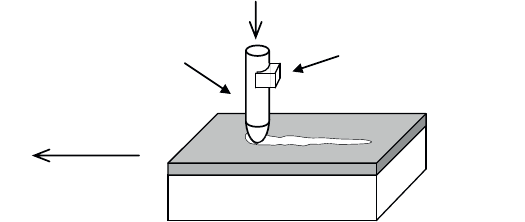
The scratch test [BUL 90, STE 85] applies a sharp indenter perpendicular to the
surface to be treated with an applied load (F) that increases linearly with time. As
the indenter penetrates the surface of the material, we subject the material to a
sliding movement with a speed of a few millimeters per minute.
Scratch tests are usually carried out using a Rockwell indenter (a conical
indenter with an apex angle of 120° and a radius of curvature of 200 μm), with a
load ranging between 1 and 200 N, a loading rate of 10 N min
–1
and a sliding speed
of 10 mm min
–1
.
Figure 3.60 shows the principle of this experimental set-up. The damage
commonly observed during the sample motion falls into three main categories:
– semi-circular Hertzian cracks (at the beginning of the test: low load);
– cohesive scaling due to internal rupture within the film (medium load); and
– adhesive scaling due to interfacial rupture at the film-substrate interface (at the
end of the test: high load).
Acoustic emission
detector
Sample motion
F
Scratching stylus
Figure 3.60. Scratch test principle (adapted from [CSM 08])
During the test, we generally measure the tangential force T and the acoustic
emission (AE) generated during the cracking or scaling of the surface (see Figure
3.61).
The critical load corresponding to the onset of adhesive scaling is denoted Lc
and can be used to characterize the adherence of coatings. However, it is important
to note that there are some discrepancies and debates in the literature concerning the
definition of Lc in terms of its particular degradation mode, as well as its detection
and characterization. Some authors find that measurement of the tangential force is
satisfactory, while others use primarily acoustic emission. Both methods involve
observing the scratches and using optical or scanning electron microscopy in order
check the state and mode of coating degradation.