
Takadoum J. Materials and Surface Engineering in Tribology
Подождите немного. Документ загружается.

Materials for Tribology 145
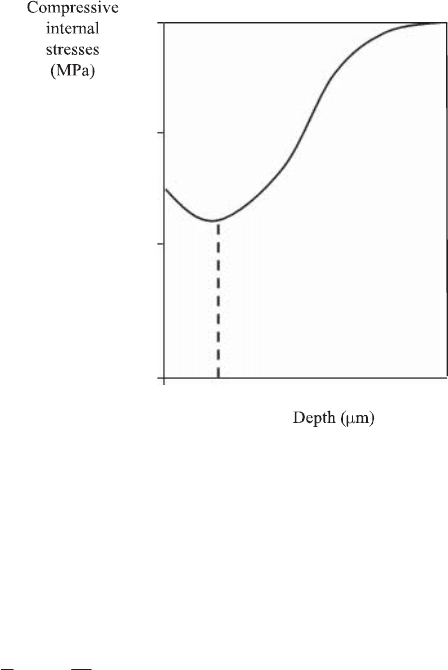
Figure 3.22 shows the profile of the residual stresses introduced into the treated
surface. It clearly shows the presence of a maximum of the compressive stresses at a
depth of Z
0
below the surface.
In the case of a surface intended for friction, the mechanical treatment conditions
will be chosen so that the depth Z
0
coincides with the zone to be subjected to the
greatest shear stresses (see section 2.3.1, Figure 2.7).
0
-600
-400
-200
0Z
0
500
Figure 3.22. Experimental result showing an example of the residual
compressive stress profile introduced into steel by shot peening
The kinetic energy (E) of the incident shot of mass m and density ȡ is
proportional to the square of the projection speed v and to the cube of the diameter
d:
232
122
1
vdmvE
U
S
[3.29]
By increasing the shot projection speed or the shot diameter, it is possible to
increase the induced stress level as well as the depth affected by shot peening.
However, the use of shot peening conditions that are too extreme can have adverse
effects: if the shot projection speed, diameter or hardness is too high, or if the
treatment time is too long or the degree of shot peening coverage is too high, this can
146 Materials and Surface Engineering in Tribology
lead to cracking of the material and rapid surface deterioration when exposed to
mechanical stress.
Furthermore, however simple its implementation may be, shot peening can only
be successfully performed provided some preliminary measures have been taken.
Indeed, the operating conditions need to be tailored to the nature of the material
being treated and to the mechanical stresses it is likely to be exposed to. It is
therefore essential to be aware of the mechanical and metallurgical characteristics of
the material in order to choose the type of shot and projection speed accordingly.
Note that it is also important for the treatment to be applied to the whole surface
so that its mechanical properties are homogenous. The proportion of the surface of
material to be treated is characterized by the degree of shot peening coverage
N, which is defined as the ratio between the surface that has been impacted and the
total area. Coverage of 100% corresponds to homogenous surface treatment.
As well as modifying the mechanical state of the surface layers of a material,
shot peening also leads to high surface roughness. The degree of roughness increases
with the diameter or projection speed of the shots, and/or with the softness of the
material undergoing treatment. The final roughness of the surface is therefore that
which is obtained after shot peening. In the case of tribological applications (under
friction), a large (uncontrolled) roughness can cause significant tearing of material
from the surface and even alter the efficiency of lubrication in the case of lubricated
contact. A simple means of reducing shot peening-induced roughness is to perform a
finishing shot peening process which, if carried out under moderate conditions, yields
a surface having a smoother micro-geometric state.
3.3.2. Deposition techniques
Deposition techniques consist of the application onto a surface of a coating of a
chosen material which is deposited either in the liquid or the gaseous phase. In order
to ensure good adhesion of the coating onto the substrate, the surface of the material
must be mechanically cleaned (through polishing, sand blasting, etc.), degreased and
then activated using a physical or chemical process. Additionally, before depositing
the coating onto the material, it is sometimes necessary to coat the surface with an
undercoat which is designed to perform at least one of the following functions:
– facilitate the adhesion of the final coating onto the substrate;
– adapt the thermal expansion coefficients in order to reduce residual stresses
within the coating (this is particularly true for high temperature processes); and
– act as a barrier layer when the aim is to avoid the diffusion of elements from
the substrate into the coating and vice versa.
Materials for Tribology 147
3.3.2.1. Thermal projection techniques
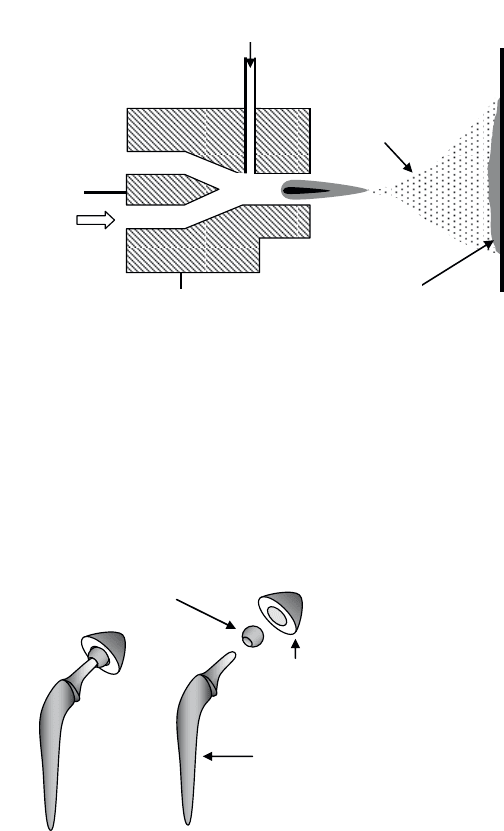
Thermal projection consists of melting the metal, ceramic or plastic-coating
material and projecting it onto a surface in the form of droplets. These droplets are
progressively superimposed and form deposits with thickness ranging from a few
tens of microns to several millimeters. The principal thermal projection processes
are based on the use of an electrical arc, a flame or a plasma torch (see Figure 3.23).
Gaz
plasmagène
Le jet
plasma
(+)
(–)
Poudre du matériau
à déposer
Dépôt
Powder of the metal
to be deposited
Plasmagen
gas
Molten
droplets
Coating
Figure 3.23. Principle of thermal projection using a plasma torch
The most widely used coatings in the tribological domain are alloys such as WC-
Co, Al
2
O
3
-TiO
2
, NiCrBSi, Cr
3
C
2
-NiCr and Cr
3
C
2
-NiAl. They are used in many
applications such as the car manufacturing industry, where thermal projection is
used on valves, piston rings, synchronization rings for gear boxes or clutch disks. In
biomedical applications, certain prostheses such as artificial hip joints are covered
with projected titanium or hydroxylapatite so as to facilitate their osteointegration
and to encourage bone regeneration [COD 99] (see Figure 3.24).
Sphere
(metal or ceramic)
Metal coated with titanium o
r
hydroxylapatite
Cotyle
(ceramic or polyethylene
UHMWPE)
Figure 3.24. Complete hip joint prosthesis
148 Materials and Surface Engineering in Tribology
3.3.2.2. Liquid-phase deposition techniques
There are two classes of liquid-phase deposition techniques:
– electrochemical deposition, which relies on an electric current or voltage
source to induce the reaction that yields the formation of the coating; and
– chemical deposition, where the electrons required for the chemical reactions
originate from the oxidation of a reducing agent contained in the bath, or from the
oxidation of the substrate.
3.3.2.2.1. Electrochemical deposition
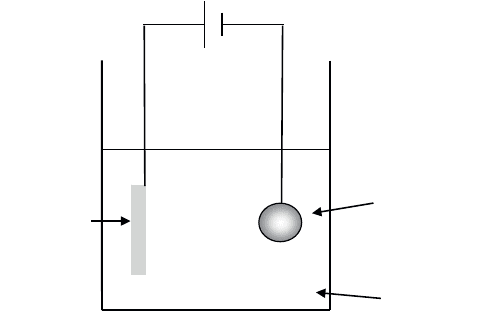
Electrochemical deposition, also referred to as electrodeposition or
galvanoplasty, uses an electrolysis cell containing a bath in which electrodes are
dipped (see Figure 3.25).
Figure 3.25. Principle of electrodeposition
The metal to be deposited is present in ionic form in the electrolytic bath. The
electrodes are connected to a current source. The object to be coated is negatively
polarized (cathode), while the anode consists of the metal to be deposited (except in
certain cases, such as with gold, where an insoluble anode is used). The metallic
ions in the electrolytic bath are reduced by contact with the cathode according to the
following reaction:
Mn
+
+ ne
-
ĺ M
Objet à revêtir
(cathode)
Métal à
déposer
(anode)
Electrolyte
+
–
Surface to
plate
(anode)
Metal to be
deposited
(cathode)
Electrolyte
Materials for Tribology 149
M
n+
+ ne
–
ĺ M [3.30]
At the same time, an atom from the anode passes into the solution:
M ĺ M
n+
+ ne
–
[3.31]
These two inverse reactions compensate each other and allow the M
n+
ion
concentration to remain constant in the solution.
In an acidic medium (pH < 5), the reduction reaction occurring at the cathode is
accompanied by the electrolysis of water and the dihydrogen evolution according to
the reaction:
2H
+
+ 2e
–
ĺ H
2
[3.32]
Hydrogen diffuses within the coating and it often results in the brittleness of
electrolytic deposits.
The electrical current densities used for electrochemical deposition usually range
from 0.5–50 A dm
–
2
. These values can be significantly increased if pulsed currents
are used. In this case, instead of subjecting the material to be treated to a continuous
current, it is subjected to a pulsed current
. The high current densities used yield
increased deposition speed, higher density and harder coatings [MEN 00, NGU 98]
and improved functional properties with regard to corrosion [CHAS 95, KON 97]
and wear [NGU 98]. Moreover, pulsed current also yields coatings of homogenous
thickness and avoids the development of excess thickness on the edges of the coated
materials.
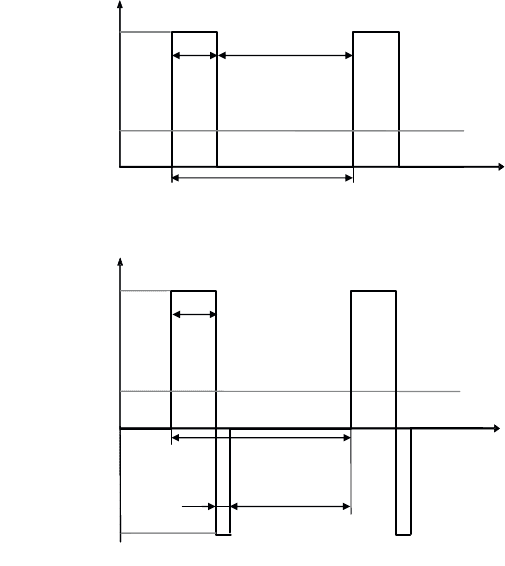
Figure 3.26 shows the form of the electrical signals commonly used. Two types
of pulsed currents can be defined:
– simple pulsed currents consisting of cathodic pulses with a forward on-time Tc
and a forward off-time Tr; and
– reverse pulsed currents when each cathodic pulse Tc is followed by an anodic
pulse Ta.
150 Materials and Surface Engineering in Tribology
t (s)
t (s)
J
c
J
m
T
T
c
T
r
J(A.dm
-2
)
J
c
J
m
T
T
c
T
r
T
a
J(A.dm
-2
)
J
a
Figure 3.26. Forms of pulsed currents used: a) simple pulsed current; b) reverse pulsed
current (T: period (s);T
c
: cathodic current application time (s); T
a
: anodic current
application time (s); J
c
: peak cathodic current density (A dm
–2
); J
a
: peak anodic current
density (A dm
–2
); J
m
: mean current density (A dm
–2
); T
r
: rest interval (s))
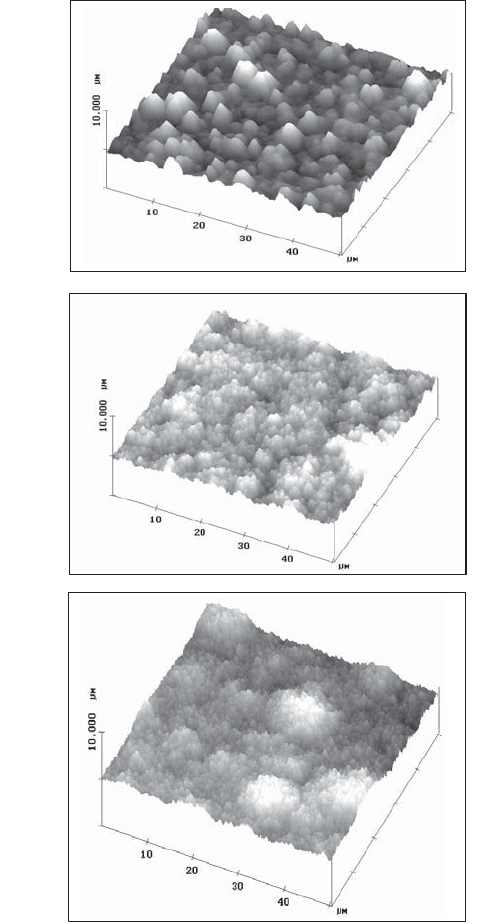
The shape of the signal used can significantly impact on the morphology and
characteristics of the deposited coating. Figure 3.27 and Table 3.5 show, for example,
the case of chromium deposits for which three different types of morphologies and
corresponding hardnesses were obtained under various deposition conditions
[ADD 06].
a)
b)
Materials for Tribology 151
Figure 3.27. Chromium coatings deposited onto steel (deposition conditions are
listed in Table 3.5): a) large grains (hardness: 390 HV); b) medium grains
(hardness: 557 HV); c) fine grains (hardness: 724 HV) [ADD 06]
a)
b)
c)
152 Materials and Surface Engineering in Tribology
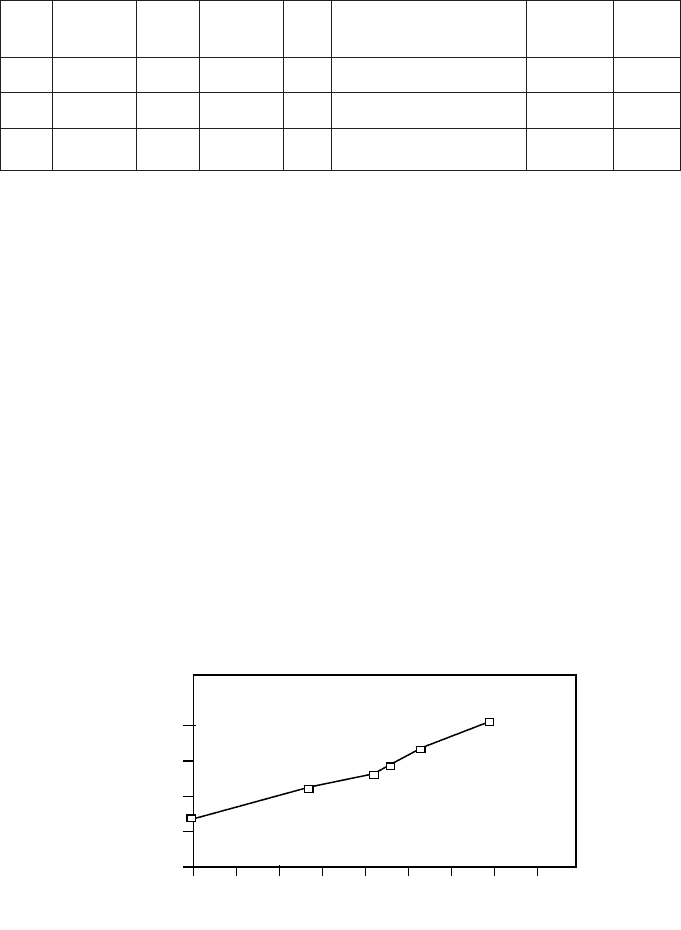
Table 3.5. Conditions of chromium deposition by reverse pulsed current with no forward
off-time (T
r
= 0 s): values for morphology and hardness [ADD 06]
Electrochemical deposition also permits the generation of composite coatings
consisting of a metallic base combined with hard particles (such as SiC, ZrO
2
,
Al
2
O
3
, diamond, etc.) or with solid lubricants (such as PTFE or MoS
2
). These micro-
or nano-size particles are kept suspended in the electrolyte using an appropriate
agitator [BERC 03].
The electrochemical deposition of composites such as Au-PTFE [REZ 05] or Ni-
PTFE [PEN 98] can significantly reduce the friction coefficient of a metal compared
to its pure state. Moreover, the embedding of hard, usually ceramic, particles into
the coating generally leads to improved resistance to abrasion and to increased
material hardness. This is true of several compounds such as Ni-SiC [GAR 01,
GROS 01], Ni-Al
2
O
3
[GAN 04, SHR 01] or Ni-TiO
2
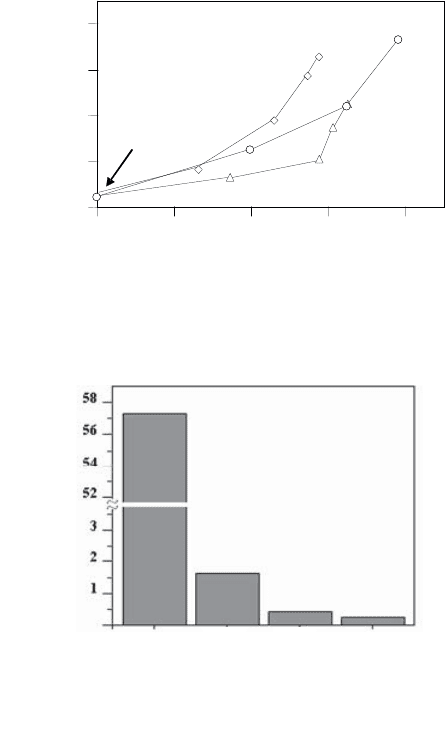
[LOS 99]. Figure 3.28 shows the
variation of the hardness as a function of the volume fraction of ZrO
2
introduced in
the case of the Ag-ZrO
2
composite. We see that the increase in hardness is
proportional to the increase in the volume of embedded ceramic.
0
2 4 6 8 10 12 14 16
60
80
1
00
120
140
Taux d’incor
p
oration de ZrO
2
(
%
)
Dureté Vickers
Hardness (HV)
Fraction of ZrO
2
(%vol)
Figure 3.28. Hardness of a Ag-ZrO
2
deposit as a function of the
volume fraction of zirconia [GAY 01]
T
(°C)
J
c
(A dm
–2
)
T
c
(ms)
J
a
(A dm
–2
)
T
a
(ms)
Morphology
Hardness
(HV)
Figure
57.5 48 13000 48 40 Large grains 390 3.27a
57.5 36 13000 36 40 Medium grains 557 3.27b
57.5 36 5000 48 40 Fine grains 724 3.27c
Materials for Tribology 153
In the case of the Ni-SiC composite, the mechanical characteristics of the
material have been shown to depend on the volume fraction of SiC and its
granularity (see Figure 3.29) [GROS 01]. Another study reported hardness values
ranging from 650 to 1300 HV and an increased resistance to wear proportional to the
percentage of siliceous carbide (see Figure 3.30) [ABD 06].
0
510
15
20
500
600
700
800
900
N
i
Fraction of SiC (%vol)
Hardness (HV)
Figure 3.29. Variation in the hardness of the Ni-SiC composite as a function of the size and
volume fraction of ceramic particles. Mean diameter of grains: 1 μm (
); 0.75 μm (c);
0.5 μm (
U) [GROS 01]
Substrat fer
+ 50 vol. %
+ 60 vol. %
+ 80 vol. %
Taux d’usure ( g.s
-1
)
Wear rate (g.s
-1
)
Substrate
+ 50 vol %
+ 60 vol %
+ 80 vol %
Figure 3.30. Rate of wear as a function of the volumic percentage of silicon carbide in a
Ni-SiC composite coating deposited onto an iron substrate. The wear tests were carried
out using a pin/cylinder set-up. The cylinder was made of steel (of hardness 63 HRC)
and its rotating speed was 30 rotations per minute (0.1 m s
–1
). The applied load
was 40 N and the fixed test duration was 0.5 hour [ABD 06]
154 Materials and Surface Engineering in Tribology
3.3.2.2.2. Chemical deposition
In the case of chemical deposition, the reduction of metallic ions does not require
the use of a current generator. The necessary electrons are provided either by
oxidation of a reducing agent present in the bath or by oxidation of the substrate
which must necessarily be less noble than the metal to deposit. In the case of
chemical nickel deposits, the hypophosphite ion is very often used as a reducing
agent.
The two main reactions occurring in the solution are:
H
2
PO
–
2
+ H
2
O o H
2
PO
–
3
+ 2H
+
+ 2 e
–
[3.33]
This reaction, corresponding to the reduction of hypophosphite ions, liberates
electrons which will in turn enable the reduction of Ni
2+
ions into metallic nickel:
Ni
2+
+ 2 e
–
o Ni [3.34]
The total reaction is therefore:
Ni
2+
+ H
2
PO
–
2
+ H
2
O o Ni + H
2
PO
–
3
+ 2H
+
[3.35]
Commercially available baths can also be used to deposit nickel-boron or nickel-
phosphorus alloys particularly onto steels and copper-based or aluminum-based
alloys. These deposits are amorphous, characterized by good hardness (500–1000
HV) and good resistance to wear. They are usually deposited as thin films ranging
from 15 to 40 microns.
The main advantage of the chemical deposition technique over the electrolytic
technique is that it allows homogenous deposits covering the whole surface of the
material to be treated, irrespective of shape.
As with electrochemical deposition techniques, chemical deposition can
successfully be used to apply a number of different composite deposits.
3.3.2.3. Vapor-phase deposition techniques
A distinction is generally made between physical vapor deposition processes
(PVDs) and chemical vapor deposition processes (CVDs) [GAL 02].
The characteristics of the coatings generated with these surface treatments
depend on the technique chosen and the experimental conditions. Vapor phase
deposition techniques have a wide range of applications: they may be applied as
anti-reflection coatings for optical lenses, as thin films for electronic components or
connectors or as decorative or anti-wear coatings.