
Takadoum J. Materials and Surface Engineering in Tribology
Подождите немного. Документ загружается.

Materials for Tribology 155
3.3.2.3.1 Chemical processes (CVD and PACVD)
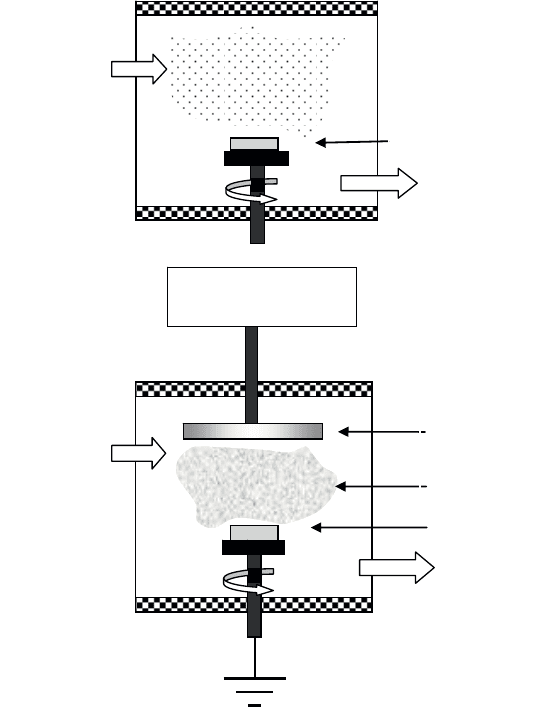
CVD deposits are the product of a chemical reaction between the heated
substrate and one or several reactive gases that are introduced into the experimental
reaction chamber (see Figure 3.31a).
As an illustrative example, we can see how titanium carbide and silicon oxide
can be prepared according to the following reactions:
TiCl
4
(g) + CH
4
(g) ĺ TiC (s) + 4HCl (g) [3.36]
SiH
4
(g) + O
2
(g) ĺ SiO
2
(s) + 2 H
2
(g) [3.37]
The substrate temperature usually ranges between 500 and 1,500°C. These
relatively high temperatures mean that this process cannot be applied to materials
having a low melting point and, in the case of steels, to those having a tempering
temperature higher than that at which the coating forms on the substrate.
Moreover, when the thermal expansion coefficient of the deposit and substrate
are too different, the coating may exhibit high residual thermal stresses which can
potentially cause it to peel off.
In order to overcome the drawbacks of classic CVD, other techniques have been
developed. These techniques, known as plasma-assisted chemical vapor deposition
(PACVD) and plasma-enhanced chemical vapor deposition (PECVD), are based on
plasma generated by the creation of an electric discharge in the reaction chamber.
The high temperature required for the activation of the chemical reaction in the
classic CVD technique is partly replaced by the action of the electrons accelerated
within the plasma. The deposition temperature can therefore be significantly reduced
to about 300°C (see Figure 3.31b).
The electrical discharge used is at a high frequency of 13.56 MHz in order to
allow deposition of insulating films. Indeed, the deposition of such films would not
be possible using a direct current as it would rapidly stop the discharge.
This technique can be applied to yield a number of metallic and ceramic
materials with remarkable mechanical and tribological characteristics [PAW 03,
RIC 94].
156 Materials and Surface Engineering in Tribology
Figure 3.31. Vapor phase chemical deposition:
a) CVD; b) PACVD
3.3.2.3.2. Physical processes
PVD refers to several types of processes operating under low pressure conditions
(ranging from 10
–4
to 10
–1
Pa) and at low temperatures (between 100 and 500°C).
A distinction is generally made between three types of physical processes:
– thermal evaporation;
– ionic deposition; and
– sputtering.
Arrivée
des gaz
Générateur H.F.
Cathode
Plasma
Pompe
à vide
Pompe
à vide
Arrivée
des gaz
Echantillon
Chauffé
(T = 500 – 1 500 °C)
Gas
Entry
Heated
Sample
Vacuum
pump
Cathode
Sample
H.F. Generator
Gas
Entry
Vacuum
pump
Plasma
a)
b)
Materials for Tribology 157
Thermal evaporation
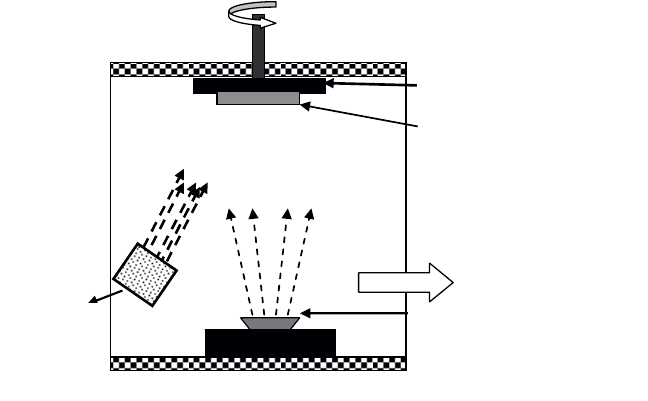
This technique consists of vaporizing the source material to be subsequently
deposited onto the substrate by heating it in a vacuum (usually ranging from 10
–2
to
10
–3
Pa). The atoms that are evaporated are then progressively deposited as a film
onto the surface of the substrate to be treated. The most commonly used vaporizing
sources are wires or foils heated with an electrical current. The material to be
deposited can also be sublimed under the impact of an electron beam [GAL 02,
RIC 94]. Moreover, it is possible to significantly improve the density of the film as
well as its adhesion and its mechanical properties by carrying out ionic
bombardment during its growth: an ion beam (generally argon) is then aimed at the
substrate and bombards the film as it grows. This particular technique is known as
ion beam-assisted deposition (IBAD) (see Figure 3.32).
Figure 3.32. Ion beam assisted deposition (IBAD)
Prior to thermal evaporation the ion beam is used to clean the surface of the
substrate through ionic etching, which consists of removing the contamination layer of
surface oxides. This significantly increases the reactivity of the surface and so ensures
better adhesion of the deposited films.
Porte substrat
Echantillon
Pompe à vide
Sublimation du matériau
à déposer (chauffage ou
impact électronique)
Canon à ions
(Ar, Xe,…)
Sample holder
Sample
Vacuum pump
Sublimation of the material
to be deposited (through
heating or electronic
impact)
Ion beam
(Ar, Xe,
etc.)
158 Materials and Surface Engineering in Tribology
Ionic deposition
Ionic deposition (or ion plating) consists of evaporating the deposition material
inside a chamber and subsequently creating a discharge by negatively polarizing the
specimen to be treated. The ionized atoms are attracted to the surface of the
specimen, which is subjected to ionic bombardment throughout the deposition
process. In addition, reactive gases such as oxygen, nitrogen or hydrocarbides can
also be injected into the reactor to form oxides, nitrides or carbides, respectively.
This technique of ionic deposition is referred to more specifically as reactive ion
plating (RIP).
At elevated deposition speeds, this technique allows the formation of dense
coatings that exhibit good adhesion to the substrate.
Sputtering
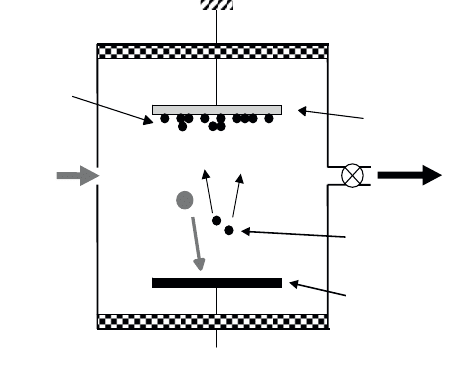
This technique consists of applying a continuous voltage of a few hundred volts
between the material to be deposited (cathode) and the material to be coated (anode)
in the presence of argon in a vacuum ranging from 10
–1
to 10
–2
Pa. This results in the
ionization of the accelerated argon atoms that bombard the cathode, causing the
ejection of surface atoms which leave the target with high kinetic energy and are
deposited onto the substrate (see Figure 3.33).
(-)
Atome pulvérisé
de la cible
Substrat (anode)
Film
Ar
+
Arrivée
d’argon
Pompe à vide
Cible
Coating
Substrate
(anode)
Vacuum pump
Atom
sputtered
Target
Argon
g
as
Figure 3.33. Principle of sputtering
Reactive gases other than argon can also be injected into the reactor. For
example, oxygen or nitrogen can be used, and these gases combine with the atoms
Materials for Tribology 159
ejected from the target to form oxide or nitride films. This technique is referred to as
reactive sputtering and allows films of TiN, CrN, AlN, SiO
2
or TiON to be easily
obtained.
After deposition of the coating, it is possible to negatively polarize the sample
being treated in order to attract argon ions and thus submit it to ionic bombardment.
This treatment can also be performed during film preparation. It effectively
increases the density of the deposition material and yields improvement in the
interface quality and in the adhesion between different layers for multi-layered
material deposition. This has been clearly demonstrated in the case of multilayered
TiN/AlN films [THOB 99, THOB 00]. In addition, ionic deposition can also be
assisted by a beam of argon ions that bombard the film during growth. Many alloys
such as TiB
2
, SiC or NiTiN have been produced in this way and deposited onto
silicon, steel and TA6V substrates [RIV 00].
However, applying a continuous voltage to the cathode does not allow the
sputtering on targets made of insulating material, because sputtering is rapidly
arrested by the accumulation of surface charge. This problem is solved using a radio
frequency system where an alternating voltage is applied to the cathode. With this
technique, argon ions bombard the surface of the target material and eject the
surface atoms during the negative-going polarization phase. When the polarization is
reversed, the cathode attracts the electrons which then neutralize the positive surface
charge.
The deposition speed depends on a number of parameters such as the sputtering
yield of the target material, the kinetic energy of the argon ions and the reactor
geometry. The deposition speed can be greatly increased by fitting the sample-
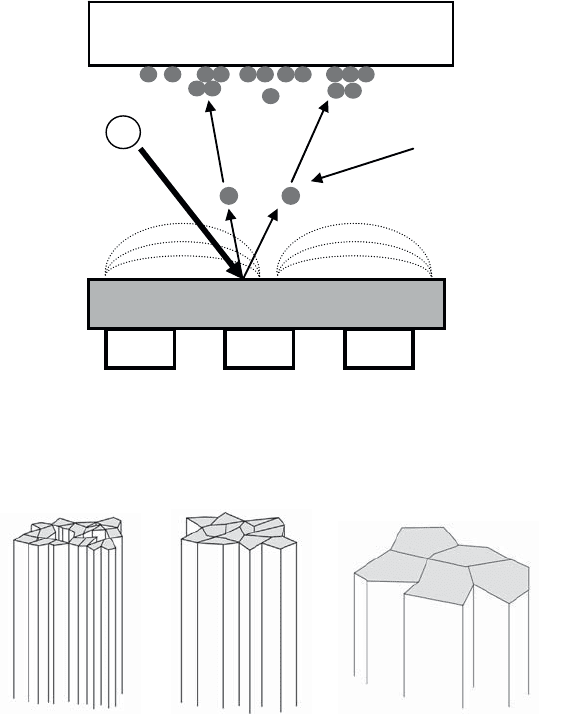
holder with a magnetron (Figure 3.34) in order to apply a strong magnetic field
using magnets placed behind the target. Electrons therefore follow the magnetic
field lines and follow a helical path. This significantly increases the length of their
trajectory and, as a result, the number of their collisions with argon atoms. The
ensuing increase in the number of argon ions leads to greater sputtering and enhanced
deposition speeds.
Films produced through cathodic sputtering are generally characterized by a
columnar structure with a morphology that depends on the pressure and on the ratio
between the deposition temperature (T) and melting point of the material deposit
(Tm).
Figure 3.35 shows a schematic representation of typical microstructures obtained.
For a relative temperature (T/Tm) between 0 and 0.4, the structure obtained is porous
and the columns are very thin (see Figure 3.35a). When the relative temperature is
between 0.6 and 0.8, the columns join together and the structure of the material is
160 Materials and Surface Engineering in Tribology
denser (see Figure 3.35b). At higher relative temperatures (T/Tm ranging from 0.8 to
1), we observe recrystallization and the growth of grains (see Figure 3.35c). For
relative temperatures in the range 0.4 to 0.6, the structures are poorly-defined. It is
important to note, however, that these temperature ranges can vary slightly as a
function of the pressure [MES 84, THOR 74].
Sputtered atom
S N N
Ar
+
Target
Subs
trat
e
Figure 3.34. Principle of the magnetron. Under the effect of the magnetic field,
the electrons take on a helicoidal trajectory. The atoms of the target are sputtered
under the impact of the argon ions and are deposited onto the substrate
a) b) c)
Figure 3.35. Schematic representation of the microstructure of a film deposited by sputtering:
a) porous microstructure made up of fine columns; b) wider columns of a less porous
structure; c) recrystallization and growth of grains
Materials for Tribology 161
Sputtering set-ups always place the target material and sample to be coated
opposite one another (see Figure 3.33), allowing for the generation of column
deposits perpendicular to the surface of the sample. Modifying the angle of the
sample-holder to a certain degree relative to the target makes it possible to achieve
oblique films. However, use of this glancing angle deposition (or GLAD) technique
is currently somewhat limited [BUZ 04, SATOM 00, SET 99].
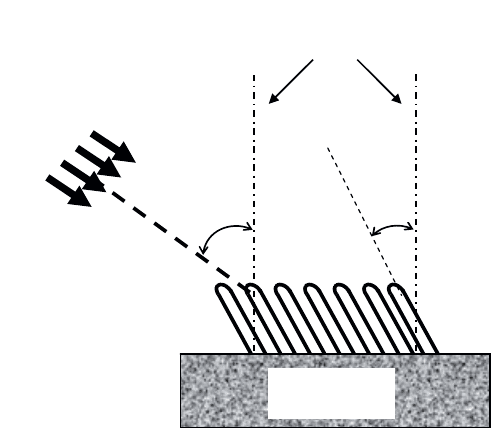
Experimentally, it is observed that there is always a difference between the angle
between the normal to the surface and the direction of incident particle flux (Į) and
the angle between the normal and the direction of column growth (ȕ) (see Figure
3.36). The angle D is generally between ȕ and 2 ȕ.
Substrat
Flux de particules
D
ȕ
Normale à la surface
du substrat
Flux of particles
Normal to substrate
Substrate
Figure 3.36. Definition of the incident particle angle (Į) and of the glancing angle (ȕ) of the
columns relative to the substrate (adapted from [LIN 03a])
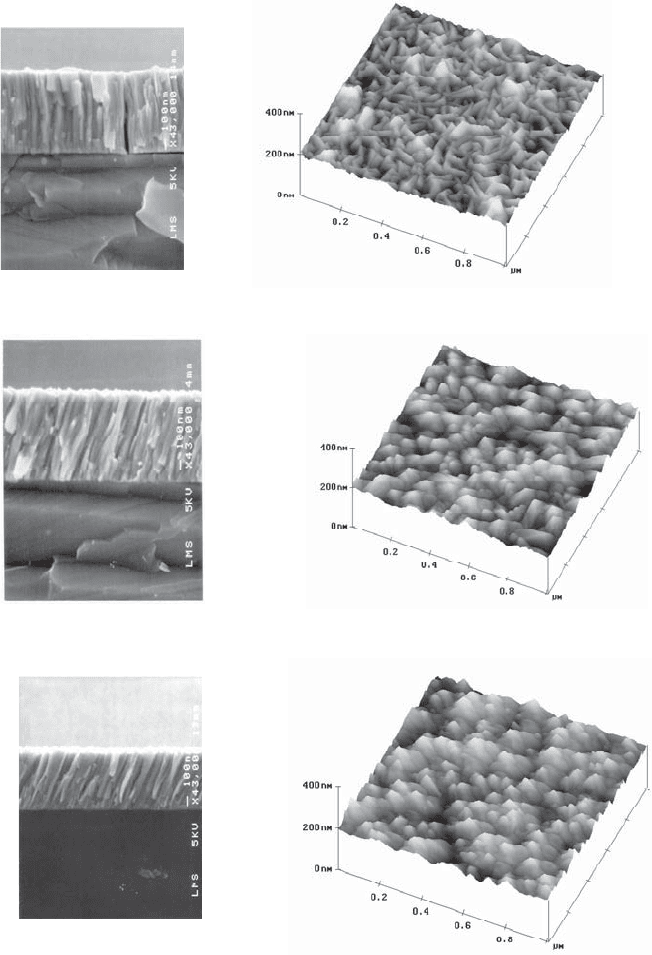
Figure 3.37 shows the microstructure and surface morphology of some oblique
chromium films deposited onto silicon for various angles Į. It is clearly seen that the
surface topography can be modified by changing the incident angle of the primary
particles. It is therefore possible to obtain surfaces of varying porosity and
roughness and with a tailored distribution of hills and valleys.
The possibility to produce surfaces with topographically engineered surfaces
makes this technique a very important tool for tribological applications.
162 Materials and Surface Engineering in Tribology
D
= 0°
D
= 30°
D
= 50°
Figure 3.37. Microstructure and surface morphology of oblique chromium films
as a function of various angles Į [LIN 03b]
Materials for Tribology 163
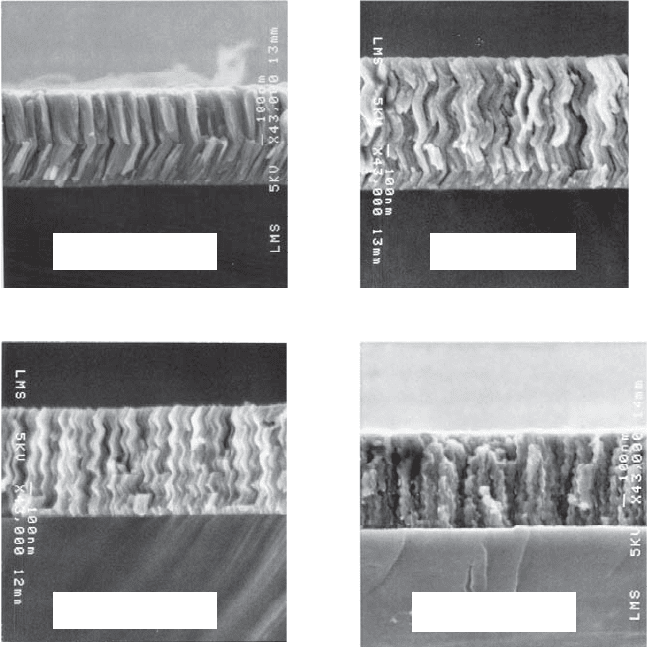
Apart from oblique films such as shown in Figure 3.37, it is also possible to
deposit zigzag-structured films consisting of successive layers alternately inclined in
opposite directions relative to the normal to the surface of the sample. This is shown
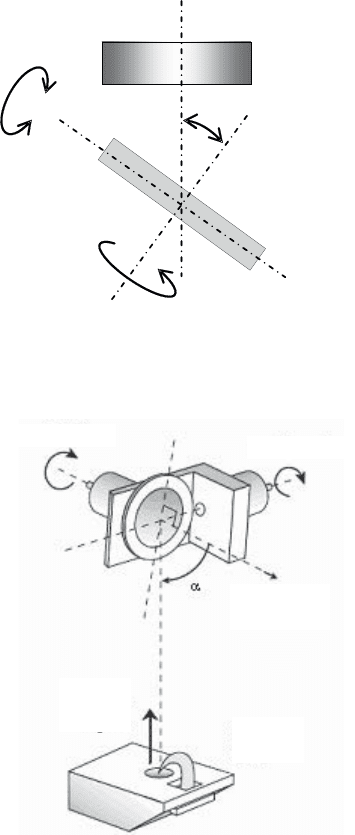
in Figure 3.38. To achieve this, it is necessary to tilt the sample in two directions
relative to the incident particle flux, alternatively (+Į and –Į). If, in addition to this
inclination, the sample is also subjected to a (continuous) rotation in its reference
plane (see angle ij in Figures 3.39 and 3.40), it may be possible to generate C-
shaped, S-shaped or even helix-shaped films [LIN 03a, SATOM 00, VANP 05].
n = 6 n = 2
n = 10
n = 20
Figure 3.38. Zigzag-shaped chromium films. The inclination angle Į is 50°
and n indicates the number of deposited layers in each case [LIN 04]
164 Materials and Surface Engineering in Tribology
Figure 3.39. Schematic representation showing the movements of a sample-holder
that allows the deposition of successive layers with different microstructures
(figure inspired from [LIN 03a])
Figure 3.40. Schematic representation of the principle of controlled deposition using the
GLAD technique. Two motors allow the sample to undergo rotations in two orthogonal
planes, thus allowing the desired structure to be obtained (see Figure 3.4) [VANP 04]
Į - Rotation
Normal to
substrate
PVD
source
Vapor
flux
ij - Rotation
Target
S
ubstrat e
ij
Į
Į