
Thomas M. Cover, Joy A. Thomas. Elements of information theory
Подождите немного. Документ загружается.

14.4 KOLMOGOROV COMPLEXITY OF INTEGERS 475
Removing the conditioning on the length of the sequence is straight-
forward. By similar arguments, we can show that
H(X) ≤
1
n
x
n
f(x
n
)K(x
n
) ≤ H(X)+
(|
X|+1) log n
n
+
c
n
(14.36)
for all n. The lower bound follows from the fact that K(x
n
) is also a
prefix-free code for the source, and the upper bound can be derived from
the fact that K(x
n
) ≤ K(x
n
|n) + 2logn + c. Thus,
E
1
n
K(X
n
) → H(X), (14.37)
and the compressibility achieved by the computer goes to the entropy
limit.
14.4 KOLMOGOROV COMPLEXITY OF INTEGERS
In Section 14.3 we defined the Kolmogorov complexity of a binary string
as the length of the shortest program for a universal computer that prints
out that string. We can extend that definition to define the Kolmogorov
complexity of an integer to be the Kolmogorov complexity of the corre-
sponding binary string.
Definition The Kolmogorov complexity of an integer n is defined as
K(n) = min
p: U (p)=n
l(p). (14.38)
The properties of the Kolmogorov complexity of integers are very sim-
ilar to those of the Kolmogorov complexity of bit strings. The following
properties are immediate consequences of the corresponding properties
for strings.
Theorem 14.4.1 For universal computers
A and U,
K
U
(n) ≤ K
A
(n) + c
A
. (14.39)
Also, since any number can be specified by its binary expansion, we
have the following theorem.
Theorem 14.4.2
K(n) ≤ log
∗
n + c. (14.40)

476 KOLMOGOROV COMPLEXITY
Theorem 14.4.3 There are an infinite number of integers n such that
K(n) > log n.
Proof: We know from Lemma 14.3.1 that
n
2
−K(n)
≤ 1 (14.41)
and
n
2
−log n
=
n
1
n
=∞. (14.42)
But if K(n) < log n for all n>n
0
,then
∞
n=n
0
2
−K(n)
>
∞
n=n
0
2
−log n
=∞, (14.43)
which is a contradiction.
14.5 ALGORITHMICALLY RANDOM AND INCOMPRESSIBLE
SEQUENCES
From the examples in Section 14.2, it is clear that there are some long
sequences that are simple to describe, like the first million bits of π.By
the same token, there are also large integers that are simple to describe,
such as
2
2
2
2
2
2
2
or (100!)!.
We now show that although there are some simple sequences, most
sequences do not have simple descriptions. Similarly, most integers are
not simple. Hence, if we draw a sequence at random, we are likely to
draw a complex sequence. The next theorem shows that the probability
that a sequence can be compressed by more than k bits is no greater than
2
−k
.
Theorem 14.5.1 Let X
1
,X
2
,...,X
n
be drawn according to a Bernoulli
(
1
2
) process. Then
P
(
K(X
1
X
2
...X
n
|n) < n − k
)
< 2
−k
. (14.44)

14.5 ALGORITHMICALLY RANDOM AND INCOMPRESSIBLE SEQUENCES 477
Proof:
P(K(X
1
X
2
...X
n
|n) < n − k)
=
x
1
x
2
...x
n
: K(x
1
x
2
...x
n
|n)<n−k
p(x
1
,x
2
,...,x
n
)
(14.45)
=
x
1
x
2
...x
n
: K(x
1
x
2
...x
n
|n)<n−k
2
−n
(14.46)
=
|
{x
1
x
2
...x
n
: K(x
1
x
2
...x
n
|n) < n − k}
|
2
−n
< 2
n−k
2
−n
(by Theorem 14.2.4) (14.47)
= 2
−k
. (14.48)
Thus, most sequences have a complexity close to their length. For
example, the fraction of sequences of length n that have complexity less
than n − 5 is less than 1/32. This motivates the following definition:
Definition A sequence x
1
,x
2
,...,x
n
is said to be algorithmically ran-
dom if
K(x
1
x
2
...x
n
|n) ≥ n. (14.49)
Note that by the counting argument, there exists, for each n, at least
one sequence x
n
such that
K(x
n
|n) ≥ n. (14.50)
Definition We call an infinite string x incompressible if
lim
n→∞
K(x
1
x
2
x
3
···x
n
|n)
n
= 1. (14.51)
Theorem 14.5.2 (Strong law of large numbers for incompressible se-
quences) If a string x
1
x
2
...is incompressible, it satisfies the law of large
numbers in the sense that
1
n
n
i=1
x
i
→
1
2
. (14.52)
Hence the proportions of 0’s and 1’s in any incompressible string are
almost equal.
478 KOLMOGOROV COMPLEXITY
Proof: Let θ
n
=
1
n
n
i=1
x
i
denote the proportion of 1’s in x
1
x
2
...
x
n
. Then using the method of Example 14.2, one can write a program
of length nH
0
(θ
n
) + 2log(nθ
n
) + c to print x
n
. Thus,
K(x
n
|n)
n
<H
0
(θ
n
) + 2
log n
n
+
c
n
. (14.53)
By the incompressibility assumption, we also have the lower bound for
large enough n,
1 − ≤
K(x
n
|n)
n
≤ H
0
(θ
n
) + 2
log n
n
+
c
n
. (14.54)
Thus,
H
0
(θ
n
)>1 −
2logn + c
n
− . (14.55)
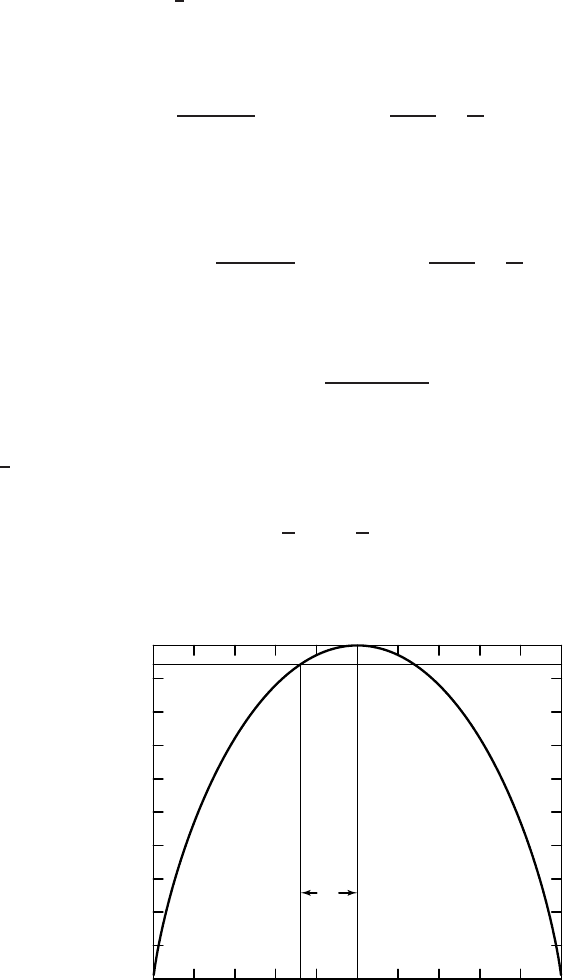
Inspection of the graph of H
0
(p) (Figure 14.2) shows that θ
n
is close to
1
2
for large n. Specifically, the inequality above implies that
θ
n
∈
1
2
− δ
n
,
1
2
+ δ
n
, (14.56)
0
0.1
0.2
0.3
0.4
0.5
0.6
0.7
0.8
^
0.9
H
0
(
p
n
)
1
0 0.1 0.2 0.3 0.4 0.5
d
n
0.6 0.7 0.8 0.9 1
p
H
(
p
)
FIGURE 14.2. H
0
(p) vs. p.
14.5 ALGORITHMICALLY RANDOM AND INCOMPRESSIBLE SEQUENCES 479
where δ
n
is chosen so that
H
0
1
2
− δ
n
= 1 −
2logn + c
n
+ c
n
, (14.57)
which implies that δ
n
→ 0asn →∞. Thus,
1
n
x
i
→
1
2
as n →∞.
We have now proved that incompressible sequences look random in the
sense that the proportion of 0’s and 1’s are almost equal. In general, we
can show that if a sequence is incompressible, it will satisfy all computable
statistical tests for randomness. (Otherwise, identification of the test that x
fails will reduce the descriptive complexity of x, yielding a contradiction.)
In this sense, the algorithmic test for randomness is the ultimate test,
including within it all other computable tests for randomness.
We now prove a related law of large numbers for the Kolmogorov
complexity of Bernoulli(θ ) sequences. The Kolmogorov complexity of
a sequence of binary random variables drawn i.i.d. according to a
Bernoulli(θ) process is close to the entropy H
0
(θ). In Theorem 14.3.1
we proved that the expected value of the Kolmogorov complex-
ity of a random Bernoulli sequence converges to the entropy [i.e.,
E
1
n
K(X
1
X
2
...X
n
|n) → H
0
(θ)]. Now we remove the expectation.
Theorem 14.5.3 Let X
1
,X
2
,...,X
n
be drawn i.i.d. ∼ Bernoulli(θ ).
Then
1
n
K(X
1
X
2
...X
n
|n) → H
0
(θ) in probability. (14.58)
Proof: Let
X
n
=
1
n
X
i
be the proportion of 1’s in X
1
,X
2
,...,X
n
.
Then using the method described in (14.23), we have
K(X
1
X
2
...X
n
|n) ≤ nH
0
X
n
+ 2logn + c, (14.59)
and since by the weak law of large numbers,
X
n
→ θ in probability, we
have
Pr
1
n
K(X
1
X
2
...X
n
|n) − H
0
(θ) ≥
→ 0. (14.60)
Conversely, we can bound the number of sequences with complexity sig-
nificantly lower than the entropy. From the AEP, we can divide the set
of sequences into the typical set and the nontypical set. There are at

480 KOLMOGOROV COMPLEXITY
least (1 − )2
n(H
0
(θ)−)
sequences in the typical set. At most 2
n(H
0
(θ)−c)
of these typical sequences can have a complexity less than n(H
0
(θ) − c).
The probability that the complexity of the random sequence is less than
n(H
0
(θ) − c) is
Pr(K(X
n
|n) < n(H
0
(θ) − c))
≤ Pr(X
n
/∈ A
(n)
) + Pr(X
n
∈ A
(n)
,K(X
n
|n) < n(H
0
(θ) − c))
≤ +
x
n
∈A
(n)
,K(x
n
|n)<n(H
0
(θ)−c)
p(x
n
) (14.61)
≤ +
x
n
∈A
(n)
,K(x
n
|n)<n(H
0
(θ)−c)
2
−n(H
0
(θ)−)
(14.62)
≤ + 2
n(H
0
(θ)−c)
2
−n(H
0
(θ)−)
(14.63)
= + 2
−n(c−)
, (14.64)
which is arbitrarily small for appropriate choice of , n,andc. Hence with
high probability, the Kolmogorov complexity of the random sequence is
close to the entropy, and we have
K(X
1
,X
2
,...,X
n
|n)
n
→ H
0
(θ) in probability. (14.65)
14.6 UNIVERSAL PROBABILITY
Suppose that a computer is fed a random program. Imagine a monkey
sitting at a keyboard and typing the keys at random. Equivalently, feed a
series of fair coin flips into a universal Turing machine. In either case, most
strings will not make sense to the computer. If a person sits at a terminal
and types keys at random, he will probably get an error message (i.e., the
computer will print the null string and halts). But with a certain probability
she will hit on something that makes sense. The computer will then print
out something meaningful. Will this output sequence look random?
From our earlier discussions, it is clear that most sequences of length n
have complexity close to n. Since the probability of an input program p
is 2
−l(p)
, shorter programs are much more probable than longer ones; and
when they produce long strings, shorter programs do not produce random
strings; they produce strings with simply described structure.
The probability distribution on the output strings is far from uniform.
Under the computer-induced distribution, simple strings are more likely
14.6 UNIVERSAL PROBABILITY 481
than complicated strings of the same length. This motivates us to define
a universal probability distribution on strings as follows:
Definition The universal probability of a string x is
P
U
(x) =
p: U (p)=x
2
−l(p)
= Pr(U(p) = x), (14.66)
which is the probability that a program randomly drawn as a sequence of
fair coin flips p
1
,p
2
,... will print out the string x.
This probability is universal in many senses. We can consider it as the
probability of observing such a string in nature; the implicit belief is that
simpler strings are more likely than complicated strings. For example, if
we wish to describe the laws of physics, we might consider the simplest
string describing the laws as the most likely. This principle, known as
Occam’s Razor, has been a general principle guiding scientific research
for centuries: If there are many explanations consistent with the observed
data, choose the simplest. In our framework, Occam’s Razor is equivalent
to choosing the shortest program that produces a given string.
This probability mass function is called universal because of the fol-
lowing theorem.
Theorem 14.6.1 For every computer
A,
P
U
(x) ≥ c
A
P
A
(x) (14.67)
for every string x ∈{0, 1}
∗
, where the constant c
A
depends only on U and
A.
Proof: From the discussion of Section 14.2, we recall that for every
program p
for A that prints x, there exists a program p for U of length
not more than l(p
) + c
A
produced by prefixing a simulation program for
A. Hence,
P
U
(x) =
p: U (p)=x
2
−l(p)
≥
p
:A(p
)=x
2
−l(p
)−c
A
= c
A
P
A
(x). (14.68)
Any sequence drawn according to a computable probability mass func-
tion on binary strings can be considered to be produced by some computer
A acting on a random input (via the probability inverse transformation
acting on a random input). Hence, the universal probability distribution
includes a mixture of all computable probability distributions.

482 KOLMOGOROV COMPLEXITY
Remark (Bounded likelihood ratio). In particular, Theorem 14.6.1 guar-
antees that a likelihood ratio test of the hypothesis that X is drawn
according to P
U
versus the hypothesis that it is drawn according to
P
A
will have bounded likelihood ratio. If U and A are universal, the
P
U
(x)/P
A
(x) is bounded away from 0 and infinity for all x.Thisisin
contrast to other simple hypothesis-testing problems (like Bernoulli(θ
1
)
versus Bernoulli(θ
2
)), where the likelihood ratio goes to 0 or ∞ as the
sample size goes to infinity. Apparently, P
U
, which is a mixture of all
computable distributions, can never be rejected completely as the true
distribution of any data drawn according to some computable probability
distribution. In that sense we cannot reject the possibility that the universe
is the output of monkeys typing at a computer. However, we can reject
the hypothesis that the universe is random (monkeys with no computer).
In Section 14.11 we prove that
P
U
(x) ≈ 2
−K(x)
, (14.69)
thus showing that K(x) and log
1
P
U
(x)
have equal status as universal algo-
rithmic complexity measures. This is especially interesting since log
1
P
U
(x)
is the ideal codeword length (the Shannon codeword length) with respect
to the universal probability distribution P
U
(x).
We conclude this section with an example of a monkey at a typewriter
vs. a monkey at a computer keyboard. If the monkey types at random
on a typewriter, the probability that it types out all the works of Shake-
speare (assuming that the text is 1 million bits long) is 2
−1,000,000
.Ifthe
monkey sits at a computer terminal, however, the probability that it types
out Shakespeare is now 2
−K(Shakespeare)
≈ 2
−250,000
, which although
extremely small is still exponentially more likely than when the monkey
sits at a dumb typewriter.
The example indicates that a random input to a computer is much more
likely to produce “interesting” outputs than a random input to a typewriter.
We all know that a computer is an intelligence amplifier. Apparently, it
creates sense from nonsense as well.
14.7 THE HALTING PROBLEM AND THE NONCOMPUTABILITY
OF KOLMOGOROV COMPLEXITY
Consider the following paradoxical statement:
This statement is false.
This paradox is sometimes stated in a two-statement form:
14.7 KOLMOGOROV COMPLEXITY 483
The next statement is false.
The preceding statement is true.
These paradoxes are versions of what is called the Epimenides liar para-
dox, and it illustrates the pitfalls involved in self-reference. In 1931, G
¨
odel
used this idea of self-reference to show that any interesting system of
mathematics is not complete; there are statements in the system that are
true but that cannot be proved within the system. To accomplish this, he
translated theorems and proofs into integers and constructed a statement
of the above form, which can therefore not be proved true or false.
The halting problem in computer science is very closely connected
with G
¨
odel’s incompleteness theorem. In essence, it states that for any
computational model, there is no general algorithm to decide whether a
program will halt or not (go on forever). Note that it is not a statement
about any specific program. Quite clearly, there are many programs that
can easily be shown to halt or go on forever. The halting problem says
that we cannot answer this question for all programs. The reason for this
is again the idea of self-reference.
To a practical person, the halting problem may not be of any immediate
significance, but it has great theoretical importance as the dividing line
between things that can be done on a computer (given unbounded memory
and time) and things that cannot be done at all (such as proving all true
statements in number theory). G
¨
odel’s incompleteness theorem is one of
the most important mathematical results of the twentieth century, and its
consequences are still being explored. The halting problem is an essential
example of G
¨
odel’s incompleteness theorem.
One of the consequences of the nonexistence of an algorithm for the
halting problem is the noncomputability of Kolmogorov complexity. The
only way to find the shortest program in general is to try all short programs
and see which of them can do the job. However, at any time some of
the short programs may not have halted and there is no effective (finite
mechanical) way to tell whether or not they will halt and what they will
print out. Hence, there is no effective way to find the shortest program to
print a given string.
The noncomputability of Kolmogorov complexity is an example of the
Berry paradox. The Berry paradox asks for the shortest number not name-
able in under 10 words. A number like 1,101,121 cannot be a solution
since the defining expression itself is less than 10 words long. This illus-
trates the problems with the terms nameable and describable;theyare
too powerful to be used without a strict meaning. If we restrict ourselves
to the meaning “can be described for printing out on a computer,” we can
resolve Berry’s paradox by saying that the smallest number not describable

484 KOLMOGOROV COMPLEXITY
in less than 10 words exists but is not computable. This “description” is
not a program for computing the number. E. F. Beckenbach pointed out
a similar problem in the classification of numbers as dull or interesting;
the smallest dull number must be interesting.
As stated at the beginning of the chapter, one does not really anticipate
that practitioners will find the shortest computer program for a given
string. The shortest program is not computable, although as more and more
programs are shown to produce the string, the estimates from above of
the Kolmogorov complexity converge to the true Kolmogorov complexity.
(The problem, of course, is that one may have found the shortest program
and never know that no shorter program exists.) Even though Kolmogorov
complexity is not computable, it provides a framework within which to
consider questions of randomness and inference.
14.8
In this section we introduce Chaitin’s mystical, magical number, ,which
has some extremely interesting properties.
Definition
=
p: U (p) halts
2
−l(p)
. (14.70)
Note that = Pr(
U(p) halts), the probability that the given universal
computer halts when the input to the computer is a binary string drawn
according to a Bernoulli(
1
2
) process.
Since the programs that halt are prefix-free, their lengths satisfy the
Kraft inequality, and hence the sum above is always between 0 and 1. Let
n
= .ω
1
ω
2
···ω
n
denote the first n bits of . The properties of are
as follows:
1. is noncomputable. There is no effective (finite, mechanical) way
to check whether arbitrary programs halt (the halting problem), so
there is no effective way to compute .
2. is a “philosopher’s stone”. Knowing to an accuracy of n
bits will enable us to decide the truth of any provable or finitely
refutable mathematical theorem that can be written in less than n
bits. Actually, all that this means is that given n bits of ,there
is an effective procedure to decide the truth of n-bit theorems; the
procedure may take an arbitrarily long (but finite) time. Of course,
without knowing , it is not possible to check the truth or falsity of