
Thomas M. Cover, Joy A. Thomas. Elements of information theory
Подождите немного. Документ загружается.

14.8 485
every theorem by an effective procedure (G
¨
odel’s incompleteness
theorem).
The basic idea of the procedure using n bits of is simple: We
run all programs until the sum of the masses 2
−l(p)
contributed
by programs that halt equals or exceeds
n
= 0.ω
1
ω
2
···ω
n
,the
truncated version of that we are given. Then, since
−
n
< 2
−n
, (14.71)
we know that the sum of all further contributions of the form 2
−l(p)
to from programs that halt must also be less than 2
−n
. This implies
that no program of length ≤ n that has not yet halted will ever halt,
which enables us to decide the halting or nonhalting of all programs
of length ≤ n.
To complete the proof, we must show that it is possible for a com-
puter to run all possible programs in “parallel” in such a way that
any program that halts will eventually be found to halt. First, list all
possible programs, starting with the null program, :
, 0, 1, 00, 01, 10, 11, 000, 001, 010, 011,.... (14.72)
Then let the computer execute one clock cycle of for the first
cycle. In the next cycle, let the computer execute two clock cycles
of and two clock cycles of the program 0. In the third cycle, let
it execute three clock cycles of each of the first three programs, and
so on. In this way, the computer will eventually run all possible
programs and run them for longer and longer times, so that if any
program halts, it will eventually be discovered to halt. The com-
puter keeps track of which program is being executed and the cycle
number so that it can produce a list of all the programs that halt.
Thus, we will ultimately know whether or not any program of less
than n bits will halt. This enables the computer to find any proof
of the theorem or a counterexample to the theorem if the theorem
can be stated in less than n bits. Knowledge of turns previously
unprovable theorems into provable theorems. Here actsasan
oracle.
Although seems magical in this respect, there are other numbers
that carry the same information. For example, if we take the list of
programs and construct a real number in which the ith bit indicates
whether program i halts, this number can also be used to decide
any finitely refutable question in mathematics. This number is very
dilute (in information content) because one needs approximately 2
n
486 KOLMOGOROV COMPLEXITY
bits of this indicator function to decide whether or not an n-bit
program halts. Given 2
n
bits, one can tell immediately without any
computation whether or not any program of length less than n halts.
However, is the most compact representation of this information
since it is algorithmically random and incompressible.
What are some of the questions that we can resolve using ?
Many of the interesting problems in number theory can be stated
as a search for a counterexample. For example, it is straightforward
to write a program that searches over the integers x, y, z,andn
and halts only if it finds a counterexample to Fermat’s last theorem,
which states that
x
n
+ y
n
= z
n
(14.73)
has no solution in integers for n ≥ 3. Another example is Goldbach’s
conjecture, which states that any even number is a sum of two
primes. Our program would search through all the even numbers
starting with 2, check all prime numbers less than it and find a
decomposition as a sum of two primes. It will halt if it comes across
an even number that does not have such a decomposition. Knowing
whether this program halts is equivalent to knowing the truth of
Goldbach’s conjecture.
We can also design a program that searches through all proofs
and halts only when it finds a proof of the theorem required. This
program will eventually halt if the theorem has a finite proof. Hence
knowing n bits of , we can find the truth or falsity of all theorems
that have a finite proof or are finitely refutable and which can be
stated in less than n bits.
3. is algorithmically random.
Theorem 14.8.1 cannot be compressed by more than a constant;
that is, there exists a constant c such that
K(ω
1
ω
2
...ω
n
) ≥ n − c for all n. (14.74)
Proof: We know that if we are given n bits of , we can determine
whether or not any program of length ≤ n halts. Using K(ω
1
ω
2
···
ω
n
) bits, we can calculate n bits of , and then we can generate a list
of all programs of length ≤ n that halt, together with their corresponding
outputs. We find the first string x
0
that is not on this list. The string x
0
is then the shortest string with Kolmogorov complexity K(x
0
)>n.The
14.9 UNIVERSAL GAMBLING 487
complexity of this program to print x
0
is K(
n
) + c, which must be at
least as long as the shortest program for x
0
. Consequently,
K(
n
) + c ≥ K(x
0
)>n (14.75)
for all n. Thus, K(ω
1
ω
2
···ω
n
)>n− c,and cannot be compressed by
more than a constant.
14.9 UNIVERSAL GAMBLING
Suppose that a gambler is asked to gamble sequentially on sequences
x ∈{0, 1}
∗
. He has no idea of the origin of the sequence. He is given
fair odds (2-for-1) on each bit. How should he gamble? If he knew the
distribution of the elements of the string, he might use proportional betting
because of its optimal growth-rate properties, as shown in Chapter 6. If he
believes that the string occurred naturally, it seems intuitive that simpler
strings are more likely than complex ones. Hence, if he were to extend
the idea of proportional betting, he might bet according to the universal
probability of the string. For reference, note that if the gambler knows the
string x in advance, he can increase his wealth by a factor of 2
l(x)
simply
by betting all his wealth each time on the next symbol of x. Let the wealth
S(x) associated with betting scheme b(x),
b(x) = 1, be given by
S(x) = 2
l(x)
b(x). (14.76)
Suppose that the gambler bets b(x) = 2
−K(x)
on a string x. This betting
strategy can be called universal gambling. We note that the sum of the
bets
x
b(x) =
x
2
−K(x)
≤
p:p halts
2
−l(p)
= ≤ 1, (14.77)
and he will not have used all his money. For simplicity, let us assume
that he throws the rest away. For example, the amount of wealth resulting
from a bet b(0110) on a sequence x = 0110 is 2
l(x)
b(x) = 2
4
b(0110) plus
the amount won on all bets b(0110 ...) on sequences that extend x.
Then we have the following theorem:
Theorem 14.9.1 The logarithm of the wealth a gambler achieves on a
sequence using universal gambling plus the complexity of the sequence is
no smaller than the length of the sequence, or
log S(x) + K(x) ≥ l(x). (14.78)

488 KOLMOGOROV COMPLEXITY
Remark This is the counterpart of the gambling conservation theorem
W
∗
+ H = log m from Chapter 6.
Proof: The proof follows directly from the universal gambling scheme,
b(x) = 2
−K(x)
,since
S(x) =
x
x
2
l(x)
b(x
) ≥ 2
l(x)
2
−K(x)
, (14.79)
where x
x means that x is a prefix of x
. Taking logarithms establishes
the theorem.
The result can be understood in many ways. For infinite sequences x
with finite Kolmogorov complexity,
S(x
1
x
2
···x
l
) ≥ 2
l−K(x)
= 2
l−c
(14.80)
for all l.Since2
l
is the most that can be won in l gambles at fair odds,
this scheme does asymptotically as well as the scheme based on knowing
the sequence in advance. For example, if x = π
1
π
2
···π
n
···, the digits
in the expansion of π, the wealth at time n will be S
n
= S(x
n
) ≥ 2
n−c
for all n.
If the string is actually generated by a Bernoulli process with parameter
p,then
S(X
1
...X
n
) ≥ 2
n−nH
0
(
X
n
)
−2logn−c
≈ 2
n(1−H
0
(p)−2
log n
n
−
c
n
)
, (14.81)
which is the same to first order as the rate achieved when the gambler
knows the distribution in advance, as in Chapter 6.
From the examples we see that the universal gambling scheme on a
random sequence does asymptotically as well as a scheme that uses prior
knowledge of the true distribution.
14.10 OCCAM’S RAZOR
In many areas of scientific research, it is important to choose among
various explanations of data observed. After choosing the explanation,
we wish to assign a confidence level to the predictions that ensue from
the laws that have been deduced. For example, Laplace considered the
probability that the sun will rise again tomorrow given that it has risen
every day in recorded history. Laplace’s solution was to assume that the
rising of the sun was a Bernoulli(θ) process with unknown parameter θ .
He assumed that θ was uniformly distributed on the unit interval. Using
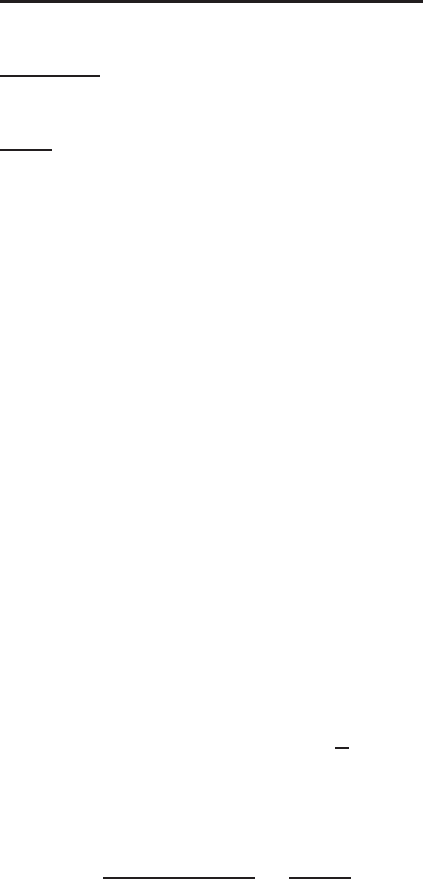
14.10 OCCAM’S RAZOR 489
the observed data, he calculated the posterior probability that the sun will
rise again tomorrow and found that it was
P(X
n+1
= 1|X
n
= 1,X
n−1
= 1,...,X
1
= 1)
=
P(X
n+1
= 1,X
n
= 1,X
n−1
= 1,...,X
1
= 1)
P(X
n
= 1,X
n−1
= 1,...,X
1
= 1)
=
1
0
θ
n+1
dθ
1
0
θ
n
dθ
(14.82)
=
n + 1
n + 2
, (14.83)
which he put forward as the probability that the sun will rise on day n + 1
given that it has risen on days 1 through n.
Using the ideas of Kolmogorov complexity and universal probability,
we can provide an alternative approach to the problem. Under the universal
probability, let us calculate the probability of seeing a 1 next after having
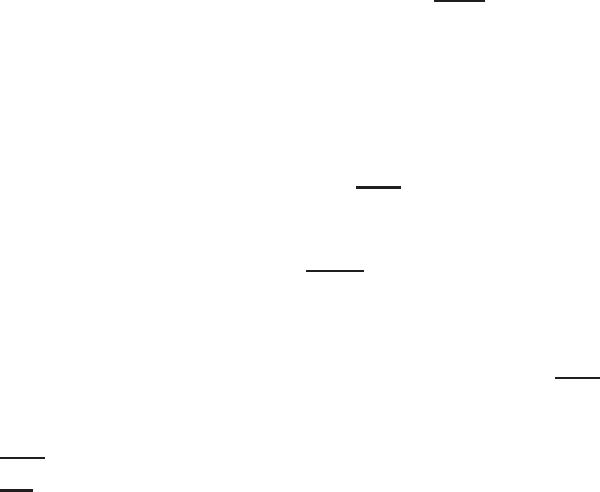
observed n 1’s in the sequence so far. The conditional probability that
the next symbol is a 1 is the ratio of the probability of all sequences
with initial segment 1
n
and next bit equal to 1 to the probability of all
sequences with initial segment 1
n
. The simplest programs carry most of
the probability; hence we can approximate the probability that the next
bit is a 1 with the probability of the program that says “Print 1’s forever.”
Thus,
y
p(1
n
1y) ≈ p(1
∞
) = c>0. (14.84)
Estimating the probability that the next bit is 0 is more difficult. Since any
program that prints 1
n
0 ... yields a description of n, its length should at
least be K(n), which for most n is about log n + O(log log n), and hence
ignoring second-order terms, we have
y
p(1
n
0y) ≈ p(1
n
0) ≈ 2
−log n
≈
1
n
. (14.85)
Hence, the conditional probability of observing a 0 next is
p(0|1
n
) =
p(1
n
0)
p(1
n
0) + p(1
∞
)
≈
1
cn + 1
, (14.86)
which is similar to the result p(0|1
n
) = 1/(n + 1) derived by Laplace.
490 KOLMOGOROV COMPLEXITY
This type of argument is a special case of Occam’s Razor, a general
principle governing scientific research, weighting possible explanations by
their complexity. William of Occam said “Nunquam ponenda est pluralitas
sine necesitate”: Explanations should not be multiplied beyond necessity
[516]. In the end, we choose the simplest explanation that is consistent
with the data observed. For example, it is easier to accept the general
theory of relativity than it is to accept a correction factor of c/r
3
to the
gravitational law to explain the precession of the perihelion of Mercury,
since the general theory explains more with fewer assumptions than does
a “patched” Newtonian theory.
14.11 KOLMOGOROV COMPLEXITY AND UNIVERSAL
PROBABILITY
We now prove an equivalence between Kolmogorov complexity and uni-
versal probability. We begin by repeating the basic definitions.
K(x) = min
p:U (p)=x
l(p) (14.87)
P
U
(x) =
p:U (p)=x
2
−l(p)
. (14.88)
Theorem 14.11.1 (Equivalence of K(x) and log
1
P
U
(x))
.) There exists
a constant c, independent of x, such that
2
−K(x)
≤ P
U
(x) ≤ c2
−K(x)
(14.89)
for all strings x. Thus, the universal probability of a string x is determined
essentially by its Kolmogorov complexity.
Remark This implies that K(x) and log
1
P
U
(x)
have equal status as uni-
versal complexity measures, since
K(x) − c
≤ log
1
P
U
(x)
≤ K(x). (14.90)
Recall that the complexity defined with respect to two different computers
K
U
and K
U
are essentially equivalent complexity measures if |K
U
(x) −
K
U
(x)| is bounded. Theorem 14.11.1 shows that K
U
(x) and log
1
P
U
(x)
are
essentially equivalent complexity measures.
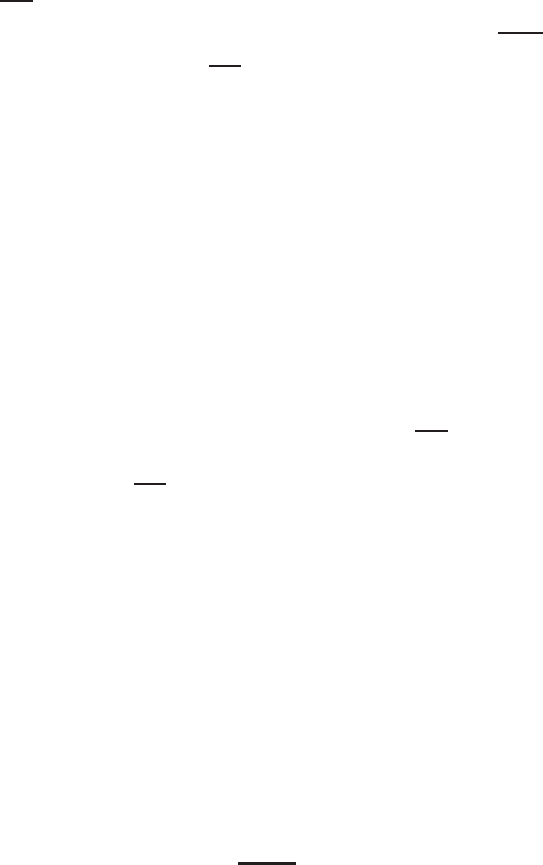
Notice the striking similarity between the relationship of K(x) and
log
1
P
U
(x)
in Kolmogorov complexity and the relationship of H(X) and
log
1
p(x)
in information theory. The ideal Shannon code length assignment
14.11 KOLMOGOROV COMPLEXITY AND UNIVERSAL PROBABILITY 491
l(x) = log
1
p(x)
achieves an average description length H(X), while in
Kolmogorov complexity theory, the ideal description length log
1
P
U
(x)
is
almost equal to K(X). Thus, log
1
p(x)
is the natural notion of descriptive
complexity of x in algorithmic as well as probabilistic settings.
The upper bound in (14.90) is obvious from the definitions, but the
lower bound is more difficult to prove. The result is very surprising, since
there are an infinite number of programs that print x. From any program
it is possible to produce longer programs by padding the program with
irrelevant instructions. The theorem proves that although there are an
infinite number of such programs, the universal probability is essentially
determined by the largest term, which is 2
−K(x)
.IfP
U
(x) is large, K(x)
is small, and vice versa.
However, there is another way to look at the upper bound that makes
it less surprising. Consider any computable probability mass function on
strings p(x). Using this mass function, we can construct a Shannon–Fano
code (Section 5.9) for the source and then describe each string by the
corresponding codeword, which will have length log
1
p(x)
. Hence, for
any computable distribution, we can construct a description of a string
using not more than log
1
p(x)
+ c bits, which is an upper bound on the
Kolmogorov complexity K(x). Even though P
U
(x) is not a computable
probability mass function, we are able to finesse the problem using the
rather involved tree construction procedure described below.
Proof: (of Theorem 14.11.1). The first inequality is simple. Let p
∗
be
the shortest program for x.Then
P
U
(x) =
p:U (p)=x
2
−l(p)
≥ 2
−l(p
∗
)
= 2
−K(x)
, (14.91)
as we wished to show.
We can rewrite the second inequality as
K(x) ≤ log
1
P
U
(x)
+ c. (14.92)
Our objective in the proof is to find a short program to describe the strings
that have high P
U
(x). An obvious idea is some kind of Huffman coding
based on P
U
(x), but P
U
(x) cannot be calculated effectively, hence a proce-
dure using Huffman coding is not implementable on a computer. Similarly,
the process using the Shannon–Fano code also cannot be implemented.
However, if we have the Shannon–Fano code tree, we can reconstruct the
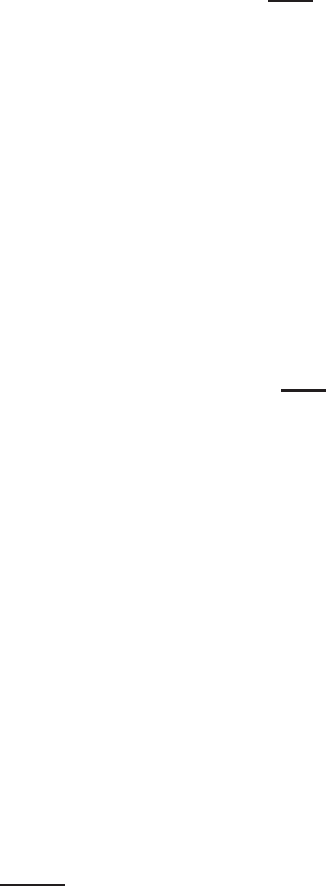
492 KOLMOGOROV COMPLEXITY
string by looking for the corresponding node in the tree. This is the basis
for the following tree construction procedure.
To overcome the problem of noncomputability of P
U
(x),weuseamod-
ified approach, trying to construct a code tree directly. Unlike Huffman
coding, this approach is not optimal in terms of minimum expected code-
word length. However, it is good enough for us to derive a code for which
each codeword for x has a length that is within a constant of log
1
P
U
(x)
.
Before we get into the details of the proof, let us outline our approach.
We want to construct a code tree in such a way that strings with high
probability have low depth. Since we cannot calculate the probability of a
string, we do not know a priori the depth of the string on the tree. Instead,
we assign x successively to the nodes of the tree, assigning x to nodes
closer and closer to the root as our estimate of P
U
(x) improves. We want
the computer to be able to recreate the tree and use the lowest depth node
corresponding to the string x to reconstruct the string.
We now consider the set of programs and their corresponding outputs
{(p, x)}. We try to assign these pairs to the tree. But we immediately
come across a problem—there are an infinite number of programs for a
given string, and we do not have enough nodes of low depth. However,
as we shall show, if we trim the list of program-output pairs, we will be
able to define a more manageable list that can be assigned to the tree.
Next, we demonstrate the existence of programs for x of length log
1
P
U
(x)
.
Tree construction procedure: For the universal computer
U,wesimulate
all programs using the technique explained in Section 14.8. We list all
binary programs:
, 0, 1, 00, 01, 10, 11, 000, 001, 010, 011,.... (14.93)
Then let the computer execute one clock cycle of for the first stage.
In the next stage, let the computer execute two clock cycles of and
two clock cycles of the program 0. In the third stage, let the computer
execute three clock cycles of each of the first three programs, and so on.
In this way, the computer will eventually run all possible programs and
run them for longer and longer times, so that if any program halts, it will
be discovered to halt eventually. We use this method to produce a list
of all programs that halt in the order in which they halt, together with
their associated outputs. For each program and its corresponding output,
(p
k
,x
k
), we calculate n
k
, which is chosen so that it corresponds to the
current estimate of P
U
(x). Specifically,
n
k
=
log
1
ˆ
P
U
(x
k
)
, (14.94)
14.11 KOLMOGOROV COMPLEXITY AND UNIVERSAL PROBABILITY 493
where
ˆ
P
U
(x
k
) =
(p
i
,x
i
):x
i
=x
k
,i≤k
2
−l(p
i
)
. (14.95)
Note that
ˆ
P
U
(x
k
) ↑ P
U
(x) on the subsequence of times k such that x
k
= x.
We are now ready to construct a tree. As we add to the list of triplets,
(p
k
,x
k
,n
k
), of programs that halt, we map some of them onto nodes of
a binary tree. For purposes of the construction, we must ensure that all
the n
i
’s corresponding to a particular x
k
are distinct. To ensure this, we
remove from the list all triplets that have the same x and n as a previous
triplet. This will ensure that there is at most one node at each level of the
tree that corresponds to a given x.
Let {(p
i
,x
i
,n
i
) : i = 1, 2, 3,...} denote the new list. On the winnowed
list, we assign the triplet (p
k
,x
k
,n
k
) to the first available node at level
n
k
+ 1. As soon as a node is assigned, all of its descendants become
unavailable for assignment. (This keeps the assignment prefix-free.)
We illustrate this by means of an example:
(p
1
,x
1
,n
1
) = (10111, 1110, 5), n
1
= 5 because P
U
(x
1
) ≥ 2
−l(p
1
)
= 2
−5
(p
2
,x
2
,n
2
) = (11, 10, 2), n
2
= 2 because P
U
(x
2
) ≥ 2
−l(p
2
)
= 2
−2
(p
3
,x
3
,n
3
) = (0, 1110, 1), n
3
= 1 because P
U
(x
3
) ≥ 2
−l(p
3
)
+ 2
−l(p
1
)
= 2
−5
+ 2
−1
≥ 2
−1
(p
4
,x
4
,n
4
) = (1010, 1111, 4), n
4
= 4 because P
U
(x
4
) ≥ 2
−l(p
4
)
= 2
−4
(p
5
,x
5
,n
5
) = (101101, 1110, 1), n
5
= 1 because P
U
(x
5
) ≥ 2
−1
+ 2
−5
+ 2
−5
≥ 2
−1
(p
6
,x
6
,n
6
) = (100, 1, 3), n
6
= 3 because P
U
(x
6
) ≥ 2
−l(p
6
)
= 2
−3
.
.
.
.
(14.96)
We note that the string x = (1110) appears in positions 1, 3 and 5 in
the list, but n
3
= n
5
. The estimate of the probability
ˆ
P
U
(1110) has not
jumped sufficiently for (p
5
,x
5
,n
5
) to survive the cut. Thus the winnowed
list becomes
(p
1
,x
1
,n
1
) = (10111, 1110, 5),
(p
2
,x
2
,n
2
) = (11, 10, 2),
(p
3
,x
3
,n
3
) = (0, 1110, 1),
(p
4
,x
4
,n
4
) = (1010, 1111, 4),
(p
5
,x
5
,n
5
) = (100, 1, 3),
.
.
.
(14.97)
The assignment of the winnowed list to nodes of the tree is illustrated in
Figure 14.3.
494 KOLMOGOROV COMPLEXITY
(
p
3
,
x
3
,
n
3
),
x
3
= 110
(
p
2
,
x
2
,
n
2
),
x
2
= 10
(
p
5
,
x
5
,
n
5
),
x
5
= 100
(
p
4
,
x
4
,
n
4
),
x
4
= 1111
(
p
1
,
x
1
,
n
1
),
x
1
= 1110
FIGURE 14.3. Assignment of nodes.
In the example, we are able to find nodes at level n
k
+ 1towhich
we can assign the triplets. Now we shall prove that there are always
enough nodes so that the assignment can be completed. We can perform
the assignment of triplets to nodes if and only if the Kraft inequality is
satisfied.
We now drop the primes and deal only with the winnowed list illustrated
in (14.97). We start with the infinite sum in the Kraft inequality and split
it according to the output strings:
∞
k=1
2
−(n
k
+1)
=
x∈{0,1}
∗
k:x
k
=x
2
−(n
k
+1)
. (14.98)
We then write the inner sum as
k:x
k
=x
2
−(n
k
+1)
= 2
−1
k:x
k
=x
2
−n
k
(14.99)