
Thomas M. Cover, Joy A. Thomas. Elements of information theory
Подождите немного. Документ загружается.

14.11 KOLMOGOROV COMPLEXITY AND UNIVERSAL PROBABILITY 495
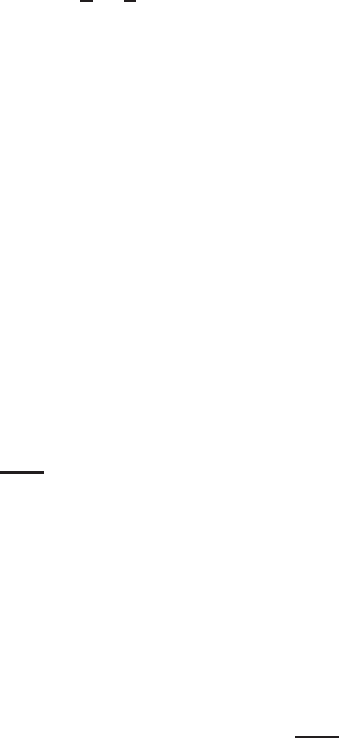
≤ 2
−1
2
log P
U
(x)
+ 2
log P
U
(x)−1
+ 2
log P
U
(x)−2
+···
(14.100)
= 2
−1
2
log P
U
(x)
1 +
1
2
+
1
4
+···
(14.101)
= 2
−1
2
log P
U
(x)
2 (14.102)
≤ P
U
(x), (14.103)
where (14.100) is true because there is at most one node at each level
that prints out a particular x.Moreprecisely,then
k
’s on the winnowed
list for a particular output string x are all different integers. Hence,
k
2
−(n
k
+1)
≤
x
k:x
k
=x
2
−(n
k
+1)
≤
x
P
U
(x) ≤ 1, (14.104)
and we can construct a tree with the nodes labeled by the triplets.
If we are given the tree constructed above, it is easy to identify a given
x by the path to the lowest depth node that prints x. Call this node ˜p.
(By construction, l( ˜p) ≤ log
1
P
U
(x)
+ 2.) To use this tree in a program
to print x, we specify ˜p and ask the computer to execute the foregoing
simulation of all programs. Then the computer will construct the tree as
described above and wait for the particular node ˜p to be assigned. Since
the computer executes the same construction as the sender, eventually the
node ˜p will be assigned. At this point, the computer will halt and print
out the x assigned to that node.
This is an effective (finite, mechanical) procedure for the computer to
reconstruct x. However, there is no effective procedure to find the lowest
depth node corresponding to x. All that we have proved is that there is
an (infinite) tree with a node corresponding to x at level log
1
P
U
(x)
+1.
But this accomplishes our purpose.
With reference to the example, the description of x = 1110 is the path
to the node (p
3
,x
3
,n
3
) (i.e., 01), and the description of x = 1111 is the
path 00001. If we wish to describe the string 1110, we ask the computer
to perform the (simulation) tree construction until node 01 is assigned.
Then we ask the computer to execute the program corresponding to node
01 (i.e., p
3
). The output of this program is the desired string, x = 1110.
The length of the program to reconstruct x is essentially the length of
the description of the position of the lowest depth node ˜p corresponding
496 KOLMOGOROV COMPLEXITY
to x in the tree. The length of this program for x is l( ˜p) + c,where
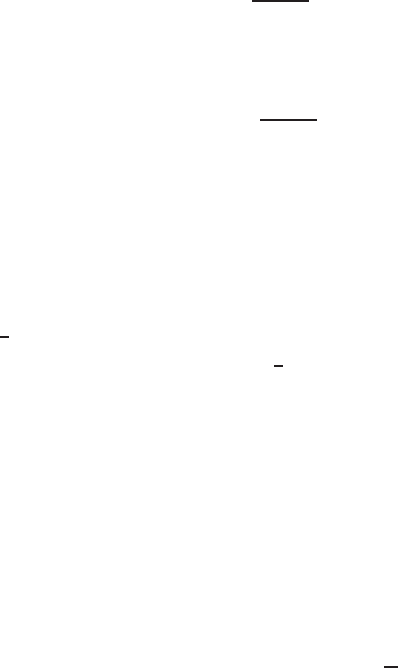
l( ˜p) ≤
log
1
P
U
(x)
+ 1, (14.105)
and hence the complexity of x satisfies
K(x) ≤
log
1
P
U
(x)
+ c. (14.106)
14.12 KOLMOGOROV SUFFICIENT STATISTIC
Suppose that we are given a sample sequence from a Bernoulli(θ ) process.
What are the regularities or deviations from randomness in this sequence?
One way to address the question is to find the Kolmogorov complexity
K(x
n
|n), which we discover to be roughly nH
0
(θ) + log n + c. Since,
for θ =
1
2
,thisismuchlessthann, we conclude that x
n
has structure
and is not randomly drawn Bernoulli(
1
2
). But what is the structure? The
first attempt to find the structure is to investigate the shortest program p
∗
for x
n
. But the shortest description of p
∗
is about as long as p
∗
itself;
otherwise, we could further compress the description of x
n
, contradicting
the minimality of p
∗
. So this attempt is fruitless.
A hint at a good approach comes from an examination of the way in
which p
∗
describes x
n
. The program “The sequence has k 1’s; of such
sequences, it is the ith” is optimal to first order for Bernoulli(θ) sequences.
We note that it is a two-stage description, and all of the structure of the
sequence is captured in the first stage. Moreover, x
n
is maximally complex
given the first stage of the description. The first stage, the description of
k, requires log(n + 1) bits and defines a set S ={x ∈{0, 1}
n
:
x
i
= k}.
The second stage requires log |S|=log
n
k
≈ nH
0
(x
n
) ≈ nH
0
(θ) bits and
reveals nothing extraordinary about x
n
.
We mimic this process for general sequences by looking for a simple
set S that contains x
n
. We then follow it with a brute-force description of
x
n
in S using log |S| bits. We begin with a definition of the smallest set
containing x
n
that is describable in no more than k bits.
Definition The Kolmogorov structure function K
k
(x
n
|n) of a binary
string x ∈{0, 1}
n
is defined as
K
k
(x
n
|n) = min
p : l(p) ≤ k
U(p, n) = S
x
n
∈ S ⊆{0, 1}
n
log |S|. (14.107)
14.12 KOLMOGOROV SUFFICIENT STATISTIC 497
The set S is the smallest set that can be described with no more than
k bits and which includes x
n
.ByU(p, n) = S, we mean that running the
program p with data n on the universal computer
U will print out the
indicator function of the set S.
Definition For a given small constant c,letk
∗
be the least k such that
K
k
(x
n
|n) + k ≤ K(x
n
|n) + c. (14.108)
Let S
∗∗
be the corresponding set and let p
∗∗
be the program that prints out
the indicator function of S
∗∗
. Then we shall say that p
∗∗
is a Kolmogorov
minimal sufficient statistic for x
n
.
Consider the programs p
∗
describing sets S
∗
such that
K
k
(x
n
|n) + k = K(x
n
|n). (14.109)
All the programs p
∗
are “sufficient statistics” in that the complexity of
x
n
given S
∗
is maximal. But the minimal sufficient statistic is the shortest
“sufficient statistic.”
The equality in the definition above is up to a large constant depending
on the computer U .Thenk
∗
corresponds to the least k for which the two-
stage description of x
n
is as good as the best single-stage description of
x
n
. The second stage of the description merely provides the index of x
n
within the set S
∗∗
; this takes K
k
(x
n
|n) bits if x
n
is conditionally maximally
complex given the set S
∗∗
. Hence the set S
∗∗
captures all the structure
within x
n
. The remaining description of x
n
within S
∗∗
is essentially the
description of the randomness within the string. Hence S
∗∗
or p
∗∗
is called
the Kolmogorov sufficient statistic for x
n
.
This is parallel to the definition of a sufficient statistic in mathematical
statistics. A statistic T is said to be sufficient for a parameter θ if the
distribution of the sample given the sufficient statistic is independent of
the parameter; that is,
θ → T(X)→ X (14.110)
forms a Markov chain in that order. For the Kolmogorov sufficient statistic,
the program p
∗∗
is sufficient for the “structure” of the string x
n
;the
remainder of the description of x
n
is essentially independent of the “struc-
ture” of x
n
. In particular, x
n
is maximally complex given S
∗∗
.
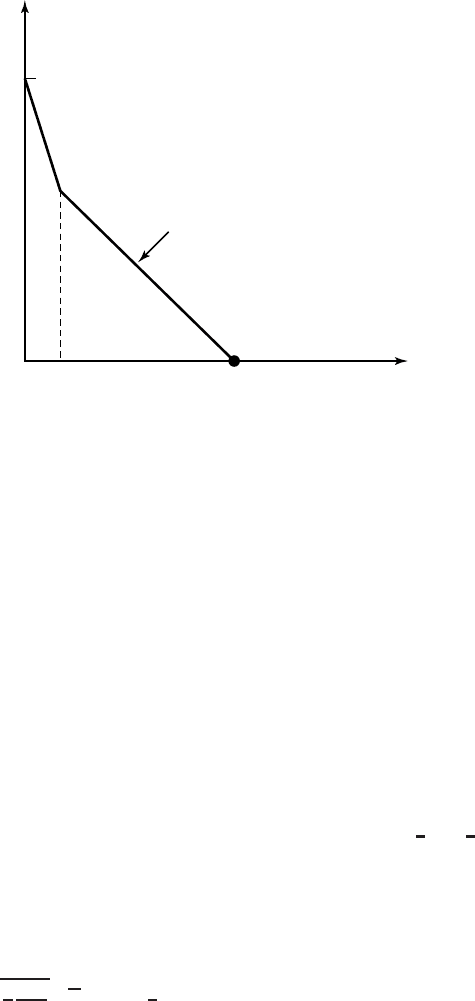
A typical graph of the structure function is illustrated in Figure 14.4.
When k = 0, the only set that can be described is the entire set {0, 1}
n
,
498 KOLMOGOROV COMPLEXITY
Slope = −1
k
*
K
(
x
)
k
n
K
k
(
x
)
FIGURE 14.4. Kolmogorov sufficient statistic.
so that the corresponding log set size is n. As we increase k, the size of
the set drops rapidly until
k + K
k
(x
n
|n) ≈ K(x
n
|n). (14.111)
After this, each additional bit of k reduces the set by half, and we pro-
ceed along the line of slope −1 until k = K(x
n
|n).Fork ≥ K(x
n
|n),the
smallest set that can be described that includes x
n
is the singleton {x
n
},
and hence K
k
(x
n
|n) = 0.
We will now illustrate the concept with a few examples.
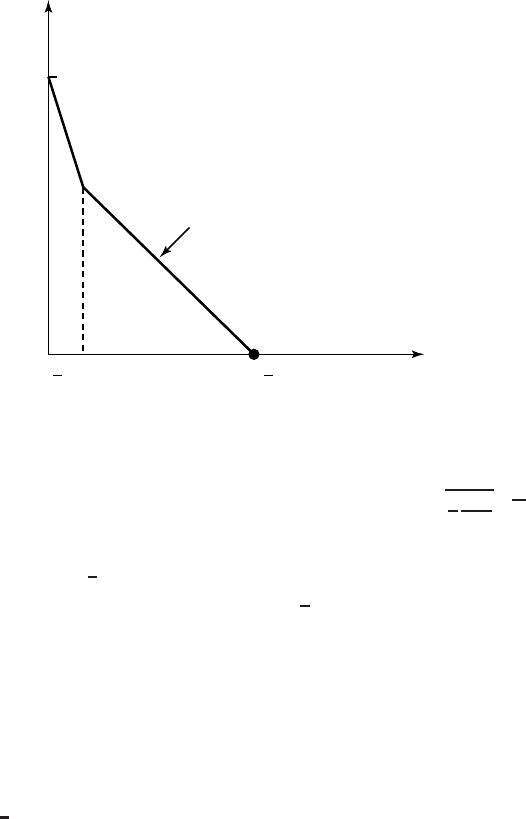
1. Bernoulli(θ ) sequence. Consider a sample of length n from a
Bernoulli sequence with an unknown parameter θ. As discussed in
Example 14.2, we can describle this sequence with nH
k
n
+
1
2
log n
bits using a two stage description where we describe k in the first
stage (using log n bits) and then describe the sequence within all
sequences with k ones (using log
n
k
bits). However, we can use an
even shorter first stage description. Instead of describing k exactly,
we divide the range of k into bins and describe k only to an accu-
racy of
k
n
n−k
n
√
n using
1
2
log n bits. Then we describe the actual
14.12 KOLMOGOROV SUFFICIENT STATISTIC 499
Slope = −1
log
n
1
2
nH
0
(
p
) + log
nk
n
K
k
(
x
)
1
2
FIGURE 14.5. Kolmogorov sufficient statistic for a Bernoulli sequence.
sequence among all sequences whose type is in the same bin as k.
The size of the set of all sequences with l ones, l ∈ k ±
k
n
n−k
n
√
n is
nH
k
n
+ o(n) by Stirling’s formula, so the total description length
is still nH
k
n
+
1
2
log n + o(n), but the description length of the
Kolmogorov sufficient statistics is k
∗
≈
1
n
log n.
2. Sample from a Markov chain. In the same vein as the preceding
example, consider a sample from a first-order binary Markov chain.
In this case again, p
∗∗
will correspond to describing the Markov type
of the sequence (the number of occurrences of 00’s, 01’s, 10’s, and
11’s in the sequence); this conveys all the structure in the sequence.
The remainder of the description will be the index of the sequence
in the set of all sequences of this Markov type. Hence, in this case,
k
∗
≈ 2(
1
2
log n) = log n, corresponding to describing two elements
of the conditional joint type to appropriate accuracy. (The other
elements of the conditional joint type can be determined from these
two.)
3. Mona Lisa. Consider an image that consists of a gray circle on a
white background. The circle is not uniformly gray but Bernoulli
with parameter θ . This is illustrated in Figure 14.6. In this case, the
best two-stage description is first to describe the size and position of
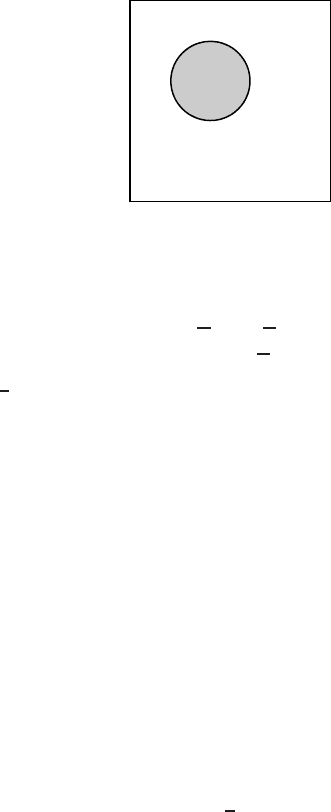
500 KOLMOGOROV COMPLEXITY
FIGURE 14.6. Mona Lisa.
the circle and its average gray level and then to describe the index of
the circle among all the circles with the same gray level. Assuming
an n-pixel image (of size
√
n by
√
n), there are about n + 1 possible
gray levels, and there are about (
√
n)
3
distinguishable circles. Hence,
k
∗
≈
5
2
log n in this case.
14.13 MINIMUM DESCRIPTION LENGTH PRINCIPLE
A natural extension of Occam’s razor occurs when we need to describe
data drawn from an unknown distribution. Let X
1
,X
2
,...,X
n
be drawn
i.i.d. according to probability mass function p(x). We assume that we
do not know p(x), but know that p(x) ∈
P, a class of probability mass
functions. Given the data, we can estimate the probability mass function in
P that best fits the data. For simple classes P (e.g., if P has only finitely
many distributions), the problem is straightforward, and the maximum
likelihood procedure [i.e., find ˆp ∈
P that maximizes ˆp(X
1
,X
2
,...,X
n
)]
works well. However, if the class
P is rich enough, there is a problem
of overfitting the data. For example, if X
1
,X
2
,...,X
n
are continuous
random variables, and if
P is the set of all probability distributions, the
maximum likelihood estimator given X
1
,X
2
,...,X
n
is a distribution that
places a single mass point of weight
1
n
at each observed value. Clearly, this
estimate is too closely tied to actual observed data and does not capture
any of the structure of the underlying distribution.
To get around this problem, various methods have been applied. In the
simplest case, the data are assumed to come from some parametric distri-
bution (e.g., the normal distribution), and the parameters of the distribution
are estimated from the data. To validate this method, the data should be
tested to check whether the distribution “looks” normal, and if the data
pass the test, we could use this description of the data. A more general
procedure is to take the maximum likelihood estimate and smooth it out
to obtain a smooth density. With enough data, and appropriate smoothness

SUMMARY 501
conditions, it is possible to make good estimates of the original density.
This process is called kernel density estimation.
However, the theory of Kolmogorov complexity (or the Kolmogorov
sufficient statistic) suggests a different procedure: Find the p ∈
P that
minimizes
L
p
(X
1
,X
2
,...,X
n
) = K(p) + log
1
p(X
1
,X
2
,...,X
n
)
. (14.112)
This is the length of a two-stage description of the data, where we first
describe the distribution p and then, given the distribution, construct the
Shannon code and describe the data using log
1
p(X
1
,X
2
,...,X
n
)
bits. This pro-
cedure is a special case of what is termed the minimum description length
(MDL) principle: Given data and a choice of models, choose the model
such that the description of the model plus the conditional description of
the data is as short as possible.
SUMMARY
Definition. The Kolmogorov complexity K(x) of a string x is
K(x) = min
p: U (p)=x
l(p) (14.113)
K(x|l(x)) = min
p: U (p,l(x))=x
l(p). (14.114)
Universality of Kolmogorov complexity. There exists a universal
computer
U such that for any other computer A,
K
U
(x) ≤ K
A
(x) + c
A
(14.115)
for any string x, where the constant c
A
does not depend on x.IfU and
A are universal, |K
U
(x) − K
A
(x)|≤c for all x.
Upper bound on Kolmogorov complexity
K(x|l(x)) ≤ l(x) + c (14.116)
K(x) ≤ K(x|l(x)) + 2logl(x) + c. (14.117)

502 KOLMOGOROV COMPLEXITY
Kolmogorov complexity and entropy. If X
1
,X
2
,...are i.i.d. integer-
valued random variables with entropy H , there exists a constant c such
that for all n,
H ≤
1
n
EK(X
n
|n) ≤ H +|X|
log n
n
+
c
n
. (14.118)
Lower bound on Kolmogorov complexity. There are no more than
2
k
strings x with complexity K(x) < k.IfX
1
,X
2
,...,X
n
are drawn
according to a Bernoulli(
1
2
) process,
Pr
(
K(X
1
X
2
...X
n
|n) ≤ n − k
)
≤ 2
−k
. (14.119)
Definition A sequence x is said to be incompressible if
K(x
1
x
2
...x
n
|n)/n → 1.
Strong law of large numbers for incompressible sequences
K(x
1
,x
2
,...,x
n
)
n
→ 1 ⇒
1
n
n
i=1
x
i
→
1
2
. (14.120)
Definition The universal probability of a string x is
P
U
(x) =
p: U(p)=x
2
−l(p)
= Pr(U(p) = x). (14.121)
Universality of P
U
(x). For every computer A,
P
U
(x) ≥ c
A
P
A
(x) (14.122)
for every string x ∈{0, 1}
∗
, where the constant c
A
depends only on U
and A.
Definition =
p: U (p) halts
2
−l(p)
= Pr(U(p) halts) is the proba-
bility that the computer halts when the input p to the computer is a
binary string drawn according to a Bernoulli(
1
2
) process.
Properties of
1. is not computable.
2. is a “philosopher’s stone”.
3. is algorithmically random (incompressible).

PROBLEMS 503
Equivalence of K(x) and log
1
P
U
(x)
. There exists a constant c inde-
pendent of x such that
log
1
P
U
(x)
− K(x)
≤ c (14.123)
for all strings x. Thus, the universal probability of a string x is essen-
tially determined by its Kolmogorov complexity.
Definition The Kolmogorov structure function K
k
(x
n
|n) of a binary
string x
n
∈{0, 1}
n
is defined as
K
k
(x
n
|n) = min
p : l(p) ≤ k
U(p, n) = S
x ∈ S
log |S|. (14.124)
Definition Let k
∗
be the least k such that
K
k
∗
(x
n
|n) + k
∗
= K(x
n
|n). (14.125)
Let S
∗∗
be the corresponding set and let p
∗∗
be the program that prints
out the indicator function of S
∗∗
.Thenp
∗∗
is the Kolmogorov minimal
sufficient statistic for x.
PROBLEMS
14.1 Kolmogorov complexity of two sequences.Letx, y ∈{0, 1}
∗
.
Argue that K(x, y) ≤ K(x) + K(y) + c.
14.2 Complexity of the sum
(a) Argue that K(n) ≤ log n + 2loglogn + c.
(b) Argue that K(n
1
+ n
2
) ≤ K(n
1
) + K(n
2
) + c.
(c) Give an example in which n
1
and n
2
are complex but the sum
is relatively simple.
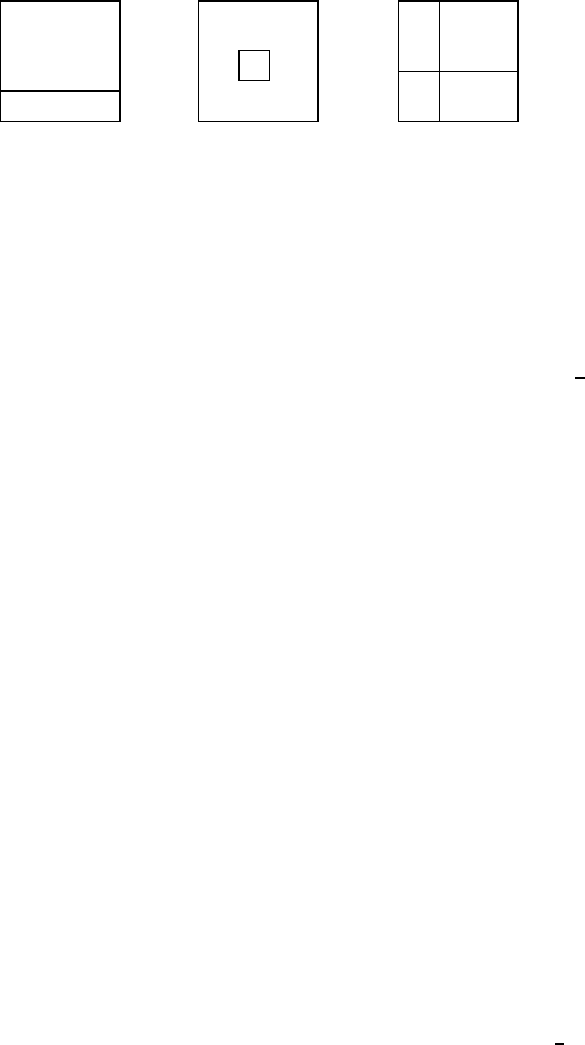
14.3 Images. Consider an n × n array x of 0’s and 1’s . Thus, x has
n
2
bits.
504 KOLMOGOROV COMPLEXITY
Find the Kolmogorov complexity K(x | n) (to first order) if:
(a) x is a horizontal line.
(b) x is a square.
(c) x is the union of two lines, each line being vertical or hori-
zontal.
14.4 Do computers reduce entropy? Feed a random program P into
an universal computer. What is the entropy of the corresponding
output? Specifically, let X =
U(P ),whereP is a Bernoulli(
1
2
)
sequence. Here the binary sequence X is either undefined or is
in {0, 1}
∗
.LetH(X) be the Shannon entropy of X. Argue that
H(X) =∞. Thus, although the computer turns nonsense into
sense, the output entropy is still infinite.
14.5 Monkeys on a computer. Suppose that a random program is
typed into a computer. Give a rough estimate of the probability
that the computer prints the following sequence:
(a) 0
n
followed by any arbitrary sequence.
(b) π
1
π
2
...π
n
followed by any arbitrary sequence, where π
i
is
the ith bit in the expansion of π.
(c) 0
n
1 followed by any arbitrary sequence.
(d) ω
1
ω
2
...ω
n
followed by any arbitrary sequence.
(e) A proof of the four-color theorem.
14.6 Kolmogorov complexity and ternary programs. Suppose that the
input programs for a universal computer
U are sequences in
{0, 1, 2}
∗
(ternary inputs). Also, suppose that U prints ternary out-
puts. Let K(x|l(x)) = min
U(p,l(x))=x
l(p). Show that:
(a) K(x
n
|n) ≤ n + c.
(b) |x
n
∈{0, 1}
∗
: K(x
n
|n) < k| < 3
k
.
14.7 Law of large numbers. Using ternary inputs and outputs as in
Problem 14.14.6, outline an argument demonstrating that if a
sequence x is algorithmically random [i.e., if K(x|l(x)) ≈ l(x)],
the proportion of 0’s, 1’s, and 2’s in x must each be near
1
3
.It
may be helpful to use Stirling’s approximation n! ≈ (n/e)
n
.