
Thomas M. Cover, Joy A. Thomas. Elements of information theory
Подождите немного. Документ загружается.

PROBLEMS 505
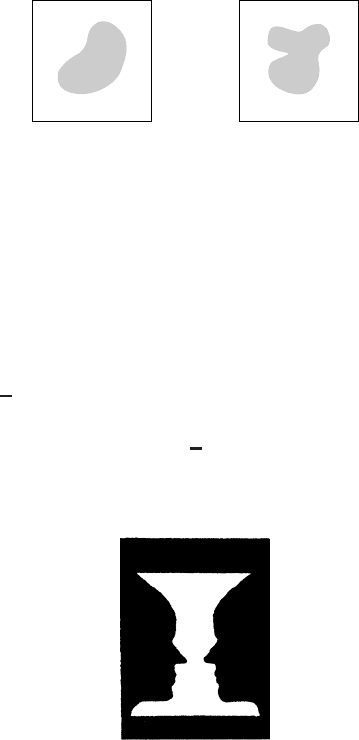
14.8 Image complexity. Consider two binary subsets A and B (of an
n × n grid): for example,
Find general upper and lower bounds, in terms of K(A|n) and
K(B|n),for:
(a) K(A
c
|n).
(b) K(A ∪ B|n).
(c) K(A ∩ B|n).
14.9 Random program. Suppose that a random program (symbols
i.i.d. uniform over the symbol set) is fed into the nearest available
computer. To our surprise the first n bits of the binary expansion
of 1/
√
2 are printed out. Roughly what would you say the proba-
bility is that the next output bit will agree with the corresponding
bit in the expansion of 1/
√
2?
14.10 Face–vase illusion
(a) What is an upper bound on the complexity of a pattern on an
m × m grid that has mirror-image symmetry about a vertical
axis through the center of the grid and consists of horizontal
line segments?
(b) What is the complexity K if the image differs in one cell
from the pattern described above?
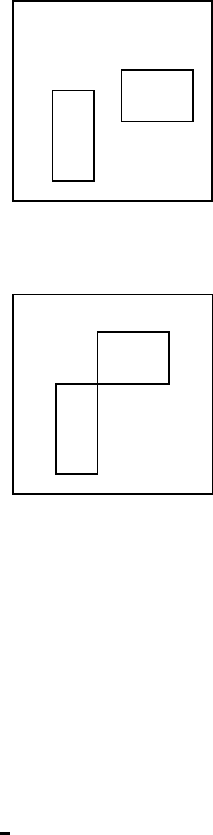
14.11 Kolmogorov complexity. Assume that n is very large and known.
Let all rectangles be parallel to the frame.
506 KOLMOGOROV COMPLEXITY
(a) What is the (maximal) Kolmogorov complexity of the union
of two rectangles on an n × n grid?
(b) What if the rectangles intersect at a corner?
(c) What if they have the same (unknown) shape?
(d) What if they have the same (unknown) area?
(e) What is the minimum Kolmogorov complexity of the union
of two rectangles? That is, what is the simplest union?
(f) What is the (maximal) Kolmogorov complexity over all images
(not necessarily rectangles) on an n × n grid?
14.12 Encrypted text. Suppose that English text x
n
is encrypted into
y
n
by a substitution cypher: a 1-to-1 reassignment of each of the
27 letters of the alphabet (A–Z, including the space character)
to itself. Suppose that the Kolmogorov complexity of the text
x
n
is K(x
n
) =
n
4
. (This is about right for English text. We’re
now assuming a 27-symbol programming language, instead of a
binary symbol-set for the programming language. So, the length
of the shortest program, using a 27-ary programming language,
that prints out a particular string of English text of length n, is
approximately n/4.)
(a) What is the Kolmogorov complexity of the encryption map?
HISTORICAL NOTES 507
(b) Estimate the Kolmogorov complexity of the encrypted text
y
n
.
(c) How high must n be before you would expect to be able to
decode y
n
?
14.13 Kolmogorov complexity. Consider the Kolmogorov complexity
K(n) over the integers n. If a specific integer n
1
has a low Kol-
mogorov complexity K(n
1
), by how much can the Kolmogorov
complexity K(n
1
+ k) for the integer n
1
+ k vary from K(n
1
)?
14.14 Complexity of large numbers.LetA(n) be the set of positive
integers x for which a terminating program p of length less than
or equal to n bits exists that outputs x.LetB(n) be the com-
plement of A(n) [i.e., B(n) is the set of integers x for which no
program of length less than or equal to n outputs x]. Let M(n)
be the maximum integer in A(n),andletS(n) be the minimum
integer in B(n). What is the Kolmogorov complexity K(M(n))
(approximately)? What is K(S(n)) (approximately)? Which is
larger (M(n) or S(n))? Give a reasonable lower bound on M(n)
and a reasonable upper bound on S(n).
HISTORICAL NOTES
The original ideas of Kolmogorov complexity were put forth indepen-
dently and almost simultaneously by Kolmogorov [321, 322], Solomonoff
[504], and Chaitin [89]. These ideas were developed further by students of
Kolmogorov such as Martin-L
¨
of [374], who defined the notion of algorith-
mically random sequences and algorithmic tests for randomness, and by
Levin and Zvonkin [353], who explored the ideas of universal probability
and its relationship to complexity. A series of papers by Chaitin [90]–[92]
developed the relationship between algorithmic complexity and mathemat-
ical proofs. C. P. Schnorr studied the universal notion of randomness and
related it to gambling in [466]–[468].
The concept of the Kolmogorov structure function was defined by Kol-
mogorov at a talk at the Tallin conference in 1973, but these results
were not published. V’yugin pursues this in [549], where he shows that
there are some very strange sequences x
n
that reveal their structure arbi-
trarily slowly in the sense that K
k
(x
n
|n) = n − k, k<K(x
n
|n).Zurek
[606]–[608] addresses the fundamental questions of Maxwell’s demon
and the second law of thermodynamics by establishing the physical con-
sequences of Kolmogorov complexity.

508 KOLMOGOROV COMPLEXITY
Rissanen’s minimum description length (MDL) principle is very close
in spirit to the Kolmogorov sufficient statistic. Rissanen [445, 446] finds a
low-complexity model that yields a high likelihood of the data. Barron and
Cover [32] argue that the density minimizing K(f) + log
1
f(X
i
)
yields
consistent density estimation.
A nontechnical introduction to the various measures of complexity can
be found in a thought-provoking book by Pagels [412]. Additional refer-
ences to work in the area can be found in a paper by Cover et al. [114] on
Kolmogorov’s contributions to information theory and algorithmic com-
plexity. A comprehensive introduction to the field, including applications
of the theory to analysis of algorithms and automata, may be found in the
book by Li and Vitanyi [354]. Additional coverage may be found in the
books by Chaitin [86, 93].

CHAPTER 15
NETWORK INFORMATION
THEORY
A system with many senders and receivers contains many new elements
in the communication problem: interference, cooperation, and feedback.
These are the issues that are the domain of network information theory.
The general problem is easy to state. Given many senders and receivers
and a channel transition matrix that describes the effects of the interference
and the noise in the network, decide whether or not the sources can be
transmitted over the channel. This problem involves distributed source
coding (data compression) as well as distributed communication (finding
the capacity region of the network). This general problem has not yet been
solved, so we consider various special cases in this chapter.
Examples of large communication networks include computer networks,
satellite networks, and the phone system. Even within a single computer,
there are various components that talk to each other. A complete theory
of network information would have wide implications for the design of
communication and computer networks.
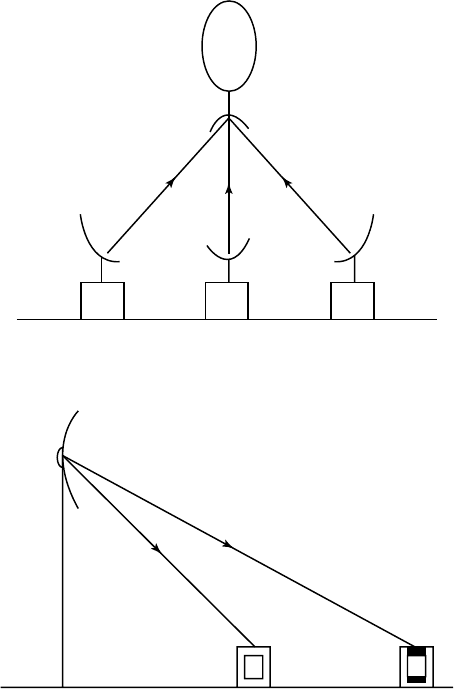
Suppose that m stations wish to communicate with a common satellite
over a common channel, as shown in Figure 15.1. This is known as a
multiple-access channel. How do the various senders cooperate with each
other to send information to the receiver? What rates of communication are
achievable simultaneously? What limitations does interference among the
senders put on the total rate of communication? This is the best understood
multiuser channel, and the above questions have satisfying answers.
In contrast, we can reverse the network and consider one TV station
sending information to m TV receivers, as in Figure 15.2. How does
the sender encode information meant for different receivers in a common
signal? What are the rates at which information can be sent to the different
receivers? For this channel, the answers are known only in special cases.
Elements of Information Theory, Second Edition, By Thomas M. Cover and Joy A. Thomas
Copyright 2006 John Wiley & Sons, Inc.
509
510 NETWORK INFORMATION THEORY
FIGURE 15.1. Multiple-access channel.
FIGURE 15.2. Broadcast channel.
There are other channels, such as the relay channel (where there is
one source and one destination, but one or more intermediate sender–
receiver pairs that act as relays to facilitate the communication between the
source and the destination), the interference channel (two senders and two
receivers with crosstalk), and the two-way channel (two sender–receiver
pairs sending information to each other). For all these channels, we have
only some of the answers to questions about achievable communication
rates and the appropriate coding strategies.
All these channels can be considered special cases of a general com-
munication network that consists of m nodes trying to communicate with
each other, as shown in Figure 15.3. At each instant of time, the ith node
sends a symbol x
i
that depends on the messages that it wants to send

NETWORK INFORMATION THEORY 511
(
X
1
,
Y
1
)
(
X
2
,
Y
2
)
(
X
m
,
Y
m
)
FIGURE 15.3. Communication network.
and on past received symbols at the node. The simultaneous transmis-
sion of the symbols (x
1
,x
2
,...,x
m
) results in random received symbols
(Y
1
,Y
2
,...,Y
m
) drawn according to the conditional probability distribu-
tion p(y
(1)
,y
(2)
,...,y
(m)
|x
(1)
,x
(2)
,...,x
(m)
).Herep(·|·) expresses the
effects of the noise and interference present in the network. If p(·|·) takes
on only the values 0 and 1, the network is deterministic.
Associated with some of the nodes in the network are stochastic data
sources, which are to be communicated to some of the other nodes in the
network. If the sources are independent, the messages sent by the nodes
are also independent. However, for full generality, we must allow the
sources to be dependent. How does one take advantage of the dependence
to reduce the amount of information transmitted? Given the probability
distribution of the sources and the channel transition function, can one
transmit these sources over the channel and recover the sources at the
destinations with the appropriate distortion?
We consider various special cases of network communication. We con-
sider the problem of source coding when the channels are noiseless and
without interference. In such cases, the problem reduces to finding the set
of rates associated with each source such that the required sources can
be decoded at the destination with a low probability of error (or appro-
priate distortion). The simplest case for distributed source coding is the
Slepian–Wolf source coding problem, where we have two sources that
must be encoded separately, but decoded together at a common node. We
consider extensions to this theory when only one of the two sources needs
to be recovered at the destination.
The theory of flow in networks has satisfying answers in such domains
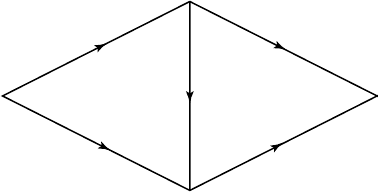
as circuit theory and the flow of water in pipes. For example, for the
single-source single-sink network of pipes shown in Figure 15.4, the max-
imum flow from A to B can be computed easily from the Ford–Fulkerson
theorem . Assume that the edges have capacities C
i
as shown. Clearly,
512 NETWORK INFORMATION THEORY
C
1
AB
C
2
C
4
C
5
C
= min{
C
1
+
C
2
,
C
2
+
C
3
+
C
4
,
C
4
+
C
5
,
C
1
+
C
5
}
C
3
FIGURE 15.4. Network of water pipes.
the maximum flow across any cut set cannot be greater than the sum
of the capacities of the cut edges. Thus, minimizing the maximum flow
across cut sets yields an upper bound on the capacity of the network. The
Ford–Fulkerson theorem [214] shows that this capacity can be achieved.
The theory of information flow in networks does not have the same
simple answers as the theory of flow of water in pipes. Although we
prove an upper bound on the rate of information flow across any cut set,
these bounds are not achievable in general. However, it is gratifying that
some problems, such as the relay channel and the cascade channel, admit
a simple max-flow min-cut interpretation. Another subtle problem in the
search for a general theory is the absence of a source–channel separation
theorem, which we touch on briefly in Section 15.10. A complete theory
combining distributed source coding and network channel coding is still
a distant goal.
In the next section we consider Gaussian examples of some of the
basic channels of network information theory. The physically motivated
Gaussian channel lends itself to concrete and easily interpreted answers.
Later we prove some of the basic results about joint typicality that we use
to prove the theorems of multiuser information theory. We then consider
various problems in detail: the multiple-access channel, the coding of cor-
related sources (Slepian–Wolf data compression), the broadcast channel,
the relay channel, the coding of a random variable with side information,
and the rate distortion problem with side information. We end with an
introduction to the general theory of information flow in networks. There
are a number of open problems in the area, and there does not yet exist a
comprehensive theory of information networks. Even if such a theory is
found, it may be too complex for easy implementation. But the theory will
be able to tell communication designers how close they are to optimality
and perhaps suggest some means of improving the communication rates.

15.1 GAUSSIAN MULTIPLE-USER CHANNELS 513
15.1 GAUSSIAN MULTIPLE-USER CHANNELS
Gaussian multiple-user channels illustrate some of the important features
of network information theory. The intuition gained in Chapter 9 on the
Gaussian channel should make this section a useful introduction. Here the
key ideas for establishing the capacity regions of the Gaussian multiple-
access, broadcast, relay, and two-way channels will be given without
proof. The proofs of the coding theorems for the discrete memoryless
counterparts to these theorems are given in later sections of the chapter.
The basic discrete-time additive white Gaussian noise channel with
input power P and noise variance N is modeled by
Y
i
= X
i
+ Z
i
,i= 1, 2,..., (15.1)
where the Z
i
are i.i.d. Gaussian random variables with mean 0 and vari-
ance N. The signal X = (X
1
,X
2
,...,X
n
) has a power constraint
1
n
n
i=1
X
2
i
≤ P. (15.2)
The Shannon capacity C is obtained by maximizing I(X;Y) over all
random variables X such that EX
2
≤ P and is given (Chapter 9) by
C =
1
2
log
1 +
P
N
bits per transmission. (15.3)
In this chapter we restrict our attention to discrete-time memoryless chan-
nels; the results can be extended to continuous-time Gaussian channels.
15.1.1 Single-User Gaussian Channel
We first review the single-user Gaussian channel studied in Chapter 9.
Here Y = X + Z. Choose a rate R<
1
2
log(1 +
P
N
). Fix a good (2
nR
,n)
codebook of power P . Choose an index w in the set 2
nR
.Sendthe
wth codeword X(w) from the codebook generated above. The receiver
observes Y = X (w) + Z and then finds the index ˆw of the codeword
closest to Y.Ifn is sufficiently large, the probability of error Pr(w = ˆw)
will be arbitrarily small. As can be seen from the definition of joint typ-
icality, this minimum-distance decoding scheme is essentially equivalent
to finding the codeword in the codebook that is jointly typical with the
received vector Y.

514 NETWORK INFORMATION THEORY
15.1.2 Gaussian Multiple-Access Channel with
m
Users
We consider m transmitters, each with a power P .Let
Y =
m
i=1
X
i
+ Z. (15.4)
Let
C
P
N
=
1
2
log
1 +
P
N
(15.5)
denote the capacity of a single-user Gaussian channel with signal-to-noise
ratio P/N. The achievable rate region for the Gaussian channel takes on
the simple form given in the following equations:
R
i
<C
P
N
(15.6)
R
i
+ R
j
<C
2P
N
(15.7)
R
i
+ R
j
+ R
k
<C
3P
N
(15.8)
.
.
. (15.9)
m
i=1
R
i
<C
mP
N
. (15.10)
Note that when all the rates are the same, the last inequality dominates
the others.
Here we need m codebooks, the ith codebook having 2
nR
i
codewords
of power P . Transmission is simple. Each of the independent transmitters
chooses an arbitrary codeword from its own codebook. The users send
these vectors simultaneously. The receiver sees these codewords added
together with the Gaussian noise Z.
Optimal decoding consists of looking for the m codewords, one from
each codebook, such that the vector sum is closest to Y in Euclidean
distance. If (R
1
,R
2
,...,R
m
) is in the capacity region given above, the
probability of error goes to 0 as n tends to infinity.