
Thomas M. Cover, Joy A. Thomas. Elements of information theory
Подождите немного. Документ загружается.


15.1 GAUSSIAN MULTIPLE-USER CHANNELS 515
Remarks It is exciting to see in this problem that the sum of the rates
of the users C(mP/N) goes to infinity with m. Thus, in a cocktail party
with m celebrants of power P in the presence of ambient noise N ,the
intended listener receives an unbounded amount of information as the
number of people grows to infinity. A similar conclusion holds, of course,
for ground communications to a satellite. Apparently, the increasing inter-
ference as the number of senders m →∞does not limit the total received
information.
It is also interesting to note that the optimal transmission scheme here
does not involve time-division multiplexing. In fact, each of the transmit-
ters uses all of the bandwidth all of the time.
15.1.3 Gaussian Broadcast Channel
Here we assume that we have a sender of power P and two distant
receivers, one with Gaussian noise power N
1
and the other with Gaussian
noise power N
2
. Without loss of generality, assume that N
1
<N
2
. Thus,
receiver Y
1
is less noisy than receiver Y
2
. The model for the channel is
Y
1
= X + Z
1
and Y
2
= X + Z
2
,whereZ
1
and Z
2
are arbitrarily corre-
lated Gaussian random variables with variances N
1
and N
2
, respectively.
The sender wishes to send independent messages at rates R
1
and R
2
to
receivers Y
1
and Y
2
, respectively.
Fortunately, all scalar Gaussian broadcast channels belong to the class
of degraded broadcast channels discussed in Section 15.6.2. Specializing
that work, we find that the capacity region of the Gaussian broadcast
channel is
R
1
<C
αP
N
1
(15.11)
R
2
<C
(1 − α)P
αP + N
2
, (15.12)
where α may be arbitrarily chosen (0 ≤ α ≤ 1) to trade off rate R
1
for
rate R
2
as the transmitter wishes.
To encode the messages, the transmitter generates two codebooks, one
with power αP at rate R
1
, and another codebook with power αP at rate
R
2
,whereR
1
and R
2
lie in the capacity region above. Then to send
an index w
1
∈{1, 2,...,2
nR
1
} and w
2
∈{1, 2,...,2
nR
2
} to Y
1
and Y
2
,
respectively, the transmitter takes the codeword X(w
1
) from the first code-
book and codeword X(w
2
) from the second codebook and computes the
sum. He sends the sum over the channel.

516 NETWORK INFORMATION THEORY
The receivers must now decode the messages. First consider the bad
receiver Y
2
. He merely looks through the second codebook to find the clos-
est codeword to the received vector Y
2
. His effective signal-to-noise ratio is
αP/(αP + N
2
),sinceY
1
’s message acts as noise to Y
2
. (This can be proved.)
The good receiver Y
1
first decodes Y
2
’s codeword, which he can accom-
plish because of his lower noise N
1
. He subtracts this codeword
ˆ
X
2
from
Y
1
. He then looks for the codeword in the first codebook closest to
Y
1
−
ˆ
X
2
. The resulting probability of error can be made as low as desired.
A nice dividend of optimal encoding for degraded broadcast channels is
that the better receiver Y
1
always knows the message intended for receiver
Y
2
in addition to the message intended for himself.
15.1.4 Gaussian Relay Channel
For the relay channel, we have a sender X and an ultimate intended
receiver Y . Also present is the relay channel, intended solely to help the
receiver. The Gaussian relay channel (Figure 15.31 in Section 15.7) is
given by
Y
1
= X + Z
1
, (15.13)
Y = X + Z
1
+ X
1
+ Z
2
, (15.14)
where Z
1
and Z
2
are independent zero-mean Gaussian random variables
with variance N
1
and N
2
, respectively. The encoding allowed by the relay
is the causal sequence
X
1i
= f
i
(Y
11
,Y
12
,...,Y
1i−1
). (15.15)
Sender X has power P and sender X
1
has power P
1
. The capacity is
C = max
0≤α≤1
min
C
P + P
1
+ 2
√
αPP
1
N
1
+ N
2
,C
αP
N
1
, (15.16)
where
α = 1 − α. Note that if
P
1
N
2
≥
P
N
1
, (15.17)
it can be seen that C = C(P/N
1
),which is achieved by α = 1. The channel
appears to be noise-free after the relay, and the capacity C(P/N
1
) from
X to the relay can be achieved. Thus, the rate C(P/(N
1
+ N
2
)) without
the relay is increased by the presence of the relay to C(P/N
1
).Forlarge
15.1 GAUSSIAN MULTIPLE-USER CHANNELS 517
N
2
and for P
1
/N
2
≥ P/N
1
, we see that the increment in rate is from
C(P/(N
1
+ N
2
)) ≈ 0toC(P/N
1
).
Let R
1
<C(αP/N
1
). Two codebooks are needed. The first codebook
has 2
nR
1
words of power αP . The second has 2
nR
0
codewords of power
αP. We shall use codewords from these codebooks successively to cre-
ate the opportunity for cooperation by the relay. We start by sending a
codeword from the first codebook. The relay now knows the index of
this codeword since R
1
<C(αP/N
1
), but the intended receiver has a list
of possible codewords of size 2
n(R
1
−C(αP/(N
1
+N
2
)))
. This list calculation
involves a result on list codes.
In the next block, the transmitter and the relay wish to cooperate to
resolve the receiver’s uncertainty about the codeword sent previously that
is on the receiver’s list. Unfortunately, they cannot be sure what this list
is because they do not know the received signal Y . Thus, they randomly
partition the first codebook into 2
nR
0
cells with an equal number of code-
words in each cell. The relay, the receiver, and the transmitter agree on
this partition. The relay and the transmitter find the cell of the partition
in which the codeword from the first codebook lies and cooperatively
send the codeword from the second codebook with that index. That is, X
and X
1
send the same designated codeword. The relay, of course, must
scale this codeword so that it meets his power constraint P
1
. They now
transmit their codewords simultaneously. An important point to note here
is that the cooperative information sent by the relay and the transmitter
is sent coherently. So the power of the sum as seen by the receiver Y is
(
√
αP +
√
P
1
)
2
.
However, this does not exhaust what the transmitter does in the second
block. He also chooses a fresh codeword from the first codebook, adds it
“on paper” to the cooperative codeword from the second codebook, and
sends the sum over the channel.
The reception by the ultimate receiver Y in the second block involves
first finding the cooperative index from the second codebook by looking
for the closest codeword in the second codebook. He subtracts the code-
word from the received sequence and then calculates a list of indices of
size 2
nR
0
corresponding to all codewords of the first codebook that might
have been sent in the second block.
Now it is time for the intended receiver to complete computing the
codeword from the first codebook sent in the first block. He takes his list
of possible codewords that might have been sent in the first block and
intersects it with the cell of the partition that he has learned from the
cooperative relay transmission in the second block. The rates and powers
have been chosen so that it is highly probable that there is only one
518 NETWORK INFORMATION THEORY
codeword in the intersection. This is Y ’s guess about the information sent
in the first block.
We are now in steady state. In each new block, the transmitter and the
relay cooperate to resolve the list uncertainty from the previous block. In
addition, the transmitter superimposes some fresh information from his
first codebook to this transmission from the second codebook and trans-
mits the sum. The receiver is always one block behind, but for sufficiently
many blocks, this does not affect his overall rate of reception.
15.1.5 Gaussian Interference Channel
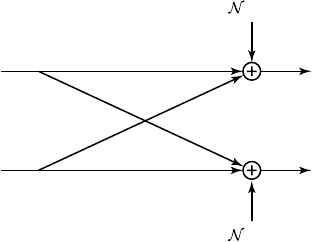
The interference channel has two senders and two receivers. Sender 1
wishes to send information to receiver 1. He does not care what receiver
2 receives or understands; similarly with sender 2 and receiver 2. Each
channel interferes with the other. This channel is illustrated in Figure 15.5.
It is not quite a broadcast channel since there is only one intended receiver
for each sender, nor is it a multiple access channel because each receiver
is only interested in what is being sent by the corresponding transmitter.
For symmetric interference, we have
Y
1
= X
1
+ aX
2
+ Z
1
(15.18)
Y
2
= X
2
+ aX
1
+ Z
2
, (15.19)
where Z
1
,Z
2
are independent N(0,N)random variables. This channel has
not been solved in general even in the Gaussian case. But remarkably, in
the case of high interference, it can be shown that the capacity region of
this channel is the same as if there were no interference whatsoever.
To achieve this, generate two codebooks, each with power P and rate
C(P/N). Each sender independently chooses a word from his book and
X
1
Y
1
X
2
Y
2
Z
1
~
(0,
N
)
Z
2
~
(0,
N
)
a
a
FIGURE 15.5. Gaussian interference channel.
15.1 GAUSSIAN MULTIPLE-USER CHANNELS 519
sends it. Now, if the interference a satisfies C(a
2
P/(P + N)) > C(P/N),
the first transmitter understands perfectly the index of the second transmit-
ter. He finds it by the usual technique of looking for the closest codeword
to his received signal. Once he finds this signal, he subtracts it from
his waveform received. Now there is a clean channel between him and
his sender. He then searches the sender’s codebook to find the closest
codeword and declares that codeword to be the one sent.
15.1.6 Gaussian Two-Way Channel
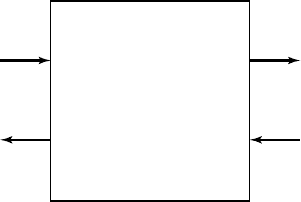
The two-way channel is very similar to the interference channel, with the
additional provision that sender 1 is attached to receiver 2 and sender 2
is attached to receiver 1, as shown in Figure 15.6. Hence, sender 1 can
use information from previous received symbols of receiver 2 to decide
what to send next. This channel introduces another fundamental aspect
of network information theory: namely, feedback. Feedback enables the
senders to use the partial information that each has about the other’s
message to cooperate with each other.
The capacity region of the two-way channel is not known in general.
This channel was first considered by Shannon [486], who derived upper
and lower bounds on the region (see Problem 15.15). For Gaussian chan-
nels, these two bounds coincide and the capacity region is known; in
fact, the Gaussian two-way channel decomposes into two independent
channels.
Let P
1
and P
2
be the powers of transmitters 1 and 2, respectively,
and let N
1
and N
2
be the noise variances of the two channels. Then
the rates R
1
<C(P
1
/N
1
) and R
2
<C(P
2
/N
2
) can be achieved by the
techniques described for the interference channel. In this case, we generate
two codebooks of rates R
1
and R
2
. Sender 1 sends a codeword from the
first codebook. Receiver 2 receives the sum of the codewords sent by the
p
(
y
1
,
y
2
|
x
1
,
x
2
)
X
1
Y
1
X
2
Y
2
FIGURE 15.6. Two-way channel.

520 NETWORK INFORMATION THEORY
two senders plus some noise. He simply subtracts out the codeword of
sender 2 and he has a clean channel from sender 1 (with only the noise of
variance N
1
). Hence, the two-way Gaussian channel decomposes into two
independent Gaussian channels. But this is not the case for the general
two-way channel; in general, there is a trade-off between the two senders
so that both of them cannot send at the optimal rate at the same time.
15.2 JOINTLY TYPICAL SEQUENCES
We have previewed the capacity results for networks by considering mul-
tiuser Gaussian channels. We begin a more detailed analysis in this section,
where we extend the joint AEP proved in Chapter 7 to a form that we
will use to prove the theorems of network information theory. The joint
AEP will enable us to calculate the probability of error for jointly typical
decoding for the various coding schemes considered in this chapter.
Let (X
1
,X
2
,...,X
k
) denote a finite collection of discrete random vari-
ables with some fixed joint distribution, p(x
(1)
,x
(2)
,...,x
(k)
), (x
(1)
,x
(2)
,
...,x
(k)
) ∈ X
1
× X
2
×···×X
k
.LetS denote an ordered subset of these
random variables and consider n independent copies of S. Thus,
Pr{S = s}=
n
i=1
Pr{S
i
= s
i
},s∈ S
n
. (15.20)
For example, if S = (X
j
,X
l
),then
Pr{S = s}=Pr
(X
j
, X
l
) = (x
j
, x
l
)
(15.21)
=
n
i=1
p(x
ij
,x
il
). (15.22)
To be explicit, we will sometimes use X(S) for S. By the law of large
numbers, for any subset S of random variables,
−
1
n
log p(S
1
,S
2
,...,S
n
) =−
1
n
n
i=1
log p(S
i
) → H(S), (15.23)
where the convergence takes place with probability 1 for all 2
k
subsets,
S ⊆{X
(1)
,X
(2)
,...,X
(k)
}.

15.2 JOINTLY TYPICAL SEQUENCES 521
Definition The set A
(n)
of -typical n-sequences (x
1
, x
2
,...,x
k
) is
defined by
A
(n)
(X
(1)
,X
(2)
,...,X
(k)
)
= A
(n)
=
(x
1
, x
2
,...,x
k
) :
−
1
n
log p(s) − H(S)
<, ∀S ⊆{X
(1)
,X
(2)
,...,
X
(k)
}
. (15.24)
Let A
(n)
(S) denote the restriction of A
(n)
to the coordinates of S. Thus,
if S = (X
1
,X
2
),wehave
A
(n)
(X
1
,X
2
) ={(x
1
, x
2
) :
−
1
n
log p(x
1
, x
2
) − H(X
1
,X
2
)
<,
−
1
n
log p(x
1
) − H(X
1
)
<,
−
1
n
log p(x
2
) − H(X
2
)
<}. (15.25)
Definition We will use the notation a
n
.
= 2
n(b±)
to mean that
1
n
log a
n
− b
< (15.26)
for n sufficiently large.
Theorem 15.2.1 For any >0, for sufficiently large n,
1. P(A
(n)
(S)) ≥ 1 − , ∀S ⊆{X
(1)
,X
(2)
,...,X
(k)
}.(15.27)
2. s ∈ A
(n)
(S) ⇒ p(s)
.
= 2
n(H (S)±)
.(15.28)
3. |A
(n)
(S)|
.
= 2
n(H (S)±2)
.(15.29)

522 NETWORK INFORMATION THEORY
4. Let S
1
,S
2
⊆{X
(1)
,X
(2)
,...,X
(k)
}.If(s
1
, s
2
) ∈ A
(n)
(S
1
,S
2
),then
p(s
1
|s
2
)
.
= 2
−n(H (S
1
|S
2
)±2)
. (15.30)
Proof
1. This follows from the law of large numbers for the random variables
in the definition of A
(n)
(S).
2. This follows directly from the definition of A
(n)
(S).
3. This follows from
1 ≥
s∈A
(n)
(S)
p(s) (15.31)
≥
s∈A
(n)
(S)
2
−n(H (S)+)
(15.32)
=|A
(n)
(S)|2
−n(H (S)+)
. (15.33)
If n is sufficiently large, we can argue that
1 − ≤
s∈A
(n)
(S)
p(s) (15.34)
≤
s∈A
(n)
(S)
2
−n(H (S)−)
(15.35)
=|A
(n)
(S)|2
−n(H (S)−)
. (15.36)
Combining (15.33) and (15.36), we have |A
(n)
(S)|
.
= 2
n(H (S)±2)
for
sufficiently large n.
4. For (s
1
, s
2
) ∈ A
(n)
(S
1
,S
2
),wehavep(s
1
)
.
= 2
−n(H (S
1
)±)
and
p(s
1
, s
2
)
.
= 2
−n(H (S
1
,S
2
)±)
. Hence,
p(s
2
|s
1
) =
p(s
1
, s
2
)
p(s
1
)
.
= 2
−n(H (S
2
|S
1
)±2)
. (15.37)
The next theorem bounds the number of conditionally typical sequences
for a given typical sequence.
15.2 JOINTLY TYPICAL SEQUENCES 523
Theorem 15.2.2 Let S
1
,S
2
be two subsets of X
(1)
,X
(2)
,...,X
(k)
.For
any >0, define A
(n)
(S
1
|s
2
) to be the set of s
1
sequences that are jointly -
typical with a particular s
2
sequence. If s
2
∈ A
(n)
(S
2
), then for sufficiently
large n, we have
|A
(n)
(S
1
|s
2
)|≤2
n(H (S
1
|S
2
)+2)
(15.38)
and
(1 − )2
n(H (S
1
|S
2
)−2)
≤
s
2
p(s
2
)|A
(n)
(S
1
|s
2
)|. (15.39)
Proof: As in part 3 of Theorem 15.2.1, we have
1 ≥
s
1
∈A
(n)
(S
1
|s
2
)
p(s
1
|s
2
) (15.40)
≥
s
1
∈A
(n)
(S
1
|s
2
)
2
−n(H (S
1
|S
2
)+2)
(15.41)
=|A
(n)
(S
1
|s
2
)|2
−n(H (S
1
|S
2
)+2)
. (15.42)
If n is sufficiently large, we can argue from (15.27) that
1 − ≤
s
2
p(s
2
)
s
1
∈A
(n)
(S
1
|s
2
)
p(s
1
|s
2
) (15.43)
≤
s
2
p(s
2
)
s
1
∈A
(n)
(S
1
|s
2
)
2
−n(H (S
1
|S
2
)−2)
(15.44)
=
s
2
p(s
2
)|A
(n)
(S
1
|s
2
)|2
−n(H (S
1
|S
2
)−2)
. (15.45)
To calculate the probability of decoding error, we need to know the
probability that conditionally independent sequences are jointly typical.
Let S
1
, S
2
,andS
3
be three subsets of {X
(1)
,X
(2)
,...,X
(k)
}.IfS
1
and
S
2
are conditionally independent given S
3
but otherwise share the same
pairwise marginals of (S
1
,S
2
,S
3
), we have the following probability of
joint typicality.
524 NETWORK INFORMATION THEORY
Theorem 15.2.3 Let A
(n)
denote the typical set for the probability mass
function p(s
1
,s
2
,s
3
), and let
P(S
1
= s
1
, S
2
= s
2
, S
3
= s
3
) =
n
i=1
p(s
1i
|s
3i
)p(s
2i
|s
3i
)p(s
3i
). (15.46)
Then
P {(S
1
, S
2
, S
3
) ∈ A
(n)
}
.
= 2
n(I (S
1
;S
2
|S
3
)±6)
. (15.47)
Proof: We use the
.
= notation from (15.26) to avoid calculating the
upper and lower bounds separately. We have
P {(S
1
, S
2
, S
3
) ∈ A
(n)
}
=
(s
1
, s
2
, s
3
)∈A
(n)
p(s
3
)p(s
1
|s
3
)p(s
2
|s
3
) (15.48)
.
=|A
(n)
(S
1
,S
2
,S
3
)|2
−n(H (S
3
)±)
2
−n(H (S
1
|S
3
)±2)
2
−n(H (S
2
|S
3
)±2)
(15.49)
.
= 2
n(H (S
1
,S
2
,S
3
)±)
2
−n(H (S
3
)±)
2
−n(H (S
1
|S
3
)±2)
2
−n(H (S
2
|S
3
)±2)
(15.50)
.
= 2
−n(I (S
1
;S
2
|S
3
)±6)
. (15.51)
We will specialize this theorem to particular choices of S
1
,S
2
,andS
3
for the various achievability proofs in this chapter.
15.3 MULTIPLE-ACCESS CHANNEL
The first channel that we examine in detail is the multiple-access channel,
in which two (or more) senders send information to a common receiver.
The channel is illustrated in Figure 15.7. A common example of this
channel is a satellite receiver with many independent ground stations, or
a set of cell phones communicating with a base station. We see that the
senders must contend not only with the receiver noise but with interference
from each other as well.
Definition A discrete memoryless multiple-access channel consists of
three alphabets,
X
1
, X
2
,andY, and a probability transition matrix
p(y|x
1
,x
2
).