
Thomas M. Cover, Joy A. Thomas. Elements of information theory
Подождите немного. Документ загружается.

15.3 MULTIPLE-ACCESS CHANNEL 525
p
(
y
|
x
1
,
x
2
)
X
1
Y
1
W
1
(
W
1
,
W
2
)
W
2
Y
^^
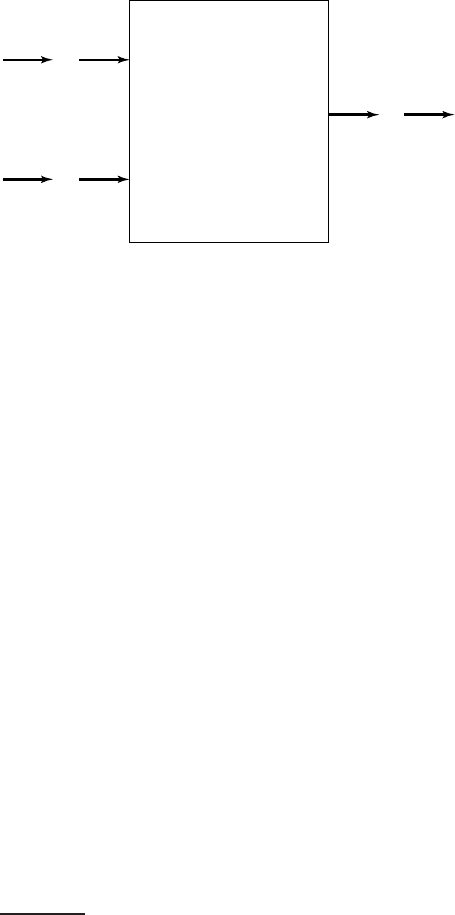
FIGURE 15.7. Multiple-access channel.
Definition A ((2
nR
1
, 2
nR
2
), n) code for the multiple-access channel con-
sists of two sets of integers
W
1
={1, 2,...,2
nR
1
} and W
2
={1, 2,...,
2
nR
2
}, called the message sets,twoencoding functions,
X
1
: W
1
→ X
n
1
(15.52)
and
X
2
: W
2
→ X
n
2
, (15.53)
and a decoding function,
g :
Y
n
→ W
1
× W
2
. (15.54)
There are two senders and one receiver for this channel. Sender 1
chooses an index W
1
uniformly from the set {1, 2,...,2
nR
1
} and sends
the corresponding codeword over the channel. Sender 2 does likewise.
Assuming that the distribution of messages over the product set
W
1
× W
2
is uniform (i.e., the messages are independent and equally likely), we
define the average probability of error for the ((2
nR
1
, 2
nR
2
), n) code as
follows:
P
(n)
e
=
1
2
n(R
1
+R
2
)
(w
1
,w
2
)∈W
1
×W
2
Pr
g(Y
n
) = (w
1
,w
2
)|(w
1
,w
2
) sent
.
(15.55)
Definition A rate pair (R
1
,R
2
) is said to be achievable for the multiple-
access channel if there exists a sequence of ((2
nR
1
, 2
nR
2
), n) codes with
P
(n)
e
→ 0.
526 NETWORK INFORMATION THEORY
Definition The capacity region of the multiple-access channel is the
closure of the set of achievable (R
1
,R
2
) rate pairs.
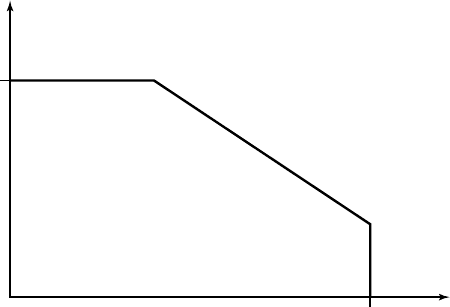
An example of the capacity region for a multiple-access channel is
illustrated in Figure 15.8. We first state the capacity region in the form of
a theorem.
Theorem 15.3.1 (Multiple-access channel capacity) The capacity of
a multiple-access channel (
X
1
× X
2
,p(y|x
1
,x
2
), Y) is the closure of the
convex hull of all (R
1
,R
2
) satisfying
R
1
<I(X
1
;Y |X
2
), (15.56)
R
2
<I(X
2
;Y |X
1
), (15.57)
R
1
+ R
2
<I(X
1
,X
2
;Y) (15.58)
for some product distribution p
1
(x
1
)p
2
(x
2
) on X
1
× X
2
.
Before we prove that this is the capacity region of the multiple-access
channel, let us consider a few examples of multiple-access channels:
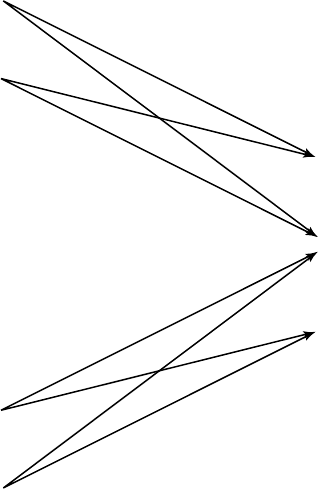
Example 15.3.1 (Independent binary symmetric channels) Assume
that we have two independent binary symmetric channels, one from sender
1 and the other from sender 2, as shown in Figure 15.9. In this case, it is
obvious from the results of Chapter 7 that we can send at rate 1 − H(p
1
)
over the first channel and at rate 1 −H(p
2
) over the second channel.
R
1
R
2
0
C
2
C
1
FIGURE 15.8. Capacity region for a multiple-access channel.
15.3 MULTIPLE-ACCESS CHANNEL 527
X
2
X
2
Y
FIGURE 15.9. Independent binary symmetric channels.
Since the channels are independent, there is no interference between the
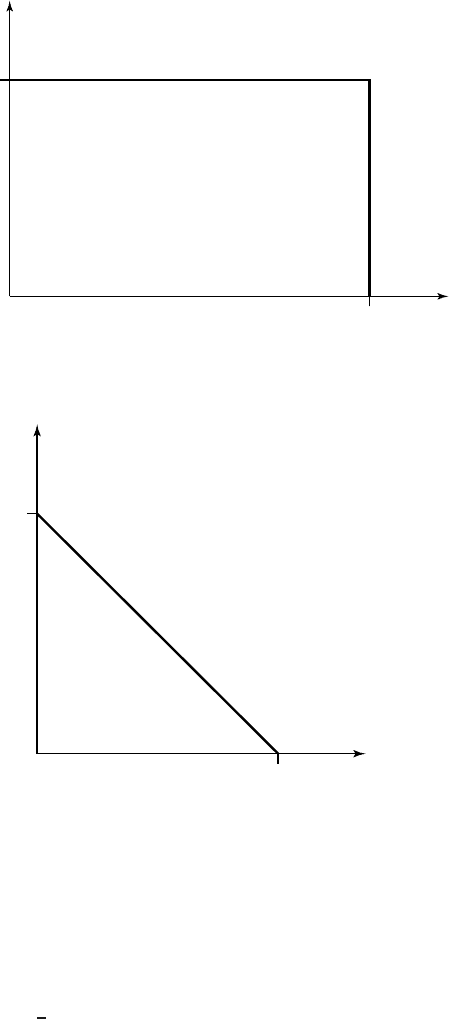
senders. The capacity region in this case is shown in Figure 15.10.
Example 15.3.2 (Binary multiplier channel) Consider a multiple-
access channel with binary inputs and output
Y = X
1
X
2
. (15.59)
Such a channel is called a binary multiplier channel. It is easy to see
that by setting X
2
= 1, we can send at a rate of 1 bit per transmission
from sender 1 to the receiver. Similarly, setting X
1
= 1, we can achieve
R
2
= 1. Clearly, since the output is binary, the combined rates R
1
+ R
2
of sender 1 and sender 2 cannot be more than 1 bit. By timesharing, we
can achieve any combination of rates such that R
1
+ R
2
= 1. Hence the
capacity region is as shown in Figure 15.11.
Example 15.3.3 (Binary erasure multiple-access channel)This
multiple-access channel has binary inputs,
X
1
= X
2
={0, 1},anda
ternary output, Y = X
1
+ X
2
. There is no ambiguity in (X
1
,X
2
) if Y = 0
or Y = 2 is received; but Y = 1 can result from either (0,1) or (1,0).
528 NETWORK INFORMATION THEORY
R
2
R
1
C
2
= 1 −
H
(
p
2
)
C
1
= 1 −
H
(
p
1
)
0
FIGURE 15.10. Capacity region for independent BSCs.
R
2
R
1
0
C
2
= 1
C
1
= 1
FIGURE 15.11. Capacity region for binary multiplier channel.
We now examine the achievable rates on the axes. Setting X
2
= 0, we
can send at a rate of 1 bit per transmission from sender 1. Similarly, setting
X
1
= 0, we can send at a rate R
2
= 1. This gives us two extreme points of
the capacity region. Can we do better? Let us assume that R
1
= 1, so that
the codewords of X
1
must include all possible binary sequences; X
1
would
look like a Bernoulli(
1
2
) process. This acts like noise for the transmission
from X
2
.ForX
2
, the channel looks like the channel in Figure 15.12.
This is the binary erasure channel of Chapter 7. Recalling the results, the
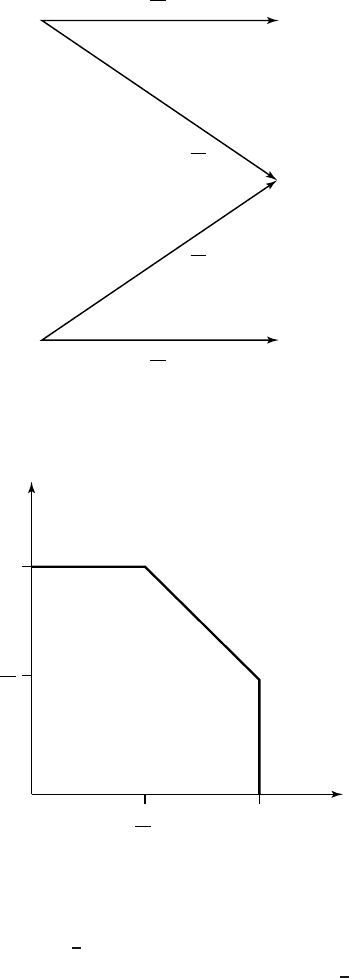
15.3 MULTIPLE-ACCESS CHANNEL 529
00
11
?
1
2
1
2
1
2
1
2
FIGURE 15.12. Equivalent single-user channel for user 2 of a binary erasure multiple-
access channel.
R
2
R
1
C
2
= 1
C
1
= 1
1
0
2
1
2
FIGURE 15.13. Capacity region for binary erasure multiple-access channel.
capacity of this channel is
1
2
bit per transmission. Hence when sending at
maximum rate 1 for sender 1, we can send an additional
1
2
bit from sender
2. Later, after deriving the capacity region, we can verify that these rates
are the best that can be achieved. The capacity region for a binary erasure
channel is illustrated in Figure 15.13.
530 NETWORK INFORMATION THEORY
15.3.1 Achievability of the Capacity Region for the
Multiple-Access Channel
We now prove the achievability of the rate region in Theorem 15.3.1;
the proof of the converse will be left until the next section. The proof
of achievability is very similar to the proof for the single-user channel.
We therefore only emphasize the points at which the proof differs from
the single-user case. We begin by proving the achievability of rate pairs
that satisfy (15.58) for some fixed product distribution p(x
1
)p(x
2
).In
Section 15.3.3 we extend this to prove that all points in the convex hull
of (15.58) are achievable.
Proof: (Achievability in Theorem 15.3.1). Fix p(x
1
,x
2
) = p
1
(x
1
)p
2
(x
2
).
Codebook generation: Generate 2
nR
1
independent codewords X
1
(i),
i ∈{1, 2,...,2
nR
1
}, of length n, generating each element i.i.d.
∼
n
i=1
p
1
(x
1i
). Similarly, generate 2
nR
2
independent codewords X
2
(j),
j ∈{1, 2,...,2
nR
2
}, generating each element i.i.d. ∼
n
i=1
p
2
(x
2i
).These
codewords form the codebook, which is revealed to the senders and the
receiver.
Encoding: To send index i, sender 1 sends the codeword X
1
(i). Simi-
larly, to send j , sender 2 sends X
2
(j).
Decoding: Let A
(n)
denote the set of typical (x
1
, x
2
, y) sequences. The
receiver Y
n
chooses the pair (i, j ) such that
(x
1
(i), x
2
(j), y) ∈ A
(n)
(15.60)
if such a pair (i, j) exists and is unique; otherwise, an error is de-
clared.
Analysis of the probability of error: By the symmetry of the random
code construction, the conditional probability of error does not depend on
which pair of indices is sent. Thus, the conditional probability of error
is the same as the unconditional probability of error. So, without loss of
generality, we can assume that (i, j ) = (1, 1) was sent.
We have an error if either the correct codewords are not typical with
the received sequence or there is a pair of incorrect codewords that are
typical with the received sequence. Define the events
E
ij
={(X
1
(i), X
2
(j), Y) ∈ A
(n)
}. (15.61)
15.3 MULTIPLE-ACCESS CHANNEL 531
Then by the union of events bound,
P
(n)
e
= P
E
c
11
∪
(i,j )=(1,1)
E
ij
(15.62)
≤ P(E
c
11
) +
i=1,j=1
P(E
i1
) +
i=1,j=1
P(E
1j
)
+
i=1,j=1
P(E
ij
), (15.63)
where P is the conditional probability given that (1, 1) was sent. From the
AEP, P(E
c
11
) → 0. By Theorems 15.2.1 and 15.2.3, for i = 1, we have
P(E
i1
) = P((X
1
(i), X
2
(1), Y) ∈ A
(n)
) (15.64)
=
(x
1
,x
2
,y)∈A
(n)
p(x
1
)p(x
2
, y) (15.65)
≤|A
(n)
|2
−n(H (X
1
)−)
2
−n(H (X
2
,Y )−)
(15.66)
≤ 2
−n(H (X
1
)+H(X
2
,Y )−H(X
1
,X
2
,Y )−3)
(15.67)
= 2
−n(I (X
1
;X
2
,Y )−3)
(15.68)
= 2
−n(I (X
1
;Y |X
2
)−3)
, (15.69)
where the equivalence of (15.68) and (15.69) follows from the indepen-
dence of X
1
and X
2
, and the consequent I(X
1
;X
2
,Y) = I(X
1
;X
2
) +
I(X
1
;Y |X
2
) = I(X
1
;Y |X
2
). Similarly, for j = 1,
P(E
1j
) ≤ 2
−n(I (X
2
;Y |X
1
)−3)
, (15.70)
and for i = 1,j = 1,
P(E
ij
) ≤ 2
−n(I (X
1
,X
2
;Y)−4)
. (15.71)
It follows that
P
(n)
e
≤ P(E
c
11
) + 2
nR
1
2
−n(I (X
1
;Y |X
2
)−3)
+ 2
nR
2
2
−n(I (X
2
;Y |X
1
)−3)
+2
n(R
1
+R
2
)
2
−n(I (X
1
,X
2
;Y)−4)
. (15.72)
Since >0 is arbitrary, the conditions of the theorem imply that each
term tends to 0 as n →∞. Thus, the probability of error, conditioned
532 NETWORK INFORMATION THEORY
on a particular codeword being sent, goes to zero if the conditions of the
theorem are met. The above bound shows that the average probability of
error, which by symmetry is equal to the probability for an individual
codeword, averaged over all choices of codebooks in the random code
construction, is arbitrarily small. Hence, there exists at least one code
C
∗
with arbitrarily small probability of error.
This completes the proof of achievability of the region in (15.58) for
a fixed input distribution. Later, in Section 15.3.3, we show that time-
sharing allows any (R
1
,R
2
) in the convex hull to be achieved, completing
the proof of the forward part of the theorem.
15.3.2 Comments on the Capacity Region for the
Multiple-Access Channel
We have now proved the achievability of the capacity region of the
multiple-access channel, which is the closure of the convex hull of the set
of points (R
1
,R
2
) satisfying
R
1
<I(X
1
;Y |X
2
), (15.73)
R
2
<I(X
2
;Y |X
1
), (15.74)
R
1
+ R
2
<I(X
1
,X
2
;Y) (15.75)
for some distribution p
1
(x
1
)p
2
(x
2
) on X
1
× X
2
. For a particular
p
1
(x
1
)p
2
(x
2
), the region is illustrated in Figure 15.14.
R
2
R
1
I
(
X
2
;
Y
|
X
1
)
DC
B
A
I
(
X
2
;
Y
)
I
(
X
1
;
Y
)
I
(
X
1
;
Y
|
X
2
)
0
FIGURE 15.14. Achievable region of multiple-access channel for a fixed input distribution.
15.3 MULTIPLE-ACCESS CHANNEL 533
Let us now interpret the corner points in the region. Point A corresponds
to the maximum rate achievable from sender 1 to the receiver when sender
2 is not sending any information. This is
max R
1
= max
p
1
(x
1
)p
2
(x
2
)
I(X
1
;Y |X
2
). (15.76)
Now for any distribution p
1
(x
1
)p
2
(x
2
),
I(X
1
;Y |X
2
) =
x
2
p
2
(x
2
)I (X
1
;Y |X
2
= x
2
) (15.77)
≤ max
x
2
I(X
1
;Y |X
2
= x
2
), (15.78)
since the average is less than the maximum. Therefore, the maximum
in (15.76) is attained when we set X
2
= x
2
,wherex
2
is the value that
maximizes the conditional mutual information between X
1
and Y .The
distribution of X
1
is chosen to maximize this mutual information. Thus,
X
2
must facilitate the transmission of X
1
by setting X
2
= x
2
.
The point B corresponds to the maximum rate at which sender 2 can
send as long as sender 1 sends at his maximum rate. This is the rate that
is obtained if X
1
is considered as noise for the channel from X
2
to Y .In
this case, using the results from single-user channels, X
2
can send at a
rate I(X
2
;Y). The receiver now knows which X
2
codeword was used and
can “subtract” its effect from the channel. We can consider the channel
now to be an indexed set of single-user channels, where the index is the
X
2
symbol used. The X
1
rate achieved in this case is the average mutual
information, where the average is over these channels, and each channel
occurs as many times as the corresponding X
2
symbol appears in the
codewords. Hence, the rate achieved is
x
2
p(x
2
)I (X
1
;Y |X
2
= x
2
) = I(X
1
;Y |X
2
). (15.79)
Points C and D correspond to B and A, respectively, with the roles of the
senders reversed. The noncorner points can be achieved by time-sharing.
Thus, we have given a single-user interpretation and justification for the
capacity region of a multiple-access channel.
The idea of considering other signals as part of the noise, decoding
one signal, and then “subtracting” it from the received signal is a very
useful one. We will come across the same concept again in the capacity
calculations for the degraded broadcast channel.

534 NETWORK INFORMATION THEORY
15.3.3 Convexity of the Capacity Region of the Multiple-Access
Channel
We now recast the capacity region of the multiple-access channel in order
to take into account the operation of taking the convex hull by introducing
a new random variable. We begin by proving that the capacity region is
convex.
Theorem 15.3.2 The capacity region
C of a multiple-access channel
is convex [i.e., if (R
1
,R
2
) ∈ C and (R
1
,R
2
) ∈ C,then(λR
1
+ (1 − λ)R
1
,
λR
2
+ (1 − λ)R
2
) ∈ C for 0 ≤ λ ≤ 1].
Proof: The idea is time-sharing. Given two sequences of codes at dif-
ferent rates R = (R
1
,R
2
) and R
= (R
1
,R
2
), we can construct a third
codebook at a rate λR + (1 − λ)R
by using the first codebook for the
first λn symbols and using the second codebook for the last (1 − λ)n
symbols. The number of X
1
codewords in the new code is
2
nλR
1
2
n(1−λ)R
1
= 2
n(λR
1
+(1−λ)R
1
)
, (15.80)
and hence the rate of the new code is λR + (1 − λ)R
. Since the overall
probability of error is less than the sum of the probabilities of error for
each of the segments, the probability of error of the new code goes to 0
and the rate is achievable.
We can now recast the statement of the capacity region for the multiple-
access channel using a time-sharing random variable Q. Before we prove
this result, we need to prove a property of convex sets defined by lin-
ear inequalities like those of the capacity region of the multiple-access
channel. In particular, we would like to show that the convex hull of two
such regions defined by linear constraints is the region defined by the
convex combination of the constraints. Initially, the equality of these two
sets seems obvious, but on closer examination, there is a subtle difficulty
due to the fact that some of the constraints might not be active. This is
best illustrated by an example. Consider the following two sets defined
by linear inequalities:
C
1
={(x, y) : x ≥ 0,y ≥ 0,x ≤ 10,y ≤ 10,x + y ≤ 100} (15.81)
C
2
={(x, y) : x ≥ 0,y ≥ 0,x ≤ 20,y ≤ 20,x + y ≤ 20}. (15.82)
In this case, the (
1
2
,
1
2
) convex combination of the constraints defines the
region
C ={(x, y) : x ≥ 0,y ≥ 0,x ≤ 15,y ≤ 15,x + y ≤ 60}. (15.83)