
Thomas M. Cover, Joy A. Thomas. Elements of information theory
Подождите немного. Документ загружается.

15.3 MULTIPLE-ACCESS CHANNEL 535
It is not difficult to see that any point in C
1
or C
2
has x + y<20, so
any point in the convex hull of the union of C
1
and C
2
satisfies this
property. Thus, the point (15,15), which is in C, is not in the convex hull
of (C
1
∪ C
2
). This example also hints at the cause of the problem—in the
definition for C
1
, the constraint x + y ≤ 100 is not active. If this constraint
were replaced by a constraint x + y ≤ a,wherea ≤ 20, the above result
of the equality of the two regions would be true, as we now prove.
We restrict ourselves to the pentagonal regions that occur as compo-
nents of the capacity region of a two-user multiple-access channel. In
this case, the capacity region for a fixed p(x
1
)p(x
2
) is defined by three
mutual informations, I(X
1
;Y |X
2
), I (X
2
;Y |X
1
),andI(X
1
,X
2
;Y),which
we shall call I
1
,I
2
,andI
3
, respectively. For each p(x
1
)p(x
2
),thereisa
corresponding vector, I = (I
1
,I
2
,I
3
), and a rate region defined by
C
I
={(R
1
,R
2
) : R
1
≥ 0,R
2
≥ 0,R
1
≤ I
1
,R
2
≤ I
2
,R
1
+ R
2
≤ I
3
}.
(15.84)
Also, since for any distribution p(x
1
)p(x
2
),wehaveI(X
2
;Y |X
1
) =
H(X
2
|X
1
) − H(X
2
|Y, X
1
) = H(X
2
) − H(X
2
|Y, X
1
) = I(X
2
;Y, X
1
) =
I(X
2
;Y)+ I(X
2
;X
1
|Y) ≥ I(X
2
;Y), and therefore, I(X
1
;Y |X
2
) +
I(X
2
;Y |X
1
) ≥ I(X
1
;Y |X
2
)+ I(X
2
;Y) = I(X
1
,X
2
;Y), we have for all
vectors I that I
1
+ I
2
≥ I
3
. This property will turn out to be critical for
the theorem.
Lemma 15.3.1 Let I
1
, I
2
∈ R
3
be two vectors of mutual informations
that define rate regions C
I
1
and C
I
2
, respectively, as given in (15.84).
For 0 ≤ λ ≤ 1, define I
λ
= λI
1
+ (1 − λ)I
2
, and let C
I
λ
be the rate region
defined by I
λ
.Then
C
I
λ
= λC
I
1
+ (1 − λ)C
I
2
. (15.85)
Proof: We shall prove this theorem in two parts. We first show that
any point in the (λ, 1 −λ) mix of the sets C
I
1
and C
I
2
satisfies the con-
straints I
λ
. But this is straightforward, since any point in C
I
1
satisfies the
inequalities for I
1
and a point in C
I
2
satisfies the inequalities for I
2
,so
the (λ, 1 − λ) mix of these points will satisfy the (λ, 1 −λ) mix of the
constraints. Thus, it follows that
λC
I
1
+ (1 − λ)C
I
2
⊆ C
I
λ
. (15.86)
To prove the reverse inclusion, we consider the extreme points of the
pentagonal regions. It is not difficult to see that the rate regions defined
in (15.84) are always in the form of a pentagon, or in the extreme case
536 NETWORK INFORMATION THEORY
when I
3
= I
1
+ I
2
, in the form of a rectangle. Thus, the capacity region
C
I
can be also defined as a convex hull of five points:
(0, 0), (I
1
, 0), (I
1
,I
3
− I
1
), (I
3
− I
2
,I
2
), (0,I
2
). (15.87)
Consider the region defined by I
λ
; it, too, is defined by five points. Take
any one of the points, say (I
(λ)
3
− I
(λ)
2
,I
(λ)
2
). This point can be written as
the (λ, 1 −λ) mix of the points (I
(1)
3
− I
(1)
2
,I
(1)
2
) and (I
(2)
3
− I
(2)
2
,I
(2)
2
),
and therefore lies in the convex mixture of C
I
1
and C
I
2
.Thus,allextreme
points of the pentagon C
I
λ
lie in the convex hull of C
I
1
and C
I
2
,or
C
I
λ
⊆ λC
I
1
+ (1 − λ)C
I
2
. (15.88)
Combining the two parts, we have the theorem.
In the proof of the theorem, we have implicitly used the fact that all
the rate regions are defined by five extreme points (at worst, some of
the points are equal). All five points defined by the I vector were within
the rate region. If the condition I
3
≤ I
1
+ I
2
is not satisfied, some of the
points in (15.87) may be outside the rate region and the proof collapses.
As an immediate consequence of the above lemma, we have the fol-
lowing theorem:
Theorem 15.3.3 The convex hull of the union of the rate regions defined
by individual I vectors is equal to the rate region defined by the convex
hull of the I vectors.
These arguments on the equivalence of the convex hull operation on
the rate regions with the convex combinations of the mutual informa-
tions can be extended to the general m-user multiple-access channel. A
proof along these lines using the theory of polymatroids is developed in
Han [271].
Theorem 15.3.4 The set of achievable rates of a discrete memoryless
multiple-access channel is given by the closure of the set of all (R
1
,R
2
)
pairs satisfying
R
1
<I(X
1
;Y |X
2
,Q),
R
2
<I(X
2
;Y |X
1
,Q),
R
1
+ R
2
<I(X
1
,X
2
;Y |Q) (15.89)
15.3 MULTIPLE-ACCESS CHANNEL 537
for some choice of the joint distribution p(q)p(x
1
|q)p(x
2
|q)p(y|x
1
,x
2
)
with |
Q|≤4.
Proof: We will show that every rate pair lying in the region defined in
(15.89) is achievable (i.e., it lies in the convex closure of the rate pairs
satisfying Theorem 15.3.1). We also show that every point in the convex
closure of the region in Theorem 15.3.1 is also in the region defined
in (15.89).
Consider a rate point R satisfying the inequalities (15.89) of the theo-
rem. We can rewrite the right-hand side of the first inequality as
I(X
1
;Y |X
2
,Q)=
m
q=1
p(q)I (X
1
;Y |X
2
,Q = q) (15.90)
=
m
q=1
p(q)I (X
1
;Y |X
2
)
p
1q
,p
2q
, (15.91)
where m is the cardinality of the support set of Q. We can expand the
other mutual informations similarly.
For simplicity in notation, we consider a rate pair as a vector and
denote a pair satisfying the inequalities in (15.58) for a specific input
product distribution p
1q
(x
1
)p
2q
(x
2
) as R
p
1
,p
2
as R
q
. Specifically, let R
q
=
(R
1q
,R
2q
) be a rate pair satisfying
R
1q
<I(X
1
;Y |X
2
)
p
1q
(x
1
)p
2q
(x
2
)
, (15.92)
R
2q
<I(X
2
;Y |X
1
)
p
1q
(x
1
)p
2q
(x
2
)
, (15.93)
R
1q
+ R
2q
<I(X
1
,X
2
;Y)
p
1q
(x
1
)p
2q
(x
2
)
. (15.94)
Then by Theorem 15.3.1, R
q
= (R
1q
,R
2q
) is achievable. Then since R
satisfies (15.89) and we can expand the right-hand sides as in (15.91),
there exists a setof pairs R
q
satisfying (15.94) such that
R =
m
q=1
p(q)R
q
. (15.95)
Since a convex combination of achievable rates is achievable, so is R.
Hence, we have proven the achievability of the region in the theorem.
The same argument can be used to show that every point in the convex
closure of the region in (15.58) can be written as the mixture of points
satisfying (15.94) and hence can be written in the form (15.89).
538 NETWORK INFORMATION THEORY
The converse is proved in the next section. The converse shows that
all achievable rate pairs are of the form (15.89), and hence establishes
that this is the capacity region of the multiple-access channel. The cardi-
nality bound on the time-sharing random variable Q is a consequence of
Carath
´
eodory’s theorem on convex sets. See the discussion below.
The proof of the convexity of the capacity region shows that any convex
combination of achievable rate pairs is also achievable. We can continue
this process, taking convex combinations of more points. Do we need to
use an arbitrary number of points ? Will the capacity region be increased?
The following theorem says no.
Theorem 15.3.5 (Carath´eodory) Any point in the convex closure of a
compact set A in a d-dimensional Euclidean space can be represented as
a convex combination of d +1 or fewer points in the original set A.
Proof: The proof may be found in Eggleston [183] and Gr
¨
unbaum
[263].
This theorem allows us to restrict attention to a certain finite convex
combination when calculating the capacity region. This is an important
property because without it, we would not be able to compute the capacity
region in (15.89), since we would never know whether using a larger
alphabet
Q would increase the region.
In the multiple-access channel, the bounds define a connected compact
set in three dimensions. Therefore, all points in its closure can be defined
as the convex combination of at most four points. Hence, we can restrict
the cardinality of Q to at most 4 in the above definition of the capacity
region.
Remark Many of the cardinality bounds may be slightly improved by
introducing other considerations. For example, if we are only interested
in the boundary of the convex hull of A as we are in capacity theorems,
a point on the boundary can be expressed as a mixture of d points of
A, since a point on the boundary lies in the intersection of A with a
(d − 1)-dimensional support hyperplane.
15.3.4 Converse for the Multiple-Access Channel
We have so far proved the achievability of the capacity region. In this
section we prove the converse.

15.3 MULTIPLE-ACCESS CHANNEL 539
Proof: (Converse to Theorems 15.3.1 and 15.3.4). We must show that
given any sequence of ((2
nR
1
, 2
nR
2
), n) codes with P
(n)
e
→ 0, the rates
must satisfy
R
1
≤ I(X
1
;Y |X
2
,Q),
R
2
≤ I(X
2
;Y |X
1
,Q),
R
1
+ R
2
≤ I(X
1
,X
2
;Y |Q) (15.96)
for some choice of random variable Q defined on {1, 2, 3, 4} and joint
distribution p(q)p(x
1
|q)p(x
2
|q)p(y|x
1
,x
2
).Fixn. Consider the given
code of block length n. The joint distribution on
W
1
× W
2
× X
n
1
× X
n
2
×
Y
n
is well defined. The only randomness is due to the random uniform
choice of indices W
1
and W
2
and the randomness induced by the channel.
The joint distribution is
p(w
1
,w
2
,x
n
1
,x
n
2
,y
n
) =
1
2
nR
1
1
2
nR
2
p(x
n
1
|w
1
)p(x
n
2
|w
2
)
n
i=1
p(y
i
|x
1i
,x
2i
),
(15.97)
where p(x
n
1
|w
1
) is either 1 or 0, depending on whether x
n
1
= x
1
(w
1
),the
codeword corresponding to w
1
, or not, and similarly, p(x
n
2
|w
2
) = 1or0,
according to whether x
n
2
= x
2
(w
2
) or not. The mutual informations that
follow are calculated with respect to this distribution.
By the code construction, it is possible to estimate (W
1
,W
2
) from the
received sequence Y
n
with a low probability of error. Hence, the condi-
tional entropy of (W
1
,W
2
) given Y
n
must be small. By Fano’s inequality,
H(W
1
,W
2
|Y
n
) ≤ n(R
1
+ R
2
)P
(n)
e
+ H(P
(n)
e
)
= n
n
. (15.98)
It is clear that
n
→ 0asP
(n)
e
→ 0. Then we have
H(W
1
|Y
n
) ≤ H(W
1
,W
2
|Y
n
) ≤ n
n
, (15.99)
H(W
2
|Y
n
) ≤ H(W
1
,W
2
|Y
n
) ≤ n
n
. (15.100)
We can now bound the rate R
1
as
nR
1
= H(W
1
) (15.101)
= I(W
1
;Y
n
) + H(W
1
|Y
n
) (15.102)
(a)
≤ I(W
1
;Y
n
) + n
n
(15.103)

540 NETWORK INFORMATION THEORY
(b)
≤ I(X
n
1
(W
1
);Y
n
) + n
n
(15.104)
= H(X
n
1
(W
1
)) − H(X
n
1
(W
1
)|Y
n
) + n
n
(15.105)
(c)
≤ H(X
n
1
(W
1
)|X
n
2
(W
2
)) − H(X
n
1
(W
1
)|Y
n
,X
n
2
(W
2
)) + n
n
(15.106)
= I(X
n
1
(W
1
);Y
n
|X
n
2
(W
2
)) + n
n
(15.107)
= H(Y
n
|X
n
2
(W
2
)) − H(Y
n
|X
n
1
(W
1
), X
n
2
(W
2
)) + n
n
(15.108)
(d)
= H(Y
n
|X
n
2
(W
2
)) −
n
i=1
H(Y
i
|Y
i−1
,X
n
1
(W
1
), X
n
2
(W
2
)) + n
n
(15.109)
(e)
= H(Y
n
|X
n
2
(W
2
)) −
n
i=1
H(Y
i
|X
1i
,X
2i
) + n
n
(15.110)
(f)
≤
n
i=1
H(Y
i
|X
n
2
(W
2
)) −
n
i=1
H(Y
i
|X
1i
,X
2i
) + n
n
(15.111)
(g)
≤
n
i=1
H(Y
i
|X
2i
) −
n
i=1
H(Y
i
|X
1i
,X
2i
) + n
n
(15.112)
=
n
i=1
I(X
1i
;Y
i
|X
2i
) + n
n
, (15.113)
where
(a) follows from Fano’s inequality
(b) follows from the data-processing inequality
(c) follows from the fact that since W
1
and W
2
are independent,
so are X
n
1
(W
1
) and X
n
2
(W
2
), and hence H(X
n
1
(W
1
)|X
n
2
(W
2
)) =
H(X
n
1
(W
1
)),andH(X
n
1
(W
1
)|Y
n
,X
n
2
(W
2
)) ≤ H(X
n
1
(W
1
)|Y
n
) by
conditioning
(d) follows from the chain rule
(e) follows from the fact that Y
i
depends only on X
1i
and X
2i
by the
memoryless property of the channel
(f) follows from the chain rule and removing conditioning
(g) follows from removing conditioning
Hence, we have
R
1
≤
1
n
n
i=1
I(X
1i
;Y
i
|X
2i
) +
n
. (15.114)

15.3 MULTIPLE-ACCESS CHANNEL 541
Similarly, we have
R
2
≤
1
n
n
i=1
I(X
2i
;Y
i
|X
1i
) +
n
. (15.115)
To bound the sum of the rates, we have
n(R
1
+ R
2
) = H(W
1
,W
2
) (15.116)
= I(W
1
,W
2
;Y
n
) + H(W
1
,W
2
|Y
n
) (15.117)
(a)
≤ I(W
1
,W
2
;Y
n
) + n
n
(15.118)
(b)
≤ I(X
n
1
(W
1
), X
n
2
(W
2
);Y
n
) + n
n
(15.119)
= H(Y
n
) − H(Y
n
|X
n
1
(W
1
), X
n
2
(W
2
)) + n
n
(15.120)
(c)
= H(Y
n
) −
n
i=1
H(Y
i
|Y
i−1
,X
n
1
(W
1
), X
n
2
(W
2
)) + n
n
(15.121)
(d)
= H(Y
n
) −
n
i=1
H(Y
i
|X
1i
,X
2i
) + n
n
(15.122)
(e)
≤
n
i=1
H(Y
i
) −
n
i=1
H(Y
i
|X
1i
,X
2i
) + n
n
(15.123)
=
n
i=1
I(X
1i
,X
2i
;Y
i
) + n
n
, (15.124)
where
(a) follows from Fano’s inequality
(b) follows from the data-processing inequality
(c) follows from the chain rule
(d) follows from the fact that Y
i
depends only on X
1i
and X
2i
and is
conditionally independent of everything else
(e) follows from the chain rule and removing conditioning
Hence, we have
R
1
+ R
2
≤
1
n
n
i=1
I(X
1i
,X
2i
;Y
i
) +
n
. (15.125)

542 NETWORK INFORMATION THEORY
The expressions in (15.114), (15.115), and (15.125) are the averages of the
mutual informations calculated at the empirical distributions in column i
of the codebook. We can rewrite these equations with the new variable Q,
where Q = i ∈{1, 2,...,n} with probability
1
n
. The equations become
R
1
≤
1
n
n
i=1
I(X
1i
;Y
i
|X
2i
) +
n
(15.126)
=
1
n
n
i=1
I(X
1q
;Y
q
|X
2q
,Q= i) +
n
(15.127)
= I(X
1Q
;Y
Q
|X
2Q
,Q)+
n
(15.128)
= I(X
1
;Y |X
2
,Q)+
n
, (15.129)
where X
1
= X
1Q
, X
2
= X
2Q
,andY
= Y
Q
are new random variables
whose distributions depend on Q in the same way as the distributions
of X
1i
, X
2i
and Y
i
depend on i.SinceW
1
and W
2
are independent, so are
X
1i
(W
1
) and X
2i
(W
2
), and hence
Pr
(
X
1i
(W
1
) = x
1
,X
2i
(W
2
) = x
2
)
= Pr{X
1Q
= x
1
|Q = i}Pr{X
2Q
= x
2
|Q = i}. (15.130)
Hence, taking the limit as n →∞, P
(n)
e
→ 0, we have the following
converse:
R
1
≤ I(X
1
;Y |X
2
,Q),
R
2
≤ I(X
2
;Y |X
1
,Q),
R
1
+ R
2
≤ I(X
1
,X
2
;Y |Q) (15.131)
for some choice of joint distribution p(q)p(x
1
|q)p(x
2
|q)p(y|x
1
,x
2
).As
in Section 15.3.3, the region is unchanged if we limit the cardinality of
Q to 4.
This completes the proof of the converse.
Thus, the achievability of the region of Theorem 15.3.1 was proved in
Section 15.3.1. In Section 15.3.3 we showed that every point in the region
defined by (15.96) was also achievable. In the converse, we showed that
the region in (15.96) was the best we can do, establishing that this is
indeed the capacity region of the channel. Thus, the region in (15.58)
15.3 MULTIPLE-ACCESS CHANNEL 543
cannot be any larger than the region in (15.96), and this is the capacity
region of the multiple-access channel.
15.3.5
m
-User Multiple-Access Channels
We will now generalize the result derived for two senders to m senders,
m ≥ 2. The multiple-access channel in this case is shown in Figure 15.15.
We send independent indices w
1
,w
2
,...,w
m
over the channel from
the senders 1, 2,...,m, respectively. The codes, rates, and achievability
are all defined in exactly the same way as in the two-sender case.
Let S ⊆{1, 2,...,m}.LetS
c
denote the complement of S.Let
R(S) =
i∈S
R
i
,andletX(S) ={X
i
: i ∈ S}.Thenwehavethefollow-
ing theorem.
Theorem 15.3.6 The capacity region of the m-user multiple-access
channel is the closure of the convex hull of the rate vectors satisfying
R(S) ≤ I(X(S);Y |X(S
c
)) for all S ⊆{1, 2,...,m} (15.132)
for some product distribution p
1
(x
1
)p
2
(x
2
) ···p
m
(x
m
).
Proof: The proof contains no new ideas. There are now 2
m
− 1termsin
the probability of error in the achievability proof and an equal number of
inequalities in the proof of the converse. Details are left to the reader.
In general, the region in (15.132) is a beveled box.
p
(
y
|
x
1
,
x
2
,...,
x
m
)
X
1
X
2
X
m
.
.
.
Y
FIGURE 15.15. m-user multiple-access channel.
544 NETWORK INFORMATION THEORY
15.3.6 Gaussian Multiple-Access Channels
We now discuss the Gaussian multiple-access channel of Section 15.1.2
in somewhat more detail.
Two senders, X
1
and X
2
, communicate to the single receiver, Y .The
received signal at time i is
Y
i
= X
1i
+ X
2i
+ Z
i
, (15.133)
where {Z
i
} is a sequence of independent, identically distributed, zero-
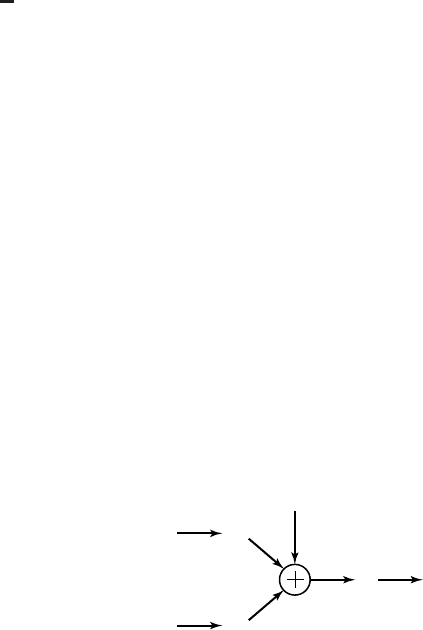
mean Gaussian random variables with variance N (Figure 15.16). We
assume that there is a power constraint P
j
on sender j ; that is, for each
sender, for all messages, we must have
1
n
n
i=1
x
2
ji
(w
j
) ≤ P
j
,w
j
∈{1, 2,...,2
nR
j
},j= 1, 2. (15.134)
Just as the proof of achievability of channel capacity for the discrete
case (Chapter 7) was extended to the Gaussian channel (Chapter 9), we
can extend the proof for the discrete multiple-access channel to the Gaus-
sian multiple-access channel. The converse can also be extended similarly,
so we expect the capacity region to be the convex hull of the set of rate
pairs satisfying
R
1
≤ I(X
1
;Y |X
2
), (15.135)
R
2
≤ I(X
2
;Y |X
1
), (15.136)
R
1
+ R
2
≤ I(X
1
,X
2
;Y) (15.137)
for some input distribution f
1
(x
1
)f
2
(x
2
) satisfying EX
2
1
≤ P
1
and
EX
2
2
≤ P
2
.
Z
n
X
n
1
W
1
W
2
P
1
X
n
2
P
2
Y
n
(
W
1
,
W
2
)
^^
FIGURE 15.16. Gaussian multiple-access channel.