
Tsoulos George (ред.) MIMO System Technology for Wireless Communications
Подождите немного. Документ загружается.

44 MIMO System Technology for Wireless Communications
where V is the angle corresponding to phase shift between the neighbor array
elements.
In order to simplify the analysis, the distance between the receiving and
the transmitting antennas is assumed substantially larger than the distance
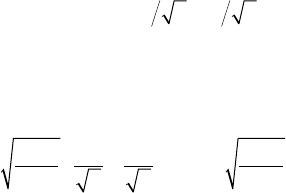
between the antenna elements. So, under the assumption of , V is
minimized to the point that it can be omitted from the matrix in Equation
2.38 (see Appendix 2C for the proof). In that case H
LOS
is given by an n
r
× n
t
matrix, with ones as elements (we refer to this matrix as H(1)).
Also, it is obvious that K
0
affects the contribution of H
LOS
to H
Rice
. For reasons
of simplicity it is assumed that
K
0
= U/4, so e
jK
0
=
As a result, the real and the imaginary parts of the H
Rice
elements are influ-
enced in the same manner. After some manipulation, Equation 2.37 becomes:
(2.39)
Equation 2.39 is used to produce the simulation results shown in the next
section.
The assumptions made regarding the Ricean channel analysis can be sum-
marized as follows:
• The dominant component is considered to be caused by LOS prop-
agation.
• The distance between the transmitter and the receiver is considered
substantially larger than the interelement distance.
Although these assumptions might not always be valid, the results indicate
the effect of the dominant component on the MIMO system capacity, gener-
ally. In cases that the dominant signal component is caused by directional
multipath propagation, this component is time varying, and hence, the above
analysis cannot be applied.
However, the case can be found in multibase operations [3]. In these
scenarios the transmit/receive antenna elements are cited in different base
stations. The matrix that describes the constant component of the Ricean
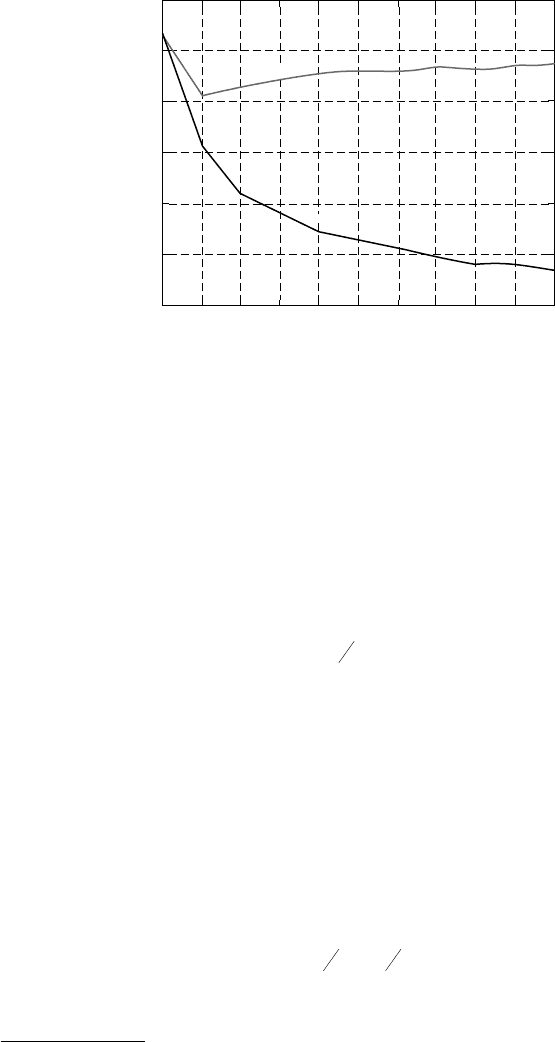
channel, in that case, is orthogonal. In Figure 2.5 is illustrated the ergodic
capacity of a Ricean channel when the H
LOS
is orthogonal and when H
LOS
=
H(1).
Apparently, Figure 2.5 shows that the form of the H
LOS
matrix, which
represents the fixed channel component, influences the capacity for large
values of K-factor. Specifically, the channel with the orthogonal H
LOS
outper-
forms the channel with the degenerate H
LOS
for increasing K.
Rd
12 12+ j
HHH
Rice
1
2
+j
1
2
1=
+
©
«
ª
¹
»
º
()
+
+
K
KK
w
1
1
1
Rd
4190_book.fm Page 44 Tuesday, February 21, 2006 9:14 AM
Theory and Practice of MIMO Wireless Communication Systems 45
2.6.3 Channel Matrix with Spatial Fading Correlation
The Rayleigh channel assumes flat fading in the space, time, and frequency
domains. However, the signal’s components arriving at the receiver may
experience correlation due to the limited distance of the antenna elements.
As a result, the use of H
W
as the channel matrix is inappropriate. In order
to include the correlation effect the following equation is used [1, 3]:
(2.40)
where vec(H), denotes a vector* made by the columns of H, and R is the
covariance matrix of the channel of dimension n
r
n
t
× n
r
n
t
.
(2.41)
The analysis can be simplified with the use of the channel matrix of Equation
2.42.
(2.42)
FIGURE 2.5
Ergodic capacity of a 2 × 2 Ricean channel when the H
LOS
is orthogonal, and H
LOS
= H(1).
* If H = [h
1
h
2
…
h
n
t
] is n
r
× n
t
then vec(H) = [h
1
T
h
2
T
…h
T
n
t
]isn
r
n
t
× 1.
7.5
H
LOS
orthogonal-H
LOS
degenarated as a function of K
7
6.5
6
5.5
Ergodic capacity(bits/sec/Herz)
5
4.5
0 2 4 6 8 10 12
K
16 18 14 20
Ones
Orth
vec R vecHH
()
=
()
1
2
W
RHH=
() ()
{}
E vec vec
H
HRHR=
RWT
1
2
1
2
4190_book.fm Page 45 Tuesday, February 21, 2006 9:14 AM
46 MIMO System Technology for Wireless Communications
where R
R
is the reception correlation matrix and R
T
is the transmission
correlation matrix. Equation 2.42 is derived by 2.40 under the assumption
that matrix R
R
and R
T
remain unchanged, regardless of the transmitting and
receiving elements, respectively.
The correlation matrices R
T
and R
R
are calculated using two different mod-
els. The first (used for the simulations), calculates these matrices as a function
of the distance between the receiving and transmitting elements [16]. A short
description follows assuming that the R
T
, R
R
matrices have the form:
(2.43)
where r is the fading correlation between two adjacent antenna elements
and it is approximated by:
(2.44)
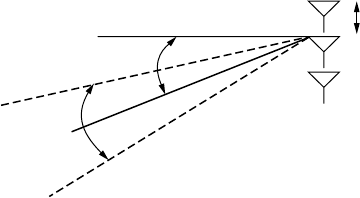
) is the angular spread and d is the distance in wavelengths between the
antenna elements (Figure 2.6). In order to simplify the procedure we can
make the following assumptions concerning the model:
FIGURE 2.6
The mean angle of arrival (O) and the angle spread ()) of an incoming multipath signal.
R
T
TT T
n
tT
TT T
T
rr r
rr
rr r
r
r
t
=
1
1
1
4
1
44
2
()
TT
n
TT
R
RR
t
rr
rr
()
¬
®
¼
¾
½
½
½
½
½
½
½
=
1
4
4
2
1
1
R
r
rr
rr r
r
r
R
n
RR
RR R
R
R
n
r
r
()
()
1
44
1
2
2
1
1
rr
RR
4
1
¬
®
¼
¾
½
½
½
½
½
½
½
rd d
()
~
()
exp 23
22
)
d
2∆
ϕ
4190_book.fm Page 46 Tuesday, February 21, 2006 9:14 AM
Theory and Practice of MIMO Wireless Communication Systems 47
• For very small r(d) the higher order terms of the above matrices can
be omitted. Hence, the correlation matrices take the form of triagonal
matrices.
• Moreover, if the same interelement distance for both the transmitter
and the receiver is considered (d
r
= d
r
and r
T
= r
R
= r), we can use a
single parameter model that simplifies the capacity calculations.
The final form of the matrices used in simulations are:
(2.45)
The second model is described in [17], where the analysis from [18] is
adopted and calculates the correlation matrices via the following formula:
(2.46)
where J
0
is the zero-order Bessel function of the first kind, , and R
ik
is the signal correlation coefficient between the ith and the kth antenna array
element.
For very small ) and O = 0 Equation 2.46 can be approximated by:
(2.47)
The largest value of ) that maintains the validity of Equation 2.47 is U/4.
2.7 Simulations
In this section we present simulation results for the three capacity cases
presented in Section 2.6. The Cumulative Distribution Function (CDF) of the
capacity is produced for the following scenarios:
• Rayleigh channel without spatial fading correlation
• Rice channel with the dominant component caused by LOS propa-
gation
R
T
r
rr
r
r
r
=
¬
®
¼
¾
½
½
½
½
½
100
1
010
001
½½
=
¬
®
¼
¾
½
½
½
R
R
r
rr
r
r
r
100
1
010
001
½½
½
½
RJzik
ik
=
0
[( )]
zd= 2UQ
R
zi k
zi k
ik
~
sin( ( ) )
()
)
)
4190_book.fm Page 47 Tuesday, February 21, 2006 9:14 AM
48 MIMO System Technology for Wireless Communications
• Rice channel with the dominant component caused by weak multipath
• Rayleigh channel with spatial fading correlation
2.7.1 MIMO Capacity for a Rayleigh Channel without Spatial
Fading Correlation
The capacity formula used for the simulations of this section is presented in
Equation 2.13. The channel matrix that it is used for capacity calculations is
H
W
. This matrix is full rank and its elements are independent variables that
follow a Gaussian distribution. As a result, the MIMO channel is transformed
into exactly SISO subchannels.
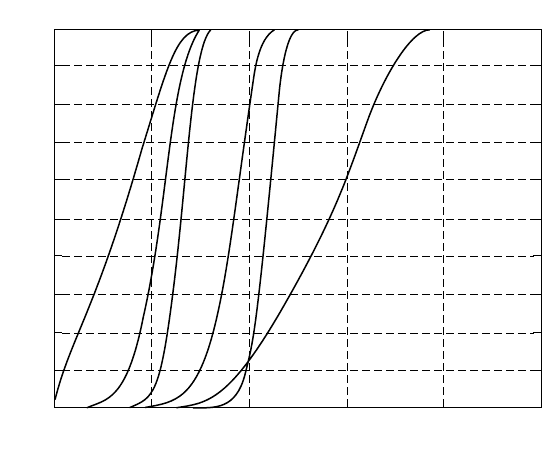
Figure 2.7 indicates that increasing the number of antenna elements leads
to a capacity increase. Especially, we notice that the large capacity increase
involves array antennas at both the transmitter and the receiver. For example,
the (8,1) MIMO channel supports lower capacity gain than the (2,2) MIMO
channel. This is justified by the MIMO system transformation concept men-
tioned earlier. Specifically, the (8,1) channel gives n = 1 while (2,2) gives n = 2.
The result can be justified considering the fact that the independent SISO
subchannels that resulted from the MIMO system transformation are respon-
sible for the information transfer.
Also, Figure 2.7 indicates that the presence of an antenna array at the
receiver is more important than the presence of the same antenna array at
the transmitter. For example, we notice again that the channel (4,1) presents
FIGURE 2.7
MIMO capacity for a Rayleigh channel with different antenna array elements (SNR=10 dB).
nrank nn
rt
==()min(,)H
W
1
CDF-Rayleigh-SNR = 10
0.9
0.8
0.7
0.6
0.5
0.4
0.3
(1, 1)
(1, 4)
(4, 1)
(1, 8)
(8, 1)
(2, 2)
Prob(capacity < c)
0.2
0.1
0
0 5 10 15
c bits/sec/Hz
20 25
4190_book.fm Page 48 Tuesday, February 21, 2006 9:14 AM
Theory and Practice of MIMO Wireless Communication Systems 49
better capacity behavior than the channel (1,4). The explanation for this lies
in the assumption that the transmitter does not have CSI, and as a result it
“equi-powers” the elements regardless of the channel. On the contrary, the
receiver is considered to possess this information, and as a result it may use
its antenna array for optimum combining based on CSI.
2.7.2 MIMO Capacity for a Rayleigh Channel with Spatial
Fading Correlation
In this case the channel matrix is given by Equation 2.42. Figure 2.8 illustrates
the capacity for different antenna configurations and interelement spacing
distances, d in wavelengths.
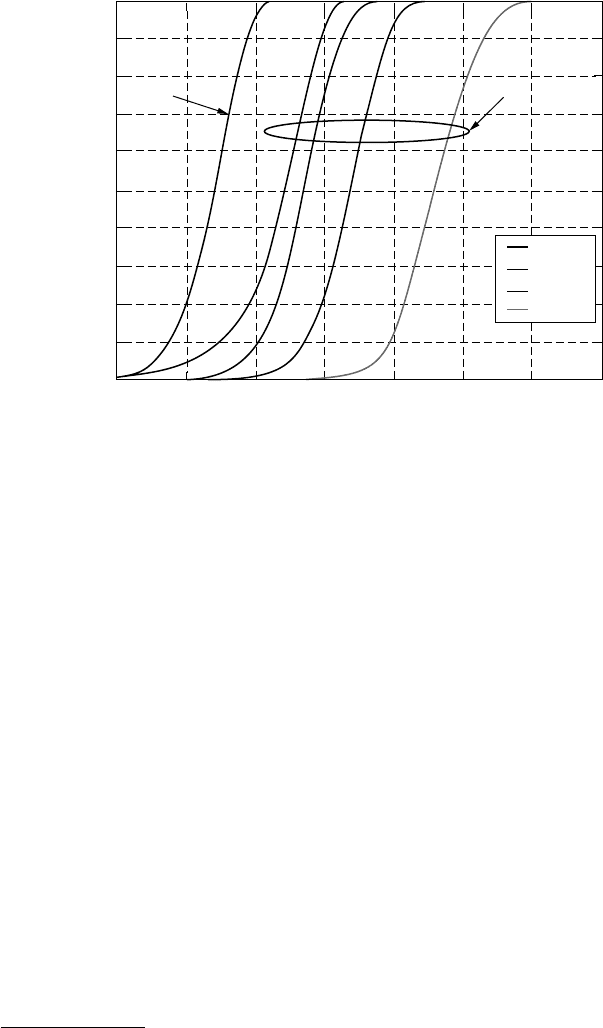
Figure 2.8 proves the great effect of correlation to the MIMO channel
capacity. We can easily notice that the uncorrelated channel* (d = 0.5 Q) offers
high capacity performance in comparison to rest cases. Specifically, the
ergodic capacity of the (4,4) uncorrelated channel is about 13 bits/sec/Hz
greater than the fully correlated one. So as the distance between the antenna
elements decreases, the capacity decreases too. The reason lies in the
correlation increase with the decrease of the interelement distance.
Correlation between the transmitted and received signals decreases the
FIGURE 2.8
CDFs of capacity for the Rayleigh MIMO channel with spatial fading correlation.
* We consider the scenario where half wavelength interelement distance introduces low enough
correlation that the fades can be considered independent [1].
1
0.9
0.8
0.7
(2, 2)
CDF-corre
l
ate
d
c
h
anne
l
-SNR = 10
(4, 4)
0.6
0.5
0.4
0.3
Prob(capacity < c)
0.2
0.1
0
0 5 10 15 20 25 30
c bits/sec/Hz
35
d = 0.01
d = 0.1
d = 0.2
d = 0.5
4190_book.fm Page 49 Tuesday, February 21, 2006 9:14 AM
50 MIMO System Technology for Wireless Communications
independent propagation paths and, as a result, decreases the information
transferred.
Also, we notice that the (4,4) MIMO channel achieves higher capacity
compared to the (2,2) channel, under any correlation conditions.
2.7.3 MIMO Capacity for a Ricean Channel
The channel matrix that it is used for capacity calculations is given by
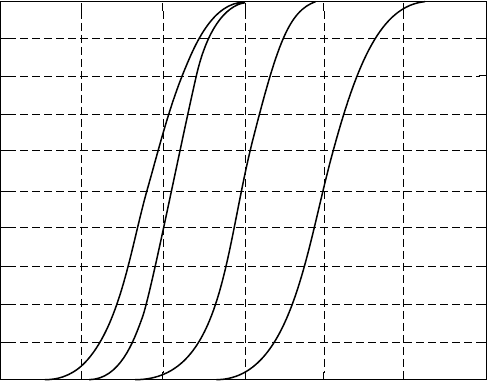
Equation 2.39. Figure 2.9 illustrates the CDFs of capacity for different antenna
configurations and for a constant Ricean factor equal to K = 4. Figure 2.10
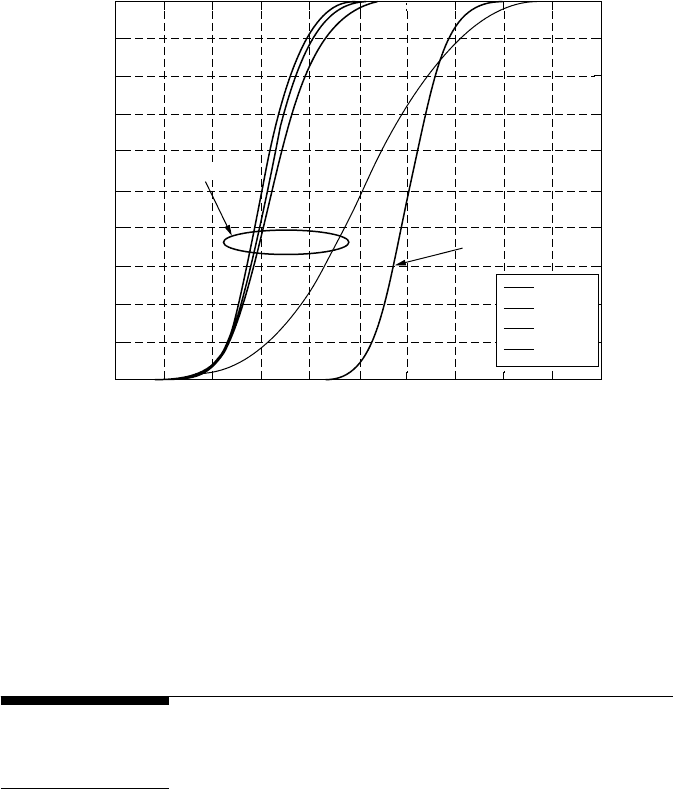
illustrates the CDFs of capacity for a (2,2) MIMO channel for different Ricean
factors. The CDF for K = 0 represents the case of Rayleigh fading channel.
Apparently, Figure 2.9 indicates that the use of array antennas at both the
transmitter and receiver improves substantially the capacity. The same result
arose in the case of the simple Rayleigh channel studied in the previous section.
Figure 2.10 proves that the presence of a fixed component can cause great
damage to the MIMO channel capacity performance. We easily see that the
channel capacity decreases when the Ricean factor increases. The value of K
corresponds to the strength of the dominant component. As K increases, the
dominant component appears stronger and the correlation coefficient
increases too. As mentioned before, correlation leads to the limitation of the
independent paths that transfer information and, hence, to lower capacity
gains.
FIGURE 2.9
CDFs of capacity for the Ricean MIMO channel with K = 4.
1
0.9
0.8
0.7
(2, 2)
(2, 4)
(4, 2)
(4,4)
CDF-rank
(
H
Rice
) = 1, SNR = 10, K = 4
0.6
0.5
0.4
0.3
Prob(capacity < c)
0.2
0.1
0
2 4 6 8 10 12
c bits/sec/Hz
14
4190_book.fm Page 50 Tuesday, February 21, 2006 9:14 AM
Theory and Practice of MIMO Wireless Communication Systems 51
Finally, Figure 2.10 shows that the capacity decrease, due to the fixed
component reaching the receiver, can be easily compensated by the use of
more elements. Specifically, we notice that the (4,4) channel with K = 12
outperforms the (2,2) Rayleigh fading channel (K = 0).
Appendix 2A
Capacity of a MIMO Channel Using the Singular Values
of the Channel Matrix H
In Equation 2.13 we presented the MIMO channel capacity with no CSI at
the transmitter. Equation 2.13 can be transformed into Equation 2.14 as
follows:
According to singular value decomposition
(2A.1)
D is a diagonal matrix with elements the singular values of H. The singular
values of a complex matrix are always non-negative and equal to the square
FIGURE 2.10
CDFs of capacity for a (2,2) channel for different K-factors.
1
0.9
0.8
0.7
CDF-SNR = 10
0.6
0.5
0.4
0.3
Prob(capacity < c)
0.2
0.1
0
2 3 4 5 6 8 9 10 11 7
c bits
/
sec
/
Hz
12
(2, 2)
(4, 4)
K = 8
K = 10
K = 12
K = 0
HUDV=
H
4190_book.fm Page 51 Tuesday, February 21, 2006 9:14 AM
52 MIMO System Technology for Wireless Communications
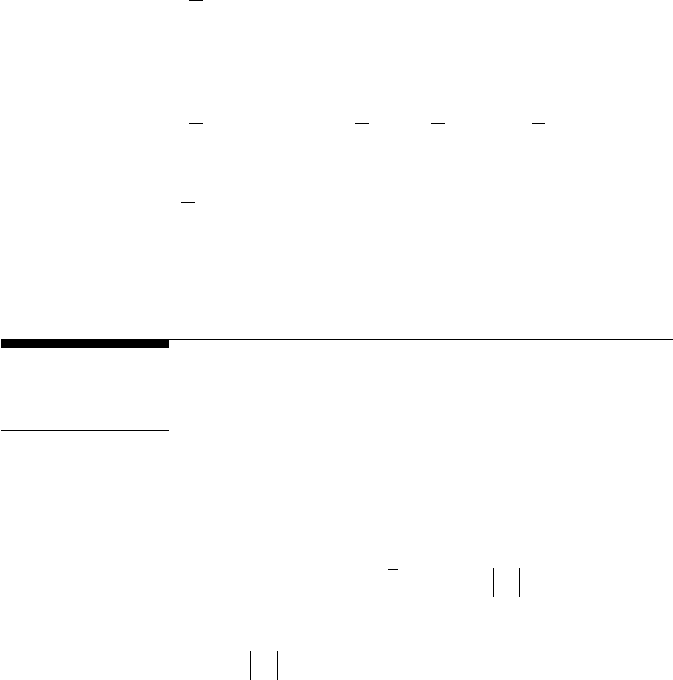
root of the eigenvalues of the positive semi-hermitian matrix . Let J
k
be
the kth singular value of H, hence, will be the kth eigenvalue of .
Using transformation Equation 2A.1 for the matrix we get:
(2A.2)
We replace Equation 2A.2 in Equation 2.13:
(2A.3)
Appendix 2B
Proof That
J
2
1
= n
r
When n
t
= 1 and
J
2
1
= n
t
When n
r
= 1,
When
冨
h
i,j
冨
= 1
We use the known algebraic equality :
(2B.1)
HH
H
J
k
2
HH
H
HH
H
HH UDV UDV UDV VD U UDD U
HH UD U
HHH
H
HHH HH
HH
=
()
==¡
=
2
== UD U
2 H
C
p
n
H
=+
©
«
ª
¹
»
º
¬
®
¼
¾
½
log det
2
2
IUDU,
we use the equality det detIAB IB+
¬
®
¼
¾
=+
AA
ID
¬
®
¼
¾
=+
©
«
ª
¹
»
º
¬
®
¼
¾
½
=+C
p
n
p
n
log det log (
2
2
2
1 JJJ J
1
2
2
22
2
11
1
)( ) ( )
log
+ +
¬
®
¼
¾
½
¡
=+
p
n
p
n
C
p
n
n
JJ
k
k
n
2
1
©
«
ª
¹
»
º
=
¨
J
k
k
n
r
Tr
2
1=
¨
=
()
HH
H
J
k
k
n
H
ij ij
j
n
i
n
i
r
t
r
Tr h h h
2
111===
¨¨¨
=
()
= =HH
,, ,jj
j
n
i
n
k
k
n
ij
j
n
i
n
t
r
r
t
r
h
2
11
2
1
2
11
==
===
¨¨
¨¨¨
¡
=J
,
4190_book.fm Page 52 Tuesday, February 21, 2006 9:14 AM
Theory and Practice of MIMO Wireless Communication Systems 53
When n
t
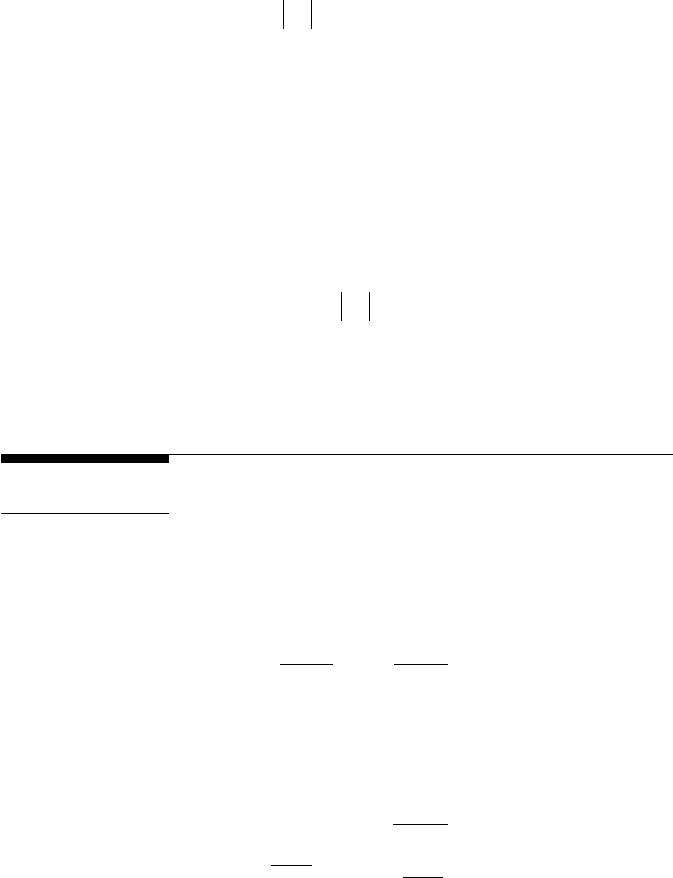
= 1, Equation 2B.1 gives:
(2B.2)
However, since n
t
= 1, and as a result there is only one .
Hence, Equation 2B.2 takes the form:
(2B.3)
When n
r
= 1, Equation 2B.1 gives:
(2B.4)
Appendix 2C
Minimization of Angular Shift When R
d
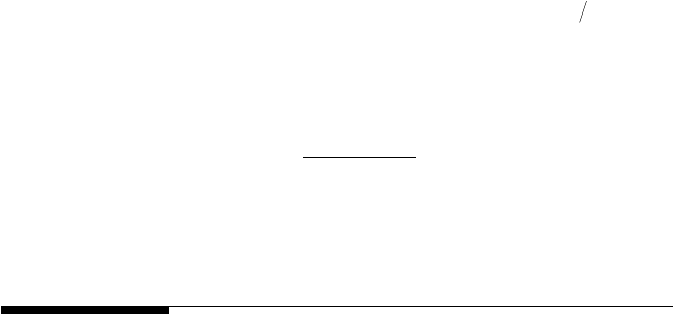
In accordance with Figure 2.4, we denote V the angular shift between the
neighbor elements; this angle is given by the equation:
(2C.1)
where Q is the wavelength of the transmitted signal.
From the figure above we have:
(2C.2)
substituting Equation 2C.2 into Equation 2C.1:
JJJJ
k
k
n
ij
ji
n
n
rr
r
h
2
1
2
1
1
1
1
2
2
22
===
¨¨¨
= ¡ +++
,
... == n
r
rank
H
()HH = 1 J
k
2
0|
J
1
2
= n
r
JJ
k
k
n
ij
j
n
i
t
rt
hn
2
1
2
11
1
1
2
===
¨¨¨
= ¡ =
,
VU U
Q
=
e
=
e
22
RR
c
f
RR
RR
R
d
R
d
R
d
=
e
e
=
¿
À
²
Á
²
¡
=
e
=
cos
sin
cos
sin
sin
I
I
I
I
I
4190_book.fm Page 53 Tuesday, February 21, 2006 9:14 AM