
Tsoulos George (ред.) MIMO System Technology for Wireless Communications
Подождите немного. Документ загружается.

314 MIMO System Technology for Wireless Communications
27. A. Paulraj, R. Nabar, and D. Gore. 2003. Introduction to Space-Time Wireless
Communications, Cambridge, U.K.: Cambridge University Press.
28. D. Shiu, G.J. Foschini, M.J. Gans, and J.M. Kahn. 2000. “Fading correlation and
its effects on the capacity of multielement antenna systems, ” IEEE Trans. on
Commun., Vol. 48, No. 3, March 2000, pp. 502–513.
29. C.-N. Chuah, G.J. Foschini, R.A. Valenzuela, D. Chizhik, J. Ling, and J.M. Kahn,
“Capacity growth of multi-element arrays in indoor and outdoor wireless
channels,” IEEE WCNC 2000, Chicago, Sept. 23–28, 2000, Vol. 3, pp. 1340–1344.
30. T. Svantesson and J. Wallace. 2003. “On signal strength and multipath richness
in multi-input multi-output systems,” ICC 2003, Vol. 4, May 11–15, 2003,
pp. 2683–2687.
31. R. Rao. 2004. “Performance Analysis of MIMO-OFDM systems,” Ph.D. Thesis,
University of California, Los Angeles, Oct. 1, 2004.
32. W. Zhu, D.W. Browne, and M.P. Fitz. 2005. “An open access wideband multi-
antenna wireless testbed with remote control capability,” IEEE TridentCom,
Feb. 2005.
33. D. Browne, W. Zhu, and M.P. Fitz. 2005. “A signaling scheme and estimation
algorithm for characterizing frequency selective MIMO channels,” IEEE VTC,
May 2005.
34. G.J. Foschini. 1996. “Layered space-time architecture for wireless communica-
tions in a fading environment when using multiple antennas,” Bell Labs Tech-
nical Journal, Autumn 1996, pp. 41–59.
35. V. Tarokh, N. Seshadri, and A.R. Calderbank. 1998. “Space-time codes for high
data rate wireless communication: Performance criterion and code construc-
tion,” IEEE Info. Theory, Vol. 44, March 1998, pp. 744–765.
36. J.-C. Guey, M.P. Fitz, M.R. Bell, and W.-Y. Kuo. 1996. “Signal design for trans-
mitter diversity wireless communication systems over Rayleigh fading chan-
nels,” 1996 IEEE Vehicular Technology Conference, Atlanta, GA, pp. 136–140.
37. S.M. Alamouti. 1998. “A simple transmit diversity technique for wireless com-
munications,” IEEE J. Select Areas Commun., Vol. 16, Oct. 1998, pp. 1451–1458.
38. J.-C. Belfiore, G. Rekaya, and E. Viterbo. 2004. “The golden code: A2 × 2 full-
rate space-time code with non-vanishing determinants,” IEEE International
Symposium on Information Theory, Chicago, IL, June 2004, p. 308.
39. S. Siwamogsatam and M.P. Fitz, ”Improved high rate space–time TCM via
orthogonality and set partitioning,” International Symposium on Wireless Personal
Multimedia Communications, Alborg, Denmark, September 2001.
40. S. Siwamogsatam and M.P. Fitz. 2002. “Improved high rate space–time TCM
via concatenation of expanded orthogonal block codes and MTCM,” IEEE
International Conference on Communication, New York, April 2002.
41. Z. Chen, J. Yuan, and B. Vucetic. 2001. “Improved space-time trellis coded
modulation scheme on slow Rayleigh fading channels,” Electronics Letters,
Vol. 37, March 2001, pp. 440–441.
42. W. Zhu, H. Lee, D.N. Liu, and M.P. Fitz. “Antenna array geometry and coding
performance,” submitted to IEEE International Symposium on Information
Theory, 2005.
43. L. Wei, O.Y. Takeshita, P. Gupta, W. Zhu, and M.P. Fitz. 2003. “Implementation
and testing of super-orthogonal space time trellis codes,” IEEE Vehicular Tech-
nology Conference, Volume 3, Fall 2003, pp. 1748–1752.
4190_book.fm Page 314 Tuesday, February 21, 2006 9:14 AM

315
11
Gigabit Mobile Communications Using Real-
Time MIMO-OFDM Signal Processing
Volker Jungnickel, Andreas Forck, Thomas Haustein, Christoph Juchems,
and Wolfgang Zirwas
CONTENTS
11.1 Introduction ..............................................................................................315
11.2 Implementation Concept ........................................................................318
11.3 A Code-Multiplexed Preamble ..............................................................322
11.4 Channel Estimation .................................................................................324
11.5 Adaptation to the Time-Variant Channel ............................................330
11.6 Data Reconstruction ................................................................................332
11.7 Framing, Mapping, Channel Coding, and Real-Time
Data Interface............................................................................................335
11.8 Implementation, Complexity, and System Integration......................337
11.9 Transmission Experiments......................................................................340
11.10 Conclusions...............................................................................................345
11.11 Summary ...................................................................................................347
11.12 Acknowledgments ...................................................................................348
Appendix 11A......................................................................................................348
Appendix 11B ......................................................................................................349
References.............................................................................................................351
11.1 Introduction
There is an ever-increasing demand for higher bandwidths in mobile com-
munication systems. While the target of the first generations was mobile
telephony, currently deployed systems aim to enhance people’s lives by
enabling high-speed mobile access to the Internet anywhere and at any time.
While the integration of heterogeneous mobile and wireless access tech-
niques may be one important aspect of the next generation (4G), a second
4190_book.fm Page 315 Tuesday, February 21, 2006 9:14 AM
316 MIMO System Technology for Wireless Communications
goal is the support of even higher data rates, similar to fixed networks, as
well as to provide high-quality multimedia applications at reasonable costs
for multiple mobile users. These applications need a dramatically increased
sum capacity to be realized in parallel to the existing mobile services. Services
are expected to become available between 2012 and 2015, most likely in an
extended, but definitely limited spectrum with a scalable bandwidth
between 5 and 100 MHz [1].
Recent work on wireless data transmission for indoor applications at
Gbit/s data rates is merely based on classical microwave [2–4] or infrared
[5] techniques. There are commercial products combining both approaches,
which replace, in principle, an optical fiber for wireless bridge applications.
But these systems generally use directional transceivers to extend the range
and to suppress unwanted multipath components: By tracking the direction
of a principal path with a narrow-beam antenna, the multipath fading
becomes negligible. Since the power of the other paths is so reduced, the
link becomes almost “transparent,” i.e., the coherence bandwidth is no
longer limited by the multipath propagation. Simple single-carrier modula-
tion and demodulation techniques can then be used with no equalization.
On the other hand, this concept limits the mobility of the users, since trans-
mitter (Tx) and/or receiver (Rx) must be aligned to each other and a free
line-of-sight (LOS) or a strong reflection is required as the principal path.
In a mobile communications environment, the base station often has sector
antennas and knows the direction of the terminal equipped with omni-
directional antennas only coarsely. True mobility requires such widely opened
antenna apertures, and with them it is difficult to select and track the direction
of a principal path out of the potentially large number of received signals
coming from many different directions. As a consequence, the data signals
are corrupted by the statistical fading in time, frequency, and space. Very
robust signaling schemes need to be used for reliable communications.
A modern approach for wireless fading channels is to use multiple anten-
nas both at the Tx and Rx in combination with sophisticated space–time (ST)
signal processing techniques, as space–division multiple access (SDMA) and
multiple-input multiple-output (MIMO). The implementation of advanced
signal processing becomes more and more attractive even at mobile termi-
nals. But the complexity of the ST algorithms is considerable, in particular
when they are combined with the WCDMA technology used in the third
generation of mobile communication systems [6,7]. To reduce this complex-
ity, one may want to simplify the transmission, detection, and coding tech-
niques in future air interfaces.
Almost a decade ago it was noticed [8] that the complexity of the ST
processing for multipath MIMO channels can be substantially reduced with
the discrete matrix multitone technique operating in the space–frequency
domain, which became popular under the term MIMO-OFDM. By perform-
ing an inverse fast Fourier transform (IFFT) and inserting a cyclic prefix (CP)
between consecutive OFDM symbols at each transmitter, and by removing
the CP and performing a fast Fourier transform (FFT) at each receiver, the
4190_book.fm Page 316 Tuesday, February 21, 2006 9:14 AM
Gigabit Mobile Communications Using Real-Time Signal Processing
317
equivalent space–frequency channel matrix becomes block-diagonal. The
well-known SDMA and MIMO algorithms for frequency-flat fading channels
can therefore be used also in frequency-selective channels, by applying them
individually on each OFDM subcarrier. The complexity for the adaptation
of the signal processing to the time-variant channel scales then linearly with
N, which is the length of the OFDM symbol without CP (and equal to the
number of subcarriers), rather than cubic with N
for the space–time
approach. Also the complexity of the data reconstruction scales linearly with
N
rather than quadratic. Using a joint water-filling across the spatial eigen-
modes and subcarriers (see Section 11.2), the channel capacity is asymptot-
ically achieved for infinite symbol length with this approach.
But despite this fundamental complexity reduction, it is still challenging
to implement MIMO-OFDM in real-time with current digital signal proces-
sors (DSPs). Most MIMO-OFDM prototypes in the recent literature transmit
the signals over the air and perform the processing off-line, as in [9,10]. But
the joint water-filling requires real-time adaptation to the time-variant chan-
nel along the entire transmission chain, and the real-time implementation of
the signal processing is an essential step toward the application of these new
techniques.
The algorithmic part of new signal processing schemes is highly developed
in the literature on wireless communications. But there are surprisingly few
detailed reports about hardware implementations, and how state-of-the-art
real-time signal processing components, such as digital signal processors
(DSPs), field-programmable gate arrays (FPGAs), and application-specific
integrated circuits (ASICs) can be used to implement new algorithms in order
to bring them closer to application.
It is well known that the step from the algorithmic to the register-transfer
level is a highly critical process in any implementation where teamwork
between algorithm and hardware specialists and a good portion of creative
intelligence are needed to get an efficient and reliable system at the end. So
it might be helpful to describe such a hardware implementation by using
MIMO-OFDM as a timely example.
The first real-time MIMO-OFDM prototype was implemented using a DSP
farm [11]. It was intended for the evolution of existing 3G systems and
allowed a peak data rate of 37 Mbit/s with two transmit and up to four
receive antennas in a bandwidth of 5 MHz. However, one would have to
increase the DSP processing power by more than an order of magnitude to
cover the projected 4G cell capacity. The ITU-R Recommendation M.1645
states that “potential new radio interface(s) will need to support data rates
of up to approximately 100 Mbit/s for high mobility such as mobile access
and up to approximately 1 Gbit/s for low mobility such as nomadic/local
wireless access.”
In order to meet this challenge, we develop a dedicated implementation
concept for MIMO-OFDM. As a proof-of-concept, the system is implemented
on a reconfigurable experimental prototype realizing the projected 1 Gbit/s
data rate in real-time in a bandwidth of 100 MHz. For this, we needed to
4190_book.fm Page 317 Tuesday, February 21, 2006 9:14 AM

318 MIMO System Technology for Wireless Communications
• Perform a basic complexity study of the MIMO-OFDM algorithm
concerning real-time implementation
• Find a suitable partitioning of the signal processing using state-of-
the-art reconfigurable signal processing components (DSP, FPGA)
• Define an efficient preamble for the channel estimation and to realize
the corresponding channel estimator
• Analyze the complexity for the adaptation of the MIMO-OFDM
signal processing to the time variation of the channel
• Develop an efficient MIMO-OFDM detector that is capable of pro-
cessing the received data continuously
• Integrate the MIMO-OFDM signal processing with forward error
correction and data source and sink
• Perform transmission experiments and measure the performance
This chapter is organized as follows: Section 11.2 describes the implemen-
tation concept. Section 11.3 develops the structure of a new preamble for
the channel estimation. Section 11.4 introduces the channel estimator and the
implementation using a wrapped pipeline structure. Section 11.5 considers
methods to speed up the adaptation to the time-variant channel and reports
benchmark results concerning the achieved adaptation rate in the experi-
mental system. The data reconstruction unit is described in Section 11.6.
Section 11.7 sketches the simplified channel coding, data mapping, and inte-
gration of the data source and sink. Section 11.8 gives insights into the signal
processing platform and the integration of the system. Section 11.9 describes
the measurement set-up and reports results from over-the-air transmission
experiments.
11.2 Implementation Concept
Basic algorithm:
The implementation concept is derived from the optimal
information-theoretic structure of the MIMO-OFDM system [8], which is first
briefly reviewed. The transmission is conveniently formulated in the fre-
quency domain as
(11.1)
where the (n
Tx
×
1) vector x
n
contains the signals transmitted from all Tx
antennas at the OFDM subcarrier with index n =
1…N
where N
denotes the
number of OFDM subcarriers. The (n
Rx
×
1) vectors y
n
and SS
SS
n
contain the
received signals and the noise, respectively, at all Rx antennas. The integers
n
Tx
and n
Rx
denote the numbers of antennas at the transmitter and receiver,
yHx
nnnn
=+S
4190_book.fm Page 318 Tuesday, February 21, 2006 9:14 AM

Gigabit Mobile Communications Using Real-Time Signal Processing
319
respectively. The (n
Rx
× n
Tx
) matrix H
n
denotes the channel matrix for sub-
carrier n
with the complex-valued channel coefficient between each transmit
and each receive antenna, and it can be obtained from the time-domain
channel impulse response matrices H
l
as
(11.2)
where L
denotes the number of resolved multipath components. In the
optimal way, based on full channel state information (CSI) both at the Tx
and Rx, the channel capacity is approached asymptotically by performing a
singular value decomposition (SVD) of H
n
on each subcarrier,
(11.3)
which gives the matrices V
n
and U
n
containing the eigenvectors of the chan-
nel matrix in the Tx and Rx spaces, respectively, and the diagonal matrix D
n
,
which contains i
= 1…min(n
Tx
, n
Rx
) singular values , referred to as the
amplitude gains of the spatial eigenmodes. The superscript H
denotes the
conjugate transpose of a matrix. The capacity is asymptotically approached
for infinite N
by a joint water-filling across all spatial eigenmodes i
and all
subcarriers n
[8].
Realization:
In a practical system, the Tx signal x
n
= V
n
d
n
is obtained from
the transmitted data vector d
n
and the spatially multiplexed data signals are
reconstructed at the Rx as . The noise in each stream is then
boosted differently, according to the actual singular values at the given
subcarrier index. Unlike in the information theory, in practice we employ
discrete instead of continuous modulation alphabets. A joint bit-loading and
power allocation algorithm is used with individual modulation on each
eigenmode and each subcarrier, according to the current channel state, so
that important optimization criteria (throughput, fairness, stability of
queues) can be fulfilled.
Depending on the availability of the CSI, there are modifications. When
CSI is available at the receiver only, no pre-processing can be applied.
Assuming additionally linear detection, which requires a simple matrix-
vector multiplication, the transmitted signals on each subcarrier may be
reconstructed using the minimum mean-square error detector given by the
formula
(11.4)
where I
and X
2
are the (n
Tx
× n
Tx
) identity matrix and the noise variance at
one Rx antenna, respectively.
HH
nl
l
L
exp j
nl
N
=
©
«
ª
¹
»
º
=
¨
2
0
1
U
HUDV
nnnn
H
=
Q
i
n
ˆ
dDUy
nn
H
n
=
1
ˆ
xHH IHy
nnn
H
n
H
n
=+
()
X
2
1
4190_book.fm Page 319 Tuesday, February 21, 2006 9:14 AM
320 MIMO System Technology for Wireless Communications
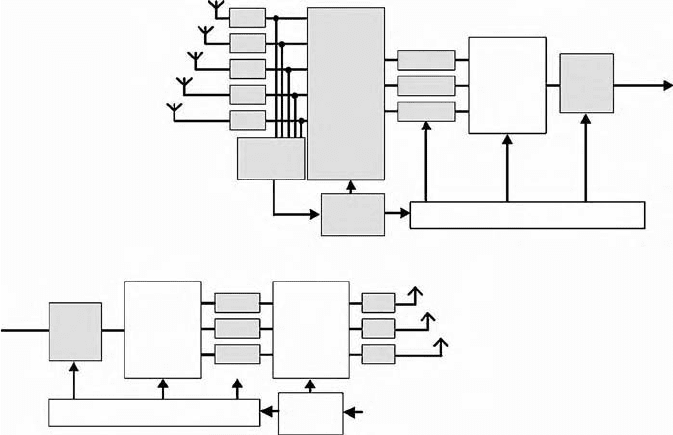
The two proposed concepts are jointly shown in Figure 11.1. The first
concept based on the eigenmode signaling requires all components, while
the second concept based on the linear MMSE needs only the shaded ones.
In what follows, we describe the first concept. The input data are jointly
interleaved and encoded across the spatial channels and subcarriers before
passing them to the adaptive flow control unit. The consecutive link adap-
tation uses an individual modulation for each stream and each subcarrier.
1
The next step is a joint pre-processing of the data signals on all streams,
which is performed individually for each subcarrier. The resulting signals
are then passed through the IFFT, the CP is inserted, and the signals are
transmitted over the air. The CSI for the spatio-temporal pre-processing can
be obtained by exploiting the reciprocity of the radio channel (i.e., transmit
pilot signals in the reverse link and reuse CSI for the forward link), which
is possible in the time-division duplex mode or by a suitable feedback tech-
nique in frequency-division duplex mode. Additional information on the
interference is needed for proper pre-processing and link adaptation. It can
be provided via feedback from the Rx over the reverse link.
At the receiver, the CP is removed and the signals are passed through the
FFT. The channel estimation is performed in the frequency domain during
a dedicated time slot in each frame. Based on the estimates for each subcar-
rier, for each frame a new set of SVD or MMSE matrices is calculated. The
data signals are then reconstructed using spatial post-processing individu-
ally for each subcarrier. Thereafter, the signals are demodulated and decoded
so the binary data stream can be reconstructed.
FIGURE 11.1
Implementation concept for the experimental MIMO-OFDM system.
FFT
FFT
FFT
FFT
FFT
IFFT
IFFT
IFFT
Channel
estimation
Channel
coder
Space-
frequency
post-
processing
Space-
frequency
pre-
processing
Demod 1
Demod 2
Demod 3
Adaptive
flow
control
Adaptive
flow
control
Channel
decoder
Link adaptation, scheduling
Link adaptation, scheduling
Channel
tracking
Channel
tracking
Mod 1
Mod 1
Mod 1
Data
in
Data
out
CSI based on channel reciprocity
and feedback on interference
4190_book.fm Page 320 Tuesday, February 21, 2006 9:14 AM
Gigabit Mobile Communications Using Real-Time Signal Processing
321
The second concept based on the MMSE detector is actually implemented,
since the experimental link is unidirectional, due to effort limitations. Due
to the lack of CSI at the transmitter, pre-processing and link adaptation
cannot be used. Also, the adaptive flow control unit in Figure 11.1 is not yet
implemented. Note that the linear MMSE exploits a fraction of the available
spatial diversity only. An asymmetric antenna configuration with 3 Tx and
5 Rx is therefore used to add more diversity and to stabilize the link.
Structural analysis and functional mapping:
At first, Figure 11.1 reveals that
two basic groups of tasks must be realized in real time: In the first group
(sample rate processing), we have the IFFTs and FFTs with their complex-
valued serial inputs and outputs and a number of tasks that must be per-
formed consecutively and individually for each subcarrier, as modulation,
demodulation, channel estimation, and space–frequency pre- and post-
processing. This kind of processing includes elementary operations that must
be performed at a very high processing clock, which is 100 MHz in the
experimental system. The flow of data signals is naturally arranged in a
chain. It can be realized so that the input of one operation is the output of
the previous operation. Signals are then fed through different steps in the
processing chain and signals for consecutive subcarriers are processed simul-
taneously while being in a different pass. Effectively, each signal needs then
a single clock cycle to be processed, which is called “pipelining” in the
literature. Pipelining is the first basic principle of how complex computations
can be broken down into elementary operations which can be executed in
real time so that the effective number of operations performed in each clock
cycle is much larger than unity. The second basic principle is parallel com-
puting, which is heavily used in the MMSE MIMO-OFDM detector described
below.
The algorithm assessment shows that the sample rate processing for
MIMO-OFDM can be organized so that only primitive look-up, multiply,
add, or combined multiply-and-accumulate operations are needed with a
high potential of parallel processing. This workload is ideally suited for
implementation in FPGA.
This is in great contrast to the second group of operations called channel
rate processing, which is shown in parallel below the signal path in
Figure 11.1. This group includes the adaptation of the entire signal processing
chain to the time-variant channel, i.e., the renewal of pre- and post-process-
ing matrices, the link adaptation and the scheduling units. These algorithms
operate on a totally different time scale, which must not be confused with
the requirements for the sample rate processing. Besides other factors, the
required update interval scales with the coherence time of the time-variant
wireless channel, which is on the order of 10 ms for 1 m/s velocity in an
indoor scenario at 5 GHz carrier frequency.
Some of these channel rate algorithms operate on matrices that sometimes
become singular. The results may then have a high dynamic, which is most
easily handled in floating point arithmetic. Furthermore, these algorithms
depend on the available type of the CSI, and we want to maintain and
4190_book.fm Page 321 Tuesday, February 21, 2006 9:14 AM

322 MIMO System Technology for Wireless Communications
exchange them easily. For testbed purposes, the channel rate processing is
best implemented in a floating point DSP operating in a loop, which renews
all settings in a fraction of the channel coherence time.
11.3 A Code-Multiplexed Preamble
For MIMO and SDMA, a precise CSI must be available. In [9], the simplest
time-multiplex approach is used for the training signals, i.e., the same pre-
amble is transmitted consecutively by all antennas. But the experimental
results in Figure 11.12 in [9] indicate that there is a significant penalty when
this kind of channel estimation is used. An obvious drawback of the time-
multiplexed preamble is that only one out of n
Tx
antennas is active at once,
and so the potentially valuable contribution of the other antennas to the
signal-to-noise ratio is lost.
Here we use a code-multiplexed preamble being orthogonal over multiple
OFDM symbols. All antennas and subcarriers are active during the whole
training phase, i.e., each antenna transmits at the maximal energy. The use
of all subcarriers enables a rapid carrier-wise raw estimation, which may be of
advantage in space–frequency scheduled multi-user systems where it
enables the ultimate granularity of the resource allocation — on each spatial
mode and on each carrier.* In real time and at very high data rates, there are
additional constraints. Normally it takes some time until the weight matrices
are obtained from the channel estimates. Moreover, there is no buffer memory
in the experimental system to delay the sampled and Fourier-transformed
signals for one or more frames.** Only in this way can they be processed/time
aligned with the corresponding weight matrices. Hence the weights are
applied with some delay in our system, which is minimized when the channel
estimates on all subcarriers and for all antennas are available instantly after
the last training symbol.
The preamble structure is most easily explained in the frequency-time grid:
On the time axis (i.e., OFDM symbol by OFDM symbol), the pilots for
different antennas shall be mutually orthogonal. This is achieved by assign-
ing a characteristic code
H
j
(k
) to the j-th
Tx antenna out of the well-known
Hadamard sequence set. To reduce the hardware effort at the receiver, it is
essential to reuse the same sequence H
j
(k
) for all subcarriers. But this would
yield an undesired sharp pulse after the IFFT. So the subcarrier signals are
scrambled in the frequency domain using the same binary sequence S
n
on
all Tx antennas. This way the binary signal structure in the frequency-time
grid is maintained, and we can use a simpler correlation circuit for the
* In particular, we need no multiplication in the estimator.
** For future implementations, it is highly recommended to foresee such first-in first-out (FIFO)
buffer memory with an interface of considerable bandwidth to transfer the 12 bit I and Q signals
for multiple antennas from and to the FPGA.
4190_book.fm Page 322 Tuesday, February 21, 2006 9:14 AM
Gigabit Mobile Communications Using Real-Time Signal Processing
323
channel estimator.* In the experimental system, we have used the well-
known scrambling sequence S
-26…26
from the 802.11a standard. For other
numbers of subcarriers, a suitable scrambling sequence may be found by
extensive computer search among random sequences having a small peak-
to-average power ratio of the Tx signal after the IFFT. The elementary form
of the preamble is given as
(11.5)
where j
= 1…n
Tx
. Note that this form of the preamble is also suggested by
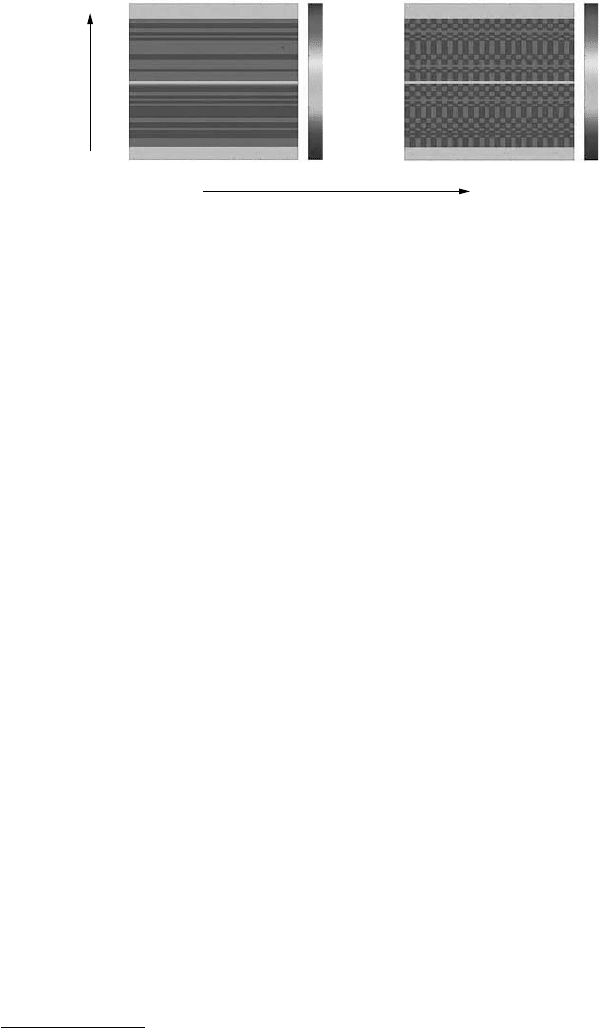
others [12,13]. In Figure 11.2, the training signals at the first and third antenna
according to Equation 11.1 are shown in the subcarrier-index vs. OFDM
training-symbol-index grid.
In Figure 11.2, one can observe that the same scrambling is used for all
antennas along the frequency axis. The first antenna is marked by the all-
ones Hadamard sequence, while the third Hadamard sequence used for the
third antenna alters the sign after each second symbol.
Some modifications have been added to this elementary preamble form
for practical reasons.
• We have observed that it is good to avoid the all-ones sequence since
it regularly causes slightly biased estimates not present for other
sequences, most likely due to an imperfect DC offset compensation
in our analogue IQ demodulators. So the original Hadamard matrix
(which is taken over from MATLAB) is flipped, i.e., the last sequence
is now assigned first, and so the critical sequence is not used.
• We have assigned different sequences to the I and Q branches of the
complex-valued Tx signal, similar to our recent flat fading real-time
FIGURE 11.2
Graphical representation of the preamble according to Equation 11.1: red: 1, blue: –1, green: 0.
* A time-domain estimation would need a larger bandwidth to predict the channel on a single
subcarrier.
First antenna
ird antenna
Sub-carrier index:
scrambling
10
20
30
40
50
60
10
20
30
40
50
60
1.5
1
0.5
0
0.5
−1
−1.5
1.5
1
0.5
0
0.5
−1
−1.5
10
20 30 40 50 60 10
20 30 40 50 60
OFDM s
y
mbol index: identif
y
antennas
pk S Hk
n
j
nj
() ()=
4190_book.fm Page 323 Tuesday, February 21, 2006 9:14 AM