
Tsoulos George (ред.) MIMO System Technology for Wireless Communications
Подождите немного. Документ загружается.

24 MIMO System Technology for Wireless Communications
5. L. Schumacher, L.T. Berger, J. Ramiro-Moreno, and T.B. Sorensen. 2004. “Prop-
agation characterization and MIMO channel modeling for 3G,” in Adaptive
Antenna Arrays, S. Chandran, ed., Heidelberg: Springer-Verlag, pp. 377–393.
6. W.C.Y. Lee. 1973. “Effects on correlation between two mobile radio basestation
antennas,” IEEE Transactions on Communications, Vol. 21, No. 11, 1214–1224.
7. S.C. Swales, “Spectrum efficient cellular base station antenna architectures,”
Ph.D. Thesis, University of Bristol, U.K., 1990.
8. S.P. Stapleton, X. Carbo, and T. McKeen. 1994. “Tracking and diversity for a
mobile communications base station array antenna,” Proc. IEEE VTC,
pp. 1695–1699.
9. S.P. Stapleton, X. Carbo, and T.McKeen, 1994. “Spatial channel simulator for
phased arrays,” Proc. IEEE VTC, pp. 1789–1792.
10. D. Asztely. 1996. ”On antenna arrays in mobile communication systems: fast
fading and GSM base station receiver algorithm,” Ph.D. Dissertation, Royal
Institute of Technology, Stockholm, Sweden, March.
11. P. Petrus, J.H. Reed, and T.S. Rappaport. 1997. “Effects of directional antennas
at the base station on the Doppler spectrum,” IEEE Communications Letters,
Vol. 1, No. 2, March.
12. P. Petrus, J.H. Reed, and T.S. Rappaport. 1996. “Geometrically based statistical
channel model for macrocellular mobile environment,” IEEE GLOBECOM,
pp. 1197–1201.
13. J. Fuhl, A. Molisch, and E. Bonek. 1998. “Unified channel model for mobile
radio systems with smart antennas,” IEE Proc. — Radar, Sonar. Navig. Vol. 145,
No. 1, Feb., pp. 32–41.
14. J. Liberty and T. Rappaport. 1996. “A geometrically based model for line-of-
sight multipath radio channels,” IEEE VTC, pp. 844–848.
15. R.B. Ertel and J.H. Reed. 1999. “Angle and time of arrival statistics for circular
and elliptical scattering models,” IEEE Journal on Selected Areas in Communica-
tions, Vol. 17, Nov., pp. 1829–1840.
16. M. Lu, T. Lo, and J. Litva. 1997. “A physical spatio-temporal model of multipath
propagation channels,” IEEE VTC, pp. 180–184.
17. O. Norklit and J.B. Andersen. 1998. “Diffuse channel model and experimental
results for array antennas in mobile environments,” IEEE Transactions on An-
tennas and Propagation, Vol. 46, No. 6, June, pp. 834–840.
18. P. Zetterberg and B. Ottersten. 1994. “The spectrum efficiency of a basestation
antenna array system for spatially selective transmission,” IEEE VTC.
19. P. Zetterberg and P.L. Espensen. 1996. “A downlink beam steering technique
for GSM/DCS1800/PCS1900,” IEEE PIMRC, Taipei, Taiwan, October.
20. P. Mogensen, P. Zetterberg, H. Dam, P.L. Espensen, and F. Fredekirsen. 1997.
“Algorithms and antenna array recommendations — part 1,” ACTS TSUNAMI
deliverable, January.
21. B. Ottersten. 1995. “Spatial Division Multiple Access (SDMA) in wireless Com-
munications,” Proc. Nordic Radio Symp.
22. R.J. Piechocki and G.V. Tsoulos. 1999. “Combined GWSSUS and GBSR channel
model with temporal variations,” Joint COST259/260 Workshop, April, Vienna,
Austria.
23. R.J. Piechocki, J.P. McGeehan, and G.V. Tsoulos. 2001. “A new stochastic spatio-
temporal propagation model (SSTPM) for mobile communications with antenna
arrays,” IEEE Transactions on Communications, Vol. 49, No. 5, May, pp. 855–862.
4190_book.fm Page 24 Tuesday, February 21, 2006 9:14 AM
Spatio-Temporal Propagation Modeling 25
24. R.J. Piechocki, G.V. Tsoulos, and J.P. McGeehan. 1998. “Simple general formula
for PDF of angle of arrival in large cell operational environment,” IEE Electronics
Letters, Vol. 34, September 3, pp. 1784–1785.
25. Q.H. Spencer, B.D. Jeffs, M.A. Jensen, and A.L. Swindlehurst. 2000. “Modeling
the statistical time and angle of arrival characteristics of an indoor multipath
channel,” IEEE Journal on Selected Areas in Communications, Vol. 18, No. 3, March,
pp. 347–360.
26. A.A. Saleh and R.A. Valenzuela. 1987. “A statistical model for indoor multipath
propagation,” IEEE Journal on Selected Areas in Communications, Vol. SAC-5,
No. 2, Feb.
27. R. Janaswamy. 2002. “Angle and time of arrival statistics for the Gaussian
scatter density model,” IEEE Transactions on Wireless Communications, Vol. 1,
July, pp. 488–497.
28. M.P. Lotter and P. van Rooyen. 1999. “Modeling spatial aspects of cellular CDMA/
SDMA systems,” IEEE Communications Letters, Vol. 3, May, pp. 128–131.
29. K.I. Pedersen, P.E. Mogensen, and B.H. Fleury. 2000. “A stochastic model of
the temporal and azimuthal dispersion seen at the base station in outdoor
propagation environments,” IEEE Transactions on Vehicular Technology, Vol. 49,
No. 2, March, pp. 437–447.
30. S.A. Zekavat and C.R. Nassar. 2003. ”Power-azimuth-spectrum modeling for
antenna array systems: a geometric-based approach,” IEEE Transactions on An-
tennas and Propagation, Vol. 51, No. 12, Dec., pp. 3292–3294.
31. S.A. Zekavat and C.R. Nassar. 2002. “Smart antenna arrays with oscillating
beam patterns: characterization of transmit diversity using semi-elliptic-cover-
age geometric-based stochastic channel model,” IEEE Transactions on Commu-
nications, Vol. 50, Oct., pp. 1549–1556.
32. A. Algans, K.I. Pedersen, and P.E. Mogensen. 2002. “Experimental analysis of the
joint statistical properties of azimuth spread, delay spread, and shadow fading,”
IEEE Journal on Selected Areas in Communications, Vol. 20, No. 3, April, pp. 523–531.
33. C.A. Balanis. 1989. Advanced Engineering Electromagnetics, New York: John
Wiley & Sons.
34. J.B. Keller. 1962. “Geometrical Theory of Diffraction,” Journal of the Optical
Society of America, Vol. 52, Feb., pp. 116–130.
35. R.G. Kouyoumjian and P.H. Pathak. 1974. “A uniform geometric theory of
diffraction for an edge on a perfectly conducting surface,” IEEE Proceedings,
Vol. 62, No. 11, Nov., pp. 1448–1461.
36. R.J. Luebbers. 1984. “Finite conductivity uniform GTD versus knife edge dif-
fraction in prediction of propagation path loss,” IEEE Trans. on Antennas &
Propagation, Vol. AP-32, No. 1, Jan., pp. 70–76.
37. H. Bach. 1977. Modern Topics in Electromagnetics and Antennas, London: Peter
Peregrinus Ltd., Chap. 5.
38. G.L. Turin, et al. 1972. “A statistical model for urban multipath propagation,”
IEEE Transactions on Vehicular Technology, Vol. VT-21, Feb., pp. 1–9.
39. R.A. Valenzuela. 1993. “A ray tracing approach to predicting indoor wireless
transmission,” IEEE VTC ’93, New Jersey, May 18–20, pp. 214–218.
40. G.E. Athanasiadou, A.R. Nix, and J.P. McGeehan. 2000. ”A microcellular ray-
tracing propagation model and evaluation of its narrowband and wideband
predictions,” IEEE Journal on Selected Areas in Communications, Wireless Commu-
nications Series, Vol. 18, No. 3, March, pp. 322–335.
4190_book.fm Page 25 Tuesday, February 21, 2006 9:14 AM
26 MIMO System Technology for Wireless Communications
41. S.Y. Seidel and T.S. Rappaport. 1994. “Site-specific propagation prediction for
wireless in-building personal communications system design,” IEEE Transac-
tions on Vehicular Technology, Vol. 43, No. 4, Nov., pp. 1058–1066.
42. K.R. Schaubach and N.J. Davis IV. 1994. “Microcellular radio-channel propa-
gation prediction,” IEEE Antennas and Propagation Magazine, Aug., pp. 25–34.
43. G.E. Athanasiadou and A.R. Nix. 2000. “A novel 3D indoor ray-tracing prop-
agation model: the path generator and evaluation of narrowband and wide-
band predictions,” IEEE Transactions on Vehicular Technology, Vol. 49, No. 4, July,
pp. 1152–1168.
44. G.E. Athanasiadou, I.J. Wassell, and C.L. Hong. 2004. “Deterministic propaga-
tion modeling and measurements for the broadband fixed wireless access chan-
nel,” IEEE VTCF 2004, Los Angeles, Sept 26–29.
45. G.E. Athanasiadou and I.J. Wassell. 2005. “Comparisons of ray tracing predic-
tions and field trial results for broadband fixed wireless access scenarios,”
WSEAS Transactions on Communications, Issue 8, Vol. 4, Aug., pp. 717–721.
46. G.V. Tsoulos, G.E. Athanasiadou, and M.A. Beach. 1998. “Adaptive antennas
for microcellular and mixed cell environments with DS-CDMA.” Wireless Per-
sonal Communications Journal, Special Issue on CDMA for Universal Personal
Communications Systems, Kluwer Academic Publishers, Vol. 7, No. 2/3, Aug.,
pp. 147–169.
47. G.V. Tsoulos and G.E. Athanasiadou. 2002. “On the application of adaptive
antennas to microcellular environments: radio channel characteristics and sys-
tem performance,” IEEE Transactions on Vehicular Technology, Vol. 51, No. 1, Jan.,
pp. 1–16.
48. H. Xu, V. Kukshya, and T.S. Rappaport. 2002. “Spatial and temporal character-
istics of 60GHz indoor channels,” IEEE Journal on Selected Areas in Communica-
tions, Vol. 20, No. 3, April, pp. 620–630.
49. T. Zwick, C. Fischer, D. Didascalou, and W. Wiesbeck. 2000. “A stochastic
spatial channel model based on wave-propagation modeling,” IEEE Journal on
Selected Areas in Communications, Vol. 18, No. 1, Jan., pp. 6–15.
50. M. Marques and L. Correia. 2001. “A wideband directional channel model for
UMTS microcells,” IEEE PIMRC, pp. B-122–B-126.
51. C. Oestges, V. Erceg, and A. Paulraj. 2003. “A physical scattering model for
MIMO macrocellular broadband wireless channels,” IEEE Journal on Selected
Areas in Communications, Vol. 21, No. 5, June, pp. 721–729.
52. C. Oestges, V. Erceg, and A. Paulraj. 2004. “Propagation modeling of MIMO
multipolarized fixed wireless channels,” IEEE Transactions on Vehicular Technol-
ogy, Vol. 53, No. 3, May, pp. 644–654.
53. A. Molisch. 2002. “A generic model for MIMO wireless propagation channels,”
IEEE ICC, pp. 277–282.
54. M. Steinbauer, A. Molisch, and E. Bonek. 2001. “The double-directional channel
model,” IEEE Antennas and Propagation Magazine, Vol. 43, No. 4, pp. 51–63.
55. K. Kalliola, H. Laitinen, P. Vainikainen, M. Toeltsch, J. Laurila, and E. Bonek.
2003. “3-D double-directional radio channel characterization for urban macro-
cellular applications,” IEEE Transactions on Antennas and Propagation, Vol. 51,
No. 11, Nov., pp. 3122–3133.
56. K.I. Pedersen, J.B. Andersen, J.P. Kermoal, and P. Mogensen. 2000. “A stochastic
multiple-input-multiple-output radio channel model for evaluation of space-
time coding algorithms,” IEEE VTC, Fall, pp. 893–897.
4190_book.fm Page 26 Tuesday, February 21, 2006 9:14 AM
Spatio-Temporal Propagation Modeling 27
57. K. Yu, M. Bengtsson, B. Ottersten, D. McNamara, P. Karlsson, and M. Beach.
2001. “Second order statistics of NLOS indoor MIMO channels based on
5.2GHz measurements,” IEEE Globecom 2001, Vol. 1, Nov., pp. 156–160.
58. K. Yu, M. Bengtsson, B. Ottersten, D. McNamara, P. Karlsson, and M. Beach.
2002. “A wideband statistical model for NLOS indoor MIMO channels,” IEEE
VTC, Spring, Vol. 1, pp. 370–374.
59. D.-S. Shiu, G.J. Foschini, M.J. Gans, and J.M. Kahn. 2000. “Fading correlation
and its effect on the capacity of multielement antenna systems,” IEEE Transac-
tions on Communications, Vol. 48, No. 3, pp. 502–513.
60. D.-S. Shiu. 2000. Wireless Communications Using Dual Antenna Arrays, Norwell,
MA: Kluwer Academic Publishers.
61. A. Abdi and M. Kaveh. 2002. “A space-time correlation model for multielement
antenna systems in mobile fading channels,” IEEE Journal on Selected Areas in
Communications, Vol. 20, No. 3, pp. 550–560.
62. D. Gesbert, H. Bolcskei, D. Gore, and A. Paulraj. 2000. “MIMO wireless chan-
nels: capacity and performance,” Global Telecommunications Conference, Vol. 2,
Nov., pp. 1083–1088.
63. 3rd Generation Partnership Project, Technical Specification Group Radio Access
Network. Spatial channel model for Multiple Input Multiple Output (MIMO) sim-
ulations, 3GPP TR 25.996 V6.1.0 (2003-09) Technical Report.
4190_book.fm Page 27 Tuesday, February 21, 2006 9:14 AM

29
2
Theory and Practice of MIMO Wireless
Communication Systems
Dimitra Zarbouti, George Tsoulos, and Dimitra Kaklamani
CONTENTS
Summary ................................................................................................................30
2.1 Shannon’s Capacity Formula.....................................................................30
2.2 Extended Capacity Formula for MIMO Channels.................................31
2.2.1 General Capacity Formula.............................................................31
2.2.2 Transformation of the MIMO Channel into n
SISO
Subchannels......................................................................................32
2.2.3 No CSI at the Transmitter..............................................................34
2.2.4 CSI at the Transmitter.....................................................................35
2.2.5 Channel Estimation at the Transmitter........................................35
2.3 Remarks on the Extended Shannon Capacity Formula........................36
2.3.1 Bounds on MIMO Capacity ..........................................................36
2.3.2 Capacity of Orthogonal Channels................................................38
2.3.3 Effective Degrees of Freedom .......................................................38
2.4 Capacity of SIMO — MISO Channels......................................................39
2.5 Stochastic Channels.....................................................................................40
2.5.1 Ergodic Capacity .............................................................................40
2.5.2 Outage Capacity..............................................................................41
2.6 MIMO Capacity with Rice and Rayleigh Channels ..............................41
2.6.1 MIMO Channel Matrix for Rayleigh Propagation
Conditions ........................................................................................42
2.6.2 MIMO Channel Matrix for Ricean Propagation Conditions ...43
2.6.3 Channel Matrix with Spatial Fading Correlation......................45
2.7 Simulations ...................................................................................................47
2.7.1 MIMO Capacity for a Rayleigh Channel without Spatial
Fading Correlation..........................................................................48
2.7.2 MIMO Capacity for a Rayleigh Channel with Spatial
Fading Correlation..........................................................................49
2.7.3 MIMO Capacity for a Ricean Channel........................................50
4190_book.fm Page 29 Tuesday, February 21, 2006 9:14 AM

30 MIMO System Technology for Wireless Communications
Appendix 2A .........................................................................................................51
Appendix 2B..........................................................................................................52
Appendix 2C..........................................................................................................53
References...............................................................................................................54
Summary
This chapter introduces the principles of MIMO systems employing the
necessary mathematical analysis to consider the achieved capacity perfor-
mance. In this context, flat fading across time and frequency is considered,
and the Rayleigh model is employed for describing the wireless channel.
Furthermore, the case of spatial selective fading is examined by considering
LOS propagation, with the Ricean model.
The mathematical representation of the MIMO system is performed
through a complex matrix, which depends on the scenario considered each
time (i.e., flat or selective spatial fading). The capacity achieved by the MIMO
channel in all the above cases is studied with the use of the Shannon extended
capacity formula. The capacity performance results, developed from the
simulations performed, are related to the number of the multiple antenna
elements that the Rx and the Tx are equipped with, the distance between
them and the degree of correlation evidenced.
2.1 Shannon’s Capacity Formula
Shannon’s capacity formula approximated theoretically the maximum
achievable transmission rate for a given channel with bandwidth B, trans-
mitted signal power P and single side noise spectrum N
o
, based on the
assumption that the channel is white Gaussian (i.e., fading and interference
effects are not considered explicitly).
(2.1)
In practice, this is considered to be a SISO scenario (single input, single
output) and Equation 2.1 gives an upper limit for the achieved error-free
SISO transmission rate. If the transmission rate is less than C
bits/sec (bps),
then an appropriate coding scheme exists that could lead to reliable and
error-free transmission. On the contrary, if the transmission rate is more than
C
bps, then the received signal, regardless of the robustness of the employed
code, will involve bit errors.
CB
P
NB
o
= +
©
«
ª
¹
»
º
log
2
1
4190_book.fm Page 30 Tuesday, February 21, 2006 9:14 AM
Theory and Practice of MIMO Wireless Communication Systems
31
2.2 Extended Capacity Formula for MIMO Channels
For the case of multiple antennas at both the receiver and the transmitter
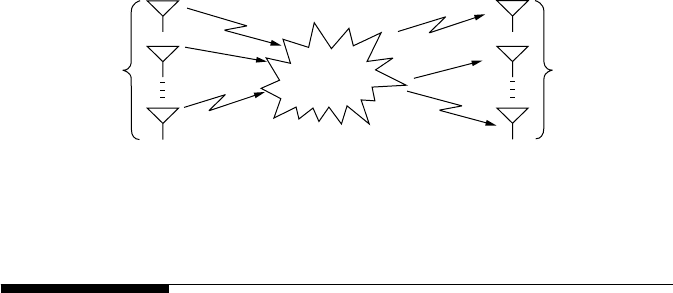
ends (Figure 2.1), the channel exhibits multiple inputs and multiple outputs
and its capacity can be estimated by the extended Shannon’s capacity for-
mula, as described below.
2.2.1 General Capacity Formula
We consider an antenna array with n
t
elements at the transmitter and an
antenna array with n
r
elements at the receiver. The impulse response of the
channel between the j
th transmitter element and the i
th receiver element is
denoted as h
i,j
(Y
,t
). The MIMO channel can then be described by the n
r
×
n
t
H
(Y
,t
) matrix:
(2.2)
The matrix elements are complex numbers that correspond to the attenu-
ation and phase shift that the wireless channel introduces to the signal
reaching the receiver with delay Y
. The input-output notation of the MIMO
system can now be expressed by the following equation:
(2.3)
where denotes convolution, s
(t
) is a n
t
×
1 vector corresponding to the n
t
transmitted signals, y
(t
) is a n
r
×
1 vector corresponding to the n
r
received
signals and u
(t
) is the additive white noise.
FIGURE 2.1
The MIMO channel.
Channel
H
Tx
n
t
n
r
Rx
H(,)
(,) (,) (,)
(,
,, ,
,
Y
YY Y
Y
t
ht ht h t
h
n
t
=
11 12 1
21
ttht h t
hth
n
nn
t
rr
)(,) (,)
(,) (
,,
,,
22 2
12
YY
Y
YYY,) (,)
,
tht
Mn
Rt
¬
®
¼
¾
½
½
½
½
½
yH su() ( ,) () ()tttt= +Y
4190_book.fm Page 31 Tuesday, February 21, 2006 9:14 AM
32 MIMO System Technology for Wireless Communications
If we assume that the transmitted signal bandwidth is narrow enough that
the channel response can be treated as flat across frequency, then the discrete-
time description corresponding to Equation 2.3 is
(2.4)
The capacity of a MIMO channel was proved in [1, 4] that can be estimated
by the following equation:
(2.5)
where H
is the n
r
×
n
t
channel matrix, is the covariance matrix of the
transmitted vector s, H
H
is the transpose conjugate of the H
matrix and p
is
the maximum normalized transmit power. Equation 2.5 is the result of
extended theoretical calculations, and its practical use is not obvious. Never-
theless, we can perform linear transformations at both the transmitter and
receiver converting the MIMO channel to SISO subchannels
(given that the channel is linear) and, hence, reach more insightful results.
These transformations can be found in [1] and are briefly described in the
following section.
2.2.2 Transformation of the MIMO Channel into n SISO Subchannels
Every matrix can be decomposed accordingly to its singular val-
ues. Suppose that for the aforementioned channel matrix this transformation
is given by Equation 2.6.
(2.6)
where the matrices U
, V
are unitaries of dimensions n
r
×
n
r
and n
t
×
n
t
accordingly, while D
is a non-negative diagonal matrix of dimensions n
r
×
n
t
.
The diagonal elements of matrix D
are the singular values of the channel
matrix H
. The algorithm of singular value decomposition that provides the
above transformation can be found in [2].
The operations that lead to the linear transformation of the channel into
n
= min(n
r
, n
t
) SISO subchannels are described as follows: First, the trans-
mitter multiplies the signal to be transmitted x
Y
with the matrix V
, the receiver
multiplies the received signal r
Y
and noise with the conjugate transpose of
the matrix U
. The above are presented in Equation 2.7 through Equation 2.9.
(2.7)
rHsu
YYY
=+
C
tr p
ss
H
ss
=+
()
¬
®
¼
¾
f
max log det
()R
IHRH
2
R
ss
nnn
rt
= min( , )
H
×
nn
rt
HUDV=
H
sVx
YY
=
4190_book.fm Page 32 Tuesday, February 21, 2006 9:14 AM
Theory and Practice of MIMO Wireless Communication Systems
33
(2.8)
(2.9)
Substituting Equation 2.4 into Equation 2.8 gives:
Since U
and V
are unitary matrices, they satisfy , and
hence:
(2.10)
Each component of the received vector y
Y
can be written as:
(2.11)
where J
k
are the singular values of matrix H
according to the transformation
that took place above. Equation 2.11 implies that the initial (n
r
, n
t
) MIMO
system has been transformed into n
= min(n
r
, n
t
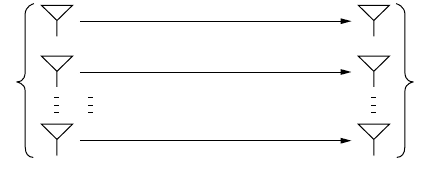
) SISO subchannels, as illus-
trated in Figure 2.2.
The above analysis of a Multiple Antenna Element (MEA) system capacity
is presented in [1]. It was proven in [1] that the total capacity of n SISO
FIGURE 2.2
Conversion of the MIMO channel into n
SISO subchannels.
yUr
YY
=
H
nUu
YY
=
H
yUr
yUHsUu
yUHVx
YY
YYY
YY
= ¡
=+ ¡
=
H
HH
H
(.),(.)27 29
++ ¡
=+
n
yUUDVVxn
Y
YYY
(.)26
HH
UU I
H
n
r
=
VV I
H
n
t
=
yDxn
YYY
=+
yxn
YYY
J
k
k
kk
=+
Tx
1
2
n = min(n
r
,n
t
)
n
t
Rx
n
r
4190_book.fm Page 33 Tuesday, February 21, 2006 9:14 AM