
Vaccari D.A., Strom P.F., Alleman J.E. Environmental Biology for Engineers and Scientists
Подождите немного. Документ загружается.

as syphilis are spread in this way. Many skin diseases, such as ringworm, are also trans-
mitted via direct contact, but they may also be spread indirectly on objects (such as
towels) because the causative agent can persist in the environment for a sufficient period
of time. Most respiratory diseases are droplet infections, spread through aerosols (liquid
or solid particles in air) resulting from exhaling, sneezing, or coughing. These remain sus-
pended briefly in the air (during which time the agents remain viable), then are inhaled by
the new host. Thus, the transmission is not truly direct, but is still generally considered to
be so because the time in the air is so short (minutes or less). It is now believed that the
common cold often is spread by direct contact through the following scenario: an infected
person’s hand becomes infectious when it touches the fluids of his or her mouth, nose, or
eye; transmission occurs when he or she touches another person’s hand; the new host
becomes infected when touching his or her own mouth, nose, or eye.
Indirect transmission occurs through some other medium. A nonliving material that is
capable of infecting a large number of individuals is referred to as a vehicle. Food and
water are the two most common. Air can also be considered a vehicle, provided that
the infectious agent is able to survive in this usually hostile (mainly because of drying
and ultraviolet radiation) environment. Other nonliving means of transmission, such as
clothing, furniture, toys, doorknobs, and bandages, are referred to as fomites.
A living intermediate for indirect transmission is called a vector. Many common vec-
tors are biting insects (e.g., mosquitoes, malaria and some types of encephalitis; fleas, pla-
gue; lice, typhus; and flies, sleeping sickness) or ticks (Lyme disease and Rocky Mountain
spotted fever). The vector picks up the infectious agent when it bites an infected host, then
transmits it to a new host with another bite. In many cases the infectious agent reproduces
within the vector (which is then considered an alternate host), thus increasing the likeli-
hood of successful transmission to the next host. However, in some cases an organism
such as a nonbiting fly is simply a mechanical vector, transporting the infectious agent
from host to host on its mouth parts, feet, wings, or body hairs.
Not every transmission of a pathogen to a new potential host results in infection and
disease. First, the host must be susceptible—a species that the pathogen can parasitize,
and without previously developed immunity (resistance) from vaccination or prior expo-
sure. Also, at least a minimum quantity of pathogens, called an infective dose, must be
transmitted. Although for a few pathogens (perhaps the virus hepatitis A or the round-
worm Ascaris) only a single viab le particle (e.g., cell, spore, cyst, egg) may be sufficient,
it more commonly takes at least tens (e.g., the bacterium Shigella and the protozoans
Entamoeba histolytica, Cryptosporidium parvum, and Giardia lamblia), thousands (Vibrio
cholerae), or even milli ons (e.g., Salmonella, Clostridium perfringens) of pathogens to
overcome a healthy body’s defense mechanisms and produce disease.
Example 12.1 While hiking in a national forest, a group of healthy young adults drinks
from a clear mountain brook. Unknown to them, a short distance upstream there is a col-
ony of beaver that has been infected with Giardia lamblia, and the water they consumed
contains 2 viable cysts/mL. How much could a person probably drink without developing
giardiasis, assuming that the infective dose is 20 cysts?
Solution If the number of cysts likely to result in disease is 20, a person could drink
20 cysts 2 cysts=mL ¼ 10 mL
or about 2 teaspoons. Thus the hikers are likely to develop giardiasis.
348 EFFECT OF MICROBES ON HUMAN HEALTH

Not all people show equal resistance to disease, and individual resistance also varies
over time. In general, the very young and very old have weaker immune systems, and
some diseases may also severely compromise the ability to fight off other infections.
This is of special concern in hospitals, since patients are typically in poorer health than
is the general population, and thus more susceptible to contracting additional diseases. A
nosocomial infection is one that is acquired in a hospital. In the United States alone, about
100,000 deaths per year occur from such infections, making them the fourth highest killer
here (after heart disease, cancer, and strokes).
Parasites and their hosts evolve together over time. In general, it is not in the ‘‘interest’’
of a pathogen to kill its host. In fact, some fatal diseases, such as rabies and plague, are
actually zoonoses, with h umans an accidental (and therefore unadapted) host. Cholera,
which is a human disease, appears to have grown somewhat milder over the last two cen-
turies. Other huma n diseases remain fatal, however, perhaps because they have not suffi-
ciently evolved yet. Also, previously unexposed populations may be particularly
susceptible to a disease. This was the case, for example, among the indigenous peoples
of North America when smallpox and measles were introduced from Europe.
Routes of Infection There are several logical ways in which to classify diseases. One
way is by the region of the body that is infected, such as respiratory disease, gastrointest-
inal illness, or urinary tract infection. Another is to group diseases by their causative
agents, such as diseases caused by particular types of bacteria or viruses. However, for
environmental engineers and scientists, it is usually most helpful to categorize diseases
by their mode of transmission.
That is the approach that is taken here. In the following sections we look at diseases
transmitted by water, food, air, vectors, sexual activity, and other direct contact. This is
somewhat arbitrary, since a single disease may be spread by more than one route (e.g.,
water and food). The greatest emphasis is placed on waterborne dise ase, since this is
where the role of the environmental engineer and scientist is greatest.
Table 12.3 provides an alphabetical listing of many diseases, along with their causative
agents and mode of transmission. Although the list is certainly not all-inclusive, an effort
was made to list all diseases mentioned in this and other chapters.
TABLE 12.3 Selected Diseases of Humans, Their Causative Agents, and Major Modes
of Transmission
Disease Microbial Agent Taxa
a
Transmission
b
Comments
Abscesses, boils Staphylococcus
aureus
b-7 C-w; I Most common agent
African sleeping
sickness
Trypanosoma
gambiense,
T. rhodesiense
p-f V-tsetse fly Trypanosomiasis
Amoebic dysentery Entamoeba
histolytica
p-a W-f/o Amebiasis
Anthrax Bacillus anthracis b-7 C-d; A Zoonosis—sheep,
cattle; usually
contracted through
cuts in skin; air-
borne as biological
weapon
(Continued)
MICROBIAL COLONIZATION OF HUMANS 349

TABLE 12.3 (Continued )
Disease Microbial Agent Taxa
a
Transmission
b
Comments
Aquired immune
deficiency syndrome
(AIDS)
Human immuno
deficiency virus
(Retroviridae)
v S; C-b
Ascariasis Ascaris
lumbricoides
w-n F-f/o Ingestion of
contaminated
soil or plants
Aspergillosis Aspergillus
fumigatus,
Aspergillus spp.
f-d A Opportunistic
pathogen
Athlete’s foot, jock itch Epidermophyton spp.,
Trichophyton spp.
f-d C-d, f
Bacterial dysentery Shigella dysenteriae,
Shigella spp.
b-6g C,W,F-f/o Shigellosis
Botulism Clostridium
botulinum
b-7 F Nearly 100% fatal
food poisoning
Bovine spongiform
encephalitis
BSE prion pri F Mad cow disease
Chaga’s disease Trypanosoma cruzi p-f V-triatomid
bug
South American
sleeping sickness
Chickenpox Varicella-zoster virus
(Herpesviridae)
v A; C-d Varicella; same virus
causes shingles
(zoster)
Chlamydial urethritis
and pelvic
inflammatory disease
Chlamydia
trachomatis
b-8 S Most common
sexually
transmitted disease
Cholera Vibrio cholerae b-6g W,F -f/o Gastrointestinal
Cold sores Herpes simplex
type 1 virus
(Herpesviridae)
v C-d Fever blisters
Common cold Rhinoviruses
(Picornaviridae),
coronaviruses
(Coronaviridae),
adenoviruses
(Adenoviridae),
others
v A; C-d,f Rhinoviruses account
for 75% of colds,
coronaviruses
15%; adenovirus
colds may be more
severe
Cow pox Vaccinia virus
(Poxviridae)
v C-d Spread between cows
and humans during
milking; source of
smallpox vaccine
Creutzfeldt–Jakob
disease
CJD prion pri F Fatal brain disease
Cryptosporidiosis Cryptosporidium
parvum
p-s W-ing From animal feces;
infectious oocyst
Dengue fever Dengue virus
(Flaviviridae)
v V-mosquito Usually not fatal; can
be a hemorrhagic
fever
Diphtheria Corynebacterium
diphtheriae
b-7 A Respiratory disease—
throat and tonsils
350
EFFECT OF MICROBES ON HUMAN HEALTH

TABLE 12.3 (Continued )
Disease Microbial Agent Taxa
a
Transmission
b
Comments
Ear infections
(otitis media)
Streptococcus
pyogenes
b-7 C-d; I Present in respiratory
tract
Pseudomonas
aeruginosa
b-6g W-c Swimmers’ ear;
opportunistic
Ebola hemorrhagic
fever
Ebola virus
(Filoviridae)
v C-b,d,f 90% mortality
Ergotism Claviceps purpurea f-a F Infects cereals;
severe central
nervous system
damage if
ingested
Food poisoning Bacillus cereus b-7 F Starchy foods
Clostridium
perfringens
b-7 F Common; meats
(7–15 h after
eating)
Staphylococcus
aureus
b-7 F Most common (1–6 h
after eating)
Gas gangrene Clostridium
perfringens
b-7 C-w Wound infection
Gastroenteritis Campylobacter jejuni b-6e F,W-f/o Human and animal
Escherichia coli
O157:H7
b-6g F
reservoirs
Norwalk virus
(Calvicindae)
v F,W,C-f/o
Rotaviruses
(Reoviridae)
vW
Vibrio
parahemolyticus
b-6g W(F)-ing Raw fish and shellfish
Infantile acute
gastroenteritis
Rotaviruses
(Reoviridae)
v W Major agent;
major cause of
mortality in
children
Genital herpes Herpes simplex
type 2 virus
(Herpesviridae)
v S Associated with
cervical cancer
Genital warts Papilloma virus
(Papovaviridae)
v S Associated with
cervical cancer
Giardiasis Giardia lamblia p-f W-ing From animal feces;
infectious cyst
Gonorrhea Neisseria
gonorrhoeae
b-6b S
Hantavirus pulmonary
syndrome
Hantavirus
(Bunyaviridae)
v A Zoonosis—aeroso-
lized mouse
droppings
Hepatitis A Hepatitis A virus
(Picornaviridae)
v W,F,C-f/o Infectious hepatitis
Hepatitis B Hepatitis B virus
(Hepadnaviridae)
v S; C-b Serum hepatitis, liver
cancer
(Continued)
MICROBIAL COLONIZATION OF HUMANS 351

TABLE 12.3 (Continued )
Disease Microbial Agent Taxa
a
Transmission
b
Comments
Histoplasmosis Histoplasma
capsulatum
f-d A Respiratory disease—
inhaled spores
germinate in lungs
Impetigo Staphylococcus
aureus,
Streptococcus
pyogenes
b-7 C; I Skin sores
Influenza Influenza virus
(Orthomyxoviridae)
vA
Kuru Kuru prion pri F Ritualistic
cannibalism
Legionellosis Legionella
pneumophilia
b-6g W-inh Legionnaires’ disease;
milder infections
called Pontiac fever
Leprosy Mycobacterium
leprae
b-7 C; A Hansen’s disease
Leptospirosis Leptospira
interrogans
b-9 W-c Zoonosis—rodent,
dog, or pig urine
Listeriosis Listeria
monocytogenes
b-7 F Agent common in soil
and water
Lyme disease Borrelia burgdorferi b-9 V-tick Deer and mice are
primary hosts
Malaria Plasmodium spp. p-s V-mosquito
Measles Measles virus
(Paramyxoviridae)
v A; C Rubeola
Meningococcal
meningitis
Neisseria meningitidis b-6b A 50% mortality
without treatment
Mononucleosis Mononucleosis virus
(Herpesviridae)
v C-d,f ‘‘Kissing disease’’
Mumps Mumps virus
(Paramyxoviridae)
v A Epidemic parotitis
Peptic ulcers Helicobacter pylori b-6e W?,F?,C? H. pylori found in
drinking water
Pfisteria Pfisteria a-d W-c Skin disease in
fishermen
Pinkeye Haemophilus
aegyptius
(H. influenzae),
Moraxella
lacunata
b-6g C-d,f; A Bacterial
conjunctivitis
Plague, bubonic Yersinia pestis b-6g V-flea Zoonosis—primary
hosts are rats, other
rodents
Plague, pneumonic Yersinia pestis b-6g A Form of plague in
which lungs
infected; highly
contagious
Pneumonia,
pneumococcal
Streptococcus
pneumoniae
b-7 A
Pneumonia, viral RS virus
(Paramyxoviridae)
v A Respiratory syncytial
disease
352
EFFECT OF MICROBES ON HUMAN HEALTH

TABLE 12.3 (Continued )
Disease Microbial Agent Taxa
a
Transmission
b
Comments
Pneumonia, walking Mycoplasma
pneumoniae
b-7 A; C Primary atypical
pneumonia
Poison mushrooms Amanita spp., others f-b F Some fatal, others
sickening or
hallucinogenic
Poliomyelitis Poliovirus
(Picornaviridae)
v W-f/o An enterovirus;
causes paralysis
Primary Amoebic
meningoencephalitis
Naegleria fowleri p-a W-c Swimming in warm
ponds; enters
through mucous
membranes in
mouth
Psittacosis Chlamydia psittaci b-8 A Zoonosis—birds;
20% mortality
without antibiotics
Rabies Rabies virus
(Rhabdoviridae)
v C-animal bite Zoonosis—mammals
Rheumatic fever Streptococcus
pyogenes
b-7 A Autoimmune disease
from untreated
strep throat
Ringworm Epidermophyton spp.,
Trichophyton spp.
f-d C-d, f
Rocky Mountain
spotted fever
Rickettsia rickettsii b-6a V-tick Tick-borne typhus
Rubella Rubella virus
(Togaviridae)
v A; C German measles
Salmonellosis Salmonella spp. b-6g F,W,C-f/o Gastrointestinal
disease
San Joaquin Valley
fever
Coccidioides immitis f-d A Coccidioidomycosis;
respiratory;
opportunistic
Scarlet fever Streptococcus
pyogenes
b-7 A Systemic disease from
untreated strep
throat
Schistosomiasis Schistosoma spp. w-t W-c Bilharziasis; snails are
intermediate hosts
Smallpox Smallpox virus
(Poxviridae)
v C-d,f; A Variola; eradicated
Staph infections Staphylococcus
aureus
b-7 A; C; I
Strep throat Streptococcus
pyogenes
b-7 A; I Respiratory disease
Swimmers’ itch Schistosoma spp. w-t W-c Zoonosis—birds;
snails are
intermediate hosts
Syphilis Treponema pallidum b-9 S
Tapeworm Diphyllobothrium,
Taenia saginata,
T. solium
w-c F Fish, beef, pork
(Continued)
MICROBIAL COLONIZATION OF HUMANS 353

12.2 WATERBORNE DISEASES
The major sanitary concern with waterborne disease classically has been contamination of
drinking water with fecal material, commonly from wastewater. This important fecal–
oral route is discussed in more detail below. However, it is now recogn ized that several
TABLE 12.3 (Continued )
Disease Microbial Agent Taxa
a
Transmission
b
Comments
Tetanus Clostridium tetani b-7 C-w Lockjaw
Toxic shock syndrome Staphylococcus
aureus
b-7 C; I Most common agent
Toxoplasmosis Toxoplasma gondii p-s F; C Undercooked meat,
cat feces
Trachoma Chlamydia
trachomatis
b-8 C-d,f Leading cause of
blindness
Travelers’ diarrhea
(also see
Gastroenteritis)
Escherichia coli
(pathogenic strains)
Rotaviruses
(Reoviridae)
b-6g
v
W,F-f/o
Trichinosis Trichinella spiralis w-n F Mainly undercooked
pork, but now rare
in United States
Trichomoniasis Trichomonas
vaginalis
p-f S
Tuberculosis Mycobacterium
tuberculosis
b-7 A
Tularemia Francisella tularensis b-6g V-deer fly Rabbit fever;
zoonosis—rodents
Typhoid fever Salmonella typhi b-6g W,F-f/o
Typhus fever Rickettsia prowazekii b-6a V-louse Epidemic typhus
Vaginal yeast
infection
Candida albicans
(Monilia albicans)
f-d S; I Vulvovaginitis,
candidiasis,
moniliasis;
opportunistic
West Nile encephalitis West Nile Virus
(Flaviviridae)
v V-mosquito Zoonosis—birds
Whooping cough Bordetella pertussis b-6b A Pertussis; upper
respiratory tract
Yaws Treponema pertenue b-9 C-d Produces skin sores
Yellow fever Yellow Fever Virus
(Flaviviridae)
v V-mosquito ‘‘Yellow jack’’;
mortality up to 50%
Yersiniosis Yersinia
enterocolitica
b-6g F; W? Acute gastroenteritis
a
a, algae (-d, dinoflagellate); b, bacteria (- number, refers to bacterial kingdom, from Table 10.3; for
Proteobacteria, Kingdom 6, class a, b, g, d, e also indicated); f, fungus (-a, ascomycete; -b, basidiomycete; -d,
deuteromycete); p, protozoans [-a, amoeba (Sarcodina); -f, flagellate; -s, sporozoan]; pri, prion; v, virus (family
given in parentheses in preceding column after name of agent); w, worm [-c, cestode; -n, nematode (roundworm);
-t, trematode (fluke)].
b
Main routes of transmission: A, air; C, contact (-b, blood; -d, direct; -f, fomites; -w, wound); F, food; I,
indigenous; S, sexual; V, vector; W, water (-c, contact; -f/o, fecal–oral route; -ing, other ingestion; -inh, inhalation).
354 EFFECT OF MICROBES ON HUMAN HEALTH
other modes of disease transmission through water are also possible. We therefore look
first more broadly at the types of water, sources of contamination, and routes of infection
that can contribute to waterborne disease.
12.2.1 Types of Water
People may get their potable (drinking) water from a community source, such as a public
or private water utility, or from an individual private source, such as a residen tial well.
Water supplied to members of the public from private sources (usually, wells) by hotels,
gasoline stations, camps, and similar small institutions are referred to as noncommunity
sources. Potable water is also used for food preparation, cleaning dishes and clothes, and
washing and bathing, as well as for direct ingestion. In most cases it is also used for flush-
ing toilets and watering lawns and gardens, although in areas with limited supplies a sepa-
rate nonpotable source may be used for these purposes. Industries commonly use potable
water for their process water needs, sometimes following further purification. After use,
much of the water from homes and industry becomes wastewater.
Other types of water that might be involved in disease transmission include recrea-
tional waters (such as rivers, lakes, and oceans) used for swimming and other water con-
tact sports, swimming pool water, and irrigation water. Some natural waters are used for
fish and shellfish harvesting. Industrial cooling waters may be from a potable source, or
from ground or surface waters. Also, of course, there is precipitation (rain, snow, sleet,
hail) and stormwater runoff.
12.2.2 Sources of Contamination
As indicated earlier, a major source of potential pathogens is human fecal material. People
with gast rointestinal and some other types of infections may shed massive numbers of
pathogens in their fece s. Urine is also a potential source of contamination for some dis-
eases. Thus, untreated or inadequately treated human wastes and sewage are a major sani-
tary concern.
However, there also are several other potential sources of water contamination. Water
from activities such as bathing, showering, and toothbrushing, and from hand, dish, and
clothes washing (often referred to as graywater, as opposed to the blackwater containing
fecal material) may also contain pathogens, although typically in lower concentrations
and of some different types. Urban and suburban stormwater contains fecal material
and urine from pets and probably from rats, squirrels, and other wildlife. In some areas
heavy concentrations of geese contribute large quantities of waste material. Agriculture
may also be an important source of contamination directly from the animals being raised,
or from the spreading of their manure; this may enter water through treated or untreated
discharges, stormwater, or irrigation return flows (the portion of the irrigation water that
flows off the field and back to a surface water, mainly to prevent salt buildup). Even in
pristine areas water may not be safe to drink without treatment because of pathogens con-
tributed by wildlife (e.g., beaver are a major reservoir of Giardia).
Human solid wastes may contain pathogens (e.g., from used facial tissues, diapers, and
sanitary pads) that can enter water from litter, runoff, or landfill leachate (water that
passes through the waste material in a landfill). Some industries (e.g., slaughterhouses,
tanneries), institutions (e.g., hospitals), and other facilities (e.g., laboratories and doctor,
WATERBORNE DISEASES 355
dentist, and veterinary offices) are other potential sources. And especially in swimming
pools, even the human body itself is a source, from skin sloughings and mouth, nose,
and eye discharges.
12.2.3 Routes of Infection
Ingestion Ingestion is the major route of infection for waterborne diseases, primarily
from drinking contaminated water. However, ingestion can also occur from eating
foods containing or washed with the water, or from eating fish or shellfish harvested
from contaminated water (which could also be considered transmission through food).
Ingestion may also occur during swimming or other water-contact activities.
Most important waterborne diseases are transmitted through the fecal–oral route, dis-
cussed in Section 12.2.4. However, some pathogens occur naturally in water. Vibrio para-
hemolyticus, for example, is a marine bacterium that cause gastroenteritis, mainly in
people who eat raw fish or shellfish that have accumulated it (or in some cases, been
infected by it). Other diseases, such as giardiasis and cryptosporidiosis, often appear to
result from contamination by the feces of wildlife or domestic animals, although the tra-
ditional (human) fecal–oral route can also play a role.
Contact It is not always necessary to ingest a waterborne pathogen for it to cause dis-
ease. For example, some bacterial eye and ear infections, such as those caused by the
opportunistic pathogen Pseudomonas aeruginosa, can be transmitted through water in
swimming pools that are overused or inadequately maintained. Leptospirosis, on the
other hand, is caused by an obligate parasite, Leptospira interrogans, that is spread
through contact with infected urine. The bacteria enters through mucous membranes or
cuts in the skin, then attacks the kidneys and liver. It can be fatal in humans, but the
main reservoirs are rodents, dogs, and pigs.
As another example, some free-living protozoans (e.g., Naegleria) in warm ponds can
cause a fatal primary amoebic meningoencephalitis in swimmers. This organism also
contaminated the hot springs of the famous Roman baths at Bath, England, and forced
their closing for many years in the late twentieth century. The organism enters the
body by penetrating the mucous membranes of the mouth and nose. (Thus, the route of
exposure is not really ingestion, since the amoeba is not swallowed.)
Schistosomiasis is one of the most important debilitating parasitic diseases of the tro-
pics, infecting over 200 million people. It is caused by several species of trematode flat-
worms of the genus Schistosoma. Eggs of thes e blood flukes are discharged in the urine
and/or feces (depending on species) of the infected human. As part of their complex life
cycle, the eggs hatch in water and the larva are ingested by certain aquatic snails, which
then become infected and serve as the intermediate host. A distinct larval stage, the cer-
caria, develops, leaves the snail, and penetrates the skin of a new human host who walks
through or bathes in the water. Building of dams has inadvertently led to increases in this
disease by extending the range of the snails.
Fortunately, the appropriate snails do not live in the United States, so schistosomiasis
does not occur here. However, related flukes do infect birds, again with snails as the inter-
mediate host. Occasionally, one of these cercaria will inadvertently penetrate a human’s
skin, where it dies, unable to complete its life cycle. The resulting irritation is referred to
as swimmers’ itch.
356 EFFECT OF MICROBES ON HUMAN HEALTH
Inhalation Inhalation can be a route of exposure for a few waterborne diseases. Legio-
naires’ disease, or legionellosis, caused by Legionella pneumophilia, is perhaps the best
known example. This bacterium grows in warm water, such as that in cooling towers, air-
conditioning system evaporators, and hot-water tanks, as well as in natural aquatic habi-
tats. If aerosols from such a system are inhaled, infection and potentially fatal pneumonia
can result, especially in elderly or immunocompromised patients. (A milder infection of
L. pneumophilia is referred to as Pontiac fever.) Unlike most other respiratory diseases,
however, legionellosis is not spread from person to person, but rather, from aerosolized
water. The first recognized outbreak resulted in 26 deaths at a 1976 convention in
Philadelphia of the American Legion (hence its name). Later cases have included expo-
sure while taking a shower.
12.2.4 Fecal–Oral Route
Fecal material is almost universally recognized as being unsanitary. How is it then that the
fecal–oral route is such an important source of disease transmission (in food and from
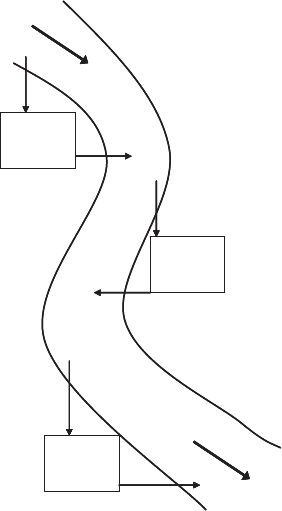
direct contact, as well as for water)? Part of the answer can be seen in Figure 12.3.
Towns historica lly have been located along rivers or streams that served as their water
source. Water typically is withdrawn upstream of the town and wastewater is discharged
downstream. Beyond the obvious sanitary merits of this approach, it allowed both water
delivery and wastewater collection to be by gravity: the water and wastewater flowing
downhill. However, as areas became more densely populated, the wastewater discharge
of one town soon became the water intake for the next community downstream.
Town
A
Town
C
Town
B
Raw water
Raw water
Raw water
Wastewater
Wastewater
Wastewater
Town
C
Figure 12.3 Typical pattern of water supply and wastewater disposal.
WATERBORNE DISEASES 357