
Vaccari D.A., Strom P.F., Alleman J.E. Environmental Biology for Engineers and Scientists
Подождите немного. Документ загружается.

Most diseases transmitted by the fecal–oral route (whether through water, food, or
direct contact) have their primary effect on the intestines and thus are referred to as
enteric. To understand their importance, it is helpful to look at the historical impact of
two such bacterial diseases, cholera and typhoid fever.
Cholera Cholera is an acute intestinal disease marked by severe diarrhea and vomiting.
The bacterium responsible, Vibrio cholerae, reproduces in the small intestine, releasing an
enterotoxin (a toxin affecting the intestines) that triggers the resultant stress on the vic-
tim. Bodily fluids may be depleted so rapidly that the victim dies within hours unless pre-
ventive measures are taken, such as providing intravenous replacement of fluids and salts.
Cholera was originally endemic to South Asia, but there have been seven major pan-
demics (the first beginning in 1817), and it is now also endemic to South and Central
America and perhaps to the Gulf coast of the United States. The early U.S. epidemics
(first: 1832–1834; second: 1849–1854) produced widespread fear—not surprisingly, since
there was no cure for this usually fatal disease. In 1832, 20% of the population of New
Orleans died of cholera, while in 1849 another 5000 people died there, along with 8000 in
New York City.
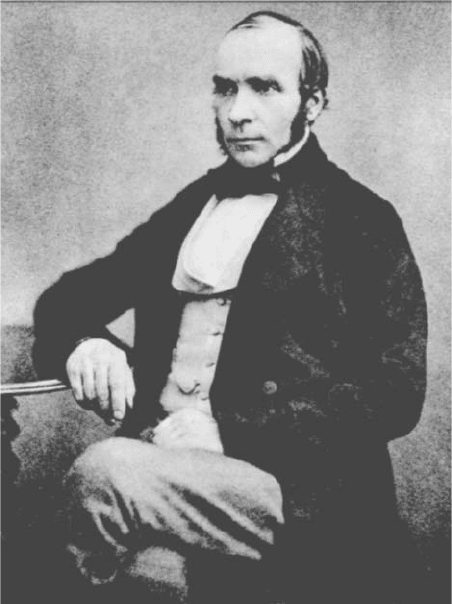
In 1854, Dr. John Snow (Figure 12.4) performed two studies of the incidence of
cholera in London. These are now recognized as the first epidemiological studies ever
Figure 12.4 John Snow in 1857, one year before his death.
358
EFFECT OF MICROBES ON HUMAN HEALTH
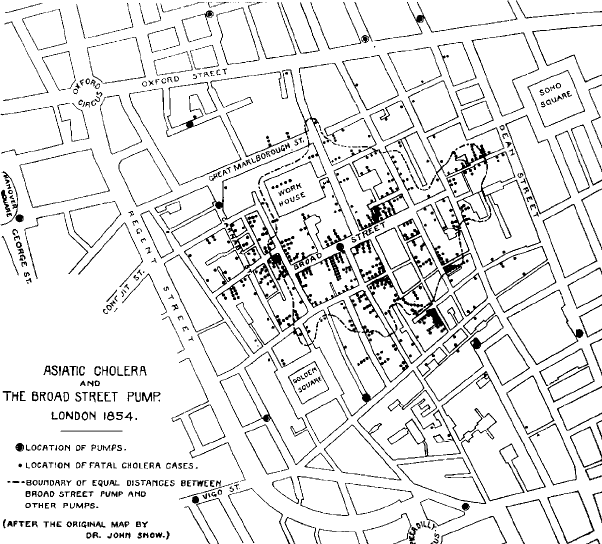
conducted, predating the formalization of the germ theory of disease (Section 12.1.1). In
the better known of these studies, Snow plotted on a map the residence of each person
who died of cholera in one area of town served by public wells with pumps (buildings
there did not have indoor plumbing). He found 521 cholera deaths within 250 yards of
the Broad Street pump (Figure 12.5). The incidence of cholera was much higher
among people living close to, and therefore presumably using water from, this pump as
opposed to others located in the area. He also found evidence that this well was contami-
nated with sewage, and in an example of an early public health measure, had the pump
handle removed (rendering it unusable)! The adjacent pub is now named in his honor
(Figure 12.6).
In the second study, Snow reviewed cholera deaths in another part of London served by
two competing water companies. Customers of the Southwark and Vauxhall Company
had 31.5 cholera deaths per 1000 houses served, whereas the rate for the Lambeth
Company was 3.7 per 1000 houses served. Both companies took their water from the
Thames River and delivered it through pipelines, without treatment. However, Southwark
and Vauxhall withdrew water from the river near central London, where it was contami-
nated with untreated sewage, whereas Lambeth’s source was upstream of the city, and
relatively pure.
Attempts to control cholera also figured in some of the earliest efforts at water purifi-
cation as a public health measure. During the German epidemic of 1892, the adjoining
cities Hamburg (upstre am) and Altona (downstream) were drawing their water from the
Elbe. However, Altona practiced slow sand filtration, and despi te the more contaminated
Figure 12.5 John Snow: cholera deaths and the Broad Street pump.
WATERBORNE DISEASES 359

water source, had a cholera death rate of only 2.3 per 1000 people (many traceable to
drinking Hamburg water), compared to 13.4 for Hamburg (Table 12.4).
Medical treatment traditionally involved intravenous rehydration until the disease ran
its course. However, this was not available to many in poorer countries. A simpler treat-
ment called oral rehydration therapy (ORT) is saving many lives around the world (see
Section 9.9).
Cholera was eradicated (eliminated) in the United States in 1911. However, it reap-
peared in 1973, and there have been small numbers of cases since, mostly associated with
eating shellfish harvested along the coast of the Gulf of Mexico. Worldwide, cholera still
accounts for more than 120,000 deaths per year.
Typhoid Fever Although typhoid fever (caused by Salmonella typhi) was later trans-
mitted mainly through food in the United States, originally it was also a major waterborne
disease. Although it does not have as high a mortality rate, and thus did not provoke quite
the same level of fear as cholera, it probably lead to more deaths overall: 500,000 cases
with 40,000 deaths in 1909, for example. Water filtration also had a beneficial effect in
reducing the incidence of typhoid fever, as can be seen in Table 12.4 for the cities of
Pittsburgh, Cincinnati, and Louisville.
Another water treatment technology, disinfection with chlorine, was first utilized for an
urban water supply in the United States in Jersey City, New Jersey, in 1908. Some of the
early beneficial effects of chlorination in controlling disease are also shown in Table 12.4.
Figure 12.6 Snow’s Pub in London’s Soho district, adjacent to the infamous Broad Street pump.
360
EFFECT OF MICROBES ON HUMAN HEALTH

Figure 12.7 shows the drop in typhoid in New York attributable largely to improved water
treatment.
In the United States, the annual incidence of typhoid fever has dropped to about 0.2
case per 100,000 population, and the majority of these are in people who acquired the
disease while abroad. However, worldwide estimat es for the incidence of typhoid fever
are still on the order of 16 million cases and over 600,000 deaths a year. Although animals
are a major source of other Salmonella species, the reservoir for S. typhi is usually man.
Other Fecal–Oral Route Diseases As indicated in Table 12.3, a number of other water-
borne diseases are spread through the fecal–oral route. This includes viral diseases such as
poliomyelitis (now essentially eradicated in the United States through vaccination) and
TABLE 12.4 Correlation between Sand Filtration (SF) or Chlorination (Chlor) of Water
Supplies and Deaths from Cholera or Typhoid Fever
Disease Date City Treatment Deaths Rate/100,000
Cholera 1892 Hamburg, Germany
a
None 8606 1344
Altona, Germany
a
SF 328 230
Typhoid fever 1907 Pittsburgh, PA None 125
1908 SF
b
49
1902–1907 Cincinnati, OH None 57
1908–1913 SF 11
1904–1909 Louisville, KT None 58
1910–1915 SF 24
11–12/1914 Hull, Quebec
c
None 200 1000
Ottawa, Ontario
c
Chlor 28 28
1917 Wheeling, WV None 200
1918 None 155
1–3/1919 Chlor
d
7
a
Adjoining cities; Hamburg is immediately upstream of Altona on the Elbe River.
b
Only part of the water supply was filtered.
c
On opposite banks of the Ottawa River, Canada.
d
Chlorination began late in 1918.
0
20
40
60
80
100
1888 1898 1908 1918 1928 1938
Year
Annual Typhoid Deaths
(# per 100,000)
Figure 12.7 Annual typhoid cases (per 100,000 residents) in New York, 1888–1938.
WATERBORNE DISEASES 361
hepatitis A. In one classic case (1955), 30,000 cases of inf ectious hepatitis were traced to
drinking water in New Delhi, India, that was properly chlorinated but which had excess
turbidity. It is believed that the viruses within the particulate material were protected from
the chlorine. Waterborne viruses (especially rotaviruses) are also responsible for a portion
of travelers’ diarrhea, and contribute to the over 3 million yearly death toll worldwide
from diarrheal diseases, mostly among young children (infantile acute gastroenteritis).
Other important bacterial enteric diseases include salmonellosis (caused by Salmo-
nella species other than S. typhi) and bacterial dysentery, or shigellosis (caused by
Shigella spp.). Salmonellosis is also easily spread through food, and Shigella by the
fecal–oral route through direct contact, especially in settings such as child-care centers.
Amebiasis,oramoebic dysentery, is caused by the protozoan Entamoeba histolytica.
This is the third most prevalent parasitic disease worldwide (after schistosomiasis and
malaria) and has the eleventh highest annual mortality (100,000) among all infectious dis-
eases. The infectious stage is a cyst.
Breaking the Chain In most developed countries, water borne disease from the fecal–
oral route has been greatly reduced. Public health practices in such countries have been
successful in breaking the chain of disease and its transmission. Through proper sewage
treatment and waste disposal, fecal contamination of water has decreased dramatically.
Water purification techniques, in turn, have been successful in virtually eliminating patho-
gens from drinking water. As a result, there are relatively few infected persons in the
population who are shedding pathogens into the wastewater. This smaller reservoir further
helps prevent disease transmission even when there are lapses in wastewater or potable
water treatment. Quickly locating the source of an outbreak and treating infected persons
further help minimize the spread of disease. Safe potable water als o makes hand washing
easier and more effective, reducing fecal–oral transmission through food and direct
contact.
12.2.5 Modern and Recent Outbreaks
Table 12.5 shows the 108 known outbreaks of waterborne disease in the United States for
1993–2000. The six organisms responsible for more than one outbreak were the protozo-
ans Cryptosporidium parvum and Giardia spp. and the bacteria Salmonella spp., Shigella
spp., Escherichia coli type O157:H7 (Section 12.3.2), and Campylobacter jejuni. There
were also two viruses. All produce gastrointestinal illness, and all but Salmonella and
Shigella are relatively newly recognized as causes of waterborne disease. Many of the
AGI (acute gastrointestinal illness from an unknown agent) cases are probably from
viruses, although one was chemical.
Cryptosporidiosis and Giardiasis The very large number of cases of cryptosporidiosis
in the table results from a single major outbreak in Milwaukee, Wisconsin, in which
403,000 people were infected, with 4400 hospitalized and 100 fatalities. Worldwide it
is estimated that there may be 500 million cases per year. A major outbreak of both cryp-
tosporidiosis and giardiasis also occurred in Sydney, Australia, in 1999, threatening the
Summer Olympics held there the following year. Both protozoans form resistant resting
stages (oocysts for Cryptosporidium, cysts for Giardia) that are highly resistant to disin-
fection. This has led to a requirement in the United States for filtration of all community
water systems that utilize surface water sources.
362 EFFECT OF MICROBES ON HUMAN HEALTH

TABLE 12.5 Disease Outbreaks in the United States Associated with Drinking Water, 1993–2000
a
Type of Water System
Community Noncommunity Individual Total Percentages
Etiologic Agent Outbreaks Cases Outbreaks Cases Outbreaks Cases Outbreaks Cases Outbreaks Cases
c
Cases
d
Giardia spp. 8 1,891 3 139 6 25 17 2,055 15.7 0.50 23.3
Cryptosporidium parvum 5 404,642 1 27 2 39 8 404,708 7.4 98.22 16.7
Shigella spp. 1 83 3 323 1 33 5 439 4.6 0.11 5.0
Escherichia coli O157:H7 3 208 2 37 3 12 8 257 7.4 0.06 2.9
Campylobacter jejuni 1 172 3 66 1 102 5 340 4.6 0.08 3.9
E. coli O157:H7/C. jejuni 0 0 1 781 0 0 1 781 0.9 0.19 8.9
Salmonella spp. 2 749 0 0 1 84 3 833 2.8 0.20 9.5
Non-O1 Vibrio cholerae 1 11 0 0 0 0 1 11 0.9 0.00 0.1
Plesiomonas shigelloides 0 0 1 60 0 0 1 60 0.9 0.01 0.7
Norwalk-like viruses 0 0 3 356 0 0 3 356 2.8 0.09 4.0
Small round-structured Virus 1 148 1 70 0 0 2 218 1.9 0.05 2.5
AGI
b
8 85 17 1,465 10 208 35 1,758 32.4 0.43 20.0
Chemical 13 215 0 0 6 8 19 223 17.6 0.05 2.5
Total 43 408,204 35 3,324 30 511 108 412,039 100.0 100.0 100.0
Percentage
c
39.8 99.1 32.4 0.8 27.8 0.12 100.0 100.0
Percentage
d
56.4 37.8 5.8 100.0
a
Compiled from data available on the Centers for Disease Control Web site; n ¼ 108.
b
AGI, acute gastrointestinal illness of unknown etiology.
c
Percentage based on all 108 outbreaks or 412,039 cases.
d
Percentage based on 8802 cases, excluding the Milwaukee outbreak of Cryptosporidium infecting 403,237.
363

Campylobacter The first reported outbreak of waterborne gastroenteritis in the United
States involving C. jejuni was in 1978, in Bennington, Vermont. Of a total population of
10,000 using the community water supply, 2000 became ill. Campylobacter (both C. jejuni
and C. fetus) can also be spread by food, especially chicken and turkey (which are reservoirs).
System Deficiency Table 12.6 indicates the breakdown of incidents by the type of defi-
ciency in the potable water system. For community systems, the outbreaks are almost
evenly divided between treatment and distribution problems, whereas for noncommunity
and individual systems, consuming untreated water was the primary known cause.
12.3 FOODBORNE DISEASES
There are many diseases that can be caused by the consumption of contaminated foods.
The responsible microbial agent may have been present in the original material (e.g.,
growth of Salmonella in chickens), or been introduced at some point during subsequent
handling and preparation steps as a result of improper sanitation. In most instances, these
problems can be linked to improper cooking or storage, particularly of foods containing
meat, milk, eggs, cheese, poultry, fish, and shellfish. Table 12.7 provides an approximate
percentile breakdown of various bacterial foodborne diseases in the United States by their
causative agent and indicates the food products with which they are typically associated.
The sanitary aspects of commercial food distribution and handling within the United
States have long been carefully regulated, but there are still serious lapses. Additionally,
many foods are now being imported from countries around the world with far less strin-
gent standards. However, most cases are assoc iated with poor practices in homes, institu-
tions (e.g., nursing homes), or small restaurants.
Foodborne diseases of microbial origin may be split into two categories. Food poison-
ing results from ingestion of preformed microbial toxins. In some cases, the microorgan-
ism itself may no longer be viable or may be incapable of infecting a human host, but the
products of its previous activity result in disease. Food-transmitted infection, on the
other hand (although sometimes also called food poisoning by the public), results when
the causative organism is transmitted via food, then parasitizes the new host to produce
disease. Some of the diseases of concern are discussed briefly below. Note that the specific
symptoms, particularly the time to their onset, may help distinguish the particular agent.
TABLE 12.6 Drinking Water System Deficiencies Associated with Waterborne Disease
Outbreaks in the United States, 1993–2000
a
Type of Water System
Community Noncommunity Individual Total
Type of Deficiency No. % No. % No. % No. %
Untreated surface water 0 0.0 0 0.0 2 6.7 2 1.9
Untreated groundwater 5 11.6 17 48.6 14 46.7 36 33.3
Treatment 16 37.2 13 37.1 2 6.7 31 28.7
Distribution system 18 41.9 4 11.4 4 13.3 26 24.1
Unknown 4 9.3 1 2.9 8 26.7 13 12.0
Total 43 100.0 35 100.0 30 100.0 108 100.0
a
Compiled from data available on the U.S. Centers for Disease Control Web site; n ¼ 108.
364 EFFECT OF MICROBES ON HUMAN HEALTH

12.3.1 Bacterial Food Poisoning
Staphylococcus Staphylococcus aureus is the most common cause of food poisoning. It
is often present on the skin, so that it is easily introduced into food during preparation and
handling. If dishes containing mayonnaise, meat, poultry, or creamy sauces or fillings are
not properly refrigerated (e.g., at a picnic), the organism can grow and produce enterotox-
ins. These can provoke severe vomiting and diarrhea within 1 to 6 hours.
Clostridium perfringens Clostri dium perfringens is another major widespread cause of
food poisoning throughout the world. It produces an enterotoxin in foods that 8 to 22
hours after ingestion creates severe diarrhea and intestinal cramps, but not vomiting.
The resulting distress typically lasts for a period of about 1 day, beyond which point
there is almost always a full recovery. C. perfringens is a normal resident in the intestinal
tract but in numbers sufficiently low to avoid any negative impact. Thus, it is a common
contaminant of meat products as well as soil and sewage. Because it is an endospore for-
mer, it most commonly causes problems in foods that are not heated sufficiently to inac-
tivate the spore s present, and then held unrefrigerated (at temperatures of 20 to 40
C),
allowing for rapid growth and toxin production.
Botulism Clostridium botulinum is also a sporeformer and is common in soil and sedi-
ment. Again, if contaminated food is not sufficiently cooked, growth can occur later. In
this case, however, neurotoxins are produced, and the resulting illness, botulism, is often
fatal. The toxins are also destroyed by adequate cooking, so that home-canned foods
(which may be inadequately heated and then stored at room temperature) that are later
eaten raw are a major source of this illness.
Unpasteurized honey may also contain spores of C. botulinum, although toxin is not
produced there. However, germination and toxin production may occur in the intestines
of very young (less than 2 months old) infants who are given raw honey, leading to sudden
TABLE 12.7 Bacterial Foodborne Diseases in the United States
Bacterial Agent Type
a
Commonly Contaminated Foods (%)
b
Bacillus cereus P Rice and starchy foods 1
Campylobacter spp.
c
I Chicken and milk 8
Clostridium botulinum P Home-canned foods; smoked fish <1
Clostridium perfringens P Reheated meats/meat products 7
Escherichia coli
d
I Meats 12
Listeria monocytogenes I Dairy products, meat, fresh produce 1
Salmonella spp. I Chicken and other meats, egg products, fresh produce 55
Shigella spp.
e
I Meats, fresh produce 6
Staphylococcus aureus P Meats, desserts, salads with eggs and/or mayonnaise 8
Vibrio cholerae I Seafood <1
Vibrio parahaemolyticus I Seafood 1
Yersinia enterocolitica I Pork and milk <1
a
I ¼ infection; P ¼ poisoning.
b
Based on 196 outbreaks (8047 cases) of bacterial etiology reported in 2003 by the Foodborne Outbreak
Response and Surveillance Unit, U.S. Centers for Disease Control and Prevention.
c
Mostly C. jejuni.
d
Mostly E. coli O157:H7.
e
Mostly S. sonnei.
FOODBORNE DISEASES
365
death from infant botulism. Babies should therefore not be given raw honey until their
intestinal biota has developed sufficiently that it can resist such opportunistic infection.
Waterfowl are also sometimes killed by botuli sm. The organism can grow in the rich
sediments of ponds, especially in parks where people throw bread in the water to feed
ducks and geese. The birds may be poisoned when they later eat bread off the bottom.
12.3.2 Bacterial Infections
Salmonellosis Based on their surface antigens, it is believed that there are actually 2200
different species of Salmonella, but in the United States, Salmonella typhimurium and
S. enteritidis are generally considered to be the leading causes of salmonellosis (gastro-
intestinal illness othe r than typhoid fever caused by Salmonella). Many commercially
raised chickens harbor Salmonella, leading to contamination of their meat and eggs.
Proper cooking prevents infection, but consuming runny eggs, reusing surfaces or utensils
that were improperly cleaned, and not refrigerating foods promptly all pose a risk. Other
meats and milk can also be sources, and because Salmonella can grow in many such
foods, contamination by a human carrier is also possible, typically from inadequate
hand washing. Turtles and some other reptiles may also be carrie rs (which is a reason
that their sale as pets is now banned in many areas).
Salmonellosis is characterized by the sudden onset of gastrointestinal distress, including
fever, abdominal cramps, diarrhea (usually bloody), and vomiting, starting 12 to 48 hours
after eating. Antibiotic treatment is usually highly effective, but massive infections may
be fatal. It is estimated that there are 50,000 foodborne cases per year in the United States.
Toxigenic E. coli There are many strains of Escherichia coli that live normally in the
intestines of humans and animals without causing disease. However, in the late 1960s,
medical researchers began finding a number of enterotoxin-producing strains. In 1973, an
acute outbreak of gastroenteritis at Japan’s Nagoya airport, which affected 956 people, was
linked to the presence of several such strains in a restaurant’s drinking water supply. Two
years later, the presence of another hazardous strain (E. coli O6:H16) in a natural spring
caused more than 1000 cases of acute diarrhea at Oregon’s Crater Lake National Park.
As of the early 1980s, another new E. coli strain, type O157:H7, was linked to cases
involving bloody and nonbloody diarrhea that were accompanied by abdominal cramps.
The latter strain also has been found to foster debilitating blood and kidney illnesses and
can affect the central nervous system. This virulent strain is now blamed for 250 deaths a
year. Most cases are linked to eating undercooked ground beef or drinking unpasteurized
milk. Dairy and beef cattle appear to be a major reservoir for this type of E. coli.
Yersiniosis Yersiniosis is a severe gastroenteritis caused by infection with Yersinia
enterocolitica, most commonly from contaminated food. These enterotoxin-producing
bacteria are invasive pathogens that are able to penetrate the gut lining, entering the lym-
phatic system and blood and causing severe pain similar to that of appendicitis.
Listeriosis Listeriosis is caused by Listeria monocytogenes. It is a widespread soil and
water organism that is becoming an important pathogen in part because it is cold tolerant.
Thus, its growth is not adequately controlled by refrigeration. It grows within and kills the
white blood cells that try to control the infection, leading to a serious illness with a 25%
mortality rate.
366 EFFECT OF MICROBES ON HUMAN HEALTH
12.3.3 Other Agents
Viruses Some viruses, such as hepatitis A, rotaviruses, and Norwalk virus, can be spread
by food as well as by water. In part, this is expected, since water is used in the preparation of
many foods. However, unlike bacteria, viruses cannot grow or replicate in food. (Animal
viruses only replicate within living animal cells.) Thus, the initial contamination must be
with a sufficient quantity of viruses to constitute an infective dose, or disease will not occur.
Fungi Several types of fungi can cause food poisoning. Some wild mushrooms are
themselves highly poisonous, but may be mistaken for edible varieties by inexperienced
pickers. On the other hand, growth of fungi within a food material can produce toxins.
Ergotism, as descr ibed in Section 10.7.4, for example, is caused by the neurotoxins pro-
duced by the ascomycete Claviceps purpurea in infected cereal grains (especially, rye).
Similarly, the aflatoxins produced by some strains of Aspergillus, particularly during
growth on stored grains and peanuts, are potential carcinogens (cancer-causing agents).
However, infection by ingested fungi is rare.
Algae Some of the marine dinoflagellates occasionally ‘‘bloom’’ in large numbers to
produce ‘‘red tides’’ (Secti on 10.7.2). Certain strains, including many Gymnodinium,
Gonyaulax, and Pfisteria, may release neurotoxins that can be taken up by filter-feeding
shellfish, such as mussels, clams, and oysters. (Thus, this listing could also be under
waterborne disease.) These concentrated toxins, which are not destroyed by cooking,
can in turn produce disease in man when ingested, in some cases leading to respiratory
failure and death. At least with Pfisteria, there are also reports of skin damage from con-
tact with toxin-contaminated water or fish.
Parasites Toxoplasmosis is caused by the protozoan Toxoplasma gondii, a sporozoan. It
is ingested in inadequately cooked meat, using the same utensils for meat before and after
cooking, or licking the fingers after handling raw meat. (It can also be spread through
contact with cat feces.) In general, infection causes no symptoms, but it can cause
birth defects if a pregnant woman becomes infected.
Tapeworms are members of the Cestoda class of flatworms (Platyhelminthes). The
most important as human parasites are those acquired by eating raw or undercooked
beef, pork, and fish. Encysted larvae in the muscle tissue of these animals are released
from the cyst once they are ingested, and attach to the intestinal lining of the small intes-
tine. There they quickly mature, reaching lengths of up to 15 m (50 ft). Tapeworms have
no mouth or digestive tract, relying on the host to provide nutrients that it absorbs through
its body wall. Over 1 million eggs per day may be produced in the worm’s ripened body
segments and shed with the human host’s feces. If the eggs are ingested by the appro priate
intermediate host (cattle, swine, or fish, respectively), the larvae develop and invade the
muscle, where they encyst, comple ting the cycle.
The causative agent of ascariasis is the nematode (roundworm) Ascaris lumbricoides.
The ova (eggs) are ingested on contaminated vegetables or from dirty hands, and hatch in
the intestine. The larvae penetrate the intestinal wall, migrate to the lungs, climb up the
respiratory tract to the throat, and are then swallowed again. The adults now attach to the
intestinal wall and feed on the partially digested food, reac hing a length of 25 cm (10 in.).
After mating, a mature female may produce 200,000 eggs per day. These are shed in the
feces and may remain infective in soil or sludge for several months.
FOODBORNE DISEASES 367