
Vaccari D.A., Strom P.F., Alleman J.E. Environmental Biology for Engineers and Scientists
Подождите немного. Документ загружается.


The other kinetic coefficients (K
s
, Y, b) also are affected by temperature. Decay rates
ðbÞ probably increase with temperature because of increased reaction rates, but the rela-
tionships with the other parameters are not well established. For the relatively few times
in which it has been determined, K
s
values have been observed to increase with tempera-
ture in some cases, but to decrease in others.
pH Microbial growth occurs over a wide range of pH due to the existence of both acidic
and alkaline extremophiles (Chapter 10). However, as with temperature, individual spe-
cies have a much narrower range, with minimum, maximum, and optimum pH values.
This stems from the effect that pH has on functional groups in essential microbial com-
ponents, especially proteins. The pH may also affect the form (including shape and
charge), and hence availability and toxicity, of organic and inorganic (e.g., NH
3
/NH
4
þ
,
H
2
S/HS
) substrates. In fact, pH is so important that even extremophiles maintain nearly
neutral pH conditions inside the cell.
The overall pH range for a species may be narrow or broad. Unlike the case of tem-
perature, the optimum can be near either end or, more likely, in the middle of this range;
also, it may be narrow or broad (several pH units). Since there is no general pattern, the
effect on kinetic coefficients (especially
^
mm) must be determined individually for each
situation of interest.
11.7.7 Inhibition
In addition to being limited by low concentrations of one or more substrates or unfavor-
able environmental factors, it is also possible for growth to be less than maximal due to
the presence of toxic agents. The effect may be to slow down reactions or to cause damage
that requires diversion of resources for repair. In general, this inhib itory agent could be
(1) a substrate used for growth, if it is at high enough concentrations; (2) a produc t of cell
metabolism; or (3) another substance or external factor.
Substrate Inhibition Some growth substra tes are toxic at higher concentrations. Poten-
tial mechanisms include reactions with critical cell constituents and dissolution of mem-
branes. Several models have been developed to describe the effects observed. The most
common is a modification of the Monod expression, based on the form of the Haldane
model [equation (5.38)] for substrate inhibition of enzymes. In the context of microbial
growth, it is usually referred to as the Andrews model (Figure 11.32):
m ¼
^
mm
S
S þ K
S
þ S=K
I
If it is assumed that K
I
is much greater than K
S
, this equation can be approximately
expressed as
m ¼
^
mm
S
S þ K
S
K
I
S þ K
I
ð11:34Þ
where K
I
is the half-inhibitory coefficient (mg/L). Note that when S K
I
, the added term
becomes 1, leaving the Monod expression. Also, when S ¼ K
I
, this term becomes
1
2
in
338 QUANTIFYING MICROORGANISMS AND THEIR ACTIVITY
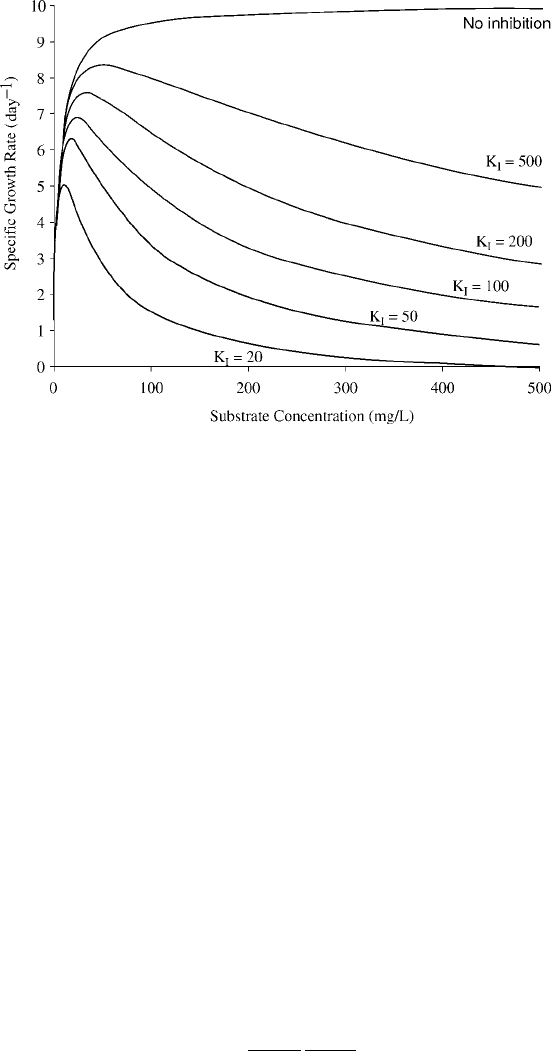
equation (11.34), and m thus becomes half of the Monod value. In the Andrews model,
growth rate approaches zero asymptotically as substrate increases. Some other models
incorporate an inhibitory level above which there is no growth; this has been found to
provide a better fit for growth on toluene, for example, which compromises the cell mem-
brane at higher concentrations.
Product Inhibition Products of cell metabolism can accumulate in the organism’s envir-
onment and produce inhibitory effects. In some cases this may be a general effect, such as
a decrease in pH. In other cases it may be a specific toxic product that is inhibitory, such
as the release of ammonia and hydrogen sulfide from proteins, nitrite produced by ammo-
nium oxidizers, or ethanol produced by fermentations. In the case of composting, accu-
mulation of heat leading to excessively high temperatures is also, in a sense, an example
of product inhibition.
Other Inhibitory Agents Other toxic chemicals present naturally or as contaminants in
the organism’s environment may exert inhibitory effects but not serve as substrates. These
might include heavy metals, toxic organics, or chlorine (per haps added for disinfection).
Ultraviolet light or other radiation can also be inhibitory. Depending on its mode of
action, one way to model the effect of the concentration (I) of an inhibitory substance
is to use another modification of the Monod expression:
m ¼
^
mm
S
S þ K
s
K
I
I þ K
I
ð11:35Þ
However, other models might be more appropriate, if, for example, there is an inhibitory
substance concentration above which the cell becomes inactive.
Figure 11.32 Andrews model of substrate-inhibited growth.
GROWTH 339

PROBLEMS
11.1. What would be the approximate dry weight of the cells in 1.0 L of medium
containing 10
6
cells/mL if they are 1.0-mm-diameter cocci?
11.2. One rod-shaped bacterium has a diameter of 0.5 mm and a length of 1.5 mm, and
another is 1:0 3:0 mm. (a) Assuming that they have equal densities , what is the
ratio (smaller/larger) of their mass? (b) What is the ratio of their surface area/
volume ratios?
11.3. If the minimum doubling time of E. coli in a particular system is 20 minutes, what
is its maximum growth rate in units of (a)h
1
;(b) day
1
?
11.4. Given the Monod coefficients for heterotrophs and for nitrifiers below, find the
substrate concentrations (mg/L of COD and NH
3
-N, respectively) that result in a
growth rate of 0.1 day
1
. Use the following maximum growth rate coefficients and
the Monod half-rate coefficients (from the International Water Association’s
Activated Sludge Model No.1):
For heterotrophs : m
max;H
¼ 6:0 day
1
K
S
¼ 20:0 mg COD = L
For autotrophs : m
max;A
¼ 0:80 day
1
K
NH
¼ 1:0mgNH
3
-N=L
11.5. Given the two-substrate growth model and coefficients for the activated sludge
process given below, compute the growth rate at a substrate concentration ð SÞ of
5.0 mg/L and dissolved oxygen (DO) concentration ðS
O
Þ of 0.3 mg/L. What would
the growth rate be if the DO term were excluded?
From Activated Sludge Model No.1: For aerobic heterotrophic growth,
m
g
¼ m
max;H
S
S
K
S
þ S
S
S
O
K
O;H
þ S
O
S
S
¼ 5:0 mg COD=L
S
O
¼ 0:3mgDO=L
K
S
¼ 20:0mg=L ðMonod coefficient for CODÞ
K
O;H
¼ 0:20 mg=L ðMonod coefficient for DOÞ
m
max;H
¼ 6:0 day
1
ðmaximum growth rateÞ
REFERENCES
Clesceri, L. S., A. E. Greenberg, and A. D. Eaton (Eds.), 1998. Standard Methods for the Examination
of Water and Wastewater, 20th ed., American Public Health Association, Washington, DC.
Updated regularly, and available at www.wef.org.
Grady, C. P. L., Jr., G. T. Daigger, and H. C. Lim, 1999. Biological Wastewater Treatment, 2nd ed.,
Marcel Dekker, New York.
340
QUANTIFYING MICROORGANISMS AND THEIR ACTIVITY
International Association on Water, 2000. Activated Sludge Models ASM1, ASM2, ASM2d
and ASM3, Scientific and Technical Report 9, IAW, London.
Metcalf and Eddy, 2003. Wastewater Engineering: Treatment and Reuse, 4th ed., revised by
G. Tchobanoglous, F. L. Burton, and H. D. Stensel, McGraw-Hill, New York.
Murray, P. R. (Ed.-in-Chief), 1999. Manual of Clinical Microbiology, 7th ed., American Society for
Microbiology, Washington, DC.
Young, J. C., and R. M. Cowan, 2004. Respirometry for Environmental Science and Engineering,SJ
Enterprises, Springdale, AR.
REFERENCES 341

12
EFFECT OF MICROBES ON
HUMAN HEALTH
Higher organisms evolved in a microbial world. From the pers pective of microorganisms,
plants and animals represent another environment to colonize. Thus, it is not surprising
that humans, as well as other animals and plants, have a diverse community of microbes
living on and in them. Some of these ‘‘passengers’’ are normal, beneficial, or even neces-
sary (e.g., rhizobia in some plants; cellulose degraders in animals such as termites and
ruminants), whereas others are abnormal, harmful, or even fatal.
12.1 MICROBIAL COLONIZATION OF HUMANS
The human body is a highly complex, multicellular life form whose structure and function
depends on the coordinated interaction of roughly 10 trillion individual cells. On a micro-
scopic level, the average human also carries a similar number of nonhuman visitors living
opportunistically on and within the body. Freshly scrubbed and brushed, therefore, your
body may outwardly appear clean and wholesome, but it is anything but sterile.
Your body is the mobile, warm-blooded equivalent of an ocean’s coral reef, supporting
a vast and highly divergent range of life. These microbes stretch from head to toe, spread
across your skin, hide in the crevices of your mouth and nose, and follow your food from
start to finish. Their presence is not just normal, but helpful or even necessary.
The life-style of these microorganisms is often described as a commensal relationship,
in which they are tolerated by or even offer certain benefits to their host. For example,
microbes are commonly found within the human intestinal tract, where they help to digest
some foods and produce essential nutrients such as vitamins B
12
, K, thiamin, riboflavin,
and pyroxidine.
Environmental Biology for Engineers and Scientists, by David A. Vaccari, Peter F. Strom, and James E. Alleman
Copyright # 2006 John Wiley & Sons, Inc.
342
Perhaps even more important, the skin’s normal biota actually offers a protective effect
known as colonization resistance, which effectively safeguards the body against a hostile
takeover by pathogenic (disease-causing) microbes. This effect can readily be appre-
ciated during those periods when broad-spectrum antibiotics are used to com bat a disease.
The associated stress imposed on a body’s normal biota can then lead to invasion by
opportunistic, abnormal microbes (e.g., excessive growths of fungi such as Candida),
which may lead to secondary health problems.
The composition of the human-associated microbial community will vary to some
extent from one person to the next, and to some degree may also change with time. How-
ever, Table 12.1 provides a basic overview of the common locations and examples of the
makeup of this normal microbial biota.
12.1.1 Abnormal Microbial Infection
Although the vast majority of microbes pose no threat whatsoever to human health, there
are many forms that are outright hazards. The importance of the infectious diseases they
cause is demonstrated by the rates of mortality (death) to which they can be linked. Even
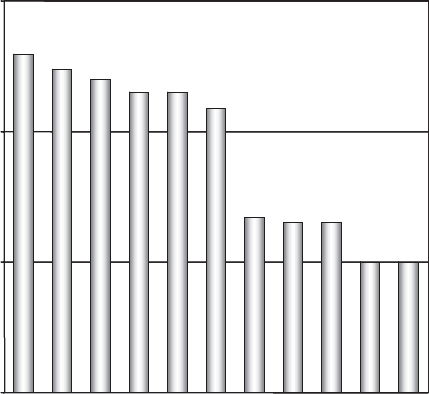
today, infectious disease is the world’s leading cause of death, with fatalities exceeding 15
million per year (Figure 12.1). Rates of overall morbidity (illness, both fatal and nonfatal)
are of course much higher and have a tremendous impact on the world’s economy and
each person’s quality of life.
Respiratory and gastrointestinal diseases account for over half of these deaths. It is also
sad to note that the majority of these deaths are of children below the age of 5 (the criter-
ion used for infant mortality). Underdeveloped or developing countries are most heavily
hit. Within industrialized countries such as the United States, for instance, the infant mor-
tality rates fall below 1%, but these figures skyrocket to nearly 10% in developing countries
and to more than 15% in the world’s least developed countries. Furthermore, about half of
the world’s population is considered to be at risk to a wide range of infectious diseases.
Indeed, within the past millennia, microbial disease has proven to be a formidable
adversary, one that has the potential to decimate the huma n population if left unchecked.
During the Middle Ages and extending into the nineteenth century, diseases such as bubo-
nic plague, cholera, and typhoid swept through Europe, causing massive morta lity. The
influenza pandemic at the end of World War I, for example, killed more people than
the war itself.
Microorganisms are ubiquitous on and within the bodies of virtually all highe r life-
forms (excluding those raised in laboratories under special ‘‘germ-free’’ conditions) ,
and for the most part they are innocuous for their host (the organism that supports
them). However, abnormal proliferation of indigenous microbes, or invasion from an
external source, can lead to disease. Most of the important problems are infectious in nat-
ure, being spread by the dissemination of viable, pathogenic cells from one host to another
by either direct or indirect means. In many instances, pathogenic microbial agents may
also subsist within an environmental reservoir, lingering in wait for an opportunity to
assert their influence.
A parasite is an organism that lives in a close relationship with another organism, ben-
efiting at the expense of its host. Pathogens are thus parasites that do enough harm to their
host to result in disease. However, it is also com mon to call disease-producing viruses,
bacteria, and fungi pathogens, while referring to infective protozoans and worms as
parasites.
MICROBIAL COLONIZATION OF HUMANS 343

The Germ Theory of Disease and Koch’s Postulates We now take for granted that
infectious diseases are caused by microbes, but this is actually a relatively new concept.
Although Leeuwenhoek (Section 10.2.1) had first observed microbes in the seventeenth
century, they were generally thought to be too small and unimportant to affect the health
of higher organisms. In the early nineteenth century, fungal diseases of plants and later
animals (silkworms) were first recognized. When Pasteur (Section 10.2.2) summarized
his findings on the germ theory of disease in 1862, and referred to mi crobially caused
spoilage as ‘‘diseases’’ of wine and beer, this influenced Englishman Joseph Lister to
theorize that surgical wound infections might be the result of bacterial growth. His
TABLE 12.1 Examples of Normal Microbial Biota of Human
Body Regions
a
Region Examples
Skin Acinetobacter
Corynebacterium
Propionibacterium acnes
Staphylococcus aureus
Staphylococcus epidermidis
Streptococcus
Nose, nasopharynx, and sinuses Haemophilus
Neisseria
Staphylococcus aureus
Staphylococcus epidermidis
Streptococcus pneumoniae
Streptococcus pyogenes
Mouth and throat Corynebacterium
Fusobacterium
Neisseria
Staphylococcus epidermidis
Streptococcus mitis
S. salivarius
Treponema
Lower respiratory tract Normally, few microorganisms
Stomach (pH 2) Helicobacter pylori
Lactobacillus
Small intestine (pH 4–5) Enterococcus
Lactobacillus
Large intestine (colon) (pH 7) Bacteroides
Clostridium
Enterococcus faecalis
Escherichia coli
Eubacterium
Lactobacillus
Urethra Escherichia coli
Proteus mirabilis
Vagina Candida (yeast)
Escherichia coli
Lactobacillus acidophilus
Streptococcus
a
All are bacteria, except Candida, a fungus.
344 EFFECT OF MICROBES ON HUMAN HEALTH
development of antiseptic surgical techniques in 1864 succeeded in greatly reducing the
number of such often fatal outc omes. In 1873, Norwegian physician Gerhard Henrik
Armauer Hansen, who oversaw a leper hospital, proposed that a specific bacterium
(now called Mycobacterium leprae) was responsible for leprosy.
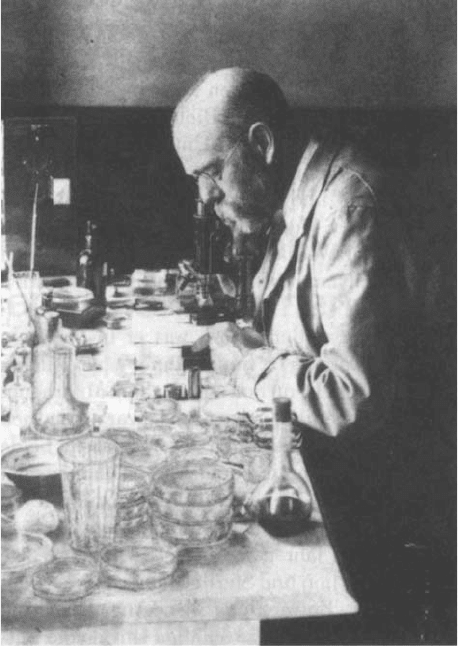
However, it was not until the definitive work of German Robert Koch (Figure 12.2) in
1876 that bacteria were proven to be agents of disease. About 10 years earlier, C. J.
Davaine and others had shown that rod-shaped bacteria were pres ent in the blood of ani-
mals suffering from anthrax (an important disease of animals, occasionally transmitted to
humans), but not in that of healthy animals, and that an injection of infected blood would
cause anthrax in previously uninfected animals. Koch provided the final proof of the bac-
terial etiology (causation) of anthrax by isolating the organism (now called Bacillus
anthracis), growing it in pure culture in the laboratory, and injecting it into healthy
mice, which then developed anthrax.
Koch was thus the first to meet the criteria for proving the causative relationship
between a microorganism and a specific disease, as proposed in 1840 by German J.
Henle (one of Koch’s teachers). These are now referred to as Koch’s postulates:
1. The microbial agent must be present in every diseased organism, but not in healthy
organisms.
2. The agent must be isolated from the diseased host and grown in pure cultur e.
3. Inoculation of a healthy susceptible host with the pure culture must result in the
same disease.
4. The same agent must be recoverable from the experimentally infected host.
These postulates, which Koch published in 1884 following his work on tuberculosis
(which later won a Nobel prize), still represent an important benchmark used to judge
whether there is a causal relationship between a particular microbe and a given disease .
amoebiasis
pertussis
schistosomiasis
meningitis
measles
HIV/AIDS
hepatitis
malaria
tuberculosis
acute lower respiratory infection
diarrheal infection
10,000
100,000
1,000,000
10,000,000
Deaths/year
amoebiasis
pertussis
schistosomiasis
meningitis
amoebiasis
pertussis
schistosomiasis
meningitis
measles
HIV/AIDS
hepatitis
malaria
tuberculosis
acute lower respiratory infection
diarrheal infection
Figure 12.1 Infectious diseases with annual global mortalities of at least 100,000.
MICROBIAL COLONIZATION OF HUMANS 345
The methods that Koch developed also helped lead to rapid identification of numerous
other causative agents of disease (Table 12.2).
Prevalence and Distribution of Diseases Diseases can vary widely in their prevalence
(fraction of individuals infected) and geographic distribution. Epidemiologists (scientists
who study diseases and their transmission) refer to an endemic disease as one that is con-
stantly present in a specific area, usually at a low level (relatively few affected indivi-
duals). An epide mic refers to a disease with an unusually high prevalence in a specific
geographical area. A pandemic is a widespread—nearly global—epidemic. The term out-
break is used to describe a sudden increase in the prevalence of a disease in a specific
population; this may be associated with a single source, such as a contaminated water
supply or food. Each victim may be called a case.
Disease Transmission A disease reservoir is a site in which an infectious agent remains
viable so that it can serve as a source of infection for new hosts. Commonly, this is the
pool of already infected hosts, so that humans are the primary reservoir for many human
diseases. However, some disease organisms can also infect other species, and some go
through a complex life cycle in which the host species alternate for the various life stages.
Figure 12.2 Robert Koch. (Photo by F. H. Hancox, 1896.)
346
EFFECT OF MICROBES ON HUMAN HEALTH

A disease mainly of animals that also can be transmitted to humans (such as anthrax) is
called a zoonosis (plural, zoonoses). Some infectious agents are able to survive in the
environment, outside any host. This includes some species, referred to as opportunistic
pathogens, which normally g row in soil or water or other environments but are capable of
infecting a host that is compromised (weakened) by an injury, condition, or disease.
The human reservoir may include both people with the disease and those who are
infected but show no symptoms. Individuals with such subclinical infection s are referred
to as asymptomatic carriers. The most notorious example of a carrier was Mary Mallon,
known as ‘‘Typhoid Mary.’’ Although she showed no symptoms herself, she was the
source of a number of typhoid outbreaks in the New York City area in the early twentieth
century. Because she refused to stop working as a food handler, eventually she was jailed.
One source of infection is the native microorganisms living on or in an individual. As a
result of some change in it (increased virulence, the abili ty to cause disease) or (more
commonly) the host, this usually innocuous indigenous microbe may become pathogenic.
For example, the common intestinal Escherichia coli can acquire a virulence factor lead-
ing to severe diarrhea, the common skin inhabitant Staphylococcus aureus can cause ser-
ious illness after being transferred into former ly sterile tissue as the result of a
subcutaneous wound penetration, or a fungal vaginal infection can result from suppression
of the normally dominant bacterial populations because of antibiotic use.
However, in most cases an infectious agent must be transmitted from one host to
another. This transmission may be relatively direct or may involve an intermediate. Direct
transmission occurs through contact or exchange of bodily fluids between an infected host
and the new, previously noninfected host. Rabies and sexually transmitted diseases such
TABLE 12.2 Chronology of Some Major Disease Agent Discoveries
Disease Microbial Agent
a
Discoverers Year
Anthrax Bacillus anthracis Koch 1876
Gonorrhea Neisseria gonorrhoeae Neisser 1879
Malaria Plasmodium spp. Laveran 1880
Tuberculosis Mycobacterium tuberculosis Koch 1882
Cholera Vibrio cholerae Koch 1883
Diphtheria Corynebacterium diphtheriae Klebs and Loeffler 1883–1884
Typhoid fever Salmonella typhi Gaffky 1884
Diarrhea Escherichia coli Escherich 1885
Tetanus Clostridium tetani Nicolaier and Kitasato 1885–1889
Pneumonia Streptococcus pneumoniae Fraenkel 1886
Meningitis Neisseria meningitidis Weichselbaum 1887
Gas gangrene Clostridium perfringens Welch and Nuttal 1892
Plague Yersinia pestis Kitasato and Yersin 1894
Botulism Clostridium botulinum Van Ermengem 1896
Dysentery Shigella dysenteriae Shiga 1898
Syphilis Treponema pallidum Schaudin and Hoffmann 1905
Whooping cough Bordella pertussis Bordet and Gengou 1906
Rocky Mountain Rickettsia rickettsii Ricketts 1909
spotted fever
Tularemia Francisella tularensis McCoy and Chapin 1912
a
All are bacteria, except Plasmodium, a protozoan.
MICROBIAL COLONIZATION OF HUMANS
347