
Vaccari D.A., Strom P.F., Alleman J.E. Environmental Biology for Engineers and Scientists
Подождите немного. Документ загружается.

Eichornia crassipes (water hyacinth) is an introduced species that grows very rapidly and
has become a nuisance in the southeastern United States.
Phragmites and cattails are among the most productive wetlands plants, having photo-
synthetic efficiency from 4 to 7%. Measurements of primary production ranges from 1000
to 6000 g/m
2
yr for Phragmites and 2,040 to 3,450 g/m
2
yr for Typha. However, the pat-
tern differs for these two plants. Typha grows fastest early in the growing season, then
slows down. Phragmites grows at a fairly constant rate throughout the season.
The most obvious invertebrates in the freshwater marsh are members of the insect
order Diptera, the true flies. These include the mosquitoes as well as midges and crane
flies. Many are herbivores, although many others are benthic in their larval stages.
Most of the mammals are also herbivorous. One of the most common mammals is the
muskrat (Ondatra zibethicus).
Omnivorous and herbivorous waterfowl are plentiful. They nest in northern marshes
and migrate between them and southern marshes in the winter. The loon frequents deeper
ponds where there may be fish. Some ducks nest in upland locations; those that fish by
diving nest over the water. Geese, swans, and canvasback ducks are the major herbivores
in the marsh. Wading birds nest in colonies in marshes and fish in shal low waters. Song-
birds and swallows usually nest and perch in uplands near the marsh, and fly into the
marsh to feed.
Marshes may provide shelter for reproduction of fish from adjacent lakes. Common
carp (Cy prinus carpio) are able to withstand great fluctuations in water temperature
and dissolved oxygen that occurs in shallow marshes. They graze and uproot the vegeta-
tion, increasing turbidity in the water.
Freshwater marshes tend to be both nitrogen and phosphorus limited. Vegetation plays
a role in nutrient cycling similar to that in forests. They remove nutrients from the soil,
only to return them as dead plant mater ial is degraded.
Riparian Wet lands The riparian zone is the area adjacent to rivers that has a high water
table and is regularly flooded by the river. Also called the floodplain, they are widely dis-
tributed, even in arid areas. They are open systems, with significant exchanges of energy
and material with the adjacent upland and riverine ecosystems, as well as upstrea m and
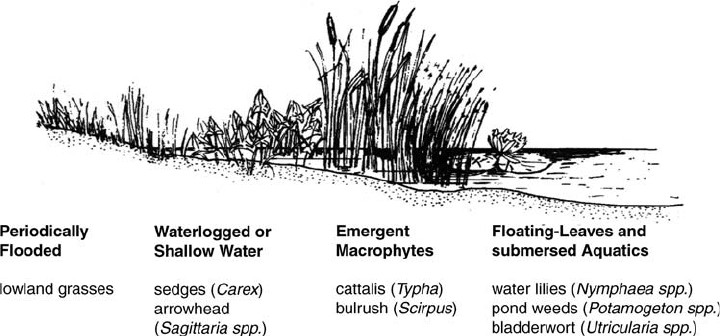
Figure 15.22 Zonation of vegetation in a freshwater marsh. (From Mitsch and Gosselink, 1993.
Used with permission.)
548
ECOSYSTEMS AND APPLICATI ONS
downstream areas. Because of their wide distribution and narrow geometry, they have
been particularly vulnerable to draining and filling. Riparian wetlands provide water
storage during flood stages of the river. The elimination of this ‘‘safety valve’’ has
contributed to downstream damage due to floods.
Western riparian wetlands of the United States tend to be narrow and have steep geo-
morphology. The uplands tend to be clearly distinguished from the wetlands. Eastern
riparian systems include those of the Mississippi valley, the southeastern and northeastern
United States. They may have steep morphology along low-order streams near the high-
elevation headwater. The higher-order streams at lower elevations tend to have gentler
slopes, wider wetlands, and more gradual transition to uplands. A natural levee often
forms by sediment deposition between the wetland and the river.
As flooding is intermittent, anoxic conditions in the soil occur only when inundated.
The organic matter content is intermediate, about 2 to 5%. Clay deposits and import by
flooding results in accumulation of a large quantity of nutrients.
Spatial and temporal scales are linked, as distance from the river (or actually, eleva-
tion) determines the frequency of flooding. Figure 15.23 shows an example of this in
terms of a classification applied to southwestern U.S. bottomland forest wetl ands. The
type of vegetation correlates approximately with the zone. For example, among the
oaks, overcup oak (Quercus lyrata) is typical of zone III, laurel oak (Quercus laurifolia )
of zone IV, and water oak (Quercus nigra) in zone V.
In arid areas, riparian wetlands are easy to distinguish from upland ecosystems, since
the latter are usually grasslands or deserts and the former are forested. They tend to form
narrow strips along the river, snaking their way through the otherwise dry region.
Obviously, they serve as a local oasis to animals and humans. These wetlands usually
lack oak but include willow (Salix spp.) and cottonwood (Populus fremontii), which are
also common throughout the United States. Western riparian wetlands also have sycamore
(Platanus wrightii), ash (Fraxinus pennsylvanica velutina), and walnut (Juglans major),
as well as alder (Alnus tenuifolia) at higher elevations.
Riparian wetlands often provide the only woodlands in an area, either because the
uplands have been converted to agriculture or because it was that way in the first
place, as in arid areas. This increases the importance of riparian wetlands for providing
food and habitat, and as corridors for dispersal or migration.
Animal life in riparian wetlands is too diverse to describe here . Most are common to
adjacent upland or aquatic systems as well. Some are strongly associated with wetlands,
such as the beaver and the cottonmouth snake. In the western United States there are
88 species of birds that are strictly riparian. In southern California there are 45 riparian
mammals. Some species of fish spawn in the floodplains during flood stage.
The intermittent nature of riparian flooding augments the ecosystem productivity by
providing moisture without causing long periods of anoxic soil conditions, while provid-
ing nutrients and flushing wastes away. Typically, riparian ecosystems with regular wet
and dry periods have an aboveground net biomass productivity exceeding 1000 g/m
2
yr.
Riparian ecosystems are open systems. Much of their productivity is exported to the
adjacent waterway, and they can be sinks for nutrients from upla nd ecosystems.
15.3.7 Wetland Law and Management
In the United States, federal regulation of wetlands is not governed by any single piece of
legislation, as is the case with air and water pollution. Instead, wetlands issues are covered
WETLANDS 549
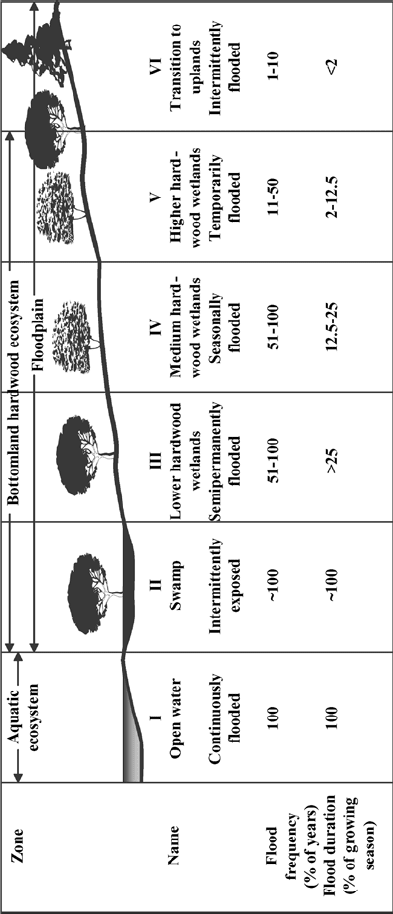
Figure 15.23 Zones of a southeastern U.S. riparian wetland. (Based on Mitsch and Gosselink, 1993.)
550

by a variety of laws related to water pollution and flood control, plus Executive Orders.
The major relevant law is Section 404 of the Federal Water Pollution Control Act of 1972
(the ‘‘Clean Water Act,’’ PL 92-500). This section, without mentioning wetlands, gave the
Army Corps of Engineers authority to regulate dredging and filling in US waters. Cou rt
decisions plus another Executive Order expanded this auth ority to wetlands.
This led to the problem of creating a legal definition of a wetland. Wetlands identifi-
cation and delineation is the process of determining whether a property is a wetland and
identifying the boundaries of the wetland. The primary guide for this purpose is the Corps
of Engineers Wetlands Delineation Manual (U.S. Army Corp of Engineers, 1987). Iden-
tification and delineation are best done during the growing season. A site is classified as a
wetland only if it possesses indicators of wetland hydrology, hydric soil, and hydrophytic
vegetation. Hydrologic indicators include the actual presence of water at or near the soil
surface, and stains from flooding on the trunks of trees. Hydric soil indicators include the
presence of mottling below the surface.
For the purpose of wetlands identification and delineation, an area possesses hydrophy-
tic vegetation only if the dominant vegetation have one or more of the special adaptations
for survival in saturated soil conditions, such as were described in Section 15.3.2 . The
Manual places plants into several categories, based on the estimated probability that
they occur in wetlands under natural conditions (Table 15.21). Species that have an indi-
cator status of OBL, FACW, or FAC are considered to possess hydrophytic adaptations.
Exactly what is and isn’t a wetland must be prescribed very precisely for the purpose of
deciding whether legal restrictions apply. This is a matter of great importance to property
owners, because if they cannot develop their property, the property loses much of its eco-
nomic value. In 1992, the U.S. Supreme Court ruled that identifying a private parcel of
land as a wetland could constitute a ‘‘taking’’ of that land for the public good, and that the
landowner must therefore be compensated for the economic loss. Altho ugh this issue is
not resolved entirely, it could have a major impact on the ability of the government to
prevent further loss of wetlands.
The policy of ‘‘no net loss’’ has led to the strategy of creating wetlands to compensate
for the loss of wetlands due to pressing economic needs, such as highway construction.
Wetlands that are created where none existed before are called constructed wetlands.
Besides their use to compensate for losses, wetlands may also be construc ted to create
TABLE 15.21 Plant Indicator Status Categories
Wetlands Nonwetlands
Indicator Category Symbol Probability (%) Probability (%) Examples
Obligate wetland plants OBL > 99 <1 Spartina alterniflora,
Taxodium distichum
Facultative wetland plants FACW 67–99 1–33 Fraxinus pennsylvanica,
Cornus stolonifera
Facultative plants FAC 33–99 33–99 Gleditsia triacanthos,
Smilax rotundifolia
Facultative upland plants FACU 1–33 67–99 Quercus rubra,
Potentilla arguta
Obligate upland plants UPL <1 >99 Pinus echinata,
Bromus mollis
Source: U.S. Army Corps of Engineers (1987).
WETLANDS
551
habitats fish and wildlife, for flood control, for nonpoint-source water pollution control, or
for wastewater treatment.
Wetlands, whether constructed or natural, purify wastewater by physically entrapping
particulate matter in the soil and organic litter, by the act ion of microorganisms on the
plants and in the soil, and by uptake directly by macrophytes, especially of nutrients.
Because the soil has both aerobic and anaerobic zones, wetlands can serve as a nitrogen
sink by both nitrifying and denitrifying. Wastewater treatment systems tend to use either
floating or emergent plants.
15.4 MARINE AND ESTUARINE ECOSYSTE MS
In contrast to the land , the oceans of the world are continuous with each other. Neverthe-
less, factors such as temperature, salinity, and lighting gradients isolate parts from each
other. The marine environments are those with salt or brackish water. Included in these
are the estuarine environments, which are bodies of water, partially enclosed by land,
in which fresh and salt water mix. Estuaries communicate with rivers and the ocean.
Saltwater marshes are often considered to be part of estuarine ecosystems.
A distinguishing feature of estuaries, besides having salinities intermediate between
fresh and ocean waters, is the existence of a salinity gradient in one of several forms.
In a vertically mixed estuary the salinity varies with distance from the mouth of the
river, but not with depth. A stratified estuary has salinity that varies both along the
axis of flow and wi th depth, to varying degrees. In the most extreme case, salt water
flows upstream along the bottom while brackish water flows seaward along the surface.
This affects the transport of nutrients and of planktonic organisms. The salt wedge
estuary has salinity gradients with both depth and axially.
The oceans can be classified into two zones: the pelagic environment is occupied by
free-floating organisms; the benthic environment is the bottom subst rate. The benthic
environment includes the littoral zone, which is the part between the high-tide and
low-tide levels. Notice the difference from the use of this term for lakes, as defined in
Section 15.2.1. Also, in oceans the term abyssal, which denotes the part of the ocean
deeper than the continental shelves, takes the role of the term profundal in lakes.
The pelagic zones of the oceanic province can also be distinguished based on
light penetration. Light penetration can be approximated as an exponential function
with depth:
I ¼ I
0
expða
l
zÞð15:9Þ
where I is the light intensity at wavelength l and at depth z, I
0
the intensity at the surface,
and a
l
the empirical extinction coefficient corresponding to wavelength l. For example,
infrared wavelengths have a
l
¼ 20 m
1
in clear water. Using equation (15.9) to solve for
the depth at which the intensity is 1% of the surface yields z
01
¼ 0:23 m. Blue light is
weakly absorbed, with a
l
¼ 0:004 m
1
and a resulting z
01
¼ 1150 m. Red light is
absorbed intermediately, with a
l
¼ 0:4m
1
and a resu lting z
01
¼ 11:5 m. The total
light energy versus depth will thus be a complex sum of exponentials for the various
wavelengths (or, more accurately, an integral over wavelength). Overall, the extinction
of total light energy reaches 1% in water as deep as 110 m in clear tropical seawater,
or as shallow as only several meters in coastal waters.
552 ECOSYSTEMS AND APPLICATIONS
Overall, photosynthesis occurs in the top 100 m of the ocean, a portion of the epipe-
lagic zone called the photic zone. Below about 500 to 1000 m is the aphotic zone,in
which essentially no light exists. In between is the ‘‘twilight’’ or disphotic zone.
15.4.1 Productivity and Nutrients
Primary production in the open ocean is thought to be due mostly to phytoplankton.
Some 2 to 10% may be due to seaweeds, and less than 1% to chemoautotrophs. For all
the oceans as a whole, the gross productivity is estimated to be 50 to 100 g C/m
2
yr. Due
to surface scattering and light extinction, the efficiency of capturing incident sunlight is
only about 0.1 to 0.2%.
The phytoplankton are dominated by diatoms, and secondarily by dinoflagellates.
Although in the past most of the primary productivity of the oceans was attributed to
the larger phytoplankton, evidence is growing that as much as 70% of all the photosyn-
thetic activity in the oceans is due to smaller forms. These range from 2 to 20 mm in sizes
and are termed nanoplankton. They include the small single-celled plants called cocco-
lithophores. These are covered with plates of calcium carbonate. They can form deep beds
of ooze on the ocean floor, which fossilize into chalk formations such as the White Cliffs
of Dover in England. Another source of productivity is the phototrophic bacteria, such as
cyanobacter (not necessarily nitrogen-fixing forms, however). Their abundance is of the
order of 100,000 mL
1
. They are from 0.2 to 2 mm in size and are termed picoplankton.
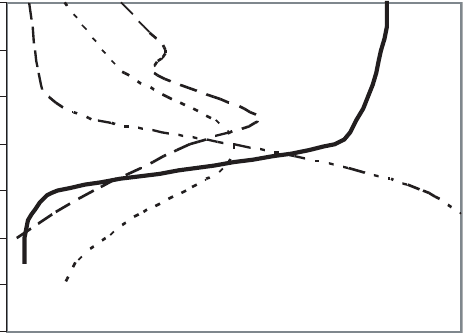
Productivity has an interesting relationship with depth in the epipelagic zone. Typi-
cally, the photosynthesis rate, and the concentration of chlorophyll, peaks some tens
of meters below the surface (Figure 15.24) . Several possible reasons are given for the
surprising observation that photosynthesis is not a maximum at the surf ace. One is that,
ironically, the light intensity may be inhibitory, causing bleaching of phytoplankton. It
may also be due to the effects of grazing by zooplankton. Mathematical modeling of phy-
toplankton growth dynamics suggests that nutrient limitations near the surface are respon-
sible. Nutrients continue to increase with depth up to on the order of 1000 m, and then
decrease modestly to the bottom. Oxygen reaches a minimum at similar depths, and then
increases steadily toward the bottom.
0
10
20
30
40
50
60
70
Depth (m)
Nitrate
Temperature
Primary production
Chlorophyll
Figure 15.24 Typical tropical structure of the water column. (Based on Mann and Lazier, 1991.)
MARINE AND ESTUARINE ECOSYSTEMS 553
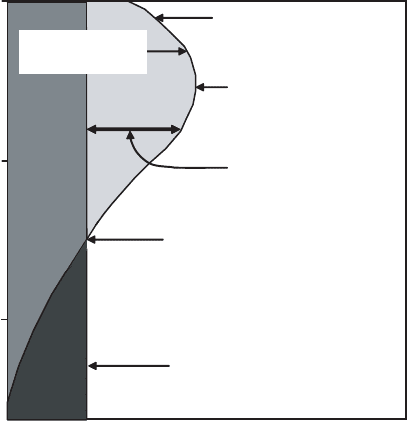
If respiration is fairly uniform with depth, a point will occur where the rate of primary
production becomes equal to the respiration rate, yielding a net primary produc tion of
zero. This depth is called the compensation depth. It tends to occur approximately at
the depth where the light intensity has dropped to 1% of the surface intensity. This
depth defines the bottom of the euphotic zone. Below the compensation depth respiration
exceeds photosynthesis, and oxygen levels must be maintained by transport from surface
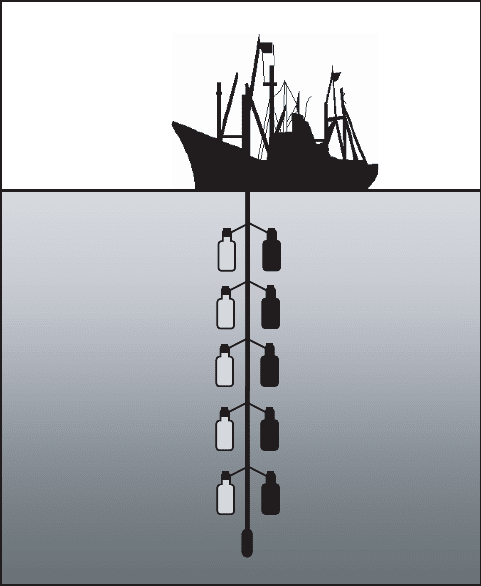
waters by mixing and advection. Figure 15.25 shows these relationships, and Figure 15.26
shows how they can be measured.
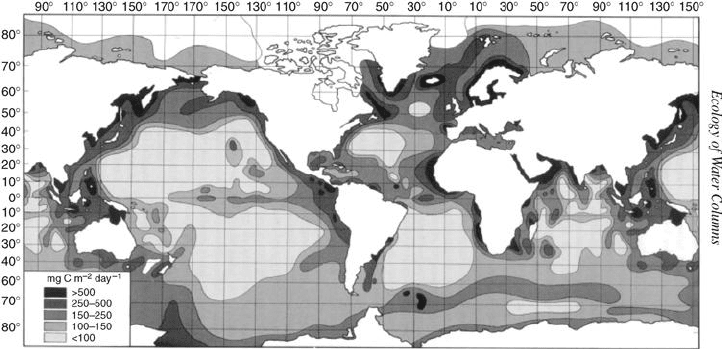
There are some interesting seasonal and geographical patterns in productivity as well
(Figure 15.27). One might expect that among open ocean waters, tropical oceans would
have the highest productivity. However, nutrients are always being lost to the euphotic
zone by the sedimentation of phytoplankton and zooplankton fecal pellets, and a perma-
nent thermocline prevents the nutrients from being mixed back upward. At 20
N latitude
the nitrate and phosphate concentrations are about 1% of the levels typical of temperate
oceans during the winter. In the tropics the nutrients lie mostly below 150 m depth, and
their concentrations peak at a depth of 500 to 1000 m. Productivity in most tropical waters
is less than 30 g C/m
2
per year. Exceptions to this situation are upwelling zones and reefs,
as noted below.
Polar zones, on the other hand, compensate for their low temperatures and low insola-
tion by a lack of stratification. Thus, nutrients mix freely at the surface, except when
snowmelt forms a shallow layer of relatively fresh water. The shallow stratified layer
traps phytoplankton close to nutrients at the pycnocline (location of high vertical density
gradient), producing a very intense, though short-lived algal bloom. In the Antarctic
waters a unique circulation pattern produces upwelling of nutrients that stimulate produc-
tivity. However, even wi th these factors, the polar region productivity as a whole averages
less than 25 g C/m
2
yr.
Depth (m)
0
50
100
Respiration rate
Compensation point
(marks bottom of
euphotic zone)
Net productivity
Maximum productivity
Productivity inhibited
by intense light at surface
Photosynthesis
rate
Figure 15.25 Productivity and respiration vs. depth, as would be measured using the light bottle/
dark bottle method. (Based on Garrison, 1993.)
554
ECOSYSTEMS AND APPLICATI ONS
In temperate and subpolar oceans, on the other hand, productivity is at a higher average
level, due to more dependable insolation and the nutrient replenishment that comes
with seasonal stratification. Productivity peaks with a spring algal bloom, but it is mod-
erately high yearround. Typical productivity is around 120 g C/m
2
yr, but can be as high
as 250 g C/m
2
yr. Thus, these regions provide most of the productivity of the world’s
oceans.
In all climates, productivity as high as 1000 g C/m
2
yr can be maintained where
hydrodynamic factors bring nutrients to the surface. Places where this occurs are called
upwelling zones. These are caused by wind-driven currents combined with the Coriolis
effect. Th e Coriolis effect is the tendency caused by Earth’s rotation for flows to be
diverted to the right in the northern hemisphere and to the left in the southern. Thus, hemi-
sphere, the trade winds around the equator cause a westerly current in the Pacific and
Atlantic oceans. The Coriolis effect produces a divergence of flow, as the northern
edge diverts toward the north and the southern toward the south. The net effect is that
surface water flows away from the equator, and deeper waters are brought up to replace
it. This phenomenon is called equatorial upwelling. The regions of high productivity
that result from the upwelling nutrients can be seen in Figure 15.27. A simi lar divergence
zone encircles the Antarctic, where ocean currents flow in opposite directions, due to
Oxygen consumption
in light (transparent)
bottles includes the
sum of respiration
and photosynthesis.
Oxygen consumption
in dark (opaque)
bottles includes the
respiration only.
Photosynthesis
can be computed
as the difference
between the
two.
Figure 15.26 Light bottle/dark bottle method of measuring primary and net productivity vs. depth.
At the compensation point the dissolved oxygen (DO) concentration in the light bottle will not
change with time. Above that point, photosynthesis exceeds respiration and DO will increase. At
greater depth the DO will decrease with time. (Based on Garrison, 1993.)
MARINE AND ESTUARINE ECOSYSTEMS 555
trade winds. The resulting enhancement to productivity partially compensates for the
otherwise low productivity of the polar oceans.
Another important mechanism is coastal upwelling, in which winds parallel to the
coast, in combination with the Coriolis effect, produce an offshore current. This brings
the deeper waters to the surface with their nutrients. This occurs throughout the world
but is particularly massive in four locations: the coasts of Peru, California and Oregon,
northern Africa, and southwestern Africa. These upwelling zones form important food
chains, with humans at the top. When climatic conditions interfere with their productivity,
the human economy and food supply is severely affected. The most important example
of this concerns the Peru upwelling, caused by a steady offshore wind at the equator,
and is the basis of a huge commercial anchovy fishery.
Upwelling occurs on a smaller scale at the mouths of estuaries when relatively fresh
water entrains deeper salt water. The mixture is still less dense than seawater and floats
on the surface, carrying nutrient both from the river discharge and from deep entrained
seawater.
Every two to 10 years, the winds responsi ble for the Peru upwelling reverse, in what is
called the southern oscillation. Instead of the upwelling of cold, nutrient-rich water,
warm, nutrient-depleted current appea rs, and the thermocline becomes deeper. The
warm current is cal led the El Nin
˜
o, and it creates havoc with the economy of Peru, as
fishermen lose their anchovy harvest. (El Nin
˜
o is also associated with climatic changes
in regions far from Peru, such as in reducing the number of hurricanes in the Caribbean.)
The phenomenon is referred to as ENSO, for El Nin
˜
o–Southern Oscillation.
Phytoplankton extract carbon, nitrogen, and phosphorus from seawater in the ratio
116 : 16 : 1, respectively. Carbon, of course, is readily available as carbonate. Nitrogen
is more often limiting in marine environments than in freshwater environments, because
nitrogen-fixing cyanobacter (blue-green bacteria) are less abundant in salt water. For this
reason, and becau se phosphorus is recycled faster than nitrogen, phosphorus is less impor-
tant than nitrogen as a limiting nutrient. Silicon can be a limiting nutrient for diatoms.
Figure 15.27 Global distribution of primary productivity in the world’s oceans. (From Barnes and
Mann, 1991. Used with permission.)
556
ECOSYSTEMS AND APPLICATI ONS

Since, as noted previously, silicon cell walls require less energy to form than those made
of cellulose, diatoms are relatively more efficient, and therefore more productive, if sili-
con is sufficiently available.
Iron is often the limiting nutrient in the open ocean. As shown in laboratory results in
Table 15.22, iron supplementation of water taken from the Sargasso Sea produced tenfold
increases in productivity when combined with other nutrients. Iron alone produced a
short-term increase in productivity, after which nitrogen and phosphorus limitations
came into play.
A large-scale iron supplementation field experiment produced algal blooms in the
Southern Ocean around Antarctica. The experiment was proposed to test a technology
to increase the ocean’s uptake of carbon dioxide, as a way to ameliorate anthropogenic
CO
2
emissions that could lead to global warming. Since iron is a micronutrient, relatively
small amounts would be necessary to eliminate it as a limiting factor. It could easily be
distributed over a wide area. Although the field results support the technical feasibility
of this idea, many other objections remain. These include the possibility of unintended
ecological effects that are likely to result from such a large-scale manipulation of the
environment.
15.4.2 Marine Adaptations
As with wetland animals (see Section 15.3.3), simpler animals tend to be osmoconfor-
mers. This is the case with most invertebrates, such as worms, mussels, and octopi.
Their bodily fluids are isotonic wi th seawater. Therefore, they do not require special
mechanisms to control their internal osmolarity.
Marine fish are hypotonic: Their body fluids are about one-third as saline as seawater.
Without active mechanisms to counter it, their bodies would lose water by osmosis and
absorb salt. The mechanism is the drinking of large volumes of water, coupled with the
excretion of salt by special ‘‘chloride cells’’ in their gills and by the discharge of a highly
concentrated urine. It is because humans do not have these adaptations that makes it
dangerous for us to drink seawater.
Viscosity becomes an important factor for small organisms. Viscosity is a measure of
the force required to create shear, or velocity gradient, in a fluid. Motion of differing
objects can be compared in terms of the Reynolds number, which is the ratio of momen-
tum to viscosity. If a huma n propels herself through the water with a few strokes o f the
arms, she can expect to coast a short distance because her momentum is great compared to
TABLE 15.22 Nutrient Enrichment Experiment Using
Sargasso Sea Water
Relative Uptake of
14
C Compared
Nutrient Supplementation to Control (%)
Control (no supplementation) 100
N þ P þmetals, including iron 1290
N þ P 110
N þ P þmetals except iron 108
N þ P þiron 1200
Source: Krebs (1994); original source D. W. Menzel and J. H. Ryther,
1961, Deep Sea Res., Vol. 7, pp. 275–281.
MARINE AND ESTUARINE ECOSYSTEMS
557