
Vaccari D.A., Strom P.F., Alleman J.E. Environmental Biology for Engineers and Scientists
Подождите немного. Документ загружается.

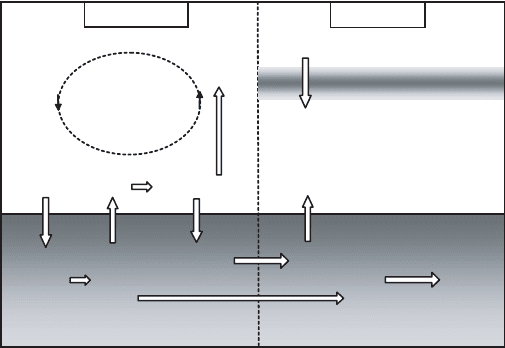
In the fall turnover the phosphate is mixed back into surface layers, where it is available to
plants and algae. With the transport of oxygen back to the depths, the iron and sulfur are
oxidized again, and the cycle repeats. The process can be summarized by the following
reaction, in which oxic conditions push the reaction to the right and anoxic conditions
force it to the left.
4FeðIIÞS þ 4PO
3
4
þ 4H
þ
þ 9O
2
, 4FeðIIIÞPO
4
þ 4SO
2
4
þ 2H
2
O
The phosphate concentration falls in the epilimnion thr oughout the summer stratifica-
tion as phytoplankton take it up, then die and settle toward the bottom. Phytoplankton are
highly efficient at taking up phosphate, even at very low environmental concentrations.
The Monod half-rate coefficient for phosphate uptake is about 1 to 3 mg/L PO
4
-P.
Thus, the uptake mechanism is rarely saturated unless pollution increases the concentra-
tion greatly. Differences in ability to compete for phosphorus may contribute to the suc-
cession of algal species during the summer stratification. Algae also exhibit luxury
consumption of phosphorus, in which they store as much as 20 times the amount needed
for cell division in cellular bodies cal led polyphosphate granules. Asterionella can store
100 times its immediate needs. By such hoarding they can continue their growth after the
water column has been depleted of phosphorus.
Phosphorus is recycled rapidly in the water column. Zooplankton eat the phytoplank-
ton, then excrete ph osphorus at the rate of 10% of their body stor e daily. Half of this is
phosphate and is readily reused. The other half is organic phosphate. Phytoplankton have
the unusual capability to excrete the extracellular enzyme alkaline phosphatase. This
acts in the water, outside the phytoplankton cell, to break the bond between the phosphate
and the rest of the organic molecule. This represents a risky investment for the phyto-
plankton, since other species may benefit from the cost they bear for excreting the
enzymes. When phosphorus is plentiful, the enzyme production slows considerably.
Diatoms need large amounts of silica (SiO
2
) for their cell walls. Abou t half of the dry
weight of diatoms is silica. An absence of silica can result in replacement by cyanobacter.
O
2
Lake turnover Stratification
Fe(III)PO
4
Fe
2+
PO
4
3-
Fe
3+
Epilimnion
Hypolimnion
PO
4
3-
Fe(II)S
SO
4
2-
Fe
2+
+
+
PO
4
3-
+
Fe
2+
S
2
-
+
Fe(II)S
Oxic sediment Anoxic sediment
PO
4
3-
Figure 15.19 Phosphorus interaction with sulfur and iron in lakes. (Based on Horne and Goldman,
1994.)
528
ECOSYSTEMS AND APPLICATI ONS
Rivers typically have about 13 mg SiO
2
per liter, derived from weathering of feldspars.
Lakes range from 0.5 to 60 mg/L.
Iron, besides its role in the phosphorus cycle of lakes, is often a limiting nutrient. In the
eplimnion much of the iro n is chelated with organics. Some algae can only use inorganic
iron, others only the chelated form, and othe rs use both. Cyanobacter produce powerful
iron-chelating organics, which limit their competitors’ access to iron.
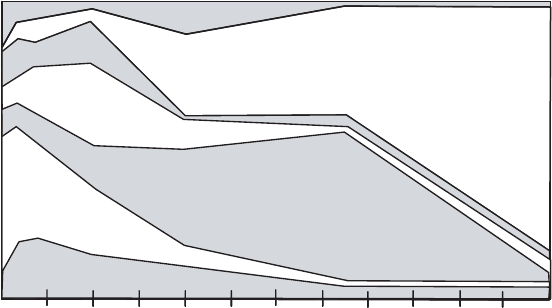
Eutrophication produces changes in the community species structure. As nutrient
levels increase, the dominant algal species shift from diatoms to green algae to cyanobac-
ter (Figure 15.20). In the more extreme forms of cultural eutrophication the phytoplankton
growth exceeds the ability of zooplankton to control them. More bacteria and detritus
feeders are found. Respiration by the plants at night or by bacteria degrading dead plants
can deplete oxygen, affecting higher organisms including fish. Species diversity and
richness may increase in moderate eutrophy, then decrease in the extreme form, although
abundance continues to increase. At such high abundance these blooms may produce
phytotoxins affecting higher forms of life, such as fish or cattle that drink the water.
Cultural eutrophication can be controlled by eliminating nutrient loading, reducing
nutrients in the lake, or by addressing the symptoms, whether they be low dissolved
oxygen or plant accumulation. Nut rients can be eliminated by using advanced wastewater
treatment or by diverting the wastewater to another watershed. In the case of Lake Tahoe,
a highly oligotrophic lake on the border between California and Nevada, the wastewater is
both treated and pumped over the mountains surrounding the lake. This has eliminated
enough phosphorus so that the lake has changed from being nitrogen limited to being
phosphorus limited. However, significant nitrogen loading still results from atmospheric
deposition of nitrogen oxides fixed by combustion in automobile engines and wood-
burning stoves.
Dredging of lakes is used to remove phospho rus and nitrogen stored in sediments.
Phosphorus can be precipitated from the water column by adding alum. This also removes
suspended solids including bacteria, increasing the clarity of the water. Swimmers in
small recreational lakes can tell if this treatment has recently been applied, because the
alum flocs are easily resuspended by waving the hand over the bottom.
Various
Cyanobacter
Chrysophyceae
Chlorophyceae(green algae)
Bacillariophyceae(diatoms)
Cryptophyceae
Dinoflagellates
ULTRAOLIGOTROPHIC (mm
2
/L biomass)
84
3
21
76
51110
9
RELATIVE ABUNDANCE (%)
Various
Cyanobacter
Chrysophyceae
Chlorophyceae (green algae)
Bacillariophyceae (diatoms)
Cryptophyceae
Dinoflagellates
HYPEREUTROPHIC
Figure 15.20 Changes in algal species composition with degrees of eutrophication. (From Connell
and Miller, 1984.)
FRESHWATER ECOSYSTEMS 529
Algae can be killed or inhibited by application of 500 mg Cu/L using copper sulfate.
Phytoplankton will be killed, although any taste and odor or toxic compounds may
remain. Cyanobacter are especially sensitive to copper. Fish and zoopl ankton are rela-
tively insensitive, but algae can develop resistance. In the case of macrophytes, physical
removal both eliminates the nuisance and takes nutrients out of the system.
The problem may be low dissolved oxygen in the hypolimnion. In this case, mechan-
ical mixing can be used to destratify the lake, mixin g the oxygen-rich epilimnion and the
deficient hypolimnion. Sometimes it is desired not to destroy the stratification: for exam-
ple, to support cold-water fish such as tro ut. In this case a variety of hypolimnetic aera-
tion techniques can be applied in which hypolimnion water usually is pumped to the
surface, aerated, then returned below the thermocline. Oxygen can also be dissolved
directly into the water of the hypolimnion.
15.2.7 Organic Pollution of Streams
The first successes of modern environmental engineers and scientists were in protecting
human and environmental health from the effects of discharging human wastes (sewage)
to streams. The concerns wer e transmission of waterborne disease and gross degradation
of the receiving water body due to excessive organic loading. Sewage discharge affects
streams by adding toxins, pathogens, suspended solids, nutrients, and readily biodegrad-
able organic carbon. These produce a cascade of effects, mostly related to reduced oxygen
concentration in the water column. The oxygen depletion, in turn, is due to augmented
heterotrophic oxygen consumption in the water column and in the sedime nts and to
chemoautotrophic oxidation of ammonia. Recall that the nitrogenous oxygen demand
of typical domestic wastewaters can be very high, since nitrification of each milligram
of NH
3
-N to NO
3
-N consumes 4.57 mg of oxygen.
DO Sag Equation If the organic pollution comes from only a single point source, the
stream gradually recovers with distance downstream in a fairly predictable way. The mas-
ter variable in this situation is oxygen. The changes in oxygen can be described by a
model involving the following variables with their typical units (note that g/m
3
is equiva-
lent to mg/L):
C dissolved oxygen concentration (also called DO; g/m
3
).
C
s
saturated DO, or oxygen concentration the water would have if it were in
equilibrium with the atmosphere. Values decrease with temperature, sali-
nity, and altitude. Example values in pure water at sea level range from
14.6 g/m
3
at 0
C to 9.2 g/m
3
at 20
C.
L biochemical oxygen demand (BOD; g/m
3
).
D DO deficit, the amount the DO is below saturation; equal to C
s
C.
The major processes affecting oxygen levels in streams are:
U oxygen uptake rate (g/m
3
per day); a combination of heterotrophic
(organic carbon) and autotrophic (ammonia) biochemical oxidation.
B benthic oxygen demand (g/m
2
day), due to heterotrophic and auto-
trophic oxidation in the sediment. Also called sediment oxygen demand
(SOD).
530
ECOSYSTEMS AND APPLICATI ONS

R reaeration rate (g/m
2
pre day); the rate at which oxygen enters the water
from the atmosphere by physicochemical mass transfer.
P specific photosynthetic oxygen production rate (g/m
3
day), by green
plants and algae.
At the point that a parcel of water mixes with the discharge, the mixture has a DO of C
0
and a BOD of L
0
. The DO at this point corresponds to an initial deficit D
0
¼ C
s
C
0
.As
the parcel continues downstream, its DO changes in response to a balance between the
sources of oxygen, R and P , and the depletion by U and B:
dC
dt
¼
R
h
þ P U
B
h
ð15:2Þ
where h ¼ V=A is the average depth of the water column, or the volume of a section of
a stream, V, divided by its p lan area, A. Note from the units that reaerati on and benthic
consumption are normalized to the area, since they represent transport of oxygen across
the top and bottom surfaces of the water column, respectively.
At the same time that oxygen is disappearing according to equation (15.2), the BOD in
the water column is being depleted as oxygen is consumed by the uptake process:
dL
dt
¼U ð15:3Þ
Much can be learned from a simpl ified model that neglects photosynthesis and benthic
oxygen demand. Recall that rivers tend to be allochthonous to begin with, and this will
be more so for polluted streams. Benthic demand may be quantitatively important, but it
behaves similarly to the water column BOD and does not greatly change the qualitative
behavior of the model. Thus, only U and R remain in the model. Oxyg en uptake can be
described as a first-order decay:
U ¼ k
1
L ð15:4Þ
The parameter k
1
is the rate coefficient for decay of BOD. This is sensitive to the tem-
perature and biodegradability of the BOD . The k
1
values must be determined experimen-
tally either in the laboratory or, preferably, in field experiments. To measure k
1
in the field,
BOD bottles containing samples of river water are submerged directly in the stream being
modeled for 2 to 6 hours. Initial and final DO measurements yield a rate of oxygen con-
sumption, U. Dividing by the BOD yields a value for k
1
. Biodegradation rate coefficients
have been measured for numerous industrial chemicals in laboratory experiments (see
Appendix B).
Usually, parallel experiments will be done with clear glass bottles and with black-
painted ones. The difference between the light and dark bottles gives an estimate of phy-
toplankton photosynthesis, and the dark bottle measures respiration. This is done either to
validate the assumption of neglecting photosynthesis or to quantify it for including in the model.
Combining equations (15.3) and (15.4) and solving the resulting differential equa-
tion produces the typical exponential or first-order decay of BOD in the stream
(Figure 15.21a):
L ¼ L
0
e
ðk
1
tÞ
ð15:5Þ
FRESHWATER ECOSYSTEMS 531
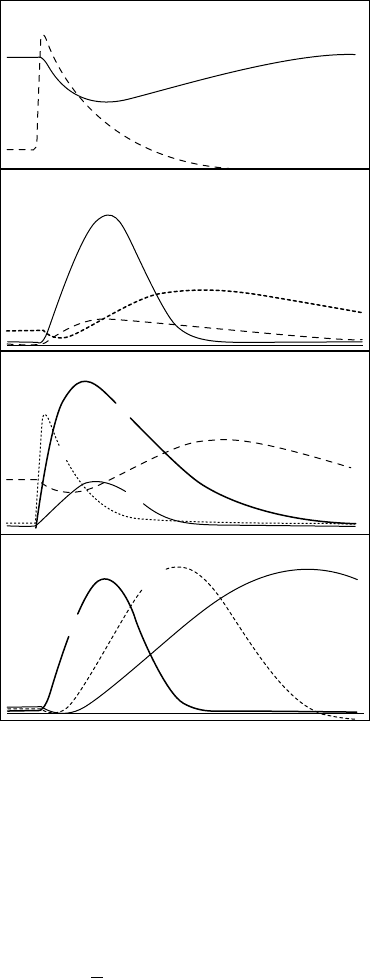
Note that the distance downstream, x, in Figure 15.21 corresponds to the distance traveled
in time, t, at a stream velocity, v, by the transformation x ¼ vt.
Reaeration is also first order, with respect to the DO deficit. That is, the rate at which
oxygen enters the water is assumed to be proportional to how far the water is below
saturation:
R
h
¼ k
2
D ¼ k
2
ðC
s
CÞð15:6Þ
The parameter k
2
is the coefficient of reaeration. It is controlled by turbulent mixing in the
water. Correlations are available to estimate the value of k
2
from hydraulic parameters of
the stream such as its depth, velocity, and hydraulic slope.
Combining (15.4) and (15.6) with (15.2) and (15.4) yields a differential equation
which can be solved for initial conditions L
0
and D
0
, resulting in the Streeter–Phelps
Tubifex
Chironomids
Ascellus
Algae
NO3–
PO4–3
NH4+
BOD
DO
Spheaerotilus
Bacteria
Protozoa
Figure 15.21 Changes downstream from a point of organic loading such as a sewage discharge.
(Based on Connell and Miller, 1984.)
532
ECOSYSTEMS AND APPLICATI ONS

or DO sag equation (D ¼ C
s
C is the DO deficit):
D ¼
k
2
L
0
k
2
k
1
ðe
k
1
t
e
k
2
t
ÞþD
0
e
k
2
t
ð15:7Þ
Figure 15.21a shows the shape of this curve. Qualitatively, the DO initially decreases
rapidly when U > R= h . However, U is decreasing as L decreases (less food available
for respiration), and R increases as C decreases farther below saturation. Ultimately, if
the initial pollution is not too great, these two rates will approach each other, and the
curve bottoms out. The DO deficit at this point is called the critical deficit, D
c
, and occurs
at a distance downstream called the critical time of travel, t
c
:
t
c
¼
1
k
2
k
1
ln
k
2
k
1
1
D
0
ðk
2
k
1
Þ
k
2
L
0
ð15:8Þ
The critical deficit can then be found by substituting the result of equation (15.8) into
(15.7).
As the BOD continues to decrease farther downstream, the stream starts to recover. If
the critical DO concentration, C
c
¼ C
s
D
c
is low enough, it can form a barrier to the
movement of fish or other oxygen-sensitive organisms. The critical concentration is often
used for regulatory purposes to indicate the seriousness of the pollution. In the regulatory
process of waste load allocation, models of the river are manipulated to determine how
much pollution must be reduced at the source to meet some minimum DO standard at the
critical point.
Other Chemical Changes and Effects Other changes occur as one travels downstream
of the discharge. Biological effects are described below. Chemical change s include
increases in nutrient concentrations. As shown in Figure 15.21b, ammonia increases
due to mineralization of organic nitrogen and raw ammonia in the wastewater. The ammo-
nia is gradually depleted as nitrification converts it ultimately into nitrate. Th e nitrate may
be removed by phytoplankton uptake, and then either stays in the water column as organic
nitrogen or is settled to the benthic zone. If the bent hic zone is anoxic, nitrate may be
removed from the water column to use to oxidize buried organics by denitrification.
Sedimentation of suspended solids near a discharge can smothe r benthic organisms.
Sedimentation of suspended solids from the wastewater, plus biomass produced by growth
on dissolved and colloidal material, can biodegrade in the sediment. The oxygen con-
sumed in this way contributes to the benthic oxygen demand. Besides removing oxygen
from the overlying water column, benthic oxygen demand reduces oxygen availability to
the benthos. Benthic invertebrates are particularly sensitive.
Oxygen enters the sediment in a mass transport process similar to oxygen transport
from the atmosphere to the water in reaeration. In this case the rate of transport is con-
trolled by diffusion through the pores of the sediment and by the concentration in the
water. If the oxygen demand is high enough or the rate of transport sufficiently low,
the oxygen will only penetrate to a certain depth before it is consumed completely.
Thus, there will be an oxic layer covering an anoxic laye r, where denitrification replaces
oxygen respiration. The depth of transition between the oxic and anoxic layers is
controlled by a balance between the oxygen concentration in the water and the benthic
oxygen demand.
FRESHWATER ECOSYSTEMS 533

At greater depths in the sediment, nitrate may be depleted and anaerobic conditions
would prevail. Under these conditions respiration uses sulfate and carbonate as electron
acceptors, producing H
2
S and methane. The H
2
S can diffuse back up through the sedi-
ment and enter the water column, where it can exert a toxic effect. The LC
50
of H
2
S
(the concentration that kills half the organisms in a laboratory test) to several freshwater
invertebrates has been measured to range from 11 to 1070 mg /L. Some zoobenthos can
live in anoxic sediments because they circulate water containing oxygen mechanically
from the surface of the sediment.
Ultimately, the organic matter becomes oxidized and no longer affects the river. How-
ever, many of the nutrients remain. In fact, degradation of organic-rich sediments may
release previously stored nutrients. Thus, the high organic-loading condition of the stream
can give way to a eutrophic situation, with photosynthesis exceeding the baseli ne level
upstream of the discharge.
The Streeter–Phelps equation is a steady-state solution. If it is necessary to take photo-
synthesis into account, P should be modeled with a diurnal function. This would result in
DO concentrations that oscillate, reaching a minimum in the morning. It is even possible
to achieve supersaturation ðC > C
s
Þ during sunny days if the amount of pollution is not
great. The addition of organic pollution increases the ratio of heterotrophic to photosyn-
thetic activity simply by providing food for the heterotrophs. However, photosynthesis
may also be reduced directly by the effect of increased turbidity in the water, which
can limit light availability.
Individual and Ecological Effects Fish and larger invertebrates breathe through gills
and have a circulatory system to bring oxygen-enriched blood to the tissues. When oxy-
gen becomes depleted, these organisms can increase the pumping of water over the gills in
order to extract more. Organisms such as fish that can readily move in resp onse to oxygen
have been found to avoid areas where concentrations have dropped below 3 to 5 mg/L.
Small invertebrates such as zooplankton obtain their oxygen by diffusion through the
skin, without specialized organs; some do not even have circulatory systems. Some organ-
isms are adapted to low-oxygen conditions. Annelid worms have special high-capacity
hemoglobin. Chironomid larvae have a high concentration of hemoglobin, giving them
a red color. Table 15.12 shows some of the oxygen limitations observed experimentally
with aquatic animals.
Systems with large organic carbon input are called saprobic, as opposed to eutrophic,
which refers primarily to excess nitrogen and phosphorus. In eutrophic waters primary
production exceeds respiration. In saprobic waters the reverse is true. As organic pollution
TABLE 15.12 Dissolved Oxygen Limits for Several Organisms
Organism Temperature (
C) Type of Test DO (mg/L)
Brown trout (Salmo trutta) 6.5–24 Limiting concentration 1.28–2.9
Coho salmon (Oncorhynchus kisutch) 16–24 Limiting concentration 1.3–2.0
Rainbow trout (Salmo gairdnerii) 11.1–20 Limiting concentration 1.05–3.7
Worm (Nereis grubei) 21.7–26.3 28-day LC
50
2.95
Worm (Capitella capitata) 21.7–26.3 28-day LC
50
1.50
Amphipod (Hyalella azteca) — Threshold 0.7
Amphipod (Gammarus fasciatus) — Threshold 4.3
Source: Connell and Miller (1984).
534 ECOSYSTEMS AND APPLICATIONS

levels increase, population shifts occur. Clean waters are dominated by fish and green
algae. The Shannon–Weaver diversity index for benthic invertebrates in clean water is
greater than 3. At moderate saprobic levels, the diversity index drops to between 1 and
3 and the dominant population shifts to oligochaetes such as tubifex. Seriously polluted
waters have these as well as increasing numbers of ciliates and flagellate protozoans, and
a diversity index less than 1.
A succession occurs with time in saprobic lakes that is similar to what occurs down-
stream of a wastewater disc harge. A pure lake begins in a xenosaprobic state, correspond-
ing to oligotrophic. If a large pollution discharge occurs, it becomes polysaprobic. As the
organic matter is degraded and the lake recovers, it passe s through intermediate stages
termed mesosaprobic and oligosaprobic. At this point the organic matter has been elimi-
nated, but nutrients remain. Primary productivity may exceed respiration, and the lake
passes into a eutrophic phase. The same terms are applied to rivers at various stages of
recovery from pollution.
Besides tolerance of low oxygen levels, the animals that proliferate in saprobic
conditions include detrital feeders that feed as filterers or collectors. Examples are certain
caddis flies and mayflies, chrionomids, and clams. Grazers also are successful and include
certain other caddis flies and mayflies, and snails. Predators such as leeches and midges
respond to the increasing saprobic community. Table 15.13 shows some selected organ-
isms that are found in various saprobic conditions. Although the term mesosaprobic is
TABLE 15.13 Tolerance of Organisms to Organic Pollution
Taxonomic Oligosaprobic Mesosaprobic Polysaprobic
Group (Unpolluted) (Moderately Polluted) (Highly Polluted)
Cyanobacter Oscillatoria Chamasiphon
Diatoms Nitzschia palea Cocconeis placentula
Gomphonema parulum
Green algae Chlamydomonas Chlamydomonas Chlamydomonas
Ulothrix Ulothrix
Scenedesmus Chaetophora
Turbellaria Polycelis nigra Polycelis cornuta
Annelids Tubifex tubifex Lubricus, Stylaria Chaetogaster
Hirudinea Erpobdella octoculata
(leeches) Helobdella stagnalis
Glossiphonia spp.
Crustaceans Daphnia Daphnia
Cyclops Cyclops
Asellus aquaticus
(water louse)
Sialis lutaria (alder flies)
Insects Eristalis tenax Chironomous plumosus Stoneflies and mayflies
(rat-tailed maggot) (all species)
Chironomous plumosus Caddis flies Chironomous spp.
Hydropsyche spp.
Anabolia, Molanna spp.
Fish Eel, stickleback, carp, Trout, pike, perch
goldfish
Source: Connell and Miller, 1984.
FRESHWATER ECOSYSTEMS
535
associated with ‘‘moderately polluted,’’ this condition can occur naturally if there are
large allochthonous inputs.
15.3 WETLANDS
Wetlands have experienced a remarkable turnaround in the public mind. Not long ago
they were derided as swamps and mires, sources of disease, impediments to travel, and
a waste of real estate. If they could not be drained for agriculture or development, the only
practical use for them was as a location for garbage dumps. If at all possible, they were
eliminated by draining or filling. Between the late eighteenth century and the mid-1980s,
it is estimated that over 50% of the wetlands in the lower 48 states of the United States
have been lost.
Today they are regarded as natural treasures. They are protected by strict laws, and
their importance is touted in newspaper articles and elementary school curricula. What
has changed is public recognition of the ecological value of wetlands. Salt marshes are
among the most productive ecosystems in the world (Table 15.1). They are the breeding
ground for numerous animals that range far beyond the marsh, including shorebirds and
pelagic ocean fish. Mig ratory birds use them as stopping-off points, where they feed and
restore their energy reserves before continuing their journey.
Although wetlands occupy only about 2% of Earth’s land area, they store 10 to 14% of
its organic carbon in their soil. When wetlands are dewatered, such as by draining or by a
decrease in precipitation, the organic matter is exposed to increased amounts of oxygen.
As a result, the organic matter becomes oxidized to CO
2
. This is one of the ‘‘positive feed-
back mechanisms’’ that may aggravate the effect of global warming.
Wetlands mitigate storm flows and flooding and serve as sourc es for groundwater
recharge. Surface water passing through a marsh can be reduced in nutrient level and
other contaminants. They have traditionally been, and continue to be, used as a source
of natural resources, including lumber, moss, shellfish, waterfowl, and pelts. Finally, as
can be attested to by the birders and hunters who venture into them, they have aesthetic
value. It is fortunate that nature made its most productive ecosystem so inaccessible to humans,
so that wetlands hav e survived e ven in the midst of the world’s most densely populated cities.
Some consider wetlands to be merely an ecotone, an intermediate zone between terres-
trial and deepwater ecosystems. They can also be viewed as a stage in the successional
change from open water to terrestrial ecosystem (recall the discussi on of eutrophication in
Section 15.2.6). However, wetlands have a number of unique characteristics. Wetlands are
defined by their water, soil, and plants. Specifically:
Water is present at a depth either above the surface (but not so deep as to preclude
the presence of rooted plants that emerge from the water) or below the soil surface
but within the root zone.
The soil is anaerobic within at least part of the root zone during a significant part of
the growing season.
The ecosystem is capable of supporting plants that are specially adapted for wet
conditions and has no plants that are flood intolerant.
A more precise definition is necessary for legal purposes. This is discussed in Section
15.3.7. There are numerous terms for specific types of wetlands in both common use
536 ECOSYSTEMS AND APPLICATIONS
and scientific use. Sometimes, the terms marsh or swamp are used interchangeably with
wetland. However, these terms both have more specific meanings. Some examples are:
Bog: a peat-accumulating wetland with little or no inflow or outflow. Most of its
nutrients come from precipitation. Its waters tend to be acidic, and as a result it
supports mosses primarily, such as sphagnum moss.
Fen: a peat-accumulating wetland that receives some flow and nutrients from
surrounding uplands. It supports some vegetation similar to marshes.
Marsh: a wetland that is freq uently or continuously inundated and has emergent plants
that are specially adapted to saturated soil conditions. In Europe this term excludes
wetlands that are peat accumulating.
Moor: in European use, any wetland that accumulates partially decayed organic
matter.
Muskeg: large expanses of bogs, such as in northern Canada and Alaska.
Riparian wetlands (or floodplains): occasion ally flooded lands along rivers that are
dry during parts of the growing season.
Swamp: in the United States, a wetland dominated by shrubs or trees. In Europe, a
forested fen or wetland dominated by reedgrass (Phragmites, or common reed).
Vernal pool: an intermittently inundated wet meadow that is usually dry during the
summer and fall.
Table 15.14 shows how several of these wetland types fit along the continuums for
plant type, water flow, soil organic matter content, pH, and nutrient condition. A rheo-
trophic wetland is one that receives significant inflow vs. an ombrotrophic wetland
that receives little flow. All of the characteristics in Table 15.14 relate to input of nutrients
and whether the wetland accumulates peat. The oligotrophic wetlands become acidic
because products of degradation are not washed away. Combined with anaerobic condi-
tions in saturated soils, this limits biodegradation. Instead, the partially degraded biomass
accumulates, forming peat.
Wetlands can also be classified as to whether they are coastal or inland, tidal or non-
tidal, freshwater or saline, intermittent or permanent. Tidal salt marshes are found all
along the U.S. Atlantic and Gulf coasts. They are dominated by the grass Spartina and
the rush Junca. Moving inland the salt marsh gives way to tidal freshwater marshes.
Tidal freshwater marshes are dominated by both grasses and broadleafed aquatic plants.
In tropical and subtropical regions, such as southern Florida and parts of Louisiana and
Texas, the tidal freshwater marsh, in turn, gives way to the mangrove swamp. The man-
grove swamp is dominated by the salt-tolerant mangrove tree, such as the red mangrove
Rhizophora or black mangrove Avicennia. All of these coastal marshes require protection
from ocean storm action and are frequently found behind barrier islands.
There are four major types of inland wetlands in North America. Freshwater marshs
occur throughout the continent and consist of shallow water, thin peat deposits, and
diverse emergent plants, including cattails, arrowheads, pickerel-weed, reeds, and grasses
and sedges. They include the prairie potholes of the Dakotas, the Great Lake marshes, and
the Everglades of Florida. The northe rn peatlands include bogs and fens from the north-
ern midwestern and northeastern United States and central and eastern Canada. Many are
filled-in lake basins, in final stages of natural eutrophication (Section 15.2.6). The south-
ern deepwater swamps have standing water through most of the growing season and are
WETLANDS 537