
Vaccari D.A., Strom P.F., Alleman J.E. Environmental Biology for Engineers and Scientists
Подождите немного. Документ загружается.

the visc osity of the water. A microscopic zooplankter, on the other hand, stops within
milliseconds if it stops propelling itself.
Salt water is more viscous than fresh water. Seawater is about 25% more viscous at 0
C
than at 20
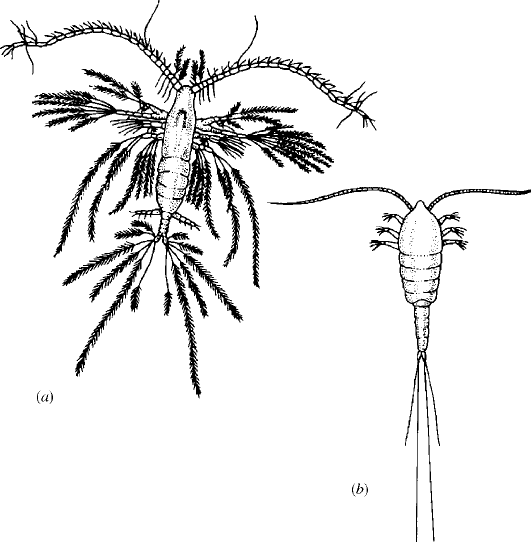
C. Figure 15.28 shows how two species of one genus react to this difference.
The warm-water form has more elaborate appendages to slow its sedimentation rate in the
less viscous water.
Many marine animals control their position not only by swim ming but by buoyancy.
Several mollusks have rigid air containers. These include the genus Nautilus, the cuttlefish
Sepia, and the squid Spirula. Their air chambers just balance the buoyant weight of the
rest of their bodies, making them neutrally buoyant. Some of the boney fish have a swim
bladder to store air. The bladder is filled either by extracting gases from the blood or by
direct ingestion through the esophagus. Active swimmers, such as the tuna, or fish that
live on the bottom do not have swim bladders.
15.4.3 Marine Communities
Several marine communities are important or interesting enough to merit special
attention.
Estuaries. Estuaries have high productivity because they receive a constant nutrient input
from rivers, and tidal motions provide an energy subsidy that improves oxygen transfer
Figure 15.28 Adaptation of two species of the copepod genus Oithona to viscosity differences due
to temperature: ðaÞ warm-water species; ðbÞ cold-water species. (From Garrison, 1993. #
Wadsworth Publishing Co. Used with permission.)
558
ECOSYSTEMS AND APPLICATI ONS
and mass transfer of nutrients from the sediment. They receive detritus inputs from adja-
cent salt marshes. The organisms that populate estuaries are similar to those already
described for salt marshes.
Rocky Intertidal Communities. This group constitute one type of littoral zone; others
include the sand beach and the salt marsh. The wave energy that strikes these ecosystems
would seem to make it an inhospitable place. Besides the crushing wave energy, they
are subjected to sharp swings in moisture and temperature. In fact, they are highly pro-
ductive ecosystems and have one of the highest species richness and diversities of any
marine ecosystem. For this reason, and also because they are among the most accessible
of the high-richness ecosystems, they are among the most interesting. There are few other
en vironments where the casual observer could find so many different animals in one place.
Several reasons explain why. The wave energy provides mixing, gas transfer, and flush-
ing of wastes. It also eliminates competition from species not specially adapted for this
environment. The tides add to the energy subsidy. Detritus is brought in by the tides. Tides
naturally create a range of habitats, classified by the fraction of the time that each is
exposed. Areas near the low-tide mark are submerged almost all the time, high-tide
areas only briefly. Since the intertidal zone spends time both above and below the
water, organisms there are subjected to attack by predators from the land and the sea.
Heavy predation is one of the factors that contributes directly to species diversity. Finally,
the rocky intertidal environment itself provides many diverse habitats and niches: tide
pools, crevices, exposed rock, and gravel beds.
Algae encrust rocks or grow in the form of large, tough, elastic, and slippery plants,
such as kelp, to resist wave energy. Sessile filter-feeding animals such as barnacles and
mussels attach themselves to rocks. Snails scrape algae from the rocks. Clams, octopi,
starfish, crabs, sea urchins, anemones, sponges, shrimp, fish, and shorebirds are all
present.
Coral Reefs. Coral reefs are unique and important communities formed from colonial
types of coral. Corals are cnidarians with a polyp body plan that sits in a cuplike exoske-
leton made of calcium carbonate. The opening at the top of the polyp has tentacles with
stinging cells for capturing prey. The outer layer of the coral tissue has embedded within it
thousands of dinoflagellates called zooxanthellae. There may be as many as 30,000 cells
per milliliter of coral tissue, up to 75% by mass, and they provide the bright and varied
colors for which coral reefs are famous. The coral and the zooxanthellae exist in a sym-
biotic relationship in which the coral provide shelter and nutrients and the algae provide
food and removal of the coral’s waste products (which are nutrients to them). The zoox-
anthellae also seem to give the coral its ability to secrete large amounts of calcium car-
bonate. The coral–algae association seems a most intimate form of nutrient recycling,
which must be essential since coral tends to grow in nutrient-depleted waters.
Coral grows on a solid substrate. When the coral dies, the exoskeleton remains, and
new organisms can grow on top of this. Over many hundreds and thousands of years
the skeletons accumulate, forming reef structures. Coral can only grow in warm, shallow
waters. If the land subsides or sea level increases (as has been happening over the last
dozen millennia or so), the reef grows to maintain its position relative to the surface, form-
ing offshore barrier reefs or, where a central island has become submerged, a ring-shaped
atoll with a lagoon. Reef-forming coral grows almost exclusively in waters with a
seasonal temperature minimum above 20
C.
MARINE AND ESTUARINE ECOSYSTEMS 559
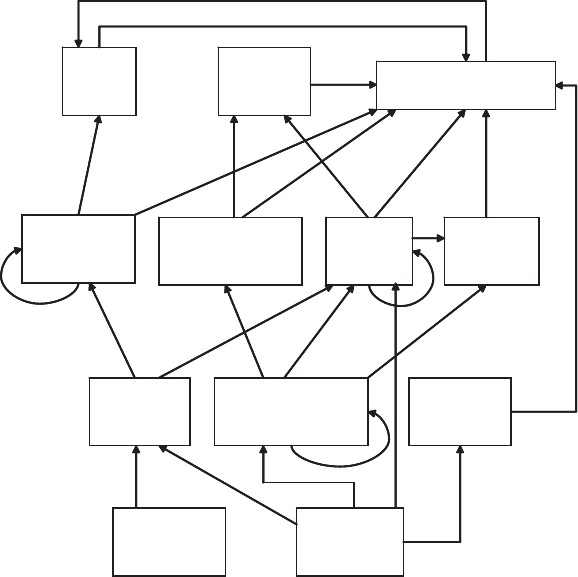
The mas sive reef structure creates numerous ecological niches. The zooxanthellae,
plus filamentous green algae and other algae, form the base of the coral reef food pyramid
(Figure 15.29). The corals themselves are primary consumers, as well as fish, clams, sea
urchins, crustaceans, and other invertebrates. Secondary consumers include sea urchins,
sea anemones, sea stars, and fish. The top carnivores are eels, octopi, and barracuda. The
animal diversity of coral reefs is the highest of all marine communities. Despite their high
productivity, coral reefs do not support large fisheries. It is thought that high predation
rates limit production at each level of the food chain. The overall effect is a low transfer
efficiency.
Coral reefs will grow at depths no greater than 150 m, where light levels in the clear
water they require falls below 4% of the surface levels. Too high a nutrient level hurts
coral because other benthic plants and suspension feeders such as clams will outcompete
them. Higher nutrient levels also brings increased plankton concentrations and resulting
turbidity, which also inhibits coral growth.
Abyssalpelagic and Abyssal Benthos. With the exception of hot vents described below,
the deep-sea bottom is sparsely populated. While the nearshore sediments may have
5000 g of biomass per square meter and the continental shelf could have 200, the abyssal
Seabirds
B = 15
P = 81
Benthic heterotrophs
B = 1.7e5
P = 5.1e5
Zooplankton
B = 899
P = 3.6e6
Small pelagics
B = 1836
P = 2020
Lobsters and Crabs
B = 1348
P = 701
Bottom fish
B = 94
P = 30
Monk seals
B = 63
P = 189
Reef fish
B = 13966
P = 20949
Sharks, jacks, scombrids
B = 536 P = 192
Phytoplankton
B = 3.3e3
P = 2.3e5
Benthic algae
B = 2.0e5
P = 2.5e6
Green turtles
B = 15
P = 12
47
2.3e5 2.3e4 2.4e6 3.3e4
1.3e4
2.3e4
1.1e4 6.1e4 87
2
1.6e4
826
191432
243
847
2500
219
150
57
4.3e5
Seabirds
B = 15
P = 81
Benthic heterotrophs
B = 1.7e5
P = 5.1e5
Zooplankton
B = 899
P = 3.6e6
Small pelagics
B = 1836
P = 2020
Lobsters and Crabs
B = 1348
P = 701
Bottom fish
B = 94
P = 30
Monk seals
B = 63
P = 189
Reef fish
B = 13966
P = 20949
Sharks, jacks, scombrids
B = 536 P = 192
Phytoplankton
B = 3.3e3
P = 2.3e5
Benthic algae
B = 2.0e5
P = 2.5e6
Green turtles
B = 15
P = 12
47
2.3e5 2.3e4 2.4e6 3.3e4
1.3e4
2.3e4
1.1e4 6.1e4 87
2
1.6e4
826
191432
243
847
2500
219
150
57
4.3e5
Figure 15.29 Food web of a coral reef with a biomass budget. B is average annual biomass in kg/
km
2
; P is the production in kg/m
2
yr. (Based on Barnes and Mann, 1991; original source is R. W.,
Grigg, J. J. Polovina, and M. J. Atkinson, 1984, Coral Reefs, Vol. 3, pp. 32–37).
560
ECOSYSTEMS AND APPLICATI ONS
benthos typically has less than 1 mg. Furthermore, the deeper it is, the less biomass there
will be. This is because it is entirely a detritus-based food web, the energy input comes
from sedimentation from the euphotic zone, and this input has increasing chances of being
intercepted by pelagic organisms on its way down.
The environment is permanently dark, cold, and currents are weak. Adaptations
include low rates of metabolism and growth, and enzymes that are specially optimized
to function at the high pressures found on the o cean floor. Most organisms are blind,
but some, such as the lanternfish, use bioluminescence (the biological production of
light) to find and lure prey. All the animals are predators or scavengers. There are no
plants, so there are no herbivores.
Mesopelagic fish have swim bladders, which makes them difficult to harvest without
rupturing them and killing the fish. Fish from below 1000 m depth typically lack swim
bladders. They and other organisms from this depth can survive in aquaria at the surface if
the temperature and other physical factors are favorable. Some fish, such as the lantern-
fish, migrate diurnally to the euphotic zone at night to feed, then descend to between
700 and 900 m during the day. More than 2000 species of animals live in the aphotic
zone, including copepods, ostracods, jellyfish, prawns, mysids, amphipods, swimming
worms, and a group of strange-looking fish. The fish are typically small but have huge
mouths. Since prey are scarce, they need not to have to reject larger victims.
Feeding strategies of deep-sea creatures are often bizarre. Some bury themselves in the
sediment with their mouths open at the surface. Other creatur es mistake them for caves
and crawl in for shelter, only to be forced to crawl right into the stomach by downward-
projecting spines. Others can smell dead organisms from kilometers away, then spend
weeks crawling to the source of the scent. Some organisms feed less than once per
year and live for hundre ds of years.
Surprisingly, species diversity at the bottom of the sea is very high. This may be
explained by the principle of competitive exclusion, which states that high predation
pressure prevents any single species from dominating.
Hot Vent Communities. In 1977, scientists in the submersible Alvin disc overed a new
ecosystem northeast of the Gala
´
pagos Islands while searching for a source of heated
water at a depth of 3000 m. There, at the rift where two of the tectonic plates that
form Earth’s crust are spreading apart, hydrothermal vents were spewing water at
350
C, laden with dissolved minerals, including H
2
S.
But the astonishing thing about the vents were the abundance of benthic invertebrates
surrounding them, many of them huge in size and previously unknown to science. Besides
large crabs, clams, shrimp, and anemones, there were huge ‘‘tube worms,’’ contained
in parchmentlike tubes the diameter of a human arm and about 3 to 4 m. Three species
have been found so far, forming a new genus called Riftia, in the phylum Pogonophora.
Altogether, about 100 species live in vent communities.
The vent community had no plants and was too dense to subsist on detritus from above.
What was the source of the energy to maintain it? Furthermore, the worms had no mouth,
digestive tract, or anus. Instead, the worms and some clams contained ‘‘feeding bodies’’
packed wi th chemoautotrophic bacteria. The worms would absorb hydrogen sulfide from
the water and transport it to the feeding bodies. These would then produce the carbohy-
drates to sustain the ecosystem. Thus, this unique ecosystem is based not on the energy
from sunlight, as is every other ecosystem on Earth, but on geochemical energy from deep
within the Earth itself.
MARINE AND ESTUARINE ECOSYSTEMS 561
Hot vent communities have been discovered in seas throughout the world, including
sites on the mid-Atlantic ridge, the Gulf of California, offshore from the state of Washing-
ton, and near Okinawa. Similar communities have been found where hydrogen sulfide–
rich water seeps from the base of the continental shelf off Florida, Oregon, and Japan.
These communities also have tube worms. In a third type of deep ocean chemoautotrophic
ecosystem, sites were found in the Gulf of Mexico and Baffin Bay, where ecosystems
subsist on hydrogen sulfide and methane seeping from natural hydrocarbon deposits.
15.4.4 Adverse Impacts on Marine Ecosystems
Many years ago, the vastness of the oceans made it easy to assume that nothing that
humans could do to it could have any long-term or widespread effect. Today, however,
our species has become so successful that nothing in the biosphere can be held to be
insensitive to our activities.
Overfishing. Improvement of fishing technology led to overfishing in many marine fish-
eries. There are many instances of this. Peru led the world in its catch with 4 million
metric tons in 1960. In 10 years it increased the harvest to 13 million metric tons. But
this high level, combined with a series of El Nin
˜
o events, devastated the industry until
it was reduced to 100,000 tons in 1985. Cod and herring are seriously depleted in the
North Atlantic. The Pacific sardine has been reduced to commercial extinction,in
which it is no longer profitable to harvest it. Of 11 species of large whales that have
been hunted commercially, eight are now commercially extinct.
When a fishery becomes overfished, instead of prudently reducing its take, fishermen
instead increase their efforts by adding more boats and more efficient methods. One of
these methods is called drift net fishing, in which a 7-m-wide net up to 80 km long is
deployed vertically overnight, then hauled in the next morning. This method ensnares tur-
tles, birds, and marine mammals that are not intended for harvesting. Furthermore, about
1600 km of these nets are lost each season, becoming ‘‘ghost nets’’ that drift and kill for
decades.
Oil Pollution. Oil pollution in the ocean is sometimes very dramatic. However, spills due
to accidents are a small part of the total discharge: only 13% in 1985. A significant frac-
tion, about 8%, is of natural origin. A major source (about one-third) is due to routine
flushing of oil tankers when loading and unloading. Another third comes from use and
disposal on land via rivers and streams. Once in the water, fractions of crude oil may dis-
perse by evaporating, dissolving, forming emulsions, or settling to the bottom. Floating oil
slicks may directly harm wildli fe at the surface, especially birds, and can devastate
benthic organisms of the littoral zone. These effects are most severe and may persist
for many years. The dispersed fractions are biodegraded or assimilated by zooplankton
and higher organisms, thus entering the food chain. Compounds absorbed by organisms
have toxic effects at all trophic levels. Also, they may affect the commercial use of the
resource by imparting an unpleasant taste to fish, shellfish, and so on. Spills of refined
hydrocarbons can be more damaging than crude oil, since it contains lighter fractions
and additives that are more easily taken up by organisms and are often more toxi c.
Water Pollution. Coastal areas are affected by discharge of water pollutants from land
sources via rivers, direct pipeline disposal, or dumping by barges. Barge dumping was
562 ECOSYSTEMS AND APPLICATIONS
practiced by communities in the New York Metropolitan Area up to the early 1990s. Ori-
ginally, sewage sludge dumping was confined to a 10-km-square site some 20 km from the
coast of New Jersey and Long Island. When it became known that sludge was accumulat-
ing at that site, an interim site was chosen in deeper waters at a distance of 196 km from
New York Harbor. The new site provided enhanced dilution. Ultimately, ocean dumping
was banned altogether in favor of land-based alternatives.
When these discharges are used as an alternative to treatment, they discharge toxic
materials and nutr ients to the marine environment. The nutrients can cause algal blooms
in excess of what might occur naturally. Sometimes, the algae themselves are toxic to
marine life. Other times, the algae have been responsible for fish or benthos kills due
to deoxygenation, when the algae decompose. Discharge of sewage and sludge have
also been blamed for diseases of finfish, including ‘‘black gill’’ and ‘‘fin rot.’’
Severe cases of hypoxia (low-dissolved-oxygen condi tions) have been observed in the
New York Bight and in the Gulf of Mexico. The New York Bight is the continental shelf
area into which the Hudson River discharges. In one inciden t in the late 1980s, dissolved
oxygen levels dropped to low levels over a 300 100 km area in the Bight, falling all the
way to zero in a portion of the region off Atlantic City, New Jersey. A similar incident
occurred in a 420-km band along Louisiana in the Gulf of Mexico. Even in the absence of
such catastrophes, continuing sanitary pollution causes public health risks to swimmers in
the ocean and eliminates many shellfish beds from use as a resource due to contamination
by pathogens.
Coral Diseases. In 1983, scientists discovered a disturbing disease of coral called coral
bleaching. For unknown reasons, the coral will expel its zooxanthellae, leaving the coral
a pale color. Without their symbionts, coral cannot deposit calcium carbonate and are
subject to erosion. If it does not regain its zooxanthellae, the coral dies.
This was first noticed in the Pacific but has since been found in Caribbean coral reefs as
well. The cause of this disease is still unknown and is being sought with some urgency by
marine biologists. Some blame a combination of pollution and high temperatures. The
original observation occur red during a particularly severe El Nin
˜
o event in the eastern
Pacific, when sea surface temperatures averaged 30 to 31
C for 5 to 6 months.
Coral are vulnerable to other problems as well. The crown-of-thorns sea sta r Acantha-
ster planci is destroying coral reefs in the western Pacific. A number of other diseases are
found on coral, including white-band disease. Anecdotal evidence points to many of
these problems as having proliferated recently. Thus, human activities are being blamed,
although there is no strong evidence for it.
Thermal Pollution. Industries, especially steam-powered electrical generating plants,
often discharge large amounts of heated water to adjacent surface waters. At low levels
these may provide an energy subsidy to the ecosystem, encouraging growth. The benefits
may vary by organism, resulting in population shifts. Detrimental effects include stimula-
tion of fungal organisms, which may cause disease for aquatic organisms. Cyanobacter
have been found to dominate at temperatures above 35
C, green algae between 28 and
35
C, and diatoms at lower temperatures. Oxygen consumption rates increase with tem-
perature, but oxygen solubility decreases, both effects increasing oxygen depletion. Stress
may occur if the heated discharge is suddenly halted due to operating considerations of
the source.
MARINE AND ESTUARINE ECOSYSTEMS 563
The sensitivity of animals to temperature may be measured by the upper lethal tem-
perature (ULT), the temperature at which 50% mortality occurs over long-term exposure.
The ULT for the fishes Salmo trutta and Salmo gairdneri was measured at 25 and 24
C,
respectively. Others, including the fish Carassius auratus, Cyprinus carpio, and Lepomis
macrochirus and the invertebrates Gammarus fasciatus, Procladius, and Cryptochirono-
mus had ULT between 30 and 35
C. At lower temperatures, growth and reproduction will
be inhibited.
Use of large volumes of surface water for cooling can have a direct effect as the water
is passed through pumps and heat exchangers. Shear and pressure forces can kill or
damage organisms. Discharge of water from below the thermocline in reservoirs can
produce a low-termperature anomaly. These usually have nonlethal effects, such as
population shifts or inhibition of spawning of fish.
15.5 MICROBIAL ECOLOGY
The study of microorganisms too often treats each species as a pure strain. However, in
the environment this is rarely the case. Many of the important behaviors depend on the
interactions among microbial populations and between them and other organisms. Here
we describe some of these interactions.
Cooperation is the positive interaction among organisms within a single population.
Bacteria cooperate in nume rous ways. Bacteria form flocs, biofilms, and other kinds of
aggregates for the purpose of degrading solid substrates, whether lignin, cellulose, or
rocks. The aggregates can benefit more efficiently from the investment of extracelllular
products than a single individual can. In laboratory-batch microorganism growth experi-
ments, a lag phase of growth is often missing when a large initial concentration is used.
It may be that at a high initial density , the cells share gro wth factors with each other . A certain
minimum number of microorganisms, called the infective dose,isrequiredtotransmitadisease
to a host. The bacteria in this case cooperate to overwhelm the host’ s defenses.
Individuals also compete within a population. They certainly use the same reso urces. In
the case of photoautotrophic microbes, there is competition for light.
Microorganisms exhibit most of the types of two-population interactions shown in
Table 14.5. Neutralism (0/0) is uncommon among microorganisms if there is any overlap
in their niches. Commensalism (þ/0) is common. One microbial population may solubi-
lize rock minerals, and other microbes benefit from the nutrients. One microbe may man-
ufacture growth factors that others require. Biotin is a growth factor that is very important
in marine habitats. Methanogenesis may result from commensal relationships. Desulfovi-
brio produces acetate and hydrogen by fermentation, which is then used by Methanobac-
terium to reduce CO
2
to methane. Several of the micro bially mediated pathways in
biogeochemical cycling involve one population using the products of another (e.g., Nitro-
somonas and Nitrobacter).
Cometabolism is, by some definitions, commensal. Mycobacterium vaccae can come-
tabolize cyclohexane if it has propane available for its own benefit. The cyclohexane is
converted to cyclohexanone, which can be used by other bacteria. The Mycobacterium
does not assimilate the cyclohexanone itself.
One population may utilize a substance that is toxic to another population. An example
is the oxidation of H
2
S. Some marine bacteria produce organics that chelate heavy metals,
reducing their bioavailability.
564 ECOSYSTEMS AND APPLICATIONS
Synergism (þ/þ) refers to a loose two-way benefit, in which both populations can exist
separately, but benefit when together. Sometimes two populations together can produce
metabolic products that neither can produce by themselves. For example, neither Sterpto-
coccus faecalis nor Escherichia coli can convert arginine to putrescine, but together, they
can. Cyclohexane can be degraded by Nocardia and Pseudomonas together, but not sepa-
rately. The reason is that Nocardia needs biotin and other growth factors produced by
Pseudomonas to do the job. Together, Arthrobacter and Streptomyces can degrade and
grow on the organophosphate pesticide diazinon, but not separately. Pseudomonas stutzeri
combines with Pseudomonas aeruginosa to mineralize parathion. One form of synergism
is called syntrophy or cross-feeding. In this situation one species provides a nutritional
requirement for anot her, and vice-versa. For example, Enterococcus faec alis requires folic
acid for growth, and Lactobacillus arabinosus requires phenylalanine. Together, they can
grow in a medium that contains neither, because E. faecalis produces pheynylalanine and
L arabinosus produces folic acid.
Mutualism,orsymbiosis (þ/þ), is an obligatory relationship between two organisms
that enables them to occupy a habitat that they otherwise could not. Lichens, an associa-
tion between a fungus and a photoautotroph, are the best known example of symbiosis.
Some protozoans form mutualistic associations with algae. For example, Paramecium can
contain many cells of the alga Chlorella within its protoplasm. Under conditions of stress,
the protozoan may digest its algae. Paramecium aurelia can also harbo r a bacterium of the
Rickettsia group. These paramecia have an advantage over a different strain from the same
species that does not contain the bacteria. Apparently, the Rickettsia manufacture a toxin
used to inhibit neighbors.
Some methanogenic cultures, once thought to be pure, have been found to consist of
mutualistic associations. Methanobacterium omeliansk ii is associated with another strain,
called ‘‘S.’’ Methane formation involves an electron transfer reaction that actually starts in
the S organism and ends in the Methanobacterium. It is thought that some other metha-
nogenic mechanism may involve interactions among three organisms. Methanogens also
participate in a mutualistic relationship with eubacteria. The methanogens require simple
substrates such as acetate, CO
2
, formate, and methanol. These are waste products for the
eubacterial degradation of more complex organics. Thus eubacter benefits by having their
wastes removed, and the archaean methanogens benefit by having substrates provided.
Bacteria can also enter into symbiotic relationships with viruses. Corynebacte rium
diphtheriae harbors a virus that enables it to produce a toxin and to infect host organisms,
causing the disease diptheria. Without the virus, it cannot do either.
Competition ( /) is also uncommon because of the principle of competitive exclu-
sion. Unless competition is weak, two species cannot occupy the same niche. However, if
each species has some distinguishing feature, they can compete in overlapping portions of
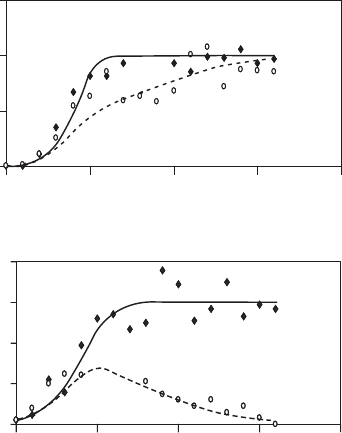
their niches. The classic example of these behaviors is laboratory work by Gause
(Figure 15.30). This shows two species of Paramecium that althoug h they do not attack
each other or secrete toxins, compete to the degree that one species is eliminated after
16 days. In a separate experiment, P. caudatum and P. bursaria were found to be able
to coexist because they tended to occupy different areas of the laboratory flask.
Nutrient limitations can also produce coexistence. When the diatoms Asterionella
formosa and Cyclotella meneghiniana were cultured together, the former would be limited
by silica and the latter by phosphate.
Some organisms are relatively efficient at low substrate concentrations but are outcom-
peted at high nutrient levels. This causes the microb ial populations in raw sewage to shift
MICROBIAL ECOLOGY 565
to the typical populations found in rivers and streams as substrate is consumed. This also
explains why some organisms that cause filamentous bulking in the activated sludge pro-
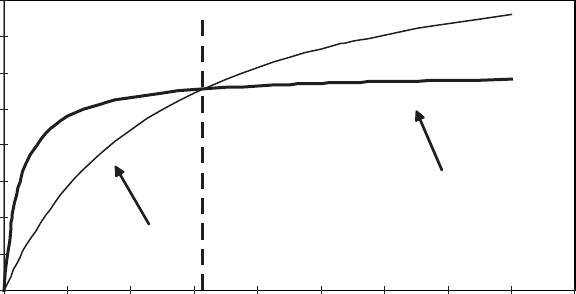
cess, such as Sphaerotilus natans, are favored by low-loading conditions. Figure 15.31
shows how this could occur by comparing the growth rate, r
g
, as a function of substrate
concentration, S, for two hypothetical microorganisms. Species A has a higher maximum
growth rate, m
m
; species B has a lower Monod coefficient, K
S
. As a result, species B has
the higher growth rate at low substrate concentration (to the left of the dashed line).
Among bacteria, amensalism (antagonism) (0/), usually comes in the form of allelo-
pathy, the production of chemical inhibitors. In some cases it takes the form of acid
production leading to pH changes, many produce toxic short-chain fatty acids, and
some produce complex inhibitors that we exploit as antibiotics. Inhibitors allow the
first population to gain a foothold in an environment to exclude newcomers.
Thiobacillus oxidans oxidizes sulfur, producing sulfuric acid, which lowers the pH of
mine drainage to between 1 and 2, inhibiting most other microbes. Microorganisms on the
skin produce fatty acids that are believed to prevent colonization by yeasts and other
microbes. The fatty acids produced during methanogenesis are not just intermediates in
the reaction but inhibit microbes that otherwise would disrupt the electron transfer
between Methanobacterium and S.
Antibiotics are substances that kill or inhibit at very low concentration. Their role in
natural habitats is unclear. They do not seem to accumulate to effective levels under
natural conditions.
P. aurelia
0
50
100
150
0.0 5.0 10.0 15.0 20.0
Days
Volume
P. caudatum
0
20
40
60
80
0.0 5.0 10.0 15.0 20.0
Da
y
s
Volume
Figure 15.30 Competition between P. aurelia and P. caudatum. Solid diamonds show growth of
each paramecium species in the absence of the other. Open circles show growth in mixed culture.
The curves are for equation (14.28) fitted to the data by eye. For P.aurelia, r ¼ 1:5 day
1
, K ¼ 100
volume units, and b ¼ 1:5. For P.caudatum, r ¼ 1:0 day
1
, K ¼ 60, and b ¼ 0:8. (Original data
from Gause, 1934.)
566
ECOSYSTEMS AND APPLICATI ONS
Bacteria, fungi, algae, and protozoans all have their parasites. Many of the parasites
are viruses, which are obligate parasites. Vibrio cholerae is thought to be eliminated from
river water following fecal contamination by the action of viral parasites. Bdellovibrio is a
bacterium that is parasitic on bacteria. It attaches to larger gram-negative bacteria, causing
cell lysis. E. coli has been found to be partially protected from Bdellovibrio by the
presence of clay particles. Other bacteria produce extracellular enzymes that can lyse
bacteria, algae, or protozoans, making their cell contents available for upta ke.
It can sometimes be difficult to distinguish predation from parasitism among microbes.
The distinction can be made if predation is limited to cases where the prey is actually
ingested by the predator. Some protozoans prey on other protozoans. Didinium preys
on Paramecium. Many protozoans prey on bacteria. When bacteria are under strong pre-
dation pressure, they may change their growth habits: for example, growing in an attached
form instead of dispersed. Again, clay particles have been observed to reduce the vulner-
ability of some bacteria.
Even algae and fungi can prey on other organisms. Some dinoflagellates consume bac-
teria, other algae, and other dinoflagellates. Slime molds such as Dictyostelium prey on
bacteria. The nematode-trapping fungi capture nematodes by adhesives or by ‘‘lasso-
ing’’ them with constricting rings. When it attempts to swim through a ring, the ring
swells, trapping the worm. Despite thrashing motions, the nematode cannot free itself.
Eventually, the fungus hyphae grow into the body of the prey. Interestingly, the fungi
do not produce the trapping structures in laboratory culture unless nematodes are also
present in the culture.
15.6 BIOLOGICAL EFFECTS OF GREENHOUSE GASES
AND CLIMATE CHANGE
Our industrial economy is almost entirely heterotrophic, relying on energy stored in coal
and petroleum deposits. These were formed from atmospheric CO
2
removed over the eons
0.000
0.020
0.040
0.060
0.080
0.100
0.120
0.140
0.160
0 20 40 60 80 100 120 140 160 180
S (mg/L)
r
g
(day
−1
)
Species A
Species B
Figure 15.31 Effect of substrate concentration on competition. Maximum growth rate, m
m
, for
species A and B are 0.2 and 0:12 day
1
, respectively, and K
S
values are 50 and 5.0 mg/L,
respectively.
BIOLOGICAL EFFECTS OF GREENHOUSE GASES AND CLIMATE CHANGE 567