
Vaccari D.A., Strom P.F., Alleman J.E. Environmental Biology for Engineers and Scientists
Подождите немного. Документ загружается.


Fish tend to feed selectively in the pelagic, littoral, or benthic zones. Food sources
include phytoplankton, zooplankton, detritus, or other fish. Cannibalism is not uncom-
mon, especially by adults on the young. Pelagic fish usually feed at the surface. Shad her-
ring, whitefish, and minnows feed almost entirely on zooplankton. Some of the large
predators wi ll also depend on zooplankton in their early life stages. Tilapia feeds on the
blue-green alga Microsystis aeruginosa. This makes it a candidate for producing meat on
manned space flight, since the algae can also help close the nitrogen cycle on spacecraft.
Most fish live for many years, so the biomass is not subj ect to seasonal cycles. How-
ever, survival of the young produced in a single year, the cohort, depends on predation,
the availability of food for the young (usually plankton), and environmental factors. In the
presence of intense predation, juvenile fish may restrict their activity to macrophyte beds
for protection. Others may venture into deep water to feed on zooplankton in the early
hours of the day, retreating to the littoral zone when daylight makes them easy targets
for predatory fish. Others move from the depths to the surface and back in a similar way.
Floods and droughts may affect the availability of nesting sites. In tropical rivers, which
are much less affected by human activity than other rivers of the world, some fish depend on
the floodplains to a great degree. They often breed there and feed heavily during floods.
When there are a large number of species with similar food requirements, species often
evolve to avoid direct competition by specializing in a subset of the available food. This is
called resource partitioning. In the case of fish, for example, several species that eat zoo-
plankton may restrict their hunt to particular habitats. One species of fish may only eat
organisms from the benthic zone, others only from the pelagic surface, and others only
from the littoral zone.
Some fish are anadromous, meaning that they live most of their lives in salt water but
spawn in fresh water. The best known example is the salmon, which remember the
‘‘smell’’ of the stream that they hatched in after several years in the ocean. They even
remember the odor associated with each tributary they passed as a hatchling, and follow
them back in reverse order. The six species of Pacific salmon die after spawning; Atlantic
salmon and steelhead trout return year after year. The movement of grown fish can also be
viewed as a transport of nutrients from the sea to the relatively nutrient-poor headwater
streams.
TABLE 15.9 Some Common Families of Fish
Family Examples
Lampreys Sea lamprey
Anguillids Freshwater eel
Herrings Alewife, herring
Salmonidae Salmon, trout, whitefish
Cyprinids Minnows, carp
Catostomids Suckers
Ictalurids Catfish
Cyprinodontids Killifish
Gastersteids Sticklebacks
Percichtyidae Striped bass
Centrachids Sunfish, largemouth black bass
Cichlids Tilapia
Gadidae Cod
Source: Horne and Goldman (1994).
518 ECOSYSTEMS AND APPLICATIONS
Other fish are catadromous—they live in fresh water but return to the sea to spawn.
The eels of the North Atlantic are a remarkable example of catadromous fish. For centu-
ries it was observed that the adults all left their streams in the fall for the ocean, and in the
spring a large upstream migration of matchstick-sized elvers appeared. Finally, in the
early part of the twentieth century it was realized that all the eel s from North America
and Europe swam to the Sargasso Sea near Bermuda. There they spawned and the eels
died. Over three years the larvae drift with the Gulf Stre am and metamorphose into elvers
and swim up the estuaries and streams of the North Atlantic. The males stay in the estu-
aries and the females continue upstream. They remain for 8 to 15 years before returni ng to
their place of hatching. The North American and European species are distinct from each
other, although they breed in overlapping areas of the Sargasso Sea and sort themselves
out for the reverse migration.
Many human activities have disrupted fish populations around the world. The first
apparent effect is usually on populations used for food supply. Direct chemical alteration
by pollution can result in eutrophication or toxic exposures. Both can cause fish kills, the
former by deoxygenation, the latter by direct toxic effect. Fish can tolerate dissolved oxy-
gen levels down to about 4 to 5 mg/L. If not severe, eutrophication can increase fisheries.
Exotic species disrupt the food chain. They may be introduced deliberately or inadver-
tently. The p eacock bass, Cichla ocellaris, was introduced to a lake in Panama as a
sport fish. Subsequently, 11 other species suffered serious declines, and gulls and herons
lost their main food sources. The loss of several larvae feeders has resulted in an increase
in mosquitoes in the area.
Inadvertent introductions may occur as a result of constructed waterways such
as canals. The alewife and the sea lamprey were introduced to the Great Lakes in
this way after having been limited by Niagara Falls. The sea lamprey, Petromyzon
marinus, is a parasitic eel that attaches itself by its mouth to the side of a fish and
feeds on the fish’s body fluids. The alewife, Alosa pseudo harengus, competes with
lake herring for zooplankton. The lampreys killed off the larger fish of the popular
salmonid species, forcing fishermen to take smaller sizes. This gradually elim inated the
breeding stock, until the fishery suddenly collapsed. Overfishing also caused depletion of
some fisheries, such as sturgeon, which were not related to the introduction of exotic
species.
On the other hand, construction of dams has created barriers to fish that need to
migrate, such as the salmon. Dams may also flood breeding grounds. Flood control elim-
inates those species that depend on flooding to breed. Development of the river shore
eliminates overhanging trees which shade and cool, as well as provide falling insects
that some fish depend on, and leaf fall which supplies the detritivores.
Fisheries management is a set of strategies to ame liorate some of these problems.
Fish ladders are artificial cascades that can be constructed alongside dams to provide
routes for migrating fish. Reservoir releases are controlled with downstream fisheries in
mind, controlling flow and temperature. Gravel beds are constructed in streams to furnish
fish nesting sites. Competition by overabundant centrarchids in reservoirs can be con-
trolled by lowering the reservoir level at the appropriate time to strand nesting areas.
Log jams and fallen trees (snags) serve as sources of invertebrates for migrating fish,
as well as resting places in migration. They used to be cleared routinely, but now that
their role is understood, they are left undisturbed by fisheries managers. Finally, nutrients
are sometimes introduced deliberately to increase primary productivity, ultimately
increasing the productivity at higher levels of the food chain as well.
FRESHWATER ECOSYSTEMS 519
Another important tool of fisheries management is regulation of fishing. A rule of
thumb for harvesting fish is that the maximum sustainable yield is obta ined if about
one-third of the population is taken in each reproductive period. This has been found
in experimental systems to result in an equilibrium biomass that is slightly less than
50% of the unexploited fishery. The optimum was found to be independent of the carrying
capacity. However, the situation is sometimes complicated by interactions with other spe-
cies. Harvesting a single species can tip the balance toward a competitor. For example,
heavy fishing of the Pacific sardine (Sardinops caerulea) resulted in an increase in the
less valuable anchovy (Engraulis mordox).
Natural disturbances to ecosystems tend to show their strongest effects at the lowest
trophic levels. The disturbance tends to dampen as it goes up the food chain, since
each level often has alternative food supplies. On the other hand, removal of top carni-
vores tends to have impacts throughout the food chain, even disturbing phytoplankton
populations. Fishing usually concentrates on carnivorous species and thus is an example
of the latter type of disturbance.
15.2.3 Succession in Lakes
The epilimnion has plenty of oxygen since it is in contact with the atmosphere. It is also
fairly productive since it has more sunlight available. However, biomass production gra-
dually reduces nutrient availability during the growing season. Sedimentation of dead
organisms transports the nutrients to the hypolimnion or to the sediments. Degradation
reduces oxygen and releases nutrients in the hypolimnion. However, twice a year in the
temperate zone, in spring and fall, these differences disappear as temperature changes
destroy the stratification. The resulting mixing is called turnover (not to be confused
with the idea of turnover time in nutrient cycling). The turnover returns nutrients to the
surface and oxygen to the depths.
Spring turnover brings nutrients and light together with a warming environment. This
initiates successional changes in populations. A sequence of species goes through boom-
and-bust cycles. Each flourishes temporarily as it enjoys a competitive advantage over the
others. Eventually, it depletes some necessary reso urce or comes under attack by zoo-
plankton predators or fungal parasites , and the population crashes. This leaves the field
for another opportunist, which can best compete in the resulting environment.
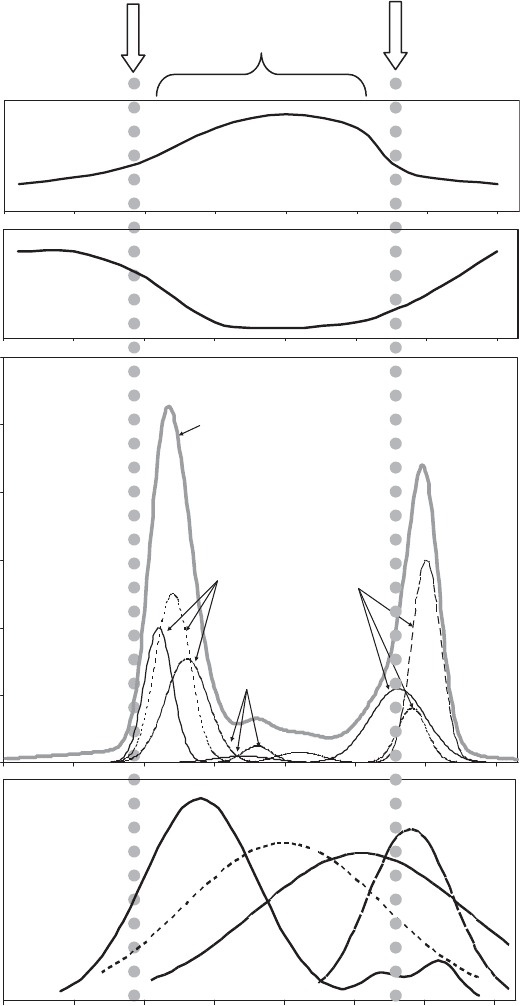
The largest total algal populations occur shortly after turnover. Large, sudden increases
in phytoplankton populations are called algal blooms. During an algal bloom, cell counts
on the order of millions per liter can color the lake green. The diatom Asterionella is often
the first algae to bloom as longer days in spring increase the sunlight available. It is faster
growing than its competitors Fragilaria, Tabellaria, and the cyanobacter, and it performs
luxury uptake of phosphorus, up to 100 times its immediate requirement. However, it is
susceptible to fungal attacks, which can give Fragillaria and Tabellaria a temporary
advantage. If the filamentous cyanobacter Oscillatoria gains a foothold, it can shade
Asterionella, outcompeting it for sunlight. Ultimately, silica limits Asterionella blooms
(Figure 15.14). Unless some other nutrient becomes limiting, Asterionella stops growing
when the silica concentration falls below 0.5 mg/L.
Because they can float on the surface, cyanobacter may gain an advantage when tur-
bidity limits light to the green algae. A cyanobacter bloom may continue into the summer
as nitrate and ammonia are depleted, since they can fix atmospheric nitrogen. Eventually,
nutrients become depleted even for the cyanobacter. Iron is often one of the limiting
520 ECOSYSTEMS AND APPLICATIONS
Log of number of phytoplankton cells
Total cells
Various
diatom
species
Diatoms,
dinoflagellates
and
cyanobacter
Small
flagellates and
cyanobacter
0 50 100 150 200 250 300 350
Da
y
of
y
ear
Zooplankton grazing rate
Crustaceans,
rotifers,
protozoans,
etc.
Spring
turnover
Fall
turnover
Thermal stratification
Temperature
Nutrients
Figure 15.14 Typical algal succession. (Based on Horne and Goldman, 1994.)
FRESHWATER ECOSYSTEMS 521
nutrients. It is needed for the nitrogenase enzyme for nitrification. Anabaena and Micro-
cystis often form late summer–autumn blooms as nutrients are recycled from sediments or
the hypolimnion.
When the fall turnover comes, large numbers of the diatom Melosira can be resus-
pended from the sediments, becoming the dominant alga over the winter period. During
the summer they settle back to the sediment before nutrient limitation begins to affect them. This,
plus their tolerance of anoxic conditions, enables them to survive in the sediment.
Phytoplankton growth responds most strongly to light availability. But zooplankton
feed at a rate strongly related to the temperature. Thus, they often peak later than the phy-
toplankton from the spring bloom, bringing it to an end. The elimination of phytoplankton
brings about the clearwater phase, during which the lake is most transparent. This initial
peak in zooplankton is usually dominated by cladocerans such as Daphnia or Bosmina.
Other animals present in this peak include predatory rotifers, carnivorous and herbivorous
copepods, and protozoans. Herbivorous rotifers follow the clearwater phase as they can
eat larger and harder-to-digest algae, as well as toxic or repulsive cyanobacter rejected by
the cladocerans.
15.2.4 Microbial Loop
Many of the aquatic organisms are omnivorous, complicating application of the concept
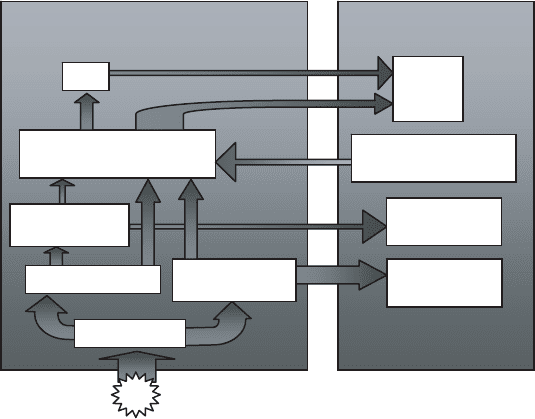
of trophic levels. Figure 15.15 shows a food web for a small lake with organisms or
groups arranged by trophic level. This lake is managed for fish production and thus
receives an artificial energy input. Notice the large loss to the system from the emergence
of chironomid insects.
As has been mentioned, most of the nutrients in the photic zone of lacustrine and mar-
ine ecosystems tend to be tied up in living things. This would place a severe limitation on
further growth except for the existence of an efficient detrital recycling process. The
Water Air or
Land
Phytoplankton
P
H
C
1
C
1
or C
2
C
3
C
3
or C
4
Adult insects
emerge into air
Chironomid larvae
(partially benthic)
730,000
7400
900
1000
Trophic Level
Sunfish
Lepomis
Chaoborus larvae
(predatory insect)
Adult insects
emerge into air
Zooplankton
Humans
Bass
Terrestrial Insects
(grasshoppers, worms)
3
200
66
6
30
24
4
3
Figure 15.15 Energy food web for a managed lake. The values represent kilocalories per square
meter per year. (From Horne and Goldman, 1994.)
522
ECOSYSTEMS AND APPLICATI ONS
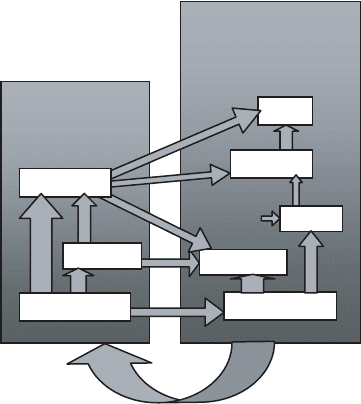
process known as the microbial loop involves the rapid uti lization by bacteria and pro-
tozoans of organic matter liberated as waste products by all of the other aquatic organisms
(Figure 15.16). This loop cycles nutrients largely independently of the phytoplankton,
enabling growth to continue in the summer when the algal blooms have disappeared.
The waste products are organics excreted by zooplankton and fish.
Another important source of soluble organic matter for the microbial loop are the
extracellular products of photosynthesis (ECPP). These are organics such as glyc olic
acid that are produced by photosynthesis and leaked continuously by phytoplankton.
The leakage has been measured to average from 7 to 41% of the carbon fixation rate.
Nutrients are also recycled by bacterial and fungal degradation of dead organisms.
These mechanisms are very important in the low-productivity areas of oligotrophic
lakes and in the open ocean.
15.2.5 River Productivity
Riverine food webs are often dominated by allochthonous inputs from terrestrial sources.
Coarse particulate organic matter (CPOM) from fallen leaves, dry grasses, and so on,
are low in nitrogen. They require nutrients from the stream for their initial degradation.
Otherwise, they are not readily available to the food chain. Nutrient availability, and
therefore productivity, tends to be higher in hard-water areas (with high calcium and
magnesium) than in soft-water regions.
Degradation of the CPOM is accomplished by a coating of fungi and bacteria that
adheres to the surface. They break down the cellulose and lignin which cannot be digested
by animal s. Lignin is degraded mostly by fungi, including species adapted to function in
the winter cold, to take advantage of the annual leaf fall. Invertebrates ingest the CPOM,
but digest only the attached fungi and bacteria. The CPOM is excreted, and the coating
regrows. In repeated cycles of degradation, ingestion, and excretion, the CPOM is
Phytoplankton
Cladocerans
Rotifers
Copepods
Fish
Dissolved Organic Carbon
508
4
Ciliates
1
17
16
168
From loop
5
54
4
7
50
6
Heterotrophic
Microbial Loop
Conventional
Autotrophic/Heterotrophic
Food Chain
Flagellates
60
Bacteria
Figure 15.16 Carbon cycle in a lake during the summer. Values indicate grams carbon per square
meter per day, ignoring respiration and cannibalism. (Based on Horne and Goldman, 1994.)
FRESHWATER ECOSYSTEMS 523
gradually broken down into fine particulate organic matter (FPOM) and then to dis-
solved organic matter (DOM) until it has entered the food chain completely.
The invertebrates that feed on the allochthonous input fall into four groups. Grazers
scrape bacteria, fungi, rotifers, and periphyton from surfaces. Examples of grazers are
snails and caddis flies. Shredders cut and ingest pieces of leaves and stems which
form the CPOM, reducing them in size. They include the stoneflies, amphipods, and cray-
fish. Colle ctors and filterers take FPOM from the water. Clams pump water through fil-
tration organs, expending considerable energy. Midge larvae use fanlike collecting
structures to ensnare particles. Caddisfly larvae spin long nets to capture FPOM from
the current. Most benthic invertebrates simply use bristles on their appendages or mouth-
parts. Worms feed on FPOM that has settled to the bottom in more quiescent areas.
Predators range from stonefly larvae and dragonfly nymphs to fish and birds of prey.
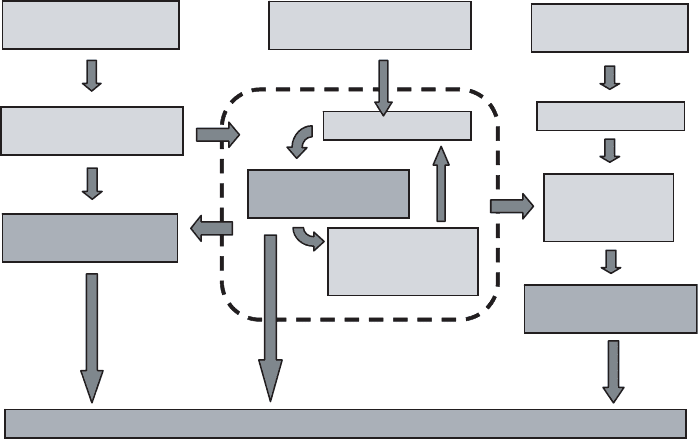
Figure 15.17 shows a schematic food web for this ecosystem. This figure shows three
kinds of inputs. Direct light energy fuels the autochthonous primary productivity.
Dissolved organics may originate in decay products that run off from the land and provide
an allochthonous input for microorganisms. Large organic matter feeds another allochtho-
nous input to the cycle, involving the shredders that break the CPOM down to FPOM,
ultimately providing food for the scrapers and the filter feeders. Finally, of course, each
group of invertebrates is subject to predation by carnivores.
During the day, most invertebrates hide under or between rocks to avoid predation.
However, at night many of these will join the current to migrate downstream. Together
with FPOM they form drift, which is an important food source for larger collectors
and fish. After a lifetime of drifting downstream, many insect larvae may emerge into
the air, then fly upstream to lay their eggs, repeating the cycle.
According to the river continuum concept, the balance between allochthanous and
autochthanous input changes gradually from small headwaters to large downriver condi-
Large allochthonous input
(leaves, seeds, etc.)
Dissolved organic
allochthonous input
Light energy and
nutrient input
Micro- and macrophyte
autochthonous input
Bacteria and fungi
Predators
Bacteria and fungi
Shredders
(crayfish, stoneflies)
Filter feeders
(midge larvae, clams)
Scrapers and Grazers
(snails, caddisflies)
Coarse Particulate
Organic Matter
(CPOM)
Fine Particulate
Organic Matter
(FPOM)
Figure 15.17 Allochthonous food web with functional groups. (Modified from Horne and
Goldman, 1994.)
524
ECOSYSTEMS AND APPLICATI ONS
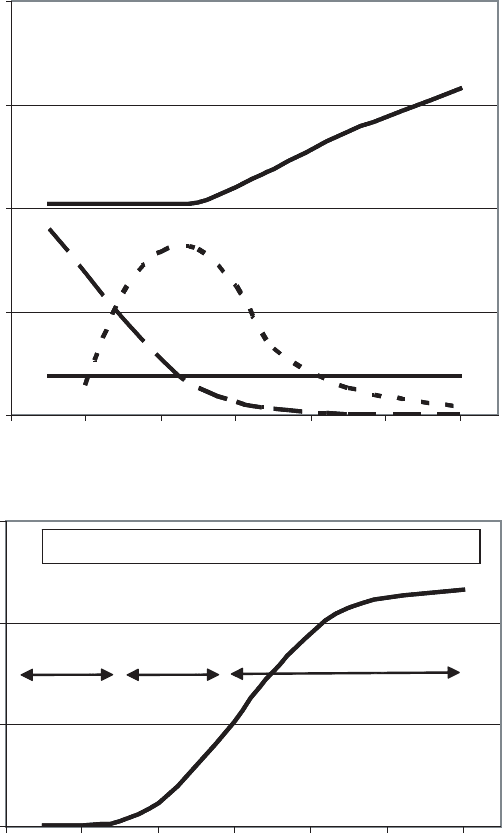
tions. As streams merge and move farther from their sources, FPOM increases relative to
CPOM and the shredders give way to collectors and filterers. Farther downstream the river
may acquire an autochthanous character based on attached algae and macrophytes, with
grazers and collectors dominating. Finally, the river may becom e more like a lacustrine
environment, dominated by collectors living off phytoplankton. The ratio of production to
respiration exceeds 1, whereas respiration dominates at other parts of the river. Diversity
is also greatest in this section. Figure 15.18 illustrates these changes with increase in river
0
1
2
3
024681012
Stream/River Order
FPOM/CPOM
0%
25%
50%
75%
100%
024681012
Stream/River Order
Percent of total invertebrate population
Shredders
Grazers
Predators
Collectors
Leaves, twigs
Fragments
Refractory particles
& dissolved organics
1.5m 10m 60m (River width) 700m
Figure 15.18 River continuum concept. (Based on Horne and Goldman, 1994.)
FRESHWATER ECOSYSTEMS 525

order, which can be roughly described as the number of branches in the river counting
from the headw aters and incrementing the count whenever equal-order tributaries merge.
In large higher-order rivers, and especially in warmer climates, the low productivity in
the main channel may be compensated for by a large input from the periodically inun-
dated flood plain along the banks. Flooding results in a large input of nutrients and detri-
tus. Many fish spawn in the floodplains, and rivers with large floodplains tend to have
more diverse fish populations.
15.2.6 Nutrients and Eutrophication in Lakes
Aquatic systems are also classified according to their status with respect to nutrients or
productivity (Table 15.10). Lakes that are relatively nutrient limited and low in produc-
tivity are called oligotrophic (‘‘poorly fed’’). Lakes with higher nutrient levels and higher
productivity are called eutrophic (‘‘well fed’’). An intermediate designation is called
mesotrophic.
Basically, an oligotrophic lake is one that would be perceived as ‘‘clean’’ vs. the rela-
tively murky eutrophic lake. However, eutrophic does not necessarily mean polluted.
Lakes proceed through a natural succession, starting as oligotrophic. Gradually, they
accumulate sediments and nutrients. The shoreline grows more and more macrophytes
as the lake becomes shallower. Eventually, they become marshes or wetlands, until
they are finally transformed into terrestrial ecosystems.
Although it occurs naturally, addi tion of anthropogenic nutrients hastens this process.
People contribute nutrients in the form of fertilizer runoff from lawns and agricultural
lands, human waste from either treatment plant discharge or indirectly from septic
tanks, and animal waste from pasture or feedlot runoff. In these cases the process is
termed cultural eutrophication . Oligotrophic lakes are preferred for numerous human
TABLE 15.10 Comparison of Oligotrophic and Eutrophic Lakes
Criteria Oligotrophic Eutrophic
Phosphorus conc. (winter) P < 10 mg/L P > 20 mg/L
Organic matter Low High
Primary productivity GPP < 150 g C/m
2
yr GPP > 250 g C/m
2
yr
Chlorophyll a < 3 mg/L Chlorophyll a > 6 mg/L
Depth <15–25 m <10–15 m
Clarity Clear, blue, Secchi depth > 5 m Dark, turbid, Secchi depth < 3m
Hypolimnion dissolved >50% saturation <10% saturation (about 1 mg/L)
oxygen in summer
Bottom fauna Diversified with deepwater fish Low-DO-tolerant organisms;
no deepwater fish; carp
Bottom sediment Low organic matter content Organic rich muck, high in N
Characteristic alga or genera Green algae Cyanobacter (Anabaena,
Desmids (Staurastrum) Aphanizomenon, Microsystis)
Diatoms (Tabellaria, Cyclotella) Diatoms (Molosira,
Chrysophyceae (Dinobryon) Stephanodiscus, Asterionella)
Examples Lake Superior Western Lake Erie
Lake Geneva (Switzerland) Lake Lugano (Switzerland)
Lake Baikal (Russia)
Source: Berner and Berner (1987); Conell and Miller (1984).
526 ECOSYSTEMS AND APPLICATIONS

purposes, whether as a source of drinking water, food, or recreation. Among the problems
caused by cultural eutrophication: Large plant biomass can cause oxygen depletion at
night or upon death of the plants. High concentrations of algae cause taste and odor
problems in water supplies. Some algal blooms can be toxic to animals that drink the
water. Toxicity or deoxygenation can cause fish kills. Macrophytes can physically
choke the lake, interf ering with uses such as boating or swimming. Table 15.11 shows
several examples of lakes in different categories of nutrient loading.
Primary produc tivity is limited by nutrient availability, especially phosphorus.
Nitrogen is less often limiting because cyanobacter (blue-green bacteria) fix N
2
. Never-
theless, dosages of nitrogen and phosphorus that individually stimulate a doubling in phy-
toplankton growth produce a fivefold increase when added simultaneously. Other potential
limits to plant growth include silicon, CO
2
, iron, and molybde num.
Phosphorus concentration in a lake can be computed from material balance considera-
tions. Loss of phosphorus from the water column by sedimentation is usually accounted
for by a reaction term. The peak summer algae concentration, measured in terms of the
average chlorophyll a concentration, shows a strong log-log correlation with the phos-
phorus concentration in the water during the spring turnover. A typical such relation is
C
a
¼ 0:37 P
0:91
w
ð15:1Þ
where the phosphorus concentration ðP
w
Þ and the chlorophyll a concentration ðC
a
Þ are
both expressed in mg/L (see Example 14.2).
One source of phosphorus in the lake water column that is difficult to quantify origi-
nates from the sediment. Phosphorus that has been deposited in the past may be liberated
again, producing what is known as internal loading. This phosphorus results from an
interaction with sulfur and iron in the hypolimnion and the sediments of lakes (see
Figure 15.19). When spring turnover brings oxygen to the depths, ferrous iron is oxidized
to ferric, which precipitates with phosphorus and settles to the sediment. During summer
stratification, oxygen is limiting and anoxic conditions may form in the sediment. The ferric
iron and sulfate are reduced to ferrous and sulfide ions, respectively, liberating the phos-
phate. The sulfide precipitates the iron and phosphate is released to the hypolimnio n.
TABLE 15.11 Trophic Status of Several Lakes
a
Avg HRT Secchi Chloro-
Lake Status
a
Depth (m) (yr) NO
3
2
-N NH
4
þ
-N P SiO
2
(m) phyll a
Superior O 149 184 220 <10 0.5 2000 11.3 0.9
Huron O 59 21 180 0.5 800 5–9 1.8
Michigan O–M 85 104 130 5 700 4.3 1.3
Erie E 1.4 3 23 1 31 2–4.4 5.4
Ontario M 86 8 40 100
Tahoe O 313 700 4 <2 2
Windermere 24 0.75 300–400 10 5
(UK)
George (Uganda) 2.4 0.34 nd <10 2
Baikal (Siberia) 730 3000
a
O, oligotrophic; M, mesotrophic; E, eutrophic; concentrations are summer measurements in mg/L; nd,
nondetectable.
Source: Horne and Goldman (1994).
FRESHWATER ECOSYSTEMS
527