
Vaccari D.A., Strom P.F., Alleman J.E. Environmental Biology for Engineers and Scientists
Подождите немного. Документ загружается.

towers, where the attached biofilm is extremely thin and tightly bound, these reactors may
not even require a fol low-up clarifier.
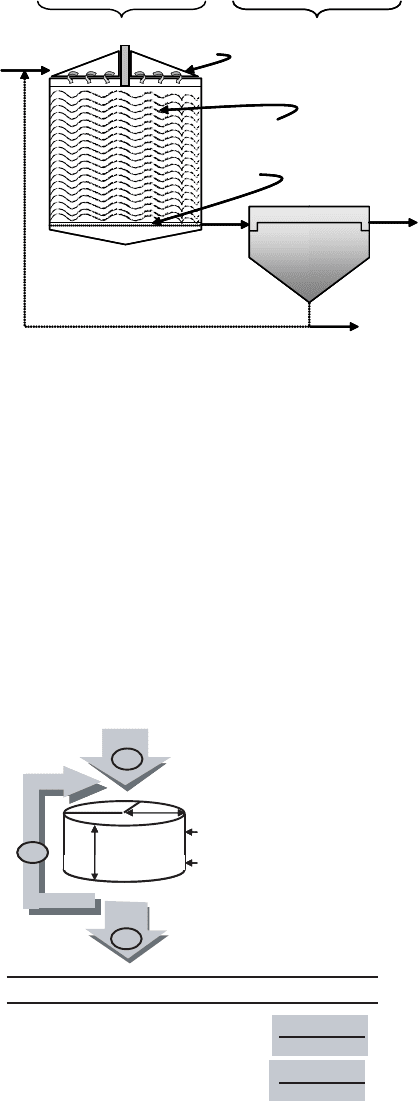
The typical hardware components used with a conventional system (Figure 16.8)
include a reactor filled with media, an underdrain platform at the base of the reactor on
which the medium rests, a rotating influent distribution arm (or, less commonly, a collec-
tion of fixed spray distributors), and the necessary valves, pipes, and pumps required to
route, and possibly recirculate, this flow through the reactor. In addition, there may be a
downstream settling tank to clarify the outgoing waste stream prior to discharge, in which
solids pulled or released (i.e., sloughed) from the biofilm surface can be settled.
As for the design strategies used by environmental engineers to configure and size
these processes, hydraulic and substrate loadings typically represent the key parameters,
as depicted in Figure 16.9. Table 16.2 provides an overview of the associated design
Influent
Effluent
Recycle
Waste Solids
Rotating Distributing Arm
Packed or Random Media
Clarifier
Attached Growth Reactor
Underdrain Support Platform
Clarifier
Figure 16.8 Attached-growth process schematic.
LOADING CRITERIA
- Hydraulic Loading
- Organic Loading (per volume)
Q
in
Area
cross-
Area
media
= V*Area
specific-media-surface-area
R = Radius
Volume
reactor
= Area
cross-section
*H
Area
cross-section
=
π*R
2
H = Height
BOD
eff
BOD
in
Recycle
BOD
in
Volume
Q
eff
Q
in
Q
r
Q
in
Area
cross
-
section
BOD
in
Volume
reactor
Effluent
Q
eff
Influent
Q
in
Q
r
Figure 16.9 Attached-growth process design considerations.
588
BIOLOGICAL APPLICATIONS FOR ENVIRONMENTAL CONTROL

values typically used for attached-growth systems, as well as information regarding
expected reactor depths and recirculation ratios. Hydraulic loading is a primary design
factor based on the flow of influent wastewater (which may or may not include recycle
flow) applied per cross-sectional surface area of the medium (with typical units of,
m
3
/daym
2
, or when simplified, m/day). One of the more subtle aspects of these systems
is that biofilm surfaces will naturally retard the movement of liquid across a media’s sur-
face in proportion to the amount of dynamic drag imparted by the physical roughn ess of
its liquid–biofilm interface. As a result, for any given system, an applied total hydraulic
loading (THL), inclusive of influent plus recycle flow, coul d well result in considerably
different operating values for the amount of time the flow actually spends in transit
through the reactor, as would be quantified using a hydraulic residence time (HRT).
Without an attached biofilm, wastewater flow over smooth, clean media surfaces would
experience little hydraulic resistance, and in turn would have a low hydraulic residence
time. Conversely, mature biofilms have an inherent degree of surface roughness associated
with microbes extending physically into the bulk fluid layer, which would then slow down
the flow and increase the HRT. By analogy, a pail of water splashed across a floor will
travel much faster across smo oth and recently waxed tile (i.e., a clean medium) rather
than a fibrous carpet (i.e., a highly nonhomogeneous microbial surface). As a result,
real-world observations of attached-growth systems have shown a considerable difference
in hydraulic residence times at equivalent THL loadings, by roughly a factor of 10 (e.g.,
1 minute for 3 m of clean media vs. 10 minutes when passed over mature biofilm)
(CH2M-Hill, 1984).
Attached-growth trickling filter systems used with wastewater treatment implicitly
benefit from this phenomena, since it gives the biofilm more time to effectively treat an
overflowing waste stream. Granted, compared to the sort of hydraulic residence times
used with suspended-growth wastewater treatment (e.g., measured in hours) or lagoons
and wetlands (e.g., measured in days, weeks, and possibly even months) , biofilm systems
have far lower contact times (e.g., 10 to 20 minutes) in which the desired treatment
can be completed. On the other hand, this sort of biofilm growth and surface roughness
would be considered problematic in many other instances of attached-growth formation,
including that of cooling towers, ship hulls, or your own teeth. In the particular case of
TABLE 16.2 Typical Attached-Growth System Design Criteria
Fixed-Film
Design Factor
Hydraulic
Loading Range
(m
3
/daym
2
)
Substrate
Loading
Range
(kg/m
3
day)
Media
Depth
(m)
Recirculation
Ratio Q
r
=Q,
Relative to
Influent Flow
Low-rate
biofilm system
1.2–3.6 0.08–0.4
(as CBOD)
2–2.5 0
High-rate
(‘‘roughing’’)
biofilm system
48–150 1.6–8
(as CBOD)
5–12 0–1
Nitrification
biofilm system
1.2–4.8 0.0015–0.002
(as N)
3–12 0–1
Source: Adapted from Metcalf and Eddy (2003).
WASTEWATER TREATMENT
589
cooling tower operations, for instance, biofilm growth on heat transfer surfaces would
reduce the overflow velocity while increasing the depth and temperature of the overlying
water stream, such that the tower would then have a lower thermal gradient and slower
rate of heat release.
As for the second, substrate loading, design parameter, this variable considers the mass
of substrate applied per unit time and per unit volume of the media (typically, kg sub-
strate/daym
3
). The magnitude of these terms, of course, varies in relation to the type
of substrate and the degradation rates expected. For example, even the low end of the
organic loading rates typically used (e.g., 0.08 kg CBOD
5
/daym
3
) is far higher than
that of nitrification rates (e.g., usually less than 0.002 kg ammonia-nitrogen/daym
3
)
(Characklis and Marshall, 1990).
Example 16.1: Preliminary Trickling Filter Design A newly proposed suburban commu-
nity near Chicago, Illinois (i.e., Deer Creek, with 400 homes in a standard three-bedroom
configuration) will require a dedicated wastewater treatment facility given the remote,
unsewered location. During a preliminary public utilities hearing, the community’s con-
sulting engineer is asked to present a preliminary design est imate for sizing a standard
attached-growth trickling filter, recommended as one possible option for the biological
secondary stage in this proposed system. With an expected per-home family size of
four and a projected average per-person wastewater discharge rate of 378.5 L/day (i.e.,
100 gal/day-person), the daily wastewater flow for the entire community would be
605,700 L/day [(150 homes) (4 people/home) (378.5 L/person day)] or 605.7 m
3
/day.
In turn, and given that the carbonaceous organic waste [i.e., typically quantified as a car-
bonaceous biochemical oxygen demand (CBOD)] in this sort of municipal wastewater is
typically around 200 mg CBOD/L, the daily organic wastewater loading generated by this
community would be 121.2 kg CBOD/day [i.e., (605.7 m
3
/day) (0.2 g CBOD/L)], of
which approximately 40% (or 48.5 kg BOD/day) would be removed by primary treat-
ment, leaving a final CBOD load on this trickling filter system of 72.7 kg CBOD/day.
Preliminary Design Details
Hydraulic loading,
system sizing, and
retention times
Design hydraulic loading rate: 8 m
3
/m
2
day (see Table 16.2)
Design media specific surface area: 98.4 m
2
/m
3
day (see
Table 16.2)
Design media depth: 3 m (see Table 16.2)
Cross-sectional tower area: (605.7 m
3
/day)/(8 m
3
/m
2
day) ¼
75.7 m
2
Circular tower diameter : [(4) (75.7 m
2
)/p]
0.5
¼ 9.82 m
diameter
Projected tower volume: (3 m media depth) (75.7 m
2
) ¼
227.13 m
3
Projected total media surface area: (98.4 m
2
/m
3
)(227.13m
3
) ¼
22,350 m
2
Projected average liquid trickling film depth: 0.2 mm
Projected total tower liquid volume: (0.2 mm) (22,350 m
2
) ¼
4.47 m
3
Projected hydraulic retention time: (4.47 m
3
)/(605.7 m
3
/day) ¼
10.6 min
590 BIOLOGICAL APPLICATIONS FOR ENVIRONMENTAL CO NTROL

Biomass values Estimated active biomass depth: 0.15 mm (or 150 mm)
Estimated total biomass depth: 1 mm
Estimated biomass density at 5% solids ¼ 50 kg/m
3
Estimated active biomass mass:
ð0:15 mmÞð22;350 m
2
Þð50 kg=m
3
Þ¼167:7kg
Estimated total biomass mass:
ð1mmÞð 22;350 m
2
Þð50=kg=m
3
Þ¼1118 kg
Organic loading Projected volumetric organic loading:
ð72:7 kg CBOD=dayÞ=ð227:13 m
3
Þ¼0:32 kg=m
3
dayÞ
Related note Although this determination was simplistically developed for
a single tower, multiple towers are typically designed by
engineers to provide beneficial system redundancy. In simi-
lar fashion, while this design estimate was based on an aver-
age daily flow, engineering designs are typically based on
higher likely flows, such as the facility’s daily peak flow,
in order to physically accommodate these types of hydraulic
transient events.
The third and fourth design factors listed in Table 16.2, which are somewhat secodary
in importance relative to the preceding loading terms, refer to the typical depths and levels
of recirculation provided with these fixed-film systems. Older, rock-media designs were
seldom built with media depths beyond 2 to 3 m, but many newer, plastic-media units are
considerably taller (with depths up to 10þ m) and are designed to handle much higher
loads. As for the notion of incorporating a recycle stream, this capability is considered
necessary with influent flows that tend to have extreme lows (e.g., smaller towns, day-
time-only industrial operations), such that the biofilm can be kept wetted during periods
with influent lulls rather than having it dry out.
Extending beyond these heuristic design criteria, there are also a number of empirical
models used to qualify the reac tion-rate kinetics and expected reactor performance levels
with attached-growth reactors. These models, typically named in honor of the responsi ble
author or group, include the following variations: Eckenfelder, Rose, NRC, Howland,
Schulze, Germain, Velz, and modified-Velz. Each of these models is considered to have
its own merits, but the modified-Velz model, given in equation (16.1), is one of the more
widely used strategies. As is the case with many of these competing models, the modified-
Velz model follows a first-order format:
C
in
¼
C
out
expðkD
T20
Þ
THL
n
ð16:1Þ
where
C
out
¼ outlet substrate concentration ðmg=LÞ
C
in
¼ inlet substrate concentration ðmg=LÞ
k ¼ empirical reaction-rate constant
WASTEWATER TREATMENT 591
D ¼ media depth ðmÞ
T20
¼ temperature correction factor ðrelative to 20
CÞ
THL ¼ hydraulic loading ðbased on influent plus recycle flowÞ
n ¼ emp irical loading constant
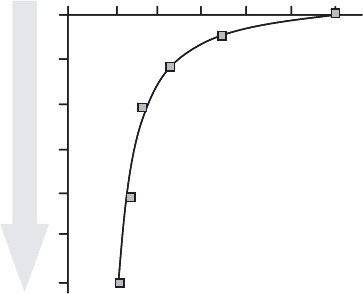
Figure 16.10 accordingly presents a representative substrate removal profile derived
with this model, as might be derived for a particular range of media heights relative to
a given set of constant values for k, n, and , In turn, this type of model does provide
an informat ive characterization of biofilm performance, at least on a qualitat ive basis.
However, on closer review, it would also appear that these types of models bear an inher-
ent degree of fuzziness on several important issues.
The parameters of the modified Velz equation are sometimes reported with high pre-
cision (e.g., n ¼ 0:4332; CH2M-Hill, 2000). However, it should be recognized that these
types of documented constants reflect cumulative, averaged values derived from real-
world biofilms whose actual site- and point-specific metabolic activities undoubtedly
vary to a significant degree, depending on time, location, season, and so on. Indeed,
these constants could well vary from reactor top vs. reactor bottom locations, and even
from one substrata depth within a biofilm to another.
Yet another level of ‘‘fuzziness’’ exists with the total hydraulic loading rate (THL). The
THL depends on influent flow and cross-sectional media area, but it does not actually
account for the manner in which the influent is applied. For example, two parallel systems
of equal design, construction, and hydra ulic loading could have identical THLs, yet have
sizably different levels of performance. In this case, the issue of ‘‘how’’ the influent is
applied represents an important factor, as opposed to simply ‘‘how much,’’ relative to
both the rate of movement of the rotating influent distributor and the corresponding pul-
sing of flow across the media. With each successive radial pass, this rotating arm distri-
butes a liquid stream whose downward passage across the media appears as a moving
wave whose cyclic repetition follows that of the arm’s travel speed. This pulsing and
1
2
3
4
5
6
Attached-Growth BiotowerDepth (m)
12020 40 60 80 100
Substrate (CBOD
1
2
3
4
5
6
Attached-Growth Biotower Depth (m)
12020 40 60 80 100
Substrate (CBOD
5
) Concentration (mg/L)
Figure 16.10 Representative pattern of exponential substrate removal relative to attached-growth
biotower depth.
592
BIOLOGICAL APPLICATIONS FOR ENVIRONMENTAL CONTROL
wavelike movement of liquid into and across the depth of the media would have an amplitude
(i.e., height of the wave) that increased as the rotating arm was slowed. In turn, higher-
amplitude waves would impose higher levels of physical shear and drag against the face
of the biofilm, to an extent that would probably yield thinner attached-growth depths.
Undoubtedly, though, one of our largest levels of uncertainty with understanding
attached-growth systems is our appreciation of the biofilm complexity in terms of biolo-
gical makeup, physical conformation, and related metabolic behavior. Attached-growth
system models akin to the modified-Velz equation implicitly suggest that biofilms are
built and behave as homogeneous surfaces, with uniform levels of depth, kinetic activity,
and structural composition, but this is hardly the case. Instead, biofilms comprise a highly
nonhomogeneous, three-dimensional matrix with a decidedly complex physical structure.
In short, attached-growth biofilms are configured as a densely arrayed microcosm of life,
composed largely of bacteria but with several higher life-forms, including protozoans,
rotifers, and nematodes, and possibly even fungus and insect forms as well.
This complexity within biofilm structures starts at an early stage during an initial per-
iod of startup and adhesion, where a preliminary layering of bacterial cells (i.e., a mono-
layer) binds to a clean med ia surface within a relatively short period of time (i.e., minutes
to hours). This adhesive phenomenon stems from the presence of a sticky coating of exo-
cellular polymeric materials secreted by bacterial cells growing under conditions of lim-
ited substrate availability, thereby allowing them to bind not only to media surface s but
also to other cells. In time, this monolayer coverage subsequently extends in thickness,
progressively melding new and old cells as well as various enmeshed inorganic precipi-
tates and particulate solids, to a point where the monolayer eventually reac hes depths ran-
ging from a few hundred to several thousand micrometers.
An apt analogy for mature biofilm growth is that of a forest canopy, with overarching
branched limbs (newly grown cells) stretched across open glades (internal cavities gouged
out by ongoing microbial sloughing and fluid shear) and underlying brush (deeper depos-
its of dead or inert cells). However, even then, this canopy will be apt to collect an added
assortment of intertwined solids and cells, including a variety of higher life-forms living
within the biofilm as well as entrapped wastewater solids. Given the chem ical complexity
of this film, yet another group of enmeshed, precipitated solids could well be wrapped into
this matrix, including such materials as sulfide-, hydroxide-, phosphate-, or carbonate-
based precipitates of iron, manganese, calcium, magnesium, and aluminum.
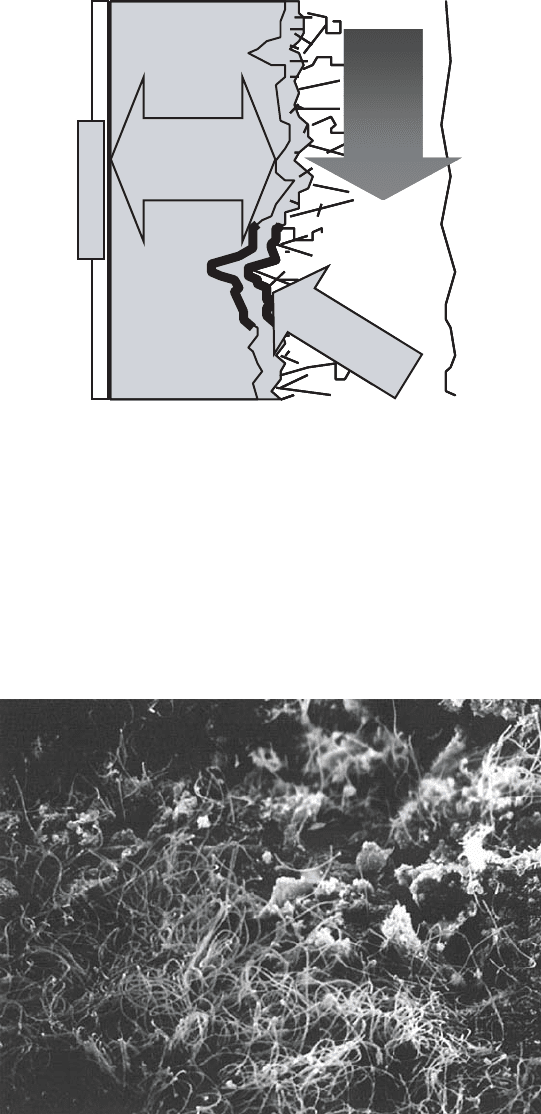
Of course, commensurate with this increased microbial depth, substrate and product
transport through the film also becomes considerably more constrained, to a point
where most biofilms eventually take on a vertically stratified layering. For those micro-
organisms living on the outer, aerobic edge of this biofilm (depicted schematically in
Figure 16.11), their proximity to energy-rich substrates, nutrients, and oxygen received
from the overlying bulk solution will allow them to reach the highest rates of aerobic
metabolic activity. Figures 16.6 and 16.7 depict the type of bacterial growth found at
this topmost, aero bic layer, including the considerable presence of filamentous forms,
which give the biofilm its inherent outer roughness.
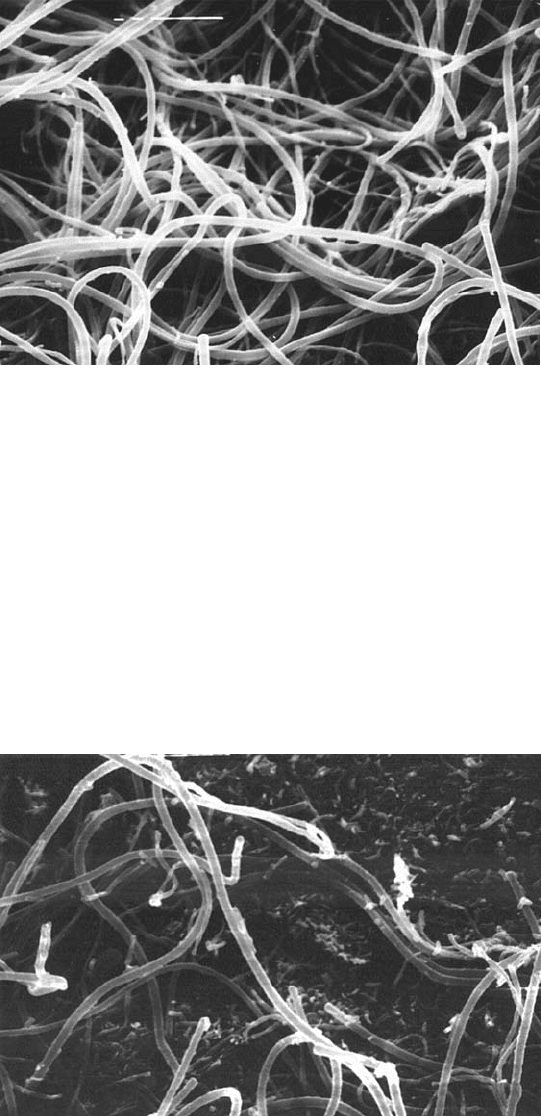
In particular, Figures 16.12 and 16.13 depict progressive enlargements of an extensive
overlying growth of a filamentous Beggiatoa-type growth. Organisms such as this are
often found living at this top-level biofilm region, catabolically using sulfide diffusing
to the surface from the underlying anoxic–anaerobic (i. e., sulfate-reducing) zone. Strictly
aerobic higher life-forms (e.g., most protozoans, rotifers, worms) are also commonly seen
in this outer region, grazing steadily through this relatively active region.
WASTEWATER TREATMENT 593
Moving downward into the biofilm, however, metabolic uptake will progressively
deplete the available substrates and nutrients , imposing metabolic limitations that progres-
sively retard the activity of these lower cells. Although no exact threshold can be pre-
dicted for the point at which the oxygen will be exhausted, interstitial measurements
taken with microscale probes suggest that this point will occur roughly in the neighbor-
hood of 150 mm.
Anaerobic sub -layer
(~1000-5000 microns)
Wastewater
stream
across
biofilm
face
Anoxic-anaerobic
sub-layer
(~typically
1000-5000 µm
depth)
Aerobic top layer
(
~100
-
150
µ
Anaerobic sub -layer
(~1000-5000 microns)
Anaerobic sub -layer
(~1000-5000 microns)
Wastewater
stream
across
biofilm
face
Attachment media
Anoxic-anaerobic
sub-layer
(~typically
1000-5000 µm
depth)
Aerobic top layer
(~100-150 µm depth)
Figure 16.11 Biofilm layering (aerobic top vs. anaerobic bottom) schematic.
Figure 16.12 Highly filamentous biofilm morphology at top surface (800).
594
BIOLOGICAL APPLICATIONS FOR ENVIRONMENTAL CONTROL
Moving deeper into the biofilm, therefore, the aero bic metabolic viability of the cells
will decline as a direct consequence o f diminished substrate and oxygen availability.
Oxygen, in particular, declines steadily in availability as depth increases, to the point
where it is depleted and anaerobic conditions begin. One such zone of transition from
an overlying aero bic top layer to an underlying anoxic and/or anaerobic zone is depicted
in Figures 16.14 and 16.15.
With oxygen reaching limiting conditions within the subsurface biofilm strata, anoxic
respiration will accordingly deplete whatever alternative electron acceptors (i.e., nitrates,
nitrites, etc.) might be present, eventually leading to sulfate reduction and a metabolic
release of sulfides. Tucked just below the overlying Beggiatoa filaments shown in
Figures 16.14 and 16.15 is a distinctly different type of bacteria, Desulfovibrio, which
Figure 16.13 Biofilm surface close-up with dense Beggiatoa-type filaments (2000).
Figure 16.14 Biofilm transition zone between aerobic top and anaerobic bottom (2000).
WASTEWATER TREATMENT 595
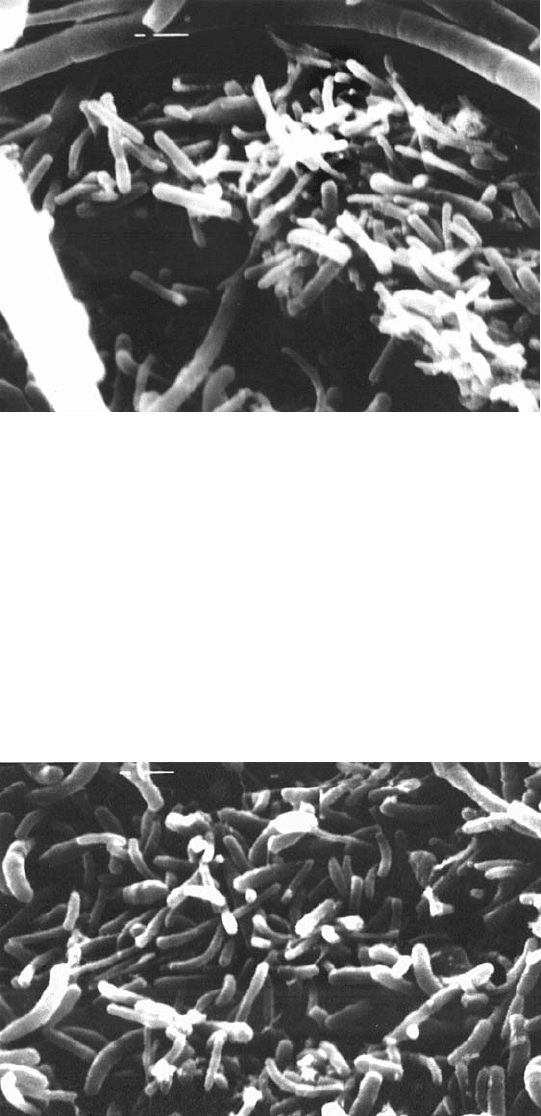
is responsible for this sulfate reduction. These lower cells are more tightly packed and
have a characteristic comma-shaped curvature. The last photograph in this series,
shown in Figure 16.16, provides a close-up look at this group of cells.
The sulfides produced at this lower level will often scavenge and precipitate a variety
of metals (probably dominated by iron sulfide, FeS, but undoubtedly including many other
metal species), leading to a sort of cementation behavior that further inhibits chemical
transport at these lower depths. Whereas optimal activity would be achieved with limited
biofilm depths, therefore, the aging process experienced with biofilms leads to progressive
metabolic constraints at the lower depths. Burie d at a depth that limits their access to key
Figure 16.15 Biofilm transition zone (aerobic to anaerobic) close-up ( 4000).
Figure 16.16 Biofilm anaerobic bottom zone close-up with Desulfovibrio-type bacteria (4000).
596
BIOLOGICAL APPLICATIONS FOR ENVIRONMENTAL CONTROL
substrates and nutrients, as well as hampered by transport problems brought about by
entrapped and precipitated solids, the underlying cells must inevitably shift to anaerobic
(or at least anoxic) life-styles.
However, when viewed in terms of microbial diversity and potential treatment efficacy,
the circumstance of having adjacently layered aerobic and anaerobic strata within a bio-
film does appear to provide a potentially beneficial arrangemen t. Indeed, these strata
could well complement one another, such as a reductive transformation of what might
otherwise comprise recalcitrant organics (e.g., chlorophenolics, nitrophenolics, aniline
dyes) within the anaerobic sublayer, followed by a concluding oxidation within the over-
lying aerobic layer.
At least in theory, it would also appear that it might hypothetically be possible to
develop a beneficially layered sequence of nitrifying and denitrifying biofilms, such
that nitrates produced in the oxidative overlying strata would then be directly inside
reduced the lower anoxic–anaerobic depth. However, this conceptual scheme would be
difficult to attain since the slow-growing nitrifiers are prone to overgrowth and submer-
gence by faster multiplying heterotrophs, at which point competition for oxygen and other
essential nutrients severely constrains their viability. As a result, nitrifying biofilm sys-
tems designed for oxidation of wastewater ammonia-nitrogen are usually configured as
stand-alone processes, supplied with a pretreated wastewater whose biodegradable
organic levels available for heterotrophic growth have been largely removed, and pro-
vided with specially designed media offering a far higher specific surface area more con-
ducive to these slow-growing lithotrophs.
Once these attached-growth systems have been placed into use, though, and their mul-
tilayered biofilm configurations have been established, operating personnel have surpris-
ingly few monitoring and control options with which they might try to improve or
optimize performance. Merely measuring the attached mass or depth of biofilm within
a reactor is quite difficult, although in rather rare instances, provisions have been made
to track biofilm mass using removable sample coupons removed from inside the reactor.
Other than shifting reactor loading patterns by taking biofilm towers off- or online, the
most significant control factor is probably that of altering the rotation speed for the dis-
tributors. In recent years, there has been a distinct shift to slow down the rotational speed
of these distributing arms, dropping the number of rotations per minute (rpm) from values
of 1 to 2 by a factor of 10 or more (i.e., to 0.1 or even lower rpm rates). Slowing down
these distributing arms while maintaining the same influent waste flow means that the
hydraulic loadings applied at the point of release are considerably higher. This increase
subsequently raises the level of hydraulic shear as it moves downward across the face of
the biofilm, and the added shear helps to keep the biofilm thinner and more active than
would be the case with a much slower-moving water film.
Notwithstanding these operational constraints with control and monitoring, though,
several sign ificant developments have occurred with attached-growth media materials
and configurations over the past several decades. In the realm of media options, rock
media largely gave way to lighter plastic media with far higher specific surface areas mid-
way through the twentieth century, and today’s vendor options include a wide range of
modular and random-packed versions. Table 16.3 provides specific technical details
regarding several of these newer media forms com pared against the older rock option.
These newer plastic media provide several times more surface area per unit volume,
which in turn yields considerable improvements in biofilm growth and loading capacities.
In addition, plastic media are distinct ly lighter and have far higher void fractions (i.e., the
WASTEWATER TREATMENT 597