
Vaccari D.A., Strom P.F., Alleman J.E. Environmental Biology for Engineers and Scientists
Подождите немного. Документ загружается.

subsurface availability of oxygen. The key variable in this case is Henry’s constant, K
H
.
Low-molecular-weight hydrocarbons, such as the BTEX compounds (see le 16.18), tend
to have high K
H
values, and as a resu lt these types of contaminants can be removed from
contaminated soils merely be providing thorough aeration or sparging [i.e., using an
approach known as soil vapor extraction (SVE)]. The difficulty encountered with biore-
mediating high K
H
compounds stems from their motivation to leave the soil by means of
physical volatilization at a rate beyond that of its biochemical degradation. Although the
soil is remediated, the contaminant is not degraded or concentrated, and may be emitted to
the atmosphere.
As for the level of halogenation, the degree of substitution also tends to progressively
reduce the biodegradability of a compound. Carbon tetrachloride offers a good example of
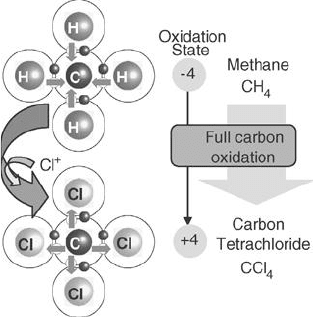
this phenomenon Figure 16.66. Starting with methane as the carbon precursor, the succes-
sive halogen-based oxidations of this parent compound with chlorine will eventually shift
the carbon oxidation state from a fully reduced (4) to a fully oxidized ( þ4) level, at
which point this CCl
4
compound no longer offers any energy whatsoever as an electron
donor during aerobic degradation. Carbon tetrachloride consequently represents a highly
recalcitrant compound in terms of its resistance to aerobic degradation. Halogenated com-
pounds with lower levels of substitution may, however, be amenable to aerobic metabo-
lism. At the same time, many of these compounds can also be degraded through reductive
anaerobic pathways in lieu of aerobic oxidations.
Theoretically, soil and groundwater bioremediation systems can be engineered and
maintained to provide a considerable variety of different biochemical mechanisms, the
specific mode and implementation of which may then be tailored on a site-specific
basis according to the target chemical(s) and the soil properties involved (Rittman and
McCarty, 2001; National Research Council, 1993). Although the engineering require-
ments of these systems are rapidly becoming better established, the fact remains that
this technology remains a rather inexact science. Simply put, our efforts to manipulate
microbial reactions remotely within soils whose characteristics usually have a high degree
of spatial inconsistency are seldom easy and are often quite difficult to complete at a
desired rate or degree.
To date, the majority of bioremediation operations have been developed with the intent
of using aerobic degradation mechanisms, but here again the reality of soil and pore space
Figure 16.66 Oxidative methane (C 4) halogenation to carbonte trachloride (C þ4).
688
BIOLOGICAL APPLICATIONS FOR ENVIRONMENTAL CONTROL
ecosystems is that they probably experience a considerable range of aerobic, anoxic, and
anaerobic reactions. At least for readily oxidizable contaminants such as the lighter
hydrocarbons, this interplay is probably a moot issue given the fact that the end result
usually involves a successfully remediated soil. These operations are engineered to pro-
vide aeration in the hopes of promoting aero bic remediation, and any commensurate sub-
surface reactions involving anoxic or anaerobic metabolism are essentially masked by the
dominant effectiveness of the aerobic reactions.
In this case, therefore, it is aerobic bacteria and fungi that are relied upon to catalyze
the degradation of the contaminants successfully using an array of hydroxylation, dealky-
lation, decarboxylation, and epoxidation reactions. The underlying thrust with these reac-
tions is that of using the contaminants as a primary energy source, drawing electrons from
the targeted contaminant and then releasing them back to oxygen as the final electron
acceptor.
However, in certain instances there may well be nonaerobic reactions that offer degra-
dative enzyme pathways that are better suited to a variety of specialized contaminants. For
example, the nitroreductase enzyme typically associated with denitrification can reduc-
tively attack the nitro groups found on nitroaromatic compounds. In this case, therefore,
an in situ remediation process designed to deal with soils contaminated with these types of
otherwise recalcitrant energetic munit ions residuals would benefit from the introduction
of nitrates rather than oxygen, such that subsurface denitrification could be promoted.
Extending beyond this particular application with nitroaromatics, denitrifying Pseudomo-
nas, Thiobacillu s, and Bacillus bacteria have also been shown to be effective metabolic
oxidizers of xylene isomers.
The bioremediation of halogenated compounds involves yet another set of potential
remediation pathways covering both aerobic and anaerobic conversions. One such aerobic
option for dehalogenating these types of contaminants can be maintained by a cometabo-
lism sequence facilitated by a special group of aerobes using monooxygena se enzymes.
This generic group of bacteria includes methan otrophic (methane-oxidizing) and ammo-
nia-oxidizing forms that employ methane-monooxygenase (MMO) and ammonia-
monooxygenase (AMO) enzymes, respectively. For those sites at which this cometabolic
scheme was selected, the soils would have to be supplied with the suitable substrates (e.g.,
dissolved methane or ammonia, and oxygen) to induce and promote the growth of the
involved bacteria at levels sufficiently high to enrich the targeted soils with their mono-
oxygenase enzymes.
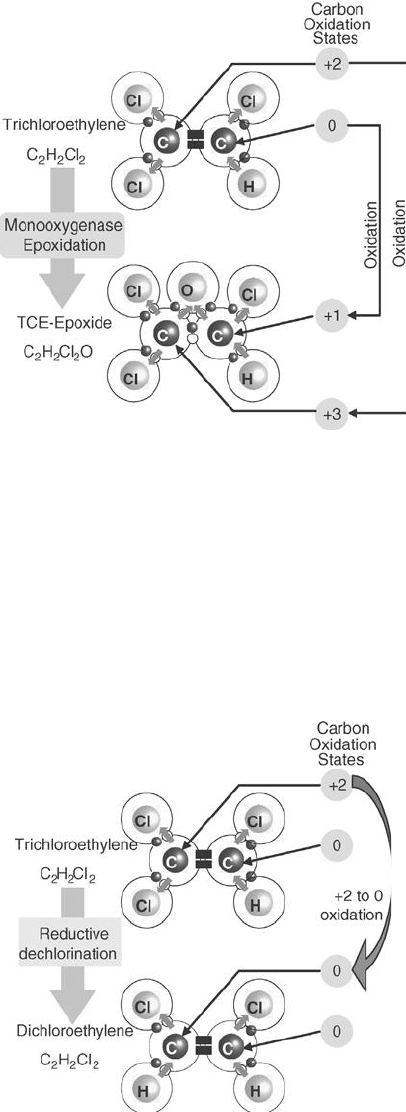
Figure 16.67 schematically depicts one such cometabolic conversion of TCE, a widely
observed soil and groundwater contaminant used historically in many industries as a sol-
vent and degreasing agent. This particular reaction is known to be mediated by a number
of bacteria, including Alcaligenes and Pseudomonas (Harker and Kim, 1990). These types
of monooxygenase reactions convert the ethylene backbone (C
C) of TCE into an
epoxide structure (i.e., TCE-epoxide) by oxidatively introducing a single mole of oxygen.
This product is chemically unstable and subsequently breaks down into smaller frag-
ments, which are then amenable to direct microbial breakdown.
The actual circumstance of these cometabol ic reactions is that they occur due to inher-
ent inefficiencies of the involved enzymes. In this case, these catalysts inadvertently
attack and oxidize secondary compounds (e.g., TCE) other than the energy-releasing pri-
mary substrate (methane or ammonia) for which the enzyme had originally been pro-
duced. The difficulty with this process is that the level of inherent inefficiency for
these cometabolic reactions is so low that far more prima ry substrate has to be introduced
SOIL AND GROUNDWATER TREATMENT 689
to the soil than the mass of secondary contaminant. In turn, the level of growth by the
induced bacteria can be so high that it can clog the soil’s pore space and restrict the migra-
tion of the added substrates away from the point of injection.
Dehalogenating pathways are also used with bioremediation systems that involve anae-
robic reactions, including those of hydrolytic dehalogenation and reductive dehalogena-
tion. The latter process of reductive dehalogenation has drawn the most attention, as it has
proven to be widely applicable to the uncoupling of attached halogen species. One such
process is depicted schematically in Figure 16.68, where the backbone carbon unit is
Figure 16.67 Oxidative monooxygenase epoxidation of trichloroethylene.
Figure 16.68 Reductive dehalogenation of trichloroethylene.
690
BIOLOGICAL APPLICATIONS FOR ENVIRONMENTAL CONTROL

reductively converted during the course of its dehalogenation. The end products created
by this latter sort of anaerobic transformation may not have been suitably transformed to
qualify the bioremediation sequence to this point as an outrigh t success. With a highly
halogenated compound such as pentachlorophenol (PCP), several such reactions may
be necessary. In the particular case of TCE, a second anaerobic repetition of the reductive
dehalogenation reaction can lead to the formation of vinyl chloride (H
2
C
CHCl). Given
the fact that the latter product has been linked to carcinogenic impacts, therefore, this
reactive sequence is not considered to be a suitable bioremediation mechanism. However,
in many instances, a coordinated linkage of cyclic, sequential anaerobic–aerobic conver-
sions could well achieve overall conversions of the targeted contaminants to a degree of
transformation that is considerably higher than either option used independently.
The structural character and environmental conditions of a soil can play a sizable role
by promoting or restricting the success of bioremediation. Certainly, one of the most
important factors is that of a soil’s hydraulic conductivity (K) (le 16.19), measured in
velocity units (e.g., cm/s). This property ranges from highly permeable gravel and sand
whose open void space is readily conducive to water transfer (i.e., with a K value of 10
2
cm/s or higher) to extremely tight, heavy clay soils with permeabiliti es (at or below 10
5
cm/s) which are so low that they restrict the necessary hydraulic throughput of moisture,
nutrients, and substrates required for metabolic activity. In fact, the majority of successful
in situ bioremediation systems have tended to fall with a hydraulic conductivity range of
10
3
to 10
1
cm/s (Staps, 1990).
Soil bioremediation depends on providing the necessary factors for microbial activity:
moisture, nutrients including substrate and electron acceptors, and the presence of species
of microbes capable of conducting the desired reaction. Moisture should be at a level of at
least 40% of saturation (i.e., 40% of the soil pore space is filled with water and the
remainder by air). Higher moisture levels would be acceptable for anaerobic systems,
and may even be helpful, but in the case of aerobic bioremediation, a bloc kage of oxygen
movement in soils with high pore water percentages would be decidedly harmful to the
process. The oxidation of a readily biodegradable aliphatic hydrocarbon would, for exam-
ple, require a supply of oxygen many times larger (in mass) than that of the oxidized con-
taminant, to the point where the soil would have had to be readily open to oxygenating air
movement. The presence, or absence, of this soil moisture in remediation systems may
also be affected in those aerobic systems that employ an aeration header or well, where
the continuous addition of atmospheric air could induce an evaporative water loss that
TABLE 16.19 Soil Hydraulic Conductivity Relative
to Bioremediation Potential
Soil Category
Hydraulic
Conductivity
(cm/s)
In Situ
Bioremediation
Potential
Very coarse sand and
gravels
10
1
–10
2
Good
Coarse sand 10
0
–10
1
Good
Fine sand 10
1
–10
0
Good
Loam 10
2
–10
4
Possibly poor
Peat < 10
5
Usually poor
Clay < 10
6
Usually poor
SOIL AND GROUNDWATER TREATMENT 691
would have to be countered with a makeup water addition. Oxidation need not be pro-
vided only by air. Fully saturated systems can be provided with electron acceptors by
way of several strategies. Oxygen can be dissolved in groundwater through sparging. It
can also be introduced indirectly using hydrogen peroxide dissolved in water, which
decomposes to produce oxygen. Alternative electron acceptors such as nitrate may be
used in specialized circumstances.
As for the chemical nature of a soil subjected to bioremediation, the pH should be
neither excessively high or low. Value s between 6 and 8 are generally considered as a
desirable operating range. The availability and supply of nutrients also represents an
important contributing factor that will affect microbial activity, relative to the availability
of key nutrients, including both organic and inorganic (e.g., primarily nitrogen and phos-
phorus). Ideally, the ratio of available carbon to nitrogen to phosphorus (C/N/P) should
fall within the range 100 : 10 : 1 to 100 : 1 : 0.5. As with water availability, these pH
and nutrient parameters may also be subject to change during the course of a remediation
activity, such that it will need to be checked on a routine basis and corrected if necessary.
Finally, the temperature at which a remediating microbial reaction is maintained will
probably have a corr esponding impact on the metabolic rate. At depths much below about
1 m the temperature of soil quickly moderates to a fairly stable level of about 12 to 13
C,
at which point most bioremediation microbes will experience little negative impact. How-
ever, it is possible for temperature to become an important factor, with both ex situ sys-
tems and near-surface soils, which are considerably more vulnerable to sizable
temperature changes. In both instances, there may be seasonal extremes during which
time the rates of microbial activity will be reduced substantially. Frost penetration during
winter periods in cold-climate regions could, for example, extend for depths even beyond
a meter, such that microbial activity could be commensurately depressed during these
periods.
Extending beyond the characteristics and properties of the soils involved, many engi-
neered bioremediation systems also rely on wells to deliver key materials, or air, to the
active subsurface site. There are three different types of wells commonly used with bior-
emediation operations: those used for ventilating soils (i.e., aerating wells); those used to
introduce water into the ground (i.e., dosing wells), possibly mixed with nutrients, and
those used for accessing ground water (i.e., moni toring wells) for sampling or monitoring
purposes. The majority of these wells are installed as rigid pipe bodies constructed of inert
plastic or metal, the lower reach of which has a series of slits cut into the face of the pipe
to act as a screen. The lower screen face of any well serves as the interface between the
well and the soil into which it was placed, and the narrowness of the screen openings is
sufficiently small to prevent the unwanted migration of all but the smallest soil grains.
Well pipes used for groundwater sampling are commonly installed into a vertically
aligned bore hole drilled into the soil to depths of a few meters to 10þ m (sufficiently
deep to reach the groundwater table), using fairly narrow diameter (e.g., 2.5 cm) stainless
steel or PVC casing. However, in the case of ventilating or dosing wells, there is consid-
erably more variation in the types of wells and their installation, including changes in the
alignment of the well, the materials employed, and the means by which they are put into
place. The depth of the aerating and dosing wells can vary considerably, from shallow
depths extending only a few meters to deep wells that reach 100þ m. To facilitate the
desired flow of air through the aerating wells, they are much larger in diameter than dos-
ing or monitoring well lines, with diameters of 7.5 to 10þ cm. Pipes installed into verti-
cally aligned wells are typically installed into drilled wells, although many dosing wells
692 BIOLOGICAL APPLICATIONS FOR ENVIRONMENTAL CO NTROL
are placed in a horizontal alignment usin g a predug ditch rather than being placed with
drilling. In some cases, particularly with loosely packed loamy or sandy-loam soils, it may
also be possible to install shallow-depth vertical wells with a cone penetrometer. How-
ever, in this case stainless steel well lines must be used to carry the bearing force during
the installation and also to avoid subsequent problems with oxidization of the metal and
consequent clogging of the screen.
For aerating wells, the depth of installation is important since air may escape from a
shallow screen when dealing with highly permeable soils (i.e., that would offer a path of
least resistance back to the soil surface rather than having the incoming air pass through
the soil). Diffusers have been suggested, with the idea that they might improve aeration
efficiency by creating smaller air bubbles with a higher surface area, but these diffuser
bubbles quickly coalesce as the air enters the soil, to the point where there is no overall
gain in transfer efficiency.
The type of aeration equipment to be selected depends on the necessary pressure
required to push or pull the air through the wells. For remediation systems that require
lower pressure [e.g., 10 to 50 kPa (1.5 to 7.5 psi)] they will commonly use rotary air
pumps or blowers called positive-displacement (PD ) blowers. These types of blowers
effectively ‘‘push’’ a relatively constant volume of air drawn into the inlet through to
the discharge. The air released is usually oil-free and can then be introduced directly
into the soil. Experimental installations have also been constructed to employ passive
aeration systems in which the motive p ower is supplied not by mechanical pumps or
blowers but by wind or natural air exchange. The latter strategy depends on baro-
metric-driven changes in airflow in a fashion analogous to that of the air exchange
found inside caves.
In the case of more highly compact ed and denser soils, high-pressure air compressor
systems may be necessary to inject air at higher pressure levels of 50 to 200 kPa (7.5 to
30 psi), and this airflow often contains a level of oil that needs to be filtered and removed
prior to its introduction into soils. Outlet gas temperatures with the latter high-pressure
systems may also be considerably higher than would be the case with a lower pressure
operation. To some extent, this heat may be helpful in raising the aerated soil temperature
and escalating the biokinetic reaction rates, but these higher temperatures may also
require a shift in piping materials to alternatives (e.g., to non-HDPE forms such as stain-
less steel) able to handle these higher temperatures. Aerating wells maintained at high
airflow rates and pressures also run the risk of fracturing tightly packed, less permeable
soils, at which time problems with short-circuiting might subsequently arise. However, air
extraction may also pull water and small soil fines into their well screens, which might
then clog their openings and restrict subsequent fluid and air movement.
In general, there are three different configurations for aerating wells on an in situ basis
with bioremediation sites, including those that inject air into a contaminated soil zone
using pressure (i.e., bioventing), those that use combined air injection and extraction
[i.e., soil vapor extraction (SVE)] to mobilize and extra contaminants from soils, and
those that inject air into a contaminated groundwater zone using pressure (air sparging).
With bioventing, the incorporated low-level airflow not only oxygenates vadose soil
with the goal of promoting enhanced aerobic metabolism of biodegradable contaminants
within these soils but may also result in some measure of gas-phase release of the soil’s
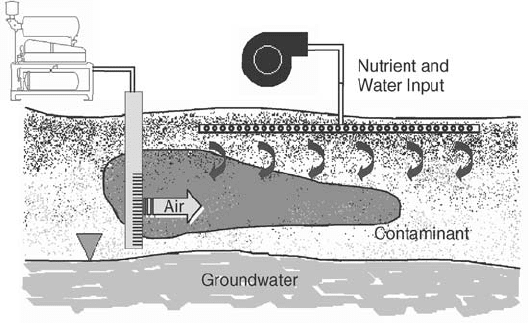
more volatile contaminants. However, the primary goal of bioventing (Figure 16.69) is
that of securing metabolic breakdown as opposed to volatilization; on the other hand,
these goals are essentially reversed with SVE syst ems.
SOIL AND GROUNDWATER TREATMENT 693
Bioventing has been used successfully to treat a variety of soil contaminants, including
petroleum hydrocarbons and nonchlorinated solvents as well as a number of pesticides,
wood preservatives, and other organic chemicals. Bioventing may also be effective at
removing heavier, semivolatile petroleum hydrocarbons such as diesel, fuel oil, kerosene,
and jet fuel. The key technical issues with bioventing all focus on the means of promoting
optimal microbial activity. The desired ventilating airflow rate has to be kept sufficiently
low to avoid significant losses of the more volatile contaminants, with typical application
pressures in the range 10 to 50 kPa.
Moisture and nutrient additions are often provided using a companion dosing well sys-
tem as replacements for their losses incurred due either to aeration or metabolic uptake.
Intermittent pulsed additions of nutrients (NH
4
Cl, KNO
3
, NaH
2
PO
4
, etc. solutions) and
water are often provided, with the intent of spreading these additions into the soil in a
fashion that will distribute the zone of microbial activity away from the immediate
reach of the well face. Cyclic aeration cycles have also been studied in terms of develop-
ing sequential aerobic–anaerobic degradation schemes that couple a far wider, and poten-
tially synergistic, range of metabolic pathways. For example, the anaerobic sequence
might enable the reductive dehalogenation of halogenated solvents otherwise unavailable
to aerobes, at which point the dehalogenated products could be reoxidized and minera-
lized during the subsequent aerobic period.
Monitoring provided during the course of a bioventing operation includes measure-
ments of soil moisture content, nutrient presence, and contaminant concentrations. The
in situ soil vapor oxygen content can also be used an indicator of metabolic activity,
whereby the oxygen uptake rat e can be tracked following intermittent shutdowns of the
aeration system. Higher respiration rates will , of course, tend to correspond to those areas
where the contaminants are still present at the highest conce ntrations, and with time these
rates will drop in parallel with contaminant depletion. Yet anot her option for tracki ng the
existing metabolic activity is that of the in situ, vapor-phase carbon dioxide content.
The rate and degree to which soil contaminants can be remediated using bioventing
depends on a number of factors, including the permeability of the soil and the form
and concentration of the contaminants. In some cases, sizable levels of cleanup with
easily degradable materials can be experienced in a matter of months, but successful
Figure 16.69 In situ engineered bioremediation using bioventing.
694
BIOLOGICAL APPLICATIONS FOR ENVIRONMENTAL CONTROL
bioventing operations usually entail operational periods measured in years rather than
months. Even then, the long-term prognosis for reaching desired cleanup endpoints will
typically extend into a time frame measured in decades. These actual cleanup levels are
usually derived on a site-specific basis and developed to achieve desired levels of risk
reduction for each of the existing contaminant species.
There is also considerable variation in the size of these operations, ranging from appli-
cations with a sing le aerating well to fields involving dozens of wells. Yet another option
is that some bioventing locations opt to add hydrogen peroxide (H
2
O
2
) in lieu of deliver-
ing oxygen, but this approach may face certain problems. It is possible for this H
2
O
2
che-
mical to react with the soil and subsequently decompose, and it may also be that catalase-
secreting bacteria could evolve at the vicinity of its release that would then lead to rapid
decomposition and loss of the desired oxygen.
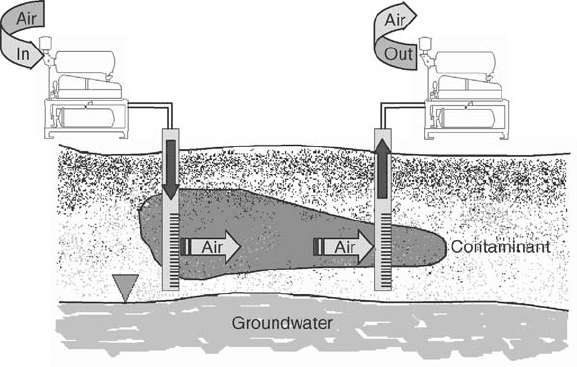
As the name implies , and as shown in Figure 16.70, soil vapor extraction (SVE) uses
both positive and negative pressure to promote in situ bioremediation, essentially meldi ng
vacuum extraction to a bioventing system. Here again, both such aeration and vacuum
operations are completed within a contaminated soil zone.
The third method of in situ groundwater treatment is that of air sparging
(Figure 16.71), by which air is injected into the groundwater to promote the release
and removal of contaminants. The key difference in this regard is that of aerating the
groundwater zone rather than the overlying soils (as practiced with either bioventing or
SVE). Two removal mechanisms will be involved, the first of which involves outright
aerobic biodegradation within a reach of the oxygenated saturated soil called the bio-
logically active zone (BAZ). The second mechanism involves volatilization and stripping
of contaminants from the saturated to the unsaturated zone (i. e., from the groundwater
into the vadose zone). As such, soil vapor extraction is typically used in conjunction
with air sparging to ensure that contaminants released from the groundwater will be
duly pulled from the overlying soils. Overall, though, sites amenable to air sparging
must have soil hydraulic conductivity that is neither so low that it traps the incoming
gas, nor too high that it allows short-circuiting of the incoming gas away from (as opposed
to being diffusely spread across) a biologically active zone.
Figure 16.70 In situ engineered bioremediation using soil vapor extraction.
SOIL AND GROUNDWATER TREATMENT 695
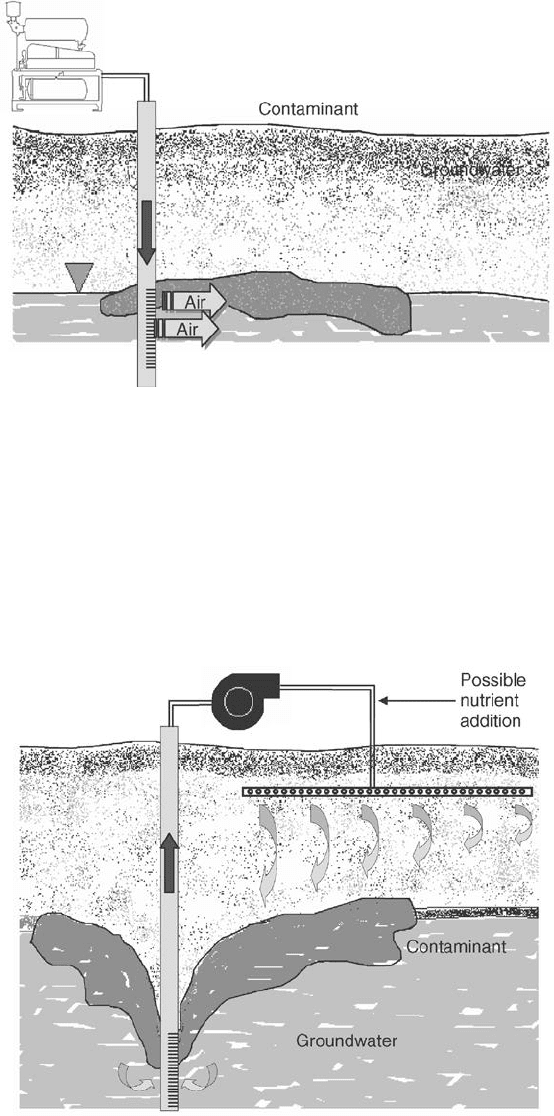
In lieu of directly aerating the groundwater, there is yet another engineering approach
to in situ groundwater bioremediation, called pump and recycle, which involves the
pumping of groundwater back to the soil surface, at which point these waters are then
injected and infiltrated back into the overlying soils (see Figure 16.72). This single tech-
nology can provide an effective means of remediating contamination found not only in the
groundwater but also in the overlying soils. To enhance and promote the metabolic effi-
ciency of the process, an aboveground water-conditioning step may also be incorporated
Figure 16.71 In situ engineered bioremediation using groundwater air sparging.
Figure 16.72 In situ engineered bioremediation using groundwater pump-and-recycle process.
696
BIOLOGICAL APPLICATIONS FOR ENVIRONMENTAL CONTROL
into this overall process, whereby nutrients and oxygen (using either air or hydrogen per-
oxide) may be added to the contaminated water prior to its release back to the soil. One
limitation with this technology, however, is that subsurface changes in soil layering and
density may have a distinct impact on the physical course that this reinjected groundwater
prefers to follow, such that these conditioned waters could well fail to reach the targeted
areas of contamination.
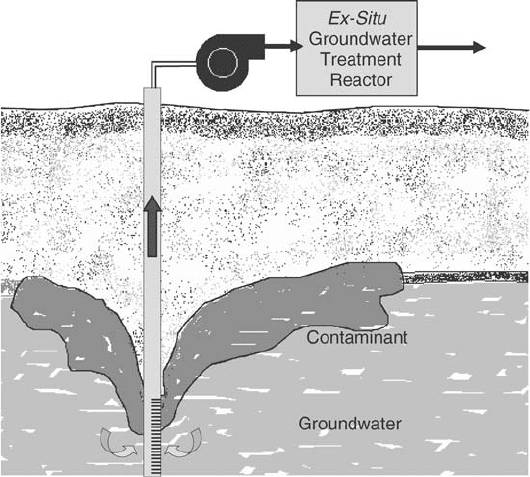
Rather than attempting to complete a bioremediation effort with groundwaters on an in
situ basis, there is also an ex situ bioremediation option in which the applied treatment
steps are completed above the soil surface. Th is concept of pump and treat basically
follows the general plan as that of the in situ groundwater bioremediation strategy men-
tioned previously, but in this case an engineered treatment process (i.e., activated sludge,
trickling filter, etc.) is added to the aboveground flow scheme. The treated water is then
recycled back to the ground, essentially flushing contaminants from the soil and moving
them into the groundwater, where they are then extracted and pumped to the aboveground
treatment unit (Figure 16.73). Yet another variation with this approach is that of using soil
extraction agents to enhance the effectiveness of this soil washing effort. This process,
known as solvent extraction, differs from conventional soil washing in that it uses sur-
factant-type organic chemicals as the solvent instead of water. The principal application
of this process has been with the removal of polychlorinated b iphenyls (PCBs), but the
technology can be effective for petroleum removal as well. The disadvantages with this
process are that these detergents may, at least in some instances, interfere with the desired
separation and biotreatment processes.
There are also three other ex situ techniques that can be used to remediate contami-
nated soils, and to some extent these schemes can be faster, easier to control, and
more amenable to a wider range contaminants and soil types than is the case with in
Figure 16.73 Ex situ engineered bioremediation using groundwater pump-and-treat process.
SOIL AND GROUNDWATER TREATMENT 697