
Vaccari D.A., Strom P.F., Alleman J.E. Environmental Biology for Engineers and Scientists
Подождите немного. Документ загружается.

The first such mechanism, rhizoenrichment, stems from the fact that plants release
into soils a number of exudates that are rich in organic carbon and that, in turn, effectively
nurture the growth of many soil microorganisms. A sizable fraction of the carbon fixed
through photosynthesis is released into soils, with estimates ranging from 10 to 30%. This
material includes a range of readily biodegradable materials with small to moderately
sized molecular weights, including sugar, protein, alcohol, and acids. Yet another group
of organic carbon residuals are also releas ed into soils by the senescence (aging) and
decay of plant tissue, particularly that of fine-root biomass. There is also a beneficial phy-
sical impact with the growth and aging of plant roots, in that they tend to loosen the soil
during both their growth and death, forming new paths for transporting water and aera-
tion. This process subsequently tends to pull water to the topsoil surface while drying the
lower saturated zones.
The latter enrichment of soils with organic carbon compounds exuded by plants sub-
sequently promotes and maintains a significant enhancement in the growth of microbes
within the immediate vicinity of the roots (i.e., microbial stimulation). There are actually
two mechanisms by which plants provide this stimulation: by feeding the microorganisms
with their exudates and by promoting the availability of oxygen. Here again, the photo-
synthetic activity of the plant is important, with at least some of its n ewly created oxygen
being effectively pumped through the roots into the soil. Channeling created by roots,
both alive and dead, also provides a means of physically opening the soil matrix and
improving its porosity. The net effect of the added substrates and improved oxygen avail-
ability leads to levels of microbial activity and density that are considerably higher than
those of barren, unvegetated soils, by several orders of magnitude. In a fashion analogous
to that shown in Figure 16.39, between 5 and 10% of root surfaces will tend to the colo-
nized by various forms of bacteria and fungi, and the adjacent rhizospheric soils will com-
monly experience considerable increases in their microbial density. Population densities
of 5 10
6
total bacteria, 9 10
5
actinomycetes bacteria, and 2 10
3
fungi per gram of
air-dried soil have been observed.
This symbiotic relationship between plants and their adjacent microbial consortia sti-
mulates microbes, which in return assist the plants in securing nutrients and essential vita-
mins. Given the diversity of the substrate forms available to these microbes and the
variable nature of the rhizospheric environment (i.e., with dynamic changes in oxygen
content, soil water presence, pH, etc.), a wide range of microbial types is found in
these soils. In turn, the metabolic breadth of these bacterial and fungal forms encompasses
a considerable range of enzymatic mechanisms and pathways. The resulting, collective
effect of these microbes is that they can be expected, either directly or indirectly, to
play a significant role in degrading organic contaminants present in the soils (i.e., micro-
bial degradation). Compared to readily biodegradable compounds, recalcitrant organic
contaminants found in soils may not be directly oxidized by these root-zone microorgan-
isms as an energy source, but they may nonetheless be converted. Indeed, in the presence
of other biodegradable root exudates, the catabolic enzymes generated to catalyze these
reactions sometimes cooxidize the recalcitrant materials through a cometabolic conver-
sion. The relative contribution of plants vs. microbes to degradation no doubt varies
from one situation to the other, and there are those who would argue that one or the
other typically plays a more dominant role. However, irrespective of which contribution
might be dominant, the fact remains that the efficacy of phytoremediation commonly
involves a coordinated and harmonious set of biological mechanisms that span the
micro- to macroscale of life.
678 BIOLOGICAL APPLICATIONS FOR ENVIRONMENTAL CO NTROL
Contaminants not degraded by rhizospheric microbes are available for plant uptake by
roots, where they may then either be retained or translocated farther upward into a plant’s
shoots and leaves (i.e., phyto uptake). Some plants simply uptake contaminants and store
them in their roots, whereas others both uptake and translocate contaminants. There is,
admittedly, a degree of uncertainty about the nature of these combined processes and
the conditions under which they may each take place, but it appears that the polarity of
the contaminants is an important factor. One of the most frequently mentioned criteria in
this regard is that of the octanol-to-water partition coefficient (K
OW
). K
OW
is used as an
indicator to represent the relative ability of a compound to concentrate in lipids vs. water
and is therefore more likely to concentrate in biological materials. K
OW
tends to be inver-
sely related to the polarity and therefore the aqueous solubility of a compound. If a com-
pound has a K
OW
value of 1, it has the same affinity for water as it has for octanol (and by
implication, for lipids). If the K
OW
value were 100, it has 100 times greater affinity for
octanol (and lipids) than for water. Because of the wide range of K
OW
values, it is
often reported as log K
OW
, so the range of K
OW
from 1 to 100 corresponds to log K
OW
from 0 to 2. Compounds amenable to plant uptake reportedly have logK
OW
values in the
range 0.5 to 3. Those materials having higher values, extending beyond the range of mod-
erately nonpolar would simply be too tightly sorbed onto root surfaces to be translocated
any farther within a plant. On the other hand, lower values (under 0.5) have such a high
preference for water (i.e., being q uite polar) that they would tend to remain withi n soil
water rather than be taken in by roots in the first place.
Some plants not only transport contaminants across their cell membranes (i.e., through
phyto uptake) but also move these materials internally beyond their roots (i.e., phytotran-
slocation). Here again, the polar vs. nonpolar nature of the contaminant is an issue, as
well as the rate of transpiration being maintained by the plant. This rate of transpiration
is, in fact, a key variable for translocation, with an apparent direct correlation between
these two factors. Once a contaminant has been taken into a plant through these sequential
processes of phyto-uptake and phytotranslocation, this contaminant could theoretically
then be removed from the site by harvesting and subsequent disposal of the plant’s above-
ground biomass.
Following uptake and translocation, many plants have evolved compound-specific
detoxification pathwa ys that involve subsequent conjugation and compartmentation reac-
tions that effectively bind contaminants into their structural makeup (i.e., phytoaccumu-
lation). These biotransformed and phytoaccumulated compounds can either be deposited
into vacuoles or converted into insoluble (and frequently covalent) complexes within cell
wall components through a process known as lignification. In some cases, the accumu-
lated compounds are passed unchanged into these deposits; in other instances the material
being accumulated is that of degradation fragments produced through preceding biochem-
ical conversions that transformed the contaminants into nonphytotoxic metabolites. How-
ever, it is also possible that some plants may accumulate contaminants internally to a level
where an ecotoxicological hazard develops that would severely restrict subsequent con-
sumption or disposal of the plants.
Phytoremediation plants can also produce a number of enzymes that may promote the
internal metabolism and degradation of contaminants (i.e., phytodegradation). For exam-
ple, nitroreductase enzymes can initiate the breakdown of nitroaromatic munitions; deha-
logenase enzymes will promote the degradation of chlorinated compounds; nitrilase will
contribute to the degradation of herbicides ; phosphatases will facilitate the catalysis of
organophosphates; and peroxidases will promote the destruction of phenols.
SOIL AND GROUNDWATER TREATMENT 679
The next process, phytovolatilization, theoretically involves the uptake and transloca-
tion of contaminants into leaves; plants may then release these compounds into the atmo-
sphere through a volatilization mechanism. One particular plant, arabidopsis (in the
mustard family) has been found to produce a specific enzyme, mercury reduc tase,
which reduces mercury to elemental mercury, which is then amenable to volatilization
and release. Yet another known volatilization seque nce involves the treatment of
selenium-contaminated soils by rice, broccoli, and cabbage through the production of
volatile dimethylselenide and dimethyldiselinide. In addition, there are a number of low-
molecular-weight VOC-type organic molecules that appear to be easily translocated and
volatilized by various plants. The extent to which the latter reactions actually take place
under real-world conditions, however, is not well established.
Although roots generally cannot be harvested in a natural environment, another phy-
toremediation process, rhizofiltration, can be used where plants are raised in greenhouses
and transplanted to sites to filter metals from wastewaters biochemically. As the roots
become saturated with metal contaminants, they can be harvested and disp osed of. Phy-
toremediation plants have also been used in this fashion to concentrate radionuclides via
rhizofiltration in the Ukraine and Ashtabula, Ohio.
Extensive water uptake and release rates can also be maintained by a number of phy-
toremediation plants, including poplars, cottonwoods, and willows, in a fashion that will
effectively pull contaminated groundwater plumes toward and through these phytoreme-
diating tree roots (i.e., evapotranspiration). A single, mature willow tree, for example,
can transpire more than 19 m
3
of water each day (5000 gallons, or about 3.5 gal/min),
and 1 ha (10,000 m
2
) of a herbaceous plant such as saltwater cord grass has been found to
evapotranspire even four times as much. There are several interrelated issues, including plant
type, leaf area, nutrient availability, soil moisture, wind conditions, and relative humidity.
le 16.16 provides a general correlation of the plant types that have been tested for the
various contaminant forms believed to be amenable to phytoremediation treatment.
Extending beyond the matter of a plant’s potential suitability for any given contaminant,
there are also a wide range of characteristics for plants in terms of their relative environ-
mental preferences. Some plants tend to have shallow roots (i.e., cottonwoods and willows
roots), whereas phreatophyte plants have produced far deeper roots (i.e., aspens and
alders). The family of salicaceae trees (including poplars) tends to have very high
water uptake rates and is usually able to tolerate high organics. Some plants are rather
salt-intolerant (e.g., hybrid poplars), whereas others have a high tolerance for salts
(e.g., mesquite, salt cedar). Some plants prefer hot humid climates (e.g., bald cypress),
whereas others prefer cold and dry climates (e.g., greasewood). Alfalfa plants, are
often used due to their high nitrogen uptake rates and ability to maintain nitrogen fixation
in the absence of available nitrogen.
The principles and practice of phytoremediat ion systems involve several important
engineering aspects, but in reality the procedures still qualify as an emerging technology.
The issues that must be considered include those of the involved soil characteristics, the
targeted contaminants and current conce ntrations, and the relative depth of the existing
residuals.
Concerns regarding soil type stem from the fact that various plants have different pre-
ferences for either fine- or coarse-grained soils, which probably reflects the ability of the
soils to hold and transfer varying amounts of moisture, air, and nutrients. The site-specific
and perhaps seasonally fluctuating depth to the groundwater table is also important, as it
affects the means by which a plant can draw water.
680 BIOLOGICAL APPLICATIONS FOR ENVIRONMENTAL CO NTROL

TABLE 16.16 Phytoremediation Agents Relative to Contaminant Species
Organic
Contaminants
Phytoremediation
Agent
Inorganic
Contaminants
Phytoremediation
Agent
Atrazine Alfalfa Arsenic Bluebells
Maple tree
Cattail
Water lily
DDT Pine tree Lead Alpine pennycress
Mangrove Indian mustard
Alyssum
Duckweed
Brass buttons
Total petroleum
hydrocarbons
Alfalfa
Sorghum
Rye grass
St. Augustine grass
Hybrid poplars
Cadmium Duckweed
Brass buttons
Alyssum
Cabbage
Sunflower
Turnips
BTEX Alfalfa
Sorghum
Rye grass
St. Augustine grass
Hybrid poplars
Cesium Sunflower
Gasoline Daisy Chromium Alyssum
Alfalfa Cabbage
Rye grass Turnips
St. Augustine grass
Hybrid poplars
Chlorinated solvents
(TCE, PCA, etc.)
Hybrid poplars
Horsetail
Cobalt Sunflower
Polychlorinated Crabapple Copper Duckweed
biphenols Osage orange Brass buttons
Mulberry Alyssum
Cabbage
Sunflower
Turnips
Polycycloaromatic Mulberry Lead Sunflower
hydrocarbons Hackberry
Rye grass
Mulberry
Pentachlorophenol Rye grass Mercury Arabidobsis
Mulberry Duckweed
Brass buttons
Nitroaromatics
(TNT, etc.)
(via nitroreductase)
Hornwart
Parrot feather
Eurasian water milfoil
Selenium Duckweed
Brass buttons
Brassica
Rice
Broccoli
Cabbage
Ammonia Alfalfa Strontium Sunflower
Nitrate Alfalfa Uranium Sunflower
Zinc Sunflower
SOIL AND GROUNDWATER TREATMENT 681
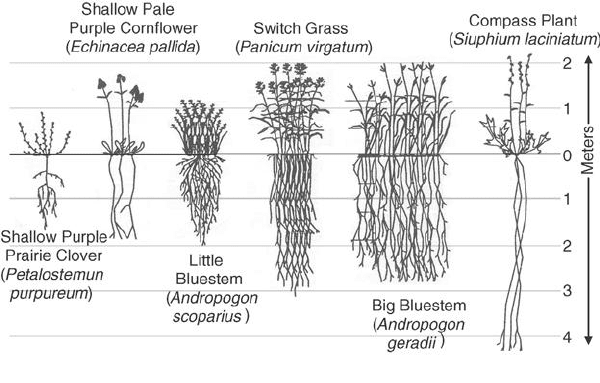
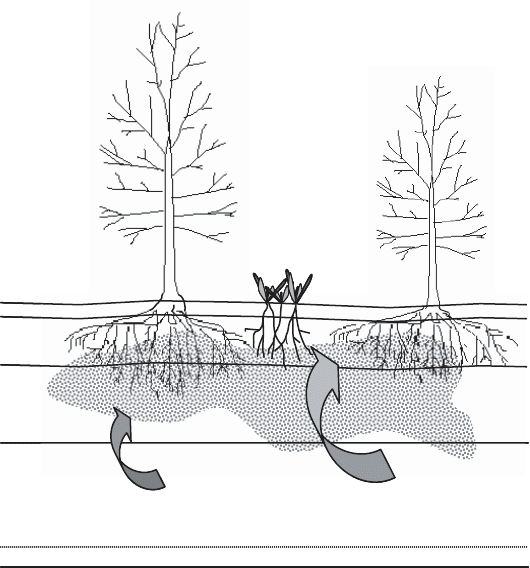
The majority of phytoremediation plant systems, such as those depicted schematically
in Figure 16.61, apply to soil depths extending to the first 2 to 3 m. In turn, most of these
plants probably draw their water either from roots closely aligned to the surface or water
drawn from vadose-zone pore moisture, as depicted in Figure 16.62. Most poplars, for
instance, tend to have shallower root systems, and as a result, these types of plants
have an inherent level of reliance on water being precipitated into, and then passed
through, the surface soils.
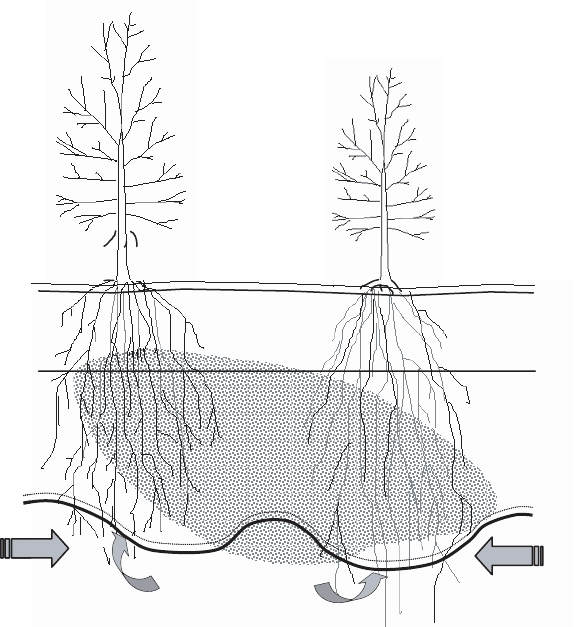
However, there are also deep-rooting plants that maintain a more water-loving life-
style, in which their root systems extend into the capillary soil region or underlying satu-
rated ground water zone (see Figure 16.63). These phreatophytic plants tend to have
remarkable high summertime water uptake rates, possibly as a competitive means of try-
ing to restrict the growth of their fellow plants. These deep-rooting plants generally have
higher levels of plant biomass as well as higher overall growth rates.
With plants such as poplars, although they may not normally pursue this sort of phrea-
tophytic growth mode, it is possible to induce these plants to form deep root systems using
special drip-irrigation practices that effectively train them to pursue progress ively deeper
levels of water uptake. Aside from extending the potential reach of these phytoremediat-
ing plants to lower levels, this induction of a deep-rooting preference helps the plan t with
its future water demand. However, at these deeper strata the matter of oxygen availability
subsequently becomes a concern, as does the presence of nutrients. Furthermore, deeper
soils usually tend to be more tightly packed, such that root impedance may also be an
important factor.
When motivated to adopt this phreatophytic mode, though, alders, ash, aspen, river
birch, and poplar have proven to be fast growers and rapid water user s, with daily uptake
rates during peak summert ime periods ranging from 100 to as much as 1000 L/day per
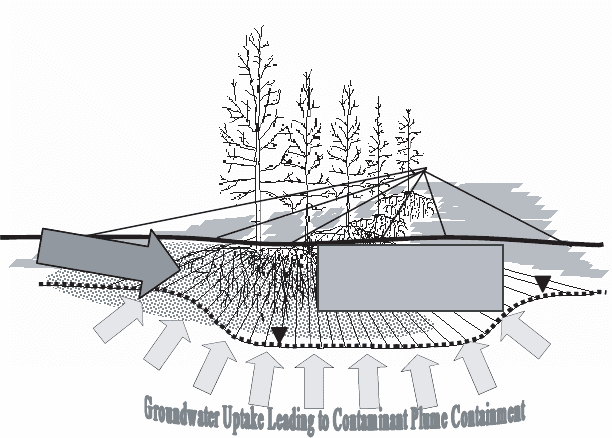
tree. The resulting uptake of water from the deep, saturated soil zone may actually pro-
duce a sizable depression of 5 to 10 cm in the water table within the capture zone where
water is being used by the trees. Field studies of this sort have been able experimentally to
Figure 16.61 Representative phytoremediation plant variations.
682
BIOLOGICAL APPLICATIONS FOR ENVIRONMENTAL CONTROL
develop hydraulic barrier strips usin g deeply rooted trees planted in rows aligned perpen-
dicular to the direction of travel for the contaminated plume (as in Figure 16.64).
Of course, the actual process of evapotranspiration depends not only on the location
and depth of the roots, but also on the numb er of plant and atmospheric parameters.
The rate of water use by plants depends on the conductance of water through the plant
stoma as well as the cumulative surface area of the leaves through which the water
will finally be released into the atmosphere. The air temperature, wind speed, humidity,
and radiation intensity will also play a part in the final rate of this release.
For those phytoremediation systems that employ trees, the spacing provided with the
original plants can also prove to be an important factor. Of course, trees spaced too far
apart will not be able to provide nearly as much of a remediating impact, but plants spaced
too tightly together can also experience problems, partic ularly as they reach maturity. In
particular, tightly bunched trees block each other’s light, and they will probably end up
contending for limiting nutrients. Recommended estimates for seedling plantings are in
the neighborhood of several thousand seedlings per hectare, which will drop to a level
of a few thousand after natural thinning takes place during the first few years of growth.
Clearly, there are instances in which phytoremediation systems can play a significant role
in site restoration, but it is not a universal solution for every contaminated soil. In some
Capillary Fringe
Groundwater Zone
Phytoremediation
Activity
Phytoremediation
Activity
Contaminated Soil Zone
Figure 16.62 Surface and vadose-zone contaminant remediation via phytoremediation.
SOIL AND GROUNDWATER TREATMENT 683
cases, the contaminants may simply be toxic to the plants, and in others the soils will not
be amenable to plant growth. Many strongly sorbed contaminants, such as PCBs or PAHs,
may be too tightly adhered onto soils to be amenable to rhizospheric degradation or
uptake. There will also be instances involving contaminants that would be bioaccumulated
into the plants (either directly or as metabolic intermediates) in forms and at concentra-
tions that are unsafe and unacceptable.
16.7.2 Bioremediation
The process of removing, or at least significantly degrading, the presence of contaminants
in soils and groundwater using biology at the microbial level alone is known as bioreme-
diation (Anderson et al., 1993). Bacteri a and fungi play the dominant role in these sys-
tems. They metabolically degrade a variety of industrial, and in some instances even
hazardous, wastes into less toxic, or perhaps nontoxic, products. There are two basic
options to the circumstances under which a bioremediating activity might develop: the
intrinsic and the engineered options. The underlying differences between them are related
to the source of the responsible microbial agents and whether their presence stems from
Groundwater Table
Depression Induced with
Evapotranspiration by
Groundwater Table
Depression Induced with
Evapotranspiration by
Deep-Rooted Phytoremediation Plants
Groundwater Flow
Drawn Toward
Phytoremediation Site
Figure 16.63 Groundwater contaminant remediation via phytoremediation.
684
BIOLOGICAL APPLICATIONS FOR ENVIRONMENTAL CONTROL
naturally occurring organisms or a manipulated, and possibly even externally seeded,
colonization.
At those sites where intrinsic bioremediation has been found to occur, the environmen-
tal conditions and contaminan t characteristics of the site (i.e., types of contaminants, rela-
tive concentrations, etc.) are such that microbes already present in the soil and/or
groundwater will naturally begin the remediating process of chemical degradation. In
fact, it is likely that many contaminated sites could experience some degree of intrinsic
bioremediation, given the biochemical diversity and metabolic flexibility of the microbial
world. However, the unfortunate reality of intrinsic bioremediation is that it often fails to
develop at a rate or degree that is sufficiently robust to fully remediate a given site within a
time frame that is acceptably short. There are many reasons for these shortcomings. The
chemistry of the soils might not have been conducive to microbial growth, as would be
the case with pH extremes or nutrient limitations. There may also be physical limitations
or constraints with these soils, created perhaps by extreme (whether high or low) moisture
contents or unduly low soil permeabilities that hinder the movement of the bacteria or
the necessary substrates and nutrients. Yet another set of problems could develop due
to the contaminants themselves, which might either be recalcitrant in form or present
at levels sufficiently high to inhibit, or possi bly even kill, the existing microbes.
The strategy of invoking engineering methods was developed to enhance the attainable
rate and efficacy of bioremediation. A wide variety of engineered bioremediation proce-
dures have now been developed, including plans that attempt to optimize the environmen-
tal conditions under which these microbial reactions might occur and also to instigate and
promote the growth of suitabl e microorganisms. These engineered bioremediation sys-
tems can largely be subdivided into two primary options (see Figure 16.65) In situ treat-
ment means, literally, ‘‘in place,’’ as opposed to ex situ treatment, in which soil is
excavated for treatment aboveground.
Phytoremediation
- Contaminant degradation
- Plume containment
Original Contaminant
PlumeMigration
Phytoremediation
-
Contaminant degradation
-
Plume containment
Original Contaminant
PlumeMigration
Original Contaminan
t
Plume Migra
t
ion
Figure 16.64 Groundwater uptake leading to contaminant plume containment.
SOIL AND GROUNDWATER TREATMENT 685

The synopsis given in le 16.17 provides an overview of the basic contaminant cate-
gories with which bioremediation has already proven to be a potentially suitable proce-
dure, as well as information regarding the relative characteristics of the various chemical
forms and the appropriate mode (aerobic or anaerobic) of their biochemical transforma-
tion. Several factors play an important role in this regard, including that of the
Soil and
Groundwater
Removal
Ex-Situ
Bioremediation
Above-Ground
Treatment
A
B
In-Situ
Bioremediation
Groundwater
Table
Figure 16.65 Engineered bioremediation options.
TABLE 16.17 Contaminant Forms Relative to Potential Bioremediation Treatment
Biodegradability
In Situ
Volatility
a
Solubility
b
——————————— Treatment
Contaminant Compounds ð/ K
H
) ð/ K
OW
) Aerobic Anaerobic Potential
Hydrocarbons
Gasoline (C
4
–C
12
) þþþ Yes
Kerosene (C
6
–C
15
) þ/þþ Ye s
Domestic fuel (C
9
–C
24
)
c
þ/ Yes
Lubricants (C
15
–C
40
) No
Aromatic hydrocarbons (BTEX) þþþþ/ Yes
Polycyclic aromati chydrocarbons
Light (2-3 rings) þ/þ/
c
þ Yes
Heavy (4-5 rings)
c
No
Chlorinated hydrocarbons
Aliphatics þþþ/ Yes
Chlorobenzene þþþ Yes
PCB No
Pesticides þ/ No
Heavy metals þ/
c
Yes
a
Contaminants that tend to be volatile (with high K
H
values) are listed as þ.
b
Contaminants that tend to be soluble in water (with low to moderate K
OW
values) are listed as þ.
c
Contaminant solubility can be increased by detergents (for hydrocarbons) or acidification (for heavy metals).
Source: Adapted from Staps (1990).
686 BIOLOGICAL APPLICATIONS FOR ENVIRONMENTAL CO NTROL

compound’s molecular weight and configuration, solubility, volatility, and degree of
halogenation. For example, the list of suitable hydrocarbon contaminants extends from
lighter fuels such as gasoline well into the heavier fuel range of 10 to 20 carbon atoms
(Kostecki and Calabrese, 1991). However, beyond this level, the heavy carbon compounds
(e.g., lubricants) are considerably less amenable to successful biodegradation. This pattern
extends to the family of aromatic hydrocarbons, where smaller two- to three-ring forms
may be biodegradable, whereas larger, four- and five-ring compounds are likely to be
highly recalcitrant.
The biochemically resistant nature of the larger aliphatic and aromatic hydrocarbons
stems not just from their size but also from their corresponding shift toward lower levels
of water solub ilities, as quantified by a determination of their octanol-to-water partition-
ing coefficient (K
OW
). This variable qualifies the extent to which any given compound is
attracted to (and miscible within) water as compared to its corresponding solubility in a
nonpolar solvent, octanol. Contaminants regarded as water-loving or hydrophilic will
have negative log K
OW
values, by which their solubility naturally ensures a maximal
opportunity for metabolic uptake and degradation. However, as the K
OW
increases, the
prospects for successful bioremediation begin to drop.
Moderately hydrophobic compounds with log K
OW
values extending up to 1 to 2 will
still be suitably available. The data given in le 16.18 for the BTEX (benzene, toluene,
ethylbenzene, and xylene) compounds exemplify the upper end of these permissible
values. Even though their log K
OW
figures range from 2.12 (benzene) to 3.26 (xylene),
these contaminants are all amenable to full aerobic catabol ism.
Nonpolar organic liquids that have low aqueous solubility, and thus form immiscible
phases, are commonly referred to as nonaqueous phase liquids (NAPLs), of which there
are two versions, dense NAPL (DNAPL) and light NAPL (LNAPL), depending on
whether they are more or less dense than water, respectively. Most hydrocarbon solvents
are LNAPLs (e.g., benzene or mixtures such as gasoline), whereas most chlorinated
hydrocarbon solvents (e.g., trichloroethylene, perchloroethylene) are DNAPLs. The sorp-
tive preference of these NAPL forms to coalesce on subsurface soils substantially limits
their available surface area and correspondingly constrains their effective bioavailability.
There are engineering strategies to counter this behavior, however, by which surfactant
(e.g., soaplike agents) chemicals can be introduced to increase the relative solubility of
low-solubility contaminants (e.g., NAPLs) in a fashion which then enhances their pro-
spective availability for metabolic degradation.
The volatility of a contaminant may also affect its rate of biodegradation, particula rly
given the fact that many bioremediation systems require aeration to enhance the
TABLE 16.18 Representative Aromatic Hydrocarbon (BTEX) Properties
Property Units Benzene Ethylbenzene Toluene Xylene
Empirical formula C
6
H
6
C
8
H
10
C
7
H
8
C
8
H
10
Molecular weight 78.12 106.18 92.15 106.18
Density at 20
C g/cm
3
0.88 0.87 0.87 0.87
Water solubility mg/L 1750 152 535 198
Henry’s constant (K
H
) atm m
3
/mol 5:59 10
3
6:43 10
3
6:37 10
3
7:04 10
3
Octanol–water (log K
OW
) Log K
OW
2.12 3.14 2.73 3.26
Partitioning coefficient
Source: Adapted from Verschueren (1983).
SOIL AND GROUNDWATER TREATMENT
687