
Vaccari D.A., Strom P.F., Alleman J.E. Environmental Biology for Engineers and Scientists
Подождите немного. Документ загружается.

9.0 g/h. If a can of beer contains 12 g of alcohol, how long does it take to eliminate
all of the alcohol from the body? (Assume a one-compartment mode l.) If a person
drinks one can of beer per hour, how much alcohol will be present 1 hour after
drinking the sixth can? Why would ethanol be eliminated by a zero-order process
instead of a first-order process?
18.5. For the case of Example 18.6, use equation (18.21) (solved for t) to compute how
long it would take for the body burden of an individual predator to increase from
zero to 40.0 mg/kg after it is placed in the contaminated environment. Note that
40.0 mg/kg is halfway from the initial to the steady-state condition. How does the
time required compare to the half-life for elimination? Why?
18.6. What do narcosis-causing compounds have in common with compounds that tend
to bioaccumulate? What properties would cause a compound to cause narcosis but
not bioaccumulate?
18.7. Why would narcosis-causing compounds tend to be less amenable to biological
wastewater treatment by the activated sludge process?
18.8. Convert equation (18.7) to the nonlogarithmic form. What does the result say
about the qu alitative relationship between K
OW
and C
s
? (Specifically, what is the
shape of the curve of K
OW
vs. C
s
?)
18.9. The pK
a
value of pentachlorophenol is 4.75. What will be the concentration of
undissociated pentachlorophenol in a solution with a total pentachlorophenol
concentration of 100 mg/L at pH 6.0? At pH well below the pK
a
, the adsorption
partition coefficient for pentachlorophenol to a soil is 840; at pH well above
the pK
a
, it is 6.10. What will be the effective adsorption coefficient at pH 4.75?
At pH 6.0?
18.10. If the environmenta l half-life of an organophosphorus pesticide were 100 days,
compute the rate coefficient, k, and t
99
.
18.11. What do bioconcentration, bioaccumulation, and biomagnification have in com-
mon? What distinguishes them from each other?
REFERENCES
Austin Community College, Chemistry Department, 2004. www.austin.cc.tx.us/chemlab/weakbase.htm.
Chiou, C. T., P. E. Porter, and D. W. Schmedding, 1983. Partition equilibria of nonionic organic
compounds between soil organic matter and water. Environmental Science and Technology,
Vol. 17, No. 4, pp. 227–231.
Christodoulatos, C., and M. Mohiuddin, 1996. Generalized models for prediction of pentachlo-
rophenol adsorption by natural soils, Water Environment Research, Vol. 68, No. 3.
Jørgensen, S. E., B. Halling-Sørensen, and H. Mahler, 1998. Handbook of Estimation Methods in
Ecotoxicology and Environmental Chemistry, CRC Press, Boca Raton, FL.
LaGrega, M. D., P. L. Buckingham, and J. C. Evans, 2001. Hazardous Waste Management, McGraw-
Hill, New York.
Lu, F. C., 1991. Basic Toxicology: Fundamentals, Target Organs, and Risk Assessment, 2nd ed.,
Hemisphere Publishing, Bristol, PA.
768
FATE AND TRANSP ORT OF TOXINS
Petrucci, R. H., W. S. Harwood, and F. G. Herring, 2001. General Chemistry, Prentice Hall, Upper
Saddle River, NJ.
U.S. EPA, 1994. Water Quality Standards Handbook, 2nd ed., EPA/823-B94/005a, U.S. Environ-
mental Protection Agency, Washington, DC, August.
Williams, P. L., and J. L. Burson (Eds.), 1985. Industrial Toxicology: Safety and Health Applications
in the Workplace , Van Nostrand Reinhold, New York.
REFERENCES 769

19
DOSE–RESPONSE RELATIONSHIPS
Toxicity is a relative measure of the ability of an agent to cause a harmful effect on a
living organism. All substances have toxic properties. Even water is an irritant to the
skin, and oxygen is toxic to humans at a high enough partial pressure and duration of
exposure. On the other hand, some substances that are common industrial toxins are
beneficial or even necessary to life at lower doses. This is particularly true with some
of the metals, such as chromium or nickel. Even ionizing radiation can fit this category.
Ultraviolet radiation from the sun converts 7-dehydrocholesterol in the skin into a form of
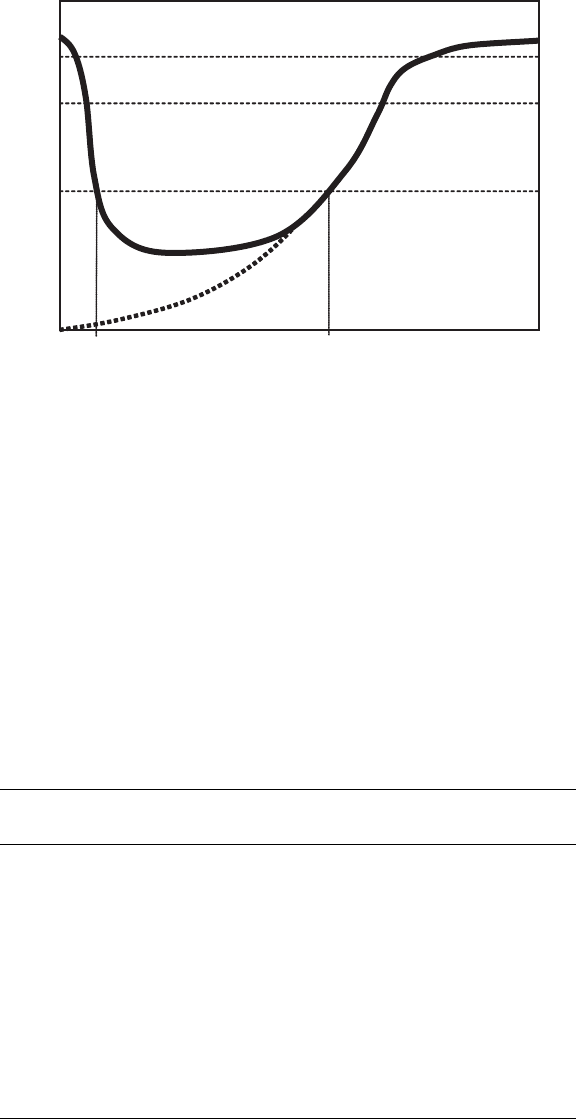
vitamin D, a necessary nutrient. Figure 19.1 compares the type of response of necessary
compounds with those that are not. Curve ðaÞ represents the case in which the substance is
a required nutrient; curve ðbÞ is the case for a substance that is not required. For case
ðaÞ there is a deficiency of the compound below the concentration C
1
, whereas it is
toxic above C
2
. Concentration C
1
would be related to the minimum daily dietary
requirement for the substance, and C
2
is related to the experimental value, called the
no observed adverse effect concentration (NOAEC).
The situation of curve ðaÞ in Figure 19.1 brings to mind a famous statement by the
sixteenth-century physician Paracelsus, often paraphrased as ‘‘the dose makes the
poison’’: ‘‘All substances are poisons; there is none which is not a poison. The right
dose differentiates a poison and a remedy.’’
Table 19.1 lists a number of substances that can be both toxic and essential. In the spirit
of Paracelsus, then, we must be interested in determining the dose–response relation-
ship: what dose of a toxin produc es what level of undesirable effect. Leaving until
later the discussion of selecting the particular effect of concern, and the experimental
details, let us assume situations similar to the following examples:
1. Two hundred white rats are divided into 10 groups of 20; each rat receives a
one-time subcutaneous (below the skin) injection of a quantity of a toxic substance
Environmental Biology for Engineers and Scientists, by David A. Vaccari, Peter F. Strom, and James E. Alleman
Copyright # 2006 John Wiley & Sons, Inc.
770
adjusted to the weight of the individual rat. The number of rats with tumors is
counted at 80 days.
2. Ten test tubes are prepared, each containing 20 Daphnia, a small crustac ean. The
concentration of a toxicant in the water of each tube is adjusted to a different
concentration. Percent mortality is measured at 96 hours.
In both cases, the individuals in the 10 groups each receive different dosages among
the following: 0 (control), 1, 2, 5, 10, 25, 50, 100, 250, and 500. The units in the former
case may be milligrams toxicant per kilogram of body weight; for the latter it could be
mg/L.
Homeostasis
Reversible damage
Irreversible damage
Death
Exposure concentration for fixed time
Toxic response
(a)
(b)
C
1
C
2
Figure 19.1 Hypothetical dose–response relationship for ðaÞ a substance required at low dosages
and ðbÞ a nonessential substance.
TABLE 19.1 Several Substances That Are Required for Growth But Are
Toxic at Higher Levels
Recommended Dietary
Substance Allowances (mg/day) Toxic Level
Iodine 0.15
Zinc 15 60 mg/day (LOAEL)
Selenium 0.05–0.2 0.8 – 1.0 mg/day
Copper 2.0–3.0 >3.0 mg/day
Chromium 0.05–0.2
Nickel 3500 mg/day
Iron 10 in males, 18 in females 0.8 mg/kg/day
Potassium 1875–5625
Sodium 2400 3500 mg/day
Vitamin D 10 mg 100 mg
Vitamin A 800 male, 1000 female (mgRE
a
) 500,000 mgRE
Vitamin E 8 male, 10 female (mg TE
a
) 800–3200 mg/day
a
RE, retinol equivalents; TE, a-tocopherol equivalents.
DOSE–RESPONSE RELATIONSHIPS
771

Dose can have different meanings, as the examples show. The use of mass per unit
body weight is ideal, as it ensures that the exposure of each individual is accurately
known. However, concentration units are often appropriate, especially with reference to
environmental pollution (mass/volume in air or water, or mass/mass in solids such as food
or soil). The concentration can refer to that of ambient air o r water, of ingested food or
water, or of a prepa ration to be applied to the skin or elsewhere. Or, in the case where
the toxicant is a complex mixture such as wastewater treatment plant effluent, one uses
dilutions measured in percent (volume/volume). In these cases it is more proper to talk
about the dose–concentration relationship.
Dose–response relationships can be divided into two types, based on the kind of
information used to describe them. One is the simpler empirical model, which begins
with assumptions about the shape of the dose–response relationship. These are called
tolerance distribution models. The other type is fundamental, based on knowledge or
assumptions about how a toxin acts. These are called mechanistic models .
19.1 TOLERANCE DISTRIBUTION AND DOSE–RESPONSE
RELATIONSHIPS
Due to individual variability, we do not expect a sharp threshold for an effect; that is, a
single value with no mortality at lower dose, and 100% mortality at a dose above that
level. If the range of concentrations is chosen properly, the usual situation will exhibit
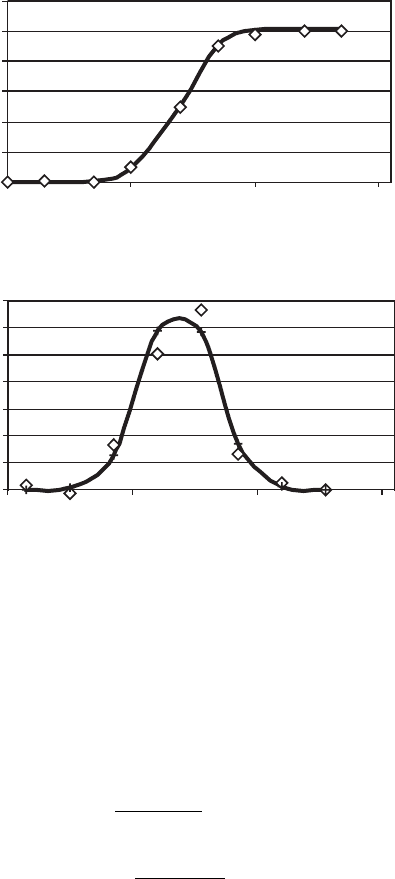
a sigmoidal response vs. either the dose or the logarithm of the dose (Figure 19.2a ).
That is, as dosage increases, the percent mortality will increase in a smooth, increasing
curve. The logarithm of the dose is often used, especially when the mean of the frequency
distribution is no more than two or three standard deviations above zero. This prevents the
theoretical problem of the distribution predicting toxic effects at negative dosages.
Each point on Figure 19.2a is the percent response, P
i
, at one dosage, d
i
. In the
Daphnia experiment example, this would be the result from one of the test tubes. If a
very large number of test tubes were tested covering a much larger number of different
dosages ðd
i
Þ, a histogr am could be prepared showing the frequency distribution for mor-
tality, called a tolerance distribution, TðdÞ. In typical toxicity tests there aren’t enough
dosage levels to do this. Instead, Tðd Þ can be estimated by numeri cally differentiating the
dose–response curve, PðdÞ, using successive pairs of points ðP
i
; d
i
Þ, ðP
iþ1
; d
iþ1
Þ, plotted at
the midpoint of each pair:
T
d
i
þ d
iþ1
2
’
P
iþ1
P
i
d
iþ1
d
i
ð19:1Þ
A sigmoidal dose–response curve would result in a bell-shaped tolerance distribution
as a function of dose. This leads naturally to an assumption of the normal distribution for
the shape of TðdÞ (Figure 19.2b). If this is a valid assumption, the dose–response curve
will be given by the integral of the normal distribution:
PðdÞ¼
Z
Y
1
1
ffiffiffiffiffiffi
2p
p
exp
u
2
2
du Y ¼ a þbx ð19:2Þ
where x is either the dose, d, or the logarithm of the dose, as described above. The dis-
tribution has two para meters, a and b, related to the mean, d
mean
, and standard deviation,
772 DOSE–RESPONSE RELATIONSHIPS
s, of the tolerance distribution. Several methods are available for estimat ing them. They
could be computed directly from the points of TðdÞ computed using the method of
moments. The procedure is as follows. First, equation (19.1) is used to compute TðdÞ.
Then the following equations are used to compute the mean and standard deviation:
d
mean
¼
P
i
d
i
Tðd
i
Þ
P
i
Tðd
i
Þ
ð19:3Þ
s ¼
ffiffiffiffiffiffiffiffiffiffiffiffiffiffiffiffiffiffiffiffiffiffiffiffiffiffiffiffiffiffiffiffiffiffiffiffiffiffi
P
i
d
2
i
Tðd
i
Þ
P
i
Tðd
i
Þ
d
2
mean
s
ð19:4Þ
Several regression methods are also available, including nonlinear regression and maxi-
mum likelihood estimation. These have the advantage of producing not only the para-
meters but also a confidence interval for the dose–response curve predicted. The
disadvantage of all the foregoing methods is that they may produc e poor results if the
data are not normally distributed or if the data do not cover the range of toxic effects
well. That is, the data must include at least one dosage with essentially zero response
and one with about 100% response. For example, if a bioassay on a wastewater produces
30% mortality at 100% concentration, these methods will not work.
0
20
40
60
80
100
120
140
01 2 3
0
20
40
60
80
100
120
0123
Dose-response curve
Percent mortality
Log dose
Lo
g
dose
Slope of response
Toxicity distribution
(a)
(b)
Figure 19.2 ðaÞ Sigmoidal logarithmic dose–response relationship; ðbÞ normal tolerance
distribution of mortality frequency.
TOLERANCE DISTRIBUTIO N AND DOSE–RESPONSE RELATIO NSHIPS 773
There are several procedures, called nonparametric methods, that do not make dis-
tributional assumptions. One of thes e is the trimmed Spearman–Kar ber method, which is a
numerical procedure for estimating the centroid of the tolerance distribution. Another is
the binomi al confidence interval, which is used when the data do not include partial kills.
The nonparametric methods, however, often cannot estimate the standard deviation of the
tolerance distribution.
The d
mean
corresponds to the dose at which half of an exposed population would be
expected to suffer the effect. This is called the median lethal dose ðLD
50
Þ or median
effective dose ðED
50
Þ. Of course, LD, refers only to results of tests where the measured
response is mortality; ED, on the other hand, can be based on any toxicological effect. If
the dose is measured in concentration units, the median may be refered to as lethal con-
centration ðLC
50
Þ or effective concentration ðEC
50
Þ instead. If the effect is reduction in
growth rate, as commonly applied to microorganisms, a parameter known as the medi an
inhibitory concentration ðIC
50
Þ may be used. This is the concentration that would reduce
the growth rate by 50%. These parameters are commonly used as a basi s to compare the
toxicity of various toxic agents. A common qualitative classification of LD
50
is given in
Table 19.2. Keep in mind that although only 50% may experience mortality at a given
dosage, it is likely that all the organisms will suffer deleterious toxicological effects
but that some may recover or at least survive. In the following discussion of toxicity,
we will refer to LD
50
, although the same principles apply to the other measures of median
effect.
Of course, it must be noted that the LD
50
is a property not only of the toxic agent but
also of experimental variables such as the organism, the time scale of the test, the method
of dosing, and so on. One can also refer to other percentiles, such as the lethal dose that
causes 1% or 10% mortality, the LD
01
or LD
10
, respectively.
The standard deviation, s, is related to the ‘‘steepness’’ of the dose–response relation-
ship. A steep slope indicates that the organism responds strongly to increases in dosage. A
flatter response curve can be caused by slow absorption, rapid excretion or detoxification,
or delayed bioactivation. In a normal distribution, 68.3% of the population will be within
one standard deviation of the mean, 95.5% within two, and so on. Table 19.3 summarizes
the relationship. Precise standard deviations are given for several of the percentiles of
interest (e.g., 1% and 10%). These can be used to compute LD
01
and LD
10
from s and
LD
50
, keeping in mind that the standard deviation is computed in log- transformed units:
LD
01
¼ LD
50
10
2:326 s
ð19:5Þ
LD
10
¼ LD
50
10
1:282 s
ð19:6Þ
TABLE 19.2 Qualitative Classification of Toxic Compounds
Classification LD
50
Range (mg/kg) Example LD
50
of Example
Supertoxic 5 or less Dioxin in guinea pig 0.002
Extremely toxic 5–50 Parathion in goats 42
Highly toxic 50–500 DDT in rat 100
Moderately toxic 500–5,000 Strychnine in rat 2,000
Slightly toxic 5,000–15,000 Ethanol in mouse 10,000
Practically nontoxic > 15,000
774
DOSE–RESPONSE RELATIONSHIPS

Thus, you should be able to see that two compounds could have the same LD
50
, but if
one has a larger value of s (a less steep dose–response curve), its LD
10
and LD
01
will be
lower. This has important consequences for the use of toxicological data in environmental
applications. A mortality of 50% woul d be far too high to be tolerated in real life. How-
ever, handbooks often report only the LD
50
. Thus, the potential exists to greatly overes-
timate, or worse, underestimate the relative toxicity of a compound. Thus, it would be
useful for slope information or lower percentile LD values to be given also. However,
these data are not commonly available. Note, on the other hand, that because the dose–
response relationship is flatter near the LD
01
or LD
10
, the uncertainty in their values will
be much greater than for LD
50
.
Example 19.1 Table 19.4 contains hypothetical results from an aquatic bioassay on the
toxicity of wastewater to Daphnia. The first column, d, is the dosage as the percentage of
wastewater in the solution to which the Daphnia were exposed. The second column, n,is
the total number of organisms tested at each dosage; the third column, m, is the number
killed after 48 hours of exposure; and M is the percent morta lity, m=n. Since the control
ðd ¼ 0%Þ shows 4.7% mortality, we should first decrease both n and m by 4.7% of m. The
ratio of the resulting numbers is the adjusted percent mortality, M
0
. A plot of M
0
versus d
gives the dose–response curve shown in Figur e 19.2 a .
TABLE 19.3 Normal Distribution and the Relation to Probits
Standard Deviations Cumulative
from the Mean Probits Percentage
3 2 0.14
2 3 2.28
1 4 15.9
0 5 50.0
1 6 84.1
2 7 97.7
3 8 99.87
3.090 1.910 0.10
2.326 2.674 1.00
1.282 3.718 10.0
0.674 4.326 25.0
TABLE 19.4 Hypothetical Aquatic Bioassay Results and Tolerance Distribution Analysis
dnmMMdTðdÞ d Td
2
T
0% 43 2 4.7% 0.0% 20% 0.103 0.021 0.004
40% 35 3 8.6% 4.1% 45% 1.309 0.589 0.265
50% 38 8 21.1% 17.2% 55% 2.877 1.582 0.870
60% 33 16 48.5% 46.0% 65% 1.994 1.296 0.843
70% 40 27 67.5% 65.9% 75% 2.305 1.728 1.296
80% 38 34 89.5% 89.0% 85% 0.521 0.443 0.377
90% 36 34 94.4% 94.2% 95% 0.265 0.252 0.239
100% 33 32 97.0% 96.8% 9.374 5.911 3.894
TOLERANCE DISTRIBUTIO N AND DOSE–RESPONSE RELATIO NSHIPS 775

From the data we can see that 50% mortality falls between dosages of 60 and 70%. By
interpolating linearly between these two points, we can estimate LC
50
as 62.0%. Simi-
larly, LC
10
falls between 40 and 50% concentration, and by interpolation we find LC
10
to be 44.5%. However, we would expect the latter value to be too high, because the
response curve in this region will be curved upward. Better accuracy can be obtained
using the method of moments. First, it is necessary to compute the tolerance distribution
using equation (19.1). This gives the results shown in the sixth and seventh columns of
Table 19.4 [d and TðdÞ] and plotted in Figure 19.2b. Note that the dosages correspond to
the midpoints between those in the first column.
Equations (19.2) and (19.3) require the sums of T, dT, and d
2
T. These values are
tabulated in the last three colu mns of Table 19.4, and the sums are the numbers in the
bottom row. Thus, the mean of the distribution is d
mean
¼ 5:911=9:374 ¼ 63:1%, and
s ¼ð3:894=9:374 0:631
2
Þ
1=2
¼ 13:3%. Thus, LC
50
¼ 63:1%, and from equations
(19.5) and (19.6), LC
10
¼ 42:6 and LC
01
¼ 30:9 %. You can see that in this case, the inter-
polation estimates of LC
50
and LC
10
were not far off and that the LC
10
was overestimated,
as expected. The curves in Figure 19.2a and b are the normal distribution with the mean
and standard deviation from this example.
Toxicology retains a curious legacy from precomputer days. To simplify hand calcula-
tions involving the normal distribution, toxicologists avoided the use of negative numbers
by the expedient of adding an arbitrary value of 5 to the standard deviations. The resulting
units are called probits. Thus, 2 standard deviations from the mean is the same as þ3
probits (see Table 19.3). The median, or LD
50
(0 standard deviations) becomes 5 probits.
This has become standard practice and remains in use today.
The assumption that the tolerance distribution is normal is not based on fundamental
principles, and a number of other distributions have been proposed. The best known is the
logit, in which the following equation replaces equat ion (19.2):
P ¼
e
Y
1 þ e
Y
ð19:7Þ
Another is the logistic function, which is based on hit theory (described in the next
section):
P ¼
1
1 þ e
ðaþbxÞ
ð19:8Þ
These models have advantages over the probit model in that the parameters of the logit
model can be estimated by linear least-squares methods, and the logistic equation has a
mechanistic basis. However, the probit or log-probit model is more established. The prac-
tical differences between these models are not very great, and their selection is often a
matter of personal preference and custom.
19.2 MECHANISTIC DOSE –RESPONSE MODELS
These models developed from hit theory explanations for carcinogenesis, and cancer
remains their most important application. The one-hit model (originally developed for
radiation effects) fits the assumption that a single reaction event can transform a cell to
776 DOSE–RESPONSE RELATIONSHIPS

produce the toxic effect, and that the probability of a hit occurring is proportional to the
dosage:
PðdÞ¼1 expðbdÞ b > 0 ð19:9Þ
However, the one-hit model did not fit data well. A multihit model improved this situation.
It assumed that several hits were necessary for a toxic effect, all of which had the same
probability. This led to the multistage model, to fit the theory of carcinogenesis, which
requires several hits to the same cell, each having different probabilities, to produce a
malignancy:
PðdÞ¼1 exp
X
k
i¼1
b
i
d
i
!
b
i
0 ð19:10Þ
The parameter k is the number of stages. Although evidence may indicate many stages
(e.g., five stages in the case of colon cancer described above), for statistical validity
at least k þ 1 different dosage levels must be tested to determine k coefficients. It is
often cost prohibitive to have so many levels. Note that dosage in these models is not
log-transformed, as is often done in the probit model.
Both of these models approach linearity as dose goes to zero. However, when equation
(19.10) is extrapolat ed to doses far below those used in the calculation, the uncertainty
becomes large. This is handled by replacing the linear term in equation (19.10)
(the term with i ¼ 1) with its upper 95% confidence limit. This results in the linearized
multistage model, which is the preferred model in use by the U.S. EPA for carcinogenesis.
All of these models are linear in the low-concentration range. However, the one-hit
model cannot describe a sigmoidal curve. The multistage model can, and has the further
advantage over the probit or normal distribution model that it can describe asymmetric
tolerance distributions.
19.3 BACKGROUN D RESPONSE
For the probit model any toxic response in zero dosage control is usually subtracted from
all the data. Thus, what is used in the calculations is the excess mortality or toxic effect.
For stochastic biological models, where a hit can be caused by natural background causes,
the response can be adjusted for the probability of that o ccurring. In this case, PðdÞ is
interpreted as the additional risk over background, which can be attributed to the dose d:
PðdÞ¼
P
ðdÞp
1 p
ð19:11Þ
where P
ðdÞ is the observed response and p is the probability of a spontaneous hit. The
value of p may be so small that it cannot be measured directly in laboratory animals. In
such a case, it could be estimated by extrapolating dose–response data to zero dose, as
described in the next section.
19.3.1 Low-Dose Extrapolation
For many toxic effects, especially carcinogenesis, the goal is to control environmental
exposures to keep the risk at an extremely low level. A typical regulatory goal for a
BACKGROUND RESPONSE 777