
Velten K. Mathematical Modeling and Simulation: Introduction for Scientists and Engineers
Подождите немного. Документ загружается.


4.4 Closed Form Solutions 255
4.4.1
Problem 1
So let us reconsider the one-dimensional heat equation now (Equation 4.1 in
Section 4.2):
∂T
∂t
=
K
Cρ
·
∂
2
T
∂x
2
(4.49)
As discussed in Section 4.3.2, this equation needs boundary conditions for the
space variables and an initial condition at t = 0. Assuming (0, L)asthespatial
domain in which Equation 4.49 is solved (that is, x ∈ (0, L)), let us consider the
following initial and boundary conditions:
T(0, t) = 0 ∀t ≥ 0 (4.50)
T(L, t) = 0 ∀t ≥ 0 (4.51)
T(x,0)= T
0
∀x ∈ (0, L) (4.52)
where T
0
∈ R is a constant initial temperature. Note that this corresponds to Problem
1 in Section 4.1.3 with T
i
(x) = T
0
and T
0
= T
1
= 0. As was explained there, you can
imagine, for example, a cylindrical body as in Figure 4.1a with an initial, constant
temperature T
0
, the ends of this body being in contact with ice water after t = 0.
4.4.2
Separation of Variables
The above problem can now be solved using a separation of variables tech-
nique [111]. Note that a similar technique has been described for ODEs in Section
3.7.2. This method assumes a solution of the form
T(x, t) = a(x) · b(t) (4.53)
where the variables x and t involve separate functions a and b. Substituting Equation
4.53 in Equation 4.49 you get
db(t)/dt
K
Cρ
· b(t)
=
d
2
a(x)/dx
2
a(x)
(4.54)
Both sides of the last equation must equal some constant −k
2
with k = 0(itcan
be shown that T would be identically zero otherwise). This leads to a system of two
uncoupled ODEs:
db(t)
dt
+ k
2
K
Cρ
b(t) = 0 (4.55)

256 4 Mechanistic Models II: PDEs
d
2
a(x)
dx
2
+ k
2
a(x) = 0 (4.56)
Equation 4.55 can be solved using the methods in Section 3.7, which leads to
b(t) = Ae
−k
2
K/Cρt
(4.57)
where A is some real constant. The general solution of Equation 4.56 is
a(x) = B
1
· sin(kx) + B
2
· cos(kx ) (4.58)
where B
1
and B
2
are real constants. Equation 4.50 implies
B
2
= 0 (4.59)
and Equation 4.51 gives
kL = nπ (4.60)
or
k = k
n
=
nπ
L
(4.61)
for some n ∈ N.Thusforanyn ∈ N, we get a solution of Equation 4.56:
a(t) = B
1
· sin(k
n
x ) (4.62)
Using Equations 4.53, 4.57, and 4.62 gives a particular solution of Equations
4.49–4.51 for any n ∈ N as follows:
T
n
(x, t) = A
n
· sin(k
n
x ) · e
−k
2
n
K
Cρ
t
(4.63)
Here, A
n
is a real constant. The general solution of Equations 4.49–4.51 is then
obtained as a superposition of the particular solutions in Equation 4.63:
T(x, t) =
∞
n=1
T
n
(x, t) =
∞
n=1
A
n
· sin(k
n
x ) · e
−k
2
n
K
Cρ
t
(4.64)
The coefficients A
n
in the last equation must then be determined in a way such
that the initial condition in Equation 4.52 is satisfied:
T
0
= T(x,0)=
∞
n=1
A
n
· sin(k
n
x ) (4.65)
This can be solved for the A
n
using Fourier analysis as described in [111], which
finally gives the solution of Equations 4.49–4.52 as follows:
T(x, t) =
∞
n=1,3,5,...
4T
0
nπ
· sin(k
n
x ) · e
−k
2
n
K
Cρ
t
(4.66)

4.5 Numerical Solution of PDE’s 257
The practical use of this expression is, of course, limited since it involves an
infinite sum, which can only be evaluated approximately. An expression such as
Equation 4.66 is at what might be called the borderline between closed from solutions
and numerical solutions, which will be discussed in the subsequent sections. The
fact that we are getting an infinite series solution for a problem such as Equations
4.49–4.52 – which certainly is among the most elementary problems imaginable
for the heat equation – confirms our statement that numerical solutions are even
more important in the case of PDEs compared to ODEs.
4.4.3
A Particular Solution for Validation
Still, closed form solutions are of great use, for example, as a test of the correctness
of the numerical procedures. Remember that a comparison with closed form
solutions of ODEs was used in Section 3.8 to demonstrate the correctness of the
numerical procedures that were discussed there (e.g. Figure 3.9 in Section 3.8.2).
Inthesameway,wewillusetheparticularsolutionT
1
(x, t)fromEquation4.63as
a means to validate the finite difference method that is described in Section 4.6.
Assuming A
1
= 1inEquation4.63,T
1
turns into
T
∗
(x, t) = sin
π
L
x
· e
−
π
2
L
2
K
Cρ
t
(4.67)
which is the closed form solution of the following problem:
∂T
∂t
=
K
Cρ
·
∂
2
T
∂x
2
(4.68)
T(0, t) = 0 ∀t ≥ 0 (4.69)
T(L, t) = 0 ∀t ≥ 0 (4.70)
T(x,0)= T
∗
(x,0)= sin
π
L
x
∀x ∈ (0, L) (4.71)
4.5
Numerical Solution of PDE’s
Remember the discussion of the Euler method in Section 3.8.1.1. There, we wanted
to solve an initial-value problem for a general ODE of the form
y
(x) = F(x, y(x)) (4.72)
y(0) = a (4.73)
Analyzing the formulas discussed in Section 3.8.1, you will find that the main idea
used in the Euler method is the approximation of the derivative in Equation 4.72

258 4 Mechanistic Models II: PDEs
bythedifferenceexpression
y
(x) ≈
y(x + h) − y(x)
h
(4.74)
Using similar difference expressions to approximate the derivatives, the same
idea can be used to solve PDEs, and this leads to a class of numerical methods
called finite difference methods (often abbreviated as FD methods) [140]. An example
application of the FD method to the one-dimensional heat equation is given in
Section 4.6. The application of the FD method is often the easiest and most natural
thing to do in situations where the computational domain is geometrically simple,
for example, where you solve an equation on a rectangle (such as the domain
[0, L] × [0, T] used in Section 4.6).
If the computational domain is geometrically complex, however, the formulation
of FD methods can be difficult or even impossible since FD methods always need
regular computational grids to be mapped onto the computational domain. In such
situations, it is better to apply e.g. the finite-element method (often abbreviated as the
FE method ) described in Section 4.7. In the FE method, the computational domain
is covered by a grid of approximation points that do not need to be arranged in a
regular way as it is required by the FD method. These grids are often made up of
triangles or tetrahedra, and it is seen later that they can be used to describe even
very complex geometries.
Similar to the numerical methods solving ODEs discussed in Section 3.8.1,
numerical methods for PDEs are discretization methods in the sense that they
provide a discrete reformulation of the original, continuous PDE problem. While
the discussion in this book will be confined to FD and FE methods, you should
note that there is a number of other discretization approaches, most of them
specifically designed for certain classes of PDEs. For example, PDEs that are
formulated as an initial-value problem in one of its variables can be treated by the
method of lines, which basically amounts to a reformulation of the PDE in terms of
a system of ODEs or differential-algebraic equations [153]. Spectral methods are a
variant of the FE method involving nonlocal basis functions such as sinusoids or
Chebyshev polynomials, and they work best for PDEs having very smooth solutions
as described in [154]. Finite volume methods are often applied to PDEs based on
conservation laws, particularly in the field of CFD [155, 156].
4.6
The Finite Difference Method
4.6.1
Replacing Derivatives with Finite Differences
The FD method will be introduced now referring to the one-dimensional heat
equation 4.49 (see Section 4.2):
∂T
∂t
=
K
Cρ
·
∂
2
T
∂x
2
(4.75)

4.6 The Finite Difference Method 259
As was already mentioned above, the idea of the FD method is similar to
the idea of the Euler method described in Section 3.8.1.1: a replacement of the
derivatives in the PDE by appropriate difference expression. In Equation 4.75, you
see that we need numerical approximations of a first-order time derivative and of a
second-order space derivative. Similar to the above derivation of the Euler method,
the time derivative can be approximated as
∂T(x, t)
∂t
≈
T(x, t + t) − T(x, t)
t
(4.76)
if t is a sufficiently small time step (which corresponds to the stepsize h of the
Euler method). To derive an approximation of the second-order space derivative,
let x be a sufficiently small space step. Then, second-order Taylor expansions of
T(x, t)give
T(x + x, t) = T(x, t) +
∂T(x, t)
∂x
x +
1
2
∂
2
T(x, t)
∂x
2
(
x
)
2
+··· (4.77)
T(x − x, t) = T(x, t) −
∂T(x, t)
∂x
x +
1
2
∂
2
T(x, t)
∂x
2
(
x
)
2
−··· (4.78)
Adding these two equations, a so-called central difference approximation of the
second-order space derivative is obtained:
T(x, t + t) − T(x, t)
t
≈
T(x + x, t) +T(x − x, t) − 2T(x, t)
(
x
)
2
(4.79)
The right-hand sides of Equations 4.76 and 4.79 are called finite difference approxi-
mations of the derivatives. As discussed in [157], a great number of finite difference
approximations can be used for any particular equation. An important criterion
for the selection of finite difference approximations is their order of accuracy.For
example, it can be shown that the approximation in Equation 4.79 is fourth order
accurate in x, which means that the difference between the left- and right-hand
side in Equation 4.79 can be expressed as c
1
·
(
x
)
4
+ c
2
·
(
x
)
6
···where c
1
, c
2
, ...
are constants [157]. Hence, the approximation error made in Equation 4.79 de-
creases quickly as x → 0. Note that the high accuracy of this approximation
is related to the fact that all odd terms cancel out when we add the two Taylor
expansions (4.77) and (4.78). Substituting Equations 4.76 and 4.79 in Equation 4.75
gives
T(x, t + t) − T(x, t)
t
≈
K
Cρ
·
T(x + x, t) + T(x − x, t) − 2T(x, t)
(
x
)
2
(4.80)
4.6.2
Formulating an Algorithm
Assume now we want to solve Equation 4.75 for t ∈ (0, T]andx ∈ (0, L)where
T = N
t
· t (4.81)
L = N
x
· x (4.82)

260 4 Mechanistic Models II: PDEs
for N
t
, N
x
∈ N. Let us define
x
i
= i · x, i = 0, ..., N
x
(4.83)
t
j
= j · t, j = 0, ..., N
t
(4.84)
T
i,j
= T(x
i
, t
j
), i = 0, ..., N
x
, j = 0, ..., N
t
(4.85)
Then, Equation 4.80 suggests the following approximation for i = 1, ..., N
x
− 1
and j = 0, ..., N
t
− 1:
T
i,j+1
= T
i,j
+ η
T
i+1,j
+ T
i−1,j
− 2T
i,j
(4.86)
where
η =
Kt
Cρx
2
(4.87)
We will now use Equation 4.86 to solve Equations 4.68–4.71, since the closed
form solution of these equations is the known expression T
∗
(x, t) in Equation 4.67,
which can then be used to assess the accuracy of the numerical procedure. Using
the notation of this section, Equations 4.69–4.71 can be written as follows:
T
0,j
= 0, j = 0, ..., N
t
(4.88)
T
N
x
,j
= 0, j = 0, ..., N
t
(4.89)
T
i,0
= sin
π
L
ix
, i = 0, ..., N
x
(4.90)
Let us now write down Equation 4.86 for j = 0:
T
i,1
= T
i,0
+ η
T
i+1,0
+ T
i−1,0
− 2T
i,0
(4.91)
On the right-hand side of the last equation, everything is known from the initial
condition, Equation 4.90. Hence, Equation 4.91 can be used to compute T
i,1
for
i = 1, ..., N
x
− 1 (note that T
0,1
and T
N
x
,1
are known from Equations 4.88 and
4.89). Then, all T
i,j
with j = 0orj = 1 are known and we can proceed with Equation
4.86 for j = 1:
T
i,2
= T
i,1
+ η
T
i+1,1
+ T
i−1,1
− 2T
i,1
(4.92)
Again, everything on the right-hand side is known, so we get T
i,2
for i =
1, ..., N
x
− 1 from the last equation. Proceeding in this way for j = 2, 3, ...,allT
i,j
for i = 0, ..., N
x
and j = 0, ..., N
t
are obtained successively.
4.6.3
Implementation in R
Obviously, the procedure just described consists of the application of two nested
iterations, or, in the language of programming languages: it consists of two nested

4.6 The Finite Difference Method 261
loops. The first (outer) loop advances j from 0 to N
t
− 1, and within this loop there is
a second loop, which advances i from 1 to N
x
− 1. The entire algorithm is realized
in the R-program
HeatClos.r which is a part of the book software. The essential
part of this code consists of the two loops just mentioned:
1: for (j in 0:Nt){
2: for (i in 2:Nx)
3: T[i,2]=T[i,1]+eta*(T[i+1,1]+T[i-1,1]-2*T[i,1])
4: for (i in 2:Nx)
5: T[i,1]=T[i,2]
6:
...
7: }
(4.93)
The outer loop over j is defined in line 1 using Rs for command, which works
similar to Maximas
for command that was discussed in Section 3.8.1.2. This
commands iterates anything enclosed in brackets ‘‘
{...}’’ in lines 1–7, using
successive values
j = 0, j = 1, ...,j = Nt. The inner loop over i is in lines
2–3. The range of both the loops is slightly different from the ranges discussed
above for purely technical reasons (R does not allow arrays having index ‘‘0’’, and
hence all indices in
HeatClos.r begin with ‘‘1’’ instead of ‘‘0’’). The temperatures
are computed in line 3, which is in exact correspondence with Equation 4.86, except
for the fact that the index ‘‘2’’ is used here instead of ‘‘j + 1’’ and index ‘‘1’’ instead
of j. This means that
HeatClos.r stores the temperatures at two times only, the
‘‘new’’ temperatures in
T[i,2] and the ‘‘old’’ temperatures in T[i,1].Thisis
done to save memory since one usually wants to have the temperature at a few
times only as a result of the computation. In
HeatClos.r,avectorto defines these
fewpointsintimeandthe6ofthecode(whichwehaveleftouthereforbrevity).
After each time step, the next time step is prepared in lines 4–5 where the new
‘‘old’’ temperature is defined as the old ‘‘new’’ temperature.
Figure 4.6 shows the result of the computation. Obviously, there is a perfect
coincidence between the numerical solution (lines) and the closed form solution,
Equation 4.67. As was mentioned above, you can imagine Figure 4.6 to express
the temperature distributions within a one-dimensional physical body such as the
cylinder shown in Figure 4.1a. At time 0, the top curve in the figure shows a
sinusoidal temperature distribution within that body, with temperatures close to
100
◦
C in the middle of that body and temperatures around 0
◦
Catitsends.The
ends of the body are kept at a constant temperature of 0
◦
C according to Equations
4.69 and 4.70. Physically, you can imagine the ends of that body to be in contact
with ice water. In such a situation, physical intuition tells us that a continuous heat
flow will leave that body through its ends, accompanied by a continuous decrease
of the temperature within the body until T(x) = 0(x ∈ [0, 1]) is achieved. Exactly
this can be seen in the figure, and so you see that this solution of the heat equation
corresponds with our physical intuition. Note that the material parameters used
in this example (Figure 4.6 and
HeatClos.r) correspond to a body made up of
aluminum.
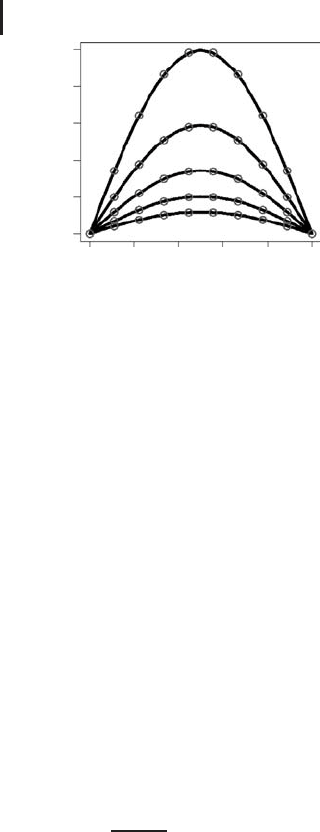
262 4 Mechanistic Models II: PDEs
100
80
60
40
20
0
0.0 0.2 0.4 0.6 0.8 1.0
Temperature (°C)
x
(
m
)
Fig. 4.6 Solution of Equations 4.68–4.71 for
K = 210 (cal/
◦
C/g), C = 900 (cal
◦
Cgs), ρ =
2700 (g/cm
3
), and L = 1. Lines: numerical
solution computed using
HeatClos.r based
on the finite difference scheme, Equation
4.86, at times t = 0, 625, 1250, 1875, 2500
s, which correspond to the lines from top
to bottom. Circles: closed form solution,
Equation 4.67.
4.6.4
Error and Stability Issues
In the general case, you will not have a closed form solution, which could be used as
in Figure 4.6 to assess the accuracy of the numerical solution. To control the error
within FD algorithms, you may look for error controlling algorithms that apply to
your specific FD scheme in the literature [3, 138, 150, 157]. Alternatively, you may
use the heuristic procedure described in Note 3.8.1, which means in this case that
you compute the solution first using x and t, and then the second time using
x/2andt/2. As explained in Section 3.8.2.1, you may assume a sufficiently
precise result if the differences between these two solutions are negligibly small.
Any newly written FD program, however, should first be checked using a closed
form solution similar to above.
Looking into
HeatClos.r, you will note that the time step t – which is denoted
as
Dt within HeatClos.r – is chosen depending on the space step x as follows:
t =
Cρx
2
8K
(4.94)
If you increase t above this value, you will note that beyond a certain limit
the solution produced by
HeatClos.r becomes numerically unstable, that is, it
exhibits wild unphysical oscillations similar to those that we have seen in the
discussion of stiff ODEs in Section 3.8.1.4. The stability of the solution, hence, is
an issue for all kinds of differential equation including PDEs. If you apply finite
difference schemes such as Equation 4.86, you should always consult appropriate
literature such as [140] to make sure that your computations are performed within
the stability limits of the particular method you are using. In the case of the FD
scheme Equation 4.86, a von Neumann stability analysis shows that stability requires

4.6 The Finite Difference Method 263
η =
Kt
Cρx
2
<
1
4
(4.95)
to be satisfied [111]. This criterion is satisfied by choosing t according to
Equation 4.94 in
HeatClos.r.
4.6.5
Explicit and Implicit Schemes
The FD scheme Equation 4.86 is also known as the leap frog scheme since it
advances the solution successively from time level j = 1toj = 2, 3, ..., similar to
the children’s game leapfrog [111]. Since the solution at a new time level j + 1can
be computed explicitly based on the given right-hand side of Equation 4.86, this
FD scheme is called an explicit FD method.
An implicit variant of the FD scheme Equation 4.86 is obtained if Equation 4.80
is replaced by
T(x, t + t) − T(x, t)
t
≈
K
Cρ
·
T(x + x, t + t) +T(x − x, t + t) − 2T(x, t + t)
(
x
)
2
(4.96)
which leads to the approximation
T
i,j+1
− T
i,j
t
=
K
Cρ
·
T
i+1,j+1
+ T
i−1,j+1
− 2T
i,j+1
x
2
(4.97)
for i = 1, ..., N
x
− 1andj = 0, ..., N
t
− 1. The last equation cannot be solved for
T
i,j+1
as before. T
i,j+1
is expressed implicitly here since the equation depends on
other unknown temperatures at the time level j + 1: T
i+1,j+1
and T
i−1,j+1
.Given
some time level j, this means that the equations (4.97) for i = 1, ..., N
x
− 1are
coupled and must be solved as a system of linear equations. Methods of this
kind are called implicit FD methods. Implicit FD methods are usually more stable
compared to explicit methods at the expense of higher computation time and
memory requirements (since a system of linear equations must be solved in
any time step for the implicit scheme Equation 4.97, while the temperatures in
the new time step could be obtained directly from the explicit scheme Equation
4.86). The implicit method Equation 4.97, for example, can be shown to be
unconditionally stable, which means that no condition such as Equation 4.95 must
be observed to ensure stable results without those unphysical oscillations discussed
above [140].
TheFDmethodEquation4.86isalsoknownastheFTCS method [158]. To
understand this, consider Equation 4.80 on which Equation 4.86 is based: as
was mentioned above, the right-hand side of Equation 4.80 is a central difference

264 4 Mechanistic Models II: PDEs
approximation of the second space derivative, which gives the letters ‘‘CS’’ (Central
difference approximation in Space) of ‘‘FTCS’’. The left-hand side of Equation 4.80,
on the other hand, refers to the time level t used for the approximation of the
space derivative and to the time level t + t, that is, to a time level in the forward
direction. This gives the letters ‘‘FT’’ (Forward difference approximation in Time)
of ‘‘FTCS’’. The implicit scheme (Equation 4.97) can be described in a similar way,
except for the fact that in this case the approximation of the time derivative goes
into the backward direction, and this is why Equation 4.97 is also known as the
BTCS method.
Note that there is a great number of other FD methods beyond the methods
discussed so far, most of them specifically tailored for special types of PDEs [138,
150, 157, 158].
4.6.6
Computing Electrostatic Potentials
After solving the heat equation, let us consider a problem from classical electrody-
namics: the computation of a two-dimensional electrostatic potential U(x, y)based
on a given distribution of electrical charges, ρ(x, y). The electrostatic potential is
known to satisfy the following PDE [111]:
∂
2
U(x , y)
∂x
2
+
∂
2
U(x , y)
∂y
2
=−4πρ(x, y) (4.98)
According to the classification in Section 4.3.1.3, this is an elliptic PDE which is
known as Poisson’s equation. Assume we want to solve Equation 4.98 on a square
(0, L) × (0, L). To formulate an FD equation, let us assume the same small space
step = L/N in the x and y directions (N ∈ N). Then, denoting U
i,j
= U(i, j),
ρ
i,j
= ρ(i, j) and using the central difference approximation for the derivatives
similar as above, the following FD equation is obtained for i = 1, ..., N − 1and
j = 1, ..., N − 1:
U
i,j
=
1
4
U
i+1,j
+ U
i−1,j
+ U
i,j+1
+ U
i,j−1
+ πρ
i,j
2
(4.99)
Note that all U terms in this equation are unknown, and hence this is again a
coupled system of linear equations, similar to the implicit BTCS scheme discussed
above. Equations of this kind are best solved using the iterative methods that are
explained in the next section.
4.6.7
Iterative Methods for the Linear Equations
Systems of coupled linear equations such as Equation 4.99 arise quite generally
in the numerical treatment of PDEs, regardless of whether you are using FD
methods, FE methods (Section 4.7), or any of the other methods mentioned in