
Versteeg H., Malalasekra W. An Introduction to Computational Fluid Dynamics: The Finite Volume Method
Подождите немного. Документ загружается.


3.7 RANS EQUATIONS AND TURBULENCE MODELS 77
the equipment (equivalent pipe diameter) by means of the following simple
assumed forms:
k = (U
ref
T
i
)
2
ε
= C
µ
3/4
= 0.07L
The formulae are closely related to the mixing length formulae given above
and the universal distributions near a solid wall given below.
The natural choice of boundary conditions for turbulence-free free
stream would seem to be k = 0 and
ε
= 0. Inspection of formula (3.44) shows
that this would lead to indeterminate values for the eddy viscosity. In prac-
tice, small, but finite, values are commonly used, and once again the sensitiv-
ity of the results to these arbitrary assumed values needs to be investigated.
At high Reynolds number the standard k–
ε
model (Launder and
Spalding, 1974) avoids the need to integrate the model equations right
through to the wall by making use of the universal behaviour of near-wall
flows discussed in section 3.4. If y is the co-ordinate direction normal to a
solid wall, the mean velocity at a point at y
P
with 30 < y
P
+
< 500 satisfies the
log-law (3.19), and measurements of turbulent kinetic energy budgets indi-
cate that the rate of turbulence production equals the rate of dissipation.
Using these assumptions and the eddy viscosity formula (3.44) it is possible
to develop the following wall functions, which relate the local wall shear
stress (through u
τ
) to the mean velocity, turbulence kinetic energy and rate
of dissipation:
u
+
==ln(Ey
+
P
) k =
ε
= (3.49)
Von Karman’s constant
κ
= 0.41 and wall roughness parameter E = 9.8 for
smooth walls. Schlichting (1979) also gives values of E that are valid for
rough walls.
For heat transfer we can use a wall function based on the universal near-
wall temperature distribution valid at high Reynolds numbers (Launder and
Spalding, 1974)
T
+
≡− =
σ
T,t
u
+
+ P (3.50)
with T
P
= temperature at near-wall point y
P
T
w
= wall temperature
C
p
= fluid specific heat at constant pressure
q
w
= wall heat flux
σ
T,t
= turbulent Prandtl number
σ
T,l
=
µ
C
p
/Γ
T
= (laminar or molecular) Prandtl number
Γ
T
= thermal conductivity
Finally P is the pee-function, a correction function dependent on the ratio of
laminar to turbulent Prandtl numbers (Launder and Spalding, 1974).
At low Reynolds numbers the log-law is not valid, so the above-
mentioned boundary conditions cannot be used. Modifications to the k–
ε
model to enable it to cope with low Reynolds number flows are reviewed in
Patel et al. (1985). Wall damping needs to be applied to ensure that viscous
D
E
F
J
K
L
σ
T,l
σ
T,t
G
H
I
A
B
C
(T − T
w
)C
p
ρ
u
τ
q
w
u
τ
3
κ
y
u
τ
2
C
µ
1
κ
U
u
τ
k
3/2
2
3
ANIN_C03.qxd 29/12/2006 04:34PM Page 77

and
C*
1
ε
= C
1
ε
−
η
= 2S
ij
. S
ij
η
0
= 4.377
β
= 0.012
Only the constant
β
is adjustable; the above value is calculated from near-
wall turbulence data. All other constants are explicitly computed as part of
the RNG process.
The
ε
-equation has long been suspected as one of the main sources of
accuracy limitations for the standard version of the k–
ε
model and the RSM
in flows that experience large rates of deformation. It is, therefore, interest-
ing to note that the model contains a strain-dependent correction term in the
constant C
1
ε
of the production term in the RNG model
ε
-equation (it can
also be presented as a correction to the sink term).
Yakhot et al. (1992) report very good predictions of the flow over a
backward-facing step. This performance improvement initially aroused
considerable interest and a number of commercial CFD codes have now
incorporated the RNG version of the k–
ε
model. Hanjaliz (2004) noted that
subsequent experience with the model has not always been positive, because
the strain parameter
η
sensitises the RNG model to the magnitude of the
strain. Therefore the effect on the dissipation rate
ε
is the same irrespective
of the sign of the strain. This gives the same effect if a duct is strongly
contracting or expanding. Thus, the performance of the RNG k–
ε
model is
better than the standard k–
ε
model for the expanding duct, but actually
worse for a contraction with the same area ratio.
Effects of adverse pressure gradients: turbulence models for
aerospace applications
Aerodynamic calculations, such as whole-aircraft simulations, involve very
complex geometries and phenomena at different length scales induced by
geometry (ranging from flows induced by vortex generators to trailing vortices
and fuselage wakes). The bulk of the flow will be effectively inviscid, but the
structure of the outer flow is affected by the development of viscous bound-
ary layers and wakes, so local effects at small scale can influence the state of
the entire flow field. Specification of a mixing length is not possible in flows
of such complexity and, as we have seen previously, the k–
ε
model does not
have an unblemished performance record. Leschziner (in Peyret and Krause,
2000) summarises the problems in this context as follows:
• The k–
ε
model predicts excessive levels of turbulent shear stress,
particularly in the presence of adverse pressure gradients (e.g. in curved
shear layers) leading to suppression of separation on curved walls
• Grossly excessive levels of turbulence in stagnation/impingement
regions giving rise to excessive heat transfer in reattachment regions
In such complex flows the RSM would be expected to be significantly better,
but the computational overhead of this method prevents its routine applica-
tion for the evaluation of complex external flows. Substantial efforts have
been made by the CFD community to develop more economical methods for
aerospace applications. We discuss the following recent developments:
• Spalart–Allmaras one-equation model
• Wilcox k–
ω
model
• Menter shear stress transport (SST) k–
ω
model
k
ε
η
(1 −
η
/
η
0
)
1 +
βη
3
88 CHAPTER 3 TURBULENCE AND ITS MODELLING
ANIN_C03.qxd 29/12/2006 04:35PM Page 88
3.7 RANS EQUATIONS AND TURBULENCE MODELS 89
Spalart---Allmaras model
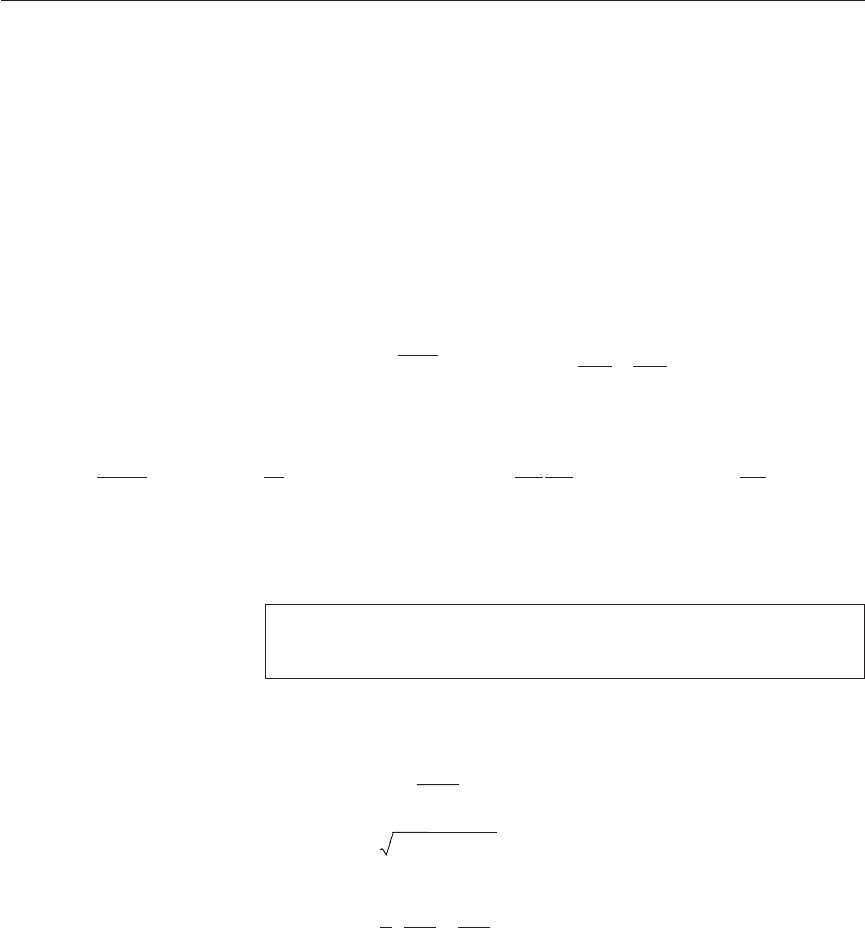
The Spalart–Allmaras model involves one transport equation for kinematic
eddy viscosity parameter 0 and a specification of a length scale by means
of an algebraic formula, and provides economical computations of boundary
layers in external aerodynamics (Spalart and Allmaras, 1992). The (dynamic)
eddy viscosity is related to 0 by
µ
t
=
ρ
0f
ν
1
(3.68)
Equation (3.68) contains the wall-damping function f
ν
1
= f
ν
1
(0/
ν
), which
tends to unity for high Reynolds numbers, so the kinematic eddy viscosity
parameter 0 is just equal to the kinematic eddy viscosity
ν
t
in this case. At
the wall the damping function f
ν
1
tends to zero.
The Reynolds stresses are computed with
τ
ij
=−
ρ
= 2
µ
t
S
ij
=
ρ
0f
ν
1
+ (3.69)
The transport equation for 0 is as follows:
+ div(
ρ
0U) = div (
µ
+
ρ
0) grad(0) + C
b2
ρ
+ C
b1
ρ
01 − C
w1
ρ
2
f
w
(3.70)
(I) (II) (III) (IV) (V) (VI)
Or in words
Rate of change Transport Transport of Rate of Rate of
of viscosity + of 0 by = 0 by turbulent + production − dissipation
parameter 0 convection diffusion of 0 of 0
In Equation (3.70) the rate of production of 0 is related to the local mean
vorticity as follows:
1 =Ω+ f
ν
2
where Ω= 2Ω
ij
Ω
ij
= mean vorticity
and
Ω
ij
=−=mean vorticity tensor
The functions f
ν
2
= f
ν
2
(0/
ν
) and f
w
= f
w
(0/(1
κ
2
y
2
)) are further wall-damping
functions.
In the k–
ε
model the length scale is found by combining the two trans-
ported quantities k and
ε
: = k
3/2
/
ε
. In a one-equation turbulence model
the length scale cannot be computed, but must be specified to determine the
rate of dissipation of the transported turbulence quantity. Inspection of the
destruction term (VI) of equation (3.70) reveals that
κ
y (with y = distance to
the solid wall) has been used as the length scale. The length scale
κ
y also
enters in the vorticity parameter 1 and is just equal to the mixing length used
in section 3.4 to develop the log-law for wall boundary layers.
D
E
F
∂
U
j
∂
x
i
∂
U
i
∂
x
j
A
B
C
1
2
0
(
κ
y)
2
D
E
F
0
κ
y
A
B
C
J
K
L
∂
0
∂
x
k
∂
0
∂
x
k
G
H
I
1
σ
ν
∂
(
ρ
0)
∂
t
D
E
F
∂
U
j
∂
x
i
∂
U
i
∂
x
j
A
B
C
u
i
′u
j
′
ANIN_C03.qxd 29/12/2006 04:35PM Page 89
90 CHAPTER 3 TURBULENCE AND ITS MODELLING
The model constants are as follows:
σ
ν
= 2/3
κ
= 0.4187 C
b1
= 0.1355 C
b2
= 0.622 C
w1
= C
b1
+
κ
2
These model constants and three further ones hidden in the wall functions
were tuned for external aerodynamic flows, and the model has been shown to
give good performance in boundary layers with adverse pressure gradients,
which are important for predicting stalled flows. Its suitability to aerofoil
applications means that the Spalart–Allmaras model has also attracted an
increasing following among the turbomachinery community. In complex
geometries it is difficult to define the length scale, so the model is unsuitable
for more general internal flows. Moreover, it lacks sensitivity to transport
processes in rapidly changing flows.
Wilcox k---
ωω
model
In the k–
ε
model the kinematic eddy viscosity
ν
t
is expressed as the product
of a velocity scale
ϑ
= k and a length scale = k
3/2
/
ε
. The rate of dissipa-
tion of turbulence kinetic energy
ε
is not the only possible length scale
determining variable. In fact, many other two-equation models have been
postulated. The most prominent alternative is the k–
ω
model proposed by
Wilcox (1988, 1993a,b, 1994), which uses the turbulence frequency
ω
=
ε
/k
(dimensions s
−1
) as the second variable. If we use this variable the length
scale is = k /
ω
. The eddy viscosity is given by
µ
t
=
ρ
k/
ω
(3.71)
The Reynolds stresses are computed as usual in two-equation models with
the Boussinesq expression:
τ
ij
=−
ρ
= 2
µ
t
S
ij
−
ρ
k
δ
ij
=
µ
t
+−
ρ
k
δ
ij
(3.72)
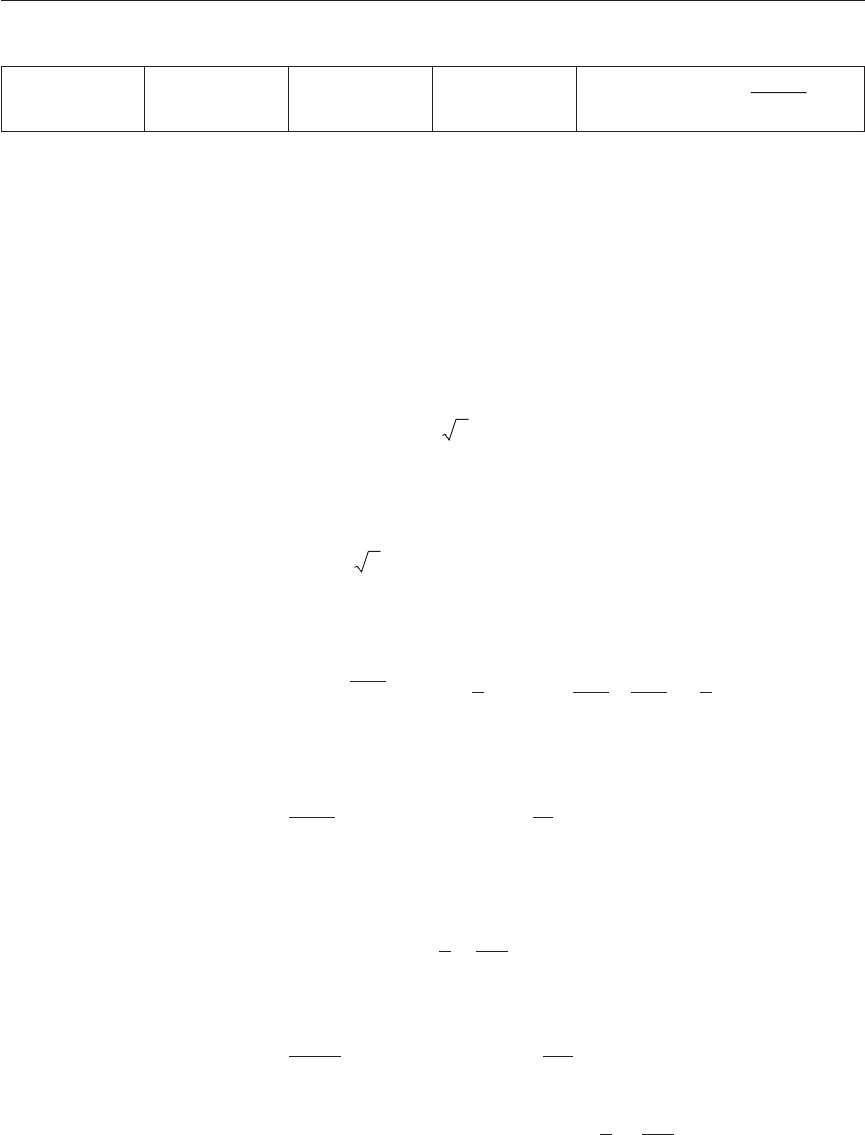
The transport equation for k and
ω
for turbulent flows at high Reynolds is
as follows:
+ div(
ρ
kU) = div
µ
+ grad (k) + P
k
−
β
*
ρ
k
ω
(3.73)
(I) (II) (III) (IV) (V)
where
P
k
= 2
µ
t
S
ij
. S
ij
−
ρ
k
δ
ij
is the rate of production of turbulent kinetic energy and
+ div(
ρω
U) = div
µ
+ grad(
ω
)
+
γ
1
2
ρ
S
ij
. S
ij
−
ρω δ
ij
−
β
1
ρω
2
(3.74)
D
E
F
∂
U
i
∂
x
j
2
3
A
B
C
J
K
L
D
E
F
µ
t
σ
ω
A
B
C
G
H
I
∂
(
ρω
)
∂
t
D
E
F
∂
U
i
∂
x
j
2
3
A
B
C
J
K
L
D
E
F
µ
t
σ
k
A
B
C
G
H
I
∂
(
ρ
k)
∂
t
2
3
D
E
F
∂
U
j
∂
x
i
∂
U
i
∂
x
j
A
B
C
2
3
u
i
′u
j
′
1 + C
b2
σ
ν
ANIN_C03.qxd 29/12/2006 04:35PM Page 90

3.7 RANS EQUATIONS AND TURBULENCE MODELS 91
Or in words
Rate of Transport Transport of k or Rate of Rate of
change + of k or
ω
by =
ω
by turbulent + production − dissipation
of k or
ω
convection diffusion of k or
ω
of k or
ω
The model constants are as follows:
σ
k
= 2.0
σ
ω
= 2.0
γ
1
= 0.553
β
1
= 0.075
β
* = 0.09
The k–
ω
model initially attracted attention because integration to the wall
does not require wall-damping functions in low Reynolds number applica-
tions. The value of turbulence kinetic energy k at the wall is set to zero. The
frequency
ω
tends to infinity at the wall, but we can specify a very large
value at the wall or, following Wilcox (1988), apply a hyperbolic variation
ω
P
= 6
ν
/(
β
1
y
P
2
) at the near-wall grid point. Practical experience with the
model has shown that the results do not depend too much on the precise
details of this treatment.
At inlet boundaries the values of k and
ω
must be specified, and at
outlet boundaries the usual zero gradient conditions are used. The boundary
condition of
ω
in a free stream, where turbulence kinetic energy k → 0 and
turbulence frequency
ω
→ 0, is the most problematic one. Equation (3.71)
shows that the eddy viscosity
µ
t
is indeterminate or infinite as
ω
→ 0, so a
small non-zero value of
ω
must be specified. Unfortunately, results of the
model tend to be dependent on the assumed free stream value of
ω
(Menter,
1992a), which is a serious problem in external aerodynamics and aerospace
applications where free stream boundary conditions are used as a matter of
routine.
Menter SST k---
ωω
model
Menter (1992a) noted that the results of the k–
ε
model are much less sensi-
tive to the (arbitrary) assumed values in the free stream, but its near-wall
performance is unsatisfactory for boundary layers with adverse pressure gra-
dients. This led him to suggest a hybrid model using (i) a transformation of
the k–
ε
model into a k–
ω
model in the near-wall region and (ii) the standard
k–
ε
model in the fully turbulent region far from the wall (Menter, 1992a,b,
1994, 1997). The Reynolds stress computation and the k-equation are the
same as in Wilcox’s original k–
ω
model, but the
ε
-equation is transformed
into an
ω
-equation by substituting
ε
= k
ω
. This yields
+ div(
ρω
U) = div
µ
+ grad(
ω
) +
γ
2
2
ρ
S
ij
. S
ij
−
ρω δ
ij
−
β
2
ρω
2
+ 2
(I) (II) (III) (IV) (V) (VI) (3.75)
Comparison with equation (3.74) shows that (3.75) has an extra source term
(VI) on the right hand side: the cross-diffusion term, which arises during the
ε
= k
ω
transformation of the diffusion term in the
ε
-equation.
Menter et al. (2003) summarise a series of modifications to optimise the
performance of the SST k–
ω
model based on experience with the model in
general-purpose computation. The main improvements are:
∂ω
∂
x
k
∂
k
∂
x
k
ρ
σ
ω
,2
ω
D
E
F
∂
U
i
∂
x
j
2
3
A
B
C
J
K
L
D
E
F
µ
t
σ
ω
,1
A
B
C
G
H
I
∂
(
ρω
)
∂
t
ANIN_C03.qxd 29/12/2006 04:35PM Page 91
92 CHAPTER 3 TURBULENCE AND ITS MODELLING
• Revised model constants:
σ
k
= 1.0
σ
ω
,1
= 2.0
σ
ω
,2
= 1.17
γ
2
= 0.44
β
2
= 0.083
β
* = 0.09
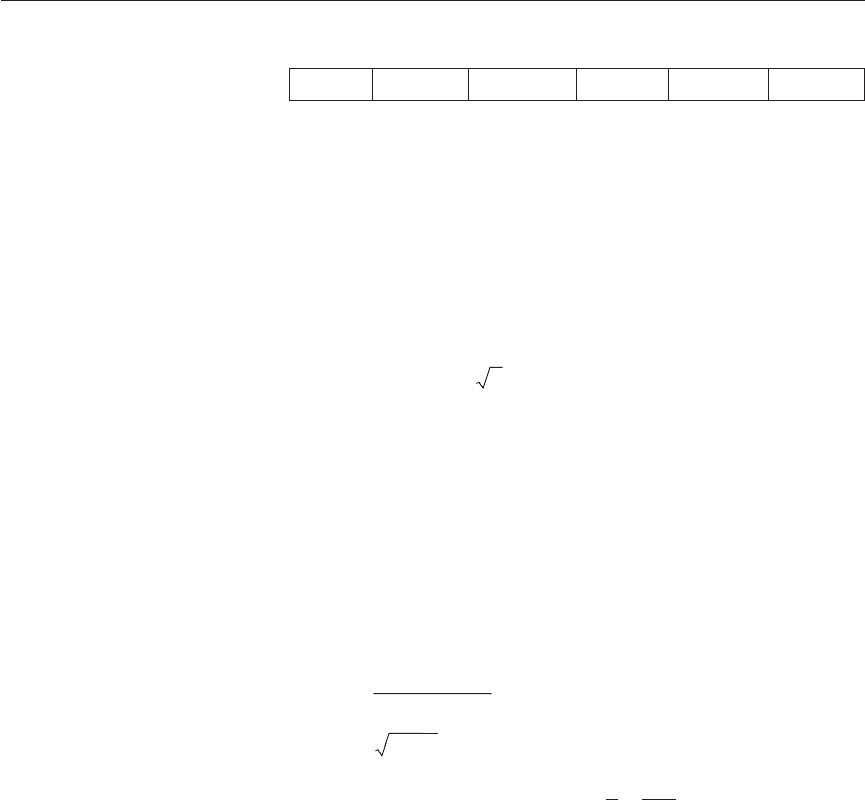
• Blending functions: Numerical instabilities may be caused by differences
in the computed values of the eddy viscosity with the standard k–
ε
model in the far field and the transformed k–
ε
model near the wall.
Blending functions are used to achieve a smooth transition between
the two models. Blending functions are introduced in the equation to
modify the cross-diffusion term and are also used for model constants
that take value C
1
for the original k–
ω
model and value C
2
in Menter’s
transformed k–
ε
model:
C = F
C
C
1
+ (1 − F
C
)C
2
(3.76)
Typically, a blending function F
C
= F
C
(
t
/y, Re
y
) is a function of the
ratio of turbulence
t
= k/
ω
and distance y to the wall and of a
turbulence Reynolds number Re
y
= y
2
ω
/
ν
. The functional form of
F
C
is chosen so that it (i) is zero at the wall, (ii) tends to unity in the
far field and (iii) produces a smooth transition around a distance half
way between the wall and the edge of the boundary layer. This way the
method now combines the good near-wall behaviour of the k–
ω
model
with the robustness of the k–
ε
model in the far field in a numerically
stable way.
• Limiters: The eddy viscosity is limited to give improved performance
in flows with adverse pressure gradients and wake regions, and
the turbulent kinetic energy production is limited to prevent the
build-up of turbulence in stagnation regions. The limiters are
as follows:
µ
t
= (3.77a)
where S = 2S
ij
S
ij
, a
1
= constant and F
2
is a blending function, and
P
k
= min 10
β
*
ρ
k
ω
, 2
µ
t
S
ij
. S
ij
−
ρ
k
δ
ij
(3.77b)
Assessment of performance of turbulence models for aerospace
applications
• External aerodynamics: The Spalart–Allmaras, k–
ω
and SST k–
ω
models are all suitable. The SST k–
ω
model is most general, and tests
suggest that it gives superior performance for zero pressure gradient
and adverse pressure gradient boundary layers, free shear layers and a
NACA4412 aerofoil (Menter, 1992b). However, the original k–
ω
model
was best for the flow over a backward-facing step.
• General-purpose CFD: The Spalart–Allmaras model is unsuitable, but
the k–
ω
and SST k–
ω
models can both be applied. They both have a
similar range of strengths and weaknesses as the k–
ε
model and fail to
include accounts of more subtle interactions between turbulent stresses
and mean flow when compared with the RSM.
D
E
F
∂
U
i
∂
x
j
2
3
A
B
C
a
1
ρ
k
max(a
1
ω
, SF
2
)
ANIN_C03.qxd 29/12/2006 04:35PM Page 92

3.7 RANS EQUATIONS AND TURBULENCE MODELS 93
Anisotropy
Two-equation turbulence models (i.e. k–
ε
, k–
ω
and other similar models)
are incapable of capturing the more subtle relationships between turbulent
energy production and turbulent stresses caused by anisotropy of the normal
stresses. They also fail to represent correctly the effects on turbulence of
extra strains and body forces. The RSM incorporates these effects exactly,
but several unknown turbulence processes (pressure–strain correlations, tur-
bulent diffusion of Reynolds stresses, dissipation) need to be modelled, and
the computer storage requirements and run times are significantly increased
compared with two-equation models. In order to avoid the performance
penalty associated with the solution of extra transport equations in the RSM,
several attempts have been made to ‘sensitise’ two-equation models to the
more complex effects. The first method to incorporate sensitivity to normal
stress anisotropy was the algebraic stress model. Subsequently, the research
groups at NASA Langley Research Center (Speziale) in the USA and at
UMIST (Launder) in the UK have developed a number of non-linear two-
equation models. These models are discussed below.
Algebraic stress equation model
The algebraic stress model (ASM) represents the earliest attempt to find an
economical way of accounting for the anisotropy of Reynolds stresses with-
out going to the full length of solving their transport equations. The large
computational cost of solving the RSM is caused by the fact that gradients
of the Reynolds stresses R
ij
etc. appear in the convective C
ij
and diffusive
transport terms D
ij
of Reynolds stress transport equation (3.55). Rodi and
colleagues proposed the idea that, if these transport terms are removed or
modelled, the Reynolds stress equations reduce to a set of algebraic equations.
The simplest method is to neglect the convection and diffusion terms
altogether. In some cases this appears to be sufficiently accurate (Naot and
Rodi, 1982; Demuren and Rodi, 1984). A more generally applicable method
is to assume that the sum of the convection and diffusion terms of the
Reynolds stresses is proportional to the sum of the convection and diffusion
terms of turbulent kinetic energy. Hence
− D
ij
≈−[transport of k (i.e. div) terms]
= (− . S
ij
−
ε
) (3.78)
The terms in the brackets on the right hand side comprise the sum of the rate
of production and the rate of dissipation of turbulent kinetic energy from the
exact k-equation (3.42). The Reynolds stresses and the turbulent kinetic
energy are both turbulence properties and are closely related, so (3.78) is
likely not to be too bad an approximation provided that the ratio /k does
not vary too rapidly across the flow. Further refinements may be obtained by
relating the transport by convection and diffusion independently to the
transport of turbulent kinetic energy.
Introducing approximation (3.78) into the Reynolds stress transport
equation (3.55) with production term P
ij
(3.57), modelled dissipation rate
u
i
′u
j
′
u
i
′u
j
′
u
i
′u
j
′
k
D
E
F
Dk
Dt
A
B
C
u
i
′u
j
′
k
Du
i
′u
j
′
Dt
ANIN_C03.qxd 29/12/2006 04:35PM Page 93

94 CHAPTER 3 TURBULENCE AND ITS MODELLING
Table 3.6 ASM assessment
Advantages:
• cheap method to account for Reynolds stress anisotropy
• potentially combines the generality of approach of the RSM (good
modelling of buoyancy and rotation effects possible) with the economy of
the k–
ε
model
• successfully applied to isothermal and buoyant thin shear layers
• if convection and diffusion terms are negligible the ASM performs as well
as the RSM
Disadvantages:
• only slightly more expensive than the k–
ε
model (two PDEs and a system
of algebraic equations)
• not as widely validated as the mixing length and k–
ε
models
• same disadvantages as RSM apply
• model is severely restricted in flows where the transport assumptions for
convective and diffusive effects do not apply – validation is necessary to
define performance limits
term (3.60) and pressure–strain interaction term (3.61) on the right hand side
yields after some rearrangement the algebraic stress model:
R
ij
==k
δ
ij
+
α
ASM
(P
ij
− P
δ
ij
) (3.79)
where
α
ASM
=
α
ASM
(P/
ε
)
and P = production rate of turbulence kinetic energy
The factor
α
ASM
must account for all the physics ‘lost’ in the algebraic
approximation. As indicated, it is a function of the ratio of the rates of pro-
duction and dissipation of turbulence kinetic energy, which will be close to
unity in slowly changing flows. The value of
α
ASM
is around 0.25 for swirling
flows. Turbulent scalar transport can also be described by algebraic models
derived from their full transport equations that were alluded to in section
3.7.3. Rodi (1980) gives further information for the interested reader.
The Reynolds stresses appear on both sides of (3.79) – on the right hand
side they are contained within P
ij
– so (3.79) is a set of six simultaneous alge-
braic equations for the six unknown Reynolds stresses R
ij
that can be solved
by matrix inversion or iterative techniques if k and
ε
are known. Therefore,
the formulae are solved in conjunction with the standard k–
ε
model equa-
tions (3.44)–(3.47).
Demuren and Rodi (1984) reported the computation of the secondary
flow in non-circular ducts with a somewhat more sophisticated version of
this model that includes wall corrections for the pressure–strain term and
modified values of adjustable constants to get a good match with measured
data in nearly homogeneous shear flows and channel flows. They achieved
realistic predictions of the primary flow distortions and secondary flow in
square and rectangular ducts. The latter is caused by anisotropy of the nor-
mal Reynolds stresses and can therefore not be represented by simulations of
the same situation with the standard k–
ε
model.
k
ε
2
3
2
3
u
i
′u
j
′
ANIN_C03.qxd 29/12/2006 04:35PM Page 94

3.7 RANS EQUATIONS AND TURBULENCE MODELS 95
Assessment of performance
The ASM is an economical method of incorporating the effects of anisotropy
into the calculations of Reynolds stresses, but it does not consistently per-
form better than the standard k–
ε
model (Table 3.6). Moreover, the ASM
can suffer from stability problems that can be attributed to the appearance of
singularities in the factor
α
ASM
=
α
ASM
(P/
ε
), which becomes indeterminate
in turbulence-free flow regions, i.e. when P → 0 and
ε
→ 0. Recently the
ASM has been rather overshadowed by the development of non-linear eddy
viscosity k–
ε
models, which will be discussed in the next section.
Non-linear k---
εε
models
Early work on non-linear two-equation models built on an analogy between
viscoelastic fluids and turbulent flows first noted by Rivlin (1957) and elabor-
ated by Lumley (1970). Speziale (1987) presented a systematic framework
for the development of non-linear k–
ε
models. The idea is to ‘sensitise’ the
Reynolds stresses through the introduction of additional effects in a math-
ematically and physically correct form.
The standard k–
ε
model uses the Boussinesq approximation (3.33) and
eddy viscosity expression (3.44). Hence:
−
ρ
=
τ
ij
=
τ
ij
(S
ij
, k,
ε
,
ρ
) (3.80)
This relationship implies that the turbulence characteristics depend on
local conditions only, i.e. the turbulence adjusts itself instantaneously as
it is convected through the flow domain. The viscoelastic analogy holds that
the adjustment does not take place immediately. In addition to the above
dependence on mean strain rate S
ij
, turbulence kinetic energy k, rate of dis-
sipation
ε
and fluid density
ρ
the Reynolds stress should also be a function
of the rate of change of mean strain following a fluid particle. So,
−
ρ
=
τ
ij
=
τ
ij
S
ij
, , k,
ε
,
ρ
(3.81)
When we studied the RSM we noted that
τ
ij
is actually a transported quantity,
i.e. subject to rates of change, convective and diffusive redistribution and
to production and dissipation. Bringing in a dependence on DS
ij
/Dt can be
regarded as a partial account of Reynolds stress transport, which recognises
that the state of turbulence lags behind the rapid changes that disturb the
balance between turbulence production and dissipation.
A group of researchers at NASA Langley Research Center led by Speziale
have elaborated this idea and proposed a non-linear k–
ε
model. Their
approach involves the derivation of asymptotic expansions for the Reynolds
stresses which maintain terms that are quadratic in velocity gradients
(Speziale, 1987):
τ
ij
=−
ρ
=−
ρ
k
δ
ij
+
ρ
C
µ
2S
ij
− 4C
D
C
µ
2
S
im
. S
mj
− S
mn
. S
mn
δ
ij
+ S
o
ij
− S
o
mm
δ
ij
(3.82)
where S
o
ij
=+U . grad(S
ij
) − . S
mj
+ . S
mi
and C
D
= 1.68
D
E
F
∂
U
j
∂
x
m
∂
U
i
∂
x
m
A
B
C
∂
S
ij
∂
t
D
E
F
1
3
1
3
A
B
C
k
3
ε
2
k
2
ε
2
3
u
i
u
j
D
E
F
DS
ij
Dt
A
B
C
u
i
′u
j
′
u
i
′u
j
′
ANIN_C03.qxd 29/12/2006 04:35PM Page 95

96 CHAPTER 3 TURBULENCE AND ITS MODELLING
The value of adjustable constant C
D
was found by calibration with experi-
mental data.
Equation (3.82) is the non-linear extension of the k–
ε
model to flows with
moderate and large strains. Expression (3.48) for the Reynolds stresses in the
standard k–
ε
model can be regarded as a special case of (3.82) at low rates
of deformation when terms that are quadratic in velocity gradients may be
dropped. Horiuti (1990) argued in favour of a variant of this approach which
retains terms up to third-order in velocity gradients.
The precise form of the model arose from the application of a number of
powerful constraints on the mathematical shape of the resulting models,
most of which were first compiled and formulated by Lumley (1978):
• Frame invariance: turbulence models must be expressed in a
mathematical form that is independent of the co-ordinate system used
for CFD computations and must give a consistent account of
interactions between turbulence and time-dependent translations or
rotations of the frame of reference
• Realisability: the values of turbulence quantities such as , k and
ε
cannot be negative and must be constrained to be always greater
than zero.
As an aside it should be noted that application of the realisability constraint
without the viscoelastic analogy has given rise to the realisable k–
ε
model
with variable C
µ
= C
µ
(Sk/
ε
) where S = 2S
ij
S
ij
and modification of the
ε
-
equation (see e.g. Shih et al., 1995).
Launder and colleagues at UMIST worked on non-linear k–
ε
models
with the aim of ‘sensitising’ the model to the anisotropy of normal Reynolds
stresses in a way that preserves the spirit of RSM to the extent that this
is possible in a two-equation model. Pope (1975) introduced a generalisation
of the eddy viscosity hypothesis based on a power series of tensor products
of the mean rate of strain S
ij
=
1
–
2
(
∂
U
i
/
∂
x
j
+
∂
U
j
/
∂
x
i
) and the mean vorticity
Ω
ij
=
1
–
2
(
∂
U
i
/
∂
x
j
−
∂
U
j
/
∂
x
i
).
The simplest non-linear eddy viscosity model relates the Reynolds
stresses to quadratic tensor products of S
ij
and Ω
ij
:
τ
ij
=−
ρ
= 2
µ
t
S
ij
−
ρ
k
δ
ij
−C
1
µ
t
S
ik
. S
jk
− S
kl
. S
kl
δ
ij
−C
2
µ
t
(S
ik
. Ω
jk
+ S
jk
. Ω
ik
) quadratic terms (3.83)
−C
3
µ
t
Ω
ik
. Ω
jk
−Ω
kl
. Ω
kl
δ
ij
The addition of the last three quadratic terms allows the normal Reynolds
stresses to be different, so the model has the potential to capture anisotropy
effects. The predictive ability of the model is optimised by adjustment of
the three additional model constants C
1
, C
2
and C
3
along with the five con-
stants of the original k–
ε
model. Craft et al. (1996) demonstrated that it is
necessary to introduce cubic tensor products to obtain the correct sensitising
D
E
F
1
3
A
B
C
k
ε
k
ε
D
E
F
1
3
A
B
C
k
ε
2
3
u
i
′u
j
′
u
i
′
2
ANIN_C03.qxd 29/12/2006 04:35PM Page 96