
Versteeg H., Malalasekra W. An Introduction to Computational Fluid Dynamics: The Finite Volume Method
Подождите немного. Документ загружается.


3.7 RANS EQUATIONS AND TURBULENCE MODELS 97
effect for interactions between Reynolds stress production and streamline
curvature. They also included:
• Variable C
µ
with a functional dependence on local strain rate S
ij
and
vorticity Ω
ij
• Ad hoc modification of the
ε
-equation to reduce the overprediction of
the length scale, leading to poor shear stress predictions in separated
flows
• Wall-damping functions to enable integration of the k- and
ε
-equation
to the wall through the viscous sub-layer
Leschziner (in Peyret and Krause, 2000) compared the performance of
linear and cubic k–
ε
models with the RSM to demonstrates the performance
enhancement for an aerofoil computation at an incidence angle where trail-
ing edge separation has just occurred. The linear k–
ε
model fails to indicate
the stall condition and gives poor accuracy for a range of other boundary
layer parameters, whereas the results of the cubic k–
ε
model are very close to
those of the RSM.
3.7.5 Closing remarks --- RANS turbulence models
The field of turbulence modelling provides an area of intense research
activity for the CFD and fluid engineering communities. In the previous
sections we have outlined the modelling strategy of the most prominent
RANS turbulence models that are applied in or under development for
commercially available general-purpose codes. Behind much of the research
effort in advanced turbulence modelling lies the belief that, irrespective
of boundary conditions and geometry, there exists a (limited) number of
universal features of turbulence, which, when identified correctly, can form
the basis of a complete description of flow variables of interest to an engineer.
The emphasis must be on the word ‘belief ’, because the very existence of
a classical model – based on time-averaged equations – of this kind is con-
tested by a number of renowned experts in the field. Encouraged by, for
example, the early successes of the mixing length model in the external
aerodynamics field, they favour the development of dedicated models for
limited classes of flow. These two viewpoints naturally lead to two distinct
lines of research work:
1 Development and optimisation of turbulence models for limited
categories of flows
2 The search for a comprehensive and completely general-purpose
turbulence model
Industry has many pressing flow problems to solve that will not wait for the
conception of a universal turbulence model. The k–
ε
model is still widely
used in industrial applications and produces useful results in spite of earlier
observations relating to its limited validity. Fortunately many sectors of
industry are specifically interested in a limited class of flows only, e.g. pipe
flows for the oil transportation sector, turbines and combustors for power
engineering. The large majority of turbulence research consists of case-
by-case examination and validation of existing turbulence models for such
specific problems.
ANIN_C03.qxd 29/12/2006 04:35PM Page 97

78 CHAPTER 3 TURBULENCE AND ITS MODELLING
stresses take over from turbulent Reynolds stresses at low Reynolds numbers
and in the viscous sub-layer adjacent to solid walls. The equations of the low
Reynolds number k–
ε
model, which replace (3.44)–(3.46), are given below:
µ
t
=
ρ
C
µ
f
µ
(3.51)
+ div(
ρ
kU) = div
µ
+ grad k + 2
µ
t
S
ij
. S
ij
−
ρε
(3.52)
+ div(
ρε
U) = div
µ
+ grad
ε
+ C
1
ε
f
1
2
µ
t
S
ij
. S
ij
− C
2
ε
f
2
ρ
(3.53)
The most obvious modification, which is universally made, is to include the
molecular viscosity
µ
in the diffusion terms in (3.52)–(3.53). The constants
C
µ
, C
1
ε
and C
2
ε
in the standard k–
ε
model are multiplied by wall-damping
functions f
µ
, f
1
and f
2
, respectively, which are themselves functions of the
turbulence Reynolds number (Re
t
=ϑ/
ν
= k
2
/(
εν
)), Re
y
= k
1/2
y/
ν
and/or
similar parameters. As an example we quote the Lam and Bremhorst (1981)
wall-damping functions:
f
µ
= [1 − exp(−0.0165 Re
y
)]
2
1 +
f
1
= 1 +
3
f
2
= 1 − exp(−Re
t
2
) (3.54)
Equations (3.51)–(3.53) and the RANS equations need to be integrated to
the wall, but the boundary condition for
ε
gives rise to problems. The best
available measurements suggest that the rate of dissipation of turbulent
energy rises steeply as the wall is approached and tends to an (unknown) con-
stant value. Lam and Bremhorst use
∂ε
/
∂
y = 0 as the boundary condition.
Other low Reynolds number k–
ε
models are based on a modified dissipation
rate variable defined as 6 =
ε
− 2
ν
(
∂
k/
∂
n)
2
, introduced by Launder and
Sharma (1974), which allows us to use the more straightforward boundary
condition 6 = 0. It should be noted that the resulting equation set is numer-
ically stiff and the further appearance of non-linear wall-damping functions
regularly gives rise to severe challenges to achieve convergence.
Assessment of performance
The k–
ε
model is the most widely used and validated turbulence model.
It has achieved notable successes in calculating a wide variety of thin shear
layer and recirculating flows without the need for case-by-case adjustment of
D
E
F
0.05
f
µ
A
B
C
D
E
F
20.5
Re
t
A
B
C
ε
2
k
ε
k
J
K
L
D
E
F
µ
t
σ
ε
A
B
C
G
H
I
∂
(
ρε
)
∂
t
J
K
L
D
E
F
µ
t
σ
k
A
B
C
G
H
I
∂
(
ρ
k)
∂
t
k
2
ε
ANIN_C03.qxd 29/12/2006 04:34PM Page 78
3.7 RANS EQUATIONS AND TURBULENCE MODELS 79
the model constants. The model performs particularly well in confined flows
where the Reynolds shear stresses are most important. This includes a wide
range of flows with industrial engineering applications, which explains its
popularity. Versions of the model are available which incorporate effects
of buoyancy (Rodi, 1980). Such models are used to study environmental
flows such as pollutant dispersion in the atmosphere and in lakes and the
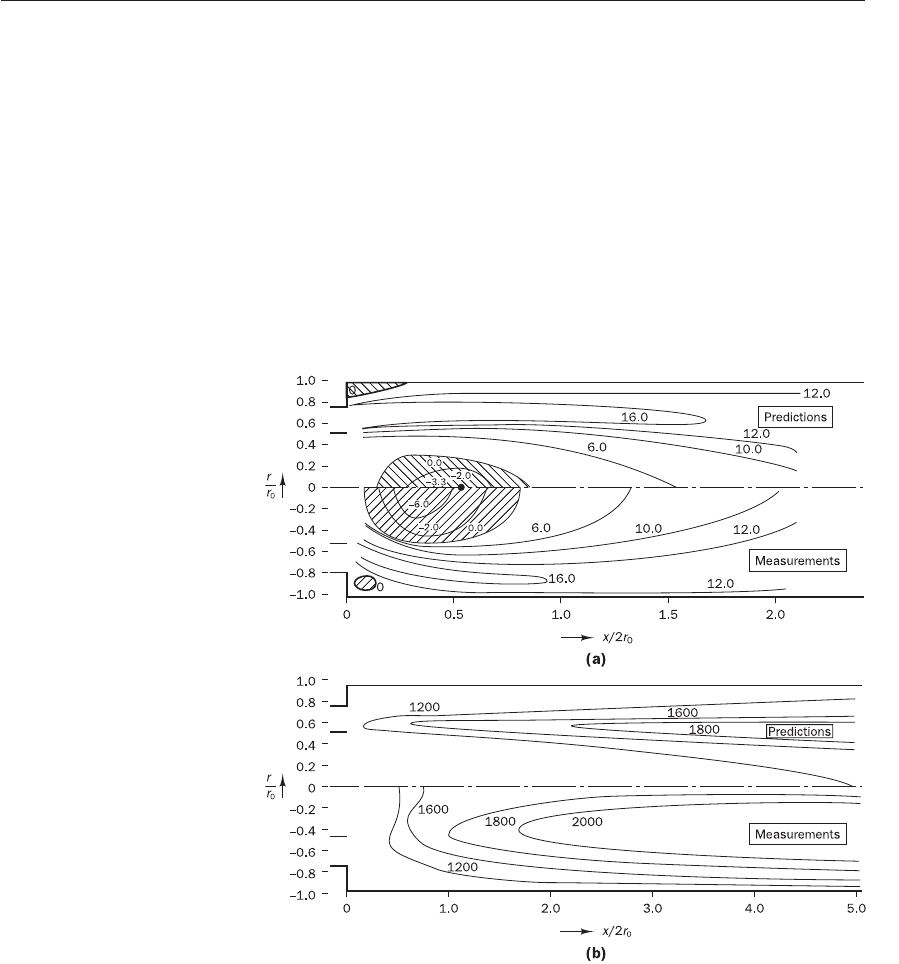
modelling of fires. Figure 3.15 (Jones and Whitelaw, 1982) shows the results
of early calculations with the k–
ε
model of turbulent combusting flows for
an axisymmetric combustor. Computed contours of axial velocity and
temperature are compared with experimental values showing good general
agreement but differences in detail. The flow pattern in the combustor is
dominated by turbulent transport and hence its correct prediction is vitally
important for the development of the flow field and the combustion process.
We come back to this issue in Chapter 12 where we examine different
models of turbulent combustion.
Figure 3.15 Comparison
of predictions of k–
ε
model
with measurements in an
axisymmetric combustor:
(a) axial velocity contours;
(b) temperature contours
Source: Jones and Whitelaw (1982)
In spite of the numerous successes, the standard k–
ε
model shows only
moderate agreement in unconfined flows. The model is reported not to perform
well in weak shear layers (far wakes and mixing layers), and the spreading
rate of axisymmetric jets in stagnant surroundings is severely overpredicted.
In large parts of these flows the rate of production of turbulent kinetic energy
is much less than the rate of dissipation, and the difficulties can only be over-
come by making ad hoc adjustment to model constants C.
Bradshaw et al. (1981) stated that the practice of incorporating the pressure
transport term of the exact k-equation in the gradient diffusion expression of
ANIN_C03.qxd 29/12/2006 04:34PM Page 79

the model equation is deemed to be acceptable on the grounds that the
pressure term is sometimes so small that measured turbulent kinetic energy
budgets balance without it. They noted, however, that many of these meas-
urements contain substantial errors, and it is certainly not generally true that
pressure diffusion effects are negligible.
We can expect that the k–
ε
model, and all other models that are based
on Boussinesq’s isotropic eddy viscosity assumption, will have problems in
swirling flows and flows with large rapid extra strains (e.g. highly curved
boundary layers and diverging passages) that affect the structure of turbu-
lence in a subtle manner. Secondary flows in long non-circular ducts, which
are driven by anisotropic normal Reynolds stresses, can also not be predicted
due to the same deficiencies of the treatment of normal stresses within the
k–
ε
model. Finally, the model is oblivious to body forces due to rotation of
the frame of reference.
A summary of the performance assessment for the standard k–
ε
model is
given in Table 3.4.
80 CHAPTER 3 TURBULENCE AND ITS MODELLING
Table 3.4 Standard k–
ε
model assessment
Advantages:
• simplest turbulence model for which only initial and/or boundary
conditions need to be supplied
• excellent performance for many industrially relevant flows
• well established, the most widely validated turbulence model
Disadvantages:
• more expensive to implement than mixing length model (two extra PDEs)
• poor performance in a variety of important cases such as:
(i) some unconfined flows
(ii) flows with large extra strains (e.g. curved boundary layers, swirling
flows)
(iii) rotating flows
(iv) flows driven by anisotropy of normal Reynolds stresses (e.g. fully
developed flows in non-circular ducts)
3.7.3 Reynolds stress equation models
The most complex classical turbulence model is the Reynolds stress equa-
tion model (RSM), also called the second-order or second-moment closure
model. Several major drawbacks of the k–
ε
model emerge when it is attempted
to predict flows with complex strain fields or significant body forces. Under
such conditions the individual Reynolds stresses are poorly represented by
formula (3.48) even if the turbulent kinetic energy is computed to reasonable
accuracy. The exact Reynolds stress transport equation on the other hand
can account for the directional effects of the Reynolds stress field.
The modelling strategy originates from work reported in Launder et al.
(1975). We follow established practice in the literature and call R
ij
=−
τ
ij
/
ρ
= the Reynolds stress, although the term kinematic Reynolds stress
would be more precise. The exact equation for the transport of R
ij
takes the
following form:
u
i
′u
j
′
ANIN_C03.qxd 29/12/2006 04:35PM Page 80

3.7 RANS EQUATIONS AND TURBULENCE MODELS 81
=+C
ij
= P
ij
+ D
ij
−
ε
ij
+Π
ij
+Ω
ij
(3.55)
Rate of Transport Rate of Transport Rate of Transport of R
ij
due Transport
change of + of R
ij
by = production + of R
ij
by − dissipation + to turbulent pressure + of R
ij
due to
R
ij
= convection of R
ij
diffusion of R
ij
– strain interactions rotation
Equation (3.55) describes six partial differential equations: one for the trans-
port of each of the six independent Reynolds stresses ( , , , ,
and , since = , = and = ). If it is compared
with the exact transport equation for the turbulent kinetic energy (3.42)
two new physical processes appear in the Reynolds stress equations: the
pressure–strain interaction or correlation term Π
ij
, whose effect on the
kinetic energy can be shown to be zero, and the rotation term Ω
ij
.
In CFD computations with the Reynolds stress transport equations the
convection, production and rotation terms can be retained in their exact
form. The convective term is as follows:
C
ij
==div(
ρ
U) (3.56)
the production term is
P
ij
=− R
im
+ R
jm
(3.57)
and, finally, the rotational term is given by
Ω
ij
=−2
ω
k
( e
ikm
+ e
jkm
) (3.58)
Here
ω
k
is the rotation vector and e
ijk
is the alternating symbol; e
ijk
=+1 if i,
j and k are different and in cyclic order, e
ijk
=−1 if i, j and k are different and
in anti-cyclic order; and e
ijk
= 0 if any two indices are the same.
To obtain a solvable form of (3.55) we need models for the diffusion, the
dissipation rate and the pressure–strain correlation terms on the right hand
side. Launder et al. (1975) and Rodi (1980) gave comprehensive details of
the most general models. For the sake of simplicity we quote those models
derived from this approach that are used in some commercial CFD codes.
These models often lack somewhat in detail, but their structure is easier to
understand and the main message is intact in all cases.
The diffusion term D
ij
can be modelled with the assumption that the rate
of transport of Reynolds stresses by diffusion is proportional to gradients of
Reynolds stresses. This gradient diffusion idea recurs throughout turbulence
modelling. Commercial CFD codes often favour the simplest form:
D
ij
==div grad(R
ij
) (3.59)
with
ν
t
= C
µ
, C
µ
= 0.09 and
σ
k
= 1.0
k
2
ε
D
E
F
ν
t
σ
k
A
B
C
D
E
F
∂
R
ij
∂
x
m
ν
t
σ
k
A
B
C
∂
∂
x
m
u
i
′u′
m
u
j
′u′
m
D
E
F
∂
U
i
∂
x
m
∂
U
j
∂
x
m
A
B
C
u
i
′u
j
′
∂
(
ρ
U
k
u
i
′u
j
′)
∂
x
k
u
2
′u
3
′u
3
′u
2
′u
1
′u
3
′u
3
′u
1
′u
1
′u
2
′u
2
′u
1
′u
2
′u
3
′
u
1
′u
3
′u
1
′u
2
′u
3
′
2
u
2
′
2
u
1
′
2
u
i
′u
j
′
∂
R
ij
∂
t
DR
ij
Dt
ANIN_C03.qxd 29/12/2006 04:35PM Page 81

82 CHAPTER 3 TURBULENCE AND ITS MODELLING
The dissipation rate
ε
ij
is modelled by assuming isotropy of the small dissi-
pative eddies. It is set so that it affects the normal Reynolds stresses (i = j)
only and each stress component in equal measure. This can be achieved by
ε
ij
=
εδ
ij
(3.60)
where
ε
is the dissipation rate of turbulent kinetic energy defined by (3.43).
The Kronecker delta
δ
ij
is given by
δ
ij
= 1 if i = j and
δ
ij
= 0 if i ≠ j.
The pressure–strain interactions constitute one of the most important
terms in (3.55), but the most difficult one to model accurately. Their effect
on the Reynolds stresses is caused by two distinct physical processes: (i) a
‘slow’ process that reduces anisotropy of the turbulent eddies due to their
mutual interactions; and (ii) a ‘rapid’ process due to interactions between
turbulent fluctuations and the mean flow strain that produce the eddies such
that the anisotropic production of turbulent eddies is opposed. The overall
effect of both processes is to redistribute energy amongst the normal
Reynolds stresses (i = j) so as to make them more isotropic and to reduce the
Reynolds shear stresses (i ≠ j). The simplest account of the slow process
takes the rate of return to isotropic conditions to be proportional to the
degree of anisotropy a
ij
of the Reynolds stresses (a
ij
= R
ij
−
2
–
3
k
δ
ij
) divided by
a characteristic time scale of the turbulence k/
ε
. The rate of the rapid pro-
cess is taken to be proportional to the production processes that generate the
anisotropy. The simplest representation of the pressure–strain term in the
Reynolds stress transport equation is therefore given by
Π
ij
=−C
1
(R
ij
− k
δ
ij
) − C
2
(P
ij
− P
δ
ij
) (3.61)
with C
1
= 1.8 and C
2
= 0.6
More advanced accounts include corrections in the second set of brackets in
equation (3.61) to ensure that the model is frame invariant (i.e. the effect is
the same irrespective of the co-ordinate system).
The effect of the pressure–strain term (3.61) is to decrease anisotropy of
Reynolds stresses (i.e. to equalise the normal stresses , and ), but
we have seen in section 3.4 that measurements indicate an increase of the
anisotropy of normal Reynolds stresses in the vicinity of a solid wall due to
damping of fluctuations in the directions normal to the wall. Hence, addi-
tional corrections are needed to account for the influence of wall proximity
on the pressure–strain terms. These corrections are different in nature from
the wall-damping functions encountered in the k–
ε
model and need to be
applied irrespective of the value of the mean flow Reynolds number. It is
beyond the scope of this introduction to give all this detail. The reader is
directed to a comprehensive model that accounts for all these effects in
Launder et al. (1975).
Turbulent kinetic energy k is needed in the above formulae and can be
found by simple addition of the three normal stresses:
k =
1
–
2
(R
11
+ R
22
+ R
33
) =
1
–
2
( ++)
The six equations for Reynolds stress transport are solved along with a
model equation for the scalar dissipation rate
ε
. Again a more exact form is
u
3
′
2
u
2
′
2
u
1
′
2
u
3
′
2
u
2
′
2
u
1
′
2
2
3
2
3
ε
k
2
3
ANIN_C03.qxd 29/12/2006 04:35PM Page 82

3.7 RANS EQUATIONS AND TURBULENCE MODELS 83
found in Launder et al. (1975), but the equation from the standard k–
ε
model
is used in commercial CFD for the sake of simplicity:
= div grad
ε
+ C
1
ε
2
ν
t
S
ij
. S
ij
− C
2
ε
(3.62)
where C
1
ε
= 1.44 and C
2
ε
= 1.92
Rate of Transport Transport Rate of Rate of
change + of
ε
by = of
ε
by + production − destruction
of
ε
convection diffusion of
ε
of
ε
The usual boundary conditions for elliptic flows are required for the solution
of the Reynolds stress transport equations:
• inlet: specified distributions of R
ij
and
ε
• outlet and symmetry:
∂
R
ij
/
∂
n = 0 and
∂ε
/
∂
n = 0
• free stream: R
ij
= 0 and
ε
= 0 are given or
∂
R
ij
/
∂
n = 0 and
∂ε
/
∂
n = 0
• solid wall: use wall functions relating R
ij
to either k or u
2
τ
,
e.g. = 1.1k, = 0.25k, = 0.66k,
−=0.26k
In the absence of any information, approximate inlet distributions for R
ij
may be calculated from the turbulence intensity T
i
and a characteristic length
L of the equipment (e.g. equivalent pipe diameter) by means of the follow-
ing assumed relationships:
k = (U
ref
T
i
)
2
ε
= C
µ
3/4
= 0.07L
= k ==k
= 0 (i ≠ j )
Expressions such as these should not be used without a subsequent test of
the sensitivity of results to the assumed inlet boundary conditions.
For computations at high Reynolds numbers wall-function-type bound-
ary conditions can be used, which are very similar to those of the k–
ε
model
and relate the wall shear stress to mean flow quantities. Near-wall Reynolds
stress values are computed from formulae such as R
ij
==c
ij
k, where the
c
ij
are obtained from measurements.
Low Reynolds number modifications to the models can be incorporated
to add the effects of molecular viscosity to the diffusion terms and to account
for anisotropy in the dissipation rate term in the R
ij
-equations. Wall-damping
functions to adjust the constants of the
ε
-equation and Launder and Sharma’s
modified dissipation rate variable 6 ≡
ε
− 2
ν
(
∂
k
1/2
/
∂
y)
2
(see also section 3.7.2)
give more realistic modelling near solid walls (Launder and Sharma, 1974).
So et al. (1991) gave a review of the performance of near-wall treatments
where details may be found.
Similar models involving three further model PDEs – one for every tur-
bulent scalar flux of equation (3.32) – are available for scalar transport.
u
i
′
ϕ
′
u
i
′u
j
′
u
i
′u
j
′
1
2
u
3
′
2
u
2
′
2
u
1
′
2
k
3/2
2
3
u
1
′u
2
′
u
3
′
2
u
2
′
2
u
1
′
2
ε
2
k
ε
k
D
E
F
ν
t
σ
ε
A
B
C
D
ε
Dt
ANIN_C03.qxd 29/12/2006 04:35PM Page 83

The interested reader is referred to Rodi (1980) for further material. Com-
mercial CFD codes may use or give as an alternative the simple expedient of
solving a single scalar transport equation and using the Reynolds analogy by
adding a turbulent diffusion coefficient Γ
t
=
µ
t
/
σ
φ
to the laminar diffusion
coefficient with a specified value of the Prandtl/Schmidt numbers
σ
φ
around
0.7. Little is known about low Reynolds number modifications to the scalar
transport equations in near-wall flows.
Assessment of performance
RSMs are clearly quite complex, but it is generally accepted that they are
the ‘simplest’ type of model with the potential to describe all the mean
flow properties and Reynolds stresses without case-by-case adjustment. The
RSM is by no means as well validated as the k–
ε
model, and because of
the high cost of the computations it is not so widely used in industrial flow
calculations (Table 3.5). Moreover, the model can suffer from convergence
problems due to numerical issues associated with the coupling of the mean
velocity and turbulent stress fields through source terms. The extension and
improvement of these models is an area of very active research. Once a con-
sensus has been reached about the precise form of the component models
and the best numerical solution strategy, it is likely that this form of turbu-
lence modelling will begin to be more widely applied by industrial users.
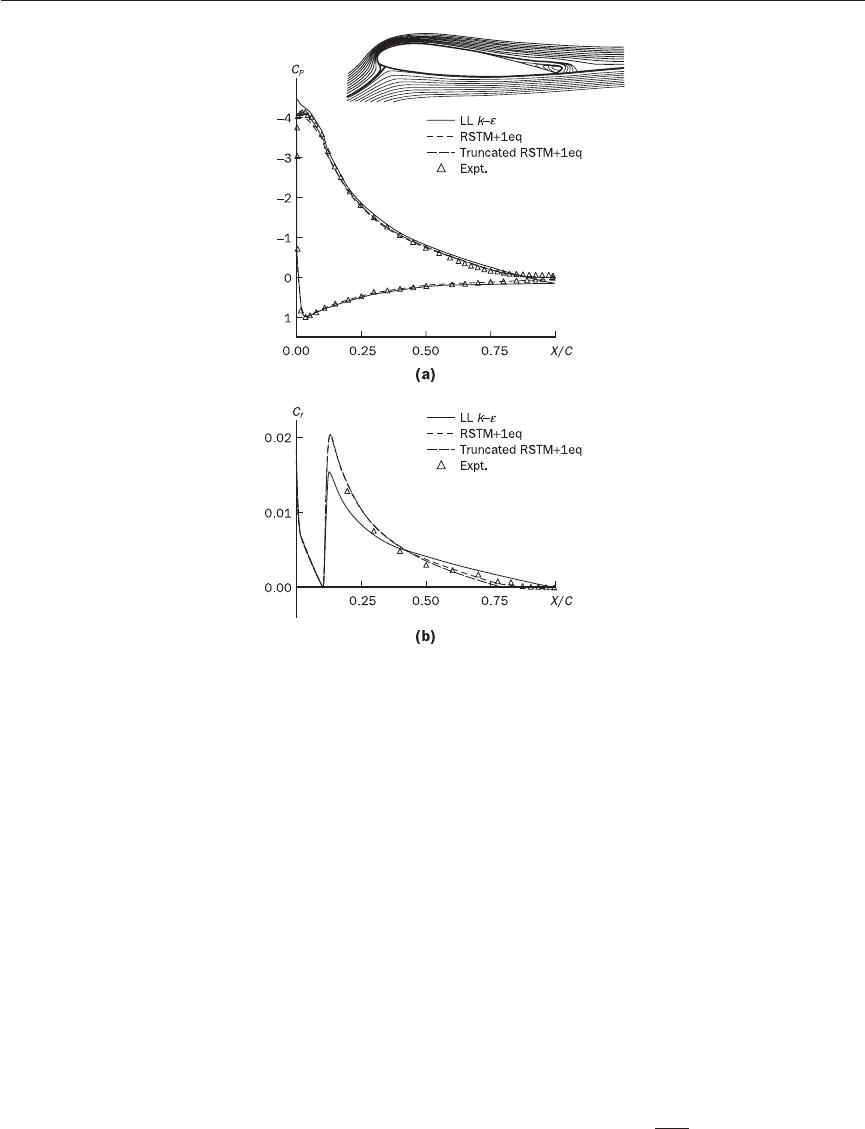
Figure 3.16 (Leschziner, in Peyret and Krause, 2000) gives a performance
comparison of the RSM and k–
ε
models against measured distributions of
pressure coefficient and suction-side skin friction coefficients for an
Aérospatiale aerofoil. Leschziner notes that the aerofoil is close to stall at the
chosen angle of attack. The diagrams show that the k–
ε
model (labelled
LL k–
ε
) fails to reproduce several details of the pressure distribution in the
leading and trailing edge regions. The prediction of the onset of separation
depends crucially on the details of the boundary layer structure just
upstream, which are captured much better by the RSM model (labelled
RSTM + 1eq, to highlight the chosen treatment of the viscous sub-layer).
This model also gives excellent agreement with the measured distribution of
skin friction on the suction side of the aerofoil.
84 CHAPTER 3 TURBULENCE AND ITS MODELLING
Table 3.5 RSM assessment
Advantages:
• potentially the most general of all classical turbulence models
• only initial and/or boundary conditions need to be supplied
• very accurate calculation of mean flow properties and all Reynolds stresses
for many simple and more complex flows including wall jets, asymmetric
channel and non-circular duct flows and curved flows
Disadvantages:
• very large computing costs (seven extra PDEs)
• not as widely validated as the mixing length and k–
ε
models
• performs just as poorly as the k–
ε
model in some flows due to identical
problems with the
ε
-equation modelling (e.g. axisymmetric jets and
unconfined recirculating flows)
ANIN_C03.qxd 29/12/2006 04:35PM Page 84
3.7 RANS EQUATIONS AND TURBULENCE MODELS 85
3.7.4 Advanced turbulence models
Two-equation turbulence models, such as the k–
ε
model introduced earlier,
give good results for simple flows and some recirculating flows, but research
over a period of three decades has highlighted a number of shortcomings.
Leschziner (in Peyret and Krause, 2000) and Hanjaliz (2004) summarised
the nature and causes of these performance problems:
• Low Reynolds number flows: in these flows wall functions based on
the log-law are inaccurate and it is necessary to integrate the k- and
ε
-equations to the wall. Very rapid changes occur in the distributions
of k and
ε
as we reach the buffer layer between the fully turbulent
region and the viscous sublayer. This requires large numbers of grid
points to resolve the changes, and we also need non-linear wall-damping
functions to force upon k and
ε
the correct behaviour as the character
of the near-wall flow changes from turbulence dominated to viscous
dominated. As a consequence the system of equations that needs to be
solved is numerically stiff, which means that it may be difficult to get
converged solutions. Furthermore, the results can be grid dependent.
• Rapidly changing flows: the Reynolds stress −
ρ
is proportional to the
mean rate of strain S
ij
in two-equation models. This only holds when
u
i
′u
j
′
Figure 3.16 Comparison of
predictions of RSM and standard
k–
ε
model with measurements on
a high-lift Aérospatiale aerofoil:
(a) pressure coefficient; (b) skin
friction coefficient
Source: Leschziner, in Peyret and
Krause (2000)
ANIN_C03.qxd 29/12/2006 04:35PM Page 85

the rates of production and dissipation of turbulence kinetic energy are
roughly in balance. In rapidly changing flows this is not the case.
• Stress anisotropy: the normal Reynolds stresses −
ρ
will all be
approximately equal to −
2
–
3
ρ
k if a thin shear layer flow is evaluated
using a two-equation model. Experimental data presented in section 3.4
showed that this is not correct, but in spite of this the k–
ε
model
performs well in such flows because the gradients of normal turbulent
stresses −
ρ
are small compared with the gradient of the dominant
turbulent shear stress −
ρ
. Consequently, the normal stresses may be
large, but they are not dynamically active in thin shear layer flows, i.e.
they are not responsible for driving any flows. In more complex flows
the gradients of normal turbulent stresses are not negligible and can
drive significant flows. These effects cannot be predicted by the
standard two-equation models.
• Strong adverse pressure gradients and recirculation regions: this problem
particularly affects the k–
ε
model and is also attributable to the isotropy
of its predicted normal Reynolds stresses and the resultant failure to
represent correctly the subtle interactions between normal Reynolds
stresses and mean flow that determine turbulent energy production.
The k–
ε
model overpredicts the shear stress and suppresses separation
in flows over curved walls. This is a significant problem in flows over
aerofoils, e.g. in aerospace applications.
• Extra strains: streamline curvature, rotation and extra body forces all
give rise to additional interactions between the mean strain rate and the
Reynolds stresses. These physical effects are not captured by standard
two-equation models.
As we have seen, the RSM incorporates an exact representation of the
Reynolds stress production process and, hence, addresses most of these
problems adequately, but at the cost of a significant increase in computer
storage and run time. Below we consider some of the more recent advances
in turbulence modelling that seek to address some or all of the above
problems.
Advanced treatment of the near-wall region: two-layer k---
εε
model
The two-layer model represents an improved treatment of the near-wall
region for turbulent flows at low Reynolds number. The intention is, as
in the low Reynolds number k–
ε
model discussed earlier, to integrate to
the wall by placing the near-wall grid point in the viscous sublayer ( y
+
< 1).
The numerical stability problems (Chen and Patel, 1988) associated with the
non-linear wall-damping functions, necessary in the low Reynolds number
k–
ε
model to integrate both k- and
ε
-equations to the wall, are avoided by
sub-dividing the boundary layer into two regions (Rodi, 1991):
• Fully turbulent region, Re
y
= yk/
ν
≥ 200: the standard k–
ε
model is
used and the eddy viscosity is computed with the usual relationship
(3.44),
µ
t,t
= C
µ
ρ
k
2
/
ε
• Viscous region, Re
y
< 200: only the k-equation is solved in this
region and a length scale is specified using =
κ
y[1 − exp(−Re
y
/A)]
for the evaluation of the rate of dissipation with
ε
= C
µ
3/4
k
3/2
/ using
A = 2
κ
C
µ
−3/4
and the eddy viscosity in this region with
µ
t,v
= C
µ
1/4
ρ
k
and A = 70
u′v′
u
i
′
2
u
i
′
2
86 CHAPTER 3 TURBULENCE AND ITS MODELLING
ANIN_C03.qxd 29/12/2006 04:35PM Page 86