
Versteeg H., Malalasekra W. An Introduction to Computational Fluid Dynamics: The Finite Volume Method
Подождите немного. Документ загружается.


3.7 RANS EQUATIONS AND TURBULENCE MODELS 67
No. of extra transport equations Name
Zero Mixing length model
One Spalart–Allmaras model
Two k–
ε
model
k–
ω
model
Algebraic stress model
Seven Reynolds stress model
These models form the basis of standard turbulence calculation procedures
in currently available commercial CFD codes.
Eddy viscosity and eddy diffusivity
Of the tabulated models the mixing length and k–
ε
models are at present by
far the most widely used and validated. They are based on the presumption
that there exists an analogy between the action of viscous stresses and
Reynolds stresses on the mean flow. Both stresses appear on the right hand
side of the momentum equation, and in Newton’s law of viscosity the viscous
stresses are taken to be proportional to the rate of deformation of fluid
elements. For an incompressible fluid this gives
τ
ij
=
µ
s
ij
=
µ
+ (2.31)
In order to simplify the notation the so-called suffix notation has been used
here. The convention of this notation is that i or j = 1 corresponds to the
x-direction, i or j = 2 the y-direction and i or j = 3 the z-direction. So, for
example,
τ
12
=
τ
xy
=
µ
+=
µ
+
In section 3.4 we reviewed experimental evidence which showed that turbu-
lence decays unless there is shear in isothermal incompressible flows. Further-
more, turbulent stresses are found to increase as the mean rate of deformation
increases. Boussinesq proposed in 1877 that Reynolds stresses might be
proportional to mean rates of deformation. Using the suffix notation we get
τ
ij
=−
ρ
=
µ
t
+−
ρ
k
δ
ij
(3.33)
where k =
1
–
2
( ++) is the turbulent kinetic energy per unit mass (see
section 3.3).
The first term of the right hand side is analogous to formula (2.31) above
except for the appearance of the turbulent or eddy viscosity
µ
t
(dimensions
Pa s). There is also a kinematic turbulent or eddy viscosity denoted by
ν
t
=
µ
t
/
ρ
,
with dimensions m
2
/s. The second term on the right hand side involves
δ
ij
,
the Kronecker delta (
δ
ij
= 1 if i = j and
δ
ij
= 0 if i ≠ j). This contribution
ensures that the formula gives the correct result for the normal Reynolds
w′
2
v′
2
u′
2
2
3
D
E
F
∂
U
j
∂
x
i
∂
U
i
∂
x
j
A
B
C
u
i
′u
j
′
D
E
F
∂
v
∂
x
∂
u
∂
y
A
B
C
D
E
F
∂
u
2
∂
x
1
∂
u
1
∂
x
2
A
B
C
D
E
F
∂
u
j
∂
x
i
∂
u
i
∂
x
j
A
B
C
ANIN_C03.qxd 29/12/2006 04:34PM Page 67

stresses (those with i = j), and hence for
τ
xx
=−
ρ
,
τ
yy
=−
ρ
and
τ
zz
=−
ρ
. To demonstrate the necessity of the extra term we consider an
incompressible flow and explore the behaviour of the first part of (3.33) by
itself. If we sum this over all the normal stresses (i.e. let i = 1, 2 and 3 whilst
keeping i = j ) we find, using continuity, that it is zero, since
2
µ
t
S
ii
= 2
µ
t
++ =2
µ
t
div U = 0
Clearly in any flow the sum of the normal stresses −
ρ
( ++) is equal
to minus twice the turbulence kinetic energy per unit volume (−2
ρ
k). In
equation (3.33) an equal third is allocated to each normal stress component
to ensure their sum always has its physically correct value. It should be noted
that this implies an isotropic assumption for the normal Reynolds stresses
which the data in section 3.4 have shown is inaccurate even in simple two-
dimensional flows.
Turbulent transport of heat, mass and other scalar properties can be mod-
elled similarly. Formula (3.33) shows that turbulent momentum transport is
assumed to be proportional to mean gradients of velocity (i.e. gradients of
momentum per unit mass). By analogy turbulent transport of a scalar is taken
to be proportional to the gradient of the mean value of the transported quan-
tity. In suffix notation we get
−
ρ
=Γ
t
(3.34)
where Γ
t
is the turbulent or eddy diffusivity.
Since turbulent transport of momentum and heat or mass is due to the
same mechanism – eddy mixing – we expect that the value of the turbulent
diffusivity Γ
t
is fairly close to that of the turbulent viscosity
µ
t
. This assump-
tion is better known as the Reynolds analogy. We introduce a turbulent
Prandtl/Schmidt number defined as follows:
σ
t
= (3.35)
Experiments in many flows have established that this ratio is often nearly
constant. Most CFD procedures assume this to be the case and use values of
σ
t
around unity.
Preamble
It has become clear from our discussions of simple turbulent flows in section
3.4 that turbulence levels and turbulent stresses vary from point to point in
a flow. Mixing length models attempt to describe the stresses by means of
simple algebraic formulae for
µ
t
as a function of position. The k–
εε
model is
a more sophisticated and general, but also more costly, description of turbu-
lence which allows for the effects of transport of turbulence properties by
convection and diffusion and for production and destruction of turbulence.
Two transport equations (PDEs), one for the turbulent kinetic energy k and
a further one for the rate of dissipation of turbulent kinetic energy
ε
, are solved.
The underlying assumption of both these models is that the turbulent
viscosity
µ
t
is isotropic: in other words that the ratio between Reynolds stress
µ
t
Γ
t
∂
Φ
∂
x
i
u
i
′
ϕ
′
w′
2
v′
2
u′
2
J
K
L
∂
W
∂
z
∂
V
∂
y
∂
U
∂
x
G
H
I
w′
2
v′
2
u′
2
68 CHAPTER 3 TURBULENCE AND ITS MODELLING
ANIN_C03.qxd 29/12/2006 04:34PM Page 68

3.7 RANS EQUATIONS AND TURBULENCE MODELS 69
and mean rate of deformation is the same in all directions. This assumption
fails in many complex flows where it leads to inaccurate predictions. Here it
is necessary to derive and solve transport equations for the Reynolds stresses
themselves. It may at first seem strange to think that a stress can be subject
to transport. However, it is only necessary to remember that the Reynolds
stresses initially appeared on the left hand side of the momentum equations
and are physically due to convective momentum exchanges as a consequence
of turbulent velocity fluctuations. Fluid momentum – mean momentum as
well as fluctuating momentum – can be transported by fluid particles and
therefore the Reynolds stresses can also be transported.
The six transport equations, one for each Reynolds stress, contain diffu-
sion, pressure–strain and dissipation terms whose individual effects are
unknown and cannot be measured. In Reynolds stress equation models
(also known in the literature as second-order or second-moment closure
models) assumptions are made about these unknown terms, and the result-
ing PDEs are solved in conjunction with the transport equation for the rate
of dissipation of turbulent kinetic energy
ε
. The design of Reynolds stress
equation models is an area of vigorous research, and the models have not
been validated as widely as the mixing length and k–
ε
model. Solving the
seven extra PDEs gives rise to a substantial increase in the cost of CFD sim-
ulations when compared with the k–
ε
model, so the application of Reynolds
stress equation models outside the academic fraternity is relatively recent.
A much more far-reaching set of modelling assumptions reduces the
PDEs describing Reynolds stress transport to algebraic equations to be
solved alongside the k and
ε
equations of the k–
ε
model. This approach leads
to the algebraic stress models that are the most economical form of
Reynolds stress model able to introduce anisotropic turbulence effects into
CFD simulations.
In the following sections the mixing length and k–
ε
models will be dis-
cussed in detail and the main features of the Reynolds stress equation and
algebraic stress models will be outlined. We also describe the k–
ωω
models
and the Spalart–Allmaras model, which are more recent entrants to the
industrial CFD arena, and outline the distinguishing features of other models
that are beginning to make an impact on industrial turbulence modelling.
3.7.1 Mixing length model
On dimensional grounds we assume the kinematic turbulent viscosity
ν
t
,
which has dimensions m
2
/s, can be expressed as a product of a turbulent
velocity scale
ϑ
(m/s) and a turbulent length scale (m). If one velocity scale
and one length scale suffice to describe the effects of turbulence, dimensional
analysis yields
ν
t
= C
ϑ
(3.36)
where C is a dimensionless constant of proportionality. Of course the
dynamic turbulent viscosity is given by
µ
t
= C
ρϑ
Most of the kinetic energy of turbulence is contained in the largest eddies,
and turbulence length scale is therefore characteristic of these eddies which
interact with the mean flow. If we accept that there is a strong connection
ANIN_C03.qxd 29/12/2006 04:34PM Page 69

70 CHAPTER 3 TURBULENCE AND ITS MODELLING
Table 3.2 Mixing lengths for two-dimensional turbulent flows
Flow Mixing length
m
L
Mixing layer 0.07L Layer width
Jet 0.09L Jet half width
Wake 0.16L Wake half width
Axisymmetric jet 0.075L Jet half width
Boundary layer (
∂
p/
∂
x = 0)
viscous sub-layer and
κ
y[1 − exp(−y
+
/26)]
log-law layer ( y/L ≤ 0.22) Boundary layer
outer layer ( y/L ≥ 0.22) 0.09L thickness
Pipes and channels Pipe radius or
(fully developed flow) L
[0.14–0.08(1 − y/L)
2
− 0.06(1 − y/L)
4
] channel half width
between the mean flow and the behaviour of the largest eddies we can
attempt to link the characteristic velocity scale of the eddies with the mean
flow properties. This has been found to work well in simple two-dimensional
turbulent flows where the only significant Reynolds stress is
τ
xy
=
τ
yx
=−
ρ
and the only significant mean velocity gradient is
∂
U/
∂
y. For such flows it is
at least dimensionally correct to state that, if the eddy length scale is ,
ϑ
= c (3.37)
where c is a dimensionless constant. The absolute value is taken to ensure
that the velocity scale is always a positive quantity irrespective of the sign of
the velocity gradient.
Combining (3.36) and (3.37) and absorbing the two constants C and c into
a new length scale
m
we obtain
ν
t
=
2
m
(3.38)
This is Prandtl’s mixing length model. Using formula (3.33) and noting
that
∂
U/
∂
y is the only significant mean velocity gradient, the turbulent
Reynolds stress is described by
τ
xy
=
τ
yx
=−
ρ
=
ρ
2
m
(3.39)
Turbulence is a function of the flow, and if the turbulence changes it is
necessary to account for this within the mixing length model by varying
m
.
For a substantial category of simple turbulent flows, which includes the
free turbulent flows and wall boundary layers discussed in section 3.4,
the turbulence structure is sufficiently simple that
m
can be described by
means of simple algebraic formulae. Some examples are given in Table 3.2
(Rodi, 1980).
∂
U
∂
y
∂
U
∂
y
u′v′
∂
U
∂
y
∂
U
∂
y
u′v′
ANIN_C03.qxd 29/12/2006 04:34PM Page 70
3.7 RANS EQUATIONS AND TURBULENCE MODELS 71
The mixing length model can also be used to predict turbulent transport
of scalar quantities. The only turbulent transport term which matters in the
two-dimensional flows for which the mixing length is useful is modelled as
follows:
−
ρ
=Γ
t
(3.40)
where Γ
t
=
µ
t
/
σ
t
and
µ
t
=
ρν
t
where
ν
t
is found from (3.38). Rodi (1980)
recommended values for
σ
t
of 0.9 in near-wall flows, 0.5 for jets and mixing
layers and 0.7 in axisymmetric jets.
In the formulae in Table 3.2 y represents the distance from the wall and
κ
= 0.41 is von Karman’s constant. The expressions give very good agree-
ment between computed results and experiments for mean velocity distribu-
tions, wall friction coefficients and other flow properties such as heat transfer
coefficients in simple two-dimensional flows. Results for two flows from
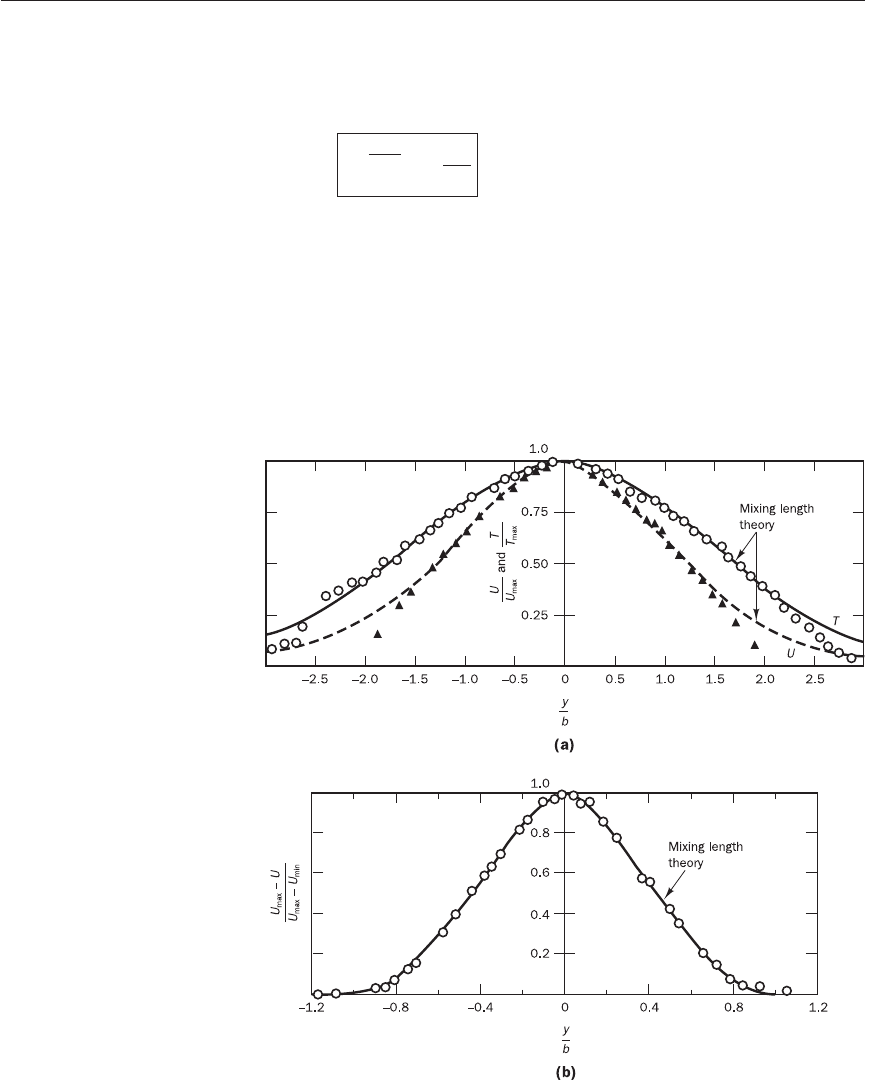
Schlichting (1979) are given below in Figures 3.14a–b.
∂
Φ
∂
y
v′
ϕ
′
Figure 3.14 Results of
calculations using mixing
length model for (a) planar jet
and (b) wake behind a long,
slender, circular cylinder
Source: Schlichting, H. (1979)
Boundary Layer Theory, 7th edn,
reproduced with permission of
The McGraw-Hill Companies
The mixing length has been found to be very useful in simple two-
dimensional flows with slow changes in the flow direction. In these cases
the production of turbulence is in balance with its dissipation throughout
ANIN_C03.qxd 29/12/2006 04:34PM Page 71

the flow, and turbulence properties develop in proportion with a mean flow
length scale L. This means that in such flows the mixing length
m
is pro-
portional to L and can be described as a function of position by means of
a simple algebraic formula. The majority of practically important flows,
however, involve additional contributions to the budgets of turbulence
properties due to transport, i.e. convection and diffusion. Moreover, the
production and destruction processes may be modified by the flow itself.
Consequently, the mixing length model is not used on its own in general-
purpose CFD, but we will find it embedded in many of the more sophisti-
cated turbulence models to describe near-wall flow behaviour as part of the
treatment of wall boundary conditions.
An overall assessment of the mixing length model is given in Table 3.3.
72 CHAPTER 3 TURBULENCE AND ITS MODELLING
Table 3.3 Mixing length model assessment
Advantages:
• easy to implement and cheap in terms of computing resources
• good predictions for thin shear layers: jets, mixing layers, wakes and
boundary layers
• well established
Disadvantages:
• completely incapable of describing flows with separation and recirculation
• only calculates mean flow properties and turbulent shear stress
3.7.2 The k---
εε
model
In two-dimensional thin shear layers the changes in the flow direction are
always so slow that the turbulence can adjust itself to local conditions. In flows
where convection and diffusion cause significant differences between produc-
tion and destruction of turbulence, e.g. in recirculating flows, a compact
algebraic prescription for the mixing length is no longer feasible. The way
forward is to consider statements regarding the dynamics of turbulence. The
k–
ε
model focuses on the mechanisms that affect the turbulent kinetic energy.
Some preliminary definitions are required first. The instantaneous kinetic
energy k(t) of a turbulent flow is the sum of the mean kinetic energy K =
1
–
2
(U
2
+ V
2
+ W
2
) and the turbulent kinetic energy k =
1
–
2
( ++):
k(t) = K + k
In the developments below we extensively need to use the rate of deforma-
tion and the turbulent stresses. To facilitate the subsequent calculations it is
common to write the components of the rate of deformation s
ij
and the
stresses
τ
ij
in tensor (matrix) form:
Gs
xx
s
xy
s
xz
JG
τ
xx
τ
xy
τ
xz
J
s
ij
= Hs
yx
s
yy
s
yz
K and
τ
ij
= H
τ
yx
τ
yy
τ
yz
K
Is
zx
s
zy
s
zz
LI
τ
zx
τ
zy
τ
zz
L
Decomposition of the rate of deformation of a fluid element in a turbulent
flow into a mean and a fluctuating component, s
ij
(t) = S
ij
+ s′
ij
, gives the fol-
lowing matrix elements:
w′
2
v′
2
u′
2
ANIN_C03.qxd 29/12/2006 04:34PM Page 72

3.7 RANS EQUATIONS AND TURBULENCE MODELS 73
s
xx
(t) = S
xx
+ s′
xx
=+ s
yy
(t) = S
yy
+ s′
yy
=+
s
zz
(t) = S
zz
+ s′
zz
=+
s
xy
(t) = S
xy
+ s′
xy
= s
yx
(t) = S
yx
+ s′
yx
=+++
s
xz
(t) = S
xz
+ s′
xz
= s
zx
(t) = S
zx
+ s′
zx
=+++
s
yz
(t) = S
yz
+ s′
yz
= s
zy
(t) = S
zy
+ s′
zy
=+++
The product of a vector a and a tensor b
ij
is a vector c whose components can
be calculated by application of the ordinary rules of matrix algebra:
Gb
11
b
12
b
13
JGa
1
b
11
+ a
2
b
21
+ a
3
b
31
J
T
Gc
1
J
ab
ij
≡ a
i
b
ij
= [a
1
a
2
a
3
] Hb
21
b
22
b
23
K = Ha
1
b
12
+ a
2
b
22
+ a
3
b
32
K = Hc
2
K
T
= c
j
= c
Ib
31
b
32
b
33
LIa
1
b
13
+ a
2
b
23
+ a
3
b
33
LIc
3
L
The scalar product of two tensors a
ij
and b
ij
is evaluated as follows:
a
ij
. b
ij
= a
11
b
11
+ a
12
b
12
+ a
13
b
13
+ a
21
b
21
+ a
22
b
22
+ a
23
b
23
+ a
31
b
31
+ a
32
b
32
+ a
33
b
33
We have used the convention of the suffix notation where the x-direction
is denoted by subscript 1, the y-direction by 2 and the z-direction by 3.
It can be seen that products are formed by taking the sum over all possible
values of every repeated suffix.
Governing equation for mean flow kinetic energy K
An equation for the mean kinetic energy K can be obtained by multiplying
x-component Reynolds equation (3.27a) by U, y-component equation
(3.27b) by V and z-component equation (3.27c) by W. After adding together
the results and a fair amount of algebra it can be shown that the time-
average equation governing the mean kinetic energy of the flow is as follows
(Tennekes and Lumley, 1972):
+ div(
ρ
KU) = div(−PU + 2
µ
US
ij
−
ρ
U ) − 2
µ
S
ij
. S
ij
+
ρ
. S
ij
(3.41)
(I) (II) (III) (IV) (V) (VI) (VII)
Or in words
Rate of change Transport Transport
Transport Transport Rate of Rate of destruction
of mean kinetic + of K by = of K by +
of K by
+
of K by
−
viscous
−
of K due to
energy K convection pressure
viscous Reynolds dissipation turbulence
stresses stress of K production
The transport terms (III), (IV) and (V) are all characterised by the appearance
of div and it is common practice to place them together inside one pair of
u
i
′u
j
′u
i
′u
j
′
∂
(
ρ
K)
∂
t
J
K
L
∂
w′
∂
y
∂
v′
∂
z
G
H
I
1
2
J
K
L
∂
W
∂
y
∂
V
∂
z
G
H
I
1
2
J
K
L
∂
w′
∂
x
∂
u′
∂
z
G
H
I
1
2
J
K
L
∂
W
∂
x
∂
U
∂
z
G
H
I
1
2
J
K
L
∂
v′
∂
x
∂
u′
∂
y
G
H
I
1
2
J
K
L
∂
V
∂
x
∂
U
∂
y
G
H
I
1
2
∂
w′
∂
z
∂
W
∂
z
∂
v′
∂
y
∂
V
∂
y
∂
u′
∂
x
∂
U
∂
x
ANIN_C03.qxd 29/12/2006 04:34PM Page 73
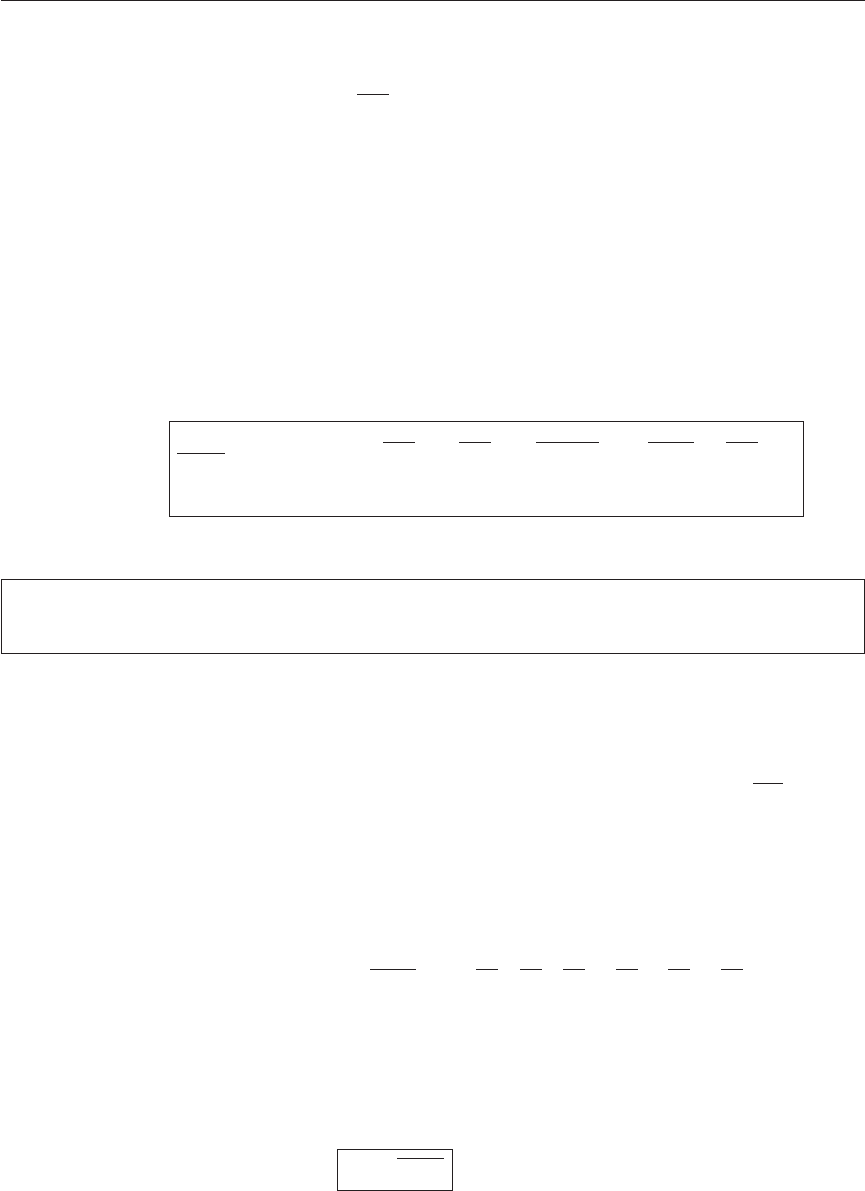
74 CHAPTER 3 TURBULENCE AND ITS MODELLING
brackets. The effects of the viscous stresses on K have been split into two parts:
term (IV), the transport of K due to viscous stresses; and term (VI), the viscous
dissipation of mean kinetic energy K. The two terms that contain the Reynolds
stresses −
ρ
account for turbulence effects: term (V) is the turbulent
transport of K by means of Reynolds stresses and (VII) is the net decrease of
K due to deformation work by Reynolds stresses giving rise to turbulence
production. In high Reynolds number flows the turbulent terms (V) and
(VII) are always much larger than their viscous counterparts (IV) and (VI).
Governing equation for turbulent kinetic energy k
Multiplication of each of the instantaneous Navier–Stokes equations (3.24a–c)
by the appropriate fluctuating velocity components (i.e. x-component equa-
tion multiplied by u′ etc.) and addition of all the results, followed by a repeat
of this process on the Reynolds equations (3.27a–c), subtraction of the two
resulting equations and very substantial rearrangement, yields the equation
for turbulent kinetic energy k (Tennekes and Lumley, 1972).
+ div(
ρ
kU) = div(−+2
µ
−
ρ
1
–
2
) − 2
µ
−
ρ
. S
ij
(3.42)
(I) (II) (III) (IV) (V) (VI) (VII)
In words
Rate of change of Transport Transport Transport of Transport of Rate of Rate of
turbulent kinetic + of k by = of k by + k by viscous + k by Reynolds − dissipation + production
energy k convection pressure stresses stress of k of k
Equations (3.41) and (3.42) look very similar in many respects; however, the
appearance of primed quantities on the right hand side of the k-equation
shows that changes to the turbulent kinetic energy are mainly governed by
turbulent interactions. Terms (VII) in both equations are equal in magni-
tude, but opposite in sign. In two-dimensional thin shear layers we found
(see section 3.4) that the only significant Reynolds stress −
ρ
is usually
positive if the main term of S
ij
in such a flow, the mean velocity gradient
∂
U/
∂
y, is positive. Hence term (VII) gives a positive contribution in the
k-equation and represents a production term. In the K-equation, however,
the sign is negative, so there the term destroys mean flow kinetic energy.
This expresses mathematically the conversion of mean kinetic energy into
turbulent kinetic energy.
The viscous dissipation term (VI),
−2
µ
=−2
µ
( +++2 + 2 + 2)
gives a negative contribution to (3.42) due to the appearance of the sum
of squared fluctuating deformation rates s′
ij
. The dissipation of turbulent
kinetic energy is caused by work done by the smallest eddies against viscous
stresses. The rate of dissipation per unit volume (VI) is normally written as
the product of the density
ρ
and the rate of dissipation of turbulent kinetic
energy per unit mass
ε
, so
ε
= 2
ν
(3.43)
s′
ij
. s ′
ij
s′
2
23
s′
2
13
s′
2
12
s′
2
33
s′
2
22
s′
2
11
s′
ij
. s ′
ij
u′v′
u
i
′u
j
′s′
ij
. s′
ij
u
i
′ . u
i
′u
j
′u′s′
ij
p′u′
∂
(
ρ
k)
∂
t
u
i
′u
j
′
ANIN_C03.qxd 29/12/2006 04:34PM Page 74

3.7 RANS EQUATIONS AND TURBULENCE MODELS 75
The dimensions of
ε
are m
2
/s
3
. This quantity is of vital importance in the
study of turbulence dynamics. It is the destruction term in the turbulent
kinetic energy equation, of a similar order of magnitude as the production
term and never negligible. When the Reynolds number is high, the viscous
transport term (IV) in (3.42) is always very small compared with the turbu-
lent transport term (V) and the dissipation (VI).
The k---
εε
model equations
It is possible to develop similar transport equations for all other turbulence
quantities including the rate of viscous dissipation
ε
(see Bradshaw et al.,
1981). The exact
ε
-equation, however, contains many unknown and unmea-
surable terms. The standard k–
εε
model (Launder and Spalding, 1974) has
two model equations, one for k and one for
ε
, based on our best understand-
ing of the relevant processes causing changes to these variables.
We use k and
ε
to define velocity scale
ϑ
and length scale representative
of the large-scale turbulence as follows:
ϑ
= k
1/2
=
One might question the validity of using the ‘small eddy’ variable
ε
to define
the ‘large eddy’ scale . We are permitted to do this because at high Reynolds
numbers the rate at which large eddies extract energy from the mean flow is
broadly matched to the rate of transfer of energy across the energy spectrum
to small, dissipating, eddies if the flow does not change too rapidly. If this
was not the case the energy at some scales of turbulence could grow or
diminish without limit. This does not occur in practice and justifies the use
of
ε
in the definition of .
Applying dimensional analysis we can specify the eddy viscosity as
follows:
µ
t
= C
ρϑ
=
ρ
C
µ
(3.44)
where C
µ
is a dimensionless constant.
The standard k–
ε
model uses the following transport equations for k
and
ε
:
+ div(
ρ
kU) = div grad k + 2
µ
t
S
ij
. S
ij
−
ρε
(3.45)
+ div(
ρε
U) = div grad
ε
+ C
1
ε
2
µ
t
S
ij
. S
ij
− C
2
ε
ρ
(3.46)
In words the equations are
Rate of Transport Transport Rate of Rate of
change of + of k or
ε
by = of k or
ε
+ production − destruction
k or
ε
convection by diffusion of k or
ε
of k or
ε
ε
2
k
ε
k
J
K
L
µ
t
σ
ε
G
H
I
∂
(
ρε
)
∂
t
J
K
L
µ
t
σ
k
G
H
I
∂
(
ρ
k)
∂
t
k
2
ε
k
3/2
ε
ANIN_C03.qxd 29/12/2006 04:34PM Page 75

76 CHAPTER 3 TURBULENCE AND ITS MODELLING
The equations contain five adjustable constants: C
µ
,
σ
k
,
σ
ε
, C
1
ε
and C
2
ε
. The
standard k–
ε
model employs values for the constants that are arrived at by
comprehensive data fitting for a wide range of turbulent flows:
C
µ
= 0.09
σ
k
= 1.00
σ
ε
= 1.30 C
1
ε
= 1.44 C
2
ε
= 1.92 (3.47)
The production term in the model k-equation is derived from the exact
production term in (3.42) by substitution of (3.33). A modelled form of the
principal transport processes in the k- and
ε
-equation appears on the right
hand side. The turbulent transport terms are represented using the gradient
diffusion idea introduced earlier in the context of scalar transport (see equa-
tion (3.34)). Prandtl numbers
σ
k
and
σ
ε
connect the diffusivities of k and
ε
to the eddy viscosity
µ
t
. The pressure term (III) of the exact k-equation can-
not be measured directly. Its effect is accounted for in equation (3.45) within
the gradient diffusion term.
Production and destruction of turbulent kinetic energy are always closely
linked. Dissipation rate
ε
is large where production of k is large. The model
equation (3.46) for
ε
assumes that its production and destruction terms are
proportional to the production and destruction terms of the k-equation
(3.45). Adoption of such forms ensures that
ε
increases rapidly if k increases
rapidly and that it decreases sufficiently fast to avoid (non-physical) negative
values of turbulent kinetic energy if k decreases. The factor
ε
/k in the pro-
duction and destruction terms makes these terms dimensionally correct in
the
ε
-equation. Constants C
1
ε
and C
2
ε
allow for the correct proportionality
between the terms in the k- and
ε
-equations.
To compute the Reynolds stresses we use the familiar Boussinesq
relationship:
−
ρ
=
µ
t
+−
ρ
k
δ
ij
= 2
µ
t
S
ij
−
ρ
k
δ
ij
(3.48)
Boundary conditions
The model equations for k and
ε
are elliptic by virtue of the gradient diffu-
sion term. Their behaviour is similar to the other elliptic flow equations,
which gives rise to the need for the following boundary conditions:
• inlet: distributions of k and
ε
must be given
• outlet, symmetry
axis:
∂
k/
∂
n = 0 and
∂ε
/
∂
n = 0
• free stream: k and
ε
must be given or
∂
k/
∂
n = 0 and
∂ε
/
∂
n = 0
• solid walls: approach depends on Reynolds number (see below)
In exploratory design calculations the detailed boundary condition informa-
tion required to operate the model may not be available. Industrial CFD
users rarely have measurements of k and
ε
at their disposal. Progress can
be made by entering values of k and
ε
from the literature (e.g. publications
referred to in section 3.4) and subsequently exploring the sensitivity of the
results to these inlet distributions. If no information is available at all, rough
approximations for the inlet distributions for k and
ε
in internal flows can
be obtained from the turbulence intensity T
i
and a characteristic length L of
2
3
2
3
D
E
F
∂
U
j
∂
x
i
∂
U
i
∂
x
j
A
B
C
u
i
′u
j
′
ANIN_C03.qxd 29/12/2006 04:34PM Page 76