
Westermeier R., Naven T., H?pker H.-R. Proteomics in Practice: A Guide to Successful Experimental Design
Подождите немного. Документ загружается.

1 Electrophoretic Techniques80
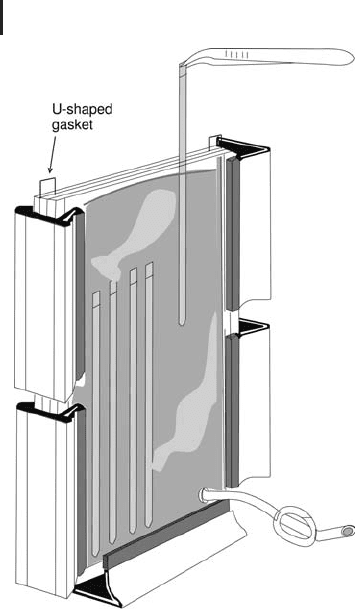
Fig. 1.23: Rehydration cassette with 0.5 mm gasket. Note the
protruding ends of the U-shaped film added to achieve 0.5 mm
thick gels on film supports.
Reswelling tray The disadvantages of the cassette technique are
avoided when using a reswelling tray (see Figure 1.24), as suggested
by Sanchez et al. (1997). The liquid volume offered to the strips must
be exactly controlled:
.
If the liquid volume is too big, the strip will pre-
ferably reswell with the low molecular weight
compounds and leave compounds with higher
viscosity and higher molecular weights outside.
There would not be any control over the reagent
concentrations inside the strip.
.
If the liquid volume is too small, the resulting
pore size will be too small to allow high molecu-
lar weight proteins to enter the gel.
Sanchez J-C, Rouge V, Pisteur
M, Ravier F, Tonella L, Moos-
mayer M, Wilkins MR, Hoch-
strasser DF. Electrophoresis 18
(1997) 324–327.
Over-swelling of a strip results
in liquid exudation during IEF.
This would cause protein trans-
port to the surface, resulting in
background smearing.
And the separation time will be
longer.
1.5 Two-dimensional Electrophoresis 81
According to a theoretical calculation the volumes for the 3 mm wide
and 0.5 mm thin strips would be 360 mL for a 24 cm and 270 mL for
an 18 cm strip. In practice the optimal reswelling volumes are:
7 cm strip 125 mL
18 cm strip 340 mL
24 cm strip 450 mL
The solutions are pipetted into the grooves as streaks; the strips are
placed on top of the solutions, and are covered with cover fluid (paraf-
fin oil) to prevent crystallization of the urea. Reswelling is performed
at room temperature, because the urea would crystallize in a cold
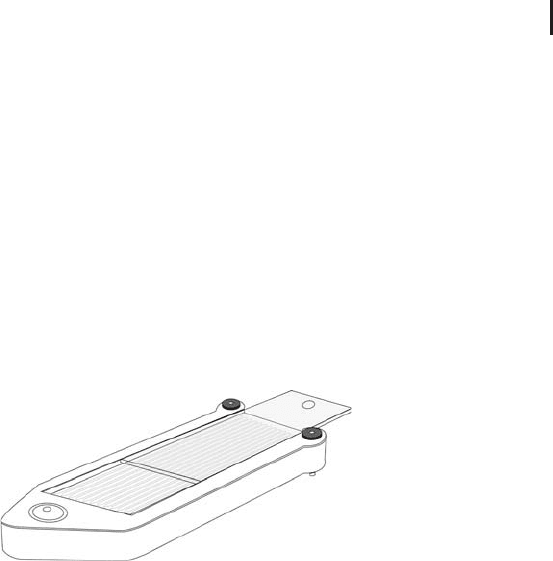
room. Figure 1.24 shows a reswelling tray for up to 12 strips of differ-
ent strip lengths up to 24 cm.
Fig. 1.24: IPG Dry strip reswelling tray for rehydration of
IPG strips in individual grooves.
Cover fluid The gel strips are covered with paraffin oil during rehy-
dration and IEF to prevent drying of the strips, crystallization of the
urea, and oxygen and carbon dioxide uptake. It has never been
observed that hydrophobic proteins change over from the rehydration
solution into the oil phase.
Rehydration time As mentioned above, there are two ways to apply
the sample to these immobilized pH gradient strips rehydration load-
ing and loading the samples on pre-rehydrated IPG strips.
Rehydration time:
Without sample >6 h
Including sample >12 h or overnight *)
These values are empirical and
have been determined and
optimizes with practical experi-
ments.
Silicon oil is not recommended,
because it can contain dissolved
oxygen and it is not easy to
remove from the instruments
and the benches.
*) The large protein molecules
need a long time to diffuse into
the strip.

1 Electrophoretic Techniques82
1.5.3.2 Sample Application onto IPG Strips
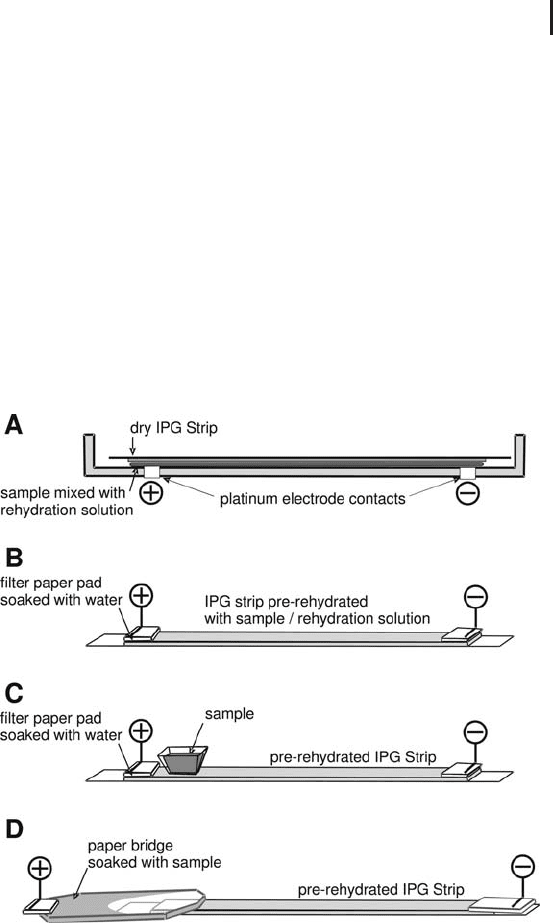
As shown in Figure 1.25, there are several ways to apply the sample
to immobilized pH gradient strips:
.
Rehydration loading. The extracted or solubilized
sample is diluted with rehydration solution to
the wanted amount of protein. Rehydration of a
strip can be carried out in an individual strip
holder or in a reswelling tray in an individual
groove with a defined volume (see above, rehy-
dration). The dry gel matrix takes up the fluid
together with the proteins. Because the pores are
very small in the beginning, the smaller mole-
cules (water, urea, detergent, and reductant) go
into the gel matrix faster than the proteins.
Many of the proteins diffuse into the fully rehy-
drated gel later. This is the reason for the much
longer rehydration time required for rehydration
loading (see above). IEF can be performed with
the gel surface up or down depending on the
accessory or equipment used. Figure 1.29 shows
the strip holder concept, where active rehydra-
tion (rehydration under low voltage) can be per-
formed, and the voltage steps and gradients for
IEF can automatically applied.
.
Cup loading. The strip is pre-rehydrated with
rehydration solution. The sample is applied into
a loading cup either on the anodal or the catho-
dal end. Depending on the equipment a maxi-
mum of 100 mL or 150 mL sample can be applied.
The optimal application point is critical, and has
to be determined for each sample type and the
gradient used. The proteins are transported into
the strip electrophoretically. In this case IEF is
always performed with the gel surface up.
Between the electrodes and the IPG strip ends
filter paper pads are applied. The electrode pads
are soaked with distilled water and blotted with a
tissue paper to become damp, not wet.
.
Paper bridge loading. For application of very high
sample volumes a modification of the cup load-
ing principle has been proposed: paper bridge
loading. Solution containing up to 5 mg protein
can be loaded on an 18 cm long narrow pH
Note: the more diluted the
sample, the easier the proteins
enter the gel.
Sabounchi-Schtt F, Astrçm J,
Olsson I, Eklund A, Grunewald
J, Bjellqvist B. Electrophoresis
21 (2000) 3649–3656.
1.5 Two-dimensional Electrophoresis 83
range IPG strip (Sabounchi-Schtt et al. 2000). A
large sample volume requires that a large paper
pad be applied at the other end of the IPG strip
to absorb excess water. Figure 1.25 D shows the
arrangement used when sample is applied to a
paper bridge positioned between the anode and
an IPG strip. The electrode pads are soaked with
distilled water and blotted with a tissue paper to
become damp, not wet. Sample solution is
applied to the paper bridge (500 mL). With anodic
application the anode is positioned as far out as
possible in the electrode holder, while the cath-
ode is positioned close to the end of the IPG
strip to ensure good contact between electrode
pad and IPG strip.
Fig. 1.25: Schematic representation of the different ways of sample
application on an IPG strip: A. Rehydration loading in a strip holder
for active rehydration and impress the voltage on it for IEF. B. Passive
rehydration loading in a reswelling tray. C. Cup-loading for up to
150 mL sample solution. D. Paper bridge loading for up to 500 mL
sample solution. For C and D anodal application is shown, for some
samples and gradients it might be better to apply the sample at the
cathodal end.

1 Electrophoretic Techniques84
Kane et al. (2006) have reported that for basic pH gradients they get
consistently better results with paper bridge loading than with cup-
loading. Furthermore, the proteins with lower isoelectric points stay
in the paper bridge and can be reloaded on acidic IPG strips – with
application at the cathodal side. In this way it is possible to apply pre-
cious, but limited samples onto several gels with different pH ranges.
& Note: The application point (anodal or
cathodal) is of importance to obtain good
results.
The way of sample loading will have an effect on the 2-D electrophor-
esis pattern. This is easy to understand: Each protein has an individu-
ally shaped titration curve; the mobility of the protein is usually differ-
ent, depending on whether it is negatively or positively charged.
.
Rehydration loading: Each protein exists in both
ionic forms: negatively and positively charged,
the proteins approach their pI from both sides
with different mobilities.
.
Cup or paper bridge loading: All proteins are
charged in the same way, all proteins approach
their pIs from the same side.
These facts can explain why some samples show better results with
cup loading compared to rehydration loading.
The following table lists the advantages and disadvantages of the
two methods.
Tab. 1.2: Comparison of rehydration and cup / paper bridge loading.
Rehydration loading Cup loading and paper bridge loading
Pro Pro
The proteins are distributed evenly
over the gradient, precipitation at
the sample application point cannot
happen.
IEF in very acidic narrow gradients,
in basic pH gradients, and HED
containing strips work much better.
Rehydration, sample application and
IEF can be combined to one single
step, resulting in less manipulation
steps.
The sample gets faster transported into
the gel and becomes separated, thus the
chances of protein interactions are
reduced.
When the sample is diluted, a higher
sample volume can be applied.
If necessary, the proteins can be loaded
onto both ends of the strip in order to
include proteins with pIs close to the
pH of their application points.
Voltage can be applied during
rehydration, which improves the
entry of high molecular weight
proteins.
For some sample types it is beneficial,
when all proteins are charged in the
same way, the molecules repel each
other and do not form aggregates.
Kane LA, Yung CK, Agnetti G,
Neverova I, Van Eyk JE. Proteo-
mics 6 (2006) 5683–5687.
See page 40: titration curves.
See Table 1,2 below, under
“Pro, cup loading”
1.5 Two-dimensional Electrophoresis 85
Rehydration loading Cup loading and paper bridge loading
Con Con
When basic gradients like pH 6–9,
pH 6–11, or pH 7–11 are employed,
rehydration loading leads to severe
protein losses, because several
proteins aggregate in basic environ-
ment.
Proteins with isoelectric points close to
the pH of the application point have low
mobility and solubility, they tend to
precipitate on the surface and build a
vertical streak in the second-dimension
gel.
If DeStreak is added to the rehydra-
tion solution, the final concentration
of DTT must not be higher than
1 mmol/L the use of reductant is
thus limited.
The procedure is more laborious and
takes longer time than rehydration
loading.
The protein mixture is kept for many
hours at room temperature, thus the
danger of exposure to protease
activities can increase.
Also when proteins are applied on both
ends, proteins precipitate at the appli-
cation points.
During the rehydration process the
protein concentration outside the gel
strip increases, which can lead to
aggregation of proteins; those cannot
enter the gel. Often they become
visible in the 2
nd
dimension as hori-
zontal streaks.
During the first phase of IEF the
proteins become concentrated at the
point of entry and can form aggregates
and precipitate.
In several papers the statement can be found that higher protein
loads can be applied with rehydration loading than with cup loading.
This should be checked for each sample type, for some samples it
might be vice versa.
A strategy for selection of the optimal procedure is described later.
1.5.3.3 IEF Conditions
In general, separation conditions have to be adjusted to the nature
and composition of the sample. Horizontal streaking in the 2-D pat-
tern, for instance, can have many different reasons: overloading
effects, too short focusing time, too long focusing time (some pro-
teins became unstable at their pIs), oxidation of cysteines, too much
salt, nucleic acids, phospholipids etc.
Gel surface up or down Running IPG strips with the gel surface up
– as shown in Figure 1.25B, C, D – has the advantage of employing
filter pads at the gel ends, which take up salt ions and proteins with
pIs lying outside the pH gradient of the IPG strip. Another benefit is
the open surface just covered with paraffin oil: when highly abundant
Gels with high protein loads
should always be run with the
surface up, also when rehydra-
tion loading is performed, see
page 95.
See page 97.
For some sample types optimi-
zation by a series of pre-experi-
ments can be necessary.
This can reduce horizontal
streaking considerably.
1 Electrophoretic Techniques86
proteins form ridges, there will not be any mechanical pressure on
them (see Figure 1.32).
Temperature It is very important to run IEF at a defined tempera-
ture, even when the proteins are denatured. It had been demon-
strated that spot positions of certain proteins can vary along the x axis
of the gel dependent on the temperature (Gçrg et al. 1991). Running
the strips at 20 C is optimal, because it is above the temperature
where crystallization of urea can be critical, and it is below overheat-
ing temperature, which can cause carbamylation of proteins during
IEF. Even, when the applied electric power, the product of current
and voltage, is very low in IPG strips, it is not sufficient to run IEF
just in a thermostated room with 20 C. Active temperature control is
necessary to dissipate local heat developed at the ion fronts in the
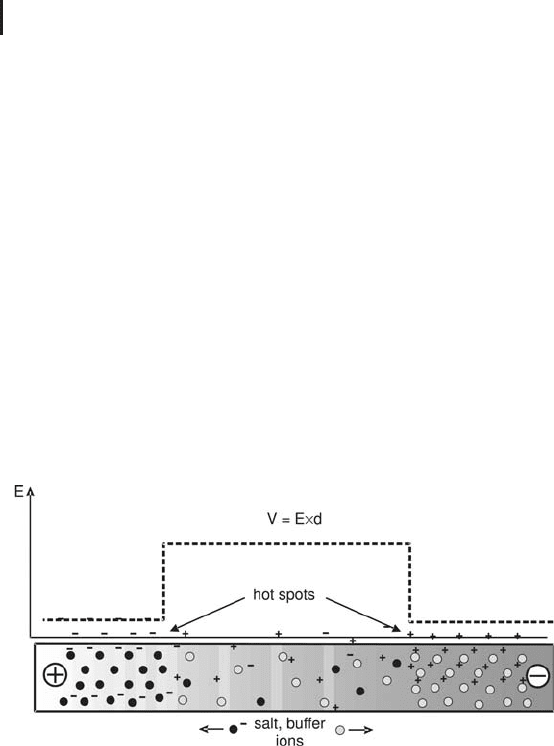
strips (“hot spots”, see Figure 1.26). Aluminum oxide ceramics has
the best thermal conductivity, and affords far the best temperature
dissipation. It is therefore the preferable material for strip holders
and manifold accessories.
Fig. 1.26: Schematic representation of the distribution of salt and
buffer ions in an IPG strip during IEF and the resulting electric field
strength. The ion fronts are migrating slowly towards the electrodes.
V = voltage, E = electric field strength, d = electrode distance.
Hot spots: In an IPG strip, there are always remains of salt and buf-
fer ions present, which have not been washed out. They are bound to
the buffering groups of the immobilized pH gradient. Additionally
there are ions, which originate from ionic sample contaminants.
In the electric field they start to migrate towards the electrodes with
the opposite signs. During the run they are forming visible ion fronts
between the region with low ion concentration and the regions with
high ion concentrations (Figure 1.26), which are moving towards the
electrodes. Immobilized pH gradients have very low conductivity,
because the buffering groups of the gradient are fixed and cannot dif-
Gçrg A, Postel W, Friedrich C,
Kuick R, Strahler JR, Hanash
SM. Electrophoresis 12 (1991)
653–658.
Electric conditions and
temperature control are closely
related.
In IEF, all non-amphoteric
compounds are transported out
of the gradient towards the
electrodes.

1.5 Two-dimensional Electrophoresis 87
fuse. Because of the differences in conductivity, the electric field
strength in these regions is varying considerably. Punctual heat devel-
opment can be observed at these fronts, so called “hot spots”.
Electric conditions As already mentioned above, immobilized pH
gradients have very low conductivity. The current is usually limited at
50 to 70 mA per strip. Higher current settings are not recommended,
because the strips could start to overheat and burn in certain areas of
the gradient. The strips should never be prefocused, because the
higher conductivity produced by salt and buffer ions in the beginning
is advantageous for sample entry and for the start conditions of pro-
teins.
The electric conditions are controlled with the voltage setting. First
low voltage is applied in order to avoid sample aggregation and preci-
pitation in the loading cup or overheating in some strip areas. The
voltage is slowly raised to reach electric field strength as high as pos-
sible in the focusing phase.
& Note: The set current can limit the achievable
voltage, when the sample contains too much
salt, or when buffers are included in the
rehydration or lysis solution.
The voltage changes are either programmed in steps or with ramping,
applying voltage gradients.
Often the instructions supplied with ready-made IPG strips suggest
relatively high voltage start conditions, like 500 V for an hour. These
settings can work well for various samples like rat liver extract or E.
coli lysate, but there are a number of samples which require lower
and slower starting conditions. Particularly samples with high con-
tents of high molecular weight and hydrophobic proteins require a
low electric field for a relatively long time in the beginning. This is
true for all ways of sample application: rehydration, cup, and paper
bridge loading.
When a new sample type is separated for the first time, it is highly
recommended to apply the safest settings. In Figure 1.30 and in the
practical part of this book (see page 314 ff) low voltage settings over
longer time are suggested. They represent the “worst case” for
unknown samples based on experiences by Burghardt Scheibe.
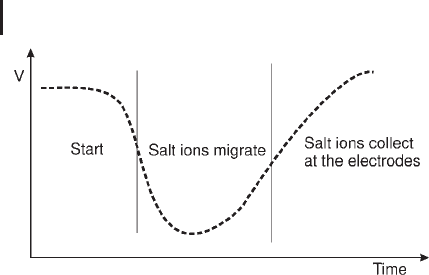
The electric conditions change sometimes dramatically during the
first phase as shown in Figure 1.27:
Burghardt Scheibe: personal
communication.
1 Electrophoretic Techniques88
Fig. 1.27: Development of the actual voltage course during the
first IEF phase in an IPG strip.
The separation can be speed up with applying higher electric field
strength. For these high voltages the instruments have to be designed
to comply with a high safety level.
Volt hours The complete voltage load is defined in volt hour inte-
grals (Vh): the amount of voltage applied over a certain time. For
example: 5,000 Vh (5 kVh) can be 5,000 V in one hour or 1,000 V over
five hours.
.
The Vh definition corrects the running condi-
tions for different conductivities in different
strips caused by different protein compositions
and salt loads.
.
In many cases increasing the voltage gradients
(ramping) rather than in steps improves the
result considerably. In order to apply comparable
voltage loads, the Vh value is a good measure-
ment.
Underfocusing When the applied volt hours are insufficient, not all
spots are round. Horizontal streaks are produced instead. Higher volt
hours loads are needed for samples containing a higher number of
high molecular weight proteins, more hydrophobic proteins and for
preparative runs.
Overfocusing When the proteins are focused too long, some other
negative effects can happen:
.
Cysteines become oxidized, the pI of the protein
changes.
.
Some proteins become instable at their isoelec-
tric point. The modified proteins or its frag-
ments have different pI and start to migrate
These effects are result of too
long time, not of too high
voltage.

1.5 Two-dimensional Electrophoresis 89
again. The result: some horizontal streaks com-
ing out from a few spots.
.
Basic narrow gradients are particularly sensitive
to over focusing. Additionally to possible protein
breakdowns, the basic extreme (> pH 10) of the
gel can become instable because of the very high
pH.
& For basic pH gradients the best results are
obtained with a focusing phase as short as
possible at a voltage as high as possible.
Should the optimal Volt hours have been achieved during the night
or another time of no attendance, the separation will stop after the
programmed value has been reached. Instead of applying a low
“cruising voltage” no voltage should be applied on the strip. Prior to
removal the strips from the strip holders the highest possible voltage
is applied for 15 minutes, in order to refocus the slightly diffused
bands.
Sample entry effects During the first phase of IEF with the cup load-
ing procedure complex phenomena are observed:
.
If the voltage setting in the beginning is low
(100 V, 18 cm IPG strip), the proteins enter the
gel, but a part of them precipitates or gets stuck
within the first few cm of the strip, when the vol-
tage is raised too quickly after this phase. As a
result of this a vertical streak can be found in the
second-dimension gel, which is displaced a few
centimeters from the application point.
.
If the voltage setting for the start is high (like
500 V on a 18 cm IPG strip), a part of the pro-
teins accumulate and precipitate on the surface
of the application point and show a vertical
streak in the second dimension. Sometimes the
precipitated proteins at the application point are
washed off during equilibration: and then no
streak is visible.
& These matters are critical: the voltage level during
sample entrance and the beginning of protein
migration, and the duration of the focusing phase
at high voltage.
Some manuals suggest
applying a low “cruising”
voltage of 500 V to maintain
the band sharpness. This is not
the optimal procedure.
Josef Blles, personal commu-
nication.
It should be continued to use
low voltage during the first few
hours.
In the second case the 2-D
separation shows a clearer
pattern than in the first.