
Westermeier R., Naven T., H?pker H.-R. Proteomics in Practice: A Guide to Successful Experimental Design
Подождите немного. Документ загружается.

1 Electrophoretic Techniques90
1.5.3.4 Instrumentation
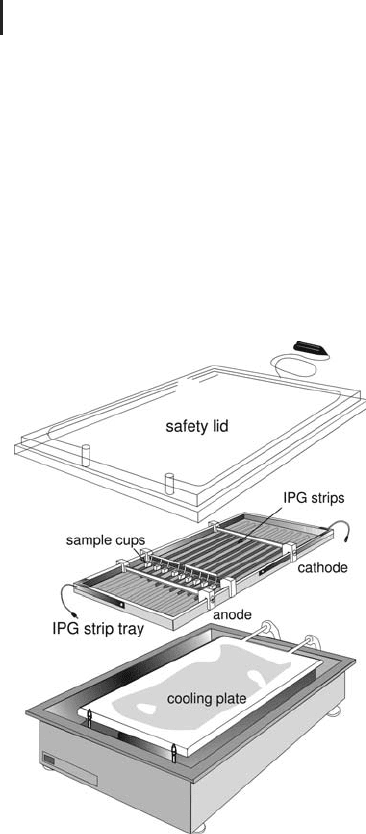
The Multiphor
Originally the IPG procedures were optimized on the
Multiphor chamber (see Figure 1.28). With this equipment, rehydra-
tion can only be performed in the reswelling tray or a rehydration cas-
sette outside the instrument. The separation is performed in a tray
for up to twelve strips. Due to safety regulations the maximum vol-
tage allowed is 3,500 V, because in the modular set-up power supply
and cooling device are connected to the chamber via cables and tub-
ing. The handling of the IPG strips and the entire IEF procedure
were improved by developing a dedicated instrument for IEF in IPG
strips for 2-D electrophoresis.
Fig. 1.28: Multiphor chamber with tray for IEF in IPG strips.
An external programmable power supply for high voltages and
a thermostatic circulator is required.
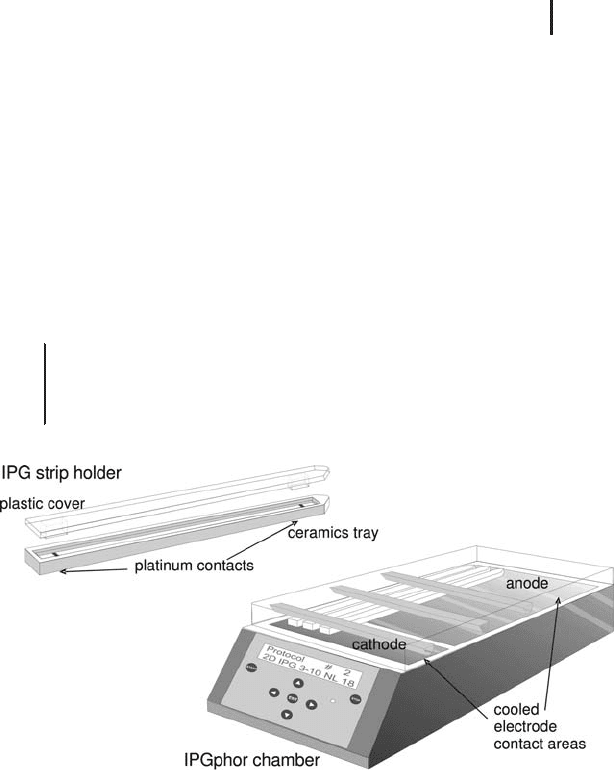
The IPGphor In the instrument shown in Figure 1.29, rehydration
and IEF can be combined. In this case the IPG strips are run facing
down. The high thermal conductivity of the ceramics material is very
important to remove the locally developed heat from some areas of
the IPG strips efficiently. The programmable power supply, which
generates up to 10,000 V, and a Peltier cooling system are integrated
into the electrophoresis chamber.
When everything is integrated
in one instrument, much higher
voltages can be applied than on
modular systems with separate
power supplies and thermo-
static circulators.
1.5 Two-dimensional Electrophoresis 91
The strip holders contain platinum contacts at fixed distances. The
electric field is applied at the gel strips through these contacts, which
are positioned on the respective contact area of the cooling plate. The
anodal contact area is large to accommodate all different lengths of
strip holders or – alternatively – a Manifold.
At the back of the apparatus – in the older versions at the bottom –
is a serial port for possible software updates and to connect a compu-
ter or serial printer to the instrument. In this way a report on the elec-
tric conditions is obtained after every five minutes of the run. With
this interface the instrument can be integrated into the laboratory
workflow system and allow procedures according to GLP (good
laboratory practice).
& It is not recommended to run strips with different
lengths and different pH gradients at the same
time. Also, the temperature setting of 20 C
should not be modified (see above).
Fig. 1.29: IPGphor strip holder and IPGphor chamber for IEF in IPG strips.
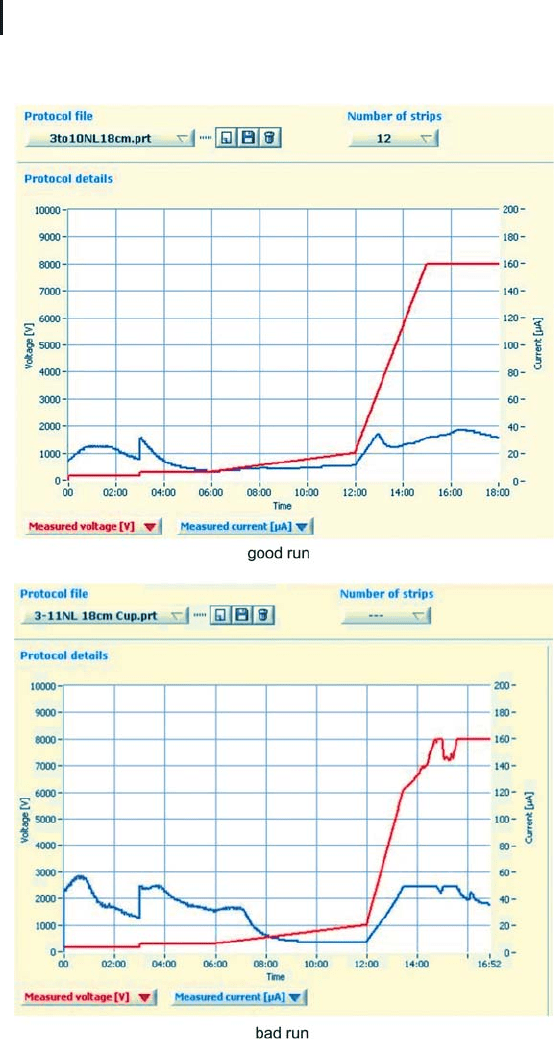
Ideally the electric settings of the IPG strip IEF system are con-
trolled and monitored by an external computer. In this way it is possi-
ble to see from the running conditions, whether the isoelectric focus-
ing run will give good or bad 2-D results. Figure 1.30 shows two
screen dumps of the programmed and monitored running conditions
of two real IPG strip runs. In both cases the current was limited to 50
mg per strip. On the upper graph the really applied voltage followed
exactly the programmed voltage, because all samples were well pre-
pared, and thus the running conditions were never limited by maxi-
mum current. On the lower graph one or more samples contained
too many salt ions: the high conductivity in one or more strips
resulted in reaching the current limit several times. The second pro-
Up to 14 regular strip holders
fit into the instrument.
For optimization of running
conditions the report of the
actual electric parameters is
very useful.
Monitoring the IPG strip runs is
a valuable tool to control the
quality of sample preparation.
In some cases the graph can
indicate that it is not worth-
while to continue with a
second-dimension run. There-
fore this function can save a lot
of work time and material.
1 Electrophoretic Techniques92
tocol indicates suboptimal isoelectric focusing conditions, which will
result in disturbances in the 2-D gel pattern.
Fig. 1.30: Monitored voltage and current graphs from two IEF
runs in IPG strips. For more details see text.
1.5 Two-dimensional Electrophoresis 93
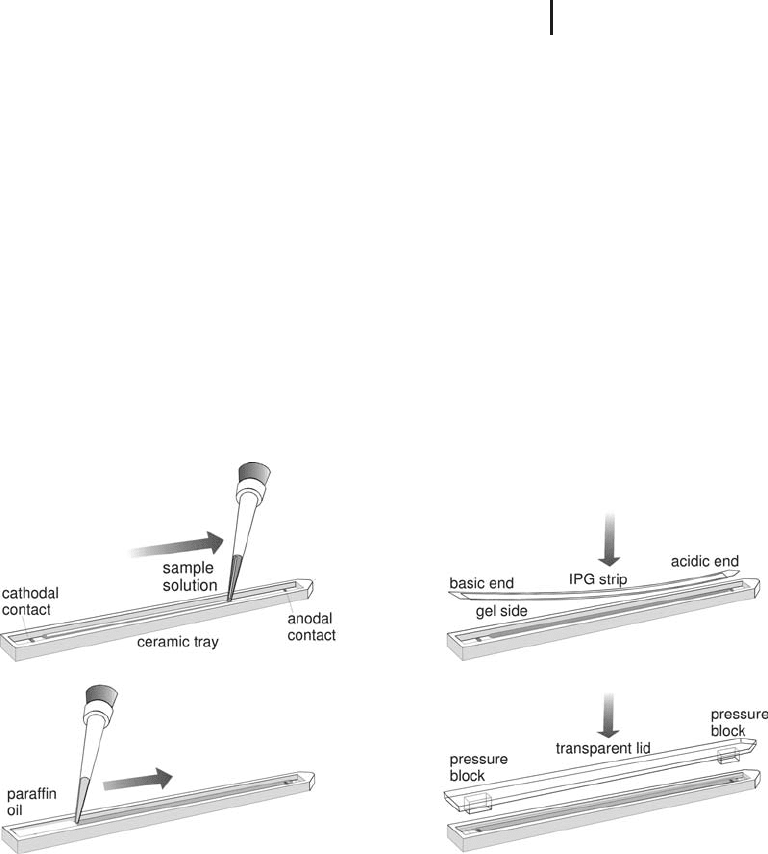
Strip holders Figure 1.31 shows the procedure how to apply the
sample and IPG strips. The trays, made from specially treated alumi-
num oxide ceramics are placed on the thermostated electrode contact
areas of the power supply. Rehydration as well as the IEF separation
is carried out at +20 C.
Ceramics material is the optimum choice; plastic does not have a
good thermal conductivity. Other materials are not usable, because
they exhibit electric conductivity, bind proteins, or show EEO effects.
The advantages of strip holders with platinum contacts are:
.
The number of manipulations and hands-on
steps is reduced.
.
Up to an entire day can be saved.
.
Active rehydration loading can be performed
under low voltage (30–60 V) for 10 hours, which
facilitates the entry of high molecular weight
proteins larger than 150 kDa into the strips
(Gçrg et al. 1998).
Fig. 1.31: Rehydration loading into IPG strips in individual
strip holders of the IPGphor.
The pressure blocks on the cover lids hold the strips down, in order
to maintain the contact also when electrolysis gas is produced during
IEF. The bars of the safety lid of the chamber press the coverlids
down. The most reproducible results are obtained when the acidic
end of the strip is always placed in direct contact with the anodal end
of the tray.
In most laboratories this
method has become the default
procedure.
Gçrg A, Boguth G, Obermaier
C, Harder A, Weiss W. Life
Science News 1 (1998) 4–6.
The distance between the
platinum contact and the end
of the tray is shorter at the
anodal end.

1 Electrophoretic Techniques94
Cleaning of the strip holders The strip holders must be carefully
cleaned after each IEF run. The solutions must never dry in the strip
holder. Cleaning is very effective, if the strip holders are first soaked a
few hours in a solution of 2–5% of the specially supplied detergent in
hot water.
Usually the strip holder slot is vigorously brushed with a tooth-
brush using a few drops of undiluted IPGphor Strip Holder Cleaning
Solution. Then it is rinsed with deionized water.
Sometimes protein deposits are left on the bottom of the strip holder
after IEF. This happens when highly abundant proteins have been
squeezed out of the gel surface at their isoelectric points (see Figure
1.32). It is not always easy to remove these proteins from the strip
holder, particularly when they are sticky like serum albumin. In this
case the strip holders should be boiled in 2% (w/w) SDS with 1% (w/v)
DTT for 30 minutes before the slot is cleaned with the toothbrush.
& Important: Strip holders may be baked, boiled
or autoclaved. But, because of the specially
treated surface they must not be exposed to
strong acids or bases, including alkaline
detergents.
& Note: The strip holder must be completely dry
before use.
For most analytical applications this procedure works very well and
delivers qualitative good and highly reproducible results. However,
there are a few situations, where running the strips gel side up works
better. In some cases cup loading delivers the best results (see also
comparison on page 84 f).
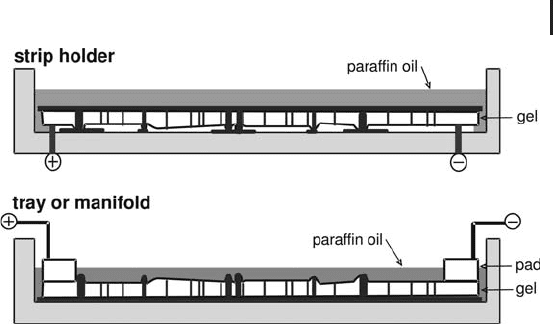
Preparative runs It has been observed that when the sample loads are
increased from analytical (ca. 100 mg) to preparative (> 1 mg) amounts,
the quality of the 2-D pattern decreases, when the strips are run with
the surface down. This phenomenon can be caused by the increasing
amount of some highly abundant proteins. In the end phase of IEF
every focused protein forms a little ridge. These little ridges can be
easily seen on the surface of the strips after IEF. When very high abun-
dant proteins are focused, they form much higher ridges than the other
proteins. In the case of regular strip holders the weight of the strips
rests on these ridges, and the proteins are partly squeezed out. These
proteins diffuse along the interface between the gel surface and the
strip holder bottom (see Figure 1.32), and create a smear. When the
strips are run with the surface up, no pressure is applied on the ridges.
Thus, the results are better, when preparative runs are performed with
the surface up, like in the Manifold (see below, Figure 1.33).
Clean strip holders should be
handled with gloves to avoid
contamination.
SDS solution in absence of
buffer has a neutral pH.
For cup loading the gels are
always run gel side up.
Another advantage of running
preparative samples with the
surface up is that the electrodes
are easier accessible for the
insertion of filter paper pads
between the electrodes and the
strip. In this way salt and buffer
ions as well as proteins with
isoelectric points outside the pH
range of the strip’s gradient can
be collected in the paper pads.
1.5 Two-dimensional Electrophoresis 95
Fig. 1.32: Schematic representation of the running conditions
for IPG strips with high protein loads. Comparison of runs with
the surface down and with the surface up.
Narrow pH gradients High sample load also means high load of
contaminants. This is particularly important for runs in narrow pH
intervals. The advantage of narrow pH gradients is the high spatial
resolution, but also the high loading capacity. Most of the protein
load, however, will accumulate at the electrodes, because most pro-
teins have isoelectric points outside the pH range of the strip. If these
proteins cannot migrate out of the gel, they will precipitate there.
Because they are charged, they can cause electroendosmotic effects:
the resulting local water transport pushes non-precipitated proteins
towards the gel center, which are visible as horizontal streaks at the
lateral sides of the 2-D gel. As a remedy is suggested to apply filter
paper pads soaked with water (damp, not wet) between the electrode
contacts and the ends of the strip after the rehydration has been com-
pleted or a few hours before the end of the separation.
If the sample has to be electrophoretically desalted (see page 62)
the filter pads have to be exchanged several times for new ones.
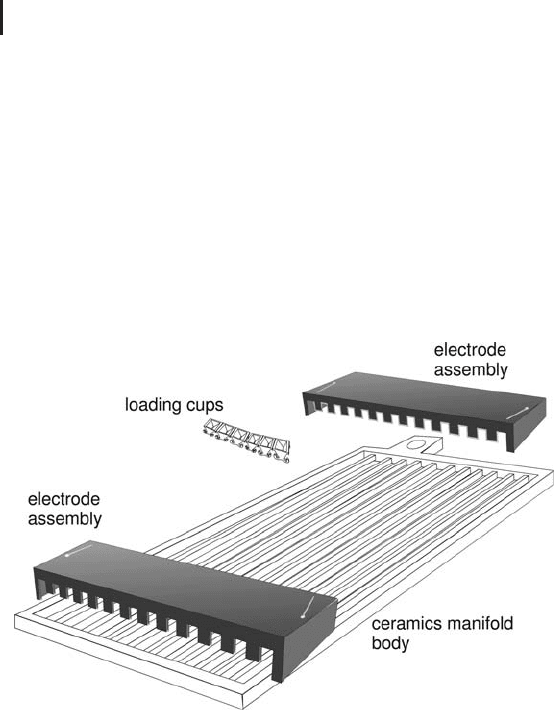
Manifold The manifold (Figure 1.33) is designed for being used
with cup loading or paper bridge loading; but also IPG strips after
rehydration loading in the reswelling tray. It is highly recommended
to use a manifold made from aluminum oxide ceramics. Plastic mate-
rial exhibits lower temperature conductivity, and is less efficient in
heat dissipation. A few degrees difference between IPG strips can
cause some protein spots to change positions, leading to false conclu-
sions.
.
As already mentioned, for basic and very acidic
gradients, and for DeStreak-containing IPG
strips cup loading should be applied. The sam-
ples are applied at the area of the milder pH.
It cannot be used for rehydra-
tion of IPG strips, because the
grooves are too wide.
1 Electrophoretic Techniques96
.
High sample loads (>1 mg) often require runs
with the gel surface facing up. Several ways of
sample applications are possible:
– Rehydration loading in the external reswelling
tray (Figure 1.24);
– Rehydration loading in strip holders;
– Cup loading;
– Paper bridge loading.
.
Because of its geometry, up to 100 mA per IPG
strip can be applied, which also facilitates pre-
parative separations.
Fig. 1.33: Manifold for running up to twelve IPG strips with
cup or paper bridge-loading. IPG strips containing already the
sample from rehydration loading in the reswelling tray are run
with the gel surface up.
Protrusions along the grooves inside the Manifold align the rehy-
drated IPG strips, keeping them straight and centered when placed
inside the manifold. Filter paper pads are soaked in deionized water
and inserted between the electrodes and the IPG strips to trap salt
ions, and those proteins, which possess pIs above and below the pH
gradient. After the loading cups are put into position 100 mL paraffin
oil is carefully poured into the Manifold, around the cups. This is a
practical way to control whether there is a leaking cup. In the manual,
which comes with the instruction, it is recommended to pour the oil
in first; in this case it is very important to rehydrate the strips with
sufficient Bromophenol blue.
Active rehydration loading can
be very useful, but it is only
possible in the strip holders.
The high volume of oil is also
needed, when only a few strips
are applied, because it should
be avoided that some strips are
run with a dry surface.

1.5 Two-dimensional Electrophoresis 97
The electrode assembly has electrode teeth on one side and hold-
down teeth for paper bridge-loading on the other side. Therefore the
length of the paper bridge is important (see also page 319 f).
Cleaning of the manifold Cleaning of the manifold is less critical
than for the strip holder, because the gel surface and the proteins do
not have direct contact with its surface. It is – like the strip holder –
brushed with a toothbrush using a few drops of undiluted IPGphor
strip holder cleaning solution. Then it is rinsed with deionized water.
The loading cups can be reused for most of the samples after thor-
ough cleaning with laboratory detergent.
1.5.3.5 Strategy for IEF Optimization
In the following an example is given how to plan optimization work
and to check the reliability of the analysis. Details on running condi-
tions are given in the protocol Step 3: Isoelectric Focusing, page 317.
18 cm or 24 cm IPG strips should be used from the beginning.
Shorter strips do not exhibit sufficient resolution.
Tab. 1.3: Strategy for IEF.
1 Wide gradient
pH 3–10 linear or non-linear
Application of ca. 100 mg total protein
by rehydration loading at 50 V for
12 hours.
2 Wide gradient
pH 3–10 linear or non-linear
Rehydration loading in reswelling tray
and IEF in cup loading strip holder.
3 Wide gradient
pH 3–10 linear or non-linear
Cup loading on pre-rehydrated strip:
one application at the anodal end and
one on the cathodal end.
Decision point: selection of the best procedure
4 Semi-wide gradients
pH 4–7, pH 6–11, etc.
Way of loading is dependent on the
results in the wide gradients; on basic
strips.
5 Narrow gradients,
like one pH unit
Way of loading is dependent on the
results in the wide gradients.
6 Basic gradients No rehydration loading; sample is ap-
plied at the anodal end.
7 Preparative runs The strips must be run with the gel
surface up.
& In general it can be said that the Manifold is the
more versatile accessory for the IPGphor.
Start with very low voltage
settings for a long time period!
The only downside is that active
rehydration loading cannot be
done in the reswelling tray.

1 Electrophoretic Techniques98
Methodology check If the result is not satisfying – streaky and
smeary pattern, only few or no spots – it is important to find out
whether the problem is caused by inadequate sample preparation or
by certain issues during the separation. The trouble shooting guide
in the appendix of this book can be very useful here. But a complete
run with a test sample – E. coli lyophilizate – is highly recommended.
Reproducibility check When the optimal conditions have been
found, samples must be run in at least doublets or triplets, in order to
check, whether observed pattern differences are caused by the noise
of the system or by variations between different samples.
After IEF Either the strips containing the focused proteins are equi-
librated in SDS buffer and run on the second dimension right away,
or they are stored at –60 C to –80 C in a deep-freezer.
Staining of an IPG strip (Acid violet 17) Sometimes it can be useful to
check whether the separation in the first dimension worked well
before all the work with the second-dimension run is started. Because
of the high urea and detergent concentrations in the gel silver and
Coomassie brilliant blue staining produce a dark background. The
most sensitive technique is Acid violet 17 staining according to Pates-
tos et al. (1988). The bands are visible after 40 minutes, during this
time the proteins in the other strips can be kept focused with the
application of a medium high voltage, like 2000 V.
1.5.3.6 Measurement of the pI
The pH gradient in an IPG strip cannot be determined with a surface
electrode, because the conductivity is too low. The calculation of the
pH gradient based on the pK values and the concentrations of the
Immobilines is rather complex, because the presence of urea and the
running temperature has to be taken in account. The addition of pro-
tein standards is generally not recommended, because absolute purity
of these proteins would be required, and adding additional proteins
to a complex mixture can easily lead to errors in interpretation of the
pattern.
Two different ways of pI measurement are proposed for 2-D electro-
phoresis.
Method 1. pH gradient graphs Graphs of operational pH gradient
profiles are published in a data file by GE Healthcare Life Sciences
(2003) as a basis for pI estimation. More information and larger
Replicate gels are highly recom-
mended for statistically reliable
results.
–20 C to –40 C are not
enough: some proteins become
modified.
Patestos NP, Fauth M, Radola
BJ. Electrophoresis 9 (1988)
488–496.
Of course, the stained strip does
no longer release the proteins
into the second-dimension gel.
1.5 Two-dimensional Electrophoresis 99
graphs can be found at this website: http://www.gehealthcare.com/
lifesciences
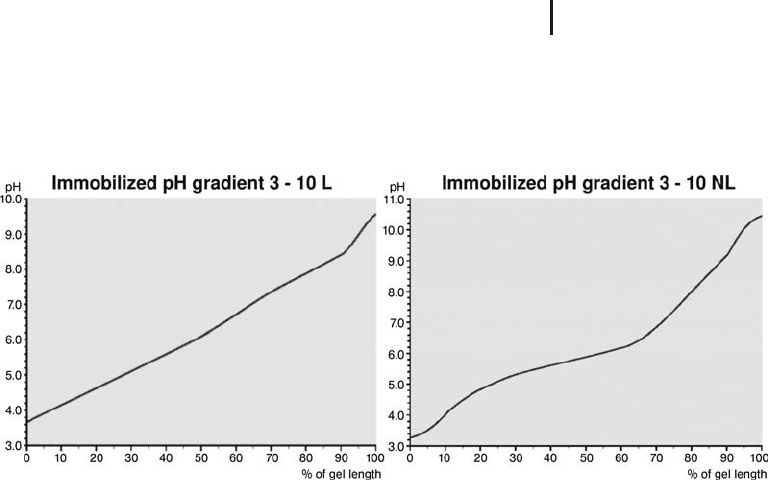
These gradients are the calculated target pH gradients at 20 C in
presence of 8 mol/L urea. The pH values are plotted over the gel
length given in per cent. Two examples are shown in Figure 1.34.
Fig. 1.34: pH gradients in IPG strips 3–10 and 3–10 NL.
Downloaded from the following website:
http://www.gehealthcare.com/lifesciences
The pI of a protein is estimated by relating the position of the pro-
tein in the SDS gel to its original position in the IPG strip, plotting
the band position versus pH, and read out the pI. The strips do not
contain pH plateaus at the ends: the graph must be aligned from one
strip end to the other. Typical standard deviations for different
batches of commercial IPG strips are given in the data file, men-
tioned above, and website.
This procedure is usually carried out with the image analysis soft-
ware as a “1-D calibration”.
Method 2. Interpolation between identified sample proteins with known
pI
Prominent spots showing up in each 2-D map of a sample type
can be analyzed for identification and amino acid sequence informa-
tion. The theoretical pIs can then be used as keystones for interpolat-
ing the pIs of the other proteins. Bjellqvist et al. (1993) have success-
fully correlated the calculated pIs from the amino acid sequences of
proteins with the protein position in immobilized pH gradients and
put the procedure into practice for human cells (Bjellqvist et al. 1994).
The second procedure is performed with the image analysis soft-
ware as “2-D calibration”.
This subject will be further explained in the chapter on image ana-
lysis of 2-D electrophoresis gels.
GE Healthcare Life Sciences
(18-1177-60): Immobiline
DryStrip gels (2004).
Note: Different strip lengths
are used, and non-backed gels
can swell or shrink.
Bjellqvist B, Hughes GJ,
Pasquali C, Paquet N, Ravier
F, Sanchez J-C, Frutiger S,
Hochstrasser D. Electrophoresis
14 (1993) 1023–1031.
Bjellqvist B, Basse B, Olsen E,
Celis JE. Electrophoresis 15
(1994) 529–539.