
Westermeier R., Naven T., H?pker H.-R. Proteomics in Practice: A Guide to Successful Experimental Design
Подождите немного. Документ загружается.


1 Electrophoretic Techniques60
with immediate precipitation of the extracted proteins. This can be
done with a 2-D cleanup kit, with the methanol chloroform method,
or at –20 C with TCA acetone (see below).
1.5.1.6 Phosphatase Inactivation
The determination of phosphorylations and their locations on the
protein molecule reveals very valuable information on biochemical
processes. This is done with tandem mass spectrometry with several
fragmentations of the tryptic peptides. To maintain the phosphoryla-
tion status two phosphatase inhibitors are added: 1–10 mmol/L
Na
3
VO
4
, a phospho-tyrosine inhibitor, and 1–10 mmol/L NaF, which
is a phospho-serine/threonine inhibitor.
1.5.1.7 Alkaline Conditions
Tris base up to 40 mmol/L or 25 mmol/L spermine base (Rabilloud
et al. 1994) is sometimes added to the lysis buffer to maximize protein
extraction, precipitate nucleic acids, or to keep protease activities low.
This should not be done, when basic proteins are of interest and
must be displayed in the gel. Care should be taken when preparative
sample loads need to be analyzed: the ionic contamination can
become too high.
For labeling with modified CyDye fluors for fluorescence 2-D differ-
ence gel electrophoresis (DIGE), the pH of the sample must be
higher than pH 8. This is achieved by adding 30 mmol/L Tris to the
lysis solution. Sometimes the sample solution pH is adjusted to pH
8.5 with NaOH solution. This pH value is the optimum for dye label-
ing (Yan et al. 2002).
1.5.1.8 Frequently Applied Sample Treatments
Cell washing
For the analysis of cell extracts washing of cells with
PBS (phosphate buffered saline) is proposed. Unfortunately PBS con-
taminates the cell surfaces with salt, which leads to horizontal streak-
ing. Either it is possible to remove the PBS solution completely, or
the cells are washed with Tris-buffered sucrose solution (10 mmol/L
Tris, 250 mmol/L sucrose, pH 7). Often cells are first washed with
PBS solution, and then as a last washing step Tris-buffered sucrose
solution is used.
Cell disruption The choice of disruption methods is dependent on
the type of sample. The easiest way is osmotic lysis of cultured cells,
using the standard lysis solution defined above. Sometimes lyophi-
lized cells are brought into solution with lysis solution. For analytical
Rabilloud T, Valette C, Lawr-
ence JJ. Electrophoresis 15
(1994) 1552–1558.
Yan JX, Devenish AT, Wait R,
Stone T, Lewis S, Fowler S.
Proteomics 2 (2002)
1682–1698.
It is important that the
washing solution contains
enough osmoticum to avoid
cell lysis at this stage. Sorbitol
does not work as well as
sucrose.

1.5 Two-dimensional Electrophoresis 61
applications 5 to 1010
6
cell equivalents are usually applied. Bacteria
cells can be extracted by repeated freezing at –20 C and thawing. For
some organisms detergent lysis or sometimes even enzymatic lysis is
necessary, for instance for tough cell walls of yeast and fungi. When
samples are treated with the anionic detergent SDS, the solution
must be diluted with lysis solution to a less than 0.1% (w/v) SDS with
at least 8 the concentration of zwitterionic detergent prior to IEF.
Sonication with a probe is very helpful for solubilization. French pres-
sure cells and mechanical homogenizers, like bead beaters, are
employed to burst tough cell walls from yeast or plant cells.
Tissues and samples with tough cell walls are often treated with
mortar and pestle at sub-zero temperatures. The handling of small
sample amounts requires smaller tools. A new sample grinding kit is
designed for the effective grinding of small samples for the purpose
of protein extraction. The kit consists of microcentrifuge tubes each
containing a small quantity of abrasive grinding resin suspended in
water. Extraction solution of choice is added to the tube along with
the sample to be ground. A grinding pestle is used to grind the sam-
ple. Cellular debris and grinding resin are removed by centrifugation.
Intracellular organelles are also disrupted, resulting in the liberation
and extraction of all proteins soluble in the extraction solution.
General The disruption method used can influence the 2-D pattern.
Therefore it has to be employed in a reproducible way and be thor-
oughly described in the analysis protocol.
1.5.1.9 Removal of Contaminants
A crude extract can be contaminated with salt ions, phospholipids
and nucleic acids, leading to disturbances or background streaking.
Nucleic acids Nucleic acids are visible after silver staining as dis-
turbing horizontal streaks in the acidic part of the gel. Furthermore,
they can precipitate with the proteins when the sample has to be
applied on the basic end of the IEF gel. They can be removed with
DNAse and RNAse treatment, or with benzonase. The easiest techni-
que is sonication, which breaks nucleic acids into little fragments.
Precipitation also removes nucleic acids.
Lipids Lipids are removed with an excess of detergent (>2%) or with
precipitation. Proteases are irreversibly inactivated by precipitation.
Solid material is removed by spinning it down by centrifugation. Salts
can be dialyzed away or removed by precipitation. In the following
pages the procedures are explained more detailed.
When a sonicator is used, the
procedure should be performed
on ice. Only short bursts should
be applied in order to avoid
heating of the urea.
Heating must be avoided when
sonicating. Proteins are not
destroyed with sonication.

1 Electrophoretic Techniques62
Salts When a sample contains too much salt, the conductivity will
be too high for isoelectric focusing.
Microdialysis Desalting with microdialysis tubes shows less protein
losses than with gel filtration. A mini dialysis kit has been designed
for the dialysis of small samples with minimal handling and without
sample loss. Each dialysis tube consists of a sample tube with a cap
that incorporates a dialysis membrane. Usually the membrane with a
molecular cut-off of 8,000 Da is used. The sample is pipetted into the
tube, which is capped and inverted in a beaker containing urea–deter-
gent solution. The tubes are held in place with floats. Salts and mole-
cules smaller than the molecular weight cut-off of the dialysis mem-
brane rapidly exchange through the membrane. Following dialysis,
the tube is centrifuged briefly to recover the contents. Then the reduc-
tant and IPG buffer are added to the sample again. Dialysis time is 2
hours to overnight.
Electrophoretic desalting There are some cases where the sample
must not be dialyzed. For example: Proteins in halobacteria lysate
will not be soluble if the salt is removed. Another example: if the
extraction solution containing bovine vitreous proteins would be
desalted, they would form a gel. Gçrg et al. (1995) showed that the
sample can be electrophoretically desalted during the first IEF phase
in the immobilized pH gradient strip: the applied voltage has to be
limited to 100 V for 5 hours.
1.5.1.10 Precipitation Methods
There are several reasons to apply a protein precipitation procedure:
.
Concentration of low concentrated proteins, like
in plant tissue;
.
Removal of several disturbing compounds at the
same time;
.
Irreversible inhibition of protease activity;
.
Disintegration of complexes;
.
Removal of endogeneous small peptides, which
would interfere with DIGE labeling.
The proteins are precipitated while interfering substances such as
detergents, salts, lipids, phenols, and nucleic acids are left behind in
solution. The proteins are then resuspended in lysis solution.
Method by Wessel and Flgge (1984) Methanol and chloroform are
added to the sample. After adding water the phases are separated and
Gçrg A, Boguth G, Obermaier
C, Posch A, Weiss W. Electro-
phoresis 16 (1995) 1079–1086.
Note: Protein losses can never
be completely prevented.
Wessel D, Flgge UI. Anal
Biochem 138 (1984) 141–143.

1.5 Two-dimensional Electrophoresis 63
the proteins are precipitated at the chloroform–methanol–water inter-
phase. Excess methanol is added, followed by centrifugation. This
precipitation method holds one of the best yields.
Method by Damerval et al. (1986) The frozen plant material is
ground in a pre-frozen mortar. The powder is mixed with 10% TCA
in cold acetone (–20 C) containing 0.07% 2-mercaptoethanol. Preci-
pitation occurs overnight in a freezer, followed by centrifugation and
repeated washing with acetone (–20 C) containing 0.07% 2-mercap-
toethanol. The pellet is resuspended in lysis buffer. The disadvantage
is, however, that some acidic proteins get lost with this procedure,
because they are not precipitated into the pellet. The yield of proteins
with pIs higher than pH 7 is much higher when extracted under
acidic conditions than with lysis buffer. Gçrg et al. (1997, 1998) have
therefore employed this procedure – with slight modifications – to
extract more basic proteins from bacterial cells, yeast, and animal tis-
sue. They used 20% TCA and replaced the 2-mercaptoethanol by
0.2% DTT.
Method by Mastro and Hall (1999) This procedure is applied for
delipidation and precipitation of lipid-rich samples. Biological
extracts with a lipid content of over 20% of dry matter are delipidated
and precipitated with a mixture of tri-n-butyl phosphate, acetone and
methanol at 4 C, centrifuged, washed with the same mixture and air-
dried.
2-D clean-up kit This procedure can be completed in one hour and
does not result in spot gain or loss. The principle is similar to the
method by Damerval et al. (1986), but with a detergent co-precipitant
proteins are more efficiently and completely removed from the solu-
tion. The wash buffer contains some organic additives that allow
rapid and complete resuspension of the proteins with lysis buffer.
The first experiences using this procedure were reported in a paper
by Stasyk et al. (2001): The spot resolution is improved and the num-
ber of spots higher compared to crude extracts or other precipitation
methods. In extreme cases no sample proteins at all can migrate into
the IPG strip because of aggregating proteins and contaminating
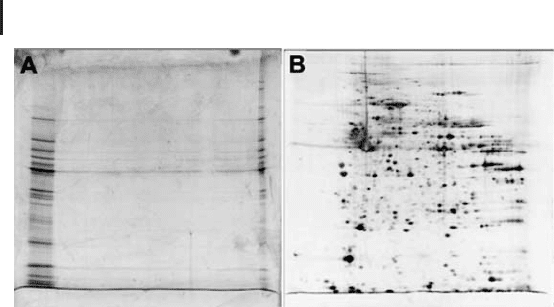
molecules. Figure 1.16 shows such a case: only after a clean-up proce-
dure is a 2-D protein pattern obtained. When the crude sample was
applied, the Bromophenol blue band did not start to migrate in the
electric field, indicating a very high salt content.
Damerval C, DeVienne D, Zivy
M, Thiellement H. Electrophor-
esis 7 (1986) 53–54.
Gçrg A, Obermaier C, Boguth
G, Csordas A, Diaz J-J, Madjar
J-J. Electrophoresis 18 (1997)
328–337.
Gçrg A, Obermaier C, Boguth
G, Harder A, Scheibe B, Wild-
gruber R, Weiss W: Electrophor-
esis 21 (2000) 1037–1053.
Mastro R, Hall M. Anal
Biochem 273 (1999) 313–315.
Stasyk T, Hellman U, Souchel-
nytskyi S. Life Science News 9
(2001) 9–12.
1 Electrophoretic Techniques64
Fig. 1.16: 2-D electrophoresis of rat tongue tissue.
IPG 3-10L 13 cm. Silver staining.
A: Crude extract of rat tongue tissue.
B: Rat tongue tissue extract after treatment with the 2-D clean-up kit.
Resolubilization In practice the 2-D clean-up kit and the method
according to Wessels and Flgge hold the highest yield among the
precipitation methods. Nevertheless, there are sometimes difficulties
to get all precipitated proteins solubilized again. In the practical Part
II on page 295 a number of procedures are proposed for getting the
protein pellet completely back into solution.
Immunoprecipitation A widely used procedure to reduce the protein
complexity for subsequent 2-D electrophoresis is immunoprecipita-
tion (IP) with agarose beads-bound antibodies. Elution with urea
solution should be avoided, because with this measure antibodies can
get removed from the beads. The standard elution buffer is
200 mmol/L glycine, titrated to pH 3 with HCl.
1.5.1.11 High Molecular Weight Proteins
It seems that this subject may not fit into the sample preparation
part, because nothing can be done here to improve the performance
of 2-D electrophoresis for displaying high molecular weight proteins
with sizes above 150 kDa. It is known that HMW proteins can get lost
during the isoelectric focusing step or between the first and second
dimensions. But they are included, when they are just run in a one-
dimensional SDS gel.
In general the number of HMW sample is not so high that they
could not be resolved in a one-dimensional SDS PAGE separation. If
HMW proteins are of interest, there is the possibility to prepare a por-
tion of the sample with SDS sample buffer and run it as a 1-D sam-
ple, either on the 2-D gel together with the IPG strip or on a separate
SDS gel.
The pellet must never become
completely dry; this is the most
frequent reason for problems
with resolubilization.
The transfer of HMW proteins
from the first to the second
dimension is improved, when
the electric field is kept very low
during the first two hours (see
below).
1.5 Two-dimensional Electrophoresis 65
1.5.1.12 Overloading Effects
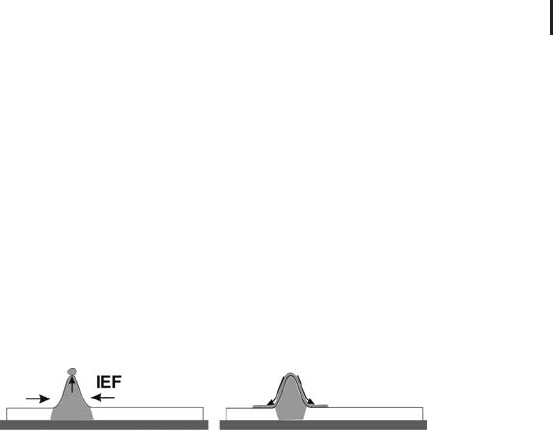
When a sample contains one or a few highly abundant proteins, an
overloading effect can occur: When the electric field focuses the pro-
tein at the isoelectric point, the gel will build a high ridge at this
point. When the amount of a protein is too high, the focusing force
will exudate a part of the protein through the gel surface of an IPG
strip. The protein will diffuse over the surface (see Figure 1.17). The
effect will be visible as strong horizontal streaks over the 2-D gel.
This phenomenon is particularly intensified, when the IPG strip is
run with the surface downward, because there is additional mechan-
ical pressure acting on the ridges.
Fig. 1.17: Effect from overloading a protein in an IPG strip.
1.5.1.13 Quantification Methods
The usually applied additives, like urea, detergents, and reductants,
interfere with the standard protein assays (e.g. Bradford, Biuret,
Lowry). False values often lead to over- or under-estimation of the pro-
tein load applied on gels. Ramagli (1999) had modified an existing
method to a relatively reliable procedure by acidifying the sample
with 0.1 mol/L HCl.
A more reliable protein assay is based on precipitation to get rid of
the additives. The subsequent assay is based on the specific binding
of copper ions to protein. Precipitated proteins are resuspended in a
copper-containing solution and unbound copper is measured with a
colorimetric agent. The color density is inversely related to the pro-
tein concentration. The assay has a linear response to protein in the
range of 0 mgto50mg.
Another possible method is the labeling of the proteins with a
fluorescent tag and dotting a dilution series on a low fluorescent
blotting membrane (Mackintosh et al. 2005). The membranes are
washed, and then scanned with a fluorescence imager.
For a reliable comparison of 2-D gels the protein load should be
similar for all IPG strips run in one gel. Therefore the protein
amount needs to be checked. Variations of protein loads must be in
certain limits to allow for corrections by the normalization function
of image analysis (see pages 131 and 133). The knowledge of the pro-
tein content of a sample is very useful to avoid under- or overloading.
Therefore estimation of the
protein content in the sample is
very important.
Ramagli LS. In Link AJ. (Ed) 2-
D Proteome Analysis Protocols.
Methods in Molecular Biology
112. Humana Press, Totowa,
NJ (1999) 99–103.
The precipitation reagents are
the same like in the 2-D clean-
up kit.
Mackintosh JA, Veal DA,
Karuso P. Proteomics 5 (2005)
4673–4677.
If possible, these highly abun-
dant proteins should be
depleted with affinity media, or
the sample should be pre-frac-
tionated.

1 Electrophoretic Techniques66
However, when the protein composition is unbalanced, this informa-
tion does not help very much. A typical example is serum or plasma,
where albumin makes up ca. 60% and the gamma globulins ca. 20%
of the total protein. These highly abundant proteins can easily cause
overloading effects (see above). Thus for such sample types the total
protein loading capacity of an IPG strips is considerably reduced.
1.5.1.14 Analytical Versus Preparative Sample Load
Sample loads are often classified into analytical or preparative loads.
In practice it is not easy to differentiate clearly between these terms:
A strong protein spot in an analytical gel can contain enough material
for further analysis whereas a weak spot in a preparative gel can be
insufficient. Roughly, when 50 to 150 mg of total protein is applied on
a gel, and silver or sensitive fluorescent staining methods need to be
employed, it is an analytical gel. Preparative gels are loaded with
500 mg to 1 mg total protein or more. These gels are usually stained
with Coomassie brilliant blue, medium sensitive fluorescent dyes, or
zinc–imidazol.
1.5.1.15 Special Cases
Human body fluids
Body fluids are an important source for detec-
tion and monitoring of disease markers. The Anderson group had
started many years ago to collect data for the Human protein index
with 2-D electrophoresis, for instance analyzing plasma and urinary
proteins (Anderson et al. 1977, 1979). A plasma protein map pro-
duced with immobilized pH gradients has been published by Hughes
et al. (1992).
Besides plasma and serum, cerebrospinal fluid is frequently used
as a sample for detecting and monitoring prognostic and diagnostic
markers. Here is a selection of papers on 2-D electrophoresis of cere-
brospinal fluid: Harrington and Merrill (1988), Yun et al. (1992), Zerr
et al. (1996), Burkhard et al. (2001).
Unfortunately most of the body fluids are loaded with some highly
abundant proteins and salt ions, which interfere with the first dimen-
sion. Microdialysis and/or low-voltage start conditions for isoelectric
focusing are required to avoid distorted patterns.
Albumin For serum and plasma usually the high abundance of albu-
min and globulins limit the loading capacity for the rest of the pro-
teins. When the albumin and IgG content in samples like plasma,
serum, and cerebrospinal fluid are removed with affinity media, the
sensitivity of detection for other proteins is considerably improved
(see, for instance, Chromy et al. 2004). However, as albumin is a
Anderson L, Anderson NG.
Proc Nat Acad Sci USA. 74
(1977) 5421–5425.
Anderson NG, Anderson NL,
Tollaksen SL. Clin Chem. 25
(1979) 1199–1210.
Hughes GJ, Frutiger S, Paquet
N, Ravier F, Pasquali C,
Sanchez JC, James R, Tissot JD,
Bjellqvist B, Hochstrasser DF.
Electrophoresis 13 (1992)
707–714
Harrington MG, Merrill C. J
Chromatogr 429 (1988)
345–358.
Yun M, Mu W, Hood L,
Harrington MG. Electrophor-
esis 13 (1992) 1002–1013.
Zerr I, Bodemer M, Otto M,
Poser S, Windl O, Kretzschmar
HA, Gefeller O, Weber T.
Lancet 348 (1996) 846–849.
Burkhard PR, Rodrigo N, May
D, Sztajzel R, Sanchez J-C,
Hochstrasser DF, Shiffer E,
Reverdin A, Lacroix JS. Electro-
phoresis 22 (2001) 1826–1833.
Chromy BA et al. J Proteome
Res , 3 (2004) 1120–1127.

1.5 Two-dimensional Electrophoresis 67
transport protein, other proteins, which stick to albumin, are
removed at the same time (Granger et al. 2005). Some research
groups have already started to study the so called “Albuminome”
(Gundry et al. 2007). Currently there is no procedure available to get
rid of albumin without losses of other proteins.
Plant proteins Sample preparation from plant tissues is particularly
troublesome, because interfering substances such as polysaccharides,
nucleic acids, lipids and phenolic compounds are present in high
concentrations, whereas the proteins exist in low abundance. The
classic procedure for protein extraction from plant tissue is the preci-
pitation with TCA and acetone according to Damerval et al. (see
above). Meanwhile some more work has been invested for more effi-
cient extraction procedures for recalcitrant plant tissue (Giavalisco
et al. 2003; Mchin et al. 2003; Carpentier et al. 2005). Relatively elabo-
rate procedures are also required for the analysis of plant membrane
proteins (Hurkman and Tanaka, 1986). Here the protein pellet has to
be extensively washed before it can be resuspended in lysis buffer for
IEF. Delaplace et al. (2006) could show for the example of potato tuber
proteins that the phenolic phase extraction method according to
Hurkman and Tanaka and an extraction with SDS lysis solution are
complementary regarding the M
r
range of preferentially extracted
proteins.
Another challenge for plant proteomics researchers is the high
abundance of Rubisco (ribulose-1,5-bisphosphate), the most abun-
dant enzyme on earth, and making up about 60% of soluble leaf pro-
tein.
1.5.1.16 Integration of Sample Preparation into a Laboratory Workflow
System
It is very important to link the sample preparation procedure to the
result data even down to mass spectrometry analysis. A good example
case for this need is described in the – already mentioned – paper by
Parness and Paul-Pletzer (2001), where the origin of the keratin of
the protein spots has been found in the reductant.
Peculiar results in mass spectrometry analysis must initiate an
automated search in the entire laboratory workflow. Therefore all
data, including the source and the LOT number of each reagent used,
have to be entered together with the sample code into the database of
the laboratory workflow system.
Granger J, Siddiqui J, Copeland
S, Remick D. Proteomics 5
(2005) 4713–4718.
Gundry RL, Fu Q, Jelinek CA,
Van Eyk JE, Cotter RJ. Proteo-
mics Clin Appl 1 (2007)
73–88.
Mchin V, Consoli L, Le Guil-
loux M, Damerval C. Proteo-
mics 3 (2003) 1299–1302.
Giavalisco P, Nordhoff E,
Lehrach H, Gobom J, Klose J.
Electrophoresis 24 (2003)
207–216.
Carpentier SC, Witters E,
Laukens K, Deckers P,
Swennen R, Panis B. Proteo-
mics 5 (2005) 2497–2507.
Hurkman WJ, Tanaka CK.
Plant Physiology 81 (1986)
802–806.
Delaplace P, van der Wal F,
Dierick J-F, Cordewener JHG,
Fauconnier M-L, du Jardin P,
America AHP. Proteomics 6
(2006) 6494–6497.
Parness J, Paul-Pletzer K. Anal
Biochem 289 (2001) 98–99.

1 Electrophoretic Techniques68
1.5.1.17 Further Developments in Sample Preparation Procedures
Whereas the methodology for the separation and further analysis of
the proteins has become much easier, reliable, and reproducible,
there is still a substantial wish list for improvements of sample pre-
paration:
.
A very important goal in for creating reliable
data is a certain standardization of sample pre-
paration and a systematic reduction of protein
complexity prior to 2-D electrophoresis.
.
A wider choice of detergents and other additives,
which support the solubility of hydrophobic pro-
teins, and would reduce the losses of proteins.
.
Multiple automated sample preparation will
reduce the manual influence and allow higher
throughput. Because most of the problems in
practice are created by contaminants of all differ-
ent kind, the 2-D clean-up precipitation and reso-
lubilization method should be applied to many
sample types.
.
Pre-fractionation of proteins according to their
isoelectric points into defined packages, which
are applied on narrow pH interval gels can sub-
stantially reduce the load of sample not dis-
played in these gels, and in this way reduce
losses of proteins.
.
More efficient methods for depletion of highly
abundant proteins need to be developed.
1.5.2
Pre-labeling of Proteins for Difference Gel Electrophoresis
With the difference gel electrophoresis (DIGE) approach the proteins
of several samples are labeled prior to the electrophoretic separation
with different – spectrally distinct – fluorescent dyes. The samples
are mixed together and run on the same 2-D gel. In this way the pro-
teins of different samples are migrating under identical conditions,
because the gel-to-gel variations are eliminated. For this method the
cyanine dyes (CyDye) are chemically modified in a way that they bind
to proteins and allow precise co-migration of the same proteins in
both dimensions (nl et al. 1997). After electrophoresis the gels are
scanned with a fluorescent imager at different wavelengths. There is
a linear relation between a labeled protein and the signal measured
with the imager, because on excitation of the dye by monochromatic
The separation conditions for
labeled proteins are exactly the
same as for non-labeled.
nl M, Morgan EM, Minden
JS. Electrophoresis 19 (1997)
2071–2077.
1.5 Two-dimensional Electrophoresis 69
light, the dye emits light in proportion to the amount of labeled com-
pound in the sample.
Three spectrally distinct dyes are available: Cy2, Cy3 and Cy5. They
can be excited with a blue, red and green laser, respectively. In the
scanner the emitted light is amplified with photomultiplier tubes and
recorded with the computer. As an alternative a white light source
can be used, and the monochromatic light is created with particular
narrow band pass excitation filters. In this case the emitted light is
collected with a scanning CCD camera. In order to prevent crosstalk
between the different sample signals, in both cases the different
channels are scanned sequentially, and narrow band pass emission
filters are inserted for the respective fluorophores.
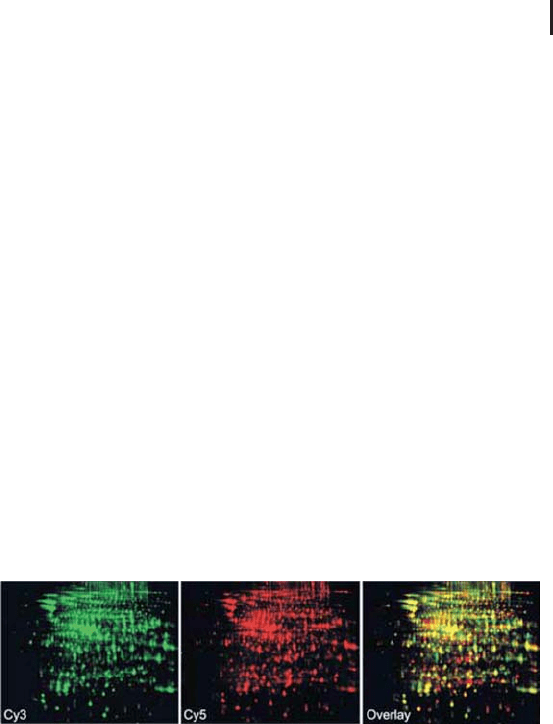
The images can be displayed on a computer screen in a false color
representation. This allows a preview on the results. Using an image-
editing program the false color pattern can be overlaid, which is an
easy way to visualize differences in protein expression. Figure 1.18
shows such an overlay for two samples. Yellow spots indicate equal
expression levels, green or red spot up- and down-regulations respec-
tively. This visual inspection is very useful as a control over the
separation quality and for optimization of sample preparation and
labeling. For the final evaluation of the results dedicated image analy-
sis software, DeCyder, has to be employed.
Fig. 1.18: False color representation of 2-D electrophoresis
separations of two samples labeled with Cy3 and Cy5. The overlay
image visualizes up and down-regulated proteins.
Two different ways of labeling are employed: lysine and cysteine tag-
ging. The by far mostly applied method is labeling of the lysine,
because its e-amino side group is easily accessible without derivatiza-
tion of the proteins. Also, lysine is one of the most frequently present
amino acids in proteins. The labeling occurs via NHS ester chemistry.
Prior to cysteine labeling the disulfide bridges have to be cleaved with
a reductant. In this case maleimide chemistry is applied. However,
cysteine is markedly less frequently present than lysine.
Laser scanners with photomul-
tipliers are more expensive than
white light images with CCD
cameras, but they are more
precise and sensitive, and have
a broader dynamic range.
Often the differences are subtle;
they are not detectable with the
eye.